
Willkie Farr & Gallagher has more than doubled its turnover since 2020, jumping from $986m to clear the $2bn marker in 2025.
But as the arms race intensifies among US law firms, the firm’s leaders want to go further still, and management are setting their sights on ‘supercharging growth’ both in the US and London.
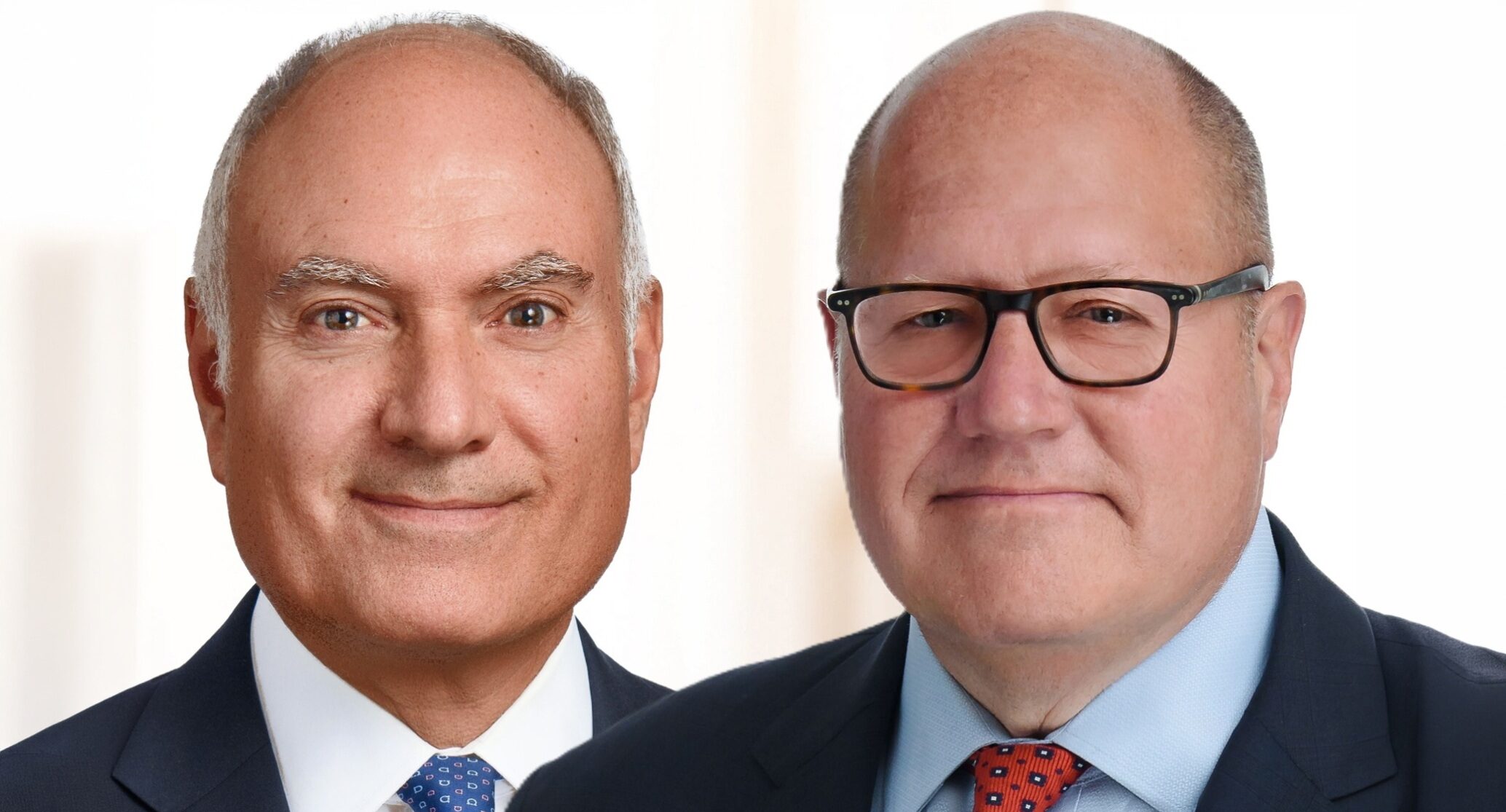
‘Our job is to move us from where we are now into the top five,’ says global private equity co-chair and incoming firmwide co-chair Jeffrey Poss (pictured left).
For Poss, ‘top five’ does not mean by firmwide revenue or profitability metrics. Instead, he is focusing on establishing the firm as a clear top-tier player from a brand and market perspective in all of its core practices: disputes, asset management, restructuring and corporate transactions.’
‘I think we have all the ingredients to do that,’ he explains. ‘We’re going to keep building, and keep growing, in a way that meets our profitability and cultural expectations.’
For restructuring partner and fellow co-chair Matt Feldman (pictured right), the focus is on future-proofing Willkie’s position in a hyper-competitive market.
‘The firms that are going to compete at the top in this consolidating market are growing, not shrinking,’ he says. ‘That group is going to break away from the pack in a way we haven’t seen in the past.’
‘Our job is to move us from where we are now into the top five’
As clients increasingly concentrate work among a narrowing pool of global advisers, Feldman believes the firm has already made significant progress.
‘We identified back in 2012 that we needed to do something fairly aggressive to be among the winners; to grow in size and in geographical footprint,’ he explains. ‘That long-term strategy is our greatest achievement over the last decade.’
The evidence of success so far is already there. With revenue doubling since 2020 – and tripling since 2015 – profit per equity partner is on a similar trajectory, up from just over $2.5m in 2015 to within touching distance of $5m in 2025.
The firm has also opened five offices since 2020 – Chicago in 2020, Los Angeles in 2021, Munich and Dallas in 2024 and Hamburg last year – and has almost doubled its global partner count over the same period, up from 200 to around 380.
But, as Feldman tells LB, while this growth is impressive, it isn’t enough. Standing still is not a strategy and the firm is now turning its attention to London – an office that, until relatively recently, has played a relatively modest part in the firm’s growth, alongside long-established operations in continental Europe.
Willkie revenue 2015-25
London calling
With 136 lawyers in London as of 1 January this year, according to LB‘s Global London report, Willkie’s City base has grown by almost 60% over the last five years, but it remains in the bottom half of the table by headcount, some way behind 200-plus peers such as Sidley, Jones Day and Goodwin.
Unlike many of its US rivals, Willkie’s European story did not begin in London, and it has yet to gain a Legal 500 tier one practice in the UK capital in any of its core practice areas.
‘It was effectively a representative office,’ Poss says of the City offering before the hire of Peter Burrell from legacy Herbert Smith Freehills as local managing partner in 2012.
A Legal 500 Hall of Famer for both regulatory investigations and corporate crime and civil fraud, Burrell’s arrival was an initial statement of intent. Today, the office is one of the firm’s principal investment priorities, with leadership conceding it has not kept pace with rivals.
‘We are laser focused on growing in London in particular,’ says Poss, with the firm aiming to add ‘depth and strength in our core practices over the next five years.’
Feldman adds: ‘We feel underweight vis-a-vis our peers, and underweight vis-a-vis the rest of the growth we’ve experienced on the Continent.
‘London is a critical market and the financial capital of Europe and the UK – it is very important to our clients. We are not going to allow ourselves to be left behind as we watch growth in this city.’
‘This office always serviced inbound work – it is now a net exporter’
To give Willkie its dues, the London office today is a far cry from the one Burrell joined in 2012. City revenue rose by 7.5% in 2025 to reach $173m, on the back of 22% growth in 2024, while London partner count has climbed by more than 75% in the past five years to reach 44.
The firm also made up seven new partners in London this year, compared to one last year – the second highest percentage increase in City promotions year on year.
Growth in the office has been built around specific practices. In 2021, Burrell identified a ‘growth opportunity’ in international arbitration, adding a six-lawyer team from WilmerHale led by disputes barrister Duncan Speller, before adding further capability across Brussels and New York.
Over the last 12 to 18 months, the firm has been targeting the transactional side, adding weight in private capital, restructuring and competition.
The hires include former Clifford Chance UK antitrust head Greg Olsen, Kirkland & Ellis corporate partner Miroslav Tomo, who has been reunited with private equity partner Hamesh Khatar, Simpson Thacher’s Marc Hecht and Nikita Kumar in restructuring and Benoit Champon from Luxembourg firm Arendt in asset management.
‘We were a relatively late entrant to London on the private capital side – but we have gone from effectively one PE partner in 2019 to eight today,’ says Gavin Gordon, another former Kirkland PE partner who joined the London office in 2019 to head the European private equity practice.
The firm also now has six asset management partners in London, up from three in 2022, following the addition of Champon and the internal promotions of Charles Hadley and Melina Combeau this January.
Burrell says hiring investments have translated to mandates in London. Last year, the firm advised CapVest Partners on its €10bn acquisition of German pharmaceuticals company Stada from Bain and Cinven.
An Anglo-German effort, the deal was led by London PE partners David Arnold and Andrew Gray, both of whom joined from Kirkland with Gordon in 2019.
Crucially, Poss says growth means London is no longer simply servicing other offices: ‘This office always serviced inbound work from the Continent and from the US,’ he says. ‘It is now a net exporter.’
Burrell maintains that this growth is only the start of a deliberate investment cycle, predicting that London headcount will grow by between 30% to 40% over the next three years.
Willkie profit per equity partner (PEP) 2015-25
Turbocharging private capital
London’s expansion, however, is one part of a much broader strategy. Leadership maintain that some of the real differentiators for the firm’s private capital practice lie across the Channel.
‘We don’t have a London-centric offering with satellite offices in Paris or Germany, as a number of our peers do,’ says Gordon (pictured right). ‘Clients are looking for a pan-European offering with practices of equal strength and standing.’
The US firm celebrated its centenary in Paris this year and has long-established market-leading practices in both Germany and France, where it boasts Legal 500 tier one private equity, fund formation and insolvency capabilities.
‘That is pretty unusual,’ reflects Poss, ‘and transformative in terms of what we can offer our clients.’
‘The firms that are going to compete at the top in this consolidating market are growing, not shrinking’
But with firms including Latham & Watkins and Kirkland all ramping up on the continent in recent years, Willkie is not resting on its laurels there either.
 The past two years have seen office openings in Munich and Hamburg, the latter providing a restructuring hub to support its private capital platform. Significant recruitment in Germany has included the hire of an 11-lawyer restructuring team from Latham in Hamburg, as well as corporate partner Sebastian Häfele from Kirkland in Munich and Quinn litigator Rüdiger Lahmer, who joined as chair of European antitrust and competition litigation last year.
‘We don’t see it as though we have some sort of right to be there,’ says Burrell (pictured right). ‘You have to keep investing.’
What next?
According to Feldman, the firm has no plans to hit the brakes, and management are exploring every avenue for growth.
Expanding geographically remains a priority, and Willkie has a gap in its resume: the Middle East.
‘It’s a market that no top performing law firms should ignore,’ says Poss, ‘and one you cannot compete in from afar. You must have boots on the ground.’
‘If we are going to stay at the top,’ adds Feldman, ‘it’s hard to imagine we’re not going to have found the right people, and the right opportunity, in a relatively short period of time.’
But scale is only one side of the coin. For Poss, client loyalty depends just as much on ‘quality and depth, over bandwidth.’
‘We focus on making sure that we deliver the very best work, put the best talent on the pitch every day, and make sure they know that we’re along for the journey with them,’ he says.
‘But platform doesn’t deliver anything unless you are in a collaborative culture,’ adds Gordon (pictured right). ‘Clients are drawn to that too; they recognise its importance in delivering outcomes.’
Feldman contrasts the firm’s approach with some rivals. ‘We’ve seen some real growth among our competitors, but frankly, they are just buying revenue. I don’t think that is a good long-term strategy,’ he says.
‘The biggest threat is becoming less relevant’
‘The biggest firms are getting market share because they are stealing smaller clients from weak firms,’ he adds. ‘I’m more interested in seeing our clients take a billion and turn it into 5 billion AUM. Maybe we don’t have a new name to put on our resume, but we have a much more important client.’
Discussing the spate of recent transatlantic and US mergers, Feldman is not ruling anything out, even if it isn’t a strategic objective.
‘As a leader you have an obligation to review all potential strategic opportunities,’ he says. ‘I wouldn’t say that I wouldn’t take a meeting or two to explore it.’
For now, however, Willkie’s preference remains targeted hires over unwieldy tie-ups that bring with them the potential of cultural challenges.
‘The acquisition of a strategic partner in London, in Dallas – that is of more interest to us than another 1,500-lawyer behemoth,’ says Feldman.
It is a philosophy that runs through all decisions at the firm. Willkie is betting on sustained, targeted growth that will prove durable in the long run.
That conviction is rooted in Feldman’s view of the legal market’s future.
‘The biggest threat is becoming less relevant,’ he says. ‘And we are not inclined to let that happen.’