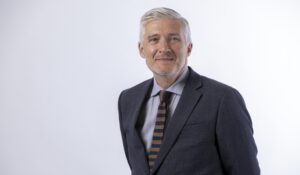
Latham & Watkins partner Oliver Felsenstein is widely regarded as one of the world’s pre-eminent private equity lawyers, acting as trusted counsel for clients including Hg Capital, Advent and CVC. He has chaired the firm’s global PE practice, served as German managing partner, and now advises the firm’s executive committee. He sat down with LB to reflect on decades of dealmaking and his plans for retirement
People don’t tend to believe this, but one of the reasons I wanted to become a lawyer was after watching The Godfather. I was fascinated by Robert Duvall’s role as Tom Hagen, the personal lawyer of Don Corleone who I thought had the coolest job – a consigliere with only one client. So, I decided I wanted to become a lawyer like him. Obviously I failed. But I never wanted to be a judge or anything else – I wanted to be a lawyer at a business firm.
I have always had some business mentality in my DNA. My father was Jewish, so he never had a chance to study because of the Holocaust. When the war ended and he left the concentration camp, he was looking for a way to leave the country. He worked as a translator of Polish and Russian for the US Army, and at the time all the soldiers were making money trading cigarettes, but they had cornered the market.
Unexpectedly, my father met a soldier who had a suitcase full of nylon stockings from the US, which didn’t exist in Europe at the time. Together, they built up a retail chain which soon became much more than nylon stockings, but in the ’50s these stockings were a very big thing.
So I never liked the purely academic part of the law; I always saw it as a business. But at the time I became a lawyer, German law firms weren’t allowed to merge with one another, and lawyers were seen as more custodians of the law than business people. I wanted to try and be more entrepreneurial.
I didn’t finish my doctor’s thesis on the German constitution. A friend had taken an LLM or Master of Laws in the US, a very unusual choice at the time, and I decided I wanted to do that too, so I went to the University of Miami to study an LLM. I was embedded with the normal class of US students, who were all a bit younger, and I ended up having the best year of my life.
The purpose wasn’t so much to learn something specific about US law – and if it was I forgot most of it – but it taught me to ‘translate’ German law to foreign clients. There were very few lawyers with an LLM in Germany at the time and I think it was a huge advantage.
‘In 2008, people were saying private equity was gone, and that I had to find a new career’
At Boesebeck Barz [the German firm where Felsenstein worked prior to its merger with Lovells in 2000], every partner had one associate that did everything for them. The partner I worked for was mainly a corporate lawyer but he also did some litigation, so the first few years I did all manner of things; not like today where you specialise very early on.
I became a private equity lawyer almost by accident: a new matter came in and my colleagues asked if I could take it; it happened to be a US PE fund that wanted to invest in a German company.
It was the early ’90s, so there was no private equity business, but I was fascinated that my client was a finance investor and not a large corporation; I was talking to the decision-maker. I also happened to be working on one of the first major private equity deals in Germany when Doughty Hansen bought a German industrial company with Quadriga Capital. From this moment on I didn’t want to do anything else with my professional life, and I never did.
There was a time in 2008 when Lehman collapsed and people were saying, ‘private equity is gone.’ Partners asked me what I was going to do. I didn’t know what they meant, but they were saying I had to find a new career. ‘No,’ I told them, ‘I will stick with private equity.’ There were two years where it was difficult and there wasn’t much new business; other lawyers decided to move on to other things.
When the market picked up again, these lawyers came back to their clients, but the clients had moved on. I’m grateful that mine chose to stick with me; I suppose because I stuck with them. That gamble paid off for me. I’ve always said you cannot drop a client when they’re having a crisis. In hindsight, it was perhaps a big risk, but I thought it was worth taking because I believed in the asset class.
It is difficult to say why clients come to me – maybe you have to ask them? The way I’ve always approached my lawyering is to put myself in the shoes of the clients: What would I want? How would I like advice presented? I wouldn’t want someone that lays out five alternatives and says these are the risks, choose one. I go in and say: I would do this and these are the reasons and, by the way, if you want to know the other options, I’m happy to give them to you.
When I was younger, I used to struggle when clients did not follow my advice. I’m more comfortable with this now. Once I have given the soundest advice I can, the decision is theirs. With conservative clients, I may encourage a bolder approach; with more risk-tolerant clients, I am careful to pull them back.
‘The driver was furious that I had crashed into her beautiful car – I lowered the window and said “Can’t you see I am speaking with my client?”
One of my strengths is client commitment, being available for my clients literally 24/7. Once, I was driving home in my car late at night and I was on the phone to Hg. I had to turn left and I didn’t see the oncoming car. I crashed into the car. There were no injuries, but the driver was furious that I had crashed into her beautiful car and stormed out, knocking on my window. I lowered it and said, ‘Can’t you see I am speaking with my client?’ The client realised and I told them I had to pause for one moment. They still tell this story some twenty years later, and say it is some of the best client commitment they’ve ever seen.
I’ve always enjoyed serving in management roles. By the time I got to Latham I’d held various positions in very different firms, including deputy managing partner at Lovells following the merger with Boesebeck, and co-global head of corporate at Clifford Chance. Arriving at Latham, I had my mind fixed on deal work. No more management – or so I thought.
Latham’s chairman at the time came to Frankfurt six months after I joined and we had dinner together and talked about the German practice. At the time, I felt the German part of Latham wasn’t embedded enough. Germany wanted to do it the ‘German way.’ I remember feeling that the German team needed to align with the global vision more, but in order to get better aligned, we also needed to have a seat at the table.
Of course, we were a relatively small part of the business, but if we were to become more closely integrated into the firm it was important for the German offices to feel like part of the decision-making. In any event, the dinner did not go as expected and I was offered to become the managing partner of Latham’s German offices the next morning.
I’m fascinated by law firms as businesses. Around the time I started there was a book about Joseph Flom of Skadden Arps: Skadden: Power, Money and the Rise of a Legal Empire. It was one of the first firms to reach 1,000 lawyers. I could scarcely dream this could happen. Fast-forward and we’re a firm with 4,000 lawyers globally. I’m just amazed by this evolution in the industry and grateful for all of my management roles.
I didn’t have the benefit of many mentors in the early part of my career, but I’ve been fortunate to work for and alongside some incredible leaders over the years, all of whom I’ve learned from. The business side can be tough, particularly in a large organisation when you’re trying to find your way. That’s why I always encourage the next generation to be authentic, to be kind to everyone, and to remember that there should be no hierarchy when it comes to how we treat people.
‘Everyone who reads this and brings a copy of the article is invited for a glass of champagne’
In terms of people who have supported my career, my wife Oxana, who is also my best friend, has helped me a lot. Moving to Latham from CC was a big decision back then. US firms were gaining ground but weren’t the obvious market leaders that they are today. My wife played a really important part in my decision-making: she didn’t push me, but helped me see it was the right decision.
In the legal community, two stand out. First, Lesley MacDonagh, who was managing partner of Lovells. After the merger with Boesebeck she became a very close friend. She modernised the whole firm; she’s really the one that made it competitive to the magic circle.
But probably the most important person is our current chairman Rich Trobman – he gave me a lot of opportunities to help the firm and do what I think is in its best interest. Rich is a huge inspiration to many people at Latham and I am one of them.
We offer coaching for partners who are approaching retirement, and one of the first questions my coach asked was what I planned to do with my time. My initial answer was ‘nothing,’ which unsurprisingly wasn’t considered much of a plan.
I’d like to have more time to travel, spend time on my boat, play golf, and be with my five children. Beyond that, I’ve spent my entire career providing a service, so there’s something appealing about the idea of selling a tangible product instead.
My current plan (but that keeps changing) is to open a ‘bar du jour’ called Maison Roque (the first part of my last name means Roque). It will be a place to go for a morning espresso and croissant, then the best sandwiches for lunch followed by a good glass of the best champagne and some oysters in the after-work hours. Everyone who reads this and brings a copy of the article is invited for the first glass.