


James Carroll is managing partner of Russell-Cooke and a family lawyer. As part of LB’s Pride Month coverage, he discusses his role as an openly gay managing partner, his experience being out in the legal profession, and why Russell-Cooke is more than just a ‘woke’ firm
I felt very comfortable being authentically myself very early on in my career. It never felt like a risk. I think I was the only ‘out’ person at law school. I now know there were other gay people there because they’ve since come out, but only many years later. This is perhaps because they qualified in the City which was different back then. For me, a family lawyer, who trained at Anthony Gold, which had a couple of openly gay partners, things were different. I realised I could not only be comfortable being out, but my sexuality could also be a benefit: I could be invited to events, engage with a community, and actually play my role in some of the legal change that was much needed.
There were particular family lawyers, often women, who were inspirational — one of whom I still call my boss, though she’s now a consultant at Russell-Cooke. Women in the ’80s and ’90s who, because of what was on the political agenda then, were incredibly vocal. People would have referred to them at the time as ‘militant lesbians.’ Back then it was discrimination, not equality, that was on the agenda — lesbians were having their children taken away from them, Section 28 was firmly on the statute books. I certainly had strong role models in lesbian women who were not going to be apologetic. And I have a lesbian mum who’s never been anything other than proud of who she is.
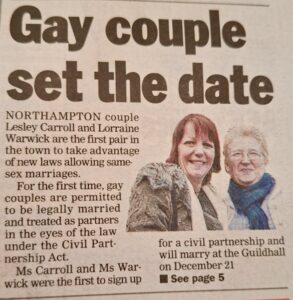
I was a ‘baby’ family lawyer when the Civil Partnership Act came in. The message we were getting at the time was: please don’t oppose this because it’s not gay marriage, it’s a step along the way. And with hindsight, that’s absolutely right. It’s also had a part in my personal life. My mum and her wife were the first lesbian couple to marry in Northampton. They were on the front page of the local paper (pictured right), which referred to ‘James, her son, who is also gay.’ I was perfectly comfortable with that, it was a celebration, and I was proud of her.
I am very comfortable with all of my colleagues, particularly more junior associates, knowing that I am a gay man from a working-class background who is now also the managing partner of a top 100 law firm. It says that if I can do it, so can you. That doesn’t mean ‘you can do it if you’re gay’ or ‘you can do it if you’re working class’ — rather it means that you can do it whoever you are. The full diversity spectrum needs to be celebrated and championed. It says the profession is no longer traditionally structured or dominated in the ways it was a decade ago. Visibility is important. That makes a difference.
‘We’ve ended up with this culturally liberal and inclusive firm. We didn’t invent that in 2026’
One of my colleagues was speaking about Russell-Cooke and the person described us as ‘a bit woke.’ Her response was that I would be proud of that. We’re 150 years old: in our very early days we represented the Liberal Party. The wife of our founding father was a suffragist. We’ve ended up with this culturally liberal and inclusive firm. We didn’t invent that in 2026 — it evolved from who we were when starting back in the 1880s, back when the equality debate was about whether women should have the right to vote. 140 odd years later, we find ourselves representing Amnesty International in the Supreme Court as the definition of woman. I wouldn’t describe us as a woke firm though. I think it’s a firm that recognises the importance of equality before the law, and which champions the rule of law and access to social justice — things we can be proud to wear on our sleeves.
The SRA diversity stats say about 2-3% of the legal community self-report as LGBTQ+. At Russell-Cooke we’re at about 5%, which suggests people either feel more comfortable self-reporting, or we do have a more diverse firm. If 2-3% of the legal community are LGBTQ+, statistically there should be two or three managing partners who are part of that community.
At one point I thought about stopping reading the news: Brexit, Trump, it seemed like one thing after another. What I really struggled with when the anti-DEI agenda was at its height, particularly coming out of the US, was that it was an impossible dilemma for leaders of large institutions employing tens of thousands of people: you can’t sit in London criticising them for trying to protect their business and their people. It takes a lot to stand up to a government and say no. However, if law firms go back to the lowest common denominators — equality before the law, the rule of law above all else — that should tell you what the driver is and what position to take.
My best friend is heavily tattooed and non-binary, and came to the law later in life. At the time, my advice was not to do it — even people like me in the law are considered slightly ‘out there,’ and I was worried about them. I was fundamentally wrong. My friend got their training contract and now works at a City firm. I was really glad to be proved wrong. My initial reaction proved I also had my own prejudices — I thought a tattooed non-binary person was probably a harder sell than a white gay man — that was my prejudices coming out. We all have to challenge ourselves — conscious or unconscious bias is a real thing.
Despite not having this as my personal intersectionality, one area that I believe the legal profession still falls short is on ethnicity. The legal industry is not getting that right at the moment. With sexuality or social mobility, there is often the ability to choose to disguise: not that I choose to hide but some people assume I am a straight man from a middle-class background. Ethnic diversity doesn’t often come with that option. There is also something uncomfortable about being able to blend being an advantage. The profession has to address all aspects of diversity and inclusivity – but I would make ethnicity the priority.