

While CMS is perhaps best-known for its top-tier reputation in the commercial property sector, its strengths as a corporate dealmaking machine can sometimes be overlooked.
Comprising more than 450 partners and over 1,400 lawyers around the world, in 2023-24 the global corporate practice contributed 29.6% of the firm’s total revenues of €1.957bn, second only to disputes at 29.9%.
The firm also consistently ranks in the global top 10 for M&A deal volume; last year advising on 453 announced transactions, according to London Stock Exchange Group data, putting it sixth place in the global rankings, up from seventh in 2023.
Announcing the firm’s financial results last year, managing partner Stephen Millar underlined the firm’s international identity and re-emphasised the importance of pursuing a ‘global’ strategy.
For corporate co-head Victoria Henry (pictured above), this identity is deeply rooted in her practice. ‘In corporate, more than half of our deals have an international element,’ she explains, adding that the firm broad coverage across Europe, where they have 50 offices across 26 countries, and the Middle East, where they have over 90 lawyers in six countries – as one of their most undersung assets.
‘Lots of firms talk about satellite offices, but where we are different is that we don’t just have two men and a dog there – we have proper teams that handle both international cross-border work and local matters, meaning we are truly embedded,’ she explains.
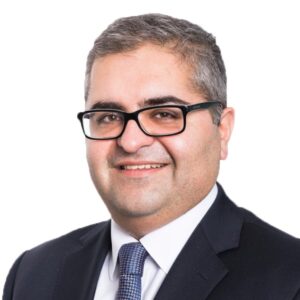 Away from Europe and the Middle East, fellow corporate co-head Dipesh Santilale (pictured right) points to Hong Kong and Singapore as key growth targets for the firm, particularly in the wake of US retrenchment from the region. ‘With certain US firms pulling back, we’re seeing significant growth opportunities for us in the region, and we are looking at similar growth opportunities across a number of jurisdictions,’ he states.
This January, the firm added to its Hong Kong base with the hire of former Morrison Foerster corporate partner Steven Tran, while other recent appointments to the Hong Kong office include funds partners Paul Moloney and Helen Wang, who joined from Mayer Brown in the latter half of last year.
There has been movement in the other direction, including former international private equity group head and Legal 500 leading partner Jason Zemmel, who left for McDermott in October, while the firm did also make some redundancies in corporate in 2023, with up to 19 lawyers losing their roles.
Henry explains: ‘We’d been flying high on the back of the merger [the 2017 combination of CMS, Nabarro and Olswang] in a positive way, which created a structure that kept growing. As the market paused and work levels stabilised, it allowed us to take a step back and assess where we were.’
‘It was never about the individuals, but about addressing structural needs,’ she adds. ‘It was a difficult process, but ultimately, it served as a catalyst for a more positive attitude within the group and an opportunity to feel refreshed. I feel like we’ve come out the other side now,’ she continues.
So, what does the other side look like? The corporate practice still boasts over 150 lawyers in the UK alone – a number Henry characterises as ‘not disproportionate when it comes to servicing a broad range of clients across all sectors on everything from venture capital investments to public markets and takeovers.’
‘It’s often challenging to convey that our approach is to look at the sectors as verticals,’ Santilale adds. Using the energy sector as an example, he elaborates: ‘For instance, we handled last year’s Equinor-Shell joint venture, creating the UK’s largest independent oil and gas company. At the same time, we also regularly support Equinor on a number of very interesting VC investments into new clean energy technologies.’
For Santilale, this vertical approach sets the firm apart from competitors who are becoming more ‘boutique-like, focusing on big litigation and large corporate deals.’ He continues: ‘For us, our increasing specialisation means we have the ability to differentiate ourselves by being able to provide those services and a wider range of services and sector expertise that others cannot.’
The firm’s current sector focus covers specialisms in energy and infrastructure, real estate, financial services, TMT, hotels, leisure and consumer, and looking ahead, sector convergence is a key strategy for the corporate team.
‘Our focus has been on identifying these and other exciting, high-growth areas where we can bring together our specialisms to present a more targeted offering that captures what we believe to be areas with significant growth potential in the market, and an already outstanding foundation of expertise within our firm,’ Santilale adds.
Henry concludes: ‘Over time, there will be a sharper focus on this as a way to further differentiate ourselves. However, we are committed to servicing a diverse client base and maintaining a high level of expertise across the board. Any refinement will be an organic development that reflects where the market is heading.’