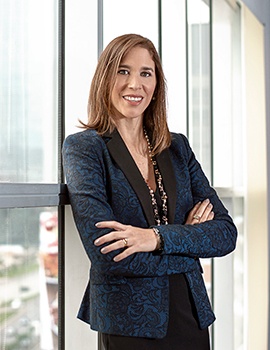
Maria-Leticia Ossa Daza, chair of the Latin America practice, Willkie Farr & Gallagher

My experience breaking barriers throughout my career has led me to be very conscious about the culture that we are building within the Latin America Practice Group at Willkie. A part of this is leading with empathy and compassion. I understand some of the unique challenges that face a diverse group of individuals, and aim to build an environment where we are all open about these hurdles and work together to help one another. I believe that the culture we have created is great for our team to thrive and helps us to provide clients with the best work possible.

Another way that this has shaped the group’s culture is that we are constantly looking for ways to lift up others and give them the opportunity and support to try out new things and be in the spotlight, especially when it comes to women, people of color and other diverse groups. I see it as my job to encourage those coming up behind me to take chances and be seen. This leads to greater professional fulfillment and inspires others beyond our firm to hopefully do the same amongst their teams.

I think that important actions can be taken at every level of the talent pipeline to help support the next generation of leaders to thrive throughout their careers. These can be grouped into retention and recruitment.

On retention: Developing a mechanism to receive feedback on how the culture supports women and other underrepresented groups is critical. This feedback can provide incredible insights and build trust. However, I would caution that this can’t be performative, and there need to be deliberate efforts to make changes based on the feedback. Another way is to build in and celebrate the mentorship efforts within the organization. If you can celebrate those who take the time to mentor and champion women, I genuinely believe this will lead to progress.

In recruitment: I think that having a robust and inclusive culture is an essential first step to continue attracting diverse talent. As a leader, I view it as my responsibility to be a vocal advocate for inclusion and find ways to support its benefits publicly. Today, with the battle for talent being at its most competitive, we need to ensure that we are out there on the public record making our contributions.

In the Latin American context, we are seeing a significant influx of women in leadership. I look throughout the region and see so many talented organizations doing great work to combat the bias that has limited our potential as a global business community for so long. I feel hopeful that this will continue and that other regions will look to Latin America for best practices on gender parity in the future.

The first piece of advice I would give is that you shouldn’t be afraid to chart your own path. For many of us, our paths will look different than those who came before us because we are different than traditional leaders of the past. This means that this path might feel lonely and awkward at times, which is okay.

Also, it’s critical to get comfortable calling out bias wherever you see it. I would always try to ensure that you are doing it with respect, but it’s important to exercise that muscle.

Unfortunately, as women and individuals of color, we will face bias. The more experience we have engaging in these courageous conversations, the better equipped we will be for the future. I also believe that you shouldn’t feel like you have to address this alone. All organizations are grappling with building inclusive cultures. Take the time to share your concerns with senior leaders that you trust because we are here to support you, but we can’t help address problems unless we are aware of them.

Another key area where I work with my mentees is getting comfortable being authentic at work, while acknowledging it can take courage. For some, this could look like developing a personal style and sharing cultural norms that celebrate who we are. It can also mean sharing information about what is going on in our lives even if it feels vulnerable. The reason that it’s so critical is that research shows that those who develop deep connections at work are more productive and feel more fulfilled. One comprehensive study showed that the number one predictor of a successful team is the psychological safety of that team, or in other words a team’s ability to feel safe to take risks and to be vulnerable in front of each other. I don’t think we can develop these deep relationships if we are hiding our true selves.

Lastly, I would also share the importance of making time for the things that bring you joy. Joy is the antidote to burnout, and it keeps us creative and connected. I think that we often feel that to be successful, as long as we put in the long hours, we will reach the top. That has not been my experience. It is also essential to maintain a multidimensional life that can fuel us for the marathon that is our careers. Building a habit of prioritizing joy is a key life lesson, especially in a business that relies heavily on interpersonal relationships among your team and client base. We are in the people business, after all.

Valéria Schmitke, Regional general counsel, Zurich Latin America; co-founder and president of Idis

Three years ago, I was discussing how the insurance sector was behind in terms of D&I with three company lawyers who were senior managers in legal departments (Ana Paula de Almeida Santos and Vera Carvalho Pinto). We decided to create Idis, an institute to improve that, so we gathered some volunteers, and we work on awareness, we do events and training and we help companies to implement their D&I programs.

Nowadays, we work across five pillars: gender, focusing on women; LGBTQIA+; race and ethnicity; generations, focusing on people above 50; and people with disabilities. All the leaders have experience in that area of diversity.

But I want to create a pillar about other areas of diversity, as well. We work a lot on the traditional pillars for D&I because we still have a lot to do. But there are many other biases that people have, and we need to at least make them aware that this can prevent some people truly contributing to the company. For example, I talk a lot nowadays about ‘fat phobia’, because some companies don’t hire overweight people. They think they are slow, or they are lazy. But actually, when we do very intellectual work, such as in financial markets, we are not running a marathon!

Finding your cause

We now have 35 volunteers, and the companies sponsor us. It has been quite a journey – very rewarding. I believe in voluntary work because it’s important to dedicate yourself to something bigger. It’s not about forcing anyone to engage in any voluntary work – I always say, for example, if the company had a program of “let’s do exercise, let’s go biking”, I would not engage in that because it’s not my cup of tea, it’s not what sparkles for me. What makes me willing to engage is D&I or social responsibility or environmental issues. This sparkles for me. If the company offers employees some possibilities for voluntary work, this creates more loyalty to the company, because even if I receive an offer from another company, I will not go because I will lose that part of my life that is important to me.

For my personal development it has also been great because I am learning to lead by influence, not by power. My team knows (even though I don’t tell them) that I will evaluate them and I can dismiss them. But when you lead an organization of volunteers, it’s all about influencing, recognition and supporting. For me personally it has been quite a journey. All of them are very much engaged and I’m proud of this thing – it’s probably the best thing I ever had in my life.

We all went to law school searching for Justice with a capital J, and D&I for me is a matter of Justice more than anything, and of respect. I think legal departments have a key role in diversity and inclusion, because we search for Justice.

Influence in action

Secondly, we are consulted about everything, including internal policies. When you are looking at a hiring policy for example, you can influence to have more rules about D&I. I’ll give you an example. If you are hiring a new lawyer, you can ask for résumés of both genders. I’m not saying that you must hire a woman, but at least you have to interview a woman. And you can try to have blind interviews, not knowing if it’s a woman or a man. When interviewing someone, I try to not open the camera – I say let’s talk by phone, because then I will not look at the person. If the person is good-looking or not good-looking, if they are black or white, I will not see.

Everybody has biases. Everybody. So, first of all, we need to be aware of our biases, and secondly, we need to try to avoid our biases. I was talking with a general counsel before the pandemic and there was a very important congress in that country, where it was a form of recognition to send someone to participate in the congress. I said to him, “What about this lady?” And he said to me, “Oh no, she has a baby, I think she won’t go, even if I give her this recognition.” And I said, “Did you ask her?” “No, I didn’t.” “So you ask her. Because whether she will go and leave the baby at home, or go and take the baby with her, it’s her decision, not yours. So if she deserves to receive this recognition, the mere fact that she has a baby is not something you need to take into account.”

We need to be vigilant. This is the point. If you are in a meeting and someone cracks a joke or makes a comment that’s offensive to any person – even if there is no one of that group there in the meeting – you need to point it out. You need to educate people. This is something that has changed over time and, I must tell you, for me it has been a journey as well. Many years ago, I would not be concerned about that. But now, I am a different person.

What corporate lawyers, more than anyone, need to be conscious of, is that we are not there to be popular. We are not there to be friends of everybody. We are there to be the annoying person that tells the truth. We need to point it out when someone is wrong, when they are going down a path that’s not the correct one. It’s our mission, including about D&I. It’s not only about law, it’s about ethics – and D&I is part of ethics.

Closing the gap

In Brazil we have economic inequality which is very much connected to ethnicity. Brazil was the last country in Latin America to abolish slavery and even nowadays, in Brazil, to be Black is almost to be poor. So, when you have a proactive action to have more Black people in your company, you need to close the gap. You don’t demand a first-league university, you don’t demand English is used, you don’t demand the full package in terms of knowledge. You need to hire people and close the gap.

It’s the same for people with disabilities. In Brazil, there is a law requiring companies to have a percentage of their employees with disabilities, and the spirit of the law is that the companies help to close the gap of those people – sometimes, perhaps, they could not go to a particular school for example. So, the company will hire them and give training to them. But, often, the companies are not so eager to do that. But big companies have a responsibility, and legal departments have to influence in this direction.

If I can work 10 years more in diversity and inclusion, I will work. I believe this will be my legacy. More than making money and have wealth, I need to leave something behind. I will be happy when 56% of all people in companies in Brazil, including senior management, are Black people. I will be happy when 50% of the senior management of companies are women. And I will be very happy when an LGBT person does not have to hide their sexual orientation, because then we will have a truly respectful environment. I will be happy if a person above 60 is still valued as a good asset to the company, who can contribute with their experience. I will be happy if companies truly develop people with disabilities. 15 years ago, I was at another company, and I had a deaf person in my team. But I was not prepared, I was not trained to deal with that person. I was not taught sign language, nothing. I didn’t know how to manage that person. I believe that companies have to train managers how to deal with people with disabilities.

Paying gratitude forward

So, we have a long way to go. I know during my lifetime this won’t change. But I have the dream of developing at least my sector, the insurance sector, a little bit. Nobody in university has ever said, ‘I will work for an insurance company!’ But insurance is very challenging, you get to know qualified people, it’s a good work environment, and I would like to make the insurance sector more attractive to young people. So they look at the insurance sector and say, ‘Look how many good things they are doing in terms of D&I, the environment, wellbeing, and other initiatives. I would like to work for the insurance sector.’ I am very grateful to the insurance sector. I have had many opportunities in it, and I want to leave something good behind to the sector.

Focus on HRC Equidad MX

This year marks the 20-year anniversary of HRC’s Corporate Equality Index (CEI), a national benchmarking tool for corporate LGBTQIA+ inclusion in the US. But Latin American countries are fast catching up with their neighbour in the drive for recognition of inclusive professional environments for LGBTQIA+ employees and, in 2016, a Mexican version was launched.

Run by LGBTQIA+ inclusion consultancy ADIL, the HRC Equidad MX: Global Workplace Equality Program promotes LGBTQIA+ equality and inclusion in the Mexican corporate landscape through an annual workplace survey, like its US counterpart. Each year, participating businesses in Mexico offer up their policies and practices for scrutiny, hoping for recognition on a list of ‘Mejores Lugares Para Trabajar LGBTQIA+’ or ‘Best Places to Work for LGBTQIA+ Equality’.

Mexico has a suite of laws prohibiting discrimination against LGBTQIA+ people in areas such as marriage, adoption and more, although these are often state-based and coverage across the country is incomplete. The Out Leadership Business Climate Score gives the country a rating of 7.5 out of 10, marking it ‘low risk’ in three out of four risk categories. However, according to that same index, ‘Pervasive anti-LGBTQIA+ violence and homophobia in Mexico and the patchwork landscape of legislation may create challenges for companies seeking to relocate LGBTQIA+ personnel to Mexico.’

Francisco Robledo Sánchez is a Mexican consultant and strategist in LGBTQIA+ labor inclusion, and founder of ADIL. He explains that culture, practices and the law do not always match, and that it remains important to campaign on LGBTQIA+ rights in the Mexican corporate space.

‘Mexico is a very conservative and Catholic country, where a lot of companies are family companies that have grown into large corporations, or companies that come from different countries with offices here, that don’t have D&I on their radar at all,’ he says.

‘Mexico, is very, very behind on sexual education and diversity and inclusiveness – basic information that’s not taught anywhere in our curriculum and at any stage of public or private education. So, the corporate world has been a great place for re-educating adults in the workplace, so they can positively impact their families and their social circles.’

But the tide is turning, according to Robledo: ‘The interest is genuine, the social pressure is big, there are a lot of ingredients in this conversation, and I can see that people are more comfortable to talk.’

Capitalising on that increased appetite for conversation about LGBTQIA+ inclusion, Equidad MX is on a mission to build workplaces where anyone can be themselves at work, and to celebrate where companies are doing this well.

Eight years ago, Robledo first met with Deena Fidas, director of HRC’s US Workplace Equality Program at that time (the current US director is Keisha Williams, a lawyer, law professor and former in-house counsel). Fidas wanted to help US-headquartered companies expand LGBTQIA+ inclusion in their Mexican operations to provide the same experience for staff working internationally, while also supporting Mexican companies to comply with the supply chain DE&I requirements of US entities. ADIL was selected to run the program, which launched in 2016 and released its first report in 2018.

By 2016, the CEI had been running for 14 years, making it an excellent template for Equidad MX.

‘We reviewed it question by question, and we asked ourselves: “what is a good fit for Mexico right now to ask for as minimum requirements?” We had a couple of roundtables discussing what we should be asking locally. We thought that, for the first five years, we should ask for the very basics,’ Robledo explains.

The team settled on three criteria, or core pillars, of LGBTQIA+ inclusion, which companies seeking to appear in the Equidad MX list need to demonstrate. The first of these is adoption of non-discrimination policies, necessitating a written commitment to encourage eventual standardisation among companies – and nuance is a must. For example, the Mexican constitution bans discrimination due to ‘sexual preferences’, Robledo explains.

‘We knew that companies would only put what the constitution says. But more involved companies would actually know that we should abide by these three big dimensions of sexual diversity and gender and diversity. So first, it was: “let’s ask them to put these terms in writing, particularly sexual orientation and gender identity, and then gender expression as an option for more involved companies.” That’s a basic commitment and we can grow from there,’ Robledo explains.

Alejandra Bogantes, legal manager for Costa Rica and El Salvador, and Bob López, deputy director of culture, diversity and inclusion, Walmart México and Central America

Bob López (BL): This is the fifth year that we have received the certification, certifying that we are a company committed to the LGBTQIA+ community, we respect the LGBTQIA+ community, that we have in place those policies, procedures with regards to talent acquisition, talent development, non-discrimination policies and so on.

Last year, for example, we rolled out our trans associates guidelines, so that here in Walmart we can be ourselves at any time, and we can explore the potential that we may have within the company.

To give an example, at Walmart, you can choose a name on your badge – you either define yourself as a female or male associate. Regardless of your birth certificate, you can choose that name on your email address or on your badge, and we respect that. Here in the region, it’s very complicated for the trans community to officially change official government documentation. But in Walmart, we are not requesting that. If you want to change your name or your email address, we can do it for you, and we respect that.

Alejandra Bogantes (AB): The legal department helps in all new initiatives, for example with the trans gender issue, because the company needs to make policies to make people feel good and so the legal department will help in terms of how we can comply with the law, working with HR.

BL: The HRC Equidad MX report is a real certification process. You need to submit a lot of information to confirm that you are making affirmative actions for the LGBT community, that you have in place policies, trainings and so on, to preserve and enforce a safe workplace for the LGBT community.

And at the end, they do an audit to confirm that you are doing this for your associates, and they give you back a report with feedback, with recommendations on how you can improve your current processes, and that way you can start working on your action plan for the next year. So, it’s adding value to the D&I strategy. It’s been a great journey, because we have been learning a lot from other companies, sharing our experiences in regard to the LGBT community.

The second pillar for candidate companies is the creation of employee resource groups (ERGs) or diversity and inclusion councils. In another example of Equidad MX’s desire to systematize LGBTQIA+ inclusion policies, the idea was to see companies build on and solidify the work done thus far by champions.

‘We found that very, very, very few companies have a diversity and inclusion area or a full-time person responsible for these matters. Some would have a diversity council. So, this part was more of a challenge because we were requesting companies to formalise their commitment by founding a council or building an ERG, or the basis of an affinity group. Because we had a lot of champions. So this was a way of saying, “ok, we have it in writing, now which group of people are going to make it real, are going to transform it into programs and procedures?” – we have to visualize that group of people,’ says Robledo.

The third pillar is engagement in public activities to support LGBTQIA+ inclusion, which means that companies must evidence at least three public activities – and these must take place throughout the year, not only during Pride.

The thread running through the criteria, and the ethos behind Equidad MX, is not just to reward the corporate ecosystem as it relates to workplace LGBTQIA+ equality and inclusion, but to move it forward. The pillars, Robledo explains, are designed to meet companies where they are now – but also to challenge them to move on.

‘It’s just a basis. One of the other missions is to empower companies to tell us where to grow, how to grow, and what’s needed locally, so we can set that as a standard and make this grow together.’

But in moving the conversation around inclusion forward, Robledo has, at times, found the legal profession to be less helpful than he believes it could be. He explains that although there is a federal law banning discrimination based on sexual orientation, it was Mexico City as a state that broke this down into sexual orientation, gender identity, sexual expression and sexual preferences, addressing the specifics of discrimination around characteristics like speech and dress for the first time. But while the federal constitution refers only to ‘sexual preferences’, many companies comply only to that degree.

‘Still today we find a lot of lawyers that still don’t want to make that change, because they say that if the law says “sexual preferences”, then that’s it. And then we say that if we don’t break it down in these terms then the company is not actually being that advanced or that forward. It takes a lot of lobbying for us to make them see how they should keep up with what society and what international laws are saying and not just local laws. It’s a tough group. Sometimes we just have to pull out the Mexico City Constitution (if they are based in Mexico City) and tell them: you’re not abiding by this law and just ignoring it and going to the other law which is incomplete,’ he explains.

‘We have to break down these terms so they can use them in a procedure of a lower scale within the company or just with internal communication. So, they may have still have just “sexual preferences” but then people in the D&I area or champions will find a way to put it in writing in a document of different rank within the company.’

Robledo argues that despite protection under legislation in Mexico, LGBTQIA+ people wishing to bring workplace discrimination claims often find themselves unprotected.

‘The federal law and the local Mexican law don’t have teeth. There’s lots that ends up only becoming recommendations,’ he says.

And, he adds, the lengthy, demanding and resource-intensive nature of the process for pursuing a claim is a disincentive for bringing proceedings in the first place.

‘People are not suing for discrimination in Mexico, so then many lawyers are very comfortable in their positions – “It’s not an issue because we are not losing money, on the reputational side there’s only very few companies that have been exposed to discrimination issues”, and so it’s not a priority for them. The global sense is: “Ok, prove to me you were discriminated against”. But the laws that we have are not that strong, so it can actually be a nicer process for me if I receive the discrimination.’

As long as the laws remain relatively toothless, Robledo believes, addressing workplace discrimination against LGBTQIA+ groups will not be a priority for in-house teams, and policies addressing the issue will remain recommendations. However, engagement among the legal profession is looking up: despite the 2021 Index featuring no law firms at all, the newly released 2022 report includes five.

Speaking with his consultant hat on, Robledo has found that, in many cases, the motivation behind improving LGBTQIA+ inclusion can be an obstacle towards achieving it.

‘We have a few very large Mexican companies that have started to do the D&I work because they have international pressure from customers and clients in other countries, but not coming from a genuine interest. As a consultant, when I ask them why they want to start doing this, almost 80% come from a business perspective: my customers, the stock market in the US is asking us for some sort of documentation, some business or money-based perspective on why they want to do it,’ he says.

Across the global corporate community, the business case for DE&I is often a major argument made for increasing workplace inclusion. But Robledo contends that can be a weak basis, leading to an underestimation of how long it can take to achieve, for example, Equidad MX certification.

There are two types of companies, he says – those with an intrinsic commitment, and those whose commitment is driven by marketing opportunities. But, buoyed by the power of social media, the public is demanding to know what commitments lie behind the Pride flag. The Index itself, says Robledo, can perhaps help such companies develop a more authentic commitment, by serving as a toolkit as well as a commendation:

‘Pride was their only option to show that they were committed, but on the marketing side. Those marketing perspective companies actually now have a reason. Six years ago, we started working with them to get them to this point.’

Since its inception, Equidad MX has seen year-on-year growth. In 2018, 32 companies received the accolade. In 2019, the list had grown to 69, 120 in 2020, 212 in 2021, and the most recent 2022 edition saw 242 companies listed, out of 262 survey applications made. Robledo is pleased, despite having had a goal of 300 applications for the 2022 edition, which may have been stymied by the pandemic. But growth may be slowing, he fears.

‘It’s coming to a maturity point where we’re not growing that much anymore. We now have 262 [applicant] companies and maybe 60% of them were doing it well in another country and they just had to put it in place in Mexico. Maybe another 15% were forced by their global business partners, global customers or clients that were pressuring for them to grow LGBTQIA+ inclusion. And the last group really just want to do the right thing by working on it – maybe they started three or four years ago and finally now in our fifth year they are ready to jump into the report,’ he says.

‘For the rest of the companies, their starting point is lower than 80% of the companies we found five years ago. So the group is going to slow down in the next three, four or five years.’

The focus for the report now is to strengthen the tools that the team is trying to develop, moving the conversation on in Mexico, and lobbying to have impact beyond the corporate sphere and linking the results with legislative and policy changes. The next report will evolve the list of criteria to look at how LGBTQIA+ people are included in employee benefits, as well as training offered by organizations. In addition, the team is looking to branch out beyond Mexico City, where many participating companies are based.

The HRC continues to broaden its reach across Latin America, having launched a similar initiative in Chile two years ago and, recently, in Brazil and Argentina. The team is also looking at Colombia and Costa Rica, where there has been interest.

‘I’ve been looking for partners in each country so they can implement and be the local focal point,’ says Robledo.

‘Maybe down the road we will have a LatAm version of the survey, where we can talk about some general requirements and some local requirements as well.’

Claudia González Montt, general counsel and external affairs, SMU S.A.

Because I am a woman, it’s very important to me that, in an organization, women have equal treatment and equal opportunities to anyone else. Diversity and inclusion means being recognized for my talent, ability, my individual characteristics and it’s important that, based on those, I can compete and develop with equal opportunity.

The importance of inclusion

But having a diverse team in an organization is not enough to get all the benefits that diversity brings. There must be an inclusive and open environment that guarantees this equal treatment and opportunity. I heard in a training session that diversity is when they invite you to the party, but inclusion is when they invite you to dance. If you don’t work on inclusion, you won’t have the environment that you need to develop your career as a woman or as a minority. You need a safe place where you can express your ideas, your different viewpoint. In my experience at different companies, women can help to develop the business because we have different perspectives than men.

For many years, I have participated in D&I initiatives, for example leading D&I committees, developing minority support programs, developing diversity management models, and participating in mentoring and sponsorship programs.

Work-life balance

I love mentoring, especially when the mentee is a woman starting out in her working life, because you can share your experience, and help other women to open up the workplace and develop their professional career; give some advice about how to balance personal life and work. I’m married, I have children and for me this part is very important, because I need to have a very good personal life in order to give a very good work performance. I need this balance in my life. Through mentoring, I can give young women tips or advice to help to balance personal life and work and about the importance of co-responsibility in caring for children.

That’s a big challenge because, traditionally in Chile, men work and women stay at home. It’s part of our culture. Unfortunately, the pandemic has impacted women more than men in terms of employment, and also due to the increase in childcare. Co-responsibility is a new concept for us and we need to work on that, to involve more men in work at home.

Only 14% of board members of IPSA companies (the top 30 companies with the largest stock market presence in Chile) are women. However, there has been an advance because, ten years ago, this precedent was close to 4%. In the legal field, things are not very different. Although today there are more women lawyers working at law firms, at the partner or general counsel level, there are very few. We are proud that SMU is one of the two IPSA companies in the country led by women. Our chair and vice president of the board are women, and we have three female board members.

Culture

In our company, D&I is a priority. It’s included in the company strategy plan, it’s one of our pillars, and the company has a management model based on our code of ethics. We have a cultural code called ‘CERCA’, which means Closeness, Excellence, Respect, Collaboration and Agility. Our culture is very important, because it tells us how we do business, and through actions and activity in the company, we seek to influence employees, their family, our clients, suppliers and the community. We have different programs in the company to support different groups, for example women and people with disabilities.

The legal team

The legal team promotes and lives the values of the company in terms of diversity and inclusion. I think we are an example for other teams. 59% of the legal team and 67% of the legal top management are women. My team has actively supported the creation of policies, procedures, and action plans related to D&I, protection of human rights and sustainability for the whole company. We have supported this process with the people team and have prepared training in these kinds of matters. The company has many activities, and my team supports all of them in their creation and organization, not only as participants.

The team has participated in a sustainability volunteers’ program. We have promoted female talent by giving them visibility, for example three women from our team represent the company in trade associations.

During 2020 and 2021, the team participated in a development program implemented for the first time in the company, which includes mentoring and sponsorship activity. We had the opportunity to put forward two women and one man as mentees, and I mentored two women.

I think as an in-house legal team we can contribute a lot. For example, we have experience of working with diverse teams from other areas, we have colleagues not only of different genders or groups, but also from different professions. This allows better collaborative work and knowledge exchange, and we share all that experience and good practice with everyone and, of course, with our external lawyers. I think we can help our outside counsel to promote these matters.

We are a client of many law firms and we contribute by giving visibility to talented women lawyers and in hiring law firms led by women. For example, in the last year we hired a law firm led by female partners for an important company matter, and we had an excellent result and developed an excellent relationship with them.

It’s very important for me, for my team, and for the company, that those who work for us share our special culture. When we hire a new law firm, as a woman, I always like to know how many female partners or minority group members the law firm has, and I share with them the importance of having women in the team.

In my opinion, in-house life is more diverse than private practice, because we are part of the company and we have relationships with other areas, other professions. SMU has many initiatives related to flexible work, different schedules to help everyone, not only women, and different thinking in everyone to try to have the same diversity in the company as in the society. My company is a retail company, we serve clients in society, and we need to have more diversity in our teams to better serve our clients.

Alexandra Blanco, general counsel, Pro Mujer

In Bolivia, unequal access to justice undermines the possibility of equality in society. As a university student, I volunteered with a human rights organization that worked in a women’s prison here in Bolivia. Most of the women that I worked with were survivors of gender violence, and it quickly became clear that many women were in jail simply because they did not have the money to afford a lawyer, not because they were likely responsible for a crime. Most of these women did not know their rights, so we worked with them to explain their human rights, help them with their legal cases, and share information on what their futures might look like.

It was obvious to me that the system had failed these women and that they needed a way to escape the vicious cycle of poverty and violence. For me, the answer was simple: help women support their families and themselves so that they could leave violence behind and start a new life.

This chapter of my life defined me. I knew that I wanted to continue to fight for women’s rights and women’s empowerment. At Pro Mujer, we spend every day working to make these objectives a reality.

Closing gender gaps

The gender gaps in the financial sector are alarming. Globally, only 6% of investment capital goes to companies led by women, and 70% of women do not have access to capital to start a business. In Latin America, women’s access to funding is even bleaker. Covid-19 has further exacerbated the situation – the progress made over the last 10 years in terms of achieving equality in the labor market has been erased, and rates of gender-based violence have exploded. In Bolivia, the figures are sobering: every day, a woman is killed by gender violence, and only one in three cases is ever reported.

Gender equality contributes to poverty reduction and boosts the economy. According to McKinsey, closing the gender gap would result in an automatic increase in global GDP of 11%, and GDP in Latin America would increase by 14% if women were encouraged to participate in the economy and received the support they need to do so.

Data show that if you give a woman access to loans, they tend to use the money to support their family and be more productive than men. In 2021 alone, Pro Mujer disbursed US$269 million in loans to women who were unable to access traditional financial services. Pro Mujer uses a holistic approach to positively impact women’s lives. We go beyond just financial inclusion and access to microfinance loans, offering access to health services, digital inclusion initiatives, and skill-building opportunities.

In 2021, we provided 400,000 health services, including 3,000 free mammograms in Mexico, preventive health services for breast cancer and cervical cancer, access to a chatbot for diabetes prevention, and access to contraceptives.

Pro Mujer’s community health workers also play a critical role in our health and well-being initiatives, as they are able to reach women in rural areas where hospitals and doctors are scarce. Each community health worker is trained to detect risk factors in their communities and refer women to a health clinic, if necessary.

Over the past few years, Pro Mujer has also ramped up its focus on digital inclusion. Today, 67% of women have access to the internet. We strongly believe that digital tools will allow us to offer more financing and training opportunities to more women.

In addition, we are working together with US Vice President Kamala Harris as a member of the Partnership for Central America and have committed to increasing our impact in the Northern Triangle, reaching more than three million people with our services. To meet this commitment, we will be opening an office in Guatemala.

Gender lens investing

Pro Mujer is committed to strengthening the gender lens investing ecosystem in Latin America by creating investment strategies, sharing best practices with investors that want to create impactful social change, and offering technical assistance to private companies to help them get gender smart.

In 2019, Pro Mujer partnered with Deetken Impact to launch the Ilu Women’s Empowerment Fund. The Fund invests in a diversified portfolio of high-impact businesses that support women in leadership and governance, offer products and services that meet the needs of women and girls, develop gender-sensitive value chains, and support workplace equity.

In 2021, the Ilu Women’s Empowerment Fund was awarded funding from USAID to develop the ILU Women’s Empowerment Program. This program seeks to increase gender equality in Latin America and the Caribbean through three main components: incremental capital, technical assistance and knowledge sharing, and advocacy.

Within the framework of this program, we launched the Ilu Toolbox, an open-source platform featuring more than 30 resources to help companies address gender gaps and implement strategies to attract gender lens investing.

Identifying the appropriate legal mechanisms

In the past, the role of general counsel was more to put out fires. These days, the general counsel is a key business partner that should be involved in an organization’s business decisions from the very beginning of its operations. Pro Mujer is always working to expand its impact footprint and empower more women. Our role as a legal team is to identify the appropriate legal mechanisms so that Pro Mujer can expand its footprint through alliances and support more women. Latin America is very politically volatile, and we must navigate a lot of legal challenges in order to continue our work.

At Pro Mujer, the legal team must go beyond the role of legal advisor to make sure that the organization is able to continue to impact and empower women. The most rewarding part of the job is going out into the field and hearing the success stories. Knowing that we have had an impact on the lives of our employees and clients is truly gratifying. We have supported women who are survivors of gender-based violence and have empowered them to start a new life. One specific success story that has stayed with me is that of a woman who has been a part of Pro Mujer for more than two decades. Twenty-four years ago, she started to sell boots in the streets of El Alto; now she owns a factory.

The role of in-house lawyers is different today than it was 20, 30 years ago. Now we are the dealmakers of the organization, and we must become thought leaders for our organizations – we are not in the back office anymore.

Not just any policies: The right policies

As members of the legal profession, we must think about the impact we can have and the critical importance of supporting women. In Latin America, many women do not have access to the courts or to fair laws, and the region is very behind in everything to do with dealing with gender-based violence. There is a lot of space to improve the laws, but it is also necessary to ensure equal access to the court system – because you can have perfect laws, but if women cannot access the justice system, those laws are useless. I think there are a lot of opportunities for lawyers to be proactive, to make our voices heard, and to identify how we can help improve women’s lives.

Something that concerns me is the fact that a lot of people do not speak about sexual harassment. When I started my career, many years back, it was something that you had to live with. I sadly have personal stories about sexual harassment; as a woman, it was just something you were expected to deal with when you navigated in a men’s corporate world. Today, times have changed, and although sexual harassment is no longer acceptable, there is still a long way to go.

As members of the legal team, we are involved in creating company policies, and these policies must include gender inclusion and diversity. I strongly believe that gender inclusion must be mandatory in every company’s internal policy—gender inclusion should not be optional. It is our role as inside counsel to make sure that the policies not only exist, but also that the right policies are in place and are effective.

Anna Martini Pereira, partner, Willkie Farr & Gallagher

Having a diverse team brings different points of view to the table where a specific solution or point is raised because of the unique perspective of an individual based on their life experience and identity. I have been in situations where someone raised a point that was within my blind spot, and without which the group would not have reached its ultimate decision. I also believe that diverse teams have the ability to be more creative and innovative in their way of thinking leading to better decision making overall.


A diverse team also tends to share more and therefore tends to be more involved and more engaged. Better engagement results in teams with strong talent retention. Beyond being good for performance, it also results in a better work environment, better culture, happier employees and gives you more access to a better talent pool – it’s a good cycle to be in.

Another key aspect to the importance of diversity is when it comes to leadership positions. When younger diverse talent sees people who reflect their own diversity in leadership, they see people that they can identify with and feel more represented and willing to stay for longer in an organization. For example, if you are a woman and see other women in leadership positions, I think there is a sense that you can trust that your own perspectives will be better represented because similar life experiences create an empathy.

Beyond gender, I think the importance of representation goes for all traditionally underrepresented groups. If you have people in leadership positions with different identities, backgrounds, etc., it creates a greater sense of trust that anyone that works hard can succeed, regardless of their background. In addition, this trust become cyclical because once you succeed you want to stay and help lift up those who are coming up behind you. All of this creates a better environment, group of talent and overall performance, as studies have shown.

When it comes to how we serve our clients, having diverse teams is also incredibly important because studies show that diverse teams consistently outperform teams that lack diversity. It is also critical that we are able to demonstrate value alignment with our clients when it comes to fostering an inclusive culture. Many clients are demonstrating that diversity is a top priority. Therefore, law firms that in the best case scenario are seen as extensions of that in-house team, must be able to further reinforce that.

María José Van Morlegan, director of legal and regulatory affairs, Edenor

To me, diversity and inclusion means the possibility for anyone to have the opportunity to participate, or to make an improvement in, their career on an equal basis with anyone else.

I belong to a percentage of the population that could do that – I am at director level after a long career of 25 years – but the conditions that we had to accept at the start of our careers are quite different to those we are trying to achieve nowadays. For example, if I had to go to an interview 20 years ago, I was compelled to wear a skirt: I remember that in my first interview as a junior associate. And nowadays, when I hire someone, I don’t care if that person has put on their résumé that they’re a man, or a woman or whatever.

Follow the rules

I think that certain practices regarding diversity have to be implemented with rules so that change can work. While we’re still talking about the idea, nothing will change. And I think that for my team to comply with this goal, and with my beliefs, I need to directly set some rules considering diversity.

Last year, Argentina passed legislation compelling public sector companies to give 1% of positions to transgender people. If you’re a private company and you achieve that 1%, you have certain tax benefits.

But last year, the Public Registry of the City of Buenos Aires (PR) tried to compel organizations to give at least 50% of board seats to women, but that regulation was attacked by certain private associations and the resolution was struck down.

There is certain view held within the corporate landscape that says, ‘ok, we can have a good corporate governance program, and let me do my job, let me decide who I want and when I want certain changes to my board or management level or key officers – but do not impose that through a law. I don’t want to reject a man just because a law says I have to comply with giving 50% of seats to women’. That’s the discussion that has been set for bills regarding quotas today in Argentina, and we are expecting to see what can be done.

In summary, we are not in the top countries for prioritizing diversity in Latin America. We are trying to improve this, but the private sector is not convinced.

Using that seat at the table

I’m a member of the Argentine Chapter of Women Corporate Directors (WCD). This is an international association, with chapters around the world, where women that have certain board seats in listed companies, have meetings and offer job opportunities to other women at any point of the corporate ladder. For instance, if a company in England needs someone bilingual who has expertise in the energy sector, WCD shares information around the world, and the search starts between us to find résumés.

In addition to that, since I am a member of the board of the Buenos Aires Stock Exchange, and a trustee of Caja de Valores S.A., I participate in certain meetings with the government and try to participate in the development of legislation concerning all of this stuff.

I arrived at Edenor in July 2021, so I have only been here for six months, and one of my goals was to work on our new corporate governance code, including specifically a chapter on diversity. Likewise, we are working on a sustainable bond to be launched probably in 2022, and one of the measures of the sustainable bond will be diversity.

Previously, Edenor didn’t have any key officers as women, and now, out of ten at the table, there are three women. Any vacant role at the company has to be opened with at least three candidates and at least one should be a woman.

The most difficult part of this is with engineers. We have an industry where it is so difficult to find electrical engineers, and it’s even more difficult to find electrical engineers who are women. So we are working with certain universities to provide seminars, trying to seek women that could be interested in exploring the energy sector. We have a program that we call ‘Women in Edenor’, and in that program we try to focus on including more women in the company at the different levels we seek. My team is comprised of 100 people and 65% are women. For any new lawyer or student that would like to work with us, I follow the three résumé rules, and that one of these should be a woman.

I think that in-house lawyers can play a significant role in driving diversity and inclusion, because when you work at a listed company, you have a lot of opportunities, through complying, for example, with the rules of the SEC, or the London Stock Exchange, which helps you to have a significant role in diversity decisions throughout the company.

A little ignition: empowering women lawyers for leadership success

‘The number of women lawyers continues to increase. Now, almost half of all the students in law schools in Mexico are women. But there are no women in the high positions,’ says Tere Paillés, partner at SMPS Legal.

It’s a sentiment echoed throughout this report: in Lati America, it remains that case that women are underrepresented among the top echelons of the legal profession – in both branches.
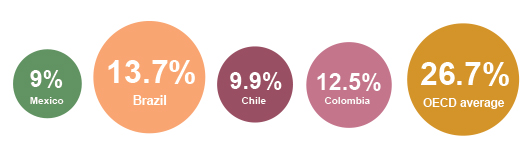
It mirrors a wider corporate environment in which the female share of board seats in the largest publicly listed companies falls far below the male share. Of the OECD Latin American countries listed (plus Brazil), Mexican women had the smallest share of board seats at 9%, while Brazilian women had the highest at 13.7%, with Chile and Colombia at 9.9% and 12.5% respectively – well below the OECD average of 26.7% (itself hardly an indicator of parity).

‘It is important to emphasise that, today, Brazilian women have a higher level of education than men, with more access to universities, but this is not reflected in their careers within organizations. Those who are in the labor market earn up to 34% less than men in the same position, and are still a minority in leadership positions,’ says Leila Melo, general counsel at Itaú Unibanco in Brazil.

‘I see that the legal and corporate universes have a lot in common regarding the challenges for gender equality,’ she says.

The women interviewed in this report reel off the causes of gender inequality in the legal and corporate workplace – unequal distribution of domestic tasks, a culture of ‘machismo’, unconscious bias. Even harassment was cited as a feature of the professional workplace, at times.

But some Latin American women decided to make their own luck: to forge opportunities, bolster their networks, and empower themselves into a force to be reckoned with – top lawyers but also agents of change.

Like Jurídico de Saias, or ‘Lawyers in Skirts’, a group of female Brazilian in-house counsel formed in 2009. Originally part of an in-house counsel committee of the American Chamber of Commerce for Brazil (Amcham), the group evolved into an assembly for the exchange of ideas and experiences under the initial leadership of Josie Jardim, now assistant general counsel of Amazon in Brazil.

Erica Barbagalo, head of law, patent and compliance Brazil and LatAm BP for Crop Science at Bayer, was one of the founding members.

‘We realized at the time that the majority of companies’ legal leadership – general counsels – are male and there are few women,’ she says. ‘We found that the leadership of legal in-house was so alone, because we are just lawyers at the company. You don’t have peers to exchange ideas within the company when it comes to legal aspects.’

OECD Latin American countries by women’s share of board seats

Over time, the group came to focus on the professional development of female corporate counsel and the creation of female leaders in law. For the more than 3,000 women who subscribe to the Jurídico de Saias app, that means access to information-sharing, job opportunities, mentoring programs, training and events. One such event is ‘De Saias Para Saias’ (‘From Skirts To Skirts’), a monthly live session on Instagram lead by senior speakers. Recent topics have included ‘thinking less like a lawyer’, and ‘the lawyer as business partner’.

‘It’s a collective, it’s a group, it’s not a legal entity, it’s not an NGO or association or anything, it’s just a group of people that benefit from this support for fostering women’s careers within legal,’ Barbagalo explains.

‘It’s not our target to be enormous, or to have thousands of subscribers, but to be effective and make a difference in the lives of women in-house counsel.’

In Mexico, the story of Abogadas MX began eight years ago, explains Paillés, who was recently elected president. Former president and founder Valeria Chapa (then general counsel for Latin America at Honeywell) returned from a Leadership Council for Legal Diversity (LCLD) fellowship program in the US, and questioned why there was nothing similar in Mexico. So, Abogadas MX was born.

‘We had very big dreams, we wanted to change everything,’ Paillés recalls.

The group started with a pilot mentoring program, where 20 senior lawyers mentored 20 younger lawyers. From there it launched an annual workshop with guest speakers – ‘we bring in people who make some sort of change in the minds of our members,’ says Paillés – which has been a virtual conference since 2020, enabling speakers to reach women outside Mexico City, in areas where equality and inclusion are scarcer.

From its beginnings as a group of 30 women lawyers, Abogadas MX is now an NGO with 700 members.

‘We have been very successful in gathering interesting people and working towards not necessarily information about law or technical information, but about soft skills that are required for women lawyers to succeed in these big law firms or international law firms or corporations,’ Paillés explains.

The organization is passionate, ambitious and structured. Four years ago, Antonia Rodriguez Miramon was hired as executive director, working with a council of senior female lawyers both in-house and in private practice, and a president.

‘We firmly believe that speaking about inclusion, diversity and leadership within the women’s sector directly translates into the development of our country,’ she says.

Through initiatives like the workshops, she adds, the organization provides a place ‘to be part of important topics to do with human development, professional development – not only legal things, but things that can nourish you as a person and help you grow.’

The work is built around four pillars: ‘support model’, where the organization provides courses, workshops, talks and networking opportunities for personal and professional development, including soft skills to hone leadership and networking skills; ‘impact on the environment’, which includes diversity and gender perspective masterclasses for law school students, and scholarship opportunities; a mentoring program; and the annual leadership and professional development workshop.

Advocacy is a key part of the Abogadas MX offering and, together with 38 law firms in the country, it has developed the ‘Mexican Standards of Diversity and Inclusion’. This takes the seven UN’s Women’s Empowerment Principles as a basis for a framework of principles to be applied to the legal profession in Mexico, and adds two more, regarding workplace sexual harassment, and gender and pro bono work.

‘We focus on being a community of women, or men allies, that know the importance of supporting gender and diversity in every place of their personal and professional lives,’ says Rodriguez Miramon.

For Barbagalo, the benefit of groups like Jurídico de Saias is precisely that sense of community. She describes her own experience of feeling alone and unsupported when returning from maternity leave and, for her, Jurídico de Saias fills a need that is especially powerful among outnumbered senior corporate counsel.

‘It’s to feel that you belong, to see that you have others like you, and to have support. Sometimes you don’t even know you have a problem if you don’t talk to others, and then you see, “Ok, there are more like me.” It is especially that you feel supported, that you have a place for equals to help you,’ she explains.

‘Being a young lawyer and having that kind of support from a group definitely would have helped me. When I got back from maternity leave, or in situations when I didn’t feel supported, I wouldn’t know there were more women like me. I wouldn’t know that I could be myself and could talk, and I could go to that group and say, “Am I crazy?” and feel ok to do that. It’s very common that people come and say, “That happened to me, is that ok, what should I have done, how should I react?” If you don’t have one formal group to do that, you don’t feel like you can look for this information, or you don’t feel confident in sharing, because it’s feels “gossipy”. But if there is an environment of openness and sharing, you see that what happens to you happens to others, and you can learn from that, and evolve, and feel empowered.’

At Women in Leadership in Latin America (WILL), that conversation takes place on a regional and even international level. Formed not only for lawyers – though managing vice president Leila Melo is one – WILL is a São Paulo-based non-profit with advisory boards in Bogotá, Miami, New York, Washington and London. Since 2013, it has supported and promoted the career development of women in Latin America, encouraged Latin America-based companies to implement programs for women in business, and promoted the exchange of best practices between national and international organizations.

Melo describes initiatives such as the annual Women in Leadership Survey – a free personal and professional development course for cisgender and transgender university students to encourage female leadership in finance, called the Dn’A Women – and the Empower Black Women to Senior Leadership mentoring program.

A wide network of women at all stages of their careers can function as a discussion forum to take stock and also move the conversation on – considering the spectrum of perspectives from generation Z, raised to expect, not request, equality, and of more seasoned women who are still fighting for it. In both Jurídico de Saias and Abogadas MX, that forum is cross-generational and both organizations have found making an intergenerational link to be fundamental in achieving sustainable empowerment for women.

‘We are very happy to see younger women looking for change, and the extent that they understand that change starts with us. Even though we need to have organizations, and men, and everybody else, involved in changing their bias, there is a little ignition, I would say, that is taking place within a lot of younger women, who want things to change,’ says Paillés.

‘We need to include younger women to see what they want and where they want to go, and how they are seeing these changes within their own organizations. You see it a lot with social media, and women doing things very differently than was done 20 or 30 years ago. Women on the board of directors of the organization are a little bit older and went through different things. I think we need that link, because the firms and the companies are controlled by older people, so we need to get that mix in place,’ says Paillés.

Adds Rodriguez Miramon: ‘We are living in an era with a lot of changes, and it’s really interesting how not only women but also men are interested in improving their way of working, the way they feel, their paternity leaves – and that finally is like a perfect match in getting our mission across faster and to talk about what we see as societal development.’

With the entry of new groups into the conversation, Barbagalo has found that a greater, and more evolved focus on inclusion and diversity is emerging, together with more understanding of intersectionality, in areas such as gender and race, but also in terms of considering all professionals as individuals with unique needs.

‘Different ways of working have a lot to do with diversity and inclusion because what works for you doesn’t necessarily work for me,’ she says.

For her, inclusion is an all-purpose tool, to be used beyond traditionally underrepresented groups, to improve the workplace as a whole. She puts this in the context of the pandemic:
‘I’m dying to go back to the office because I get distracted at home. Other people would prefer to be at home because they have a different routine. So how do we deal with that? We exercise our muscles of inclusion. I don’t look at this as a gender problem, or a race problem, or whatever problem. I just look at the different perspectives, a different person than I am, a different reality than I have.’

At WILL, Melo is conscious of the need to guarantee the rights of all vulnerable groups, not just women, and sees equality in terms of political action, health, security and education as well as the labor market.

‘When we look at the representation of women or black people in our society, or when we study the indicators of violence against the LGBTQIA+ population, or the access of people with disabilities to inclusive education and the labor market, the data show that we still face a serious situation of vulnerability and inequality,’ she says.

She believes it behoves private organizations to promote the inclusion and development of underrepresented groups in the corporate environment – and the lawyers within those organizations can play a key role.

‘Knowledge of legislation and legal issues contributes in an important way in proposing affirmative actions in the corporate environment and in private social investment, promoting advocacy for the creation of public policies that contribute to the guarantee of rights and the consolidation of a more inclusive society,’ says Melo.

Lawyers are well-represented on the board of WILL for this reason, she explains, and function as another voice in an organization which creates space for exchange between different agents of society.

In another effort to broaden the conversation, WILL has sought to involve men, with initiatives like its ‘Inviting Men to the Debate’ panel event, where leaders from national and multinational companies exchange views and experiences, and the ‘Homens da Nossa Época’ (‘Men of Our Time’), a series of interviews with male executives, who share and discuss their experiences about what it means to be a man in their time, along with conversation about diversity and inclusion.

‘For gender equality in the corporate environment, I see that organizations like WILL have been playing an important role in mediating this agenda at companies and engaging in dialogue with men, who still occupy most of the leadership positions, so that they can also understand that gender equality is also their responsibility,’ says Melo.

Abogadas MX has taken the step of admitting men as board members, mentors, workshop participants and allies – and has discovered that their presence brings the opportunity for a synergistic learning experience.

‘Maybe men don’t understand how important it is for certain skills to be there in order to succeed [in the workplace], and they think it’s a challenge where you have to run to do the best work. And it’s not that you don’t need to do the best work, it’s just that you need some additional things within your persona,’ says Paillés.

‘When they come out of these workshops, young [male] associates from law firms are amazed, because they really get touched by our analyses and it’s broadening their minds. Even the older men, when they go into this 450-woman meeting and they are a minority, just by being there they see how women feel when you go into a meeting and there’s only one of you.’

As the reach of Abogadas MX grows, so has its influence as a pressure and conscious-raising force in the industry, its leaders believe.

‘We started in a niche of high-end law firms and companies, and I think that we have become some sort of itch in every place that we’ve touched, and they know that they’ve got to change,’ says Paillés.

‘We believe that women at that level are getting stronger at requesting that their rights are met and that they are given what they deserve, and that they need to be in the same competition as men – because it’s not a matter of just “giving me things because I’m a woman”, but that we need to be at the same level. In that niche of law firms and companies I think we have made enough noise for there to be a small change.’

But there is much work to be done. The organization is working to extend its influence beyond elite law firms and corporations, to reach legally qualified women such as notaries public, or growing its program of classes at public universities, broadening its socio-economic reach into corners where bias might lurk.

‘It’s really important for us to start talking about mobility in terms of social mobility and in terms of opening our network,’ says Rodriguez Miramon.

The organization is also expanding beyond Mexico City, building on its chapters in Monterrey and Puebla.

‘It’s a matter of conscience, and we need to open up and touch more people so that the conscience of everyone starts moving. It’s a matter of making clicks within the minds of more and more people,’ says Paillés.

Systemic cultural change needs broader action than solely that of underrepresented groups. But women themselves are creating momentum to raise their own tide, lifting not only their own professional presence, but that of generations to come.

Carolina Forero Isaza, North Cluster Board Attorney and LATAM Vaccines Lead, Janssen Pharmaceutical Companies of Johnson & Johnson

I love the way the DEI team at Johnson and Johnson puts it: you belong. I love it because it’s about feeling comfortable to bring your true self to work.

It’s indispensable to have everybody’s point of view – if you have customers, patients and stakeholders all over the world, it’s important to have a wide variety of people inside the Company.
But, in addition to that, I think when you’re comfortable being yourself, you’re more creative. You feel better about raising your hand and shouting out your ideas and about participating. I also think when you’re comfortable being yourself, you’re better engaged.

Getting the culture right

We always think about our law department culture as one of camaraderie. We get invited to speak, with colleagues from other countries, about the future of our law department and how to make it better, and we’re always focused on making sure that, even as our department has grown over the years, we keep that camaraderie culture. I think we’re succeeding in that process, and I think that’s a very good grounding for DEI.

We have periodic training on different topics, for example, on unconscious bias, on building trust, and on many subjects related to DEI.

We also have Employee Resource Groups – we have groups that champion women, we have the ‘open and out’ group, which is a group that supports the LGBTQIA+ community, and we recently launched a group in Colombia that is supportive of indigenous communities.

We have been learning from the US team, which has been very active in examining racial inequality and social injustice; we’ve had book-clubs, we’ve had movie discussions, we’ve had experts come to talk to us.

Something that we had recently, that I thought was incredible, were some talks by experts on menopause, which is something that is part of being a woman, but we sometimes take it for granted. We are taught about giving birth, about being a mother, and about many things, but not about something that is so inherent to our lives as menopause. That, I think, is how inclusive our law department is.

Living DEI day-to-day

In the law department at Johnson & Johnson, one of the members of the leadership team of our general counsel is always responsible for DEI, and at the regional levels we also have leaders of DEI initiatives and DEI committees. We have some programs and initiatives that are global, and others that are regional. DEI is part of our strategic planning in the law department, and people report on our DEI efforts regularly.

We have some global objectives that we have to complete within the year – so there is some training we have to complete, we have to make sure that our goals include DEI goals, and in our conversations with our leaders, we report on how we met or did not meet those goals. But we also have a DEI committee at the regional level and, at the LatAm law department, we have our own strategic planning that we have to present to the global council. We report to them at least every quarter, and tell them how we’re doing, what we’ve finished, what we didn’t, and whether we completed our plan or not.

I think our law department leaders have made the law department really live DEI; it’s not something to check the box, but it’s really in our way of thinking.

Appreciating difference

I had a chance to lead the law department DEI group for Latin America a couple of years ago. We wanted to make sure that we respected everybody’s holidays, so we made a calendar to make sure that no regional meetings were ever scheduled during special holidays for different people in the group.

We tend to all speak Spanish in the meetings and leave our colleagues in Brazil on the side, so we tried to work on that by balancing the meetings – having some parts in Portuguese and some parts in Spanish. We even shared some glossaries of words in both languages, so we could all feel more comfortable.

We had an initiative called ‘beyond the label’, where with each LatAm law department newsletter, we got to know one of our colleagues – so, for example, someone might be the IP lawyer, but they are also interested in wildlife conservation and had a chance to live in Africa in an elephant nursery. We’ve had things like that, to connect at another
level.

It might not be rocket science, but these are things that keep us on our toes and thinking about how we’re different.

The importance of listening

On a personal level, I think being constantly reminded of the importance of listening is key in DEI. Lawyers are used to talking a lot and, in a way, we may not be so good at listening. I think the best way to make sure that everybody feels welcome, and that we hear everyone’s voice, is if we learn to listen.

I think legal strategies benefit greatly from other points of view, so I always discuss the important strategies with the business, with our marketing director, with our general manager, and I think that’s also inclusion. And that comes together with leaving aside the legal language – I like to think of myself like a translator, translating legal language into business language.

Amanda Lee Cotrim Lopez, senior legal director LATAM, ADP

Latin America is a melting point for ancestries, ethnicities and races, making it one of the most diverse regions in the world. It is also a region where minorities face significant barriers to employment. For example, recent studies show that around 90% of board seats are occupied by men. If women are not represented on boards of those huge companies that are listed, it’s hard to claim a true commitment to diversity.

ADP’s executive team in Latin America has a 40% women representation. This is well above the market average in the region. ADP was recently recognized by Great Place to Work (GPTW) as a top employer for women in Chile and Peru.

We were able to reach to this point because of the tone at the top. ADP has taken several affirmative actions to make sure diversity and inclusion is part of our DNA. In ADP, diversity and inclusion is not an HR only issue. The leadership team strongly supports D&I actions.

ADP has a global diversity and inclusion office, with dedicated associates. The D&I office works closely with HR and leaders of business units. The leadership is highly engaged and involved in diversity and inclusion globally. In Latin America, each senior leader sponsors a Business Resource Group (BRG). Since I joined ADP, I have sponsored iWIN’s activities in Latin America.

ADP’s iWIN

iWIN (International Women’s Inclusive Network) is ADP’s BRG with a focus on gender equality. iWIN currently has around 7,000 members across 16 countries around the globe. That is a big chunk of ADP’s 60,000 employees.

iWIN’s activities are conducted by a global board comprised of 25 ADP associates and by local chapters distributed in different regions and countries. iWIN organises events to create awareness, education and training – on unconscious bias, for instance. Our main goal is to make ADP a more diverse and inclusive place, not only in the workplace, but we also think about how we can impact the business and the communities close to us.

Doing the right thing

At ADP, the legal team plays an important role in terms of providing the business a perspective on what is the right thing to do. One of ADP’s main value is ‘integrity is everything’. Integrity is about doing the right thing all the time. In this sense, diversity and inclusion is the right thing to do.

When the legal team organizes the compliance week and trainings in Latin America, we educate our associates on anti-bribery and other relevant compliance aspects, but we also take the opportunity to discuss conduct, respect and inclusion. We create opportunities to discuss with associates about being inclusive and respectful with their colleagues at work, with family members, and when using social media.

Keeping an open eye

Corporate legal departments play an important role in promoting diversity and inclusion in the legal market in Latin America. We can influence the private practice market as clients and exchange experiences through our network groups.

When diversity and inclusion is part of your agenda, you will constantly call attention to inequalities, share practices to improve D&I awareness. It is important that in-house counsel keep an eye on what law firms are doing in terms of diversity and inclusion: if they have their own policies and if they are taking real actions towards their associates.

In Latin America, we have our eyes open to prioritizing discussions about minorities, either on the compliance training, hiring process, or when choosing a service provider.

Isabel Araujo, Partner, Willkie Farr & Gallagher

First, we should make mindful decisions about who we hire and resist the urge to favor people who look like us, went to the same schools as us or grew up in the same towns as us. Then, once you have a diverse legal team, be mindful that everyone’s experiences are different, and just because something has worked well for you, does not mean it will work well for me. Unsolicited commentary about the way one person handled a situation could be received differently than may have been intended so we should be aware of the impact of our words. Allow lawyers to develop their own styles and manage their projects as they see fit as long as the common goal to fulfill a client’s needs is being met.


Part of the benefit of working at a law firm is that a client has access to lawyers who have expertise in different subject matter, and transactions are not handled by only one lawyer or a group of lawyers with the same knowledge. The value a diverse legal team provides for a client is perspective and broad experience, which translates into a client being able to hear different sides to an argument or consider a strategy that had not been presented before. Having different voices in the room, in just the same way that having lawyers from across different practice areas in the same room, ensures that more ideas are being heard, with the ultimate goal to settle on the best one of the bunch.

A few examples include: (1) I think a best practice is that when a matter is being staffed, a senior lawyer should call each person on the team and tell them why he or she would make a good addition to the team. This adds instant loyalty and a sense of purpose for the lawyer. Compare that to an impersonal email alerting a group of lawyers about the new project. (2) At the start of the project, along with reminding everyone about the client’s needs, the most senior person should articulate his or her expectation that everyone on the team will actively contribute to the matter. Then follow-up. If you notice that the same people are the only ones speaking, specifically ask the others to weigh in and frame it so they know you are interested in their ideas. (3) Utilizing 360º feedback is also a simple but effective technique that allows people to feel heard (and of course, implementing changes based on that to the extent appropriate).

Ana Silvia Dias Haynes, General counsel for Brazil and Latin America, Essilor Group

Latin America is a diverse region, with over 660 million people of various ethnic groups and ancestries: Amerindians, white, mestizos, African descendants, Europeans, among others. It is essential to all companies and their workforces to continuously reinforce the need for diversity and inclusion in their work environments and, most importantly, in the Latin American boards and senior management positions, which data indicates are more than 90% occupied by men, mostly from a similar ethnic group. Diverse groups have raised their voices to increase awareness and fight for their rights and needs in the last 20 years.

However, with the ‘new’ diverse groups, such as LGBTQIA+ groups, you see very different positions. In larger cities, such as São Paulo (Brazil), Mexico City (Mexico), Buenos Aires (Argentina), Santiago (Chile), Bogotá (Colombia) and Lima (Peru), you have more respect and more protection of such rights. However, if you go less than 100 kilometres into the interior of these countries, that situation changes significantly, and people are much more provincial and less open. While governments have passed laws accepting various rights for these groups that were long awaited (such as same sex marriage), and principal media channels have supported many of those changes, there is still a big divide amongst those in society that live in the large city centres and the populations of more remote interior areas.

Historically, legal professionals were quite reserved about the topic of diversity and inclusion. In the last five years, this has changed very positively. Law firms are openly promoting diversity and a free environment. This change was supported by the new generation of lawyers, who wanted to see those values and principles embraced and actually lived in the work environment, whether in-house or in a law firm. Law firms had to rethink their standards of what they were looking for in a lawyer. Most law firms, now more than ever, know the true value of having lawyers and paralegals with different backgrounds, and even different qualifications and experiences, that bring new ideas to the legal solutions and advice provided to their clients.

Bringing diversity to life

At my workplace, I can proudly say we promote diversity through many different actions. One, most importantly, is to respect diverse people and their rights. Another is to talk about it openly and have training sessions to raise awareness and consciousness of how important it is for any company to bring diverse teams to work together collaboratively, respecting each other, and promoting innovation. Day-to-day, these actions translate into a very positive work environment, where people learn from each other, bring new experiences and ideas without fear. People have the freedom to succeed and change. I truly believe that promoting diversity is a tool to reach greater performance in terms of solutions and products, and ultimately makes people happier.
We have many internal programs supporting diversity and inclusion, such as having more women in management positions at all levels. We believe we are at the beginning of a journey, but we are, every day, bringing that to life.

Removing the filter

Five years ago, we first recognized that we needed to do more in terms of having a diverse legal team in Latin America. We were pretty much all from the same background, very
similar in terms of life choices and, although we were, at the time, divided equally between men and women.

As a team, we thought: what could we do better to be more diverse, and to support diversity and inclusion? First, we had a training session with one of the internal ambassadors, and he opened our eyes to simple actions that we could do as part of our daily routine, and when recruiting people, which would have great impact in promoting this value.
We can proudly say we are a much more diverse and united team. We have embedded diversity in our actions within our team and beyond, when selecting our external advisers and new people for our team, for example.

We look at each other as professionals who work hard together to deliver visual health products and services, focused on our mission. And we don’t judge.

Influencing others

I believe that, as lawyers, we have a huge role to play in diversity and inclusion, because we interact with multiple teams, partners, customers, external advisers and their respective communities. We are their trusted advisers; we are responsible for ‘opening their eyes’ to this important value. We also interact with government authorities and organizations. If we understand the influence we exercise during those interactions and use those to support diversity and inclusion in the respective workforces, together with our other colleagues (such as the leaders of organizations and HR, to name a few), we can be a motor for change in Latin America and other regions.

Many people are still blind about the benefits of such change and know nothing about the consequences of not respecting such values. We have historically embraced cultural and ethnic diversity, we are people moved with different and unique passions for life, which makes us who we are as Latin Americans. Why not take our diversity values to another level?

The result will surely be having a happier and more inclusive work environment, where people enjoy their work and learn from each other, putting aside any pre-conceived ideas or prejudice that can prevent us from performing well collaboratively.

As of 1st April Ana has been appointed GC for Asia Pacific and India.

Alejandra Bogantes, legal manager for Costa Rica and El Salvador and Bob López, deputy director of culture, diversity and inclusion, Walmart México and Central America

GC: Alejandra, how would you describe what diversity and inclusion mean to you? Why are they important for the corporate landscape?

Alejandra Bogantes (AB): In an organization, they are very important, because we need to make people feel comfortable.

If you accept them and let them be who they are, you are going to have employees that want to work with you. If you defend them and respect them, they are going to respect the company, and try to accomplish our goals and our vision and mission.

GC: How would you characterize the diversity and inclusion culture at Walmart?

Bob López (BL): To give you the background on this approach, we have core values for the company. One of these core values is respect for the individual in regard to differences – differences in mindset, background, education and so on.

But we also have an ‘Associate Value Proposition’ (AVP), which has five different pillars. The first one is purpose, the second is challenge, the third one is opportunity, the next is enjoyment, and the last (but not least!) is inclusion. For us, it’s really important to be an inclusive company, and that’s why we made the decision to include this pillar as part of the AVP, both internally and externally.

At this point, we’re focusing our efforts on four different approaches for the company: gender equity; people with disabilities; the LGBTQIA+ community; and the non-discrimination pillar, which is the newest one, and is working towards eliminating those barriers when it comes to talking about race, for instance.

For the company, it’s really important, and it’s part of the business strategy. We have goals to reach, we have KPIs for the company, so we are putting together all of these different thoughts within the company.

We also have a diversity, equity and inclusion council. This is a group of business leaders that are working towards an inclusive workplace for everyone within Walmart. This is not like the typical HR team working for inclusion, it’s more about the business leaders working for inclusion for the company, and they are bringing their expertise, they are bringing their ideas, and they are the ones that are writing this change. They know the business very well, they know very well the pain points that we may have in the stores, in the distribution centres, or in the home offices, and they are putting in place an action plan towards a more inclusive environment in Walmart.

In addition, one of the key actions that we have implemented since last year is to partner with external organizations outside Walmart, so we can bring their expertise within the company, and make better decisions for our associates in every pillar.

GC: It’s interesting that you mention KPIs, because it’s that sense of ‘what gets measured gets done’. How do the KPIs work; what does that look like day-to-day?

BL: We have different KPIs in regard to gender equity, and with regard to talent with disabilities. We have a work engagement survey, and last year we included a voluntary self-ID for the LGBTQIA+ community and for people with disabilities. That way, they could give us their responses and we could assess how they feel working for Walmart and with that information we have created different action plans to improve the work environment for these groups. This is also the first year that Walmart México and Central America has included a self-ID for race, because we wanted to know if we had racial diversity within the company, and how we can leverage people’s working experience within Walmart.

GC: How is the legal team supporting the company in its diversity and inclusion efforts? How does the team fit into that structure?

AB: As a legal department, we are an example and a role model for the company. We have to always act correctly – and not only look like we are acting correctly. We have to make sure the company complies with its policies and complies with the law. We help HR and the committees when they have any kind of question. We support area staff operations too, to make sure that they can explain what we are doing – we know that there are a lot of people that have prejudice and we try to make people understand. For example, we sometimes have cases where customers don’t want to go to a certain cashier because he has long hair, or tattoos, and we as a legal department have to tell them, “well, he has the right to look how he wants – we don’t have policies about how you look at work”. We have to support our employees and make them feel safe and protected by us, and we as a legal department promote a lot of efforts to make people feel comfortable.

In our legal department, we have a lot of people of different ages, some of them have kids, some of them are single parents, some of them have different sexual orientations, and we try to make the team feel completely united. We are very close, and we try to let people know that one of our values is that we are a diverse group, and we have different ideas. For example, the younger ones sometimes promote ideas about tech systems that can work for us to make things simple, and you know that people, when we are older, we sometimes don’t understand how things are going to work. So, I think that we make a really good balance.

We follow the company’s policies, and in case someone doesn’t feel respected or supported, the company has an ethics department, where people can file a complaint and they will investigate to make sure that the legal department, like everyone in the company, is compliant with the policies, and with our ethics code of conduct.

We have an open-door policy, so that everybody can go to their boss, or the boss of their boss, or the CEO of the company, to explain their concerns, and they have to listen to them. They don’t have to be afraid of retaliation, because they are allowed to express what is concerning them.

GC: Do you think that in-house legal teams have an important role to play in driving D&I? How do you think in-house legal teams can contribute to that conversation?

AB: As a legal department, people are looking to us. If the legal department is doing something incorrect or is not promoting diversity and inclusion, people are going to think that they can act in the same way. The risk is that if the legal department is not compliant with company policies, people are going to consider that that is ok, because we establish what is good or not, or what is correct in accordance with the law.

Also, the legal department has a section in our engagement letter to external lawyers where we request them to promote diversity and inclusion in their firms. For us, it’s very important that our external lawyers share our values; that they try to make a difference in society.

I think that Walmart is really working to make a difference in terms of diversity and inclusion. We are a big employer in Mexico and Central America, and the company is really trying to invest in helping people to understand what diversity and inclusion is. If our employees understand, they are going to start making a change in society, they are going to make that change with our clients, and we are, I think, contributing a little bit to making a difference.

BL: Being one of the largest companies within the region, we truly believe we can make an impact because of the cascading effect that we may have across society.

Covid-19 and the case for inclusion in Latin America

Since the Covid-19 global pandemic took the world by surprise in January 2020, no shoulder has been left untapped by the virus, which continues to intrude into personal and professional lives.

Latin America was hit hard, both in terms of health (by summer 2020, the region was declared the epicentre of the pandemic) and economic impact – Latin American GDP fell by 7.5% in 2020.

As it continues to bruise the population, Covid-19 has stressed societal fault-lines, leaving communities and countries grappling with uncomfortable facts – unequal risk of infection and severe illness according to socio-demographic factors like age, disability, ethnicity and affluence – and ethical questions, over access to healthcare and vaccine equity, for example.

We have seen that inclusion can be a matter of life and death. But Covid-19 has raised the stakes for diversity, equity and inclusion (DE&I) in corporate life too, as the workforce struggles to cope with its challenges. In August 2020, McKinsey surveyed over 1,000 executives and over 2,500 employees in large companies across 11 countries. The resulting report uncovered worries around mental health, work-life balance, and workplace health and safety, the connections between workers and employers, and job opportunities. But the gravity of hardships varied along demographic lines:

‘In every country, members of diverse populations reported additional challenges and felt them more acutely than their nondiverse counterparts. For example, nondiverse employees in the United States have experienced, on average, one acute challenge during the Covid-19 crisis, in addition to several other moderate challenges (those that are reported as being felt “somewhat” by respondents). Their diverse US colleagues reported 1.6 acute challenges.’

Furthermore, workers in emerging economies, like many in Latin America (the research looked at Brazil, Mexico, China and India as well as Canada, France, Germany, Ireland, the United Kingdom, and the United States), have felt the effects most starkly:

‘The severity and prevalence of these challenges, such as with mental health, were far higher in developing countries than in developed nations. Among diverse groups, these concerns were both higher in number and felt with greater urgency.’

Women, LGBTQIA+ people, people of color (POC) and parents were found to be struggling more, the report said.

Women at risk

Taking the first group, the pandemic has hurt women more than men at the societal level. In its July 2021 report, Gender Equality and Covid-19: Policies and Institutions for Mitigating the Crisis, the IMF set out the issues facing women across the world. Comprising 70% of the health and social care workforce, women are at greater risk of infection. They are also at increased risk of extreme poverty – likely to work in pandemic-scarred industries such as retail or hospitality, and in less secure or informal jobs, while housework and childcare duties have meant that, in some countries, women are even leaving the workforce. Meanwhile, lockdowns have led to a growth in gender-based domestic violence; school closures endanger education for girls, as many simply may not return to school when they reopen, and the digital inclusion gap for women threatens to widen.

Alexandra Blanco is general counsel at Pro Mujer, a Bolivian non-profit dedicated to empowering women, and is seeing this play out on the ground in Latin America:

‘In Bolivia, people have lost their jobs, we believe that’s been a major setback for women. We have data regarding the setback of Covid-19 especially in Latin America, that’s been extremely hit. The governments have not been able to react properly to support people or companies so it’s going to be a major hit and it hits women. Schools in many countries have not reopened, so you have women trying to navigate home school, women that have lost their jobs and are trying to also home school, and they don’t have places to take their kids and to look for other employment,’ she explains.

‘You don’t see a program to reactivate the economy as you do in countries that are more stable financially, so definitely I think Latin America is probably one of the regions that are going to take one of the biggest hits.’

Digital inclusion

Sheila La Serna, chief legal officer at pension fund manager Profuturo AFP, describes the economic background to the pandemic’s impact on Peruvian women:

‘We have a lot of informality – our economy is 70% informally employed. 95-99% of enterprises in Peru are micro and small enterprises and at least 70% of them are led by women. During the pandemic, a lot of women had to shut down their businesses, so my impression is that the gender gap will increase in future years. Women and men have a gap of almost 30% in terms of salary – women will earn 30% less than men in terms of formal jobs. But in terms of entrepreneurs, which are normally not official – they do not pay taxes, they have very little workforce – the kind of business that really helps women who are very ambiguous.’

La Serna explains that women in Peru often run service industry organizations such as beauty parlours, as entrepreneurs commercializing whatever they can, often in the face of technology inequity.

‘Very broadly speaking, the economic impact in Peru of the pandemic has been huge. We have more poorer people than 30 years ago. But, at the same time, people are reinventing themselves. They have proven resilient – that inventive and creative minds of women and men that are fostering the implementation and creation of new businesses and business models very digitally,’ she says.

‘We don’t have equal internet for everyone, so that informs everything. Every business that is engaging in digital and digital transformation is just riding the wave with the pandemic, but those that are not favored with that internet connection – not only the resource itself but the internet capabilities, for example, to be able to understand what e-commerce means, all the technological skills, are something that we are struggling with in some parts of the population. A lot of them don’t have resources like laptops. The government is working on that – there’s a governmental plan to improve the resources and the capabilities of entrepreneurs and to just reduce the technological gap in Peru.’

Corporate life

But what of corporate Latin America? The picture is not rosy, either. The female GCs we spoke to in Latin American countries all emphasised burnout and mental health strains among women in the workplace as significant pandemic-related impacts that have informed the D&I agenda.

And that is borne out by the stats. Seven out of ten female executives in Latin America believe that Covid-19 will negatively impact gender equality, according to the Esade Gender Monitor Latam report published in 2021, which surveyed 1,000 female executives in Chile, Colombia, Mexico and Peru. 41.4% felt that the pandemic would be detrimental to their prospects of promotion.
A woman’s place?

‘I think the pandemic was really hard, especially for working moms. When I talk to my female friends, the word that they always use is: “exhausting”. Because, in Latin American countries, for the most part of the time, the house tasks and raising the children, care, falls more to women. Also we have a lot of contract terminations across the country, and across the globe, and women were hit more than men,’ says Ana Paula de Almeida Santos, former head of legal for Rock Content in São Paulo.

The McKinsey report talks about the ‘double-shift’ – of work and household tasks – and the pressures these place on the mental health of women around the world. But these pressures can be more acute in emerging economies:

‘Women are also more concerned than men about increased household responsibilities – suggesting that the stress of the “double shift” continues to be a gendered issue around the world. Women in emerging economies such as India and Brazil are two to three times more likely to report challenges as their peers in developed countries, suggesting that gender and local context may have a compounding effect.’

Until a more equal distribution of household tasks is achieved, and with pandemic-related work from home seeding additional work at home, many corporations have stepped up to provide the flexibility needed for corporate professionals to keep the plates spinning.

‘Before, I think that companies didn’t believe very much in working from home, and now, if you want people to be good and healthy, you have to start to understand their needs, how they think, how they feel. It is not very important anymore if they are going to be at home for a shift, because, at the end, what you require is that they accomplish their work, not when. They are going to be a better worker and they are going to fight for you,’ explains Alejandra Bogantes, legal manager for Costa Rica and El Salvador at Walmart México and Central America.

La Serna agrees: ‘I have a lot of members of our team that are mothers, or they have to take care of their parents who are old, and they have different schedules. So, the baseline for us from the pandemic has been flexibility, to be very supportive of the team, more flexible than before the pandemic on schedules, and to provide them with all they need to have a good performance in the company,’ she explains.

‘We try to balance and be flexible. We do not, for example, schedule meetings too early in the morning, because some have home school tasks, or they have to take care of their parents, or maybe they are sharing the laptop with their little kids,’ she said.

São-Paulo-based Amanda Lee Cotrim Lopez, senior Latin America legal director for ADP, describes one company solution for lessening the burden of homeworking.

‘Latin America has a strong culture of women being primarily responsible for household activities. Since the start of the Covid-19 pandemic, lunch breaks have not been like before, when we would go to the cafeteria, buy our lunches and still have a few minutes to relax. Now people have to prepare lunch, feed their kids, help elderly people or other people at home with them. This is a huge burden that unfortunately is falling mostly on women associates. With this is mind, we decided to allow our associates to extend their lunch breaks from 60 minutes to 90 minutes during the work from home period in the Covid-19 pandemic.’

She adds: ‘This is something that directly impacts our women associates. But as we also allow our male associates to take a longer lunch time, we would expect them, if they live with a partner, to take this time to also support any household tasks.’

Gender-based violence

In one instance, we heard how corporate support can extend beyond pragmatic support for women working remotely, and into the existential. Levels of gender-based violence were extremely high in Peru even before the pandemic became a pressure for fraught households and, on top of the physical and emotional cost, the World Bank estimates that this violence is equal to 3.7% of GDP in lost productivity for the country. Sodexo in Peru has tried to tackle this issue head on during the pandemic.

‘Of all the numbers that were critical, it was the number of women that suffered violence during the pandemic, because most gender-based violence is in the home. People who suffer violence are in the same room all day with the aggressor and you have to consider all the depression and the fear that the pandemic brought us. So, violence increased a lot during the pandemic. That’s why we made a statement about violence, and we launched a campaign looking “behind the face mask” to help people that are suffering violence to speak up,’ says Mariana Olivares, director of legal and corporate affairs at Sodexo Peru.

The impact of the pandemic on diverse groups goes well beyond gender equality. While not focused specifically on Latin America, the McKinsey report found that LGBTQIA+ employees were more likely to report feeling isolated and fear losing ground at work. People of color in majority-white countries were concerned about career progression, balancing tasks at home and career progression, as well as workplace health and safety. Parents faced challenges over school closures, reporting worries about household challenges, mental health concerns and career progression.

Back in the closet

Francisco Robledo Sánchez is a consultant and strategist in LGBTQIA+ labor inclusion in Mexico and runs the annual HRC Equidad MX Global Workplace Equality Program, an index that accredits companies in Mexico based on their LGBTQIA+ inclusiveness.

One of the biggest problems he has seen in the LGBTQIA+ community in Mexico has been stress experienced by those forced by lockdowns to go back to live with people who discriminate against them, effectively putting them back ‘in the closet’.

‘We ran a survey a couple of years ago and asked people how “out” they were with their family, friends and co-workers. At work, 56% of people are in the closet. 65% are in the closet with their family, and only 20% in the closet with friends. For people going back to wherever they call home, with the people they call family or whoever they live with, 40% of people had to go back in the closet,’ he says.

‘But for people that were actually out at work, and not out with family or friends, work was their safe place. Companies are still finding their way on how to build online safe places for LGBTQIA+ workers that are doing home-based working, so it’s been a big challenge for people to actually be comfortable and be who they are while at work, when not having those safe spaces anymore.’

Robledo Sánchez adds that the suspension of face-to-face events has presented a challenge for companies engaged in LGBTQIA+ inclusion to demonstrate their commitment.

‘It’s easy just to put your flag out, participate on a Pride march, sponsor an event. But now that everything turned digital, they didn’t see the opportunity of sending out messages, having webinars, putting this conversation on the digital platforms. That’s why we have to push training, so anyone can be a sponsor or a spokesperson for LGBTQIA+ issues in their company, other than having the easy part of just using the marketing tools,’ he says.

The whole person

But the GCs we spoke to for this report also stressed that the pandemic was not all bad news for DE&I in the corporate landscape. For some, like Carolina De Nardi, chief counsel for Latin America at Zoetis Inc, it brought an increased sense of empathy.

‘You’re talking to me at home. I can have dog barking noise, or my child, whatever noise it could be. And then, as a consequence, you start to look for the person as a person, not just as a professional,’ she says.

‘Although the pandemic was dark times for some people, I do believe that it brought us the ability to look to the other person and see more than just an email. I think that it helped us to take a better look into diversity and inclusion inside our organizations. I do not have, let’s say, a thousand employees, I have a thousand people that are part of a thousand families, and they have a thousand histories behind them. The pandemic helped me to understand more about my team, to understand their histories, their fears, and what they want, not only talking about career aspirations, but talking about their life goals.’

Empty seats

With working from home not just tolerated but mandated, less emphasis on presenteeism could be beneficial for women with childcare responsibilities, says María José Van Morlegan, director of legal and regulatory affairs at Edenor in Argentina:

‘When you go to the office, and you see a man and a woman, and you see that the woman has to run away to resolve something at school or a medical situation, it’s like: “oh, she’s leaving work, she’s not taking enough care of her duties.” No one asks about what that guy is doing at the same time – if he’s going to football practice or having a lunch or playing golf. The pandemic allows us to see that she is responsible, she is good at work, she can do everything the same as a man. You see men saying, “I have to arrange this maybe in a couple of minutes, because my wife has to go to her job, so I have to take care of the baby”, which is an opportunity to see the possibility of both doing the same thing.’

One GC sees the rise of remote working as an antidote to the brutal reality of corporate law firm parenthood – if burnout can be managed.

She says: ‘I remember when I stopped working in law firms and moved to the corporate world when my first kid was born, because the law firm work seemed to me incompatible with motherhood; I could not get that to work. This will probably change the way we work in the future, because (women) didn’t have to choose between motherhood and working, they could have everything in the same place. And although it was not easy, it was probably better for a lot of us than leaving our babies and going to the office until late at night.’

Such optimism might not have yet translated into increased opportunities for women just yet: 82.8% of female executives felt that men were being preferred for management roles according to the Esade Gender Monitor – Latam report – up from the 2020 report of the same name.

Zooming towards inclusion?

The less formal video call is commonly seen as a tool for strengthening inclusion, not only for women but for other communities too – although not everyone in the Latin American corporate world is pleased with this prospect.

‘The freedom of the people, of the gender expression that they felt at home, it was priceless. A lot of companies had to rewrite business dress codes for the digital area, because they found that people were just so free. LGBTQIA+ people started to express themselves much more freely, growing their hair, using make-up and accessories, and people were starting to see that as a problem when they were looking into the camera,’ says Robledo Sánchez.

‘These months will be very decisive on how we are going to come back to day-to-day work in the office, where people are freer on expressing and dressing and being themselves.’

Video calls were also reported to widen access to information across geographical divides as well as demographic ones, with the potential for digital DE&I training to reach areas where a face-to-face event could not. In some cases, the candidate pool has even been extended outside the typical metropolitan areas from which talent would previously be drawn.

‘Our data protection officer is from the Northeast and she’ll be working from there, she’ll be coming to meet with us from time to time. Before the pandemic, this was impossible, because you just thought that everyone had to be in the office 100% of the time. We have seen many initiatives within Nubank to welcome people from different regions – because Brazil is such a huge country that just having this diversity in terms of regions brings a lot of value to the teams,’ says Pedro Frade, legal director at Nubank in São Paulo.

Improving access

Tech-assisted working can be a double-edged sword for people with disabilities, however – broadening access to previously inaccessible locations or buildings, while creating potential obstacles depending on individual needs. At Walmart, Bogantes describes how the Costa Rican Ministry of Health mandated an office for client services, for colleagues with hearing loss, impacted by face mask use, for example, to access additional support during the pandemic.

Adds López: ‘For people with disabilities, we had to accelerate accommodations, we had to accelerate this evolution to understand their needs, to understand that they had to be working from anywhere. It’s been a journey.’

As companies in Latin America have adapted to new ways of working and the resulting inclusion challenges, legal teams are often poised to support the transitions in ways that can promote equality. At Walmart, the legal team has provided guidance for Walmart’s client services offices, such as preparation for government inspections.

At Sodexo, Olivares not only leads the legal team in Peru

but also the local diversity and inclusion program, and has stepped up as an advocate to widen access to public health information.

‘I wrote an article about the responsibility of the company in the vaccination process. Although the decision about being vaccinated is a personal one, the company can do something from the position of employer and that’s giving information, giving the chance for people to hear from specialists about vaccination, because sometimes the discussions are between neighbours or relatives. I feel part of our responsibility as leaders was to provide information to our people so they can decide if they want to be vaccinated or not, and also give all the permissions they need to go to the vaccination centre,’ she explains.

Her legal function also has an important role to play as the pandemic shifts into a new phase and companies adjust to ways of working that can be sustained long term:

‘The screen is not enough, we need to return to the coffee table, to improve our capability, and we are tired, also. So we are now in the process of switching, in some instances, from remote work to this hybrid way of working, half and half, so people feel comfortable and feel safe as well. I feel that’s something very related to legal. I think we need the correct balance, because working from home has a lot of benefits, but it also raises some lines about duties. I don’t think that people 100% respect the schedule, the day, so we need to also remind them that we have schedules, that we have process [for a reason]. People and their families will have burnout, people will have some mental health issues. We have to understand that,’ she says.

‘As legal, we need to be at that table in that discussion – it’s not only how we want to make it as a company, but we also need to respect the labor regulations. I think that legal has really a great opportunity to work on this topic.’

Looking to the future

Societal divisions exploited by the virus are not new, but many of the solutions innovated by corporations in Latin America and the senior corporate counsel who are engaged in DE&I, are. It may be the case that Covid-19 has set the clock back on inclusion. But many are more hopeful: that as corporations, and as people, we have learned more about each other and our needs, and that this new understanding can be the bedrock for a more inclusive future.

As Valéria Schmitke, regional general counsel for Zurich Latin America puts it:

‘Some people are saying we retroceded 10 years in terms of D&I. I’m not sure about that really. Let’s see how the society recovers from this pandemic. History shows that after pandemics, after big crises, society flourishes. So let’s see. We will continue to work.’

Ana Paula de Almeida Santos, Former head of legal and senior director, Rock Content, Brazil

I’m going to try to say this as simply as possible: we have more women in the world, and women live longer. We have a group of people living longer without the financial resources to live well. If you consider that women don’t have a way to pursue a profession or financial independence, that economic model is not sustainable.

Of course, I could go to the UN and bring the numbers – ‘We can bring three trillion dollars into the economy if we achieve gender equity.’ But you should think of this in simpler terms: if you want to have people purchasing, living and having financial independence, you need to have everyone in the work environment.

The same arguments apply to people with disabilities, transgender people, LGBTQIA+ people and racially diverse people. We need to have everybody working; we need to have everybody pursuing financial independence. That’s the only way we can have everybody an the same table; everybody with the same resources for housing, health and education. If you take these people out, you’re going to have a huge gap in the future. We need to make it feasible for everybody to be able to work.

Access to education

Today, we have a lot of women in Latin America who are able to get into university to reach the legal profession. However, when you climb the pyramid to pursue higher positions, there is still a gap.

We still have a lot of red and yellow flags regarding children and girls. We have menstrual poverty, we have a lack of education. I think we are doing a good job with established women: we have young lawyers, we have a lot of mentorship, we have done a lot to address the women that are already in the workforce – those who have graduated from law school, graduated from engineering school, for example – and we are organizing a lot to help these women to grow.

But I feel there is a gap in terms of how we are helping all children, all girls, to achieve this step, and to really achieve a high-quality education. In Latin America, you have a lot of women who are able to go to school in the large urban areas. But if you move to the countryside, to the farms, to the less developed cities – oh my god! The girls share their time between housework, family work and also school. They don’t have access to proper places to clean themselves, proper places to study. I think it’s something we need to really think about. We are doing a good job with the women who are able to achieve education but what are we doing for the kids who do not have the same access to education?

Creating the conditions

Rock Content is a Saas Company in digital marketing, and we have this fun start-up environment. There are a lot of young people, and I have to say they have a different view about diversity and inclusion – they see that it is natural.

We have a leader for diversity and inclusion, and we are starting to have a lot of conversations and policies to raise awareness for the company about every aspect of diversity.
We have a lot of allies, to help diverse representatives. One of our goals at this moment is to bring in more people with disabilities.

We have also been thinking a lot about education. We have two main initiatives. One is led by the social impact area of the company, and we give scholarships. The other is that we are about to become a member of ‘Pledge 1%’, an initiative to commit 1% of our equity and employees’ time to educational initiatives.

An incredible journey

Rock Content is a really different environment from much of my career. My click with diversity and inclusion started around 2011 when I first achieved the GC position, and I was the only woman at the table. At that time, I was in the insurance sector, a market where I worked for 12 years, and an environment that, in Brazil, is very masculine and non-diverse.

I said, ‘I don’t want to be the only woman at the table, I don’t want to work in an environment that doesn’t see diversity as part of the strategy.’ So that’s when I started to take some actions and become an advocate for diversity and inclusion. I went to Harvard to attend the Women’s Leadership Forum, and I created a workshop for women in my company. After that, together with two other female GCs in the insurance sector, we created a task force in the Brazilian Insurance Confederation. In 2018, we founded a diversity and inclusion institute for the insurance market in Brazil. So that was the beginning of an incredible journey – we saw a lot of impact from what we started in the market.

Today, if you go to insurance companies in Brazil, all of them have some consideration for, or policy, initiative or target for diversity and inclusion. We see a lot of changes, not only as individual companies, but also as a sector.

Giving opportunities

At Rock Content, I’m a super ally for diversity and inclusion. I’m not only supporting the aspects of it, but also to make it visible, to start to help to drive policies and procedures, to have a diversity and inclusion framework that can also incorporate and embrace the company as a whole. I’ve been working really hard with our leader in diversity and inclusion, and also the head of education and the head of social impact, in order to really make sure that our environment is really inclusive.

One of the initiatives is around people with disabilities, so at this moment we have a lot of lectures and information-sharing regarding that. In September, we had a huge presentation for the whole company to help everyone understand not only the importance of employing people with disabilities, but also how we can embrace this.

We have initiatives like ‘Women Rocks’, ‘Inclusion Matters’. One of the pillars of our business is ‘Rock University’, and we give a lot of lectures, courses and we provide scholarships to low-income families to be able to attend the courses.

Within the legal team, I always pursue people with disabilities, women, and minor representation. I don’t like to say ‘minority’; I like to say ‘minor representation’.

At this moment, I’m hiring, and when they published the vacant position, I asked for somebody with a disability. It’s not only about walking the talk, it’s something that l believe: I need to give opportunity. Our company language is English, it’s our first language globally, even in Brazil. As a legal-compliance department, English is almost crucial. I know that hiring a person within minor representation groups with English knowledge is going to be challenging. But I decided, you know what? Let’s try to find somebody. Even with basic or intermediate English; we are going to develop this individual and provide support to grow as a professional.

A healthy workplace

Motherhood is part of our world, and in every team I have led, I’m always an advocate for parental leave, not only for women but also for men. At Rock Content, it was one of the goals for our CEO and so what we have today is a ‘family’ leave policy. Men and women across the globe have the same amount of leave, so we’re not talking about different policies for men and women. We are talking about four full months for everyone who becomes a mother or father. That’s why we call it family leave. And we give flexible hours too.

Among the other policies that we have established, especially in the current remote-working environment, is ensuring that work breaks will be respected. Lunch hours need to be respected too. No emails at night. These initiatives are crucial for a healthy environment.

In law, our foundational base is human rights – as lawyers, we are trained to observe human rights, and with diversity and inclusion, we are talking about fundamental human rights. It’s the right to have access to employment, to healthcare, education, to have a house. So as lawyers who work in enterprises, we make sure that we are complying with human rights, with labor laws, and make sure that we have equity. As lawyers we really have the tools to make this happen – to create healthy workplaces.

Since speaking to GC, Ana Paula de Almeida Santos has left Rock Content to become general counsel, head of legal and compliance at Argo Insurance in Brazil.

Camila Barbosa, General counsel and inclusion and diversity leader, GE Healthcare LATAM

Inclusion and diversity are gaining space in the corporate world. But the journey is long and requires not only speed, but resilience and intentionality. In Latin America, it is important to consider that the reality in Brazil is different than Mexico, Chile, Argentina… and even within the same country, it’s not the same. This plurality must be recognized and respected.

Inclusion and diversity, or ‘I&D’ as we call it at GE, is a business imperative. It is no different than other strategic pillars and embedded in ‘how’ we do business. People feeling valued and respected perform better, and this makes it fundamental for corporations. Diversity creates value for our customers, shareholders, and employees, and, at GE, we are committed to fostering an inclusive culture where everyone feels empowered to do their best work because they feel accepted, respected and that they belong.

My role as diversity and inclusion leader has been quite a journey, on which I embarked by putting into practice advice that many of us receive but not always listen to: to accept challenges even if we don’t think we are ready.

I’d been involved with the Women’s Network (WN), one of the employee resource groups (ERGs) we have at GE, for many years. I started my career with GE as an intern and being part of the WN not only allowed me to learn from experienced leaders, but also showed the power of these groups in creating a trusted network of people that help us grow professionally and personally. But when Rafael Palombini, GE Healthcare’s LATAM CEO, invited me to represent GEHC globally as Latin America’s I&D leader back in August 2020, it would be a much bigger responsibility. Although I’ve always been passionate about I&D, I was (and still am) no expert. After a candid conversation with him, where I was encouraged to focus on my willingness to learn as opposed to my limitations, I said yes.

This is a voluntary role on top of my responsibilities as general counsel. It is challenging to find the time, but all the learning, the people that I have met in connection with the I&D routine that I would otherwise not have met, the projects we are delivering and the impact – actual and potential – that the work of this team has, makes it more than worth it!

Together with the company’s senior leadership in LATAM, my role is to ensure that our inclusion and diversity strategy is embedded throughout our business, and to be the spokesperson for GE Healthcare Latin America with respect to I&D with GE Healthcare globally and regionally across the various GE businesses.

2021 has been an intense and rewarding year for I&D. All the GE businesses got together and, with the support of our employee resource groups, a strong I&D plan was developed, focusing on education and awareness, strengthening the leadership commitment and our culture of belonging.

To further the leadership commitment, an inclusion and diversity workshop was tailored to the reality of all GE people leaders in Latin America with the support of a consulting company. Almost 700 people leaders across the company participated in a three-hour interactive session that promoted reflection on empathy, unconscious biases, and how they are linked with GE’s Leadership Behaviors (act with humility, lead with transparency, and deliver with focus). We are pleased with the results, with an 80%+ approval rating from the participants.

In the talent pillar, leaders are encouraged to think of inclusive job descriptions – for example, is fluent English really a requirement? Why limit applications to people graduated from universities A or B?

One last example of our actions this year is the first GE census in Brazil. A self-declaratory anonymous survey was conducted to understand the diversity of the GE team regarding race, ethnicity, religion, gender, sexual orientation, disabilities, and other characteristics, to help guide the next steps in the company’s journey of inclusion and diversity. The level of engagement made us all really proud. More than 70% of the Brazil team participated in this important activity, carried out thanks to the support of many people but, in particular, the AAF (African American Forum) Brazil, one of our affinity groups.

For the legal profession, on top of everything, I&D is part of our jobs. There is a strong component that intersects with labor and employment, data privacy, compliance. The potential legal impacts of I&D-related matters are relevant, so it is naturally part of the legal professionals’ routine. Here with GE in Latin America, the legal and compliance team goes much further than their ‘legal hats’, actively engaging in various initiatives and being strong allies and advocates for inclusion and diversity.

I&D is really part of our job in the legal team. And, at GE, we are fortunate to have various legal and compliance team members not only engaged in connection with their day-to-day work (the Brazil census, for example, required a lot of support from the legal team as one of our main concerns was to make sure that all data privacy requirements were complied with), but as advocates, volunteers and allies, leading or actively engaged with employee resource groups, I&D initiatives, and promoting a culture of belonging across the whole company.

It is part of the job of any legal or compliance professional to look after the company’s culture and reputation. We need people need to raise their voices when they see something of concern… our job is to ensure that the environment allows for that. I once heard that behavior is driven by conviction, convenience or compliance… so I see that legal and compliance professionals have a lot to add, whether bringing technical legal insights or going beyond, as our team at GE does.

GE believes a commitment to equality, diversity, and inclusion is a key element in achieving the best legal representation by partnering with those who appreciate and include a diversity of perspectives, and who can bring more creative and innovative thinking to GE’s challenges. Outside counsel shall work actively in promoting equality, diversity and inclusion within all levels of their workplace, to make a diligent effort in the recruitment, retention, training and development, career progression and promotion of diverse lawyers and to afford such lawyers an opportunity to work on GE matters.

Mariana Olivares, Director of legal and corporate affairs, Sodexo Peru

When I joined Sodexo 11 years ago, diversity and inclusion was part of the DNA of the company even then, but not in the same way that we work now. Ten years ago, these topics weren’t part of the board of directors or the leaders of the company. Nowadays, I think it’s not acceptable if a company doesn’t take the time to discuss these topics at board level. It’s not about one specific sector or business – the market in Peru needs to talk about diversity and inclusion.



At Sodexo, we started setting D&I KPIs in 2015 – I remember the first time I asked for the number of women in the company, and we had 25%. We started working. We developed our local diversity and inclusion policy because we had a worldwide one, but we wanted to work on this topic in Peru. After six years of working and understanding the real problems of D&I, we have reached 40% women in the company. If I told you that we had improved the number of women from one year to another that’s easy – you just hire more women and that’s it. But if we see this change over six years, it’s because the culture has changed. It’s a statement by the company about how we want to be seen and how the talent sees us from the outside, especially considering we work a lot with the mining sector in Peru, where the average number of women in mining is very low, around 6%.

People need to be included; it’s not only about diversity. Peru is one of the most diverse countries in the world and that doesn’t make us necessarily inclusive. I think this is part of our challenge. It’s not enough to say, ‘I respect and hire people regardless of age, sexual orientation, gender or whatever’. It’s about taking action, making a commitment and changing the policies in order to guarantee the conditions that we are offering to our people.

Part of our commitment to diversity, equity and inclusion is to promote and foster a culture of equal opportunities, to provide inclusive workplaces everywhere we operate. It’s part of our strategy, it’s part of our core business. So, we have created policies about diversity and inclusion, and we have adjusted our policies to be fair and to guarantee that everyone, regardless of gender, orientation, disabilities, religion, whatever, all have the same rights and can hold any position in the company. Because sometimes you don’t say it, and when you don’t say it, people don’t believe it, or don’t think that it’s possible.

In 2018, Sodexo Group launched a gender balance study with McKinsey, as one of their business cases about gender equality. We share that report with our clients and providers and invite all our stakeholders to work with us and make some activism around gender equality.

According to Peruvian statistics, seven out of ten women have suffered physical or psychological violence. It’s all around. So we said, ok, we are 40% women, but we have 60% men, so we have an opportunity to talk about gender violence, not only for women – because women along can’t make the change – but also in men. We started talking about the importance of shared roles in the house, and to try to reduce or eliminate all the unconscious bias regarding, for example, positions ‘for’ women or man, like HR for women, IT for men.

We started using blank résumés in hiring, in which the user has only the information that is needed to take a decision about the position, with no name, gender, age or photo. Because, for example, if someone is hiring for a maintenance professional, the supervisor might think of 35-year-old man, and if they are presented with a 40-year-old woman, they might think they don’t fit the position. We have seen the effect of this, how people started hiring people that they did not expect: ‘Oh, I didn’t know that they were a woman!’ or ‘I didn’t know that he was a man!’ In that moment, you know you really have hired talent and not what your unconscious bias is telling you. We also started empowering women, showing success stories of women in positions that were traditionally thought of as ‘for men’, for example successful women engineers.

In Spanish, we have a lot of words that are gender-based, for example, ‘profesor’ and ‘profesora’, which is the same word for different genders. I’m a lawyer, and when I see a job advertisement that says ‘avogado’, I assume that I can apply. But if a man saw an advertisement for an ‘avogada’, they are not going to apply. So we developed an inclusive guide for language, and that way we avoid talking only to the 50% of the population that are men. We distributed the guide to all our people, so now we talk inclusively, to all genders.

We created unconscious bias workshops for people involved in HR and talent attraction, because if the people on the front line receiving a résumé have something against women or are uncomfortable with people of a certain region or whatever, they are not going to pass the résumé on to the company. So, we work a lot with people selecting talent to talk about unconscious bias to help us to have a better process for all people.

In the legal department, we review all the policies. For example, we know that our policies regarding salary sit within a framework, a scale or a band. But do the policies talk about pregnancy, for example? Because I can be in the correct band where there are no differences between women and men and the bonus is the same for each gender. But what happens if I go on maternity leave, and I don’t have the opportunity to complete the time period I need to obtain my bonus? It’s not written. And if it’s not written, it depends on the manager. As a legal team, our mission is to protect and to write those things down, because when the policy is not clear, that’s when the difference starts. We include those topics in our policies and in our communications, to raise awareness throughout the company.

In terms of D&I (and also ethics), people don’t expect companies just to comply with the law. That’s basic. People expect you to go further. You have law, you have regulation, it’s obvious that you can’t go against those, but we can improve, especially in countries in Latin America that are very far away from how things should be. So, for us, it’s important to give more attention to D&I in order to improve equality for our people. I can’t say, ‘There are no LGBT rights here in Peru so I do nothing for that community in my company.’ It’s not right. And that’s the power we have as private sector companies. We don’t want to go against the policy, but we can do better. We can’t go against the law, but we can definitely do better. I think we have a commitment with our people, with our stakeholders, and also with our society.

As a legal department, we work with the supply chain department on how we can set minimum requirements for some D&I aspects so that even small entrepreneurs can be part of our provider program – because we cannot ask the same conditions for a big, big company to a small one. 40% of our suppliers are small entrepreneurs, and 40% of those are led by women. So that’s also a way to drive and foster a D&I culture with our stakeholders.

Legal has also implemented a compliance program, and we have a hotline to report any situation that could be considered a failure in our D&I program. We listen to all reports, and we have an ethics committee that resolves them according to our policies. We also give training sessions about sexual harassment law to all our employees. We include clauses regarding human rights and diversity and inclusion in our contracts with our clients and our providers as part of our commitment to D&I with our stakeholders.

As a legal department, we search for the real equity inside the company. We are the guardians of all the policies, and how to make them live, so when we review them and align them with the diversity and inclusion program, we are making changes in the company. It’s easy to talk about diversity and inclusion but have policies that are not aligned with our speech and how we work. But we can guarantee that all the things we state are part of our conduct and ethics code. It’s important because it’s the governance, the institutionality that we need to include in our companies, because if it’s not written, if it’s not in a document approved by the company, it’s just something we said and that’s it. I think we guarantee that diversity and inclusion is not only spread among all our employees, but also can be respected as part of the DNA of the company.

Carolina De Nardi, chief counsel – Latin America, Zoetis Inc

Making waves

At Zoetis, we have an internal Colleague Resource Group (CRG) called WAVES – Women Achieving Vision, Excellence and Success. I am a board member of this group, and the idea is to empower women inside the company for leadership positions and create awareness of women and our roles. We have a female CEO, a female general counsel, and I was promoted as chief counsel recently, but, generally speaking, there are still some regions, especially in Latin America, where we could do more. So, our mission is to increase representation of women at the director level and above to 40% by 2025. How will we be able to achieve this with a CRG? If we help each other, empower each other, and also with a mentoring program.

I’m a mentor inside Zoetis and outside as well. I really like to mentor women, because in general, what I see is lack of confidence about our talent. In Brazil, and in Latin America as well, since we are born, we learn that men are strong, men are capable of doing more. And then we grow up with this bias: they are better than me.

I do pro bono mentoring every Wednesday night for young women up until the age of 26. Most of them suffer from lack of confidence; because society is created in such a way that they don’t believe in themselves. That happened with me in my career – I know that, on certain occasions, when a bigger position was offered, the first reaction I had was: am I good enough for this position? But if the position was offered, of course I was.

So that’s why it is important for women to support other women, so that we create more confidence among ourselves, and we speak up. One of the things that I notice a lot is that women often don’t speak up. We don’t ask for a salary increase. We think: I’m going to leave, I’m going to be on maternity leave, I’m so afraid. No. This is your right.

I am part of a Brazil-based diversity and inclusion group at Zoetis, and one of the things that I think about is that, ‘ok, we are all diverse, but how do we include that diversity on a day-to-day basis?’

Sharing stories

For example, if we launch online training, sometimes I have the feeling that people join the training just to check the box – but they don’t think about what it really means. So, what I like is the storytelling approach.

For instance, in our D&I group, there was a person who was legally registered as a girl at birth, but did not recognize this gender, discovering himself to be a trans man. From the beginning, he raised a hand and said my name is a ‘she’, but I recognize myself as a ‘he’. Last week, I got very emotional because I saw his new birth certificate with the gender changed, and I know that this is a victory. I worked on the legal side to change all the labor paperwork, and I was so emotional, so happy, because I know the story, I know everything that he went through.

He shared his story so the entire company knows a little bit of what he faced during this journey inside Zoetis. This is what diversity and inclusion is.

I also sit on the Global Council for Diversity and Inclusion in the company, which is a group of people from different countries, and the idea is to talk about D&I inside Zoetis. We created CRGs. We are launching online training to the entire company. We created the ‘macro’ road map, and now we are starting to work on different fronts.

Of course, there are lots of things to do, but I’m very happy to work in a company that is taking diversity and inclusion very seriously and creating awareness and discussion about such important topics. It’s not just a box to check. And the thing is that if we create an environment where people feel safe, secure and comfortable enough that they can be what they want to be, people will share new ideas. At the end of the day, we will bring more value to the shareholders. This is so simple. But we never talked about this in the way that we are talking today, ten years ago.

Diversity and inclusion is in the CEO’s agenda, so each department has a goal, or something, with regard to D&I. So when you cascade down, it goes to business leaders, and it goes to legal as well.

Opening up to talent

In legal, when we talk about talent, D&I is something that we take into consideration. Most of the time, when I see an open position for a lawyer in Brazil, I see that fluent English is mandatory, fluent Spanish is mandatory and you must have a degree from a certain university. We need to change that.

Because if I have an open position, and I say we need somebody from something similar to an Ivy League university, or someone with English and Spanish, who would I be interviewing? Just white people. If I put all this as mandatory during the hiring process, I could not take into consideration a lot of good and diverse talent. So, if I have an open position, the university doesn’t matter. As long as they are competent, I don’t care. I don’t care if they have fluency in English, in Spanish, or whatever, this is something that they can learn during the journey. I need to take into consideration that people will only have money to pay for English classes after they have a salary and can invest their money on that kind of thing. If I am so restricted during the hiring process, I would not bring diverse talent into my organization.

Lawyers in skirts

I am a member of Jurídico de Saias (‘Lawyers in Skirts’). The main purpose of this group is that we help each other, we exchange ideas (considering confidentiality) between ourselves, and we support each other. It started very small and it’s bigger now. As part of that, we created a mentoring program: I am a mentor of another (what we call) ‘skirt’ – another in-house lady – and the idea is to support and help the other lawyer to grow inside her company.

We also have a live, monthly event for subscribers on Instagram, where we talk about a subject, for example, leadership or compliance. On one occasion, I interviewed another lawyer who was an expert on a particular topic.

Through Jurídico de Saias, I began to learn the concept of helping other women, and then I started to replicate this during my pro bono mentoring sessions and in my mentoring program at Zoetis. And that’s the main purpose – because if I learn something during my process, it is great if I can share those learnings with another woman.

Being an influencer

At the end of the day, an in-house lawyer is a business partner and, by being a business partner, we play an important role. I not only advise on legal aspects but also on general aspects. And legal has an important seat at the table: we have the ability to influence the leaders, to influence the organization. Everybody listens to us, we add value, and we should take advantage of that and talk about diversity and inclusion and include that in the agenda.

Being a business partner, I can advise the team to not sign a certain contract, for example, or to do certain things for the company. I can say, oh why don’t we invest this in marketing and also how is the hiring process? How many women do we have in leadership positions in the country? The beauty of being the in-house lawyer is that we can influence the entire organization.

Erica Barbagalo, head of law, patent and compliance Brazil and LatAm BP for Crop Science, Bayer

When I was younger, I used to work in companies that were majority male or participate in groups where I was the only woman. At the time, I didn’t realize the difficulty I had in expressing my ideas or my thoughts. I didn’t feel I could talk, because I would be the different one, and I wanted to fit in, so I used to try to talk and act and think the same as the rest of the group.

Now, looking backwards and with experience, I can see how many opportunities I lost because of that. And how many opportunities the companies lost to have a different perspective, an approach that could be more effective, or a better discussion – if I had just mentioned ‘that idea’, if I had just opposed ‘that concept’, it would have been much, much richer, I would have been happier.

Nowadays I feel much more empowered, and I perceive the women around me to be much more empowered and engaged. They are open to voice their problems and thoughts, domestic or professional. It’s ok to be yourself, and not spend energy trying to be something else.

One experience that struck me in the past was coming back from maternity leave. That was a real tipping point for me – I think coming back from maternity leave is always very impactful for women, and for me it was not different. But when I got back, they didn’t have a place for me to take my milk to the baby, I had very difficult arrangements for getting to take the baby out of nursery. I was confused and insecure, and I didn’t have any support specifically for that. But at the same time, I didn’t feel secure to talk about it, because it could be understood as though I was not able to fully contribute.

I remember at that time there was an important project going on and it was a project that should have been assigned to me, because it fit under my responsibility. But the group that was negotiating the contract asked my manager to put someone else on it, because I had a small baby. Nobody asked me if I could do it; they just assigned it to another person. And I didn’t oppose. It was very frustrating. But my leader did oppose it, and assigned it to me, after checking with me, and she also offered her support.

I remember the first day we met with the client of this project. We were discussing the agenda, and I was vocal in saying, ‘I have to leave at this time because I have to collect my baby from nursery.’ My colleagues looked at me angrily, because I was supposed to be 24/7 with the customer.

But the customer looked at me and said, ‘Great, I also have a kid and I want to be home early to meet with him, so the meeting will be finished by that time.’

And that happened every day – he was the one calling off the meeting. I thought, ‘Oh my god, I just had to say it.’ Needless to say, the project finished in a timely manner, and was a success.

There had been no impact resulting from our agreed agenda – on the contrary, we ended up being very effective during the meetings, as we had a daily deadline.

Learning to use your voice

That was one example that made me realize that most women don’t talk, and that we have a lack of women in leadership teams. So, I wanted to try to create these groups. At Monsanto, I supported the creation of a group called ‘Women Network’, a project resulting from a leadership training that aimed at fostering women’s careers. It evolved, it changed, got engagement at a global level and is the Business Resource Group (BRG) for gender equality, which I’m the ambassador for in Brazil.

At Bayer, there is great awareness and commitment to inclusion and diversity. In Brazil, we have a diversity and inclusion steering committee formed by senior leadership. HR broadly coordinates the agendas, budget, initiatives and trainings, and coordinates the five different business resource groups: the one I sponsor is for gender equality, race, people with disabilities, LGBTQIA+ and generations. Each group has a sponsor, two co-leaders, and is formed by volunteers who dedicate time for activities to promote awareness and engagement related to their specific group, as well as intersectionality. We have one or two members of the Brazil law department in each of these BRGs. Globally, the legal department created an I&D (inclusion and diversity) committee that will support the leadership team in the inclusion agenda, among other actions.

Over the past three years, my group has focused on different aspects of gender equality, such as initiatives to be supportive to make it less likely for women to leave when they have kids, foster women careers by empowering them, acting in specific actions for different business or functions, as demographics show the need. For instance, one of the biggest business areas
in Brazil is agriculture, and data showed we have few women in the sales team, so we thought about and promoted actions that can help identify opportunities for them to progress in their careers.

Last year, we launched a tool for contributors to denounce domestic violence, which also provided support to the victims of said violence. It started with the pandemic, when we realized that the number of cases had increased tremendously in Brazil, and across the world. We partnered with a specialized company to offer that tool, and professional support for the women. We have also just launched a project to fight harassment in the workplace, which consists of enhancing the awareness about what is not tolerated, and creating a network to listen and support colleagues who experience harassment.

Another current focus is on intersectionality. Our BRG focuses on gender equality, but we are working together with the other groups to promote inclusion in a broader sense, so that we don’t talk about ‘women’, but ‘all women’: black women, transgender, those with disabilities, and of all ages.

We also have programs for mentoring suppliers to implement efficient inclusion and diversity policies. In the legal department, for instance, it is a requirement for the law firms to provide data to confirm diversity in the teams. Having effective I&D policies is a differential for hiring law firms in Brazil.

Tone at the top – and the bottom

At Bayer overall, and in Brazil in particular, I think that we have done a tremendous job in improving I&D culture; it’s a company value, and is part of our DNA. Although there’s a lot to be accomplished, we live our awareness and values, and people are really engaged and intentionally more open and inclusive.

It’s a global movement, as Bayer’s headquarters announced last year our global commitment to I&D, which, among other things, is to have half of the leadership occupied by women by 2030. Maybe that sounds like just a number, but it’s an implicit message for all that shows we are on the right path for fostering I&D.

Now that the awareness has been created, there is more consciousness, and also demands from the bottom up. As an example, we have a recurring program for trainees where we welcome and accelerate talent that will be in the pipeline for leadership. At the beginning of last year, we launched a program dedicated exclusively to black people. We received a lot of applause, criticism and threats from the media, but internally it was so well received. The employees were very supportive of the need for creating these opportunities, and were proud of this initiative. Another important aspect of this case is that it shows how the leadership have embraced and supported this concept, as the original idea came from a group of employees, and, at the end, the support came from employees all over the company.

The legal team

In Brazil, we have a legal team that is majority women, and we have representatives of other minority groups, although we currently lack black employees. We recently had an open position and we required of the talent acquisition team that at least half of the candidates on the shortlist should be black, and preferably women. First, the notice was in English, which we have reviewed: we can be flexible on that and then provide English classes. If we want talent, we have to be intentional, as the best lawyer could be a person that hasn’t had the opportunity to attend English classes or study abroad.

Every quarter, we have a meeting with the whole legal team and, in all these meetings, we bring someone from the I&D community to talk to us. We started welcoming the HR I&D manager to walk us through the I&D strategy and to share demographics, then we brought in members of the other BRGs groups to enhance our awareness and to enlighten us about their initiatives and how we can support them.

We Need to Talk about Race and Ethnicity: A Toolkit

‘We just hired a gentleman of Asian descent who was a food scientist for eight years before he finished law school. I immediately went to offer him a job because it was just unique.’

Gail Sharps Myers, chief legal officer and chief people officer at Denny’s, illustrates today’s corporate drive for better diversity, often as a gateway to diversity of thought – the understanding that a multiplicity of backgrounds will generate a multiplicity of perspectives, acting as an engine for performance, creativity, innovation and, ultimately, more success.

But, as leading general counsel know, diversity is only half the story. Leveraging the collective experience of a diverse workforce is not as simple as hiring different people and alchemizing their perspectives into corporate gold. The secret something, more fundamental than a drive for diversity, is inclusion – creating the environment where diverse people can feel welcome enough to perform at their full potential. And the principles of inclusion are often the same regardless of the type of diversity you are looking to promote.

For Phyllis Harris, general counsel, chief compliance, ethics and government relations officer at the American Red Cross, that means ‘providing an avenue for everyone to thrive in the workplace without thinking about “what is their sex, what is their race, what is their nationality, what is their ethnicity”. In doing so, the way that people thrive is helping them find their value that they will bring to the organization.’

For the legal profession in particular, the stakes for neglecting inclusion are much higher than the risk of losing out to competitors.

‘To truly have an inclusive representative democracy and to have laws that are embraced and supported by all people governed by that democracy, you need to have everyone in the room, which means you have to have lawyers from every ilk, color, division, religion and gender,’ says Carlos Brown, senior vice president, general counsel and chief compliance officer at Dominion Energy.

‘Those that have access, knowledge of and facility with the law tend to be able to create opportunities that benefit themselves and the people they represent. To the degree that African Americans uniquely, but also Asian and Latin Americans and other ethnic minorities, have not had equal access because of discrimination or de facto discrimination with regard to access to law school, or access to the bar or access to certain law firms and certain experiences, it also has a broader societal impact on the way that law is written, the sensitivity issues, and how they impact on the community,’ he explains.

‘Being in the room where it happens – and typically one of the hall passes to get to that room is having access to the law – makes a difference. And for your community and your people, and people who may look and speak and have other similarities to you, to the degree that’s been dominated by one societal cleavage explains why, in many cases, laws have been somewhat insensitive to others.’

The arguments for diversity, equity and inclusion (DE&I) are well known, and their impact on organizational performance has been proven. But it is useful to reiterate them, because the first step in any plan for tackling these issues is to know why you want it.

Step one: understand why

‘Let’s be honest, you’re going to have to ask your people to make changes to their behavior, which they may not like. You’re going to have to ask your leadership to start thinking differently. You have to understand why you want to do this – is it because it aligns with company values, is it because your GC really cares about DE&I, is it just because it’s the right thing to do, or is it the business case?’ says Leila Hock, chief growth officer at Diversity Lab, an incubator for ideas to further diversity and inclusion in the legal profession.

‘Your “why” will drive how you message your work and what that work is, so it’s important to get it right.’

Many organizations were spurred into greater action on race and ethnicity inclusion by the murder of George Floyd. As a wave of protests spread across the US and beyond, conversations about race in took on a new urgency. It became clear that passive opposition to racism was no longer enough – it was time for action. As with many individuals, organizations looked deeper inside than they had before, and found that meaningful change required better understanding of the nuances of systemic prejudice and the complex interplay of privilege and bias, both conscious and unconscious.

Above all else, business has had to become brave enough to listen.

‘Companies are asking questions, people are asking questions. Companies are having candid conversations that I could not have imagined five years ago,’ says Kimberly Banks MacKay, general counsel and corporate secretary of West Pharmaceutical Services.

As corporate advisers, says Banks MacKay, in-house counsel are well placed to facilitate conversations and function as agents of change. But, especially for leaders who are also diverse, there can be a cost.

‘Even though it is critical, and even though it is part of our unique position as lawyers, it doesn’t make it any less uncomfortable. I will say, candidly, as a person of color, you are oftentimes one of a few in the room to help drive these conversations, and it is not always comfortable to have the spotlight on you in that way. But I also recognize the responsibility that comes from that – because sometimes we are the only people in the room to be able to speak to these issues in a very personal way.’

The legal profession is on its own journey towards greater and more inclusive representation of racial and ethnic minority lawyers, both within law firms and corporate legal departments. At the front line of change is the Leadership Council on Legal Diversity (LCLD), an organization of over 400 CLOs and managing partners working towards DE&I in the legal profession. President Robert Grey describes the training the LCLD provides to the next generation of racial and ethnic minority lawyers to foster their success. However, he says, individual preparation is only half of the story. Culture is the other – institutionalizing practices to make them systemic and sustainable.

Don’t change the numbers, change the culture

At the highest levels, the conversation about DE&I might be about strategies, goals, metrics and KPIs. But the workplace, with all its microaggressions, is experienced on a highly personal level – and remembering that in all interactions is the essence of culture.

‘Twenty years ago, if you were being invited to a law firm social event, the invitation might say “Please bring your spouse to this event”’, says Rick Sinkfield, chief legal, ethics and compliance officer at Laureate International Universities. ‘I don’t think people meant anything offensive or exclusionary by it, but if you’re in the LGBTQIA+ community, you might be like, well, I don’t have a spouse. I have a partner. And then you wonder, is my partner welcome, or do you have to be heterosexual to attend this event?’

‘Unless that person feels empowered to go to the welcome committee and say, “Hey, maybe we should change that invitation”, then by accident you have sent out a signal. You want these people to stay and be productive and lead your firm, but you’ve kind of given them the cold shoulder,’ he explains.

‘That’s just the little stuff. What about the big stuff? Who gets assignments, who gets to work for which partners, who gets to go on the big trips, who gets to be sent to the Brussels office to learn EU law? It all builds on each other. At every institutional moment, someone has to ask the question: is the way we’re doing things – intentionally or unintentionally – sending a signal that some group isn’t welcome or isn’t on par with the others.’

It comes back to the idea of listening, says Sinkfield: ‘If there are people who are telling you that they don’t feel welcome, you need to listen to them. I think that’s the key to the workplace. Listen to people and try to make the workplace a place where everybody can excel on their merit, and performance.’

Step two: get the right leadership in place

Fundamentally, any good strategy for building inclusion for underrepresented racial and ethnic groups cannot be developed without the input of those groups. Equally, for any kind of cultural change to take root, having the right leadership in place is also essential – and the higher up the executive ladder the better. But whoever the ultimate sponsor is, they must make that commitment personal.

‘You can say that you’re in it to win it, that you have a desire to see a more equitable environment. But what people are motivated by is your conduct – what are you bringing to the table as a leader? Because if you bring your full self to this initiative, with your own commitment, then that will encourage others to do the same,’ says Robert Grey.

Myers has seen the value of this at Denny’s, where the CEO is a diversity champion: ‘As he’s tried to make sure that these issues are addressed throughout the organization, he is very vocal, very upfront, very engaged in all of our employee resource groups. He has empowered his executive team to do what they think is necessary to not only show the new employees and the old employees what our diversity and inclusion engagement is about, but also being totally transparent about the company, its numbers, its activities, and it’s commitment.’

The general counsel is also extremely well placed to spearhead such efforts, as an organizational leader with the ability to drive change, a business adviser with a responsibility to ensure that corporate values, frameworks and actions match, and as a client with the power to drive those values across the supply chain and extend influence beyond the borders of the company.

As a member of the board of directors of the Leadership Council on Legal Diversity, Carlos M. Brown has created a pledge, setting out his DE&I leadership goals at a granular level. They include having a DE&I committee specifically for the law department that provides oversight and engagement of the team’s efforts, while also requiring leaders within his department to submit their own personal diversity plans in which they identify between three and five specific actions that they will own.

Skin in the game

Personal commitment can manifest in many ways, from performance management to personal choices, and leaders who are diverse themselves have the opportunity to be the crest of the waterfall in ways that feel most personally meaningful.

Says Ashley Page, chief compliance officer at Endeavour and former general counsel at Learfield: ‘I have got to a point in my career where I feel strongly that it is my responsibility to bring my authentic self to work every day and set that example for others. I wear my hair in a natural style – I noticed when I joined the team at Learfield IMG College that other Black women in the office started feeling more comfortable wearing their hair in those styles. It is not just about being comfortable in my own skin, it is about a responsibility that I have to lead by example in bringing my authentic self to work and hit difficult conversations head on. Just by having those discussions I set the tone and the example for others around me.’

For all leaders spearheading DE&I efforts, making a personal commitment might involve risk, cautions Robert Grey – but that is part of the personal and organizational stretch required.

‘You’re going to have to risk some personal capital in this effort to show people you’re in it for the long haul. And if you don’t risk anything, nobody else will either,’ he says.

That risk could be reputational, loss of following, loss of face if others are critical of your strategy. But such risk, he says, can be minimized by another of his pillars for a successful strategy – transparency. In this context, transparency could be the support in numbers of others of a similar stature in other organizations being open about their successes, or their attempts.

Step three: be transparent

Myers agrees about the impact that transparency can have, and she has seen it on the ground at Denny’s.

‘You have to have transparency into pay and what you’re doing around your employees. So it’s terribly important, on an annual basis, to do a pay equity study. We do that at Denny’s and have been doing it for a number of years. We report that study to the board and to the executive officers of the company,’ she explains.

‘I think it’s also incredibly important, and it’s kind of new, to have a human capital report. We will be publishing our first in January, and it’s going to have full transparency into our organization, what our numbers look like and what we’re doing to make sure that we either maintain the inclusive environment that we have or that we chase after those areas where we think we have an opportunity.’

For Grey, transparency includes the process of formalizing the leader’s personal commitment by codifying goals in a written form (as with the pledges created by Brown along with roughly half of LCLD members) and displaying those goals to create a sense of accountability.

But when creating a culture of inclusion in in-house legal teams, it might not be obvious where to start. Why? Because many in-house teams suffer from of a lack of data.

Step four: gather data

‘Whereas law firms routinely submit their numbers with regards to the make-up of their teams and leadership, in-house legal departments don’t. There are some organizations that collect that information but, on a large scale, there’s no great way to understand specific gaps in the in-house legal community as a whole,’ says Hock at Diversity Lab.

‘Legal departments are… often made up of and easily attract white women. But when we start to break it down into underrepresented racial and ethnic groups, LGBTQIA+ lawyers and lawyers with disabilities, they have more challenges – and there are certainly challenges around underrepresented racial and ethnic groups,’ she explains.

Hock advises legal departments to find a way to measure where the biggest gaps are, while Valerie Portillo, Diversity Lab’s legal department and law firm integration strategist, also emphazises the importance of simply asking questions, unpicking facts from assumptions:

‘When you start asking questions, you start to uncover things that you were not necessarily aware of. We had a lot of conversations with legal departments that have started asking these questions and they said, “Oh, this partner who we had seen as falling into the faithful lieutenant role is actually the person that is our go-to, so we want to shift credit to that particular person”,’ she explains.

Hock and Portillo stress that the strategic goal should be to establish inclusive structures and practices, which will then attract diverse talent, rather than bluntly targeting underrepresented groups.

‘What we’ve seen in the legal industry is very slow movement of actual increased underrepresented racial and ethnic groups, because often people want to hire and then they don’t change their practices, they don’t make people feel like they belong and then they just go elsewhere,’ says Hock.

‘Look at your current population, make sure you’re not losing your underrepresented lawyers at a higher rate than your overrepresented lawyers. So start with the data and the metrics and go to where that takes you.’

Step five: identify areas of impact

The leader must identify areas of potential impact where change can and will occur, says Grey in another of his pillars for DE&I strategic success. Whatever those areas are, they must be explicitly said and seen.

‘We can’t account for it unless we know what it is, and we can see it, and so we think the idea of measuring ourselves against those pledges and those initiatives we’ve chosen, is also an important tool in the growth and the sustainability of these initiatives.’

We return to the importance of transparency, which Grey sees as an active concept, involving discussion, feedback and iteration.

‘To make [DE&I] scalable, which is a goal of ours, is this idea of socializing these ideas, of crowdsourcing the better practices. And so that’s the stage we’re in now. Now that we are getting people to do these pledges, let’s stay one step ahead of the curve by saying to ourselves: how can we socialize these ideas, how can we elevate the discussion to not what we intend to do but what we are actually doing? Putting those practices in front of people and opening them up for discussion, being critical of them, both internally and externally, will allow us to create the improvement that needs to take place,’ he explains.

Step six: measurement

Grey’s final pillar is measurement, and he is supportive of KPIs for DE&I. But he also is an advocate for peer review in this space.

‘We have operated in silos for a long time. So you ask a major company, “How are you doing?” And they say, “Well, I think I’m doing fine.” “How do you know?” “We’ve got more diversity than we had last year.” Ok, that’s progress,’ he says. But measurement should not stop there.

‘Are you doing the most you can do? Are you operating at the highest level you can? Are you creating a sustainable and systemic approach to the problem you’re trying to solve? What’s the review mechanism for your work? Is it your standard, or is there an industry standard? Is there a peer standard? What are we working with? I think all that has yet to come because we’ve operated in silos so long that we’ve never had a measurement outside of those silos to determine if my initiative is operating at peak efficiency.’

Grey’s ‘socialization’ of the review process seeks to transform it from a purely top-down process to something akin to an agile one, where peer discussions offer feedback and a chance for iteration.

‘I think that this idea of bringing the initiatives to a larger discussion group allows us to be critical, helpful, but, more importantly, to not have everybody trying to invent the same wheel over and over and over again,’ he says.

Building a culture of inclusion is not a quick process because organizations need to challenge themselves. That could take years. But it doesn’t mean that organizations should see that culture change in a different way to other change management processes – like technology transformation, says Grey.

Leadership Counsel on Legal Diversity (LCLD) calls for leading in-house counsel to make a personal pledge to move diversity to the front burner of their organization. Among those having taken this pledge is Carlos M. Brown, senior vice president, general counsel and chief compliance officer at Dominion Energy. The pledge offers an example of how general counsel can commit to D&I.

I, Carlos M. Brown, personally commit to the following:

  • I will champion diversity and inclusion by leading by example. My current leadership team consist of six individuals, three of whom are women and two of whom are African American. I will endeavor to maintain at least 50 plus percent diverse representation on my leadership team, including at least 25 percent racial and ethnic representation.
  • I commit that my succession plan and the succession plans of each of my direct reports and each of their direct reports will maintain at least 50 percent diverse representation, including at least 25 percent racial and ethnic representation.
  • I commit that 50 plus percent of the new hires in our organization will be diverse, which is consistent with our corporate goal and I will actively participate in the recruitment of a talent pool that will ensure that this goal is successful. I will own this goal.
  • I commit that our law department will spend at least 30% of our outside spend with diverse firms or diverse matter responsible attorneys at majority firms and vendors.
  • I commit to identify 3-5 associates at our principle outside law firms and will personally meet with them at least twice per year to provide coaching and mentoring and will insist on their substantial participation in our matters. Further, I will formally inquire with firm leadership twice annually as to their development and prospects for promotion.
  • I will commit to make myself available to diverse talent at every level of Dominion Energy and identify 3-5 individuals that I can mentor and sponsor for inclusion on executive leadership succession plans.
  • I will commit to an annual in person meeting with our outside law firms to review lawyer staffing on our matters. We will establish a goal that 35% of our work be led by or have a billing or relationship responsible partner that is a woman or a person of color.
  • We will support our teams continued participation in Leadership Council on Legal Diversity, the National Bar Association, Women of Color, other minority bar associations and local chapters. We will support the organizations financially and with our attendance at programming in order to support the work of these critical organizations and provide development opportunities for our diverse attorneys and their allies.
  • We will continue to participate in the LCLD 1L program at the level of at least 3 interns per year. We will encourage our principle firms to convert 1L offers into 2L offers and ultimately into permanent offers. We will commit internal resources to supporting these interns throughout their law school careers and after.
  • I commit to champion social justice and diversity and inclusion at Dominion Energy, in our industry and in all other spheres of influence that I may have. I will not just take up the seat at the table that has been set aside for diversity, African Americans or other people of color, I will use my voice, I will say something, I will lead.

‘“We’re going to be the best at technology than any other company”, and when you decide you want to do that, guess what? You just unleash all of the talent and authority and power, and you drive it. You start saying “I want know what we’re doing about this.” If you hold people to that same standard on diversity, then we will drive a more productive effort at making it happen.’
He adds: ‘Part of the storyline is if you apply the principles of success to diversity that you apply to other areas that you consider a challenge, you will be successful, because we know our own track record at doing these things.’

We’ve seen six steps towards a framework for inclusion, comprising understanding, leadership, transparency, data gathering, targeted potential impact areas, and measurement. Next comes the task of populating that framework with the meat of a DE&I strategy – the initiatives.

A good initiative should embed structure into processes and talent systems. In an echo of Robert Grey’s pillars for a DE&I strategy, Leila Hock at Diversity Lab believes that a good initiative should include structure, accountability, transparency and collaboration.

Cultural competence

Improving D&I through recruitment requires some degree of cultural competence, says Grey: ‘You can’t just say, “I want people from the Middle East” if you don’t know anything about people from the Middle East in your organization. Or, “I love African Americans, I’d like to have more of them”. If you don’t know anything about their plight and about the obstacles they’ve had to deal with, then how are you in your organization going to develop those individuals in a meaningful way?’

First of all, it’s essential to go where talent is, and organizations can expand the target talent pool instantly by going to the right colleges and law schools and seeking out the best candidates. But exploding structural inequalities that impact the talent pipeline takes investment in potential talent before the point that they are ready to enter the workplace.

Mentoring can be effective, says Brown. He recalls his own time as a law student preparing for the LSAT exam, when he happened to bump into Justice S. Bernard Goodwyn – the only African American lawyer he knew – in the law library. Justice Goodwyn advised him of the availability of a grant to partially fund LSAT preparation classes, something he was entirely unaware of.

‘My score increased by 20 points between my initial practice test and the actual LSAT. That LSAT score allowed me to get into Harvard, UVA, Georgetown, and a number of other very prestigious law schools, and so made me a candidate for significant scholarships. But for the fact that the one black lawyer I knew, Bernard Goodwyn, saw me in the library that day, I never would have known of the material difference that that prep class would make in my career and life. I likely would not have prepared, likely would have underperformed, and likely would not be here talking to you today,’ says Brown.

The intersectionality of diversity is an important factor, with economic disenfranchisement and other factors often overlapping with racially and ethnically diverse candidates. Brown is vocal about the need for underrepresented racial and ethnic minority lawyers to receive support throughout the entire process of qualification, whether applying to law school, achieving at law school, navigating the world of recruitment, and then getting the market exposure and visibility to succeed in their careers. Otherwise, he says, the structural obstacles faced by would-be lawyers without the experience or exposure to the law of others, without knowledge of the system gleaned from family or friends, will stymie even the brightest sparks. Internships and sponsorship for diverse student candidates can be effective.

When it comes to drafting job postings, it is important to not accidentally screen out diverse candidates by being needlessly narrow in the requirements – for example industry experience or length of service – and to focus instead on qualities, such as leadership, initiative, versatility, creativity and energy. Vacant roles should be advertised outside the traditional channels, in places that encourage a diverse slate, such as colleges with a historical representation of the groups you are looking for, affinity group bar associations, and websites of relevant organizations.

When the résumés come in, it’s important that the selection process and interview panel are staffed by a hiring team and interview panel reflecting different races and ethnicities, as well as genders, and even different parts of the business. The decision cannot be influenced by one perspective if all candidates are to have a fair chance.

Inevitably, DE&I is a chicken and egg story – if you build an inclusive culture, diverse people will come, but is it possible to create – and maintain – that truly inclusive culture without the input of diverse people in the first place?

This process is a journey along a continuum – and it’s crucial to meet people where they are, which will depend on where they’ve come from along that journey, says Grey.

Perhaps key to beginning that journey of inclusion is to confront unconscious biases and turn a room of people with unacknowledged prejudices into a room of allies.

But to uncover those biases, you need training. Lots of it, potentially.

‘Training and exploration of unconscious biases, not just in a two-hour or three-hour seminar, but in an ongoing way that will have stickiness within an organization is key, because that’s where you have to start. You have to change the mindset. Once you change the mindset or open up the mindset, then the real work can begin,’ says Myers.

Mentoring, sponsorship and allyship

Mentoring and sponsorship are important tools in the inclusion kit, to help racial and ethnic minority associates build on their strengths, navigate the cultural landscape of the company, and benefit from the various experiences of those who have succeeded.

‘That does not necessarily mean a mentor of the same race or ethnicity. I can say from my own career that some of my best mentors were white men, because they were very interested in understanding my challenges – and I was not shy in telling them some of the obstacles I was facing as I was practicing law,’ says Harris.

But just having a mentoring or sponsorship initiative in place does not mean that beneficiaries are effectively prepared for success if that initiative is not properly devised and implemented. This point speaks to the importance of Diversity Lab’s mantra of structure, accountability, transparency and collaboration.

‘An underdeveloped mentor or sponsorship program just says, “Valerie, meet your new mentor, Leila. Develop a relationship.” And that’s where actually a lot of mentoring programs stop,’ says Hock.

‘There’s no structure to how the relationship should go, there’s no accountability to make sure that the mentor and/or the sponsor actually checks in with the protégé or mentee, there’s no transparency in really understanding how that relationship is going, and there’s no collaboration amongst the mentors or sponsors or protégés.’

Phyllis Harris adds that mentorship by itself is not enough – there must also be structures in place to make sure that diverse colleagues are actually getting an equitable bite of the pie.

‘The organization needs to ensure that these individuals are getting the assignments. That allows for visibility. It’s not enough to invite people to the party, you’ve got to go across the room and ask them to dance. You ask them to dance in the legal profession when you ensure that people are getting good assignments and they are getting good, constructive feedback. The worst thing you can do is bring people into the organization and set them up to fail by not sharing with them how they can improve, as well as sharing with others when they do really good work,’ she says.

Some cross-over between mentorship, sponsorship and allyship may occur, but fundamental is advocacy, which points back to the strategic pillars of personal commitment and putting skin in the game when working to increase inclusion of racial and ethnic minority lawyers in-house.

Hock describes ‘Ally Action Pledge’ initiative, which challenges law firm partners (though she stresses it could work for senior corporate counsel) to sign a pledge, committing, for example, to advocating on behalf of a lawyer from an underrepresented group, introducing them to high profile people, taking an active role in their work assignments, and making sure they get the exposure, visibility and experience that they need.

‘It’s important to make sure we involve underrepresented racial and ethnic lawyers in these initiatives and strategies and initiatives, but they can’t be doing the work. We have to get allies involved,’ she says.

‘An inclusive workplace is better for everyone, it’s not about stealing their role or opportunities, it really is about inclusion for everyone.’

Succession planning

At Dominion Energy, Brown has worked to ensure that diverse counsel don’t hit a glass ceiling within his in-house team by embedding inclusion into departmental succession planning. All succession plans, including those of his deputies and managing counsel, must be 50% diverse before he signs off on them. This, he argues, bakes in support for those diverse lawyers all the way up the corporate ladder.

‘If that means that you have to identify a candidate who you might say is not ready now, then that’s fine, but by putting them on that list you are committing as a leader reporting to me that you are going to undertake the steps you need to get that person ready to be a candidate to compete for your job. So that it no longer is the case that when an opportunity arises and we go to the list we say, “Gosh, the reason the list is all white males is because there just was no one ready”,’ says Brown.

‘That circumstance is true for everyone until someone invests in them to get them ready. For years the excuse has been used that we don’t have any “ready-now” candidates. But the candidates that are ready now are ones who someone identified three, five, seven, ten years ago and said “Hey, we’re going to line this person up with the experiences and the exposure so that they can one day be a deputy GC or a GC in this company.” That same type of deliberate intentionality should happen for women and minority candidates, and so that’s something that we’ve mandated.’

Initiatives: the supply chain

A similar long-term intentionality can be applied to peer pressure along the supply chain – an outlet where general counsel keen to promote DE&I in the wider legal profession have much agency. Corporate counsel can be more specific than demanding racial and ethnic minority lawyers on their work – they can demand that they be supported, developed and well enough exposed to become the experts that clients demand.

Says Grey: ‘I don’t want you to put a minority lawyer or an ethnic minority lawyer on a case because they are ethnic minority. That doesn’t help me. What I want to know is who’s in that practice area whose job it is to do that kind of work and are they doing my work? That is turning the aperture to be more focused.’

Diversity Lab’s Hock acknowledges the difficulty for in-house teams to establish these new working relationships with longstanding outside counsel. In a bid to overcome this, Diversity Lab has an initiative called the ‘Diversity Dividends Collective’, which tracks demographic data of outside counsel teams, revealing to in-house teams who is receiving financial or expansion credit for leading their matters. The organization hopes that this tool will help legal teams work in partnership with their law firms to achieve better results, rather than point the finger.

‘Instead of saying, “You need to do better”, it’s saying “Look, these are your gaps, we understand them, how can we help you?”’, says Hock. ‘It’s recognizing that law firms play a role, and it is not enough to just incentivize them or say “Give us your data and we’re going to make decisions based on that”. There needs to be a consistent dialogue between legal teams and their law firms.’

‘We’ll only see true progress as a legal industry if we see ourselves as just that, a legal profession, not us and them, a legal profession working together hopefully to change the entire profession and the systems of the entire profession.’

Dominion Energy has its own tracking system for outside counsel, which encourages billable credit to be given to diverse lawyers by tying part of the legal department’s bonus program to a point system predicated on number of matters given to, or number of hours spent by, diverse outside lawyers.

‘We’ve been doing this now for about four or five years and we’ve grown our diverse spend. About 20% of our legal spend now can be credited to minority, veteran-owned, women-owned firms, or diverse lawyers at majority firms,’ says Brown.

Putting the pieces together

Better collaboration is both the reason for diversity, equity and inclusion, and the solution at the heart of strategies to achieve it. It means reaching out, accessing the know-how already out there, gathering best practice, and working to move the conversation on, and on again.

‘Our suggestion is to be bold, and you can’t be bold unless you know that there’s something better than what you’re doing out there,’ says Grey.

‘Is it uncomfortable? I think it’s a little uncomfortable, because nobody’s been doing it in the past. So, we’ve got to get to a different level of comfortable about how we work with this area. I think we come from not being comfortable at all, to now we think we’re comfortable because the status quo in a sense affords us some protection against doing more. And I think we’ve got to guard against that and say the status quo is not good enough.’