
Taylor Wessing to review secretarial jobs

96 London support staff put on notice of potential redundancy.

Taylor Wessing is to make 26 of its City secretaries redundant with all 96 secretaries in London put on notice pending a consultation.

The firm but expects the process to last for at least 30 days.

A statement released by UK managing partner Tim Eyles said: ‘The realisation of our strategy is dependent on us ensuring that all areas of our business are structured with a view to providing the best and most efficient service possible to our clients.

The redesign of our secretarial support is driven by that focus.’

Taylor Wessing in May announced that its revenues increased by 7% annually in 2012/13 to £228m, with UK revenues up 4% to £104.5m. The firm has yet to confirm partner profits for the financial year.

Taylor Wessing joins a growing list of major UK practices to announce job cuts in recent months including DWF, Berwin Leighton Paisner and Osborne Clarke, with 2013 shaping up to be the toughest legal labour market since 2009, when more than 2,000 jobs were cut in the UK.

Last month Ashurst launched a wide-ranging consultation with 350 support staff in London after announcing plans to launch a ‘north-shoring’ arm in Glasgow to provide back office and legal support.

Continue reading “Taylor Wessing to review secretarial jobs”
Financials update – Field Fisher Waterhouse pays the cost of merger mania

After a turbulent year that saw it unsuccessfully attempt merger discussions with both Laurence Graham and Osborne Clarke, Field Fisher Waterhouse has unveiled a disappointing set of financial results, with revenues and PEP both down.

The firm posted a 2.5% drop in revenues to £95m, compared to £97.6m in 2012, while profit per equity partner has decreased by 7% on the figure published in the LB100 last year, from to £434,000 £402,000 – following a 16% drop in 2011/2012. Equity partner numbers are up slightly, from 41 to 46. Continue reading “Financials update – Field Fisher Waterhouse pays the cost of merger mania”

Hard-wired – meet the ‘tabloid’ lifting the lid on the world’s largest legal market

Since its 2006 launch, irreverent blog Above The Law has built a huge audience and given voice to an increasingly embittered community of US associates and law students. Legal Business reports on the ‘tabloid’ that brought transparency to the world’s largest legal market.

One afternoon in February 2009, the leader of Pillsbury Winthrop Shaw Pittman’s corporate and securities practice, Robert Robbins, made a phone call in a train carriage on route from Washington to New York Penn station. Continue reading “Hard-wired – meet the ‘tabloid’ lifting the lid on the world’s largest legal market”

Global 100: In the club

As the international legal market stratifies, the gap between executive class and economy is widening in the Global 100. Here we discover which firms have the dream ticket

Arnold & Porter, the Washington DC-based firm that specialises in regulatory, antitrust and commercial litigation, posted a 14% increase in revenue to $731m this year, its second successive year of double-digit growth. In fact, since Legal Business first reported the finances of the leading global law firms in 2004, there has not been a single year when Arnold & Porter hasn’t posted an increase in revenue.

Continue reading “Global 100: In the club”

Making connections – how in-house counsel swap ideas (and business cards)

Legal Business assesses the options for senior in-house counsel looking to swap ideas (and business cards) with their peers

Buy-side lawyers are a continual target for a whole host of networking and marketing ‘opportunities’ that may – or more often may not – be useful. As private practice law firms look for ways to deepen their client relationship in a market where that relationship is increasingly de-personalised, others have clocked on to the fact that, to get close to private practice, you need to pull strings among their clients.

Continue reading “Making connections – how in-house counsel swap ideas (and business cards)”

Global 100: Scheduled departures

Asia continues to dominate when it comes to new offices opened by Global 100 firms. But despite the attraction of exciting Eastern destinations, there are growing questions as to whether the travel is paying off.

‘People have the view that Asia is a rice bowl and they are waiting to gorge themselves,’ says a partner at a US law firm based in Singapore. Given the trends in recent office openings by the Global 100, it would appear there are still plenty of firms queuing up to have their fill. Over half of the 41 Global 100 firms that opened new offices in the last 12 months chose to open them in Asia, adding up to 28 new offices in the region in total, with Seoul and Singapore by far the most popular destinations. This contrasts significantly with last year when just ten Global 100 firms launched ten new offices across Asia.

Continue reading “Global 100: Scheduled departures”

Global 100: The long haul

A decade of flying the Global 100 has left some legal players frazzled while others have become increasingly energised. Here we chart ten years’ performance by the world’s largest law firms

‘We want to be the number one global law firm and, without a strong US component, we won’t achieve that,’ – this comment, made by Linklaters managing partner Simon Davies in 2008, reflects a perennial issue since Legal Business first began producing its own list of the top 50 global firms by revenue in 2004. The tussle between the UK Magic Circle and the Wall Street elite has dominated agendas since that period. Continue reading “Global 100: The long haul”

In the game – will new rules on success fees see litigators take a gamble?

Three years after the Jackson review, reforms to litigation costs have finally arrived. But one change in particular, damages-based agreements, has polarised disputes lawyers. Can contingency fees work in mainstream commercial litigation?

When Lord Justice Jackson completed his year-long review of costs in civil litigation in January 2010 he proposed, in his words, ‘a coherent package of interlocking reforms, designed to control costs and promote access to justice’.

Continue reading “In the game – will new rules on success fees see litigators take a gamble?”

Global 100: Latham & Watkins

Despite facing considerable reverses in the wake of the 2008 banking crisis – which saw a sharp fall in revenues and profits in its 2009 financial year – the US-based Latham & Watkins looks to have settled back into a solid upward track.

The Los Angeles-bred firm had another robust year in 2012, reinforcing its position among the global elite with a 6% growth in net profits to over $1bn. After achieving top quartile growth for the 2011 financial year, revenue growth was this time more subdued, rising 3% to $2.22bn while profit per equity partner (PEP) rose by 8% to $2.4m. In the last full boom year of 2007, Latham posted revenues of $2bn, against PEP of $2.27m. Continue reading “Global 100: Latham & Watkins”

Global 100: Methodology

FINANCIAL YEAR-ENDS

Financial data shown is for the last financial year – either calendar year 2012 or 2012/13.

Financial years differ – most end in December in the US, and in April in the UK.

Legal Business takes the compilation of the Global 100 very seriously. We make every effort to ensure that the figures we publish are accurate and precise. The overwhelming majority of firms co-operate fully with us in this regard by providing us with the required information. Some firms choose not to co-operate officially with our data collection process and in these circumstances we rely on figures given to us by trusted but anonymous sources. Continue reading “Global 100: Methodology”

Hogan Lovells was right to get hitched. It needs to remember that.

I’m not a big fan of comparing law firm mergers to marriages. All those torturous metaphors and incongruous imagery. But in assessing the three-year old union between Lovells and Hogan & Hartson, it’s hard to escape the nuptial motif. The deal was forged amid high expectations and a simple analysis: both firms were better off together as neither looked compellingly positioned for an emerging elite of global law. Putting together a transatlantic merger of equals with two large firms that ranked just below the top tier in their respective markets made sense and was arguably a first for the profession.

But, as we address this month, the problem with raising expectations is that you’ve then got to meet them. And on that yardstick the firm has faltered. Three years in Hogan Lovells is still struggling for growth, the gap between its profitability and other global 20 peers remains too wide and the break-through in transactional work is elusive.

Continue reading “Hogan Lovells was right to get hitched. It needs to remember that.”

Global 100: DLA Piper

A highly symbolic year for DLA Piper, with the rapidly-assembled business services juggernaut becoming the world’s largest law firm in revenue terms with income up 9% to $2.44bn, while profit per equity partner (PEP) was up by 6% to $1.3m.

The 1,300-partner firm – which now has nearly 80 offices worldwide – also made ground in pushing up the value chain, a key aim behind the 2011 appointment of former Linklaters head Tony Angel as global co-chair. Profit per lawyer (PPL) was up 10% annually to around $150,000 as the number of lawyers decreased by 3% to 4,036 firm-wide. Continue reading “Global 100: DLA Piper”

Global 100: The client view

FTSE 100 general counsel (GC) say global firms have finally listened to their concerns on costs and that, if anything, the scales need to be tipped in favour of strengthening their relationship once more.

A year ago it was far from uncommon to hear the GCs of large international companies say that, while they battled to stay within a shrinking budget, their trusted advisers showed a surprising detachment from economic reality and a lack of empathy with their clients’ financial situation. Continue reading “Global 100: The client view”

Global 100: Norton Rose Fulbright

The ascent of Norton Rose up the global league has been swift in recent years, with the City-based law firm currently in 14th place in the Global 100, with turnover marginally up to $1.33bn. Profits per equity partner (PEP) were $887,000.

This growth came due to the dramatic expansion of the Norton Rose Group with the addition of Australian mid-tier Deacons in 2010 and subsequent takeovers in Canada (Ogilvy Renault and Macleod Dixon) and South Africa (Deneys Reitz). Continue reading “Global 100: Norton Rose Fulbright”

Flying High – The Legal Business Global 100

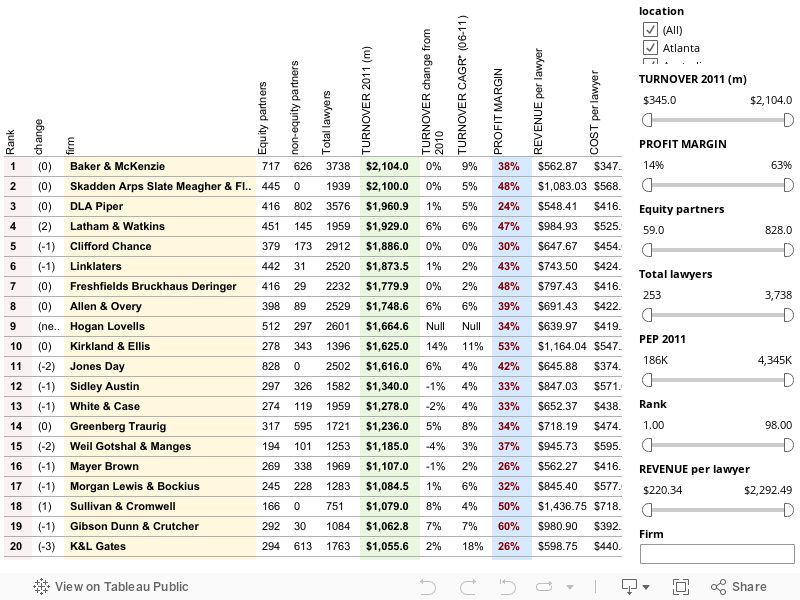
How the Global 100 has gone from turning over $71.6bn to $85bn in five years.

The world’s largest passenger plane, the Airbus A380, costs $403.9m dollars to buy. Mayer Brown, ranked 22nd in the Global 100, could buy one A380 with a year’s total equity partner profits. The equity partnership at Latham & Watkins and Skadden, Arps, Slate, Meagher & Flom could probably do a deal to buy three apiece – they almost earn enough cash.

Continue reading “Flying High – The Legal Business Global 100”

The Asian century maybe but not the Asian decade for the Global 100

The market for the world’s largest law firms remains as reliably turbulent as ever. The group as a whole eked out a 4% hike in revenues to generate $84.9bn, a figure slightly flattering underlying growth due to a handful of sizeable mergers – including the creation of Herbert Smith Freehills and King & Wood Mallesons. Revenue per lawyer was flat. In real terms, the world’s legal elite is once again modestly shrinking and headline income growth slowed in comparison to the 2011/12 year. Conditions remain considerably better than seen during 2009/10 but are a long way from pre-2008 boom years.

It has been another year that has re-enforced the overall dominance of US firms, largely due to the strength of the US economy and a delayed revival in contentious work. Of course, the relevant performance of UK advisers since 2008 looks considerably worse due to the sustained weaknesses of sterling and the euro but by any measure, the Magic Circle has lost some ground. Compared to their mid-2000s’ heyday, the profits gap against key New York rivals has again ballooned out, while a group of broad-service US rivals are now challenging their scale and global reach.

Continue reading “The Asian century maybe but not the Asian decade for the Global 100”

All or nothing: Only a handful of DBAs entered into as confusion reigns over hybrid model

‘It’s an extraordinary thing – hundreds of lawyers should have entered into damages-based agreements (DBAs) by now.’

So says Leslie Perrin, former managing partner and senior partner of Osborne Clarke, who is now chairman of litigation funding group Calunius Capital, with around £40m of capital to invest in disputes.

Instead, DBAs, which came into force under the Legal Aid, Sentencing and Punishment of Offenders Act 2012 (LASPO) and entitle a lawyer to claim a percentage of their client’s damages by way of fees, have failed to take off at all. Perrin adds: ‘The confusion around the regulations has been such that I don’t think more than a handful of DBAs have been entered into all across the country. There’s so much ambiguity and grief for the first people going down that road and disputes lawyers are unanimous in holding this position.’

Continue reading “All or nothing: Only a handful of DBAs entered into as confusion reigns over hybrid model”