Over recent decades, Latin America has seen significant change in the makeup of its labour market. An increase in women’s representation and participation in the workforce, and organisational and various governments’ strategies are evolving to incorporate practices and initiatives to manage, enhance, and promote the role of women in the workplace. Foreign investment into the region is having a positive impact as demonstrated by the increase in Latin American companies adopting HR policies that go beyond legal requirements. That said, many Latin American countries and corporates still fall well short when it comes to opportunities for women and their economic participation. The gender pay gap remains significant. And despite the existence of legislation prohibiting gender discrimination, it still happens on a daily basis.
Why, in the 21st century, is this the case and how can meaningful change happen? Unfortunately, there is no single, silver-bullet cure for the gender disparity prevalent across the Latin America region. Change comes slowly, through education, by having uncomfortable but necessary conversations, and through the subtle shift of centuries-old biases that have kept one gender subordinate to another.
In a series of exclusive interviews, GC magazine speaks to senior and general counsel from across Latin America (both women and men) about how the more traditional landscape of the region plays a large role in how women are perceived in the workplace, and how they, along with their colleagues and companies, are slowly changing the experience for women lawyers across the region – but also for women in general.
Chauvinist society
For women working in Latin America’s legal industry (both in private practice and in-house), the challenge of getting ahead, of being ‘heard’, and respected, is two-fold. The legal industry is, and has long been, dominated by men, but that is hardly surprising when seen through the lens of a still largely traditional societal view that men work, and women stay at home. Anabell González Nava, legal director, North Latin America division at Arcos Dorados, says that even though organisations are making important diversity and inclusion improvements, ‘the culture of a society plays a key role in the habits and behaviours of men and women, and consequently of companies.’
‘Traditional gender roles are still very strong and create real and persistent inequalities among men and women in the workplace and in general in Latin American society,’ agrees Mexico-based Véronique Ramon Vialar-Déchelette, LatAm regional legal director at Publicis Groupe.
Valéria Camacho Martins Schmitke, LatAm regional general counsel at Zurich in Brazil, goes further. ‘Women pay a high personal price for equality with men. Some countries more, others less – but all are very chauvinist societies, and men still believe that taking care of children is a woman’s job. They also feel less empowered if their wives make more money than them. They expect women to be home when they arrive, and to prepare dinner. Women can work, but more as a hobby.’
These entrenched views have a serious impact on the industry, and how it is perceived. As Andrea Camargo, director of international legal affairs at Odinsa S.A. states in her profile interview in this publication, ‘It is a paradox that the profession in charge of providing justice is so full of inequalities.’
Despite these challenges, change – although slow – is happening. In interviews, several factors were highlighted as having a direct impact on the region: (i) a new willingness to discuss gender diversity and inclusion; (ii) a concerted effort from leaders to address challenges head-on in meaningful and practical ways, and to lead by example; (iii) the increase in men putting their heads above the parapet to argue that gender diversity benefits everyone, not just women; and (iv) the growth of multinationals, with more advanced diversity policies, establishing subsidiaries in the region.
On gender equality issues, Ana María Delgado, the Colombia-based vice president of corporate affairs at Corona, believes her country (which the World Economic Forum ranked as 40 out of 149 countries in its 2018 Global Gender Gap Report) has been evolving positively and that the participation of women in the workforce, as well as in leadership positions, has increased significantly over time. ‘Although there is still a long way to go, I have seen an increased willingness to openly discuss these types of issues,’ she says.
A recent country survey of Chilean in-house counsel showed that only 25% of general counsel positions were held by women. However, ‘statistics also show an increase in professional women’s careers with far more successful female roles and role models,’ says Guillermo Castillo, chief compliance officer at AFP PlanVital. While women hold only a small percentage of board seats and other influential positions, the pipeline of future leaders is starting to swell.
Zurich’s Schmitke is also seeing progress at a societal level, which will, in turn, have an impact on the Brazilian workforce: ‘I have seen men participating more in family tasks, with some men following their wives to another country because of her career. I believe that with every generation, we get closer to equality.’
Although she believes that Latin America is evolving more slowly than North American and European countries, Vialar-Déchelette says the region is walking the same path. ‘Private and public conversations regarding gender and equality are common, but quite recent,’ she told us. ‘These traditional prejudices need to be properly, widely, and honestly addressed and tackled so that public and corporate leaders understand their stereotypes and are willing to act accordingly to change.’
Tone from the top
The importance of strong leadership in tackling gender equality is a common theme. In her article, ‘How to get more men to take gender balance seriously’, for the Harvard Business Review (November 2019), Avivah Wittenberg-Cox argues that ‘it isn’t enough for the CEO to say gender balance is important once a year in a management conference. Nor even to set draconian and highly publicized targets… Until leaders are convinced that gender balance is a strategic lever for the business and become authentically and articulately convincing to their colleagues about why that is, balance remains a politically correct sideline.’
The 2016/2017 McKinsey report, Reinventing the workplace for greater gender diversity, supports the idea that real change must be led from the top. For women in the workplace to have better opportunities, to train and work in skilled and better-paying jobs, and to work in environments that support work-life balance and reshape social attitudes, organisations must challenge their fundamental and prevailing leadership styles and thoroughly re-evaluate traditional performance models. This is something that is particularly difficult for the legal industry, where the traditional structures and performance measures – such as billable hours as the primary measure of success – are inherently biased towards men.
The report goes on to say that organisations with a strong CEO and senior leadership commitment to gender diversity (i.e. those who place gender diversity as one of their top three strategic priorities) are twice as likely to integrate gender diversity successfully through all levels of their organisation. However, the report also shows that most organisations are falling short in transforming that commitment into a truly inclusive working environment, with many employees citing that they often don’t see words backed up by action, nor do they feel confident calling out gender bias when they see it.
Authenticity and ‘walking the talk’ are, therefore, key. ‘There are lots of good intentions, but not a real, open-minded approach to challenge the existing establishment,’ says Erica Barbagalo, legal, patent, and compliance lead at Bayer in Brazil. ‘The tone has to come from the top. The company needs its leaders engaged and acting as role models to succeed in promoting diversity and inclusion. It is not easy: changing the culture to break biases causes discomfort, and only courageous companies and leaders can bear that.’
Sometimes, it’s small gestures that have the largest impact as Barbagalo explains: ‘At a company event for hundreds of employees, the majority of them men, a guest speaker made a light joke about women. After his speech was over, one male leader got on the stage and explicitly disqualified the statement, making it very clear that this behaviour was not accepted in the company. He apologised for the insensitivity of the speaker. Needless to say, that speaker was banned from future events. Nobody, though, remembers the joke. But everyone remembers, to this day, the leader’s message.’
Diversity is a men’s issue
What came through loud and clear in all our interviews for this publication was the need to redefine gender diversity and balance as not solely the concern of women. For far too long, it has been accepted that fixing sexism is women’s work. But, actually, this is work that everyone must be a part of, because real gender balance has a positive effect for both men and women (see Michael Bruce’s interview in this publication for more on that topic). Wittenberg-Cox’s article states it clearly: ‘Companies whose balancing initiatives involve men are more than three times more effective than those focussing only on women.’
Castillo concurs: ‘Men’s partnership is required in addressing the issues that hinder women, including structural barriers and discriminatory practices that prevent women from participating on boards and receiving equal pay. Male executives can help lead the charge with women in enacting internal regulation that promotes benefits for women and men equally, and repealing policies that discriminate and limit women’s opportunities.’
Vialar-Déchelette believes the support of men is absolutely vital for change to occur: ‘Latin America is traditional regarding gender roles, and women on their own are making slow progress; thus the proactive support of men is necessary as a starting point. These are not just “women’s issues”; they are issues for the whole of society.’
What is key is how companies go about engaging with men on the subject of gender balance and equality to ensure maximum commitment. While this might be difficult for many women to read, Wittenberg-Cox’s advice is, essentially, to present the argument using ‘existing male-dominated hierarchies.’ In short, making the case for diversity based on moral grounds rarely has the desired effect. Instead, frame diversity as a business issue; make gender diversity and balance personal, measurable, and accountable. Position and normalise the issue as a business skill. Make male support the norm, rather than the exception. When the link between gender balance and positive business results is clear and explicit, men are more likely to engage with and support it.
Another key factor is for more men to mentor women, and to be open to recognising their own biases (this applies equally to men and to women). Many of the women we interviewed across this publication spoke of male mentors whose support had a significant impact on their careers. ‘I have been very lucky to have great male mentors through my professional life. They have offered me support in changing career paths, in taking risks, and following my dreams,’ Delgado says. ‘Those decisions have helped shape and define who I am today, and I am very grateful.’
Vialar-Déchelette echoes the importance of male mentors: ‘I was very fortunate to have a modern and supportive chief when I was first employed as a paralegal in a major firm. He repeatedly said that if I wanted power, I just had to take it and not to wait for someone to give it to me. He constantly promoted me over the years, in discrete but effective ways, by teaching the profession and encouraging me to take huge responsibilities without questioning my capabilities as a young lawyer, as a foreigner, or as a woman. In fact, in a male-driven industry and firm, gender has never been a subject between us. He acted with me as if gender didn’t exist. I believe that this kind of mentoring over the years gave me the confidence to drive my career as I have wanted, without fear or self-limitation.’
International influence
There are many reasons attributed to why, in Latin America, there is a growing openness to discuss gender diversity challenges, why more leaders are waking up to the power of a diverse and gender balanced workforce, and why more and more men are beginning to vocally and actively support women’s advancement in the workplace. One of these is, of course, the growth of multinational companies, headquartered overseas, which are now opening subsidiaries across the length and breadth of Latin America.
Many of these multinationals go far beyond local legislative requirements (particularly on the gender pay gap, where legislation in some countries is still slow to come), and are putting in place progressive policies, particularly in regard to flexible working arrangements, maternity and paternity leave, and mentorship programmes. These companies are consistently outperforming their peers, particularly in their ability to attract and retain top talent. The policies are seen as reflecting a commitment to equality and serve as an indicator, to current and future employees, of a more inclusive culture.
Barbagalo says that ‘countries such as the US and some European countries have been discussing equality long before Latin American countries, and by establishing their subsidiaries in the region, these multinationals are able to promote their culture and also set examples – some have women CEOs or other high-ranking women leaders. There are, of course, local companies with high levels of awareness and actions towards gender equality and diversity, but they are the exception rather than the rule.’
And while, currently, it may seem that Latin America-domiciled companies are not as advanced as their overseas competitors when it comes to diversity, progress is being made. Many of the lawyers interviewed can point to success stories thanks to increased awareness and understanding of gender balance.
‘In many of the countries in which we operate, we have seen an increase in women in leadership positions,’ explains Nava from Arcos Dorados’ headquarters in Uruguay). ‘We have three women market directors in Martinique, Puerto Rico and Venezuela. We also have a woman sitting on our board, who is the vice president responsible for government relations.’
While these steps may seem small, they are significant, and show that the tide is certainly turning.
Michelle Obama, former First Lady of the United States, once said: ‘No country can ever truly flourish if it stifles the potential of its women and deprives itself of the contributions of half its citizens.’ And what is abundantly clear throughout this publication is that Latin America is not short on talented, strong, passionate, and determined women lawyers who have begun to pave the way for other women to follow. Despite the still patriarchal and entrenched views of women’s place in the world, these women are breaking glass ceilings. They have gone beyond merely boosting the diversity statistics of their organisations to prove that the acceptance and inclusion of women in the workforce – at all levels – has a significant positive impact, both on business and society.












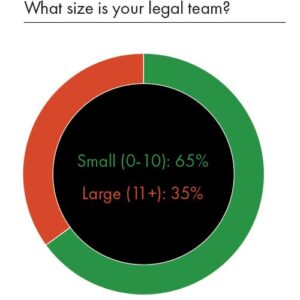 In-house legal teams come in all shapes and sizes: some companies will have small teams, preferring instead to outsource the bulk of their work to external firms, while others have internal legal departments that would outnumber many major law firms. For the purposes of the research that underpinned this report, a small legal team is classified as one with ten or fewer members, while a large legal team is one with more than ten members.