Data analysis part two: Funding the Future

Making a first foray into legal tech can be a daunting experience for some legal departments. For a profession that (whether fairly or not) retains the reputation of being technological luddites, having the support of the wider organisation when taking the first steps with legal tech – or expanding on a positive start – can make all the difference, according to the in-house counsel that participated in our research.

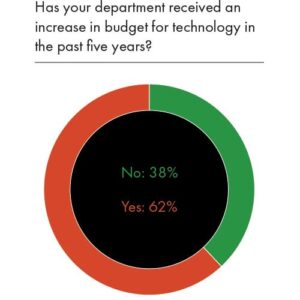
A key element of any support received from the wider business was budget. It’s one thing for an organisation to deliver empty platitudes about wanting to modernise its legal department, but putting its money where its mouth is can be an entirely different proposition altogether. Of the 140 in-house counsel across Latin America that were surveyed during the research for this report, 62% said that their department had received an increase in budget specifically for technology over the last five years.

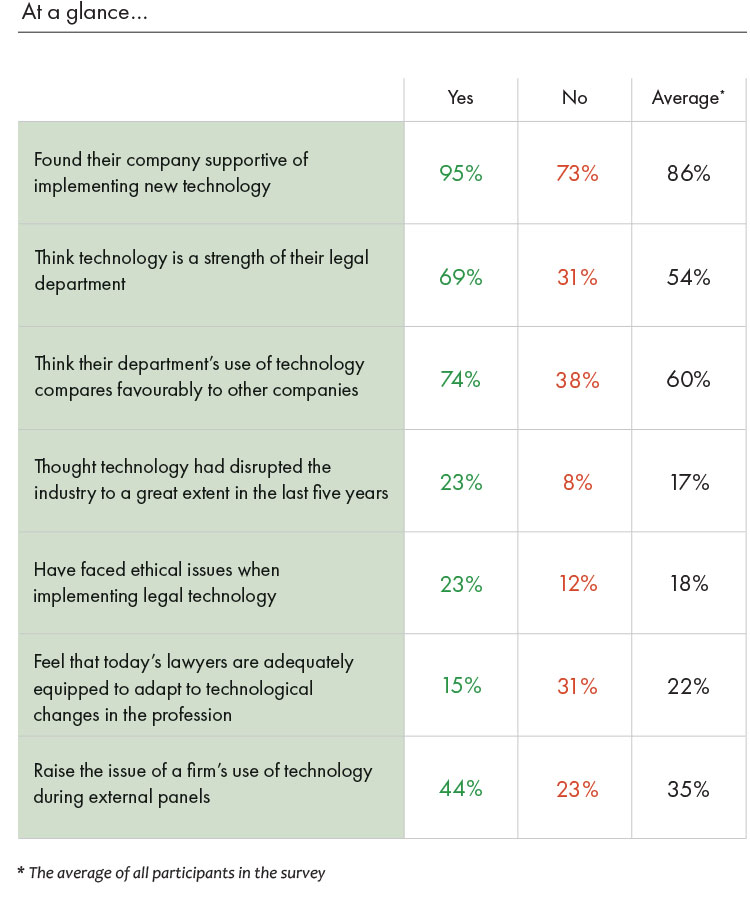
Getting that increase in budget made a big difference too – both in the use of and attitudes towards legal technology. Of the 62% who had received an increased budget, 95% felt that their company was supportive of implementing new technology, compared to 73% who had not. Those who had received a budgetary boost were also much more likely to have a positive outlook on their department, with 69% saying that technology was a strength of their legal department and 74% saying that their department’s use of technology compared favourably to other departments. Compared to the 31% and 38% respectively for those that hadn’t received an increase in budget, the difference in attitude was significant.

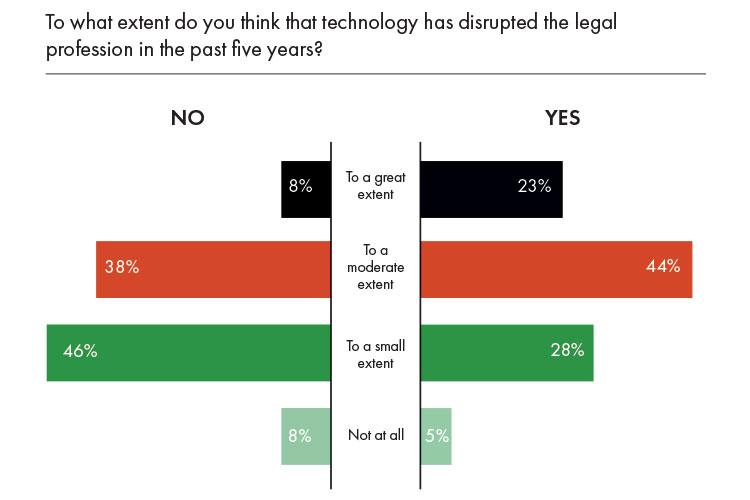
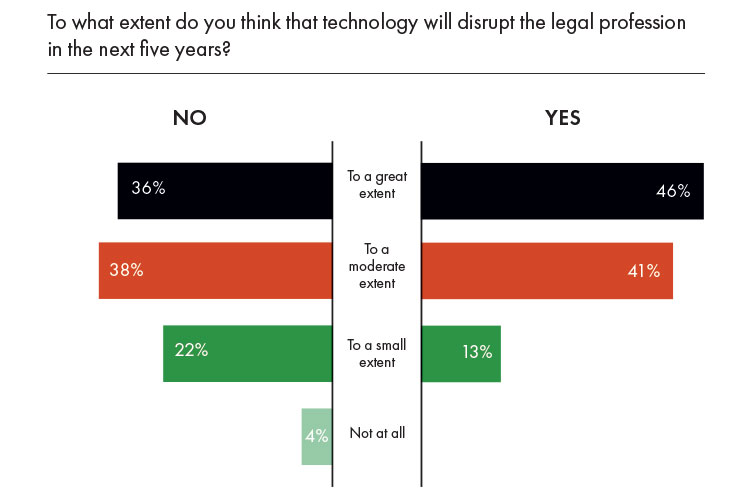
Perception of the impact technology was having on the legal profession differed significantly between those who had, and those who had not received an increase in budget too. Those who had received a boost to their budget tended to have a far more positive perspective on the impact technology had made on the legal profession in the past five years, with 23% believing it had disrupted the profession to a great extent, compared to 8% of those who hadn’t received more budget. Equally, for those who had received an increased budget, only 33% said that technology had disrupted the profession to a small extent or not at all, compared to 54% who hadn’t.

Interestingly, those who had received an increase in budget (and as a result, tended to have more experience with technology – particularly vanguard implementations) were much less likely to think that today’s lawyers are adequately equipped to deal with changes to the profession caused by technology. Only 15% of those who had received a bigger budget thought that today’s lawyers were sufficiently prepared, compared to 31% of those who hadn’t received an increase in budget. Where budget didn’t have an impact was how receptive today’s lawyers were to the use of new technology – only two respondents from each group found that their legal team was not receptive to the use of new technology, despite a difference in opinion between the groups about how well prepared they are to actually utilise it.

Ethical issues were one area where our research uncovered a significant divergence of opinions amongst general counsel. While most of our participants said that their use of technology had not raised ethical issues for their department, there was disagreement around whether these hadn’t occurred for the bulk of our respondents, or whether they were not attuned to the new types of ethical issues that were inherent with a number of these technologies. For those who had received an increase in budget, they were nearly twice as likely as their counterparts who hadn’t received an increase to report on ethical issues – 23% vs 12%. Based on the types of technologies that were being used by those with bigger budgets, it would be reasonable to infer that those who hadn’t received an increase in their budget hadn’t yet been exposed to a number of the ethical issues that were raised by those with bigger budgets.

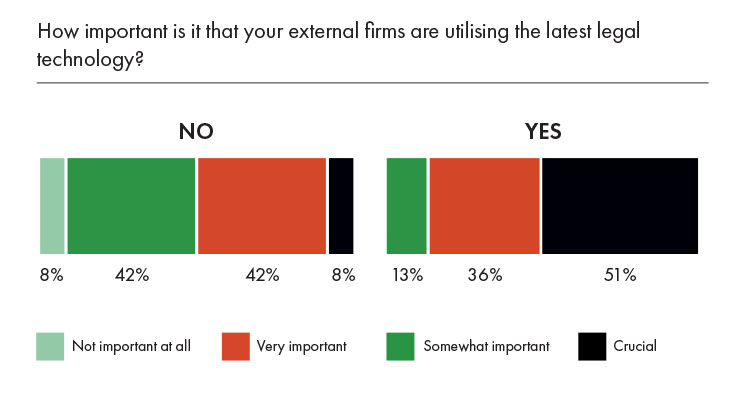
Our research also found that those who had received an increase in budget and were utilising more technology within their departments, were much more likely to take into consideration how their external firms were utilising similar solutions when assessing those relationships. For those who received an increase in budget, 51% said that it was crucial that their external firms were utilising the latest legal technology, compared to only 8% of those who hadn’t received an increase in budget. Interestingly too, not a single general counsel whose department had received an increase in budget said that it was not an important factor. Compared to those who hadn’t received an increase in budget, where 50% said it was not important or only somewhat important, it’s evident that the attitudes and behaviours internally with regards to technology translated to markedly different approaches to handling relationships with external firms.

In addition, nearly half (44%) of those who had received an increase in budget raised the issue of a firm’s use of technology during external panels, compared to 23% who didn’t. Some of the general counsel we spoke with said this was a critical issue when making decisions around external firms, as they wanted to know that firm’s were working at their optimal efficiency, but also considered whether their own internal systems would align or had the potential to be integrated with that used by their firms.

Alejandra Castro and Catalina Morales, Bayer, Costa Rica

GC: Can you tell me about how you use technology in the Bayer legal team in Costa Rica?

Alejandra Castro (AC): The legal headquarters in Germany have organised a worldwide structure in the legal department. We might be a unique global legal department where all our strategies are aligned including the vision on technology that should lead our functions. We centralise in a single IT tool the contracts, compliance cases, and data privacy processes, in addition to the monitoring of regulations in the region, plus patents as well.

As legal departments in Bayer, we handle various databases, and we are currently migrating to a new IT tool handled by regional expert teams, to make sure that everyone uses the same templates for contracts, with the same quality of service and the same regulations. The tool allows being a self-service contract database for contracts that we have already drafted, which will be harmonised for all the legal entities that we have. There will be an ability to make an online request for different templates outside those already drafted, and then these requests for new contracts will done by the legal department. Our expectation – and we are already reviewing this and finding this is what is happening now – is that the workload is getting lowered. We are trying to use these tools in order to make the process more agile, and to speed up all of the negotiations that we have with external vendors and so on.

Catalina Morales (CM): This new tool grants a contract life cycle management system. This means that you can find a template, you can send it to your business partner in legal, you can send it to your provider from the platform, the provider can give any feedback in the platform as well and, if they have the digital signature, they can also sign it online, and then you just store it in the same system. The idea is to use this system for contracts from the beginning.

AC: On the IP side, we have a different tool – it’s the same IT platform, but it’s a different tool where we upload all the patents that we have. It helps us by reminding us, for example, about deadlines and other IP risks that are very important with patents. If you miss a deadline, you can lose your patent, so for us it’s very important to keep a record of the timeline. In the past, patents were handled through local law firms and they were the ones that kept the reminders on the deadlines and the stages of the patent process. Now that we have developed our own patent tools, we do all the surveillance and the follow-up of what the law firms are doing, so it has increased our work in a positive way.

CM: On the compliance side, the tool registers every event or every investigation that we have. All compliance officers in each country or region have to input everything – every advance that has been happening in the case or the investigation. It is a tool where we are recording, but also reporting to global headquarters. It helps to visualise the impact compliance is having and guide future decision-making, such as whether we need to reinforce training or do more work on specific topics in a specific area or country. It is also useful to use as a knowledge system – you can visualise and it even helps you show that, for example, the number of investigations has gone down since you’ve trained, since you’ve provided more information. You can see, actually in a tangible way, the results of your compliance work.

GC: Have there been any particular challenges that you’ve encountered as you’ve been developing these IT platforms?

AC: Yes, there have. The first challenge was to make sure that we have a single template and that we keep the template with the most protection for the company, no matter in which jurisdiction the contract would be enforced. In my region, there are 33 countries in which we have legal operations, all of whom have different regulations, so that was challenging.

The second challenge was that, in the past, each region had developed their own IT tool for contracts. Now that we are migrating to the new tool – which is the single tool that will be used by everyone – it creates an additional challenge for areas or regions that need to leave the tools that were already developed, and migrate to this too.

CM: There’s always going to be challenges with what is a culture change. You need to explain that you’re not going to do this anymore, the way you’ve been doing it for the last 10 years – now you have to do it this way. Obviously, that is going to take time to adjust. There’s always going to be that initial scepticism about the new system – is it really going to work, do we have to do all this change if it won’t work in two or three years? We do have to do a lot of convincing, a lot of explaining why actually the system works and how it is going to benefit you. That’s the key: I think once they see the benefits, they get on board.

GC: Legal is one area where Bayer is implementing artificial intelligence. How are you currently using it and how do you think that use that will evolve from the sorts of things people are currently using it for?

AC: We currently have experience using AI in labour calculations, for example, for severance payments. It has already brought a lot of value to the department and it is just the beginning. I believe that, in contracts for example, we are going to see a lot more development around how artificial intelligence can help us work on our daily tasks.

CM: I think that AI could have an impact on the profession and the positions required in a legal department. A physical lawyer will always be needed, but the amount of lawyers needed in one department may decrease. For the company, or for the law firm, you could say that’s better because you need fewer people to do the same amount of work, but on the human side, as a lawyer, I wouldn’t like to lose my job and be replaced by technology! We need to find a common ground for us to work together.

I believe we will continue to see a rise in automation, too. It’s inevitable. I don’t know if it will change drastically and I don’t how fast it will change, but it will definitely change. The important thing is to have a company that supports this innovation and digitalisation, because it’s going to affect not only legal but every single department in the company. The engagement of the employees is going to be 100% necessary.

GC: How do you think the legal sector compares to other professional service sectors in Latin America when it comes to technology, innovation and working digitally?

AC: I think that lawyers believe they are not comparable. This is why we have sometimes not implemented technology. But I do think that our services are totally comparable to other areas that have already implemented these tools, like in accounting and finance teams. We are able and we can implement those tools – and there is no need to be afraid of that. I remember when we implemented digital signatures for several legal procedures, there was a lot of resistance from lawyers in the region, but now we use it on a regular basis and digital signatures are part of what we implement in contracts and data procedures. I think there are a lot of things that we can do and I think that legal departments are more than prepared to undertake this.

GC: How would you like to see law firms using and adapting to technology?

AC: If I request external counsel advice for legal opinions, I would love to have law firms keep a record of what they have answered to us for corporate housekeeping, to make sure that they have IT tools to give reminders on processes that are done on a yearly basis, like renewal of the corporation or payment of taxes. But it’s hard to find that in the market. At least, in my country group, we don’t have it. I know that I have peers in other country groups where they do have that service, but not in Central America.

‘The law firms that I work with use very little technology in order to provide their services.’

We are undertaking evaluations on outside law firms focused on the technology that they are implementing, so that we can look to use that as well. But, at least in the region where we have our legal department, I don’t think that there is too much going on yet. The law firms that I work with use very little technology in order to provide their services. However, from a global perspective, I know that headquarters have analysed global law firms that are using technology, so we have been able to review those technologies to see if we can apply them in our region or to our IT platforms.

GC: How can in-house teams best prepare and equip themselves for technological changes and disruption in future?

AC: There is a lot of work that has to be done from an investment and budget perspective. I think that is the first challenge that we need to face. The second is training; we’re used to having legal training, but now I think it’s very important to have specific training on the new IT tools that we are implementing, in order to be part of this new era where technology will be leading the legal department.

CM: As a legal department or a law firm that is not yet very technologically advanced, I would definitely recommend doing due diligence. Start small – start mapping out what systems can make your life easier. Maybe just a repository for a list of contracts, so you can upload a template, so that the whole law firm has a basic template that can be shared within a general system – that way, anyone that needs that type of contract can use it and the organisation has one face towards the client. Because, as a client, maybe one lawyer did the same type of contract differently than another lawyer, then you’re giving me two different versions, and maybe in one we went to labour litigation and with the other one we didn’t. So, at the end, it’s easier because they would have the same standard within.

I’m talking just basic contracts, but it works with other things, like legal opinions. If you’re going to give your client a legal opinion, you need to keep a record of what you said to the company and you can also start showing the benefits of having that to the managerial department, to see the importance of having that IT technology within the company.

A red light for red tape?

‘Bureaucracy is the death of any achievement.’ – Albert Einstein

Or is it? Perhaps ask a Brazilian – they tend to know a thing or two about bureaucracy.

‘It’s a very specific problem we have here in Brazil because we are a huge country – we have over 5,000 cities and each one of these cities has at least three different institutions from which it is possible to get different documents. Institutions like the city hall, the labour department, the justice department, the environment department, or the federal government,’ says Pedro Roso, CEO and co-founder of Docket, a legal tech start-up.

And the legal sector itself, says lawyer and tech entrepreneur Bruno Feigelson, is as swollen and filled with complexity as it could be. According to Feigelson, Brazil spends 2% of its GDP on its legal system, and there are currently 100 million ongoing lawsuits in the country.

‘If you compare that with our population – we have 200 million people – we have one lawsuit per person, because you have the plaintiff and also the defendant,’ he explains.

Discontent? Disaggregate

Felipe Monteiro is professor of strategy at INSEAD, and is also the academic director of the Global Talent Competitiveness Index, which identifies the world’s most talent-competitive countries. This has led him to look at how companies and sectors around the world are being transformed.

‘I remember talking to the CEO of a very large, fast-moving consumer goods company in Brazil. This is a very marketing intensive company, and the CEO said: “Brazil is the only country in the world where we have more lawyers than marketing people.”’

All this means one thing for start-ups armed with the technology to bat away reams of paperwork and administration: opportunity.

‘If we go to the legal sector, what’s happening is that whereas one company used to have a full range of activities, a lot of start-ups are coming and trying to break down the full service into smaller parts,’ explains Monteiro.

‘If you think about utilities, BT Group had the full service but now a lot of start-ups are saying “Maybe we can use the infrastructure of BT but start offering different things.” You can think about this as different technologies, but I think most of all, it is not about that. It is that you as a person now have different needs. Maybe an incumbent used to give you all those options, but now independent players can use the infrastructure and offer you different paths, maybe in a more efficient and effective way.’

One company aiming to apply this model to in-house legal teams and unbundle internal processes is ProJuris, a start-up currently enjoying its tenth anniversary.

‘There are more than 1.2 million lawyers in Brazil, which has led to one lawyer for every 190 Brazilian citizens,’ says digital marketing manager Tiago Fachini.

‘we have huge potential, because we have opportunities with sectors inside of the legal system.’

‘Our purpose is to eliminate inefficiencies of the legal routine. We are working with AI in several ways to help lawyers to be more efficient and happy. We are also working with automation and some very neat integrations.’

The company’s SaaS (software as a service) product automates repetitive activities, like creating or updating cases, creating documents, or distributing and managing team tasks. ProJuris also offers software to corporate legal teams designed to improve productivity of the teams who work with contracts, documents, signatures and requests from internal clients. It claims to have more than 1,800 customers, with over 20,000 lawyers using ProJuris every day.

Another is Docket. Founded in 2016, the self-proclaimed ‘document shop’ has developed a platform on which clients – for example, the legal departments of large companies – can manage documentation, allowing faster access to documents, reduced friction with public services and AI-enabled data analysis. Last year, the company participated in Google’s Launchpad accelerator programme.

‘The size of this market is huge. We used to operate without any technology and now we are looking for how technology could solve a lot of problems, through automation or AI and, with this market size, with this very complex system and with technology, I think we have the recipe to create a lot of start-ups in this market,’ says Roso.

‘In Brazil, this year [2019] was the year of fintechs. But I think the legal techs in the next two or three years will be the hype of the year, because we have a lot of solutions emerging. And we have huge potential, because we have opportunities with sectors inside of the legal system.’

Innovation by association

Someone who certainly believes in the future of legal techs is Bruno Feigelson. A lawyer himself, he founded his own legal tech company in 2016, Sem Processo, which aims to connect lawyers and companies in order to resolve and settle the vast numbers of matters that end up before Brazil’s legal system more easily.

But he didn’t stop there. The following year, together with legal departments and law firms, Feigelson – who also runs a law firm, a law school and a legal tech accelerator – created the Brazilian Association of Lawtechs and legalTechs, known as AB2L.

‘At that moment, we had some tech companies in Brazil, but we didn’t have the main legal tech or law tech – it was something like a desert in Brazil for technology. We started the association with just two companies and, nowadays, we have 200 legal techs in Brazil in the association,’ he explains.

Feigelson had observed an increasing interest in technology to assist in legal processes such as contract automation and litigation management and analysis, and he predicted this would evolve beyond the implementation of tech solutions developed in-house to the use of external platforms and processes that would become available on the market. And he is confident that he was right.

‘We have a lot of potential. It’s very interesting because the biggest change is not just the technology – it’s the change of mindset,’ he says.

‘Lawyers are now looking to find a newer way and a better way to change the field. It’s interesting to compare AB2L two years ago and now. Now we have solutions for tax, for compliance and for data protection.’

One particular area of innovation observed by Feigelson is visual law – using design to illustrate legal documents.

‘The biggest lawsuit in Brazil is one in which the state of Brazil is suing certain companies. This lawsuit could be worth billions and billions of dollars. We are drawing all the petitions in order to help the judge show the court what has happened. Three years ago it was impossible to imagine that you would be in a meeting with a lawyer and a designer to improve understanding for the client,’ he says.

‘the biggest change is not just the technology – it’s the change of mindset.’

But, he concedes, this has not yet translated to a huge number of legal tech companies in Brazil currently.

Growing pains

Roso believes that coming up with an idea for a start-up in the legal sector, particularly in Brazil, necessitates first-hand experience of the market. Docket itself was created following the challenges experienced by one of the co-founders while working for a real estate company.

‘You need to study a lot to create a start-up to solve these processes. It’s different to thinking “Oh, let’s think of something to create.” I think for legal tech you need to experience this pain, you must understand how to solve it. It’s not too simple because we don’t have a standard here,’ he says.

Put simply, however, Brazil is not the most conducive environment in which to open up a business. Placed 138th out of 190 countries included in the World Bank’s Doing Business 2020 rankings for starting a business, the country scored 124th for ease of doing business overall (figures taken from World Bank. 2020. Doing Business 2020. Washington, DC: World Bank. DOI:10.1596/978-1-4648-1440-2. License: Creative Commons Attribution CC BY 3.0 IGO).

‘The complexity to open a business, get clients, handle these physical problems that we have to understand our taxes, to pay our taxes – I think it’s not so good yet,’ says Roso.

For the legal sector, there are specific problems, and the very bureaucracy that has created a huge potential market for legal technology platforms also creates hurdles.

‘We have the problem of dealing with hundreds of different courts around the country, each one with its own system. There are more than 100,000 open cases in the Brazilian legal system, so in this decentralised and unstructured scenario, most legal techs fail to obtain and use public information,’ says Fachini.

The Doing Business website identifies some business reforms made by the governments in recent years that have smoothed the way for those looking to start a business. These include speeding up business registration, lowering the cost of the digital certificate, and establishing online systems for company registration, licensing and employment notifications for Rio de Janeiro and São Paulo. The government also launched an online portal for business licences in Rio de Janeiro.

‘I think this government, and other governments, are concerned with being more friendly with entrepreneurs. As a result, we have had laws pass through our congress that make it easier to be entrepreneurs,’ says Roso.

‘We are at the beginning of this agenda. It’s a long ride – we have a lot of things to do, but we are starting, so this is something to celebrate: we start this process here. I think the support from the government is very important because they could transform this whole scenario and bring more investment to our country and generate more jobs. Everyone has some kind of benefit from that.’

A new (ad)venture

The biggest problem, according to Feigelson, is a lack of investment relative to markets such as the US or the UK.

However, the tide may be beginning to turn in the venture capital stakes. In 2019, SoftBank Group launched a $5bn technology innovation fund focused on Latin America. In May 2019, Crunchbase reported that venture funding in Brazil reached $1.3bn in 2018, up from $859m in 2017 and $279m in 2016, according to figures taken from LAVCA, the Association for Private Capital Investment in Latin America.

‘[Venture capital funds] are more present in Latam, I think, compared to three or four years ago – when it was completely different,’ says Roso.

Perhaps a cautious approach to investment among incumbents is prudent.

Closer to home, in the legal sector, encouragement for legal tech is not as evolved as it could be, says Feigelson, whether through direct investment or by launching incubator and accelerator programmes. Early adopters are often thin on the ground, and although support is there in theory, the money is not always where the mouths are.

‘The law firms in Brazil, they don’t invest a lot of money in law techs. They don’t have a lot of money, because in Brazil we have a closed system in law firms. It’s impossible to invite a partner that is not a lawyer to introduce to this society,’ he explains.

‘They believe, but they don’t believe in this revolution. It’s very common that I’m going to a conference and talking about international big law and the companies that they are creating. But the Brazilian law firms, they are not doing the same.’

Adds Fachini: ‘Sometimes, our Brazilian bar association (called the OAB) puts some barriers in the technology way, trying to keep the old patterns instead of helping us to develop faster to help even more people.’

Perhaps a cautious approach to investment among incumbents is prudent, however. To throw a potential spanner into the trend among law firms in regions like the US and Europe to launch innovation labs, Monteiro believes that the benefits to incumbents of incubating and/or accelerating start-ups are not always clear.

‘It’s not even a billion-dollar question but a trillion-dollar question: to what extent incumbents will ever be able to integrate whatever those start-ups are doing,’ he says.

‘Imagine I’m a big company, let’s say a bank, and I start investing in fintechs – I have all those fintechs in my lab. To what extent will I be able to change the bank, or will I just be an investor in those new things? It’s not trivial, because the nature of the change is so much more profound than the previous technological changes.’

Monteiro is not speaking specifically about the legal sector, of course, but of a general response to possible technological disruption across the board.

‘I think we have a tendency of thinking that this idea of open innovation and accessing business technologies is more about “How do I connect with start-ups?” But actually, a lot of my feedback about it is that it is not about the connection itself, it’s more about “How do you bring those things home? How do you transform the mothership?”’

But Feigelson has observed the tech revolution (and, perhaps, cultural invasion) continuing apace – across all sectors in Brazil, even legal. And in-house teams, with their proximity to trends across the corporate ecosystem, are well-placed to benefit.

‘In Brazil, if you are a bank you are looking for fintech, if you are a health company you are looking for health tech – all these companies are living a special moment. We have a big movement in Brazil against wearing a tie, nobody wants to wear ties, they want to be modern, they want to be like Steve Jobs,’ he says.

‘The reconnection of the legal world with this new reality, of the fourth industrial revolution, it’s easier for legal departments than the law firms.’

In-house leading the way

‘there is no way back – technology will only be more and more relevant to the legal market.’

‘[Incumbent legal service providers] are starting to realise that technology is a friend which can help them to be more effective and efficient in their daily activities. In the beginning, there were misunderstandings about how technology would and could help, but now everyone is looking for tools to help legal routine,’ says Fachini.

But, in many cases, according to Feigelson, customers are coming from the in-house sector, and not external firms: ‘They take the money that was for the law firms and they put it into legal techs.’

At Docket, most clients are also tech-curious in-house departments. Their concerns are practical rather than innovation-related, in Roso’s view.

‘We have 130 people here, we have a huge team, and we always talk with huge clients, so we need to be prepared to absorb these huge clients. I think their consideration, at the end of the day, it’s not about [whether we are] a start-up, but if we will have the necessary structure to handle them. I think, in most cases, they are very optimistic about how technology could transform the legal department and reduce these operational jobs without any kind of value,’ says Roso.

The Brazilian general counsel GC spoke to as part of the research for this report were bullish about the potential of technology to improve in-house life, and took a pragmatic approach to the adoption of innovative tools – whether they be those developed specifically for their own departments, customised off-the-shelf software, or services procured from third-party tech providers.

‘Legal tech is the future; it is only a matter of time before they can prove what they are using is consistent and sustainable. I think that there is no way back – technology will only be more and more relevant to the legal market,’ says Rafael Dantas, director of legal and compliance in Latin America for General Mills.

For some, the challenges around technology revolve not only around selecting system tools likely to be effective, but identifying the best method of procurement. General counsel must find the right momentum and timing between developing them internally (balanced with other priorities within companies) and hiring third-party developers. But, the need for appropriate system tools is widely accepted.

Is disruption coming?

Conditions are certainly favourable in Latin America – and in Brazil specifically, says Monteiro.

‘When you are a developing market, one potential application of technology is offering leapfrogging opportunities. Remember that in a number of these markets they have nothing, and if they adopt the most recent technology, they will basically skip prior stages of technological development. The most well-known case was in Africa with M-Pesa in Kenya where, 10-15 years ago, most people didn’t have a bank account. M-Pesa started offering mobile payments on very simple phones. Many Kenyans don’t have a formal bank account and maybe they never will, because a lot of people skipped and started having a mobile wallet in their cell phones,’ he says.

‘There are a number of examples like this in Latin America. If you want to extrapolate a little and think about the legal sector, there are maybe two points to consider: one, is to imagine that some companies, and some of those start-ups, will never engage with formal legal services as we know them now – maybe they will skip that and they will start engaging with new ways of getting legal services; two, is the level of complexity of the Brazilian legal system – it is so complex, which means that you have a lot of lawyers and that’s why the legal tech sector in Brazil is thriving – because people know that there will be ways of disrupting that market and offering many different things.’

Feigelson certainly knows, and perhaps his enthusiasm – and that of the legal techs, like Docket, which is an AB2L member – will continue to be catching.

‘We believe a lot that we have the numbers and we have the anthropological conditions to make the biggest evolution in technology in Brazil. I work with researchers in Brazil, I work with law techs from other countries: people are coming to Brazil and trying to understand what’s happening here. I think we have a lot of change.’


Patricia Ulian, General Counsel, Archer Daniels Midland, Brazil

I joined ADM a year and a half ago, and in the past year we’ve invested a lot in technology. I myself am a person that really thinks that technology is important, because you really can replace operational work that I think is not a priority for senior lawyers – I try to prioritise the strategic issues and benchmarking, in order to check the other companies and really understand what we have in the market. I try to improve and, if this is the case, we invest externally.

ADM Brazil invests a lot in technology, we’re upfront: we know what works and what doesn’t. When we see something working, we can adopt that solution to what we also do in the future. But, in order to do this, we need to gather the necessary data to take such decisions. And, looking at information necessary to take those decisions, law firms are able to provide information in a better way and in a better form – things like graphics – and some law firms are able to provide us this information, so that we don’t need to do the work, which I consider to be operational, to get this information ourselves. And, it’s on information like that we can take decisions. That’s the point.

It’s never easy to get budget. It’s super difficult: you have to put a business case forward and prove why you need to bring that technology to the company, and make some sort of trade-off – this need not be in monetary terms, it could be efficiency. You need to show how valuable the technology is that you’re investing in. If you’re a big, global company you also need to prove that this technology is in accordance with the entire IT project globally. Not just in terms of local security – because what you are doing on a local level can interfere in security – but, you need to understand that everybody has to approve. Being practical in this way can bring a lot in for the company.

At ADM, we have control technology which allows us to control the litigation cases. The technology we use was acquired in the market but specifically customised to our needs. We have a massive litigation area here, so that technology helps us get the information we need. I wouldn’t call it artificial intelligence because it’s not done alone, but it does allow us to use that information gathered for practice or for analysis. With this, we can see how many cases we’re winning, how many we’ve lost, how much money we’re going to lose and how many cases we’ve received. For example, if we focus on labour pay and want to see why we have so many of these labour cases, you can detect that through our technology, and then this allows legal to brief and train the business to be aware of the current legislation and to be able to reduce these problems in the future. We can do this in relation to any problem. If we see that our consumers have a specific problem in a particular region, then we can make sure we avoid the same problem in the future. It’s a useful strategy to have in legal.

Brazil is very advanced in terms of technology and has very sophisticated solutions concerning IT because of all the investment here. Being a super big and democratic nation, we have a lot of legal work and technology here. But, Latin America consists of many nations. For example, you’ve got both Mexico and Bolivia – these are two totally different countries with different levels of development. When you think of Mexico, there are many differences in culture, and you must also consider the dependency on the US. You also have Brazil, which speaks Portuguese, whilst all other Latin American nations speak Spanish. You have many differences, but Brazil is a pioneer in this area compared to other Latin American countries.

I think that AI is revolutionary for in-house teams. I think that AI, or something related to AI, will create more connections than ever. I think the future is about AI and connection, because as much as we can be connected now, we cannot connect things and people – AI helps with this. When you can make out as many links as you can between people and information – for example, you can now make a complete profile on and of anyone. Before I meet someone, I can go into a web link, see their profile and other information about them – everything – even their personal life: whether they’re married, have kids, where they live and what they like and dislike. This is powerful because I can have a conversation with them and convince them of something, because, essentially, I know them now. Giving a simple example, if you have LinkedIn, Facebook or Instagram, I now know you. So I will know how to process our conversation in a way that I can convince you of something. We can see this when purchasing items on Amazon: when you buy a product, Amazon offers you other related products. This is embryonic and I think the future will be more like that. The more connected we are with information, the more connected we are with people.

AI and technology will not replace lawyers, but it will replace lawyers who don’t use technology. By nature, I think technology and information will become more global. So, I think privacy will become a big problem because everyone will know everything about you, and you won’t be able to have a little bit of privacy. Most of the available information is free right now, because it’s so easy to get this information. What was valuable in the past is not valuable in the future – like information. In the future, you need to be more strategic and use that to your advantage. I think the future is about AI and connecting us to as much information as possible.

Growing up: The rising importance of technology

When GC surveyed and interviewed a host of general counsel at some of the biggest corporate players in Latin America, what emerged was a variety of approaches to the question of how best to incorporate technology into the daily life of the in-house legal department. But whether the response was a wholehearted embrace, a cautious side glance, or something in between, what many agreed on was the fact that technology has made a significant advance into legal teams over the last five years – and that advance is set to continue.

‘In my three years at Bayer, I’ve seen the introduction of many systems. For example, a new tool was just introduced this year for contracts and Prime for data privacy was introduced last year. Comcat (a compliance tool) was in diapers three years ago, but it has gained significant importance around how we report on compliance cases. In my three-year period, it has moved very much towards a technology-based or technology-oriented profession,’ says Catalina Morales, data privacy manager for Central America and Caribbean at Bayer in Costa Rica, currently in an assignment based in St. Louis, US.

Bayer has taken a global approach, with the Central America region assimilating accordingly. But general counsel at Archer Daniels Midland Brazil, Patricia Ulian, has added personal momentum to the tech wave.

‘I myself am a person that really thinks that technology is important, because you really can replace operational work that I think is not a priority for senior lawyers – I try to prioritise the strategic issues and benchmarking, in order to check the other companies and really understand what we have in the market. I try to improve and, if this is the case, we invest externally,’ she says.

‘Five years ago, information control was totally dependent on human action. In-house lawyers were much more operational and less strategic, as they had to dedicate their time to fill in Excel sheets and other reports. The margin of error was high, the time of responses was longer – and those aspects directly influenced the quality of the decision-making process of the company.’

A race to technology?

In this spirit of striving to minimise administrative tasks, the GCs we interviewed for this report have much in common with their counterparts around the world, who have bid farewell to the paper-based days of yore. But some feel that parts of Latin America have further to go to catch up with peers in certain jurisdictions. Selim Erdil Guvener, general counsel at the International Potato Center in Peru, is one such person, having moved to Latin America six years ago after a career that has taken him to London, Istanbul, Nairobi and Benin.

‘I think the legal profession in Peru is behind the US and Western Europe in terms of adopting new technology. Here, I can still only see technology use at the word processing and some systems levels. But lawyers will need to adapt quickly, as digital transformation is picking up speed, especially in the government,’ he says.

96% of respondents reported using specialised legal tech within their departments.

Of course, in a region the size of Latin America – including 20 countries for the purposes of our research – and with the unique character of each country, it is impossible to draw conclusions that are too general.

‘Latin America consists of many nations,’ says Ulian. ‘For example, you’ve got both Mexico and Bolivia – these are two totally different countries with different levels of development. When you think of Mexico, there are many differences in culture, and you must also consider the dependency on the US. You also have Brazil, which speaks Portuguese, whilst all other Latin American nations speak Spanish. You have many differences, but Brazil is a pioneer in this area compared to other Latin American countries.’

Vastly differing economical, commercial, societal, and geographical landscapes across the numerous countries making up the Latin American region have resulted in similarly different priorities for the governments governing those countries. Regulatory differences therefore exist across the region and, in some cases, technology regulation might not be the most pressing or significant issue for the relevant country regulators and the legislature.

Despite the inherent differences between the various countries that comprise the Latin America region the counsel who participated in the quantitative aspect of our research were near unanimous in their agreement that technology had become an essential component of any in-house lawyer’s role. Indeed, 96% of respondents reported using specialised legal tech within their departments, with only 11% saying that the use of technology within their legal department hadn’t changed in the last five years.

Client-driven change

It’s hardly controversial to posit that technology is changing the legal profession. Afterall, the general counsel who took part in the research for this report were near unanimous, at 94%, in saying that technology had been disruptive in the past five years. All but two of the 140 surveyed predicted further disruption to arise in the coming five years.

For providers of external legal services, the prospect of change and disruption will be cause for concern in some corners of the profession.

But it needn’t be.

Since its inception in 2002, World Services Group has made technology a core component of its network offering, an ethos that has extended to its member firms around the world.

‘Technology is at the core of the administrative activities within our firm, but also part of the essence of the legal services that we provide to our clients,’ says Fabio Luiz Barboza Pereira, partner at Veirano Advogados – the World Services Group member for Brazil.

But the actions of some firms operating in insolation isn’t going to be sufficient to move the needle a meaningful amount. Rather, it will require a collective effort from all of the profession in order to achieve real progress. It is abundantly evident from the report that in-house counsel are embodying the evolution that they want to see, but they can’t be expected to assume all of the responsibility.‘At Veirano, we firmly believe that our legal analysis is enhanced – and a more time efficient process – with the support of technology. To this end, we have hired developers and implemented custom platforms for timesheet accounting, pricing, document filing and performance valuations, as well as almost all administrative activities. This gives both associates and partners alike more time to focus on core business activities, which is of course the provision of top-quality legal services.’

‘The legal profession needs guidance from true technology experts if we are to drive a digital transformation. Lawyers can be reluctant to embrace technology. We are seeing legal tech companies and multinational law firms taking the first steps towards a digital revolution, but it will require a real effort to convince the profession of the benefits and potential of legal tech,’ says Victor Manual Barajas Barrera, partner at Basham, Ringe y Correa, SC – the World Services Group member firm for Mexico.

‘At Basham, we will be conducting a digital transformation process together with our technology partners, will a host of changes expected to be implemented this year.’

At present, it appears that the pressures are beginning to mount, if only on the margins. At 97%, almost all respondents said that a firm staying abreast of new technologies was at least somewhat of an important consideration to them. Interestingly though, that hadn’t yet translated into a criterion on which firms were explicitly judged, with only 35% of respondents saying that the question had arisen when undertaking a panel review. While firms may not yet be feeling the impact of a lack of innovation on their bottom line, the responses compiled suggest that moment may not be far away.

If in-house legal departments are going to be the ones to spearhead technological change in the profession, then the rest of the legal community must be prepared to join them, or risk being left behind. By the time clients begin voting with their business, it will already be too late.

General counsel report benefits across several areas of the in-house team. Increased efficiency has been a major boon, with technology enabling a more precise focus on aspects of work that are deserving of significant time and energy, while straightforward administration work can reliably be automated and left to tech tools. Improved organisation has been another advantage, particularly an enhanced ability to keep track of and access information. The possibility of detailed and speedy data extraction extends the scope of teams and their broader organisations to retrieve information to employ in internal analysis.

Says Ulian: ‘I believe legal technology is already helping us to work smarter and can make in-house teams more efficient, improve knowledge retention, accelerate professional development and reduce potential burnout.’

Making connections

Some general counsel stressed the importance of technology in bringing closeness among parties, be they internal, external, or even customers.

‘I think the future is about AI and connection, because as much as we can be connected now, we cannot connect things and people – AI helps with this. When you can make out as many links as you can between people and information – for example, you can now make a complete profile on and of anyone… This is powerful because I can have a conversation with them and convince them of something, because essentially, I know them now,’ Ulian explains.

‘We can see this when purchasing items on Amazon: when you buy a product, Amazon offers you other related products. This is embryonic and I think the future will be more like that. The more connected we are with information, the more connected we are with people.’

But on a more prosaic level, the existence of technology can foster a greater understanding between legal department and business partner.

‘We are now a lot closer to our clients, thanks to technology. Not only from a telecommunications and technology point of view, but also because we’re able to follow their work and provide support almost instantly. Now that we have significant information technology support, we can understand what the client’s business actually is,’ says Guvener.

‘Let me give you an example: we have a monitoring and evaluation platform where we gather all the information – this is not necessarily legal information. But, we do have the key performance indicators in there. We can look at it and identify the key challenges colleagues are facing. We can see if there is anything related to legal challenges. Therefore, we can pre-empt project implementation challenges before they become real bottlenecks for projects. The ability to work on legal documents in real time is a real big change.’

The human touch

Much discussion on the topic of technology centres on the issue of how much professionals have to fear from technological advancement. But many of the general counsel we spoke to were relaxed about any potential ‘threat’ posed by machines.

‘Technology is not here to replace a lawyer’s work, but rather to enhance it. There is a human factor that lawyers provide – interpretations, judgement, decisions, solutions and knowledge of legal systems and a particular business situation – that need to be part of the entire law system, that is why technology and human knowledge are complementary. On the other hand, if a lawyer keeps up with the different technological changes and embraces new technologies, the exercise of the legal profession will be improved. In fact, I believe you will become a better professional,’ says Juan Pablo Ovalle Arana, country counsel at IBM Colombia.

Rather than replacing lawyers, those we surveyed for this report were strongly in agreement that technology was a tool to be used to enhance the outcomes provided by lawyers, not replace them. 66% said that technology could enhance outcomes for in-house departments to a great extent, with a further 31% agreeing but to a moderate degree. Only 3% of respondents had a divergent opinion.

‘Technology is not here to replace a lawyer’s work, but rather to enhance it.’

There was a sense among general counsel in the region that the increasing use of technology tools was unlikely to remove lawyers from a role as ultimate architect of legal solutions, primarily because of the importance of the human element in contributing to productive outcomes.

That humanity was defined as communicating through body language, reading through the lines, and responding to the emotional component of client representation, identifying the exceptions that prove the rule, and the quirks of life and law that build the richest understanding of any situation.

Applying emotional intelligence – be it with opposite parties negotiation or litigation, or in internal client interactions – is far from an exact science, yet the lawyer’s role relies heavily on these essential interpersonal skills alongside technical expertise. As in the healthcare profession, while a machine might contribute pinpoint accurate analysis and speed to a diagnosis or treatment, there is currently no automated substitute for bedside manner. For this reason, some of the general counsel we spoke to pointed out the limitations on true disruption to the legal profession, and the potential for hyperbole when applying buzzwords and jargon terms perhaps more suited to analysis of tech trends to the nuances of practising law. Rather than a discussion of disruption, those general counsel felt, a more accurate description of technology’s impact would be in terms of incremental time-savings rather than replacement of core duties.

‘There is an element of “frustration” that is recurrent for the legal professionals, and it is a client saying “My lawyer doesn’t understand me”. I have been in situations where I have to go through a call center bot and they give me a number of options, but I am not always sure that my question will fit any option. So, the interaction with the machine is not always perfect, and “the human touch” is still needed,’ says Ovalle Arana.

‘I think we, as lawyers, would need to learn to interact with new technologies such as Artificial Intelligence, Machine Learning and others. The work between man and technology has never been so important and efficient and it is up to us to take advantage of it to make our profession evolve.’

But, for some, even outside of AI and any mythology about the robotisation of the profession, the cold touch of technology can already be felt – ironically aided by the very tools developed to improve communication.

‘Today, you can negotiate and close a big deal without meeting the other party in person. That’s a dramatic change, because it allows you to work remotely, even in complex fields. The challenge is that by losing the personal touch, it will hurt the lawyers in their capacity to develop negotiation tactics and so forth,’ says Alberto Vergara, head of litigation for Scotiabank Chile.

‘You save cost in matters like travel and meetings but, on the other hand, you will lose some useful tools that only the experience of personal relationships provides to lawyers. Right now, you have general lawyers that don’t have external meetings – they work exclusively by their computers, so they don’t have any real relationship with their counterparties. I would say that is problematic.’

Juan Pablo Ovalle Arana, Country Counsel, IBM Colombia

For a non-millennial, old-fashioned lawyer, as I am, technology is challenging and represents a large area to explore. At IBM, we are expected to be acquainted and familiar with technology. From an operational perspective, there is a need for lawyers to be tech savvy and understand the technology.

And, it is our responsibility, as professionals, to improve the use of technology and encourage the use of it.

The way lawyers use technology has evolved in the past years and, in my view, we have made progress, but there is still a journey ahead of us. When I joined IBM – eight years ago – you could provide a quality service to your internal clients by knowing the business and products. Now everything moves at a faster pace: regulations have changed, so the only way to catch up with new regulations is by using technology – especially when you work in the fintech environment. As in every industry, there is always room for improvement, and the only way to do it is creating a culture of continuous learning, including hard and soft skills on your learning journey.

Emergent technologies are real, and we have to live with them. Technology is not here to replace a lawyer’s work, but rather to enhance it. There is a human factor that lawyers provide – interpretations, judgement, decisions, solutions and knowledge of legal systems and a particular business situation – that needs to be part of the entire law system – that is why technology and human knowledge are complementary. On the other hand, if a lawyer keeps up with the different technological changes and embraces new technologies, the exercise of the legal profession will be improved. In fact, I believe you will become a better professional.

As with many other countries in the region and globally, Colombia is starting its journey in the use of technology in different professions. Incorporating, for example, AI within in-house legal departments is helping law firms focus in what is really important – their clients – while technology ensures documents are processed in a faster and accurate way, what translates in better services for the clients and time saving for the lawyers.

Where technology is headed is a tricky question – I certainly don’t have an answer to that. New technologies emerge all the time and they develop quickly, so it is very unpredictable. It is hard to predict what’s going to happen, and, what is actually going to come up next and what you think is going to come up next, are not the same thing.

Breaking barriers: Adjusting to change

Most in-house counsel interviewed agreed that technology was a partner in the process – an increasingly unavoidable one – but not a rival. Yet support for technology in corporations, particularly legal departments, nevertheless butts up against frequent barriers.

Leadership

Unsurprisingly, support from corporate leadership is a prerequisite when it comes to weaving technology into the fabric of internal teams. Those at companies already well versed in technology often gravitate more quickly towards technological solutions.

There was a sense among some interviewees that timescales for innovation in more tech-based industry sectors could be truncated compared to more traditional sectors, or those with less of a technological provenance. Tech companies, for example, often enjoy a head start in the mindset of management, and a supportive attitude among the general workforce to tech or innovation-based change. These elements can help teams enjoy quicker productivity and efficiency gains than more traditional companies, who might be less open to technology culturally.

And, of course, expressions of support from leadership much be accompanied by practical encouragement – namely, financial support. Of those who participated in our report, 60% said their department had received an increase in budget for technology over the past five years. Those who had received an increase in budget were much more likely to cite technology as a strength of their legal team, at 71% (compared with 30% of those who hadn’t received an increase in budget), and to think that their company was well positioned with their use of technology, at 76% (versus 40%). Of course, the leadership of the legal team must be live to the necessity of obtaining budget specifically for technology – and, according to some, it’s a matter of outlook.

‘If the person that is leading the legal area doesn’t take the fact that they will need money for innovation or applying systems or technology into account when they are developing that budget, well, that’s a failure. It’s just because they haven’t thought about it,’ says Pablo Enrique Urrego Hernández, head of legal at Diageo Colombia.

‘What normally happens is, in the middle of the project, you ask the CEO to give you money for something you haven’t taken into account. Probably you can ask for some more money, but you must have already had the idea of developing that technology. You have to be smart. That’s why I say everything is part of the culture. If you have that in mind and it’s part of your DNA as a lawyer, you will be able to get the resources.’

For this, Urrego Hernández believes it is important for the GCs themselves to lead any example and model a progressive attitude towards embracing technology.

‘We need to develop leaders on these issues, and my challenge is to become a leader. I probably won’t be the one that will develop the systems, but I could be the one who can push everyone to understand that adopting these kind of systems is a good thing.’

Practical makes perfect

In a region as diverse as Latin America, practical constraints can be a common source of frustration among leaders eager to implement technology in multinational corporations.

‘We do have countries and projects where internet connectivity is an issue. In those cases, having world-class technological tools available to us can actually be time consuming and frustrating,’ explains Selim Guvener, general counsel for the International Potato Center.

‘We’ve been looking at how much can we do by teleconferencing rather than travelling, allowing us to have as much face-to-face interaction as possible – without having to travel across the world and contribute to global warming. On one hand, technology is developing significantly, but on the other, there are still parts of the continent that are lagging behind.’

‘We need to develop leaders on these issues, and my challenge is to become a leader.’

Even when accessibility is not an issue, there might be competing systems in play. In rolling out a global contract life cycle management system, Bayer found it had to abandon systems in certain jurisdictions, for example.

‘In the past, each region had developed their own IT tool for contracts. Now that we are migrating to the new tool – which is the single tool which will be used by everyone – it creates an additional challenge for areas or regions that need to leave the tools that were already developed, and migrate to this too,’ says Alejandra Costa, head of law, patents and compliance for Central America, Caribbean and Andean region.

‘If you’re a big, global company, you also need to prove that this technology is in accordance with the entire IT project globally. Not just in terms of local security – because what you are doing on a local level can interfere in security – but you need to understand that everybody has to approve,’ adds Patricia Ulian, general counsel for Archer Daniels Midland Brazil.

Interface issues might also become apparent when engaging with external parties.

‘When you are outsourcing your services to a large number of outside counsels, it is natural that each and every law firm uses their own system and has their own routine. It is difficult to make sure that the external company is using your system or actually providing the information that your company requires,’ says Rafael Dantas, general counsel/director for legal and compliance Latin America at General Mills.

[Data] Private: Keep Out

Thinking globally has not only practical implications, but also regulatory ones, meaning that companies must stay compliant across the board – preparing themselves to be fit for purpose in the most rigorous regulatory regimes, even if this means appearing heavy-handed in jurisdictions with a less prescribed approach. Nowhere is this more evident than in the context of data protection, as Catalina Morales, data privacy manager for Central America and Caribbean at Bayer, discovered when implementing a global system to ensure compliance with the EU’s General Data Protection Regulation.

‘Obviously there were, at the beginning, rejections: why do I have to apply GDPR, locally it’s not applicable, I don’t process EU data. But, even though you don’t process EU data, you may be doing a clinical trial locally, and in that clinical trial the data is being sent to our headquarters in Germany – so there you should be complying with GDPR,’ she explains.

‘We had to explain every simple situation where GDPR could be involved to make them see that actually it was important for us to apply it, even though locally you don’t have an obligation.’

In Bayer’s case, the system in question acts as a repository for data processing activities, enabling swift and detailed mapping of what data is accessed and when. But, in other contexts, technology could muddy the data security waters in terms of risk and accountability.

‘The more digital we become in our work, the more difficult it is to establish network safety and security. So, at the same time, we need to educate the people who are using and accessing our network in order to protect it. This will require training and capacity building for our workforce,’ says Guvener.

A clear understanding of accountability in data processes must also be ensured, to avoid ‘the machine’ being blamed for data leaks, when the issue might be one of process or authority.

Winning hearts and mindsets

Across the board, a major challenge for those implementing changes in systems and processes is gaining the buy-in and support of team members. Those on the frontline of using new technology might raise myriad concerns, ranging from reluctance to adjust to a new way of working, doubts in the quality of the system itself, through to a more existential fear of being rendered redundant.

Those who participated in our research thought that, as a whole, the profession was not adequately prepared to adapt to technological changes. Only 22% of participants believed that today’s lawyers were properly prepared and equipped to embrace technology, despite 97% saying that their team members were receptive to its use.

Thinking globally has not only practical implications, but also regulatory ones.

‘I believe the first step is constructing a culture of digitalisation, automation and using technology so that people understand that these are tools that can make life easier and better. They are not competition, they will not replace a lawyer – in my team, every person is important. What I want to be able to do is to free capabilities – give my lawyers freedom to work on other issues,’ says Urrego Hernández.

‘If you have a lawyer spending time doing contracts, that’s not right! You need to liberate, create time for them to do all those things and be able to develop other skills. What technology can do is become a partner in that development – it’s their best ally for that. If people start to understand that technology is a partner and not an enemy, or a possible substitute for their job, that will change the progress of what we have been doing.’

For Urrego Hernández, such a culture change means not only approaching new technological systems and processes with an open mind, but with a willingness to share company information with external legal tech developers, in order to develop bespoke solutions.

‘You might not be able to find what you want because it’s not yet developed, but you can find someone able to develop it. But in order to find that ally, you have to be really open minded,’ he says.

‘They need information that might be confidential, or to understand problems that normally you would not talk about outside the company. But once you understand they are an ally and give them trust, everything goes more easily.’

It’s an oft-repeated thought that lawyers are conservative and slow to adapt to change when compared to those in other professional sectors. But some believe that it’s sometimes unfair to stigmatise lawyers in this way. Rather than comparing apples and oranges, it’s important to compare apples and apples, this thinking says: areas that involve much human interaction can’t simply replace entire thinking or decision-making processes, and perhaps those areas of the profession not seeing drastic technology-induced changes are those that require a large amount of additional insight on top of what technology can provide.

Not everyone agrees on the uniqueness – and, hence, immunity – of the law when it comes to technological innovation, however.

‘I think that lawyers believe they are not comparable. This is why we have sometimes not implemented technology. But I do think that our services are totally comparable to other areas that have already implemented these tools, like in accounting and finance teams. We are able and we can implement those tools – and there is no need to be afraid of that,’ says Costa.

‘I remember when we implemented digital signatures for several legal procedures, there was a lot of resistance from lawyers in the region, but now we use it on a regular basis and digital signatures are part of what we implement in contracts and data procedures. I think there are a lot of things that we can do and I think that legal departments are more than prepared to undertake this.’

The chicken and the egg

Across the board, across continents even, there is a sense, even among many in the legal profession, that use of technology lags behind in the law. If there is a reluctance for legal professionals to adopt technology when compared to other professions, there was some discussion about why.

Some of those who provided input for this report speculated that, perhaps due to its difficulty as a subject, many were avoiding law, choosing instead to train in other business areas such as marketing, business administration, and other areas that are useful in a globalised business world, and currently popular career choices. Perhaps law struggles with its (perhaps unfair) reputation as a stopper, rather than an enabler, and this is a disadvantage it in the innovation stakes.

If it is true that law is at times seen as a less attractive choice for potential candidates, is it the very lack of technology and innovation in the law that is deterring minds from a traditional legal career, and attracting them to a newer breed of company? Bruno Feigelson, lawyer, entrepreneur and president of the Brazilian Association of Lawtechs and Legaltechs, thinks this might be the case:

‘They asked associates in big law firms in Brazil if they dream to be partner one day. They don’t want to be partners, they are not happy with the way things happen, so these new structures, these new law firms, these new ways, are attracting the best talent,’ he says.

‘You might not be able to find what you want because it’s not yet developed.’

‘The big challenge for the big law firms in Brazil is how to attract the better brains to the law firms. They want people that understand how to use software, how to use design, how to understand the legal system in another way, they start to search for new opportunities. We have a lot of special persons doing law tech, trying with new law firms, so we have a new evolution with these new young people and also the youngest people from the legal departments, they are searching for another way.’

Regardless, it seems obvious that the various arms of the evolving ecosystem for legal solutions – in Latin America and globally – could benefit (and are doing so, in many cases) from cross-pollination. Especially in the world of tech, recognition is growing about the importance of having people from different areas share ideas and explore how synergies can be created. Engineers, lawyers, people from different disciplines, can share experiences, generating improvements and new ideas in the process, which can then be applied to solutions.

Winning the innovation battle

But, as those in-house will be quick to attest, the legal profession is very much a profession of two halves – and it is often in-house teams, in close partnership with other business functions, who lead the game when it comes to tech adoption.

Interestingly, when it comes to using technology, looking to external law firms for guidance remained a rarity. Only 35% of our respondents said that they were satisfied with the use of technology by their external firms, despite 86% saying it was somewhat or very important to them that their law firms keep abreast of new technologies. Only 26% said that they looked to their external firms for guidance when it comes to new technology, with even fewer – 18% – saying that their firms had offered to share or help with the implementation of tech systems.

‘In Latin America, and in Colombia specifically…there are just the typical law firms that have a hierarchical structure of partner, associate, staff and so on,’ says Urrego Hernández.

‘They have the old-fashioned way of working and trying to change that is like trying to break a bargain. They do not care much about innovation and, I have to say, it’s frustrating, because in-house legal teams are far ahead of the legal firms in terms of using technology and using these kinds of tools.’

It’s not true to say that law firms are trying to hold back the tides across the board, however, and some noted some flexibility and adaptability among external providers.

Collaborate and innovate

At World Services Group, technology is one of the three founding principles of our network. We firmly believe in the power of collaboration and actively encourage our membership to work both with each other and the wider legal community. In an effort to facilitate this, we provide our membership and clients access to our proprietary platform and tools to help drive symbiotic ways of working.

But while technology is at the heart of World Services Group and our member firms, in Latin America, the results of the research would suggest that the sector has more work to do.

‘Latin American law firms are spectators rather than actors in the legal technology environment,’ says Victor Manuel Baraja Barrera, partner at Basham, Ringe y Correa, SC – the World Services Group member firm for Mexico.


Private practice lawyers are all too aware that they need to do more, with their in-house counterparts vocal in their calls to see the bar raised.
‘We fully expect the Latin American legal sector to wake up to the potential of digital transformation in our profession in the coming couple of years.’

Of the general counsel surveyed, only 28% said that they were satisfied with the use of technology by their external law firms. While that number in itself will raise some eyebrows, what truly stands out is the 43% of respondents who said that they were unsure. That speaks to the need for firms to rethink their external messaging and better engage with their clients – not just to convey what their firm is doing in the technology space – but to understand the needs and expectations of an increasingly sophisticated end-user.

What was disappointing though, was to see that only 18% reported that their firms had offered to share or help implement new technology, while just 26% of respondents said that they looked to their law firms for inspiration or guidance around new legal technology.

‘In-house clients expect their outside counsel to at the very least be familiar with the best-known technological tools for communication and file sharing, but increasingly, to have the knowledge and ability to present them with  technology that can make their jobs easier and improve productivity,’ says Fabio Luiz Barboza Pereira, partner at Veirano Advogados – the World Services Group member firm for Brazil.

‘At Veirano, we are constantly seeking new legal technologies – both internally and from several external tech partners – from whom we are constantly requesting complementary proposals that can be used I accordance with the scope of work presented to us by our clients.’

With firms’ use of technology being such an important factor for general counsel when selecting who to instruct, it would appear that too many firms are missing an opportunity to create a point of difference commercially, but perhaps more importantly, a chance to work together to help drive progress in the legal profession.

In-house counsel across Latin America have taken up the mantle and assumed a leadership role for pushing the practice of law firmly in the direction of a tech-based future. Now it’s up to those in private practice to join them.

Eventally, predicts Ulian: ‘Clients will demand it. Increasing sophistication in client technology adoption is (and will) apply pressure on law firms and lawyers, who will be selected for their technology-enhanced services and ability to focus on complex, higher-value work to solve their clients’ legal and business problems. Some of the law firms that provide services to us also used to share with us their tools and inspire us to think about new possibilities to help our lawyers in their daily work.’

Feigelson is seeing the shoots of technological growth starting to show in the legal system in Brazil – evidenced by some law schools beginning to teach coding, and an increase in management approaches such as agile, conceived in the software development sector and often assisted by technology tools.

‘It’s very common in Brazil for the boards of the big companies to invite the CEO to go to Silicon Valley to understand how disruption is happening, in order to change the way of the future. So, the CEO goes there and they get completely brainwashed. They come back to Brazil, they hire a chief of innovation and they start to do things in another way,’ he says.

‘The legal department starts to be completely alone in the company, because the legal department knows how to work in the last century; they have some trouble connecting with and understanding these new ways within the big companies. So what we are living now in this moment is that the legal department is trying to be new. It’s very common for legal counsel to be trying to understand innovation, going to legal class about innovation, reading books about innovation.’

‘But I think the legal department is more advanced than the law firms – they are inside the companies, they are living this change, and they need to reconnect with this new world. So the reconnection of the legal world with this new reality of the fourth industrial revolution – it’s easier for legal departments than the law firms,’ he says.

The future

Recent years have seen an expansion of the role of the in-house lawyer in a number of different directions. Legal qualifications now sit at the centre of a wheel with an ever-increasing number of spokes, of which technology is one – in Latin America and across the globe – and to be equipped for future success (and relevance) legal professionals must keep their toolkit well maintained.

As Urrego Hernández aptly puts it: ‘You don’t have to spend your whole time being a lawyer, you have to spend your whole time being a lawyer that can fix problems, not just by using law, but by using other tools, other skills and other people to help you.’

Marcos Jarne, General Counsel, Nubank

Nubank is a Brazilian fintech founded with the objective of fighting complexity in the financial market by offering intuitive products and services. It has grown a lot since I joined, more than four years ago, to start and build the legal team.

Today, Nubank has more than 20 million clients (it is considered the largest digital bank outside Asia) and has recently expanded beyond Brazil to explore other Latam countries. And we are still at the beginning of our journey. One of the secrets to such hyper growth is the focus on the customer. We structure ourselves in four pillars: user experience, design, technology and data science. Technology has allowed us to get where we are today, but the human factor makes the company stand out.

The legal team, like other teams in the company, uses technology to manage information and data to assist in decision making. We have created internal tools to manage certain matters we deal with and which enable us to interact with other teams more efficiently. A current focus for us is smart contract management through a combination of technology and AI.

As a company, even as we increasingly use AI in our daily work, it is worth emphasising that we don’t delegate responsibility for decisions to machines. AI enables richer insights from data and improves the quality and speed of decision making. However, at the end of the day, humans remain accountable for making decisions. We are always called upon to use our judgement in the way we use the information we obtain from AI.

That is why in-house lawyers must be what I would call architects or designers of solutions. In many negotiations and decision-making processes, the human component is essential. Understanding body language and anticipating movements based on a repertoire inaccessible to machines is not an exact science. Science can help and will, more and more, but I believe there will always be a human in the loop, at least for the foreseeable future.

Technology will indeed replace repetitive and administrative tasks. It already allows better management of documents, streamlined due diligence processes and court decisions monitoring. However, lawyers – assisted by an increasingly powerful array of technology and AI tools – will continue as key players in designing solutions.

The legal market as a whole needs to be more prepared for a technological future. Law professionals must learn to harness the power of data and AI as a natural evolution of the profession. It is auspicious the emerging trend of law schools teaching courses on data and technology, and law firms introducing tech to their daily work.

Inside a tech company it’s very enriching to have people from different areas sharing their ideas and seeing how synergies are created between lawyers, engineers, business analysts, designers or data analysts. These interactions contribute a lot to deeply understanding how technology can be a further ally in developing better products, services and solutions, including in the legal area.

All in all, technology is definitely something that is already helping in-house teams and the legal market. And it will help even further, there is no way to avoid it. The key point is understanding how technology can add value while being aware of the importance of legal ethics, data protection and accountability in such discussions.

Foreword: J. Michael Bernard

Here at World Services Group, it is our pleasure to introduce you to the second in our series of GC special reports examining the present state of technology use by in-house legal departments around the globe.

Based on the stories and experiences shared as part of this report, there appears to be no denying that the use of technology in the legal sector is flourishing across Latin America. From blockchain-backed smart contracts to law firm relationship management software and everything in between, evolution is evident in all aspects of legal life – much of which is being driven by in-house legal departments. With positivity emanating and uptake rapidly increasing, the point of maturation for legal technology is not just on the horizon, but rapidly approaching.

As private practice lawyers, this means that we must also be at the vanguard of technological development. With the range of novel applications being implemented by forward-thinking counsel and their businesses, it is crucial that we understand the disruptive potential of technology in order to ensure that we remain relevant as trusted advisers in an ever-changing corporate environment. General counsel have made technology a business priority, which means that we must make it a business imperative.

Getting buy-in and leadership from all corners of the profession will be an essential component for long-term success. New solutions will require new thinking and, as the report reveals, implementing technology into legal functions is not always a straightforward matter. Considerations around the ethics of different innovations and the impact they can have on businesses and their legal departments is just one prominent example shared of the new challenges being faced by counsel of all walks. Oftentimes, these will have no clear and obvious precedent to follow, which speaks to the importance of engaging with members across the legal fraternity.

At World Services Group, we do not want to be passengers as our profession changes around us; we strive to be agents of change that help to facilitate progress. Partnering on projects like this provides us an opportunity to directly engage with thought leaders from across the legal world and glean insights into what the future of the legal profession may look like, as we collectively chart a renewed path for the practice of law and enable our member firms to add value for their clients.

Finally, I would like to extend my thanks on behalf of everyone at World Services Group to all of those who took the time to contribute their views and opinions as part of this project. The insights you’ve shared will undoubtedly ignite discussions and establish a dialogue about the impact technology stands to have on the legal sector – both in Latin America and further afield – but more importantly, help us all to consider how we can harness its potential for the betterment of everyone in our profession.

J. Michael Bernard

Chairman,
World Services Group

Equity Member,
Dykema

Pretty, pretty, pretty good: outgoing Hogan Lovells chief lauds best-ever financials as PEP surpasses $1.5m

Steve Immelt

Hogan Lovells has posted its strongest financial performance since its transatlantic union a decade ago, with turnover rising 6% and solid year-on-year growth in all key metrics.

Revenue in 2019 came in at $2.246bn, profits per equity partner (PEP) was up 9% to just over $1.5m despite the firm growing its equity ranks by 13 to 536, while revenue per lawyer (RPL) rose 6% to $850,000 as total headcount grew marginally to 2,642. Continue reading “Pretty, pretty, pretty good: outgoing Hogan Lovells chief lauds best-ever financials as PEP surpasses $1.5m”

Simpson Thacher makes rare lateral play with hire of Linklaters tax head

Jason Glover

Traditionally one of the more conservative US acquirers of talent in the City, Simpson Thacher & Bartlett has bucked that trend with the hire of Yash Rupal from Linklaters.

The move sees Linklaters deprived of its City head of tax and is another reversal for the Magic Circle after Amy Mahon, Clifford Chance’s respected dealmaker, defected to Simpson Thacher in November 2018. Rupal becomes head of tax at Simpson Thacher following the switch. Continue reading “Simpson Thacher makes rare lateral play with hire of Linklaters tax head”

A year of two halves for White & Case as City revenue drops after tricky start to 2019

Melissa Butler

White & Case’s City revenue fell almost 4% over the last financial year following a ‘challenging’ start to 2019, while growth in global turnover also slowed.

London revenue last year dropped to $337m from $350m after a blistering 2018 on the back of a dynamic lateral hiring spree. Continue reading “A year of two halves for White & Case as City revenue drops after tricky start to 2019”

Goodwin’s City arm hikes revenue 11% to $74m on the back of lateral bonanza

City of London

In another robust year for Boston’s Goodwin, its ever-expansive City arm has seen turnover lift 11% to $74m amid a year of aggressive investment.

The double-digit City turnover growth may not be as pacey as last year’s eye-catching 58% uptick to $66.8m, but it speaks of the benefits of investing heavily and sticking to the strategy in a year characterised by a slower rate of growth for many more mature practices of US firms in London. Continue reading “Goodwin’s City arm hikes revenue 11% to $74m on the back of lateral bonanza”

More Mishcon losses as Greenberg makes dual disputes hire in London

Kas Nouroozi

Greenberg Traurig has hired a pair of disputes partners from Mishcon de Reya, in an uncommon departure for the litigation and private client specialists and a significant addition for the US outfit.

Partners Mohammed Khamisa QC and Masoud Zabeti are poised to join the London office of Greenberg. Zabeti is currently the head of the finance and banking disputes group at Mishcon, having first joined the firm over a decade ago. His practice focuses on advising hedge funds, asset managers and private equity houses on various disputes. Continue reading “More Mishcon losses as Greenberg makes dual disputes hire in London”

Dealwatch: Big-ticket M&A back on track as Cleary and NRF lead on Alstom’s €6.2bn rail acquisition

Alstom

Amid a relative dearth of substantial European buyouts recently, the proposed €6.2bn acquisition by France’s Alstom of the rail business of Canadian counterpart Bombardier will come as a boon for the international offices of Cleary Gottlieb Steen & Hamilton and Norton Rose Fulbright.

Alstom said on Monday (17 February) it had signed an agreement with Bombardier and its shareholder the Canadian pension fund Caisse de dépôt et placement du Québec (CDPQ) to acquire 100% of the shares in Bombardier Transportation for between €5.8bn and €6.2bn. Continue reading “Dealwatch: Big-ticket M&A back on track as Cleary and NRF lead on Alstom’s €6.2bn rail acquisition”

Comment: Remembering Mr Disruption – How Clayton Christensen became the legal industry’s North Star

Working in a lightbulb

Barely into 2020 and news came that probably the most influential business thinker of the last 20 years had passed away. Harvard Business School professor Clayton Christensen, who died on 23 January at the age of 67, entered the business world and then popular culture with his concept of ‘disruptive innovation’, which was first outlined in 1995. The model came to wider prominence in the 1997 book The Innovator’s Dilemma and was to grow in stature along with the rise of the US buccaneering technology giants through the 2000s.

As a study of how small upstarts can upend and ultimately crush huge, well-run industry leaders, the book’s ideas spoke to a globalising world economy in which technology and new operating models made it easier for apparently-unrelated industries to collide. Continue reading “Comment: Remembering Mr Disruption – How Clayton Christensen became the legal industry’s North Star”

Down this road before: State bars fiercely oppose ABA’s US innovation push

The American Bar Association (ABA) suggested yesterday (17 February) that American states consider ‘innovative approaches to the access to justice crisis’ before quickly facing resistance from influential state bars strongly opposed to alternative business structures (ABSs).

The recommendation came through a resolution proposed before a meeting of the ABA’s biannual ruling House of Delegates in Austin, Texas. The original resolution encouraged bars to gather data to assess regulatory innovations to ensure changes that are effective in increasing access to legal services. Continue reading “Down this road before: State bars fiercely oppose ABA’s US innovation push”

Revolving doors: Goodwin appoints BCLP real estate partner as Mayer Brown hires White & Case City projects pair

Mayer Brown

American players dominated City recruitment last week as Goodwin Procter appointed a real estate partner, Mayer Brown made two hires to its banking & finance practice and Locke Lord recruited to its energy practice.

Goodwin has appointed real estate investment funds partner Justin Cornelius in London. He joined from Bryan Cave Leighton Paisner where he was leader of funds and investment management. He focuses on the establishment and operation of unlisted pooled investment funds, private equity funds and joint ventures. Continue reading “Revolving doors: Goodwin appoints BCLP real estate partner as Mayer Brown hires White & Case City projects pair”

Comment: The 2010s marked an unsung crisis in law firm leadership

Astute readers will note that our cover feature on 2020 forecasts spends as much time casting its eye back on the 2010s as looking ahead. Assessments based on observable trends support conclusions that better stand the test of time, but such introspection has lent a jaded tone to the resulting piece. How could it not? The 2010s was a decade that began with bold claims and expectations for the legal industry, yet from the perspective of the elite UK firms, it consistently disappointed. And it is one aspect that perhaps explains much of the wider malaise: the increasingly stark problems with leadership and governance at large London-born law firms.

Back when I first started covering the legal industry, the authority of senior management at top London firms was absolute, or at least appeared so from the outside. Occasionally an imperious managing partner overreached, but in the main London firms, which had until recently been much smaller firms built with close social bonds, allowed small groups of individuals to push through rapid shifts in strategy in the 1990s and 2000s. Continue reading “Comment: The 2010s marked an unsung crisis in law firm leadership”

Akin Gump falls short of last year’s City revenue surge amid global growth and lateral push

Kim Koopersmith

The London office of Akin Gump Strauss Hauer & Feld may have failed to maintain 2018’s pacy revenue growth of 28% on the back of a restructuring bonanza, but globally the firm has reported steady global growth amid a sustained lateral push.

City turnover was broadly flat in 2019, rising only 1% to $125.1m from $123.5m after an exceptional 2018 that saw revenue surge dramatically from $96.2m. The global picture was stronger, with gross revenue increasing 6% from $1.07bn to $1.135bn and profit per equity partner (PEP) rising 8% to $2.6m from $2.4m the previous year. Continue reading “Akin Gump falls short of last year’s City revenue surge amid global growth and lateral push”