The Legal 500 View: Ranking the top firms in the new normal

winner celebrating with trophy

Legal 500 UK editor Georgina Stanley on the headline data and what’s new in this year’s guide

With thousands of distinct rankings for both law firms and individual lawyers, The Legal 500 UK Solicitors Guide 2021 is now live on legal500.com, despite the global pandemic meaning the entire thing was researched and edited remotely. Continue reading “The Legal 500 View: Ranking the top firms in the new normal”

LB100 Second 25: Once more unto the breach

A 10% jump in average revenue to £149.2m for firms ranked 26-50 in the LB100 appears to extend the robust fighting spirit of this group from last year – again eclipsing a more sedate 5% increase among the top ten and top 25 – but, as usual, this fails to tell the whole story.

In 2019 it was Womble Bond Dickinson’s transatlantic merger that inflated revenue and catapulted it into the top quartile at the expense of Fieldfisher. This year, the addition of listed firms Slater and Gordon and Ince Group has bolstered the £3.7bn total revenues of the second 25 by almost £300m and explains much of the leap. Continue reading “LB100 Second 25: Once more unto the breach”

LB100 overview: The end of the beginning 

Could anyone have known what was coming? A year ago, the 2019 Legal Business 100 (LB100) report read: ‘After a credible performance, the profession now faces a slowing economy at home and abroad amid mounting unease generated by a government under Prime Minister Boris Johnson hitting an increasingly Trumpian tone on forcing the UK out of the EU.’

The report – coming as it did before Johnson’s landslide general election victory – drew on ominous imagery of Conrad, Coppola and Castro – reflecting a very palpable fear that it might be ‘Apocalypse soon?’ The message was clear, leading law firms, which increased revenues by 9% across the LB100 to hit £26.35bn, had performed well but an outlook clouded by a slowing economy, Brexit uncertainty and political instability meant harder times were coming. Continue reading “LB100 overview: The end of the beginning ”

Der Freshfields-Skandal

It’s 9 September in the German parliament. Stefan Liebich of the democratic socialist party, Die Linke, stands up to quiz finance minister Olaf Scholz, a member of the Social Democrat Party. His question: ‘Have there been any thoughts on your part whether firms like Freshfields or others should be excluded from receiving future instructions?’

Scholz responds: ‘In relation to the law firm you mentioned… I cannot imagine that new assignments will be placed there’. Continue reading “Der Freshfields-Skandal”

Falling angels: Freshfields faces cum-ex repercussions

It has been a difficult year for Freshfields. In PR terms it has been an annus horribilis, and the enormity of the challenge faced by the firm’s first female senior partner, Georgia Dawson, cannot be understated.

Seemingly unable to move on from damaging #MeToo allegations; suggestions of an inappropriate drinking culture; an incomplete UK move to Bishopsgate; and a succession of high-profile departures culminating in Skadden’s poaching of Bruce Embley on the eve of Dawson’s appointment; all have contributed to keeping Freshfields in the press for the wrong reasons. Continue reading “Falling angels: Freshfields faces cum-ex repercussions”

LB100: Partner earnings

* Lists the 50 firms by highest top of equity that provided full equity spread data on their completed LB100 form.
** Figures in this table for WBD UK only.

LB100 Second 50 – City and Boutique: Focus for victory

The combined turnover for the 19 London firms that sit in the second half of this year’s Legal Business 100 (LB100) is £894.1m, an increase of 6% but the addition of one extra firm in this group compared to last year has seen average revenue grow just 1% to £47m. However, it is in profitability terms where this group really excels: comprising Stewarts, Sacker & Partners (see case study), Fladgate and Harbottle & Lewis, this is a collection of firms that truly punch above their weight. Average profit per lawyer (PPL) is £83,000 and profit per equity partner (PEP) stands at £460,000 – an increase of 8% on last year and bucking the trend of suppressed PEP growth in other parts of the LB100.

And it is the firms that have focused practices that have excelled once more. Technology and IP firm Bristows recorded double-digit revenue and PEP growth up 12% and 16% to £50.9m and £486,000 respectively. Harbottle & Lewis, which has a large number of private clients and was again shortlisted for Law Firm of the Year at the Legal Business Awards in 2020 on the back of a striking run that has seen turnover grow 91% in five years, had another strong year in 2019/20. Turnover was up 6%, meaning the firm has moved past the £40m-revenue barrier, while PEP was up 14% to an impressive £718,000. Continue reading “LB100 Second 50 – City and Boutique: Focus for victory”

LB100: Methodology and notes

LB100 law firms

The firms that appear in the Legal Business 100 (LB100) are the top 100 law firms in the UK (usually LLP partnerships but also some alternative business structures – see footnotes), ranked by gross fee income generated over the financial year 2019/20 – usually 1 May 2019 to 30 April 2020. We call these the 2020 results. Where firms have identical fee incomes, the firms are ranked according to highest profit per equity partner (PEP).

Sources

An overwhelming majority of firms that appear in the LB100 co-operate fully with its compilation (see ‘Transparency’, opposite) by providing our reporters with the required information. A limited number of firms choose not to co-operate officially with our data collection process and in these circumstances we rely on figures given to us by trusted but anonymous sources and estimates taken from previous years’ LLP accounts.

Law firm structures

We recognise that, as firms have expanded globally, they have developed a number of ways of structuring their businesses, for instance using Swiss Vereins, European Economic Interest Groupings, and partial and full profit-sharing models. For consistency’s sake, we now publish the global, firm-wide financials for all of the firms in the LB100, regardless of how they internally structure themselves or share profits. So the turnover, profitability, PEP and headcount figures published are all global, firm-wide figures, except where noted.

A number of firms (see footnotes) do not operate LLP partnerships and do not have equity partners. For the purposes of the main table, no profit figures are provided for these firms and readers should refer to stock exchange reports for a clearer picture of profitability and dividend payments. Therefore, the profits and partner numbers of these firms are excluded when calculating LB100 or peer group averages for PEP.

Definitions

Turnover/revenue/gross fees

Revenue figures do not include VAT, disbursements, interest or anything other than the worldwide fees generated by firms for their work during the last financial year.

Net income

We define net income as the total profits that are available to be shared among full equity partners. We treat profit sharing with non-equity partners or fixed-share equity partners as an expense and it is therefore not included in the net income figure.

Total lawyers

Total lawyer numbers include partners, trainees, assistants, associates, of counsel and all other fully qualified lawyers but do not include legal executives, paralegals or other support staff. We ask firms for actual full-time equivalent headcount at the end of the last financial year. Lawyer and partner numbers are rounded up to the nearest whole number.

Equity partners

We define full-equity partners as partners that are full participants in the firm’s profits. Fixed-share equity partners are considered non-equity partners for the purposes of this survey.

Non-equity partners

Non-equity partners, be they fixed-share, salaried, or laterals on probationary periods, are those that are not full participants in the firm’s profits, though they may have voting rights.

How we crunch the numbers

Profit per equity partner

We calculate PEP by dividing net income by the whole number of full-equity partners (where applicable) at the end of the last financial year. PEP is an average figure used to benchmark the profitability of firms, which is not necessarily the same as saying that any partners take home this amount of money.

Revenue per lawyer (RPL)/profit per lawyer (PPL)

RPL is calculated by dividing turnover by the total number of lawyers at the end of the last financial year. PPL is calculated by dividing net income by the total number of lawyers.

Profit margin

Profit margin is net income as a percentage of turnover.

Change 2015-20

This figure is the simple percentage change in revenue between the 2014/15 financial year (as reported in the 2015 LB100) and the 2019/20 financial year.

Footnotes

  1. DLA Piper and Sacker & Partners operate a year-end to 31 December 2019.
  2. DWF is admitted to the main board of the London Stock Exchange and no longer operates as a conventional partnership. As such, profit is not distributed among equity partners and profit figures are not published in the main table.
  3. Osborne Clarke – as the firm operates separate profit pools, headcount and revenue figures are global, while PPL, profit margin and PEP are calculated according to UK net income and fee-earner numbers only.
  4. Irwin Mitchell does not operate a traditional law firm partnership, and partners are remunerated according to salaries and bonuses, not profit shares. The PEP figure is illustrative for the purposes of the LB100 and is not supplied by the firm.
  5. Slater and Gordon became the world’s first listed law firm in 2007. It does not operate a traditional law firm partnership and profit is not distributed among equity partners. As such, profit figures are not published in the main table.
  6. Gateley became the UK’s first listed law firm in 2015. Gateley does not operate a traditional law firm partnership and profit is not distributed among equity partners. As such, profit figures are not published in the main table.
  7. Keoghs does not operate a traditional law firm partnership and profit is not distributed among equity partners. As such, profit figures are not published in the main table.
  8. Knights is listed on the London Stock Exchange. The firm does not operate a traditional law firm partnership and profit is not distributed among equity partners. As such, profit figures are not published in the main table.
  9. Keystone Law is listed on the London Stock Exchange. The firm does not operate a traditional law firm partnership and profit is not distributed among equity partners. As such, profit figures are not published in the main table.
  10. Minster Law does not operate a traditional law firm partnership and profit is not distributed among equity partners. As such, profit figures are not published in the main table.
  11. Moore Barlow – South-East firms Moore Blatch and Barlow Robbins merged on 1 May 2020 to form Moore Barlow. The figures published here are based on Moore Blatch’s 2019/20 financial results prior to the merger, as the combined firm will have a total revenue of around £40m.

Click here to return to the Legal Business 100 menu

Transparency

We take the compilation of the LB100 very seriously. The overwhelming majority of firms featured co-operate fully with us to provide the relevant information on headcount, revenue and profit to ensure the figures we publish are accurate. Among the 100 firms featured in the survey, six declined to provide any financial information formally. These were: Slaughter and May, Fieldfisher, Hill Dickinson, Thompsons, Harrison Clark Rickerbys and Bates Wells.

A further eight firms, in addition to those in the footnotes above, did not disclose details of profit. These were: Norton Rose Fulbright, Gowling WLG, Stephenson Harwood, Browne Jacobson, Winckworth Sherwood, Devonshires, Payne Hicks Beach and Moore Barlow.

Legal Business returns to anything but normal – new or otherwise

So, after a six-month hiatus we have returned and much has changed. Writing this as we enter a second national lockdown in the UK seems surreal but we hope that this issue finds you in a robust mood, ready to do business for your clients and able to challenge the hysteria peddled by the mainstream media as much as possible.

As Covid-19 took hold, every business changed irreversibly and Legal Business was no exception. Over the Spring and Summer months, a number of highly respected and much-loved colleagues moved on, including editor-in-chief since 2013 Alex Novarese, who has embarked upon the next stage of his career. I would like to personally thank Alex not only for his outstanding achievements with this title over the past seven plus years but also for being an amazing mentor and friend. Continue reading “Legal Business returns to anything but normal – new or otherwise”

Dealwatch: strategic acquisitions, disposals and restructuring moves dominate as firms continue advice on Covid-19 fallout

As has become customary in recent months, the deal market last week was characterised as being noticeably coronavirus driven – particularly in the tech, software, high street restructuring and strategic acquisitions spheres.

Nielsen’s $2.7bn spin-off of its Global Connect business – which provides research data to consumer goods companies – is another timely example of companies extracting value from their businesses by selling off non-core assets. In an effort to focus on its media arm and reduce debt, Nielsen is selling Global Connect to private equity firm Advent and James Peck, a former CEO of credit reporting company TransUnion. Continue reading “Dealwatch: strategic acquisitions, disposals and restructuring moves dominate as firms continue advice on Covid-19 fallout”

London and St Louis receive lion’s share of investment as BCLP announces 20-strong global promotion round

St Louis

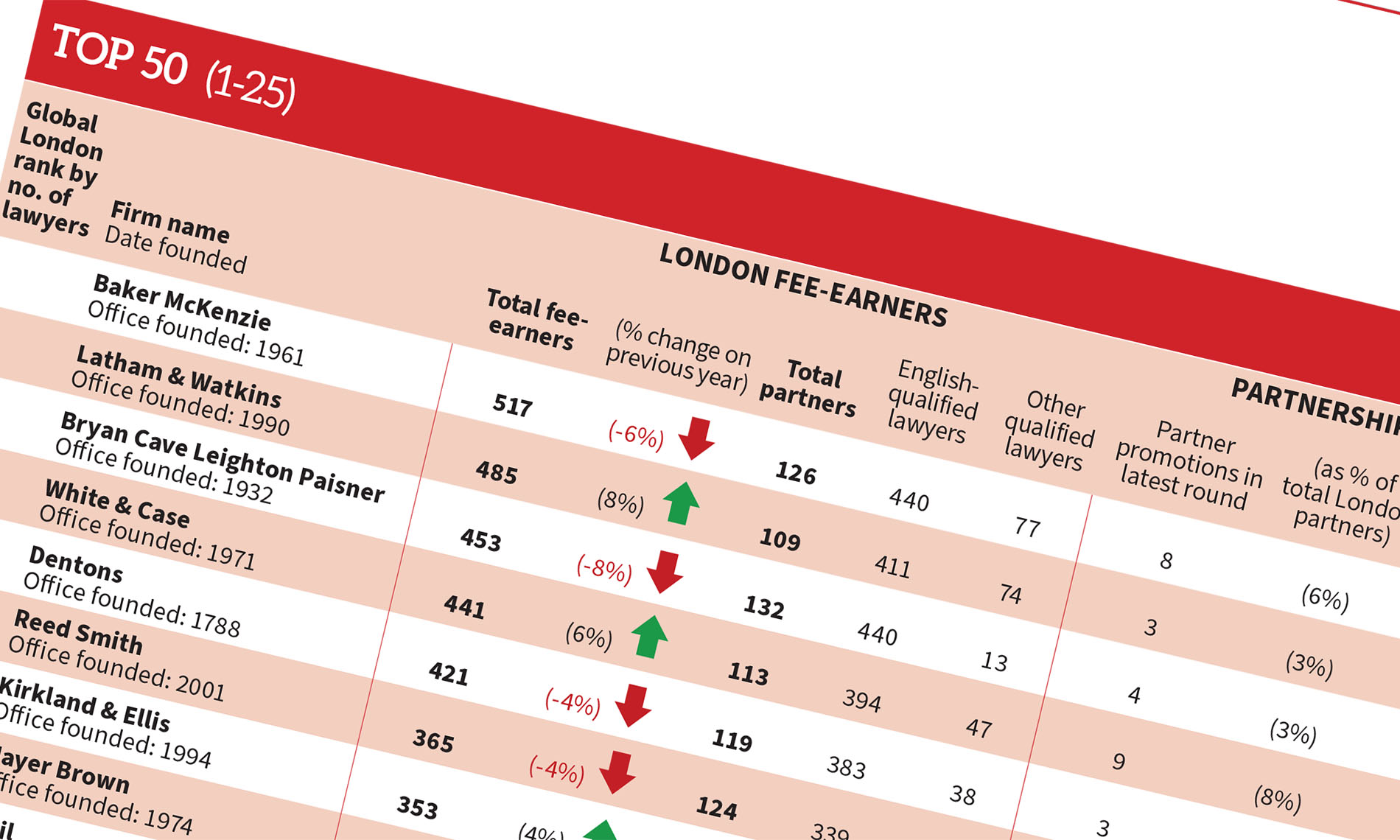
Bryan Cave Leighton Paisner (BCLP) promoted 20 lawyers as part of its latest global promotion round, the firm announced today (6 November), with London and St Louis again getting the majority of the spoils.

The figure is an increase of three on last year’s promotion push, though the City figure is one shy of last year’s five lawyers minted in London. Continue reading “London and St Louis receive lion’s share of investment as BCLP announces 20-strong global promotion round”

Revolving doors: Bumper round of lateral recruitment sees Gibson Dunn hire from Morgan Stanley as Deloitte acquires Kemp Little

Team leader moves, in-house hires and even boutique firm acquisitions have all taken place in the past week as recruitment at home and abroad picked up significantly.

The standout hire of the week was Gibson, Dunn & Crutcher recruiting Matthew Nunan, formerly a managing director and EMEA head of conduct risk at Morgan Stanley, to focus on complex contentious financial regulatory investigations and disputes in London. Prior to Morgan Stanley, he was the head of wholesale enforcement at the UK Financial Conduct Authority and previously served as a case controller at the Serious Fraud Office and as a prosecution lawyer for the Department of Trade and Industry. Continue reading “Revolving doors: Bumper round of lateral recruitment sees Gibson Dunn hire from Morgan Stanley as Deloitte acquires Kemp Little”

Guest post: Leadership in law in crises requires a human touch

General counsel and other senior in-house lawyers should not be afraid to show their human side when leading their teams through crises and seeking to deliver on business objectives, prominent figures in the legal market have agreed.

There was consensus on the issue among panellists participating in an online event jointly hosted by Legal Business and Pinsent Masons as part of the GC Powerlist UK 2020, as they reflected on the challenges they and their in-house teams have faced during the coronavirus crisis. Continue reading “Guest post: Leadership in law in crises requires a human touch”

‘Overwhelming support’: More of the same at Addleshaws as Joyce secures third term

John Joyce

Addleshaw Goddard managing partner John Joyce has reaffirmed his position at the helm of the firm following an uncontested leadership election, the firm announced today (2 November).

The deadlines for nominations closed on 30 October and Joyce has now been elected for a four-year term beginning on 1 May 2021. Joyce was first elected to the position in 2014 after a contested election against real estate head Adrian Collins. Continue reading “‘Overwhelming support’: More of the same at Addleshaws as Joyce secures third term”

Revolving Doors: City recruitment lull sees Wilson Sonsini and Ashurst make standout moves as Quinn hires in Paris

City of London

London saw few significant hires over the last week as the City recruitment market underwent a lull, with Ashurst and Wilson Sonsini Goodrich & Rosati  making the only strategic moves. Meanwhile, Quinn Emanuel Urquhart & Sullivan and Clyde & Co both looked to Paris to strengthen their benches.

Ashurst announced the hire of Markjan van Schaardenburgh from Linklaters to its City corporate practice. With considerable experience in European and Sub Sahara African private equity transactions, van Schaardenburgh represents a significant addition for the firm. Continue reading “Revolving Doors: City recruitment lull sees Wilson Sonsini and Ashurst make standout moves as Quinn hires in Paris”

Dealwatch: Magic Circle firms strike £3bn mining take-private as counsel game for $1.5bn Genius Sports deal

Briefcase

This week has seen a wealth of substantial transactions as advisers strive to capitalise on opportunities presented by the coronavirus business environment.

The most eye-catching have been the £3bn sale of Kazakhstan-based and London-listed copper company KAZ Minerals to Nova Resources and special purpose acquisition company (SPAC) dMY Technology Group Inc II on its agreement to merge with UK-based Genius Sports Group (GSG). Continue reading “Dealwatch: Magic Circle firms strike £3bn mining take-private as counsel game for $1.5bn Genius Sports deal”