Charlie Jacobs, senior partner, chairman and rainmaker of Linklaters has taken the road less travelled for outgoing law firm leaders, landing himself the role of co-head of investment banking at JP Morgan.
The audacious move will see Jacobs (pictured), who in January announced he was leaving the Magic Circle firm in October after 30 years, replace banking industry stalwart Ed Byers as he is promoted to the solely client-facing role of vice chair of UK investment banking. Jacobs will join existing co-chair David Lomer in the dual role. Continue reading “Diversity guaranteed in Linklaters senior partner race as Jacobs takes JP Morgan role”
Allen & Overy (A&O) has made a significant US leveraged finance play by hiring a partner from White & Case, as a host of firms added to their benches internationally.
White & Case has traversed the pandemic minefield to reveal its strongest City financial results yet, with the London office increasing revenue by 18% in 2020 to $397m from $337m in 2019.
For quite some time now the legal profession has acknowledged that more needs to be done to develop female talent, and there has been much discussion about women in the law. Having those conversations is a great start, but the practical piece is often missing. We wanted to develop a programme that would have a real impact on the lives and careers of female attorneys. What we have started with Finnegan FORWARD, and what we will continue to develop over the coming months, is a set of tools and resources that will help women advance their careers.
As science and engineering professionals, we are aware that women in STEM-related areas of law face a number of obstacles to career progression. Therefore, we were interested in finding ways to move the needle when it comes to our diversity and inclusion initiatives.
When we sat down to plan the Finnegan FORWARD initiatives, we wanted to make sure our female attorneys were given a clear path to partnership. The first step was to identify the practical barriers women face in the legal profession. One consistent challenge female attorneys face, both within their firms and when developing relationships with clients, is how to best market themselves. As a generalisation, women tend to downplay their experience. If a female attorney is not, for example, comfortable listing her relevant experiences or is not certain that her experiences are relevant to a particular matter, it can result in her being missed in a pool of candidates. It takes conscious effort to routinely think about everything you’ve done and been exposed to, but that is a helpful practice if you want to be more visible within a firm.
No one in this firm is ever going to overlook a qualified female attorney, but they may not see that there is a suitably qualified attorney available. We are encouraging women to put their hands up for a role on the team so that they are best positioned to get more opportunities within the firm.
Junior lawyers may sometimes assume that because they haven’t worked on a particular type of matter for 20 years they don’t have the necessary experience for a particular matter; and not every lawyer knows how to best present their experience and expertise in a particular area and how it may be beneficial to a team. Often, clients want lawyers who have approached problems from a variety of angles and who bring new and creative solutions to the table. At Finnegan FORWARD, we run programmes that help lawyers better understand how to interpret the experience they have and what qualifies as experience for a particular matter.
The other big issue we wanted to address is how female lawyers can improve their visibility with clients. Successful lawyers have inevitably developed a book of business – they have clients who have worked with them before and who trust them. These relationships of trust are foundational to a partner’s practice, and helping lawyers form those reputations is an important to their career development. We are working hard to make sure our more junior female attorneys have opportunities to network, or to spend time with mentors who can help them along that path. We are also helping female attorneys carve out a niche practice, whether by helping them publish and gain a reputation as subject matter experts, or by nominating them for awards that highlight their strengths and offer them the same exposure and recognition as our male attorneys receive.
The reason we are committed to this is to help women, but as with all D&I initiatives, the positive outcomes go far beyond that. Clients want to see diverse teams because they know those teams deliver better results. We have a large talent pool to draw on, which is great for our partners, and we are putting together more diverse, stronger teams.
As a firm, Finnegan tends to be very collaborative when it comes to business development. We also like to keep an open dialogue with our clients or potential clients about how we can do things better together. This is particularly true when it comes to D&I; GCs and legal teams have been on this journey far longer than law firms so we welcome their ideas and perspectives.
Private equity heavyweights gained major mandates as the bidding war for Signature Aviation took a riveting twist, while the US-driven special purpose acquisition companies (SPAC) craze looks set to take off outside the States.
The eight minute and forty-six second murder of George Floyd that we all witnessed in 2020 opened America’s eyes to acknowledge systemic racism. The aftermath reignited conversations around racism, discrimination, and implicit bias in the workplace. The legal profession has used this time as an opportunity to train staff and attorneys, reaffirm policies against workplace discrimination, and increase diversity initiatives. These acts are indeed necessary. But behind the cloak of formal policies remains the deep-rooted implicit bias and microaggressions directed toward black attorneys every day, especially when it comes to staffing cases and providing opportunities to take on lead roles in important matters.
There is no doubt that systemic racism and implicit bias exist in the legal profession. Several years ago, for example, a study conducted by the consulting firm, Nextions, provided empirical evidence of implicit bias against black attorneys. Two versions of a legal memo containing the same number of errors were circulated to law firm partners participating in the study. The only difference between the memos was that the participants were told that one was drafted by a white associate and the other a black associate. The exact same memo averaged a 4.1/5.0 rating for the white associate’s memo accompanied with encouraging comments such as “generally good writer but needs to work on …,” “has potential,” and “good analytical skills.” The black associate’s score? He averaged only a 3.2/5.0 rating accompanied by more negative feedback: “needs lots of work,” “can’t believe he went to NYU,” and “average at best.”
Aaron Gleaton Clay | Associate | Finnegan
Is this same implicit bias diminishing black attorneys’ role on cases? Opportunities to lead and try cases or argue motions before courts are critical for any attorney’s professional development and advancement. And while these opportunities are hard to come by for younger associates, in large part because senior and more experienced partners are slated, or because such decisions are largely driven by client demands, these opportunities seem even rarer for black attorneys, especially young, black associates. As a law clerk at both the federal district and appellate court levels, I witnessed how black attorneys were rarely given a speaking role in motions hearings, trials, or oral arguments. Some of this I attributed to the alarmingly low numbers of black attorneys in major U.S. law firms. Indeed, in 2020, the National Association for Law Placement (“NALP”) reported that only 5.1% of associates and only 2.1% of partners in U.S. law firms are black. These numbers were worse for black women who made up only 3.04% of associates and 0.8% of partners! But even with these low numbers, I wondered if there was more to the story. Why is it that black counsel has a “seat at the table” but not a lead, speaking role? Is it not important to provide these opportunities to black attorneys who not only need the experience but can add value to the case? Does the court or the jury take notice of this disparity? If so, what can we do to fix it?
To answer some of these questions, I interviewed the Honorable Gerald Bruce Lee, retired U.S. District Judge of the United States District Court for the Eastern District of Virginia, for his view from the court’s perspective. Over the course of his more than 25 years on the federal and state benches, as well as his prior experience as a trial lawyer, Judge Lee has encountered more than his fair share of attorneys and firms and has seen first-hand how younger, and arguably more knowledgeable, attorneys are “benched,” particularly black attorneys. In his view, “systemic racism is the answer; it remains a problem.”
We must “be very conscious of systemic racism that exists,” Judge Lee said, and “we have to end the ‘mirrortocracy.’” In other words, we must stop choosing to only work with someone who looks like us. Judge Lee suggests that firms and partners “pick a black associate that you want to work with and put that person to work. Give them the same coaching and mentorship that you would give someone that looks like you,” he said. Not just on one case either, he said, “work with them on 10 cases and see what happens.”
And “it’s not just for social justice reasons,” Judge Lee added. “We are creators, we are innovators, and we can think outside the box, and you need to give us a chance to do that and improve the quality of work that is being done and to create the results that are being attained.” Judge Lee said that judges “think young, black associates have ideas” because “young, black associates have had to improvise and have had to learn how to think creatively on their feet.” To him, “it seems that to have someone as gifted and talented as some of these young, black associates are, who have overcome many obstacles and have many good insights, and not to use them is like wasting resources that you’ve acquired.” He asked, “Why would you waste resources? Put your resources to work.”
Judge Lee “enjoys seeing young, black lawyers come into court who are doing more than carrying a briefcase” because he knows that “if the black attorney’s name is on the brief, then there has been some opportunity for the lawyer to communicate to the partner about the brief.” But many black lawyers are not being given a chance to argue cases, which contributes to a lack of preparedness and the professional development they need to become partners. Judge Lee is not alone in his eagerness, noting that “black and white judges want to see young, black associates at the podium, questioning witnesses, and arguing motions.” “It is time to get your black attorneys off the bench and in the field. What better time than now to acknowledge that you are going to fully use your black associates and partners?,” he asked.
Giving black attorneys more leading roles in the courtroom can also have a positive impact on the case. Judge Lee emphasized that “the days of all white judges and juries are over.” When asked what effect black attorneys have on the jury or the court, Judge Lee said, “the first thing it adds is talent and resources,” but he added that “it could also make a difference in how the jury reacts to the trial.” For example, he said, “if a jury sees a black lawyer sitting there and there are minorities in the jury and they only see that person pass paper, then they know that person is ‘window dressing.’” And from the court’s perspective, he said, having black attorneys in lead roles can also “make a difference in how I view the case from the standpoint of how it was managed and the case was being presented.”
I asked Judge Lee for any final advice for black attorneys looking for opportunities to improve and expand their skill set. He suggested that we continually seek out the work we want and “be persistent.” As a young lawyer, Judge Lee always told himself that the answer “no” was just “the beginning of the conversation, not the end of the conversation.” If partners or clients turn you down the first time, he said, use that as an opportunity to follow up again until they say “yes.” Eventually, he said, “they’ll get tired of you and give you the work.” Use that opportunity to thrive.
Quinn Emanuel Urquhart & Sullivan has reinforced its considerable disputes strength with a senior hire, as a host of firms focused on London for their partner recruitment.
Those familiar with Simpson Thacher & Bartlett’s modus operandi will barely know what’shit them this month as the usually conservative New York outfit launched a European restructuring practice and announced a Brussels office within a couple of days of each other.
The addition of a London restructuring practice to serve Europe is something of a coup coming as it does at a time when market commentators are predicting an uptick in distressed transactions on the back of the coronavirus downturn. Perhaps even more importantly, the move deprives Freshfields Bruckhaus Deringer of one of the most influential partners of its heavyweight restructuring team in the form of Adam Gallagher. A partner since 2007, Gallagher will be joined by James Watson, a partner at Kirkland & Ellis since 2017 and a fellow Freshfields alumnus. Continue reading “‘Watch this space’: Simpson Thacher belies cautious reputation with European restructuring and antitrust push”
Successful professional people are notoriously reluctant to take on the mantle of leadership. Increasingly, there are excellent reasons why they should, say Professor Laura Empson and David Morley
‘If you always do what you’ve always done, you’ll always get what you’ve always got.’
It’s a phrase that carries a useful message in the context of leadership – particularly in professional services. Because high-achieving professionals would, by and large, prefer to stick with what they’ve always done, very successfully. That is what makes them reluctant leaders. Continue reading “Guest comment: Calling all the reluctant leaders”
Gibson, Dunn & Crutcher has responded to the ever-increasing demand for environmental, social and governance (ESG) capabilities with the launch of a specialised practice fronted by a team of its lawyers out of the US and London.
The new offering – aimed at providing clients with holistic advice on corporate responsibility, risks and opportunities – will be led by London partners Susy Bullock and Selina Sagayam, Dallas senior of counsel Ronald Kirk, Los Angeles partner Perlette Jura, and Washington DC partners Elizabeth Ising and Michael Murphy. Continue reading “Gibson Dunn embraces zeitgeist with launch of transatlantic ESG practice”
By any measure, the events of 2020 have been a remarkable moment in US history: an election that showed political divisions are more entrenched than ever, the type of civil unrest that had not been seen for decades, and in the midst of it all a global pandemic that exposed the fragility and inequality of the economy and prompted the US government to send cheques to 80% of the population. But it was the growing strength of the #MeToo and #BlackLivesMatter movements that really caught the attention.
‘Twenty years from now, sociologists will write books on the factors that coalesced to make this the moment when we finally sat up and acted as a nation’, comments Laura Quatela, senior vice president and chief legal officer of Lenovo. ‘There is a renewed focus on making real and meaningful change, and the kind of momentum that has not been with [US society] since the 1960s.’
As questions over racial equity rise to the top of the corporate agenda, diversity and inclusion (D&I) more broadly is being transformed from a feel-good story to a core part of business strategy. At the same time, says Hannah Gordon, chief administrative officer and general counsel with the San Francisco 49ers, consumers are becoming more willing than ever to sanction businesses that do not meet their expectations of corporate conduct.
‘Of course, 2020 [was] a very difficult year for everyone, but one of the lasting positives is that it sparked awareness of diversity, equity and inclusion inside major corporations. Business is waking up to the fact that we live in a world where a strong commitment to equality and justice is expected, and where the right thing to do ethically is the right thing to do in a business sense. The growing power of consumers to hold business to account is one of the really exciting developments to have taken place over recent months.’
And when it comes to holding the legal market to account, general counsel find themselves in a unique position to shape one of the least diverse professions of all.
The diverse dollar
To put it bluntly, the statistics on diversity within the legal profession are not encouraging. Figures from the American Bar Association show the profession is still as white- and male-dominated as it was ten years ago. Women now represent just 37% of active attorneys in the US, a slight increase from 31% in 2010, while black, indigenous, and other people of colour (BIPOC) lawyers account for just 14% of all active attorneys. In the most underrepresented groups, the number of minority lawyers has actually fallen since 2010.
It has not gone unnoticed by GCs. ‘We still get pitches from all white, male teams’, says Lenovo’s Quatela. ‘We just scratch our heads and think, did anybody look at the roster before they came? I’ve had the same conversation with my colleagues at other big tech companies, and we just don’t understand it.’
This, everyone agrees, is a situation that needs to change. But consensus on how to change it has been harder to come by. In 2019, US Representative Emanuel Cleaver led an open letter seeking clarification on how some of the largest tech businesses in the US were applying diversity policies and practices when hiring outside counsel. This rare moment of public scrutiny for the legal profession was also a timely reminder that those who pay the bills have the power and responsibility to introduce change. And with US corporations spending an estimated $70bn on legal services each year, the potential for their general counsel to drive change is huge.
‘The traditional response among corporate counsel has always been to consider the lack of diversity within law firms as a problem for law firms to address’, says Rishi Varma, general counsel and corporate secretary at Hewlett Packard Enterprise. ‘However, there is a growing sense among GCs that they, as buyers, are just as responsible for the slow pace of change within the profession.’
Jim Chosy, senior executive vice president and general counsel with U.S. Bancorp, has a similar take. ‘In-house legal departments have big role to play in positively influencing diversity with outside counsel. Given our purchasing power, we’re able to drive change and I feel an obligation to do this with our law firms, which we consider an extension of our own in-house function.’
But, as Varma cautions, pushing law firms to hire diverse candidates is only half the battle. Ensuring those candidates are given meaningful roles is just as important. ‘The question of diversity at law firms is a lot more complicated than headline figures. A firm or team can have impressive numbers around diversity – impressive, at least, when compared to other law firms – but that in itself does not mean progress is being made. The analytics I want to see are how many hours those diverse lawyers contributed to a matter. It is also important to understand how origination credits operate at law firms, and how merit and reward is assigned more generally. We need to move the conversation away from a simple focus on diversity toward a more nuanced understanding of how lawyers move through the ranks in their firms, and we need to accept that blaming law firms for a lack of diversity is not the solution – the situation is far more complicated than that.’
Moving the Needle
If the legal industry is going to tackle its historic diversity and inclusion problem, says Lenovo’s Quatela, general counsel and law firms will have to work together. ‘GCs typically have lots of ideas on how to improve things, but they have tight budgets. Law firms also have lots of ideas, but they have profitability targets. The only way to make any of these ideas happen is by finding a place where ideation and economic interests meet.’
One of the more notable attempts to formalise collaboration between law firms and clients has come from the Move the Needle (MTN) fund, an initiative launched by legal D&I innovation incubator Diversity Lab which has since been backed with $5m of funding.
‘There has been both a huge uptick in interest, and an increasingly sophisticated interest in D&I in the legal industry’, says Leila Hock, Diversity Lab’s director of legal. ‘Ten years ago, a law firm or legal department might have thrown money to sponsor a table at an event. Now they recognise that window dressing is not enough. [D&I] is a real issue for the industry and structural and systemic changes that are required. That is a positive development. I finally feel like we are having the conversations with lawyers that many of us in the D&I space have been having among ourselves for years.’
The initiative has brough together law firms, general counsel, and community leaders to road test diversity initiatives and develop new approaches to overcoming underrepresentation which, says Hock, ‘will hopefully serve as models for lasting change.’
For many of MTN’s founding GCs, the biggest draw is its uniquely experimental nature which fosters innovation in a way that many firms or in-house departments cannot do alone, especially when it comes to financing. ‘One of the big pillars of what we are trying to achieve is the type of collaboration that hasn’t happened before in the legal industry’, says Rishi Varma, a founding member of MTN. ‘By talking and brainstorming as a group, GCs and law firms are finding non-traditional ways of brining diverse lawyers into the profession.’
While the initiative is still in its early days, fellow MTN member Laura Quatela is encouraged by the early results. ‘We are at the point of whittling down the ideas to some initiatives that we as a group want to line up behind. One of the things we’ve talked about doing is a combined law firm and in-house summer programme, where interns or clerks have the opportunity to experience both worlds early in their training so they can start to make the important decisions about where they really want to end up. Other ideas are more experimental. For example, we have been thinking about how legal teams can hire a firm’s top diverse candidates for a set period of time to help them get a solid grasp of how a business operates and what it wants to see from its lawyers. That’s what MTN is all about. It’s a laboratory for experimentation that gives lawyers committed to D&I the chance to do something new.’
For law firms and businesses alike, coming up with new ideas to improve diversity and inclusion is likely to become one of the biggest challenges of the years ahead. ‘What we absolutely don’t want to do is waste the momentum for social change that exists right now’, says Hock. ‘In response to the reawakened racial justice movement we are tracking the public statements made by the large law firms and Fortune 100 companies have made. We are going to track them and check back to see if they’re doing what they said they would do. And we are not the only ones doing this. We need to make sure that companies don’t just put out a statement or put a pride flag on their logo – they need to take action.’
Finnegan – The Legal 500 View
Ask Finnegan, Henderson, Farabow, Garrett & Dunner, LLP’s clients and you’ll hear praises of its professionalism, its technical expertise, and its ethics and integrity. And if you look to The Legal 500 you’ll find that Finnegan has been the strongest performer in its class for over a decade of coverage. This piece is a quick look at a firm that has been one of the most high-quality legal outfits in its field. It’s not one of Manhattan’s white-shoe firms, and it’s certainly no jack of all trades. Finnegan brings a level of expertise and dedication expected of a specialist boutique, but with well over over 300 IP professionals firm-wide, Finnegan is unique. A mega-boutique that is one of the most dominant players in the IP market, Finnegan, Henderson, Farabow, Garrett & Dunner, LLP is among the most consistently excellent firms in any one field of practice.
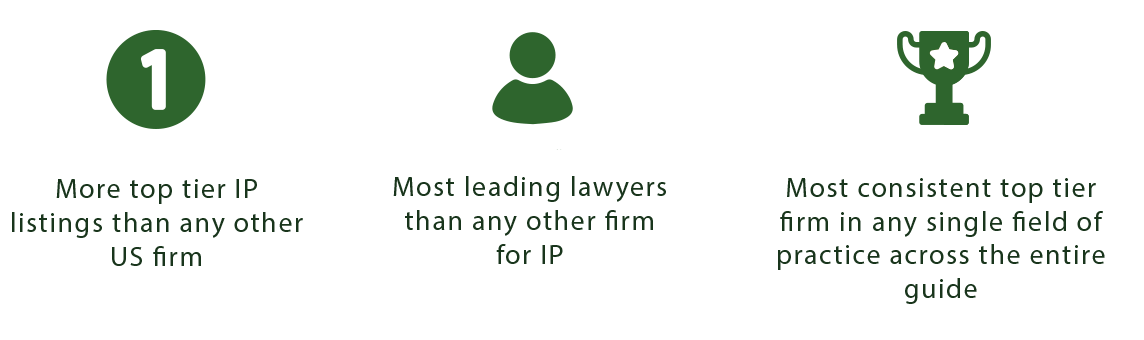
To illustrate the point, let’s look at a few statistics. With six tier 1 rankings in the US 2020 guide, Finnegan earned more top-tier IP listings than any other US firm. Finnegan’s rankings in those six tables tell us at least three important points about the firm. First, Finnegan has shown itself to be the market’s most complete firm when it comes to registered marks. The firm is ranked among the market leaders in each of the US guide’s four patents tables, as well as in both of the trademarks tables. What’s more, these rankings indicate another kind of breadth of service that is unparalleled in the US IP market. There are some firms that are known far and wide as fierce IP litigators. Other firms—often those with wider strengths in corporate and tech sector-work—have gained a reputation for high-value licensing deals and IP-heavy transactions. Finnegan, however, is the only firm with such compelling highlights in all areas of IP litigation, IP transactions, prosecution, and IP management, both for trademarks and patents.
There’s no question that Finnegan was an impressive performer in the 2020 guide, but the most impressive stat is this: Finnegan has been leading in every one of these six categories for the past five years. In fact, with the exceptions of two small blips (one in 2009 and another in 2015), Finnegan has been a tier 1 performer in every patents and trademarks ranking since the inception of the US guide. To be clear, even those two “blips” amount to dropping to tier 2 in two categories for one year each. Certainly, it’s been a long time at the tops of the tables.
Finnegan is unique in the IP market. But from a rankings perspective, Finnegan is actually the most consistent top-tier firm in any single field of practice across the entire US guide. For each of the past five years, Finnegan has scored six tier 1 rankings in the field of IP. Look to the rankings data for the areas of Finance, Dispute Resolution, M&A/corporate; there is no other firm in any single practice area that has recorded as many top-tier rankings in as many year as Finnegan. From a Legal 500 rankings perspective, and judging firms by a single core expertise, Finnegan is arguably the very best firm in the US market.
Our primary focus at The Legal 500 has always been ranking teams as a whole; but we do of course also put a lot of effort into recognizing the individual lawyers who really stand out. Some Finnegan veterans like Reston-based patent litigator Charles Lipsey have featured on the Leading Lawyers list for about a decade. Among the bearers of the firm’s legacy, Lipsey was first ranked just a couple of years after the US guide was founded, but has been with Finnegan since 1978. Lipsey stands out in particular as being one of the guide’s Hall of Fame Lawyers: a ranking that recognizes an individual’s long-standing and continued position as a leader in their legal field. At the other end of the spectrum, The Legal 500 ranking data also confirms Finnegan’s ability to attract and develop younger talent.
For many years The Legal 500 had identified the best-known and most experienced lawyers in each field of practice. Then in 2017, the US guide introduced a ranking category called Next Generation Partners, designed to shine light on future stars; market leaders of a new generation. In the year that ranking was introduced, Finnegan scored an impressive five Next Generation rankings. No other firm notched more Next Generation Partners in the IP section. Perhaps even more impressive is that of those five lawyers, three went on to become Leading Individuals at the firm. Two years after the establishment of the Next Generation Partners list, The Legal 500 introduced a category called Rising Stars, which aims to highlight promising associates in the market. Again, in its very first year of consideration, Finnegan recorded a name on the Rising Stars list. It might come as no surprise that in sheer numbers, Finnegan has more Leading Lawyers (e.g. Leading Individuals, Next Generation Partners, and Rising Stars) than any other firm in the IP rankings.
Across several points of comparison, Finnegan has been one of the strongest firms in The Legal 500 US over the last decade. The focus here has been on the firm’s top-tier rankings, but it’s also worth noting that Finnegan is featured in The Legal 500 US’ Trade Secrets category, and has also been highlighted in the Copyrights section. Finnegan is perhaps the most complete IP firm in the US, and with a strong roster of Leading Individuals—from stalwart Hall of Famers to Rising Star associates—the firm seems set to maintain its place at the top for years to come.
Pinsent Masons and Addleshaw Goddard have made significant office openings in Europe, while a host of other firms have expanded their benches worldwide this past week.
Freshfields Bruckhaus Deringer has sought to draw a line under an uncomfortable chapter for the firm with a €10m payment to German authorities in connection with the cum-ex tax controversy.
Everything we do at Nestlé is rooted in our core values of respect: respect for people, respect for the planet, and respect for diversity and difference of thought. Nestlé has one of the most diverse consumer bases of any company, with activities in nearly 200 countries globally. There is no way to understand that consumer base if we do not embrace diversity in our operations, looking at things from different perspectives to get the best outcome possible.
When I joined the executive board in 2019 I was conscious of how seriously the company takes its commitments to D&I and was excited to propel the D&I programme forwards. While I see my role more as a supporting force to the broader company initiatives, there is still a lot that a GC can do to help drive change.
It starts with being purposeful with your own team, asking: Is it diverse enough? Are we building the right culture? Are we benefiting from diverse thought and approaches? How do we know? Are we actively identifying areas where we might be short? If so, how can we fill those, whether through external hiring or searching harder within the organisation?
The freedom to speak up
To get the best out of your people, you need to create an environment where they feel free to speak up. This underpins more than diversity and inclusion. Business methodologies from Lean to Six Sigma teach us that when teams are empowered to speak up, they improve performance; likewise, the ability, freedom and trust to speak up can enable strong safety and compliance cultures. A culture that supports D&I also supports innovation and idea generation and. allows you to examine a problem or opportunity from multiple perspectives and ultimately find the most robust answer.
Leanne Geale | Nestlé
For a legal function, having the freedom to speak up is doubly important. An environment where people feel comfortable to express what they feel is ethical or the right thing to do enables my team to act as a guardian of our core values more effectively. Targets and metrics are important ways to measure progress, but they are not the end goal. Creating a welcoming and open culture should be the first concern of any GC.
I am also a big believer in creating a working environment where everyone can bring their full self to work and perform at their best. Ultimately, strong performance and inclusive, collaborative behaviours are the most valued and valuable to a complex multinational organization.
Not-so-hidden talent
For female lawyers, the advice I commonly give is to just be yourself. Don’t try to fit in a mould. Build on your strengths and use those strengths to create a more inclusive environment. Christie Smith, the former vice president of inclusion and diversity at Apple once said the most important thing you can do to promote diversity is to say hello. That is a very powerful idea. That one simple gesture creates an environment that is more inclusive in an instant.
Even if you are not in a leadership position you can be a leader in everyday circumstances. For example, if you notice there are people who haven’t had a chance to speak, you can create space for them and encourage them to give their views. That way we can all be leaders in creating an inclusive environment.
Beyond that, I am proud to support Nestlé’s goal of having at least 30% women among its top 200 managers by 2022. That is an ambitious goal, but our approach has been to say, “We have almost 300,000 employees globally; with more women at the top, we reinforce our inclusive culture, make Nestlé an even better company and contribute to shaping an equal society. All of this helps drive our business performance.”
When the UK introduced a similar target for female representation on UK company boards, it was a success. I remember one board chair commenting that it’s amazing how many qualified candidates you can find once you look. That is often the case: the talent is there, you just need to change how you are looking for it.
To succeed
The biggest step you can make as in-house counsel is to get out from behind your desk – even if it’s a virtual tour. You need to visit operations, understand the business rationale, and see how things work on the ground. Whether you’re at a mine, at a retail gas station, or in a supermarket. That gives you a more holistic perspective and allows you to contribute more meaningfully, not only in a legal sense but in a broader commercial sense.
On an interpersonal level, it’s about asking yourself the right questions continuously: how you can help someone, how you can create space where people feel free to share their experiences and collaborate, or how you can share your knowledge and experience and open doors for people to progress their careers.
I have always been a strong believer in the value of engaging with communities directly. During my time as president of the Hispanic National Bar Association (HNBA) I made community engagement my mission. HNBA representatives would go into schools in primarily black and brown communities wearing these t-shirts that had “This is what a lawyer looks like” printed on them and the kids would say, “Wait, you’re a lawyer?”. It was awesome to see that we could change their perceptions of what a lawyer looks like and make them realise they can do this job.
When I think back to my own experience of education and entry into law, I can see how useful that sort of awareness would have been. I am always very open about my experiences because I want people who find themselves in a similar situation to know these experiences are not incompatible with a successful career. I went to law school with a baby and graduated top of my class!
I was raised in a predominately Latino community where young women were not necessarily encouraged to pursue an education. I was the first person in my family to graduate high school. I married young and had my first baby when I was in college. I didn’t have any guidance on which college to apply to or any of the important questions students should take for granted: What do you want to pursue? Is this the right school? Is this the best school? Frankly, I based where I was going to study on its proximity to my boyfriend.
At college, and especially at law school, it was very, very lonely. I didn’t feel like I belonged. If you are from a background where higher education is not the norm you carry a kind of imposter syndrome around with you. Even now, after a successful 20-year career that sense of being an outsider occasionally lurks back in. Every so often I will hear a comment and think, “oh my gosh, maybe this was all just a lucky streak”. Rationally, I know that is not true, but it is something I know a lot of minorities have to deal with in the workplace, and it was certainly something I had to deal with in my early career. I was surrounded by people who did not look or sound like me, and who very likely did not have the same experiences as me.
I was a Hispanic woman, married with a kid; I just didn’t fit the mould of a successful lawyer. At law school, I was counselled by the career service team not to mention that I had a child when applying for jobs. I had to pretend to be someone I was not, and went through the first few years of my practice as a lawyer almost as two separate people living parallel lives. But I’m not someone who ever backs down. I used negative comments and prejudices to fuel me. Besides, as a young mother there was more at stake than just myself. The ability to fail was not n option.
More than a ‘diversity hire’
Majority communities can have a hard time understanding the sense of isolation or otherness that comes with being a minority in the workplace. Any complaints are seen as an attack on affirmative action programmes and minority-inclusive hiring practices. This is missing the point. As diverse candidate you naturally approach an interview thinking, “Am I here as a potential diversity hire? Does the company want me because of all the things I’ve done, or does it want me because I am a woman, and especially a woman of colour?” This is not a case of being paranoid, ot is just reporting the facts. As any minority will know, people actually do say these things.
A few years ago, I was at a dinner with a law firm and we got to talking about a particular judge who was African American. One of the partners dismissed this judge’s experience on the grounds that he was, “an affirmative action hire”. He was discussing a federal judge who went to a phenomenal school, yet felt comfortable using that language.
A couple of years later we had a partnership retreat that included a D&I component. When it came to questions from the audience, I stood up and told this story. The lawyer who had made those comments was in the audience and knew exactly what I was talking about. I wasn’t going to publicly name and shame him, but it was my way of demonstrating the point that someone will sit through a discussion of D&I without being aware of this hypocrisy, or of how outrageous and damaging these beliefs are. This sort of prejudice in the legal profession is far more widespread that is commonly acknowledged.
Leading by example
If you want to judge whether a company is truly diverse, look at the makeup of its wider management. Don’t just look at the diversity and inclusion committee, which is where you tend to find diverse people – look at who the decision-makers are and whether they are diverse. Then ask, what does that company consider a diverse team looks like? Is it just having a woman on the board, or is it a real mix of people who have got there because the company is prepared to promote talent wherever it sees it?
In that sense, it is incredibly refreshing to work at a global company like Lenovo, where I deal with a diverse set of people from all over the world. We have a CEO who is compassionate and passionate about all issues that concern underrepresented or disadvantaged people. At the start of the pandemic, he put his own personal money and effort into sending laptops to poor communities throughout China, with a personal letter from him to the recipients.
When Black Lives Matter took off, we held some really honest townhall meetings to discuss how staff felt about the movement and what more could be done to improve the workplace. We held roundtable discussions where people were free to ask bold questions about how we were going to deal with the issues BLM raised, or to make sure that all our people felt included. Not only that, but the company matches our financial contributions to social causes one to five, which made a big difference.
That commitment to D&I bleeds through everything at Lenovo. I don’t feel like my gender or my ethnicity has any bearing on how people approach me as a lawyer. Corporations are doing so much better with diversity and inclusion than law firms in the US. Law firms could really learn a lot from their clients.
The 0.2%
Of course, counsel we can say that law firms need to change until they’re blue in the face. Let’s focus on actions rather than words. In a role where you are looking at candidates, dealing with vendors, or spending money, you have the power to effect the kind of change you are preaching. Leaders in any senior-level executive position have the power to move the dial, and there is a duty to be very intentional when it comes to diversity.
I am proud to say that my entire team is diverse. I require all my outside counsel to have a diverse team. We request biannual reports giving the various demographics within the team, and more importantly we check what role each lawyer will play on a particular piece of work. Diverse talent needs to have an actual, critical, material role in the work, it can’t just be somebody who is there for optics.
One thing that I absolutely know for sure is that until we can give equal access to underrepresented communities, and particularly to black and brown communities, we are going to find ourselves dealing with these issues in the law continuously.
The legal profession remains of the least diverse professions in the US. Just 5% of lawyers are of Hispanic heritage, even though such people make up about 18% of the population. In the IP space it is even worse. Latinas make up less than 0.2% of IP lawyers. Just think about that number for a second. A community makes up about 18% of the US population accounts for less than 0.2% of IP lawyers. That level of disparity is not something that will change without intentional efforts on the part of GCs and senior counsel.
Of course, we need to think about what constitutes “diversity”, that diversity programmes are truly inclusive and not alienating any group. I have thought about this many times. Should we make diversity an economic issue, for example? Communities of colour are disproportionately poorer, but many other groups face socio-economic exclusion. The reality is this: white privilege is still white privilege. We need to address the disadvantages inherent to being a person of colour in the United States before we can look at bigger issues.
It is also a problem we can solve. Black and brown communities are abysmally underrepresented in the legal profession. As GCs we may not be able to change everything, but we can change that.
For GCs, the very first question you need to ask yourself is how much of a diverse and inclusive mindset you have as a leader. Only then can you successfully analyse how diverse and inclusive your current team is, both with respect to hard numbers but also in terms of its culture.
Luckily, I work for a company that is perhaps one of the most diverse in the world. This helps tremendously when looking at the composition of teams, but most importantly at the culture of the organization.
Diversity and Inclusion brings more value than most people think. Companies with successful D&I cultures grow faster, stronger and more sustainably. D&I attracts the best talent, it provides a much stronger management base that takes into account a more robust view of business, society, customers and consumers, and it allows you to contribute to positive change in society. At the end of the day, we are here to leave a better place for the next generation. Embracing diversity and being inclusive will certainly contribute to that.
Luis-Xavier Hernández | Unilever
Deploying D&I policies on a global scale is one of the biggest challenges for any type of global corporation, particularly one with a footprint like Unilever’s. We have to understand that a diversity and inclusion agenda means respecting different cultures in different parts of the world. It is hard to come up with a rigid approach to certain metrics that may have varying degrees of relevancy in different parts of the world. You have to really understand and cater for that, because the main reason for having a diversity and inclusion agenda is to make sure that every individual in the company has the exact same opportunity to succeed as anyone else. To do that, you need to cater for realities and cultures in different places.
From my perspective, values rest on universal principles that should apply everywhere, like treating everyone in the organization with respect, providing equal opportunities no matter the gender, race, age, religion, sexual orientation or any personal beliefs. Living and breathing these values makes us richer, stronger, and more united in every corner of our organization.
While it could be challenging to drive consistent metrics across regions with their own cultural characteristics and idiosyncrasies, I think the best way to reconcile that tension is to ensure that values are never compromised, no matter the circumstances. That to me is a must and reflects the culture of your organization.
Better business in the digital sphere
As head of Unilever’s legal team overseeing data privacy and digital, I frequently find myself balancing the value of certain data related propositions with the complexity and cost required to execute them in a legally compliant manner. It always comes down to finding that reasonable balance. What I have found helpful is to start our assessments by asking the question ‘what is the purpose of collecting personal data, in this case related to diversity and inclusion?’ This data point will lead to other relevant questions about proportionality and transparency but understanding the purpose works an effective gate and it’s definitely a strong start.
Most large organization have stats and metrics to measure their diversity and inclusion efforts, but few people realize how complicated and sensitive it is to process such information. When it comes to diversity and inclusion, most personal data is considered sensitive personal information, and for a good reason. The potential harm to the individual is heightened compared to other types of personal data, and as such organizations need to think very carefully about how such data is collected, used, and protected. The stakes are high.
From a data privacy perspective, the rules governing what sort of data organizations are permitted to hold will only get tighter. The entire ecosystem, from individuals to regulators and lawmakers, is taking more interest in use and misuse of personal data. That means we need to be ahead of the game and think through how and why we collect information. But there is an even more important question to be considered. The question of ethics.
Transitioning from what is legally required to what is ethically expected is a challenging but powerful journey that I think all players in this space should consider. It’s not only the right thing to do but also what most stakeholders would expect in these times. .
Ultimately, we want to be compliant with data protection laws while helping advance our D&I agenda, do the right thing for our employees, for the company, and for the whole ecosystem of partners, suppliers, customers, and consumers. I want to make sure that any information we collect is strictly necessary to achieve the ultimate purpose of advancing our D&I agenda and do something that is aligned with our corporate values and high ethical standards, while protecting individual privacy rights.
I think data and digital professionals will continue to face the challenge of finding the right balance between supporting legitimate business initiatives and remaining in compliance with the spectrum of regulations on a country-by-country basis – including sometimes outdated regulations.
Unilever is one of the leaders in the brand safety movement, which concerns itself with ensuring that our brands are presented to consumers in safe environments and of course a key part of this effort is holding media outlets and agencies accountable for that. It’s not as simple as it sounds though, mainly because the digital space is formed of so many different players that it has become a complex, non-linear ecosystem. However, I believe that all players but in particular the most influential ones have a degree of social responsibility to improve the digital ecosystem in the interest of millions of viewers who consume media and as a consequence advertising.
I have the privilege to serve as a board member of the Better Business Bureau National Programs Inc, a globally recognized organization that fosters consumer trust in advertising which is the reference point in the United States with regards to self-regulation and many other globally relevant programs. The BBB National Programs is a great example of an organization that really has the consumer interests at its heart. It truly stands for transparency and fairness in advertising. As such there is very much similarity in values between Unilever and the BBB National Programs and that’s why I accepted the board role without hesitation.
It has been a great experience being part of BBB NP’s board, it has given me an invaluable platform from which I can contribute my experience and passion for certain topics and perhaps shape in some way or form the strategic agenda of the organization. It has also given me an external perspective of the market place, consumers, and companies in many different industries. As GC, I have learned that having an external perspective of the world and the industry where your company operates is an invaluable enabler of a diverse vision. It also energizes me to continue to drive positive change.
I was born in Israel and my family moved to the United States when I was seven. I still have vivid memories of running in and out of bomb shelters during the 1973 Yom Kippur War. My father was drafted into the Israeli army and we didn’t see him for several months. My mom was pregnant with my brother and we moved in with my grandparents. Luckily, my dad survived the war and came home to us. My childhood was non-traditional in this way, and a few others, but in most other respects, it was a very happy one.
We came to the U.S. because my dad had the quintessential American dream. He used to draw outlines of America in the sand when we went to the beach in Israel and he was passionate in his belief that moving here would give him and his family a better chance at success.
We ended up in Skokie, Illinois, where I got my first taste of snow in the form of the blizzard of ’76. I didn’t know any English but picked it up and was fluent within a year. Though so many things were new and I often felt different in this new culture I was experiencing for the first time, I recall making friends and feeling accepted.
Anat Hakim | Eli Lilly
My parents worked their way up from the bottom. At first, we would spend many Saturdays picking through people’s garbage, for toys, furniture, whatever we could find that might be useful. For me, as a kid, it was fun and we often did it with one or two other families. I remember one time finding a game that someone had thrown out called “Don’t Spill the Beans,” which, to this day, I remember as one of my best Saturday finds! We moved on from that life, when getting 50 cents to buy a treat from the neighbourhood ice cream truck was the highlight of my week, to a life that was ultimately more middle- to upper-middle-class, all through my parents’ sheer determination and hard work. That experience really set the stage for my own philosophy and approach to life.
Hard work and great mentors
When it comes to diversity and inclusion, one of the things that stands out in my mind is my parents. I was the only girl in the family, the oldest, with two younger brothers. My parents raised me to dream big and without any limitations or barriers. It was all wrapped up in the American dream: you’re here, you’ve got these talents, go for it. It never occurred to me that gender would or could be a barrier, so I had a lot of ambition and big aspirations.
While that is a great philosophy to instil in a young person, it does not mean there are no barriers. In my 27 years as a lawyer I don’t recall experiencing overt discrimination, but I always felt the need to be the hardest worker in the room to stand out.
Hard work alone isn’t enough, though, and I’ve also been really fortunate to find wonderful mentors—people like Arne Sorenson, now CEO of Marriott, and Sharon Barner, who is now general counsel of Cummins Inc. Sharon is one of those exceptional mentors who always supported and mentored women, and still does to this day. She was intentional about it; that, I learned, was key.
They and others at every firm and company where I’ve worked pushed me or pulled me along. And I know they helped me overcome bias of which I wasn’t always aware. Fast-forward to today, when, as a leader, I recognize the need to be intentional about helping and supporting others in their career journeys.
When you’re facing unconscious or conscious bias, hard work alone is not enough; you need people who are there advocating for you, helping you navigate. Leaders must make sure to be intentionally mindful of helping, supporting and recognising what the various people in your community and in your department need. I hope I can play the role for them that my mentors played for me—whether the people I’m advocating for are aware of my support or not.
Lessons in leadership
I like to read leadership and management books for fun; the subject has always fascinated me. Even so, I didn’t realize the true meaning of leadership until I went in-house. When I joined Abbott Laboratories in 2010, I was responsible for leading the patent litigation group globally. That was the first time I had a global team and really learned how to guide and empower others in their work. For me, a lot of what I did was (and still is) guided by instinct, but I also learned to develop and question my instincts by studying, listening to others, and watching what other leaders do well.
The most valuable skill of leadership that I learned is empathy. You don’t need power to be a leader. What marks you out as a strong leader is getting the right people in place who you trust and then handing power to them. That’s when you get incredible results.
We have an incredibly diverse legal department at Lilly, and that type of empowering leadership tends to bring out the best in a diverse team. We encourage each person to bring their own experiences and skills to the table.
All the organizations where I’ve worked in-house, from Abbott to WellCare and now Lilly, have had strong representation among women and minority groups. It is something to be celebrated and it’s a continuous journey to progress on this front.
Even so, I have been struck by the exceptional and intentional commitment to diversity at Lilly, and the level of determination and focus starting at the very top of the organization. It even struck me during my interviews for this job that people talked about bringing your whole self to work. That is something I have continued to strive for in the legal team.
Psychological safety
One of the first things I ask myself when I go to work somewhere is, ‘Is there a sense of psychological safety in this group?’ I am a big believer in creating a feeling of psychological safety within my teams. When you do that, people can be themselves—not only who they are now but who they’re becoming. They can disagree openly, and that leads to sharing. To me, psychological safety is reflected in a team that can openly disagree. That helps foster an environment where inclusion is a natural by-product because different viewpoints, experiences, and approaches are openly expressed. There is diversity of people’s experiences, people’s thoughts—and an atmosphere where everyone feels they can speak up. That’s how you get the best ideas and, ultimately, the best decisions.
When I reflect on what diversity brings to the table, I realize it’s about fostering a sense of inclusion. If you’re mindful of the fact that there is discrimination, that there is bias, and you’ve had to overcome it, you understand that you need to take concrete steps to build an inclusive culture, one that welcomes and supports differences. The result is a more creative, supportive and fun place to work.
Turning empathy into action
It’s been shown that companies with gender-diverse leadership deliver, on average, better financial performance than those with low numbers of women in senior positions. Lilly has been successful in boosting the number of women in leadership roles. Nearly half of our CEO’s leadership team is female. Globally, women account for 50% of those in management roles globally, and our U.S. workforce is 29% minority group members.
Much of this progress stems from 2015, when Lilly began undertaking Employee Journeys—deep research into the lived experience of populations of Lilly employees. It involves a level of honesty and transparency you don’t often see in a major corporation.
We started with the Women’s Journey and have since used that experience and success to understand enablers and barriers for African Americans, Asians, Latinos and most recently LGBTQ employees. We’ve turned this understanding and empathy into action, so the organization can address unconscious biases to enable more career development opportunities for everyone. We have learned so much. We are just finishing up the fifth journey, for lesbian, gay, bisexual, transgender and queer employees. This work has made a tremendous difference in our culture.
The Journeys represent a key element of Lilly’s approach to diversity and inclusion: We treat it as a business challenge. Of course, D&I is about fairness, justice and so much more, but we don’t treat it as a “special case.”. We treat it as a business challenge that is as important as any other challenge the business may face. And we’re transparent with our enterprise data.
How would you go about addressing a business challenge? You would be self-reflective, you would go out and benchmark, you would collect information, you would bring in the right stakeholders, you would invest in it. Those are all things we have done to improve D&I at Lilly. We are fortunate that our top leaders are consistently setting and stating publicly their expectations that we are going to have an inclusive culture, that we are going to hold leaders accountable, and that we will build inclusive and diverse teams.
In the legal department, we do a few other things that are unique to our team. We have partnered with Indianapolis area high school programs to strengthen diversity in the pipeline by exposing diverse students to the legal profession, and right now we’re looking at doing Lilly internships for law students. We also have some mentoring programmes for law firms and colleges, which helps us to empower earlier stage lawyers and law students and provide exposure to the opportunities that are available to them. We have also been holding fireside chats within the legal department, which give people on the team an opportunity to openly share their views on our culture and what aspects of it we can improve. We participate in pro bono activities and have also put our money where our mouth is, especially on the racial justice front. Lilly has committed over 25,000 employee volunteer hours and multiple internal initiatives over the next five years, and the Lilly Foundation has committed $25 million of community investment over the same time period. When we hire, we are mindful and intentional about considering a diverse pool of candidates – and ensuring a diverse panel of interviewers.
As General Counsel, I have a lot to live up to in meeting the D&I expectations of our leadership, but it is a thrilling challenge to take on. Diverse candidates bring strength to a team and people who have overcome adversity often make exceptionally strong leaders.
Legal Business’ recent analysis of Ireland’s legal market warned against underestimating the resilience of the Irish, so Mason Hayes & Curran’s less-than-catastrophic 6% dip in turnover for a financial year defined by Covid-19 should come as little surprise.
Revenues at the full-service Irish firm fell to €80m as it acknowledged a substantial hit to both transactional and contentious workflows. In a statement, managing partner Declan Black (pictured) chalked up the fall in disputes work to ‘significantly reduced court hearings’. Overall however, he was ‘satisfied’ with the results and noted ‘professional services were comparatively insulated from the worst effects of the pandemic.’ Continue reading “Reality bites as Mason Hayes posts 6% revenue drop in bellwether for Irish firms”
Maintaining the international flavour of recent lateral hiring activity, Clifford Chance, Kirkland & Ellis, RPC and Reed Smith have all announced hires overseas this past week.
In Asia, G100 heavyweight Kirkland has strengthened its Hong Kong capital markets practice with the hire of partner Mengyu Lu, who arrives from Sidley Austin. Lu’s expertise lies in advising on IPOs, M&A and post-listing compliance matters. David Zhang, a partner in Kirkland’s Asia corporate group, described Lu as a ‘rising star’. He added: ‘We are confident that she will bolster our market-leading capital markets practice in Asia.’ Continue reading “Revolving Doors: International hires continue as firms increase Asia focus”