Sponsored briefing: Privatisations in Cabo Verde and Angola – the new El Dorado?

Both Angola and Cabo Verde have recently announced important privatisation programmes involving companies active in key sectors in the two countries’ economies.

In Angola, the programme involves 195 companies and assets and was originally planned to be concluded in 2022. Several tenders have already been launched or implemented and 14 companies/assets have already been privatised. The goal was to privatise 51 companies by the end of 2020 but because of Covid-19 the process was suspended. However, the process is now resuming slowly. Consequently, there will be investment opportunities from now on. Continue reading “Sponsored briefing: Privatisations in Cabo Verde and Angola – the new El Dorado?”

‘Living at work’ – the lessons for law firms from a year at home

‘It’s been challenging for everyone. Whether you’re living alone, or with children who need homeschooling, with teenagers who need emotional support or you’re caring for elderly parents – no-one has been unaffected,’ says Slaughter and May real estate head Jane Edwarde on the impact the last year has had on the profession. ‘A year is a very long time for any human being.’

Like many aspects of all of our lives, the way law firms operate has been turned on its head over the last 12 turbulent months. Gone (for the time being at least) is any stigma that working from home is less productive than long hours in a busy office, but gone too are the career benefits of spontaneous social interaction with clients and colleagues, and any semblance of a divide between work and home life. Continue reading “‘Living at work’ – the lessons for law firms from a year at home”

Switzerland focus: Still standing

Switzerland is often singled out as the prime model for a stable economy – apart from a temporary blip in 2009 following the global economic crisis, GDP growth has moved consistently upwards. The country’s strong employment figures and national debt position have only underlined its positive reputation even more. But when Covid-19 hit, not even Switzerland could roll with all the punches it had to take, and continue growing.

That said, at the end of 2020 the economic activity was only 2% below its pre-crisis level – a strong bounceback, especially compared to other European countries. While Switzerland remains locked down for the first quarter of 2021, the prognosis for the year ahead looks promising. Continue reading “Switzerland focus: Still standing”

Hope floats for City listing overhaul but American audacity is vital

starry sky over the City

City business has had cause to take heart in recent months with a clear display of political will behind an overhaul of UK listing rules that could see London shake off its Brexit and pandemic woes and reassert itself as a global financial hub. Our Global London report finds US and European firms alike concerned about the status of their London offices now that Brexit is a hard reality.

Proposals set out in the UK Listing Review in March, led by Lord Hill, will particularly pique the interest of anyone tracking the special purpose acquisition company (SPAC) market. Indeed, the ubiquity of those deals has made them difficult to miss. There has been much talk of London jumping on the bandwagon in a fit of FOMO as other listing destinations, especially the US and Amsterdam, pile into that frothy market with gusto. However, to say that London has been lagging competitors in the US, Europe and Asia for too long is an understatement, and any shake-up to expedite parity with peers has not come a moment too soon. Continue reading “Hope floats for City listing overhaul but American audacity is vital”

The work from home dilemma – get creative

If 2020 was about surviving coronavirus and lockdown, 2021 is most certainly about rebuilding and making up for lost time. With the Covid-19 vaccine rollout progressing well, and pubs and shops reopening ahead of a supposed return to normality by late June, going back to the office is becoming a reality.

As The Legal 500 UK editor Georgina Stanley points out in ‘Living at work’, the past year has seen the stigma that working from home is less productive than long office hours eradicated, but we have also lost the benefits of spontaneous social interaction with clients and colleagues and the ease of separation between work and home life. As for the younger generation of lawyers, they are suffering from a lack of face time with clients and partners, losing out on crucial training and development. Continue reading “The work from home dilemma – get creative”

The Client Profile: Lindsay Beardsell, Tate & Lyle

Lindsay Beardsell is never one to rest on her laurels. She trained and qualified at Freshfields Bruckhaus Deringer but, as is the case for so many established general counsel (GCs), private practice failed to satisfy the need to be closer to a business.

She recalls: ‘My parents had their own businesses and that always interested me – the cut and thrust. I wanted to be close to the commercial aspects of the business. So I left Freshfields two years post-qualification, which was a bit of a shock to people, and went to British Gas for my first in-house role.’ Continue reading “The Client Profile: Lindsay Beardsell, Tate & Lyle”

Global London: Non-US firms in London – On standby

The issue on every European partner’s lips in our Global London report in 2016 was the outcome and fallout of the UK’s Brexit referendum on 23 June that year. Even then, just a few months before the vote, there was a palpable hope that Britain would not do the unthinkable. Those hopes were soon dashed. With the transition period ending on 31 December 2020, the UK has officially left the EU. What does this mean for the London strategies of European firms that have maintained small but effective London offices? Is it time to pack their bags?

Despite the uncertainties non-US firms based in the City have faced in the past five years, there is notable confidence over the importance of the location and the sustainability of a London practice beyond 2021. Continue reading “Global London: Non-US firms in London – On standby”

Sponsored briefing: Running a people business

You have been chair of Paul Hastings’ City office since October 2018. What have been your personal highlights of how the firm has developed in London?

Arun Birla (AB): I’ve enjoyed seeing our practices grow, and not just from a client or revenue perspective, but also in other aspects that are particularly important to me – diversity and inclusion, wellness, and on the social mobility front. We’ve built on all those elements – clients, revenues and integrating new partners, alongside what some people might call the softer things, but I don’t like that term. Continue reading “Sponsored briefing: Running a people business”

Life During Law: David Patient

My father was a consultant obstetrician, his brother was an accountant, but I was rubbish at science and didn’t like maths. I was pushed down this corridor – ‘why don’t you do law?’ I knew absolutely nothing about it and no-one in our family had been a lawyer.

Some of my best friends still are people I met at university. A lot of them have gone off to do other things but one of them who has remained a close friend from the very first evening we met is a senior corporate partner at Allen & Overy, Richard Hough. Really lovely guy. Continue reading “Life During Law: David Patient”

Global London: Flying hiatus

While no two years are ever quite the same in the world of Legal Business’ Global London report, the story can usually be summed up as one of bifurcation. It tells of the dynamic high-flyers and those foreign firms whose London practices have yet to take off the ground.

For years there has also been a relative predictability in the worry lists of City leaders of non-UK law firms – concerns around London’s place on the world financial stage post-Brexit, an overdue downturn and the perennial challenge of keeping a grip on market share in an ever-more competitive arena. Continue reading “Global London: Flying hiatus”

Sponsored briefing: Piloting maritime law in Egypt

Hisham Eldib and Nada Eldib of Eldib Advocates on how the firm’s core values and network of offices align with Africa’s ever-growing infrastructure

We would like to take this opportunity to express our firm’s keenness in co-operating with Legal Business magazine and being recognised among other esteemed law firms as well as the maritime and transport society in Africa. Eldib Advocates was established in 1875; we are a full-service law firm operating across Egypt and regionally with four offices nationally, in Alexandria, Cairo, Port Said and Suez, and three regional desks, covering Libya, Sudan and Saudi Arabia. Being a player in the legal field for over 145 years, our experience spans beyond local market industries to those of international markets, rendering legal services to a wide range of national and multinational corporations; in addition, to having an established network of affiliates across Africa, the Middle East and further worldwide. Our mission is to deliver innovative business solutions and result-oriented counsel to our clients existing at all stages. We always aim to effectively articulate our clients’ options and the risks involved in any venture and hope to guide them to making the most appropriate decisions to secure themselves and their businesses. Continue reading “Sponsored briefing: Piloting maritime law in Egypt”

Sponsored briefing: Challenges facing the cement industry in Egypt

The cement industry is one of the oldest industries in Egypt, with more than a century of experience, and a total of 18 plants throughout the country. For decades, the cement industry was one of the most profitable business in Egypt, with EBITDA margin above 30%. Following the Arab Spring in early 2011, the cement industry is facing two main challenges, the increase of the production cost and capacity as outlined below.

1. Increase of the Production Cost

a) Egypt’s cement producers used to run their plants on gas as a main source of energy. However, after the Egyptian revolution in 2011, the gas price went significantly high from US$2 per mBtu to US$6 per mBtu, which consequently entailed the increase of the production cost.

As an alternative, the biggest cement companies started to invest in coal and petroleum coal as a source of energy, in order to reduce the production cost. The immediate impact was the heavy investment in coal mill, regardless of the environmental impact.

The coal is mostly imported, with difficulties related to the instability of the international market price, and the freight that can be delayed, as we recently witnessed the Suez Canal blockage crisis. In addition, in late 2016, the Central Bank of Egypt decided to fully float the Egyptian Pound and the latter lost half of its value.

b) In 2014, Law No. 198 of 2014 on the Mining Wealth was issued, as amended (the Mining Law), and has drastically increased the value of the minerals and raw materials, which are essential to the cement industry. The increase reached more than 500 times the prices previously paid by the producers.

The legislator, in application of the principle of non-retroactivity of the law, explicitly stipulated that all existing contracts concluded under previous laws shall remain in force under the provisions of such laws till the expiration of the relevant licence, when the provisions of the Mining Law will prevail. The first paragraph of Article 3 of the Articles of Issuance of the Mining Law states that:

‘The quarries licences that were issued prior to the effective date of the New Mining Law as well as the terms thereof shall remain and continue to be valid and in force. However, upon renewing the said licences; the provisions stated in the New Mining Law, regarding the annual rent, royalties and research and exploitation licence fees, shall be applied.’

Furthermore, the Egyptian State Council’s General Assembly of Advising and Legislating Sections issued an advisory opinion, confirming that the increase in the value of the annual rent and royalty, introduced by the Mining Law, shall not apply on ongoing contracts, unless the parties agreed otherwise or upon renewal of the duration of the contracts.

As a consequence, the cement companies having ongoing valid contracts started to negotiate the raw materials’ cost with the competent authorities, namely the governorates, in order to reach a reasonable price for all parties involved. Unfortunately, most of said companies failed to reach an agreement thereon and some were forced to escalate the issue before the Investment Dispute Resolution Committee at the General Authority for Investment and Free Zones (GAFI).

In addition, Law No. 193 of 2020 has transferred the management and exploitation of the quarries to the Egyptian Company for Mining Management and Exploitation of Quarries and Saline, an Armed Forces related company.

2. Increase of the Production Capacity

In 2014, a new player joined the industry. The Egyptian government started to invest in cement plants, in order to supply the needs of the government for national projects and infrastructures and decrease the cement price.

Today, the state-owned cement companies represent around 25% of the Egyptian production capacity.

These new state-owned cement companies contributed to an over-capacity of the Egyptian cement market and therefore heavily impacted the cement price, which has dropped since then.

Unfortunately, the increase of the production cost of the cement, as explained above, had an impact on the competitiveness of Egypt in the industry and export of cement to nearby countries, essentially because the production cost in other countries is lower, as is the case in Turkey, playing today one of the leaders of the cement market in the region.

Therefore, the option of exporting the over-capacity abroad is not even considered by the Egyptian producers.

Following several meetings between the Minister of Industry and Trade and the Cement Association, the Egyptian government considers the possibility of decreasing the gas price and also decreasing the market production capacity to reach 65% of the current capacity, pro rata to each producer’s share in the market, and increasing the cement price.

However, to date, the Egyptian government did not issue any decree to resolve the said challenges and the cement producers are frustrated for the lack of any concrete decision therefrom. Many are considering decreasing their investment in Egypt and others are considering filing a case before the International Centre for Settlement of Investment Disputes (ICSID) against the Egyptian government.


For more information, please contact:

Frederic Soliman
Managing partner
Soliman, Hashish & Partners

E: [email protected]
T: +2 0122 0800 290

www.shandpartners.com

Global London: Turbulence expected

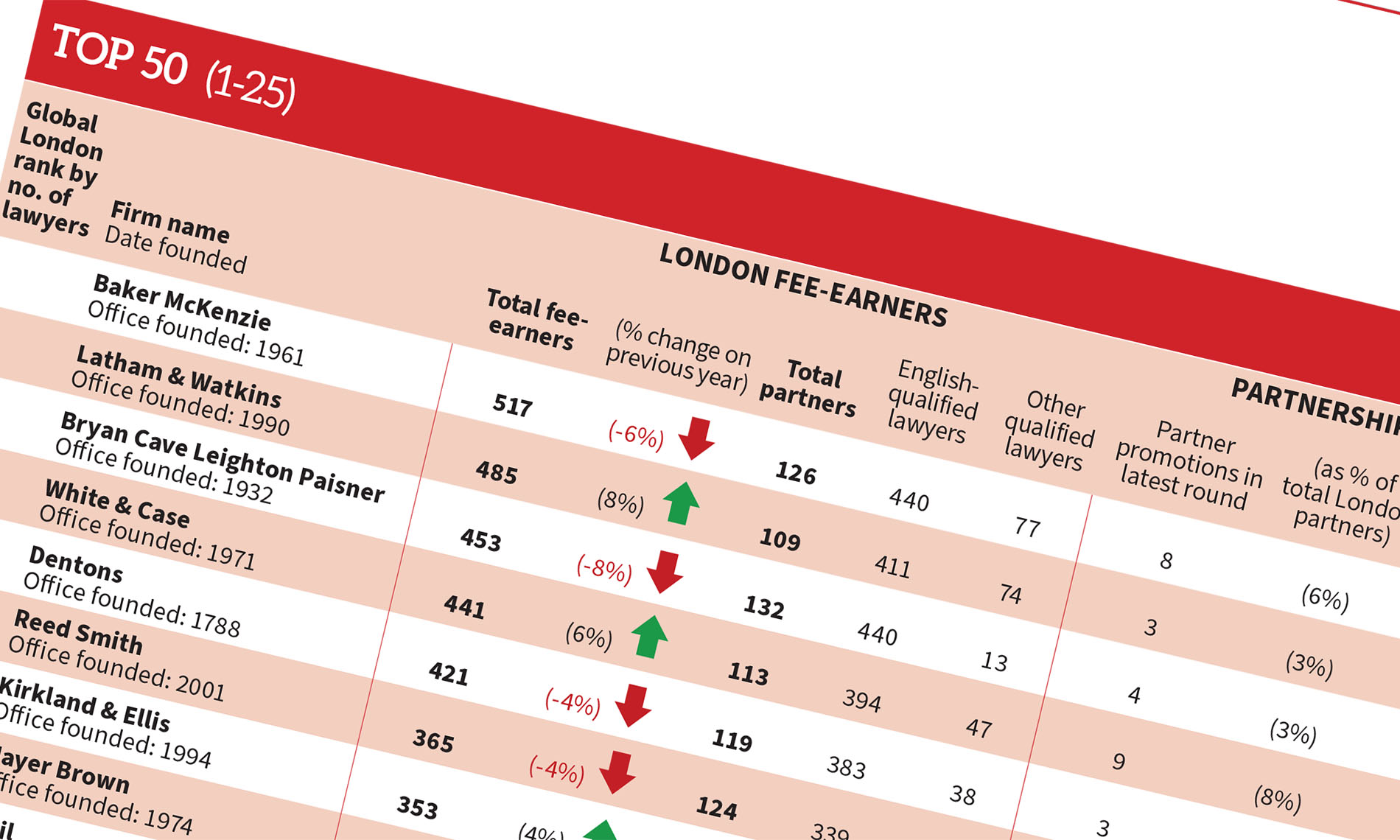
Overview: Flying hiatus

Covid-19 has intensified the divide between the Global London firms that have really taken off and those that remain grounded

Focus: Cooley

Focus: Simpson Thacher & Bartlett

Main table

Non-US firms in London: On standby

Five years ago, partners at European firms’ London offices voiced their fears over the possibility of the UK leaving the EU. What happens now this is reality?

The Last Word: Law in a time of Covid

To mark the launch of our 2021 Global London report, we asked senior figures at leading US firms for their thoughts

Sponsored briefing: Paul Hastings – Running a people business

London chair Arun Birla discusses maintaining the personal touch in a time of Zoom fatigue

Revolving doors: Gibson Dunn recruits Hong Kong regulatory team as CC expands funds practice

Hong Kong illustration

Gibson Dunn has significantly strengthened its Hong Kong bench after hiring a four-lawyer regulatory team from Herbert Smith Freehills.

Arriving with three associates, partner William Hallatt brings a broad Asia Pacific practice focused on contentious and advisory regulatory advice for major global financial institutions. Gibson Dunn chair and managing partner Ken Doran described Hallatt as ‘a terrific addition to the firm.’ He added: ‘He has built a leading cross-Asia practice as a trusted advisor on financial services regulatory issues, and his deep experience, strong relationships and market knowledge will integrate seamlessly with our leading global regulatory enforcement platform.’ Continue reading “Revolving doors: Gibson Dunn recruits Hong Kong regulatory team as CC expands funds practice”