Practice areas: Corporate and M&A, capital markets, dispute resolution, and finance and projects
Firm profile
Matouk Bassiouny is a leading, full-service MENA law firm with offices in Algiers, Algeria (Matouk Bassiouny in association with SH-Avocats), Cairo, Egypt (Matouk Bassiouny & Hennawy), Abu Dhabi and Dubai, UAE (Matouk Bassiouny) and Khartoum, Sudan (Matouk Bassiouny in association with AIH Law Firm), as well as a country desk covering our Libya practice. Our four offices are strategically located to better serve our clients’ business interests across the entire MENA region.
Our team of over 200 lawyers specialises in advising multinationals, corporations, financial institutions and governmental entities on all legal aspects of investing and doing business in the MENA region.
Trained both locally and internationally in civil and common law systems, our lawyers are deeply ingrained with international best practices and are fully conversant in English, Arabic and French.
Our firm collectively has access to a vast amount of knowledge and experience. We harness this knowledge via our 16 sector-focused groups that support our practice groups. We are therefore able to deliver legal services catered to the industry-specific needs of our clients. Our mission is to find the most innovative and cost-effective solutions for our clients, as we understand that our clients need to drive maximum value from their legal spending. We do this by maintaining a proactive commercial approach to all our legal services.
Team profile
Matouk Bassiouny and AIH Law firm joined forces in 2017 to create Matouk Bassiouny in association with AIH Law Firm, a full-service Sudanese business law firm in Khartoum. We are the first regional firm to open in Sudan. We offer a wide variety of services in the fields of corporate and M&A, finance and projects and dispute resolution. Our ultimate mission, and metric of success, is creating value for our clients.
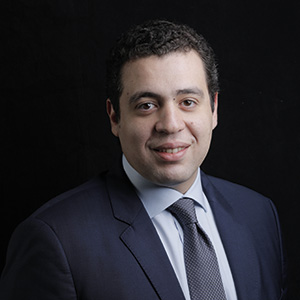
Mahmoud S. Bassiouny, regional managing partner, regional head of finance and projects, Matouk Bassiouny in association with AIH Law Firm
At a glance: Matouk Bassiouny in association with AIH Law Firm
Headcount: 200+ lawyers, 24 partners, 100+ support staff
Key clients: CDC Group, Uber, Etisalat Misr, Pfizer, LafargeHolcim, Lekela Power, First Abu Dhabi Bank, Development Partners International, Hassan Allam, Hilton
Can you give our Legal Business readers an overview of Matouk Bassiouny’s practice in the UAE?
Matouk Bassiouny in the UAE was established in 2018, incorporated on the ADGM initially, expanded afterwards in Dubai via a branch office. Matouk Bassiouny in the UAE is a full fledge law firm offering a wide variety of legal services to a wide spectrum of its clientele. In 2021, Jirayr Habibian joined the firm as its managing partner, with an aim to further strengthen the presence of the firm in the UAE, leveraging on the 20 years of experience Jirayr has in the UAE and the wider GCC.
What do you see as the main points that rank Matouk Bassiouny as a leading firm in the UAE legal business market?
Matouk Bassiouny’s competitive edge in the UAE is the ability to leverage on its large and talented regional, as well as its flexibility in allocating resources for any project, no matter how complex or big the project. This allows the firm in the UAE to be more flexible in its structure as well as more responsive to clients.
Furthermore, the quality and turnaround time that Matouk Bassiouny’s team commits towards its client base is an important component of the overall success of the firm.
Given the problems created by the Covid-19 pandemic, how is this affecting your firm and the legal business market generally in the UAE?
In its initial phases, Covid-19 did have an impact on the transactional market, however the contentious market continued to function, especially with the adaptation the courts in the UAE had to implement, as well as the phenomenal speed in the transformation towards a digital judicial system in the UAE. Law firms had to adjust to this transformation and adopt measures to follow which, in our opinion, speeded up the process of digitalising the overall judicial system as well as the law firms.
Further down the line as the markets and businesses resumed from full lockdown, and the very well managed pandemic crisis management adopted by the different local and federal authorities in the UAE, the legal business market naturally picked up and we are seeing more and more return to certain pre-pandemic levels.
Can you talk about any trends or changes in the landscape you are seeing emerge in the UAE legal business market?
The UAE legal market is evolving with the evolution of the legal system in the UAE. In the past several months we have witnessed many changes and amendments to laws that are making the UAE more and more attractive to conducting business. With competition in the GCC region starting to pick up (eg, the changes and opening of the Saudi markets) the UAE had to take further steps to increase and strengthen foreign investments. We have witnessed a liberalisation in the ownership of onshore companies (that has always been a highly protected sector where UAE nationality was mandatory to establish onshore) in a wide spectrum of activities. We are seeing Abu Dhabi, for example, opening up its energy sector (to an extent) to foreign ownership, in addition to a wide range of industrial activities. Furthermore, the UAE is also keeping pace with the ‘digital’ revolution and encouraging many start-ups in many domains. We see fintech being encouraged, alternative agriculture being developed (vertical hydroponics), and crowd funding being regulated more and more.
In a nutshell, the legal system and legal business market in the UAE is growing and keeping pace with what we see in other countries and in some cases even leading the way.
How is your firm positioned for an anticipated resurgence in activity in the UAE legal business market?
Our firm, as mentioned earlier, is very well positioned to take advantage of the resurgence in activity in the UAE legal market, since we have a very active team on the ground, with experience and network in the UAE, backed up by a robust regional structure, which makes Matouk Bassiouny in the UAE very well positioned to react to the market’s needs.
Which sectors are/will be of most interest to foreign investors, and why?
The real estate sector remains a very wanted commodity in the UAE market, however, we see now, with the liberalisation of the foreign ownership, an increasing interest in the healthcare sector (Covid-19 being one of the drivers, in addition to the oncological sector). Namely after the signing of the Abraham Accord, we are seeing an increased interest in the healthcare sector, industrial sector, sustainable energy etc. In parallel, Dubai and the UAE, given its location, remains a very competitive location for trade business, not to forget the increasing importance the UAE has in the fintech and digitalisation areas.
Are there any main changes which you have personally made within the firm that will benefit clients?
Given my very brief history with the firm (I joined on 1 April 2021) I am not in a position to have made any changes yet, although the system laid down by the founders, Omar Bassiouny and John Matouk has so far proven quite efficient with clients in the UAE, a system in which I am planing to leverage and, of course, ultimately introduce certain additions that could and will go along with the intuitu-personae I can contribute to the firm.
What has been your greatest achievement, in a professional and personal capacity?
Again, my time with the firm is yet at its beginning hence I cannot really talk about my greatest achievement within the firm quite yet. I hope that come 2022, should this interview be repeated, I will be able to share some success stories.
Practice areas: Corporate and M&A, capital markets, dispute resolution, and finance and projects
Firm profile
Matouk Bassiouny is a leading, full-service MENA law firm with offices in Algiers, Algeria (Matouk Bassiouny in association with SH-Avocats), Cairo, Egypt (Matouk Bassiouny & Hennawy), Abu Dhabi and Dubai, UAE (Matouk Bassiouny) and Khartoum, Sudan (Matouk Bassiouny in association with AIH Law Firm), as well as a country desk covering our Libya practice. Our four offices are strategically located to better serve our clients’ business interests across the entire MENA region.
Our team of over 200 lawyers specialises in advising multinationals, corporations, financial institutions and governmental entities on all legal aspects of investing and doing business in the MENA region.
Trained both locally and internationally in civil and common law systems, our lawyers are deeply ingrained with international best practices and are fully conversant in English, Arabic and French.
Our firm collectively has access to a vast amount of knowledge and experience. We harness this knowledge via our 16 sector-focused groups that support our practice groups. We are therefore able to deliver legal services catered to the industry-specific needs of our clients. Our mission is to find the most innovative and cost-effective solutions for our clients, as we understand that our clients need to drive maximum value from their legal spending. We do this by maintaining a proactive commercial approach to all our legal services.
Team profile
Matouk Bassiouny established its Dubai location in 2018, and since then has quickly established itself as one of the leading local law firms in the UAE. Led by our UAE office managing partner, Jirayr Habibian, our lawyers are experts in advising on all aspects of UAE law. Our Dubai and Abu Dhabi offices are well placed to provide local legal support across the GCC.
We advise both local and international companies on a full range of issues from contentious and non-contentious corporate and commercial matters.
At a glance: Matouk Bassiouny UAE
Headcount: 200+ lawyers, 24 partners, 100+ support staff
Key clients: CDC Group, Uber, Etisalat Misr, Pfizer, LafargeHolcim, Lekela Power, First Abu Dhabi Bank, Development Partners International, Hassan Allam, Hilton
Over the last decade, leased container securitisation transactions have increasingly enabled container lessors to raise capital and leverage growth opportunities based on strong performance and outlook in the container leasing sector. Bermuda has played an integral role for market-leading lessors such as Textainer and Triton, and has a trusted reputation among lessors as the leading offshore jurisdiction offering flexible and innovative structures for container securitisation transactions.
Structuring a Bermuda Container Securitisation Transaction
A typical container securitisation transaction involves the incorporation of a special purpose vehicle (SPV), normally a Bermuda exempted company, although exempted limited liability companies (LLCs) can also be used. The SPV can either be directly owned by the parent or use an orphan structure (held by a Bermuda purpose trust) which removes the asset from the parent’s balance sheet. The SPV will purchase the container leases (or other specified assets) with some form of regular cash flow and issue loan notes or preference shares in the capital markets to finance the purchase. The repayment of principal and interest on such notes is then secured by the purchased assets and the accompanying cash flow. Continue reading “Sponsored briefing: Container securitisation thriving in Bermuda”
Robert Sliwinski, of counsel at Alsuwaidi & Company, explains how common law principles are transforming international arbitration proceedings in the GCC region
Over the past six months there have been two important judgments in the Supreme Court of England and Wales which are likely to influence GCC-based arbitrations where they are based on common law procedures and rules. They may also impact arbitrations seated in the Dubai International Finance Centre (DIFC), the Abu Dhabi Global Markets (ADGM) and the Qatar Financial Centre (QFC) which are pockets of common law jurisdiction within the United Arab Emirates (UAE) and Qatar Civil Law Structures. Continue reading “Sponsored briefing: The effect of recent English Supreme Court judgments on GCC-based arbitration”
What are your backgrounds in terms of advising and acting for clients on ESG-related risks?
Doug Bryden (DB): I have advised clients in relation to a broad spectrum of risks for many years, from environmental to business ethics (including modern slavery and human rights) and on related governance and boardroom responses. The prevailing trend now is to view these operational, reputational and legal issues through the lens of ‘ESG’. The consolidation of these risks under a single banner is proving extremely useful in both explaining those risks to boards as well as streamlining a stronger, better considered management response. On one hand my job as an ‘ESG lawyer’ is to help clients promote ESG awareness within a business and to ensure compliance with an ever-increasing range of ESG regulatory obligations. However, this needs to be carefully balanced against the threat of novel legal risks that ESG programmes and associated public disclosures create. Much of my practice and Heather’s is focused on achieving outcomes which sensibly protect an organisation from such legal risks, without undermining the real opportunities and progress that better ESG management creates. Continue reading “Sponsored briefing: Interview with Doug Bryden (partner and head of risk and operational regulatory) and Heather Gagen (partner, dispute resolution)”
The outbreak of the Covid-19 pandemic has affected not only public health and the well-being of humanity, but also a number of economies, businesses and industries worldwide. Family offices have not remained unaffected; not only by coronavirus but also by the ever-shifting global economic environment. New trends that have arisen during the Covid era, including remote working and the demand for greater connectivity, as well as novel strategic and operational risks, are forcing family offices to rethink the way they have been traditionally doing business.
New trends and challenges
The majority of family offices were until recently relying on a more traditional model for their operation; having a few loyal employees and depending on the decision-making power of the head of the family. Currently, however, family offices are faced with a number of new matters that need to be addressed. Namely, have priorities shifted? Is the existing structure and location of the family office fit for purpose? Can the IT infrastructure in place support the electronic requirements of this new era? What about the younger generation – is it willing to step up and adapt to the new conditions? Continue reading “Sponsored briefing: Family offices: current challenges and trends”
While much of the country works from home we are providing more options for you to access your copy of Legal Business. Please see below for links to a limited version followed by a complete version. The complete version is only accessible to subscribers. Please make sure you are logged into the site to see the link.
In a more muted round of lateral partner recruitment as August draws to a close, Dechert, King & Spalding and Dentons have all strengthened their global benches while boutique firm Avonhurst has hired a London disputes veteran.
Two observations from the GC of BT Technology, Chris Fowler, stand out in our innovation feature, ‘Arrested development’. One: ‘If the work is repeatable and needs delivering to certain set outcomes at a certain price point, you become agnostic as to who is actually doing the work’ – suggesting the sacred cult of the individual may be diminishing in the eyes of clients. Two: ‘It always appears to us that the partner wins the work, the partner prices the work, and the partner delivers the work. I struggle with that in today’s world.’
Rob Booth, one of the leading lights of the in-house legal community, will be stepping away from his position as general counsel and company secretary at The Crown Estate to become the company’s new head of assets.Continue reading “Significant matters – Summer 2021”
The legal industry is still fragmenting. Pre-2008 it was an easier game: a buoyant economy, predictable government and a converging world flattened by globalisation and the internet. Law firms sought to be ‘global’ and ‘full-service’ and merged or opened offices accordingly. The business model was simple: bigger clients, bigger teams, higher utilisation, higher rates. Hold onto more rainmakers than your rivals and the fortifications of a professional monopoly took care of the rest. Continue reading “Arrested development”
‘It’s a snowball effect. Look at private equity (PE) – that used to be dominated by Clifford Chance (CC), Freshfields and Ashurst but now it’s US firms,’ warns Weil London head Mike Francies. ‘The same hasn’t happened in M&A yet but nearly all of the top US firms here are now trying to build it. In my view, in the same way that a range of top UK firms have fallen behind the Magic Circle, it’s inevitable that the Magic Circle will end up falling behind the US firms for global M&A.’ Continue reading “Is the Magic Circle’s dominance in the UK M&A market under threat?”
When discussing the current direction of antitrust regulation, Carles Esteva Mosso, a partner in the competition practice at Latham & Watkins’ Brussels office puts it succinctly: ‘In Europe, we are seeing an evolution towards more intense merger enforcement.’ At a national level, many jurisdictions appear to be keen to occupy a role at the forefront of competition enforcement, with the result being that many are taking steps to strengthen their position. Paris-based Latham partner Mathilde Saltiel describes how ‘The French authority likes to flex its muscle and show that it’s really at the forefront of anything that can exist in the field. To that extent, it can probably compete with the German authority, and also with the Competition and Markets Authority (CMA), which has also been very aggressive’.
After a few video calls, it takes only a cursory kick of the tyres to discern that employment lawyers have had a crazy year. ‘Crazy’ almost does not cover it – you would be hard pressed to identify an area of law that experienced more change in the last year, in both the rate of new law being created and the transformation in advice that advisers found themselves giving.
In a week of significant international expansion, Withers has added four lateral partners to its global benches while Curtis, Mallet-Prevost, Colt & Mosle has founded a new Saudi Arabia base.
Following on from our highly informative Risk and Litigation Report 2019, GC has partnered with Freeths once more to gather the opinions of over 100 general and senior counsel across the UK and Europe, to see how their approach to risk and litigation management has changed over a period that has tested even the most accomplished legal leaders. While undoubtedly a challenge, the Covid-19 pandemic also gave in-house counsel the chance to show their businesses just how useful they can be in a crisis; we also took the opportunity to examine how true this was, and how far the general counsel role has grown over recent months in response. Finally, our survey asked how legal teams felt they dealt with the lockdowns and subsequent shift to remote working.
This partnership project with GC magazine is a valuable opportunity for Freeths to engage with senior in-house legal colleagues and to pool the latest thinking on how best to create value, in the face of ever increasing litigation and regulatory risks.
We’re fascinated to see this survey data, which aligns with what we’re seeing through our risk advisory work. We see more businesses focusing on preparing for unforeseen, high impact, strategic risks, which have the potential to materially disrupt the business. On the positive side, this data also highlights an increasing awareness that the more sophisticated approaches to legal risk management are starting to emerge as factors which have the potential to enhance business value and give a competitive edge. Undoubtedly, the pandemic and Brexit have played their part in this heightened risk awareness.
There are plenty of theories on how GCs can convert risk into opportunity and create value for the business – but how are GCs actually achieving these things in the real, commercial world?
This survey data, webinar, and the roundtable discussions that will follow, should give us all a fascinating insight into how successful GCs are in achieving results, despite the risks and pressures.
Working with GCs to convert that insight into proactive risk management strategies is something we excel at here at Freeths.
James Hartley, Partner and National Head of Dispute Resolution
(Hartley is recognised as a leading individual by The Legal 500 in the fields of commercial litigation and dispute resolution. He uses his litigation experience to help clients undertake and implement complex risk management strategies, most notably in the recent successful claim against the Post Office.)
Risk and litigation management has become an essential skill for GCs. Boards are increasingly focused on preempting and minimising disputes and, as one respondent put it, ‘the responsible management of regulatory and compliance risks is a genuine competitive advantage that our management is acutely aware of’. Given the fact that the business landscape has changed so radically since the previous report, and that management varies across firms in different jurisdictions, GC took a fresh look at how general counsel now tend to deal with risk and litigation.
Our survey demonstrates just how important risk and litigation management strategies have become to corporate legal teams; all respondents said litigation risks and transactional risks, including contracts and projects, were part of their overall responsibilities. But the legal support they provide does not extend into other business areas, and GCs are not always aligned with their boards when it comes to the definition of risk. While only a third of respondents said that environment, social and governance (ESG) and corporate social responsibility (CSR) were part of their main responsibilities, all agreed that these areas are increasingly important business value metrics with an associated risk profile that in-house counsel are well-placed to manage.
Have the remarkable circumstances of the past 18 months given the impetus needed for a radical shake-up of how GCs are approaching their risk and litigation management, or is it business as usual? Based on the results of our survey, the latter is a more accurate statement; 60% of respondents stated that the events of the pandemic have not changed the order in which they prioritise the risks to the business. Of the remaining 40%, quite a number said their risk and litigation management has led to rigorous cost/benefit analysis in order to keep costs low; for example, one GC stated that the ‘challenging economic period requires us to now analyse, in detail, every single opportunity to save money’. Others pointed to changes such as placing greater emphasis on risks related to the pandemic, for instance prioritising the well-being of customers and colleagues.
While in-house legal departments are happy to manage risk internally, and in the main feel competent to do so, almost half of the respondents said they would benefit from external law firms providing more sophisticated and bespoke litigation risk advisory services as well as, if it was offered, dedicated financial cost/benefit analysis. For legal services providers who take pride in their risk advisory services, this may indicate an opportunity.
It also suggests that respondents are aware that improvements can be made in their corporate risk management, and the survey offers some insight into where these improvements can be made. 28% of respondents stated that they are reactive rather than proactive in terms of their risk management, while others were concerned that the many moving parts of their organisations are not working as one; 16% reported their risk management response to be wholly un-holistic in its approach.
Freeths Comment
‘We’re certainly seeing within our Dispute Advisory practice a growing awareness among corporates that decisions around litigation and regulatory situations need to be viewed as investment decisions – requiring cost/benefit analysis, and outcome scenario planning, that can be presented clearly and decisively to boards’. – James Hartley, Head of Dispute Resolution, Freeths
Creating Value
General counsel are now more likely than ever before to view their risk and litigation work in business terms and are expert at explaining this to other stakeholders within the business. As one GC eloquently put it, ‘Taking a sensible approach to risk, and having a mitigation strategy, enables the business to also take on appropriate risk, which can generate returns. All businesses take on a degree of risk and the key is finding the right balance to optimise these opportunities in order to not lose out to competitors’.
Other GCs agreed, with many focusing on how the ability to assess the merits and demerits of a case in its early stages allows for a cheaper resolution. As another GC stated, ‘from a cost perspective, gaining an early view of potential risks allows commercial decisions to be made well before expenses are incurred’. Others mentioned that being able to predict – somewhat – the cost that a case might incur as being a major boon to business-legal team relations, as the corporate side often appreciate being given a ball-park figure to be able to base their strategy around. Others still mentioned the importance of being able to avoid adverse consequences like claims and fines, and how effective mitigation efforts can also improve their company’s knowledge of the legal landscape and contribute to the good reputation of the company.
We asked respondents to score four metrics out of ten for how far they allowed them to demonstrate positive contribution to the growth and value of their business: enhancing the legal and regulatory risk profile of the business; horizon-scanning to predict and neutralise legal and regulatory risks to growth and profitability; quantifiable financial savings achieved through proactive, decisive and strategic resolution of issues and obstacles; and generating cash through the monetisation of meritorious claims or litigation by deploying external litigation funding solutions. This, also, demonstrates that general counsel still see their main contribution to the business’ bottom line to be as cost-avoiders rather than revenue-makers themselves. ‘Generating cash through the monetisation of meritorious claims or litigation by deploying external litigation funding solutions’ achieved far and away the lowest average score out of ten: 3.3. The other options, ‘legal and regulatory risk profile enhancement’, ‘horizon-scanning’ and ‘proactive, decisive and strategic resolution of issues’ received generally high average scores; 7.9, 7.3 and 7.1 respectively.
So much for the theoretical side, but how have in-house counsel actually been performing when it comes to avoiding risks before they develop? On the evidence of GC’s survey, one positive conclusion that can be made is that the in-house teams that have managed risk in a conscientious and responsible way over the last 18 months have been noticed and supported by their companies; more than half of respondents said that the pandemic has not impacted how adequately resourced their teams are. In a similar vein, 62% of respondents have not considered financing options to improve their litigation and regulatory risk management.
From Risk to Opportunity
Sixteen months after the order to work from home where possible, many of us have forgotten just how profound a shift in working practices it has been. But it is worth considering whether the changing approach to risk management within legal teams is part of a broader ‘post-pandemic’ shift in the way businesses are looking to safeguard long term stability. Intuitively, it seems that general counsel, given their risk management expertise and the analytical skills given to them by their legal training, could have been seen as ideal personnel to lean on for companies under the circumstances. The data appears to bear this out; almost half of respondents stated their greatest challenge of the past 12 months was increased responsibility, while only 15% answered that their role has not appreciably changed. This trend remained approximately the same across legal teams of vastly different sizes, indicating that general counsel at companies of all sizes have been relied on to fight fires for their companies in their hours of need. That they have been fighting fires is evidenced in the report as well; roughly four fifths of respondents reported they have been involved in litigation or regulatory activity over the past year.
But how exactly have in-house counsel seen their risk management and prevention responsibilities grow over the past year? A shade under half of those surveyed noted the greatest change in their responsibilities as an increased emphasis on unforeseeable or unpredictable risks; undoubtedly the Covid pandemic has shaken the business world into taking such threats more seriously. Interestingly ‘increased time with the board or taking on a board position’ was the second most popular way in which respondents have seen their responsibilities increase. Clearly, a significant minority of in-house counsel have raised their profile within their companies who have trusted them to safeguard them in a difficult business environment.
Those that weren’t afforded this increased level of face-to-face time with the board probably feel as though they should have been. An overwhelming majority of respondents, 93%, believe they work best as a combination businessperson and lawyer rather than as a lawyer first and foremost. With that said, most benefit from something of a separation of power with the board; 57% believe they work better as an independent advisor at arms-length rather than a fully-fledged member of the board.
Freeths Comment
‘In my experience, lawyers who are seen by boards as those who “grasp the nettle” in difficult litigation and regulatory situations, and who shape a strategy so as to gain some control, are the ones who are seen as highly valuable in the business – this applies to both internal and external legal teams’. – James Hartley, Head of Dispute Resolution, Freeths
Lessons Learned
The Covid-19 pandemic was an unprecedented business challenge that came at a time when uncertainty already gripped a UK business scene which was trying to get its head around the ramifications of leaving the European Union. That these should have changed the way in-house counsel operate seems elementary, but what have they meant in terms of how much legal work is outsourced vs kept in-house? Legal providers can take heart from the fact that results were even; half of respondents to GC said they would send a greater proportion of their legal work externally while the remainder said they would grow their in-house team in response. There is an interesting caveat to this, though; larger companies are far more likely to be relying on their in-house teams going forward. Of respondents with the largest in-house legal teams comprising over 25 members, two thirds reported they will be growing their in-house legal team as opposed to sending more work to firms. The thinking behind this tends to be based on cost. As one respondent put it, ‘While decisions will always be taken depending on work type, carrying out more work in-house generally tends to be more cost effective’.
Away from the nuts and bolts of specifically legal concerns, the day-to-day life of the average general counsel has changed markedly over the course of the pandemic and subsequent lockdowns. For most, the greatest change of all has been the need to work remotely for long periods. While there are perks to working from home, for example a decrease in commuting, greater flexibility and a better work and life balance, it does come with issues. The lack of face-to-face conversations and the drop in productivity some feel comes with not being supervised are perhaps chief among these. How do in-house lawyers feel the move to remote working has been, then? As it turns out, only roughly one in ten respondents reported a decrease in productivity when working away from the office. While this tenth of respondents may be facing obstacles in home working, such as an increase in distractions or lacking a good working environment, this does seem to be a resounding endorsement for remote working. Working from home does not appear to be hindering productivity noticeably, which more than explains why some employers are looking at making this a permanent change in the future.
The Covid pandemic and subsequent lockdowns were – hopefully – a once-in-a-lifetime business challenge that caught the vast majority of general counsel off-guard. How does the average general counsel feel they met the challenge? To find out, GC’s survey also asked the million-dollar question: would they have done anything differently about their strategy during the lockdown period if they were able to have the time over? Several responses focused on measures such as moving earlier, acting more proactively and being more conscious of how the pandemic would impact the demands of work. For example, as one GC put it, ‘[we would have] sped up getting the technology in place to permit home working at the beginning of the crisis’. Likewise, another stated ‘Planning for negotiating agreements with landlords on rent levels and review of office use’. In the main, though, respondents were pleased with how they handled the situation, and proud of how their teams rose to the challenge. ‘We identified the seriousness of the problem early’, recalls one GC, ‘and sent our employees into home working before companies were asked to do so by government. We even saw a boost in productivity soon after home working, and, now, we’re ready for the return to the office’.
Freeths Comment
‘Recalibrating resilience plans in light of the events over the last two years is now high on the corporate agenda, with more focus now on identifying and evaluating major shocks – including litigation and regulation – which might disrupt strategic objectives.’ – James Hartley, Head of Dispute Resolution, Freeths
In a major expansion of its US operations, Allen & Overy (A&O) has made an eye-catching move for seven White & Case technology partners to establish a new Silicon Valley presence.
Making the switch are partners Shamita Etienne-Cummings, Bijal Vakil, David Tennant, Eric Lancaster, Adam Chernichaw, Daren Orzechowski and Alex Touma. The new multidisciplinary team will be headed by Orzechowski and Vakil, with all of the arriving partners operating from the current locations in Silicon Valley, San Francisco, New York and Washington DC. Continue reading “Revolving doors: A&O launches Silicon Valley tech team as Linklaters hires litigation star”
Despite the pandemic, the 2020/21 financial year proved to be an improved outing for Linklaters as revenues inched up and profits saw a robust increase.