
Though Paul Hastings only occupies three floors of 100 Bishopsgate, the high-ceilinged foyer spans two levels, and the double-height windows give visitors to the City base a first impression of a firm with grand ambitions.
Those ambitions are underlined by the firm’s bold recruitment strategy, which has seen London lawyer count almost double over five years, with at least 14 more partners joining the firm since last September.
‘What seems to be attracting people is that this is a platform for builders,’ says corporate M&A partner Matt Poxon. Poxon, who has now been at the firm for 15 years, joining as an associate from Slaughter and May in 2011, has had a front seat for much of that building.
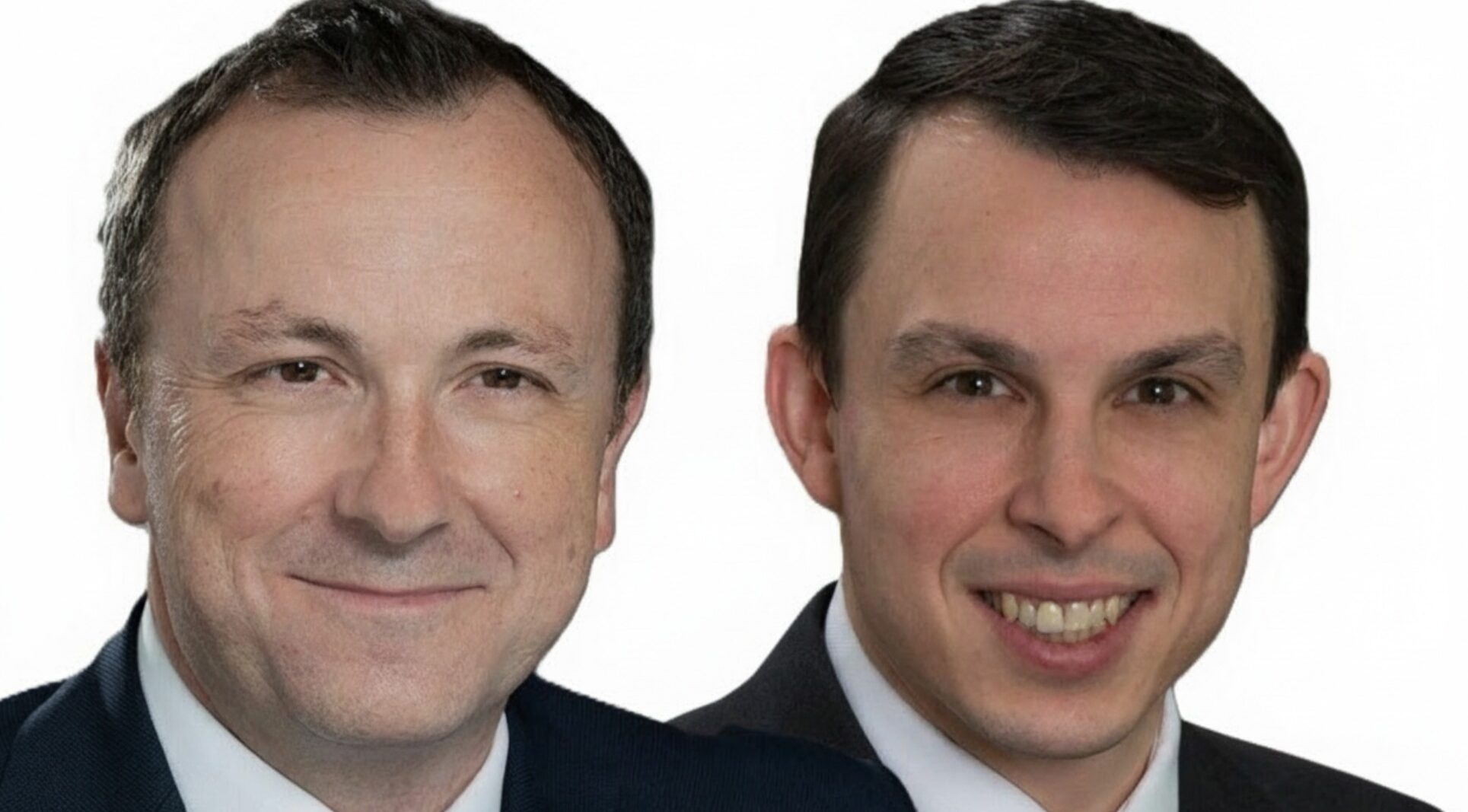
He now co-chairs the London office alongside leveraged finance partner Ross Anderson, whose 2022 arrival as part of a four-partner finance team from Latham & Watkins was a ‘sit up and take notice’ moment for Paul Hastings’ London peers. Anderson became London co-chair on his arrival at the firm, with Poxon joining him late last year after former co-chair Mei Lian’s move to Linklaters.
While the firm is perhaps best known for the ambitious leadership of New York-based chair Frank Lopez, who has been front and centre of the firm’s recruitment efforts, Anderson says there is ‘a recognition from management that the London market is fundamentally different to the US.’
‘All the foundations were there for the office to be successful. What was lacking was scale, which we have been building’
Since Lopez became chair four years ago, ushering in a sustained period of aggressive lateral hiring, the firm’s London office has been joined by a succession of splashy laterals, but has not always had a prominent leadership voice.
However, Poxon says speaking openly about London priorities is important given ‘where we are in the growth and maturity of the office, and where we want to go.’
From the airy, corner meeting room where he took his first meeting with Lopez four years ago, Anderson reflects on the significance of his move from Latham alongside fellow finance partners Mo Nurmohamed, Karan Chopra and Rob Davidson.
‘That Frank had the ambition to grow and take the whole team meant we were in from pretty much the first meeting,’ Anderson recalls. ‘All the foundations were there for it to be successful,’ he says. ‘What it was lacking was the scale, which we have been building over the last few years.’
Over the past year the firm has sought to deepen its London bench with hires including fund finance partners Leon Stephenson and Jennifer Passagne, Thomas Picton in structured credit, David Richardson in investment funds, Ferish Patel in PE and Lyndsey Laverack and Jade Williams in real estate PE. While the firm has also seen several departures, the total number of partners in London has also almost doubled over five years, rising from 30 in 2021 to just under 60 now.
Anderson says the office’s growth has helped to shift the profile of work the firm has won in the past three to four years, pointing to its involvement in the financing of GTCR’s €4.1bn acquisition of Zentiva late last year. On the M&A side, Poxon cites the firm’s role for the shareholders of The Co-operative Bank on the £780m sale to Coventry Building Society, as well as its role for AI tech company G42 on its $1.5bn investment from Microsoft.
Other key drivers behind the London office’s success include the collateralized loan obligation (CLO) practice led by structured credit co-chair Cameron Saylor, which worked on almost half of the CLOs in Europe in 2024.
 The office’s partners say the firm prides itself on its diversified business. ‘There’s no one area of Paul Hastings that the firm is reliant on,’ says Jenny Doak (pictured), who joined as co-chair of the global tax department from Weil this summer. ‘The firm is hedged across lots of areas and, from a tax perspective especially, that is great.’
The plan, however, is not to be everything to all people, according to Poxon. ‘Our desire is not to create a private equity or M&A practice to rival our finance one – we are being much more targeted.’
One area that has been earmarked for growth is sports, with the firm recently recruiting former Slaughter and May M&A partner Mark Zerdin to launch a dedicated practice group.
Though strategic direction comes from Lopez – who has described running the firm like an asset manager would a portfolio – partners say the firm’s somewhat unconventional management style and flat structure is advantageous in a fast-moving market.
 ‘There’s a real recognition that practice leaders have the best knowledge about what is likely to be worthwhile in terms of growth and strategy,’ says Jason Raeburn (pictured), who heads the London IP and technology litigation practice. ‘There aren’t structures and settings that stipulate the firm has been doing X practice for 100 years and that is the way we do it.
‘There’s a dynamism with strategic laterals joining in the areas that it makes sense to invest in,’ Raeburn adds. ‘The number of laterals means everyone is keen to help one another, and that creates an ethos of “how can I help you?” that pervades the environment.’
While characterising the London base as a platform for those that want to build, Poxon qualifies that the firm is ‘not necessarily about preserving what others have built before you’, noting that attracts ‘a certain kind of person.’
For M&A partner David Prowse, the reasons he joined as an associate are the reasons he has stayed at the firm: ‘Being part of a team that was growing and allows you to take responsibility attracted me and now as a partner that is absolutely the case.
 ‘This is a bunch of self-starting people and, as I’ve grown up with the firm, taking on responsibility makes everything a bit more rewarding,’ Prowse adds.
But both Poxon and Anderson recognise the speed of growth is not what all partners are looking for. ‘For me it is exciting, but it’s not for everyone, and the market provides different opportunities,’ Poxon says. ‘With the way the market is, we can also suffer from people wanting to pick up our top talent.’
Earlier this year, Lopez told LB that the firm’s London practices currently sit between stage two and five of a 10-step growth plan, and that while London revenue jumped 25% to $272.4m last year, Lopez wants that to double in the next three to four years.
The ambition is clear, but Poxon and Anderson are keen to dispel any notion that this brings unrealistic pressure. ‘We’re ambitious, and work at the top end of the market, so it is demanding,’ Poxon says, ‘but it doesn’t mean you have to be sharp-elbowed. You can be ambitious while being collaborative.’