Sponsored briefing: Law firms see a hybrid future enabled by the cloud

New research has revealed that law firms are increasingly shifting to hybrid working and cloud technology is underpinning this move

This article will look at some of the key findings to emerge from a new benchmarking study, undertaken by Legal IT Insider in association with Philips, that interviewed a range of leading law firms on their hybrid working plans and cloud strategies. It will also outline how the Philips SpeechLive cloud-based dictation and transcription workflow solution can help to address specific issues associated with the hybrid work approach, not least the concerns associated with cyber security.

Moving to the cloud

Following on from the global pandemic we have seen the rapid growth of the hybrid work model where employees have the flexibility to work a portion of their week from home, with the remainder of the time spent in their office.

Law firms have certainly embraced this model, recognising its growing popularity and the expectation of staff to have greater flexibility in where they work. In fact, the study indicates that 88% of respondents now have some form of policy in place to support it, while only 2% are making it mandatory for their staff to be back in the office full-time.

The result is that law firms are increasingly looking for new opportunities to support lawyers more effectively, by enhancing collaboration, streamlining processes and allowing for device and location-independent mobile working. All of which are major strengths of cloud technologies.

It’s no surprise, therefore, that the study results show 68% of respondents confirming that more than half of their core systems are now cloud-based. In contrast only 9% are still using predominantly on-premises solutions.

Another significant finding is that 79% of the respondents already have a cloud-first strategy. This is an approach to cloud computing that involves the adoption of cloud technologies for all new applications, platforms and infrastructure. In effect it prioritises cloud computing services over more traditional on-premises IT systems.

The growing shift to the cloud is also emphasised in terms of the overall strategy adopted, with 12% of respondents reporting that they are already entirely cloud-based. What’s more, a further 23% plan to be entirely cloud-based within 18 months, while 19% intend to follow suit in three years.

And cloud-based solutions have played an important part in helping legal firms to support hybrid and remote workers more effectively. For example, one of the most significant changes that law firms have seen in adapting to hybrid working has been the increasing reliance on Microsoft 365, with 56% of respondents having recently moved to this software as a service (SaaS) product.

Another commonly reported change has been the surge in adoption of eSignature usage (cited by 72% of respondents). This use of IT to authenticate the signatory and certify the integrity of the document is mobile-friendly and secure, and thus ideally suited for a hybrid work environment where colleagues and business partners will often be working remotely.

SpeechLive and the cloud

Streamlining document production processes and enhancing collaboration are major challenges for all law firms. Philips SpeechLive is a cloud-based solution that is suitable for businesses of all sizes and is ideally placed to meet these challenges. It allows legal professionals to use its advanced speech recognition and workflow capabilities to create and route documents through the production processes. Document creation can be carried out:


  • in the office via a microphone and browser-based solution; or
  • on the go using a portable voice recorder, or a mobile app which supports both Android and iOS devices.

Front-end speech recognition can also be used to directly insert text into existing software applications, such as Microsoft Word, Outlook or CRM systems, along with case management systems.

SpeechLive’s AI-based engine offers up to 99% accuracy, while voice commands can be used to insert paragraphs, punctuation marks and special characters, all contributing to speedy and effective speech-to-text conversion.

Uptime reliability can be a concern with some cloud-based solutions due to issues such as power failures or network outages. With this in mind, Philips has partnered with Microsoft Azure as its hosting provider. Azure promises a 99.9% uptime guarantee, 24 hours a day, seven days a week and 365 days a year.

Security findings

Inevitably much of the information generated by legal firms will contain personal information that is sensitive in nature. Ensuring such information is safe from the prying eyes of online hackers is paramount. Security, therefore, is a crucial issue for both existing and potential users of cloud-based solutions.

In the past a range of concerns were often expressed by both law firms and their clients regarding the security of documents stored in the cloud, particularly public clouds.

However, results from the study demonstrate a growing confidence in the levels of security now provided by cloud service providers. It found that 73% of respondents believe none of their clients are unhappy or uncomfortable with their data being stored in the cloud, while a further 21% expressed only minor reservations.

Reinforcing the above point, 74% of respondents believe that cloud solutions are now more secure than their on-premises counterparts.

This appears to have resulted in a change of emphasis in terms of the security-related concerns expressed by the clients of law firms – they are less concerned about where the data is hosted, and more about how it is actually protected. One respondent commented ‘It is impossible for on-premises to be as secure as the cloud. Security technology requires a level of scale and investment that cannot be achieved on premises.’

SpeechLive and security

There is a growing confidence that cloud service providers can offer extremely high levels of security, not least because their businesses and reputations depend on it.

This is certainly the case with SpeechLive. For example, the use of multi-factor authentication (MFA) adds an extra level of security since it requires two or more distinct factors to validate a user’s identity, rather than relying on just a simple username and password combination.

In addition, encryption techniques are employed to create a layered defence that makes it more difficult for an unauthorised person to gain access to audio recordings and file attachments. All types of audio files are always created, sent and stored with industry standard AES 256-bit encryption.

Importantly, the Azure hosting service also adheres to international standards for security and compliance. For example, the service is ‘GDPR ready’, meaning it fully complies with the European Union (EU)’s General Data Protection Regulation which seeks to ensure that EU residents’ personal data is secure, accessible, used appropriately and documented with consent.

In addition, Azure is certified for the ISO/IEC 27000 family of information security standards, in particular the mainstay of the series (ISO 27001) which sets out the specifications for an information security management system.

Azure also continuously performs penetration testing and work on threat detection and prevention in areas such as unauthorised intrusion and denial of service.

Five key takeaways

  • The appetite among staff within the legal sector for flexible and hybrid working has grown significantly, with the majority now expecting this work model to be made available to them.
  • Hybrid working is here to stay and the requirement to support it has accelerated transformation initiatives.
  • Law firms are increasingly choosing a cloud-first strategy where cloud technologies are adopted for all new applications, platforms and infrastructure.
  • Cloud technologies provide new opportunities for supporting lawyers more effectively.
  • Speech-to-text, workflow and collaboration solutions have key roles to play in streamlining processes and enabling lawyers to achieve greater efficiencies.

Reference

Hybrid Working & Law Firms’ Long-Term Cloud Journey
Cloud Report 2023 by Belinda Hermans – Flipsnack

For more information, please contact:

Ryan Braddock, VP and sales director UK and Ireland

Speech Processing Solutions UK Ltd
7 The Courtyards
Wyncolls Road
Severalls Park
Colchester CO4 9PE

T: 07825 751859
E: [email protected]

www.speechlive.com

Sponsored briefing: Litigation analytics brings hard data to high-stakes decisions

Grant McCaig, head of litigation at Phoenix Group, the UK’s largest long-term savings and retirement business, discusses the value analytics brings to high-stakes litigation decisions

The past few years has seen pioneering litigation analytics company Solomonic utilise machine learning technology and human expertise to create powerful structured data from unstructured litigation documents and judgments. This has, for the first time in English High Court cases, brought data and insight to the decision-making process. Continue reading “Sponsored briefing: Litigation analytics brings hard data to high-stakes decisions”

Sponsored briefing: Putting AI in its place: the rise of the litigation workspace

With AI and ChatGPT on the rise, Stephen Dowling explores how, and why, these new tools are a necessity for the future of dispute resolution

Litigation is undergoing a quiet revolution. Underpinning these changes are powerful AI and ChatGPT tools, which are ultimately changing how we work, and impacting on outcomes. The days of manual processes are numbered. Digital tools are now commonplace in litigation. But the next phase of development will see a harnessing of these tools to bring efficiencies never thought possible – with implications for those who do not adapt. Continue reading “Sponsored briefing: Putting AI in its place: the rise of the litigation workspace”

Sponsored briefing: Doing business in Greece

Theodore Pistiolis, managing partner of Andersen Legal in Greece, examines the benefits of doing business in the Greek market

A sea of opportunities

During the last years and despite adversities, Greece became an investment destination for local and foreign capitals. The perception of Greece as an investment destination is strong, and the country built trust and optimism about its prospects. Greece’s economy recorded solid growth in the first half of 2022, but rising inflation took its toll on growth in the year’s second half. However, the RRF program (Recover and Resilience Facility loans) supported the economy. Government measures cushioned the impact of energy prices on businesses’ input costs and households’ real disposable incomes. Continue reading “Sponsored briefing: Doing business in Greece”

Sponsored briefing: Outlook for the Greek legal market

Dimitris Zepos, managing partner of Zepos & Yannopoulos, on what the future holds for the legal market in Greece

The Greek legal market has traditionally been highly fragmented and therefore shallow, with freelance lawyers and small family-owned offices making up the lion’s share of the market. To be fair, small-scale business models have not been a particularity of the Greek legal market, but rather a replicate of the average Greek entrepreneurial model. According to the Hellenic Federation of Enterprises, 96% of SMEs employ up to nine people and this includes companies without any employees or with just one.

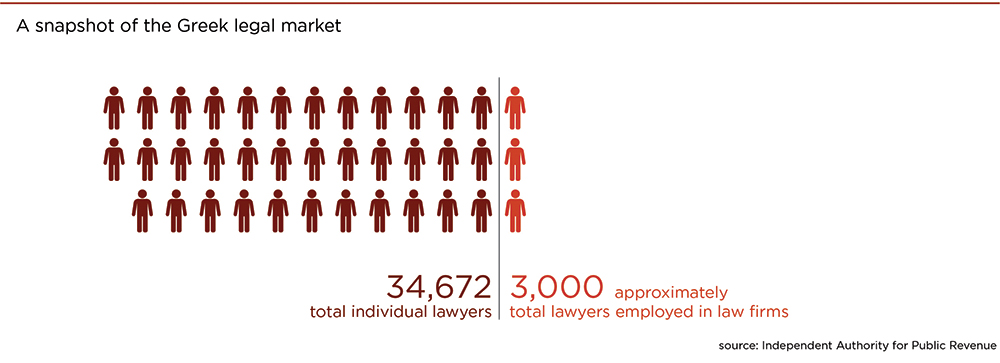
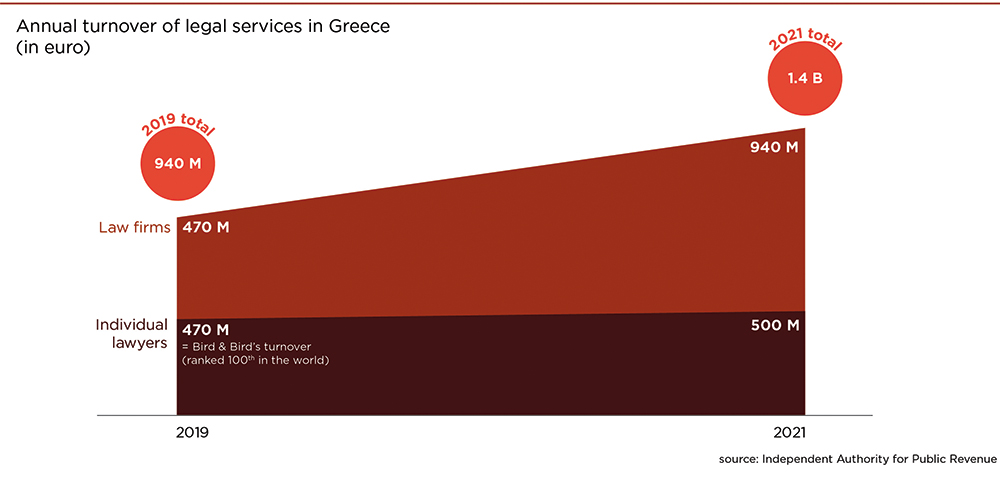
According to data published by the Greek Authority of Public Revenue, the number of individual lawyers has remained steady since 2019, amounting to approximately 35,000 (34,672 for 2021). According to the same data, the total turnover of legal services in Greece amounted to €940M in 2019, out of which, approximately €470M was generated by individual lawyers. This means that 35,000 individual lawyers generated approximately 50% of the sector’s total turnover in 2019. To put things in perspective this amount is equivalent to the annual turnover of one single international law firm, Bird & Bird, which in 2019 was ranked 100th in the world, based on turnover.

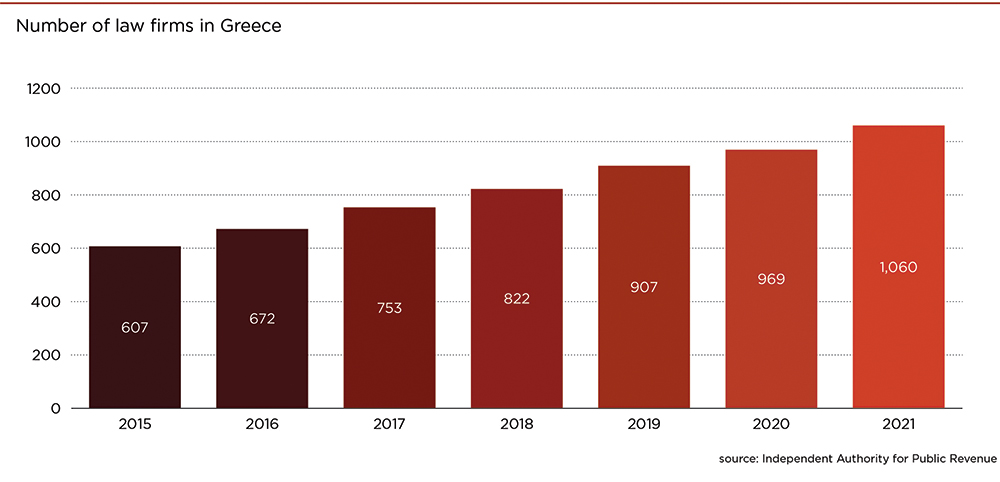
The figures in question have started shifting, indicating that the legal market is moving slowly, yet steadily, towards a more mature way of doing business. In 2021, the number of law firms increased to 1,060, compared to 907, back in 2019. The total turnover of legal services reached €1.4bn, growing by 60% compared to 2019. Out of that figure, approximately €940m of turnover has been generated by law firms, whereas the performance of individual lawyers has remained in the range of €500m. In other words, growth in the sector has been fuelled by the increasing number of law firms and their growth.

Fragmentation of the legal market is also evident when one looks at figures concerning headcount. The ten-largest law firms in Greece, based on headcount, employ approximately 600 lawyers in total, out of the approximately 38,000 active lawyers in the country.

At Zepos & Yannopoulos we have always believed that strength derives from teaming up. With a total team of 118 lawyers, 14 economists and 82 other professionals, we are proud to be within the top 3% of employers in Greece. Consolidating practices and people allows us to adapt to the pace of a constantly changing world, to foster legal talent and encourage innovative thinking, all to the benefit of our clients, our people and the community as a whole.

The legal profession in itself is changing. Firms are called upon to cater to a wide and complex range of comprehensive needs. The question is no longer whether the Greek legal market should change to adjust to this new era, but instead how fast it can do so.

For more information, please contact:

Dimitris Zepos,
Managing partner

Zepos & Yannopoulos
280 Kifissias Ave. 152 32 Halandri Athens, Greece

T: (+30) 210 69 67 000

E: [email protected]

www.zeya.com

Sponsored briefing: Greece: M&A outlook and FDI attractiveness from a legal and regulatory point of view

Early 2023 held a sweet spot for cross-border M&A activity in Greece, unmuting all those opportunities that had joined a waitlist during the Covid-19 pandemic and have been looking for the right time to be deployed and lead into new business models and scaling deal-making strategies.

In fact, the current market status suggests that deal-makers rebound with a strong intention to radically shift the transactional landscape by throwing into the mix highly sophisticated implementation plans and solid completion strategies, opening up to new industry sectors and playing up to transformational deals that will most definitely impact their core operations and medium-term strategic goals. Continue reading “Sponsored briefing: Greece: M&A outlook and FDI attractiveness from a legal and regulatory point of view”

Sponsored briefing: Legal trends in Greece

After overcoming a decade-long financial recession, Greece is currently going through a period of political stability and economic growth. During this period, the Greek government has taken a proactive role in charting a determined course for Greece that is friendly to investment, promotes growth and welcomes new business, primarily by enacting legislation that provides considerable incentives to investors.

In particular, during the year 2021, the Greek economy manifested a GDP growth of 8.3% and welcomed an increase of 90.2% in Foreign Direct Investment (FDI), in accordance with the data provided by the Hellenic Statistical Authority and Bank of Greece respectively. Continue reading “Sponsored briefing: Legal trends in Greece”

Sponsored briefing: Green bonds: the future of equity financing?

1. A BURGEONING INDUSTRY
Green bond issuance is expected to balloon over the next few years. On a global scale, predictions for 2023 alone estimate up to $600bn will be raised from green bonds, with Europe playing a leading role in this. The European Commission will fund up to €250bn over the next few years by issuing NextGenerationEU green bonds, making the EC the largest green bonds issuer in the world. Greece is expected to raise substantial amounts through green bonds in order to reduce greenhouse gas emissions by 55% by 2030 and achieve net-zero by 2050. Continue reading “Sponsored briefing: Green bonds: the future of equity financing?”

Sponsored briefing: The importance of the Greek jurisdiction and Greek law in international shipping disputes

Alexander C Dovles, partner at Saplegal – A.S. Papadimitriou & Partners Law Firm, outlines why knowledge of the Greek jurisdiction and law is often crucial in shipping disputes

Historically, Greece has always been a maritime nation, which is distinctly reflected in the modern Greek economy. Undoubtedly, Greece remains today the top ship-owning nation in the world, since the Greek shipowners with their 5,514 ships currently control approximately 21% of the global fleet. Continue reading “Sponsored briefing: The importance of the Greek jurisdiction and Greek law in international shipping disputes”

‘We’re in a really exciting moment for the London market’: Freshfields appoints Mark Sansom as new London managing partner

Freshfields Bruckhaus Deringer

Mark Sansom will take over from Claire Wills as London managing partner at Freshfields, the firm has announced. The move comes at the end of Wills’ four-year term, and will take effect on 1 May. Sansom will also continue his client work.

An accomplished competition litigator, Sansom has worked closely with Wills, first as a partner and from July 2022 as London head of dispute resolution. ‘Mark and I have been in the trenches together, working with the other practice heads, developing the London strategy,’ Wills told Legal Business. ‘What I am planning to spend my time on now is supporting Mark in action, at the coal face, with my corporate, transactional, and M&A work.’ Continue reading “‘We’re in a really exciting moment for the London market’: Freshfields appoints Mark Sansom as new London managing partner”

Risk management and professional indemnity survey 2023: Walking the talk

While our annual risk and professional indemnity report in conjunction with Marsh Specialty charted the movement of environmental, social and corporate governance (ESG) concerns up the law firm risk management agenda in 2022, this time around ESG is all-consuming. So much so that insurers and brokers are making it a key component of discussions with corporate clients.

The increase in the level of interest in ESG and the role it plays in risk management discussions has been significant. In last year’s survey, 73% of respondents said that ESG is now firmly part of their firm’s risk management agenda. That figure has now increased to 77%, with just 6% of respondents saying that ESG does not currently fall within the risk management remit. One might argue that even that is too high a proportion of leading law firms, given that ESG is front and centre of the corporate landscape today. Continue reading “Risk management and professional indemnity survey 2023: Walking the talk”

Sponsored briefing: Rise of the Machines: Shaping the Legal Response to AI’s Rapid Expansion

ChatGPT, an AI program, has experienced unprecedented growth, amassing over 100 million monthly active users. This raises concerns regarding potential threats to safety, privacy, employment, and the urgency for regulatory intervention.

AI: Boon or Bane? Weighing the Pros and Cons

A Goldman Sachs report indicates that AI could automate up to a quarter of work in the US, impacting 300 million jobs globally1. However, AI technology could also enhance labor productivity growth and increase global GDP by up to 7%2. The legal profession is among those at the highest risk of AI automation, with 44% of tasks potentially being automated. Continue reading “Sponsored briefing: Rise of the Machines: Shaping the Legal Response to AI’s Rapid Expansion”

Sponsored briefing: Recruiting top talent

The last two years have been a steep learning curve for the jobs market, and never more so than in the legal sector. Post-pandemic, the market has changed drastically- and while things are certainly starting to get easier, challenges still remain.

Here at LR Legal, we’re acutely aware of the struggles employers face right now, and we know how vital it is to recognise the impact of the changes that are taking place in the legal industry. So how can LR Legal help law firms not only secure the top talent in today’s difficult market but keep them too? Continue reading “Sponsored briefing: Recruiting top talent”

Revolving Doors: White & Case and Proskauer make antitrust plays as Paul Hastings raids A&O in New York

City of London

Leading several high-profile moves this week, White & Case has hired antitrust partner Michael Engel from Kirkland & Ellis in London. Engel, who is dual-qualified in the UK and Germany, had been a partner at Kirkland since January 2021 and, before that, was at Sullivan & Cromwell for a decade.

Engel advises on the full scope of EU, German and UK-governed competition issues. Continue reading “Revolving Doors: White & Case and Proskauer make antitrust plays as Paul Hastings raids A&O in New York”

Sponsored briefing: Overview of commercial litigation in Thailand

Tilleke & Gibbins’ Sittiwate Jewsittiprapai and Michael Ramirez share their insights into the working of Thailand’s legal system

Thailand’s legal system is based on European continental civil law systems, with a three-tier court system. Precedents set by the Thai Supreme Court are merely considered as examples of the application of laws and are not binding on Thai courts.

While the country’s judiciary and dispute resolution mechanisms are well developed, some aspects can be unfamiliar or even surprising to counsel unfamiliar with the Thai court system. This article introduces some of the Thai civil court procedures and practices, and covers several key issues it is important to understand regarding civil litigation in Thailand.

Offers of compromise or settlement

In Thailand, there is no such thing as an ‘offer without prejudice’. Anything put in writing can be used against the offering party. Therefore, compromises, settlements, and offers to compromise or settle should not be made before consulting with legal counsel. Similarly, parties at trial or anticipating litigation should be cautious in all communications with the opposing party.

Location of assets

Before initiating litigation, plaintiffs should investigate the nature and extent of the defendant’s assets in Thailand and abroad. A monetary judgment is of limited value if the defendant has little or no recoverable assets. Therefore, any information a claimant has on the opposing party should be assessed at the beginning of the case or as soon as is reasonably possible.

Language of documents

All documents submitted to a Thai court must be in the Thai language. Foreign documents must be the originals or certified copies, and certain documents also need to be notarised and then authenticated by a Thai consular official.

Court costs

A plaintiff must pay a court filing fee when submitting a case. This is usually 2% of the claim amount but will not exceed THB 200,000 per action for claims of up to THB 50 million. There is an additional 0.1% calculated on the amount of a claim exceeding the THB 50 million threshold. If the suit is successful, some of these advanced court costs are usually recoverable.

Additionally, non-resident plaintiffs may be required to deposit security with the court to insure against a potential award of court costs in favour of the defendant.

Appeals

In civil cases, appeals must be filed within one month of the judgment being read. Extensions may be granted at the court’s discretion if requested and reasonably justified.

At each level, the appealing party must deposit additional court costs of 2% of the judgment amount, with a maximum of THB 200,000 for claims of up to THB 50 million and an extra 0.1% calculated on claim amounts exceeding THB 50 million. The appealing party may also be required to post an additional guarantee to ensure its ability to cover judgment should the appeal be unsuccessful.

The Courts of Appeal and Supreme Court are not trial courts, and generally no new evidence may be introduced after the trial in the lower court is completed. Appeals at all levels are resolved through written pleadings and supporting documentation only. There is no live oral advocacy.

In 2015, Thailand changed its appeal system from a right-based system, which allows any party to appeal against the lower courts to the Supreme Court, to a permission-based system, where a judgment or an appellate court order is final unless an appeal is accepted by the Supreme Court. This change gave the Supreme Court the power to grant permission to file an appeal to the Supreme Court if it deems the question a significant matter worthy of a decision. Under this new discretionary system of review, only a minority of Supreme Court appeals are accepted by the Supreme Court.

Length of trials

Unless settled by compromise, civil litigation typically lasts between 12 and 18 months, counting from the initiation of action until a judgment by the court of first instance. Cases in the Courts of Appeal usually take an additional 18-24 months, with a similar period for appeals to the Supreme Court.

Recognition and enforcement of foreign judgments

Foreign judgments cannot be enforced in Thai courts. Thailand is not a party to any treaty or convention on the recognition and enforcement of foreign judgments. As such, a creditor must bring a new lawsuit to the relevant Thai court to obtain satisfaction. This means that a foreign judgment creditor must file a court case against a Thai debtor in Thailand and submit the foreign court’s judgment as evidence. The Supreme Court has ruled that for a foreign judgment to be admitted as evidence, it must be a final, dispositive order.

Arbitration and alternative dispute resolution

Deciding whether to litigate or seek alternative dispute resolution is commonly an anticipatory decision made by the parties to a contract before a dispute exists. Parties either specifically elect mediation or arbitration uniquely tailored to their needs or leave the matter of dispute resolution to the responsible court.

Some key reasons for choosing arbitration over court litigation are flexibility and the ability to tailor how a party’s dispute would be resolved by selecting the arbitration rules and institute, the venue, and the number of arbitrators. Administrative costs and arbitrator fees are pretty reasonable at local institutes and may help decrease the overall cost of dispute resolution in Thailand.

Thailand has three arbitration institutes: the Thai Arbitration Institute of the Office of the Judiciary, the Thai Commercial Arbitration Institute of the Board of Trade, and the Thailand Arbitration Center under the Ministry of Justice.

Enforcement of foreign arbitral awards

In general, foreign arbitral awards are recognised in Thailand if they fall within the recognition of treaties, conventions, and international agreements to which Thailand is a party – and only to the extent that Thailand is committed to be bound by them. Thailand is a party to both the New York Convention on the Recognition and Enforcement of Foreign Arbitral Awards 1958 and the Geneva Convention on the Execution of Foreign Arbitral Awards 1927. Awards brought under the auspices of the former are easier to enforce than under the latter. Foreign arbitral awards can be executed in Thailand without having to be relitigated, although enforcement does require the filing of an enforcement claim with the Thai court of jurisdiction for execution against a debtor’s assets.

Authors:


Sittiwate Jewsittiprapai, senior associate
T: +66 2056 5809
E: [email protected]


Michael Ramirez, counsel
T: +66 2056 5794
E: [email protected]

Return to the Disputes Yearbook 2023 menu

Sponsored briefing: Protecting lawyers’ rights for society and the people

Ashkhan Candey advocates access to justice for clients at risk of insolvency

Since 2009 CANDEY has striven to embrace contingency fees. First in the form of conditional fee arrangements and thereafter damages-based agreements. As a boutique firm we have always been able to onboard such matters quickly, with conflict checks and a decision to self-fund being made in a matter of hours.

Parliament dropped the ball when it came to drafting and so the unintelligible damages-based agreements regulations which could have been evolutionary have been avoided by most firms. Academic commentators observe that you would be crazy to enter into one. Sadly they are not written in plain English, have led to significant legal argument and if current Court of Appeal authority stands (CANDEY v Tonstate 2022), they discriminate against defendants as they are only available to claimants. This cannot be right or fair as the cornerstone of English law is that parties must always be on an equal footing. Except we all know that in a capitalist society parties are rarely ever on an equal commercial footing for unfunded claims (typically funders need it to be £5m+ to work as otherwise they take all the proceeds on success).

Thus the ordinary woman on the street may be eaten alive by the corporate she takes on, as absent bad publicity a loss is just a rounding figure for the corporate whereas for her she risks losing everything. Despite our advances as a society, the rich continue to have the upper hand in commercial litigation. In a civilised society this cannot be right, yet the government appears wholly disinterested in putting it right. Somehow it has been missed off the levelling up agenda. Whilst we read in the news about cases won or lost nothing is ever said about the vast majority of people for whom justice was never available as they could not hire a decent lawyer.

Leadership in this area is to be found in the Supreme Court. Lords Briggs and Leggatt and others are gravely aware of the moral inadequacy in our system and in a trio of ‘lien’ cases have championed the access to justice cause laying down and clarifying the ambit of an effective roadmap for lawyers to be paid first from the fruits of litigation. Whilst this does not address the risk of adverse costs, it does at least provide a litigant with a meritorious claim with the option of instructing solicitors and barristers on a no-win no-fee basis without having to rely on Dickensian forms of charity. Sadly the Tories have been asleep on the job or too busy on Brexit and the pandemic. Meanwhile Labour are disinterested in any policy that may appear to simply help lawyers get richer.

The fact remains that despite strides by the Supreme Court, those without cash remain unable to get before a judge. At the heart of the problem is the risk of insolvency. If litigants with meritorious claims were flush with cash, they would fund their own cases. But so often, they simply do not have the financial wherewithal to do so. Ironically, this is all too often a result of their opponent breaching obligations, contractual or otherwise, leaving them starved of cash and facing insolvency. It is at this critical point that the law, and the procedure that underpins it, should come to a litigant’s aid. But how can lawyers agree to act for them on a no-win no-fee deal if there is a significant risk that their client will go bust? We may have a wonderfully strong relationship with our trusted client but if on insolvency the lawyer is sacked and replaced by a disinterested administrator, liquidator or trustee then what? The officeholder is under no obligation to retain you. How can a firm protect themselves in that scenario from ranking as an unsecured creditor and recovering only pennies in the pound? The lien or equitable charge does not protect a lawyer who has not achieved a win. Unless they are subsequently held to have been instrumental the lawyer gets burnt. In CANDEY v Crumpler we protected our fixed fee by taking a floating charge in the BVI. In the High Court on the question of the value of our floating charge this was valued at £3.8m but on appeal and remission back to the High Court was found to be the lower hourly rate figure of time expended at just over £1m. In the intervening period we also argued in parallel proceedings that by retaining the discretion to be paid first we had reserved our lien. It is that application which ended up in the Supreme Court in 2022. The liquidators at KPMG in that case, whom we have fought for eight years (like a dog with a bone), would no doubt have sacked us immediately upon assuming office had they thought that we had a lien and used other lawyers on hourly rates instead. It was because they continued to use us to prepare for trial that we were able to invoke the lien once success had been achieved. As a footnote and by way of an interesting way of getting paid, the Court of Appeal in the first Candey and Crumpler Court of Appeal judgment (there were three) found that a payment by way of security for costs on success would revert to the client’s insolvent estate, would not be new monies generated by the liquidators, and so our charge could bite on those monies. Thus security paid into court provides a fund that can serve two purposes, to pay security for costs and in the event of success constitute a fund to pay the lawyers. As a further footnote there is old High Court authority to say that a lien would not bite on monies simply returned but I personally think that decision was wrongly decided.

Absent statutory invention by a government actually interested in access to justice the only real option as I can see it is to permit lawyers acting on a contingency to have a claim transferred to them in the event of insolvency. Obviously, the new fee agreement itself would have to survive the existing test of reasonableness, with independent advice required. It could not trespass over the existing rules for CFAs and DBAs, respectively, charging a maximum of double hourly rates or 50% of the winnings including counsels’ fees and VAT. It was thus that against the odds we fought the case of CANDEY and Miller (Court of Appeal 2022) in the hope that the Supreme Court would hear the case and determine that with the advent of contingency agreements the prohibition on champerty was dead and we should be able to have a claim transferred to us, where we had essentially been the funder, on insolvency. The Court of Appeal would have to follow existing case law forbidding transfers of claims to lawyers but the Supreme Court could depart. Sadly, the Supreme Court declined to hear the case so what could have been a revolutionary moment for access to justice fizzled out. For now.

As commercial lawyers we always stand accused of wanting to make a fast buck. We should make no apology for that. If we can help a client, take significant risk and be handsomely rewarded then what is the problem? Bankers, funders and entrepreneurs have always acted in the same way. Unlike judges, we are not civil servants. Most big firm commercial lawyers are paid very well, win or lose, so there must be an upside to incentivising lawyers to take risk, to help those who desperately need our help and must otherwise rely on the hope that they can find a pro bono lawyer. The national pro bono centre and judges such as Mr Justice Knowles have been wonderful in leading the charge to persuade lawyers to act pro bono but volunteers will never be a cure to a flawed system. Until such time that we as lawyers collectively exercise more muscle to reform the law we sadly retain the shame of a system that relies on Victorian charity or expects litigants in person to know the law and the White Book.

In the case of CANDEY v Bosheh (2022) the Court of Appeal narrowed the test of the iniquity principle: in that case we discovered that our client was not in fact our client but a dishonest solicitor who masqueraded as our client. To establish the fraud we relied on privileged communications relying on the iniquity principle but we got smacked by the court for doing so. In other jurisdictions such as the USA fraud is a clear exception to privilege, and it is immensely disheartening for the profession that that panel effectively granted immunity from prosecution to anyone who might defraud a lawyer. In this respect our rights as lawyers to assert our rights rank below that of everyone else, creating another barrier or disincentive to any lawyers prepared to depart from the hourly rate paid up front.

Judicial initiatives to cap legal costs might seem to be a good idea but they will have a dreadful impact. Whilst they admirably reduce the quantum of adverse costs the reality is that they will only be undertaken by call centre claims handlers. What would actually make a huge difference for the ordinary person would be to reintroduce the ability to defer and recover the insurance premium paid for adverse costs, typically around 35% of the actual sum insured. In that scenario on a win the loser would pay that premium.
For now, we as a firm fight on for lawyers’ rights convinced that absent government cash (which is not an option) only by advocating to protect lawyers who work and win on risk, can we broaden access to justice.

Author


Ashkhan Candey
Solicitor, barrister and managing partner
E: [email protected]

Return to the Disputes Yearbook 2023 menu