
Mega-deals and convergence stoke M&A but subdued volumes and volatile conditions linger

Andy Ryde

This time last year, a collective sigh of relief from City dealmakers was reverberating around the Square Mile as the M&A market regained momentum despite a backdrop of economic and political uncertainty. Since then, deal counsel have barely paused for breath, with many juggling multiple deals well into the parts of August in which even the most committed deal junkie would expect to be pretending not to check work emails on a sun lounger.

Such boom-time dynamics are borne out by the latest Mergermarket figures for H1 2018, which saw announced global M&A deals hit $1.94trn, its highest value since the financial crisis. Continue reading “Mega-deals and convergence stoke M&A but subdued volumes and volatile conditions linger”

Who Represents Who: The data behind the story

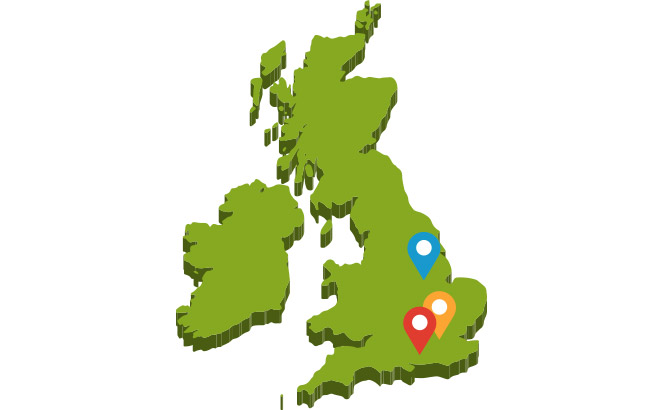
Freeths map

LB100: The rise of Freeths

Freeths has seen revenue almost double over the past five years (see Legal Business 100 table), and are often mentioned to our researchers by partners and general counsel alike as a firm that has significantly impressed. We take a look at the firm’s The Legal 500 rankings and some of the FTSE clients that it represents. Continue reading “Who Represents Who: The data behind the story”

LB100: Smoke, turmoil and a tonne of cash

'LB100 star' tattooed hands

The latest financial year has not been a vintage period for those wishing the legal industry would fall into concise patterns. Glancing at the LB100, separating the winners and losers by breed is more difficult than at any time over the last 20 years.

But murky as the picture is, some broad outlines can still be discerned. The 2017/18 season was one of the best 12 months of trading since the banking crisis a decade ago reset the legal market. Continue reading “LB100: Smoke, turmoil and a tonne of cash”

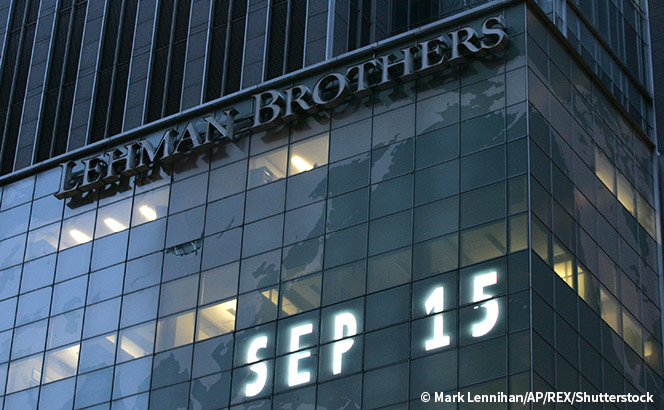
A decade since Lehman the profession still mired in the New Normal

Lehman Brothers

Within days of this issue hitting desks, it will be ten years since Lehman Brothers’ collapse marked what swiftly became the great financial crisis. That event was only the clearest symptom of a disease that had been infecting the banking system for more than a year before Lehman filed for bankruptcy on 15 September 2008.

Yet the process unquestionably signalled changes that have reverberated through economies, politics, business and, yes, the legal profession ever since. By the summer of 2009 the UK profession had for the first time engaged in industrial-scale job cuts, axing more than 5,000 roles at top 100 UK firms alone. Through the lens of the LB100, the profession starkly divides into performance patterns pre and post-Lehman. During the long boom, London’s elite was utterly untouchable. Within the Circle they could falter and scrap for fleeting inter-club advantage. But as far as the rest of the industry was concerned, they were in a world of their own. The initial advances of major US law firms had by the mid-2000s been comprehensively repelled – what chance did mid-tier rivals have? Continue reading “A decade since Lehman the profession still mired in the New Normal”

The LB100 overview: Crisis? What crisis?

LB100 Rock punk skeleton

Brexit negotiations stalling, trade wars looming, the high street hit by a raft of collapses – at first sight, there is plenty to suggest the UK has taken a trip back in time. Yet for those with a finger on the pulse in the City, it will come as no surprise to find this year’s Legal Business 100 (LB100) speaks of a standout year for Britain’s legal elite. Turmoil has mattered very little against the backdrop of booming transactional activity, interest rates near historic lows and the cheap pound.

While commercial lawyers spoke with wary optimism of healthy markets in the summer of 2017, caution progressively turned into bemused enthusiasm as the City realised it was living through its busiest winter for years during a period that seemed to resemble the Winter of Discontent. By spring, some were hailing the best financial year since the banking crisis. This year’s survey confirms that there is some substance to such claims. Continue reading “The LB100 overview: Crisis? What crisis?”

LB100 case study: Clifford Chance

Matthew Layton

The only firm among London’s big four to have retained its position in the Legal Business 100 table, Clifford Chance (CC) is the second-largest UK-bred shop after DLA Piper, having added £83m to its top line to hit £1.623bn.

But if the 5% uptick in revenue is broadly comparable to Linklaters, Allen & Overy and Freshfields Bruckhaus Deringer, it is the 16% surge in profit per equity partner (PEP) to £1.6m where CC has edged ahead of its rivals. Continue reading “LB100 case study: Clifford Chance”

LB100 case study: Taylor Wessing

Long-serving managing partner Tim Eyles (pictured) received a nice farewell gift in his last year at the helm of Taylor Wessing, as the firm posted one of the strongest financial performances in the top 25.

The tech-focused shop rode hugely on the boom in transactional activity and the high demand for GDPR advice to grow UK revenue by a solid 12% to £144.6m. Globally, Taylor Wessing – which over the last financial year moved from a looser alliance of international firms into a formal verein structure – broke the £300m barrier after hiking turnover 12% to £301.5m. Continue reading “LB100 case study: Taylor Wessing”

Draining the swamp – Do NDAs represent a #MeToo problem for the profession?

Zelda Perkins

A light has lately shone on a legal document which, by definition, should never bask in the sunshine. The saga, which was to trigger reverberations concerning abusive behaviour in many industries – and lawyers’ role in drafting gagging orders – began in October 2017, with disclosures by British producer Zelda Perkins (pictured).

In written evidence to MPs, Perkins called the gagging order she signed nearly 20 years ago with her former boss Harvey Weinstein amid sexual harassment allegations ‘stringent and thoroughly egregious’. Continue reading “Draining the swamp – Do NDAs represent a #MeToo problem for the profession?”

LB100 Second 25: The ex-pistols

Punk-style LB100 badges

The story of last year’s Legal Business 100 (LB100) was the emergence of a group of mobile mid-tier outfits that were threatening to take the market by storm. For some, that has become a reality, with the pacesetting Fieldfisher surging into the top 25 on the back of another stellar year. For those it left behind in the 26-50 bracket, the going has been generally tougher.

Despite a modest 5% jump in average revenue to £122.6m for the mid-market cohort, there was a 3% slump in average profit per lawyer to £65,000. Average revenue per lawyer also slipped 2% to £267,000, although there was a 3% rise in the average profit per equity partner (PEP) figure to £501,000. Continue reading “LB100 Second 25: The ex-pistols”

For good or ill, Kirkland is now redefining high-end law

Kirkland & Ellis wrecking ball

Though I’ve always known that soul-of-a-law-firm cover features are the biggest draw for our readers, the response to our Kirkland & Ellis epic in July has been striking. Not since ‘Branded’ two years ago exposed the state of King & Wood Mallesons’ European business has a piece in these pages provoked such an intense reaction. Our team did a good job but that also reflects the hold the K&E phenomenon has taken over the industry’s imagination. Having covered the law for a good number of years, I cannot think of a firm that has attracted such strong emotions split between appalled detractors and the growing band battered into submissive admiration.

The critics loathe the outfit in part for upending some accepted notions of how global law firms are supposed to excel. But most of the distaste springs from the potency of a challenge emerging from outside the profession’s established London and New York elites. Kirkland’s success, however, isn’t just about defying norms. In some areas, Kirkland took platitudes of focus, meritocracy and leadership and turned them into realities. Sometimes brutal realities but that’s reality for you. Continue reading “For good or ill, Kirkland is now redefining high-end law”

LB100 case study: Travers Smith

David Patient

You can always rely on Travers Smith for revenue growth; the City independent has posted its ninth consecutive year of financial expansion. Although, in many ways, the 18% uptick in turnover to £146.9m was a triumphant bounce back from 2016/17’s results, when revenue inched up just 4% against a backdrop of Brexit uncertainty.

The revenue increase is more impressive when considering that only £900,000 of the £146.9m figure was generated overseas – in Travers’ small Paris branch – emphasising the firm’s strength in its domestic market. Continue reading “LB100 case study: Travers Smith”

LB100 case study: Hill Dickinson

Peter Jackson

Things have gone from bad to worse at insurance and shipping specialist Hill Dickinson, as the firm recorded a second consecutive drop in turnover.

Hill Dickinson would have hoped to improve on 2016/17’s less-than-stellar 1% fall in revenue, but this was off the cards when a 5% drop to £96.8m was announced. The impact was softened by a more robust showing in profitability with profit per equity partner rising 22% from £274,000 to £334,000. However, this is largely attributable to the firm cutting its equity partner count from 57 to 47. Continue reading “LB100 case study: Hill Dickinson”

Methodology and notes

LB100 punk badge

LB100 law firms

The firms that appear in the Legal Business 100 (LB100) are the top 100 law firms in the UK (usually LLP partnerships but also some alternative business structures – see footnotes), ranked by gross fee income generated over the financial year 2017/18 – usually 1 May 2017 to 30 April 2018. We call these the 2018 results. Where firms have identical fee incomes, the firms are ranked according to highest profit per equity partner (PEP).

Sources

An overwhelming majority of firms that appear in the LB100 co-operate fully with its compilation (see ‘Transparency’, below) by providing our reporters with the required information. A limited number of firms choose not to co-operate officially with our data collection process and in these circumstances we rely on figures given to us by trusted but anonymous sources. Continue reading “Methodology and notes”

Ireland: A case to make

Businessman running to Dublin

Centuries of imperiousness towards the Irish could be one of England’s greatest historical mistakes, and when Legal Business set about asking Irish independents whether Dublin is a viable alternative to London for disputes work following Brexit, it felt as though this underestimation was very much alive today. However, the Irish legal elite remains defiant in the face of any English condescension.

‘Absolutely it’s viable,’ says Dillon Eustace’s managing partner Mark Thorne when asked if the Irish Bar’s initiative to promote Dublin as a global disputes centre was realistic. ‘You’re asking if the big independent firms have the talent to achieve that, and the answer is yes, absolutely.’ Continue reading “Ireland: A case to make”

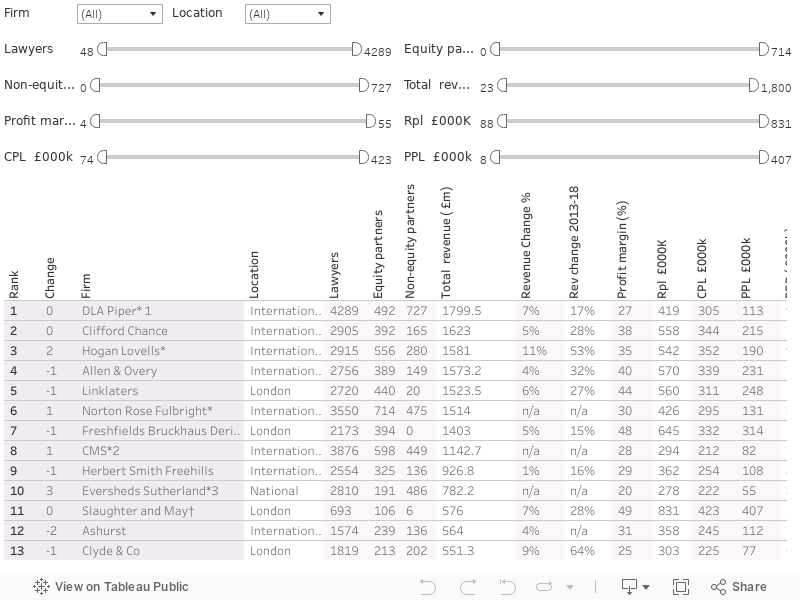
Legal Business 100 2018: Main table

View the table as a pdf.

Click to return to the Legal Business 100 menu

The Last Word: One way or another

From retaining talent to going public, LB100 leaders give their take on how to survive in an age of disruption

Go big

‘The markets are pretty buoyant in terms of legal services despite all the economic and political disruption out there. It was a particularly good year if you are global and full service. Anecdotally, I talk to lots of managing partners and the firms that have had a harder time I tend to think of as being quite niche or quite local to a particular country or market. The broader you can be geographically and from a service point of view, the better you’ve done.’
Simon Levine, global co-chief executive and managing partner, DLA Piper Continue reading “The Last Word: One way or another”

Behind the numbers – Profitability revealed

Sponsored by

mason hayes and curran logo

In this table we blend together the three key profitability metrics – profit per equity partner (PEP), profit per lawyer and profit margin – to discover which of the top 100 firms are the most profitable. The firms have been ranked according to their aggregate score across all three measurements. Firms marked * are either listed firms or alternative business structures and do not have equity partnerships, meaning their ranking for PEP bears no relation to profit distribution. See methodology for further explanation. Continue reading “Behind the numbers – Profitability revealed”

LB100 Second 50: London stalling?

Political montage

With initial post-referendum Brexit shock giving way to pre-breakaway uncertainty, the boutique and mid-market London firms in the second half of the Legal Business 100 are maintaining a brave front in the face of political and economic uncertainty.

Overall the story is encouraging for London firms in the second 50, with total revenue up 6% to £774m, with an average revenue of £40.7m across the 19 City firms in the second – the same number as last year. Average profit per equity partner (PEP) spiked by 12% to £409,000. Continue reading “LB100 Second 50: London stalling?”

LB100 Second 50: Regional view – Comfortably numb

Consolidation, planning, investment and ‘cautious optimism’ proved dominant themes for the smaller regional and national firms in this year’s Legal Business 100 (LB100). The 31 non-City firms in the 51-100 bracket grew steadily amid a slow summer and dip in confidence during the 2016/17 financial year. Last year, however, the group’s collective revenue only managed a weak 1% rise to £1.27bn, with an average revenue of £41m. While real estate and construction continue to boom, deal flows are noticeably beginning to slow for many.

While regional firms are typically less productive per capita than London counterparts, that gap has widened. Revenue per lawyer was £181,000, down 8% and much lower than the £264,000 in London. Profits tell a similar story: profit per lawyer down 10% at £38,000, against £80,000 in the City. Continue reading “LB100 Second 50: Regional view – Comfortably numb”