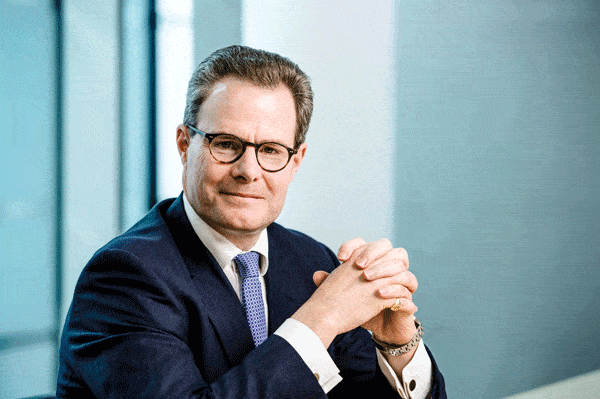
Tip of the iceberg: Beckwith prosecution sparks Freshfields misconduct and financial penalty clampdown

Freshfields Bruckhaus Deringer

Freshfields Bruckhaus Deringer has ushered in radical reforms to handling misbehaviour, including financial penalties, as the #MeToo fallout intensifies following former partner Ryan Beckwith’s prosecution for sexual misconduct.

The move sees a conduct committee established and new enforcement protocols which mean partners under internal investigation will receive a final warning about their behaviour and face an automatic fine equal to 20% of their profit share for 12 months. Continue reading “Tip of the iceberg: Beckwith prosecution sparks Freshfields misconduct and financial penalty clampdown”

Dealwatch: Kirkland and Slaughters lead on £3.1bn Sophos take-private as Fried Frank advises on €11bn Permira final close

Slaughter and May office

Continuing the recent trend for high-value take-private deals, the £3.1bn buyout of UK cybersecurity company Sophos Group Plc has prompted lead mandates for Slaughter and May and Kirkland & Ellis as a transatlantic team from Fried, Frank, Harris, Shriver & Jacobson advised Permira on the €11bn final close of its seventh buyout fund.

Oil & gas deals have also kept City teams busy with White & Case, Freshfields Bruckhaus Deringer and Mayer Brown all fielding teams on lead mandates. Continue reading “Dealwatch: Kirkland and Slaughters lead on £3.1bn Sophos take-private as Fried Frank advises on €11bn Permira final close”

Conference Sketch – Thousands flock to law tech showcase but echo chamber concerns creep in

Karl Chapman

Walking trees. High-fives. A cinema. Virtual reality headsets. Arcade games. Disco balls. General counsel (GCs) dressed as Willy Wonka. Filing cabinet piñatas. T-shirts reading ‘no bullshit’ and nobody in a suit and tie.

Since its debut in 2016, legal tech community Legal Geek’s annual conference has grown dramatically from a respectable 500 attendees to more than 2,000 packing out a former brewery near London’s Brick Lane.

The event is the brainchild of Legal Geek founder and legal tech start-up community lynchpin Jimmy Vestbirk. He kicked proceedings off Wednesday (16 October) from the main stage, where it was standing-room only, by setting the tone for a different type of law conference: ‘Anyone who’s been here before knows we like to start by high-fiving the people around you.’

The eruption of high fives was followed by an invoking of the conference’s start-up roots, with Vestbirk adding: ‘Today is not about hierarchy. The legal profession is very hierarchical, but the student is as likely to change the profession as the managing partner.’

No managing partners were present to hear, however. The senior end of in-house was better represented, with figures such as Chris Fowler, technology GC for telecoms giant BT, and Panasonic’s associate GC for legal innovation Bea Miyamoto among the speakers. Thomson Reuters’ newly-recruited chief strategy officer Richard Punt also spoke, while New Law was represented by Daniel Reed, chief executive of US-based alternative legal services provider, UnitedLex.

A key point at this year’s conference was the need for in-house legal functions and private practice to get a grip on their data. ‘Most legal functions face increased demand and pressure to reduce cost,’ said EY Riverview Law chief executive Karl Chapman (pictured). ‘Legal cannot avoid the need to use the right data. A staggering amount of work legal teams are doing should not be in the legal function and not be done by lawyers.’

Anna Power, GC at American retailer Crabtree & Evelyn, reiterated the point: ‘Data can help demonstrate value and the need for something, but some of the metrics to get hold of that data are hard to find and it’s not clear how to do it.’

There was wide agreement among the speakers that compared to other professional services, legal is slow to make data and digital a pervasive force throughout the industry. Reed in particular took opportunity to stress the need for a digital revolution throughout Big Law, noting: ‘Digital fluency is a pre-requisite to a legal society moving forward. Law needs to get a grip on its data.’

Meanwhile, in a space awash with technology tools tailored to niche concerns, companies and firms were being encouraged to move towards broader platforms to address their needs. ‘We have too many pieces of tech that do not talk to one another,’ Fowler confessed. ‘This means manual processes are in play between them which increases points of failure. We need to move towards a platform environment.’

Likewise, others stressed that while finance had SAP and sales had Salesforce, legal is overdue an equivalent platform which permeates the work of a legal function. But technology providers are seemingly taking heed. When in January Thomson Reuters snapped up legal software provider HighQ, it was done so with a view towards integrating existing tools into the HighQ platform. This will include Thomson Reuters’ flagship contract tool Contract Express, which is now in the process of being integrated into HighQ alongside other products at the technology giant.

Punt, among others, warned that consolidation was inevitable in such a fragmented industry; an ominous message for the many nascent data extraction and contract tools with stands on the strip coined ‘Start-up Alley.’ Standing out among the new names were some of the longer-standing players, with Legatics, Orbital Witness and Avokka all returning to the circuit. Outside the alley, well-known names Luminance and Lexoo were also exhibited.

Echoing a theme of many speakers, Punt noted: ‘There will be consolidation because legal technology is an extraordinary fragmented industry, and that’s true of every part of the wider industry.’ Reed at UnitedLex noted the challenge for smaller players of achieving the scale to build credible business models: ‘Start-ups need to achieve scale quickly, otherwise they’ll remain a ripple forever and never be a current.’

The start-ups themselves had been decamped from the prime real estate next to the conference’s entrance they enjoyed last year, with the main sponsors Freshfields Bruckhaus Deringer, iManage, Barclays and Thomson Reuters dominating the conference space.

Some vendors felt Legal Geek’s burgeoning size – though a great sign for interest in the market – removed some of the event’s original intimacy and networking benefits. One company’s head of sales complained the turnout was fuelled by juniors being sent on intelligence missions, and the event lacked the juice – and buying power – brought by more senior figures.

Not all were worried. In his opening address Vestbirk lauded the fact attendees’ name tags did not reveal a person’s role within their company or firm, in the hope it would create a more egalitarian environment.

But undoubtedly the conspicuous absence was senior leadership figures from private practice. One sponsor told Legal Business they feared the event had become ‘the converted speaking to the converted’ while one company complained that the conference had become the same faces broadly saying the same things.

Nevertheless, Legal Geek has succeeded in creating one of the most diverse legal conferences in the area. A glance over the packed audience to the main stage revealed a diverse and energetic community from which legal’s monoculture could learn a great deal. But, despite its remarkable size, there remains swathes of the legal profession Legal Geek is unable to proselytize.

However, such challenges are arguably a product of Legal Geek’s success: with packed crowds and plenty of energy, attention in the event shows no signs of waning.

[email protected]

Click here to see Legal Business’s extended focus on the start-up community

Significant matters – Autumn 2019

WeWork picks 11 firms for first EMEA panel

Workspace provider WeWork has launched its first legal panel for the EMEA region with 11 firms for an initial two-year period. The panel includes Addleshaw Goddard, Bird & Bird, Bryan Cave Leighton Paisner, CMS Cameron McKenna Nabarro Olswang, DLA Piper, Eversheds Sutherland, Freshfields Bruckhaus Deringer, Hogan Lovells, McCann FitzGerald, Shoosmiths and Simmons & Simmons. The panel follows the appointment of Sarah Nelson Smith as its first regional GC, who joined from KFC, where she was European legal chief.

Continue reading “Significant matters – Autumn 2019”

A no-deal outlook and the law – time for pragmatic pessimism

We go to press with Parliament and the courts locked in battle with the Government over threats to take the UK into a ‘no-deal’ exit from the European Union (EU). I’m not going to offer political predictions but we are clearly at the point where a disorderly exit from the EU is a very real prospect for the country and the profession. Continue reading “A no-deal outlook and the law – time for pragmatic pessimism”

Brexit v Dicey

Britain has developed an uncharacteristically laid-back attitude to constitutional change, with once-rare reforms to the UK’s ad hoc democratic settlement coming at a startling pace in recent years. The previous Labour administration ushered in varying degrees of devolution in Scotland and Wales, before in 2003 pulling the UK’s highest court out of the House of Lords and into the new Supreme Court (tacked on was reform of the Lord Chancellor’s historic role). The process of further EU integration under the Maastricht Treaty, not to mention Labour’s 1998 Human Rights Act, which gave domestic force to the European Convention on Human Rights, also had significant impact.

Continue reading “Brexit v Dicey”

Under pressure

The crisis engulfing high-street retailers is showing few signs of abating. May saw the public collapse of almost the entirety of Jamie Oliver’s restaurant eateries and, in June, retail tycoon Philip Green’s Arcadia empire narrowly avoided bankruptcy with a rescue deal severing some 50 clothing stores. Continue reading “Under pressure”

Reaping what you sow

2018 was a good year for Indian entrepreneurs. The world’s third-largest start-up ecosystem saw its base expand by 12-15% and investor funding grow by 108% year-on-year, as well as a rise in late-stage funding, according to a 2018 report by industry association NASSCOM and consultants Zinnov. This boom was last year enough to hand unicorn status – valuations on young tech companies of more than $1bn – to more than eight Indian companies. Continue reading “Reaping what you sow”

Dealing with no deal

Simon Davis has had quite a start to his one-year term as the 175th president of the Law Society of England and Wales. Taking office just a few weeks before Boris Johnson was appointed prime minister in July, the Clifford Chance (CC) litigation partner faced the reality of a nation that was heading for a cliff-edge exit from the EU, with major potential disruption for its legal industry.
Continue reading “Dealing with no deal”

Adoption is accelerating: legal tech start-up investment more than doubles to £61m in 2018

Jim Leason

Cash flowing into UK legal tech start-ups rose to £61m in 2018, a considerable increase on the previous year’s £22m, according to a Thomson Reuters report published today (16 October).

Over a five-year period the increase is even more drastic, with just £1.5m invested into legal tech companies in 2014 according to the report, created in collaboration with legal technology community Legal Geek. Moreover, the cash influx shows no signs of abating, with 2019’s investment already standing at £62m. Continue reading “Adoption is accelerating: legal tech start-up investment more than doubles to £61m in 2018”

A&O’s transatlantic woes continue as New York leveraged finance pair quit for Shearman

New York City, US, cityscape

Allen & Overy (A&O) has suffered a fresh blow to its transatlantic aspirations following its failed US merger as two key leveraged finance partners depart for Shearman & Sterling.

Alan Rockwell and Michael Chernick are leaving A&O’s New York office for the US firm just a month after A&O lost well-respected London corporate partners Simon Toms and George Knighton to Skadden, Arps, Slate, Meagher & Flom. That blow came only 10 days after the Magic Circle firm’s long-winded merger talks with O’Melveny & Meyers came to nothing and was widely viewed as collateral damage from the failed tie-up. Continue reading “A&O’s transatlantic woes continue as New York leveraged finance pair quit for Shearman”

Revolving doors: Former Quinn white collar head sets up City boutique as Shearman and HFW make Paris corporate plays

Paris

Quinn Emanuel Urquhart & Sullivan’s former white-collar crime and corporate investigations head in London Robert Amaee has launched a boutique – Amaee Law – in what has been a muted week for City laterals.

Elsewhere, firms have bolstered their European offices with Shearman & Sterling and HFW hiring corporate partners in Paris and Watson Farley & Williams adding to its employment bench in Munich. Continue reading “Revolving doors: Former Quinn white collar head sets up City boutique as Shearman and HFW make Paris corporate plays”

Editor’s Letter

It’s been nearly three years since GC magazine last examined the state of diversity and inclusion within the legal sector of the US. And since
that time, it’s fair to say that a lot has happened!

In the wake of the #MeToo movement, which in late 2017 mushroomed from a social media hashtag into a global phenomenon – one which has irrevocably transformed the film industry and the treatment of its staff – corporate America has found itself on the back foot as a renewed spirit of protest has captured the hearts and minds of the wider population.

In the current political climate, that in and of itself may not be surprising. But the prominence of the underlying diversity and inclusion issues has proved powerful. Google employees across the globe walked out in protest at what they characterized as the company’s culture of ‘sexual harassment discrimination and systemic racism’, utilizing the power of social media to spread their message and tell their stories.

Another company that bore the brunt of social media-fueled outrage was Starbucks, after two African American men were arrested in one of its Philadelphia stores, seemingly for just being there. The powerful eyewitness footage, which went viral online, prompted a public apology from the company’s CEO and a complete rethink of just how Starbucks trains its staff members to be more inclusive and recognize diversity – something we discuss with general counsel Rachel Gonzalez inside this issue.

Perhaps most importantly, such incidents highlight the fact that no matter how diverse a community or a company might be, there remains a compelling need and opportunity for corporations to help make both public spaces and workplaces not just diverse, but welcoming and inclusive for all.

But while it would be all too easy to focus on the negatives, once again GC has found that the legal arm of many corporations, fed and supported by the broader legal profession, is an enthusiastic participant in that collective project.

Consider Michael Wasser, assistant corporation counsel at the New York City Law Department. He shared with us his story of how his own battle with muscular dystrophy and the need for him to advocate for himself from early on in his life not only drove him to become a lawyer, but one willing to champion the cause for inclusiveness within the legal profession for other attorneys with a disability – visible or otherwise.

Or there’s the story of Kimberley Harris, general counsel of NBCUniversal, who has taken up the mantle of improving diversity – a real challenge during a period when the microscope is truly on anyone involved within the entertainment industry.

In the pages that follow, it’s abundantly evident that while diversity and inclusion will continue to be an ongoing issue – both for the legal sector and corporate Americas as a whole – the progress being made, and the increasing awareness underpinning that progress, gives rise to the belief that change is not just possible, but achievable. And if the examples featured throughout this report are anything to go by, lawyers – whether in-house, private practice or otherwise – are in a prime position to continue to be agents of agent.

Finally, I would be remiss to not thank our partners on this project, Weil, Gotshal & Manges LLP. Their input throughout the lengthy process of identifying the thought leaders, diversity and inclusion champions, as well as providing a private practice perspective on the issues discussed has been invaluable – and without that, none of this would have been possible.

alex speirs

Editor-in-Chief – GC magazine
[email protected]

Riverview Law and Pangea3 brands to be dropped following EY acquisition

EY London

Big Four accountancy firm EY is finalising the combination of its two high-profile acquisitions, Riverview Law and Pangea3, into one managed services business under the EY Law brand.

The rebranding means that both Riverview and Pangea3, acquired over the last year, will be absorbed into EY Law’s global managed services delivery, while also keeping an onshore presence through Riverview’s office in Wirral. Continue reading “Riverview Law and Pangea3 brands to be dropped following EY acquisition”

White & Case’s City partner promotions drop to three in shift from NYLon focus amid 45-strong round

Oliver Brettle

In an unusual move, White & Case has largely overlooked London in its latest partnership promotions as the firm minted only three in the City as part of its largest ever round.

The firm announced today (11 October) that as of January 2020 it will promote 45 of its lawyers to partner, four more than last year, but promotions in the City dropped by ten from 13 in the previous round. Continue reading “White & Case’s City partner promotions drop to three in shift from NYLon focus amid 45-strong round”

Foreword

In my 35 years of practice at Weil, I have seen the significant evolution of diversity and inclusion within the legal marketplace. Commitment to the recruitment, retention and advancement of diverse talent has been a pillar of Weil’s culture since our inception. In fact, Weil senior partner Ira Millstein chaired the New York City Bar committee that first looked closely at diversity in the profession and steered Weil toward the adoption of its first diversity policy, which then served as a model for the City Bar. This was game-changing for its time. And, in my tenure at the firm, there have been myriad other examples of how we all, as lawyers, have evolved to better think about and appreciate the vital importance of diversity and inclusion, and how we have formalized our efforts to effect lasting change.

That said, I know more than ever how much ground the legal industry still has to cover in becoming sufficiently diverse and inclusive as a profession. Like all our peers in the industry, we have been disappointed at both the pace of change and the continued lack of diversity in the legal profession, especially within the partnership ranks in private practice and across the highest levels of management and decision-making.

All of you in the in-house community have been great role models for those of us within law firms to follow. As a result of your many great examples, we at Weil have instituted a host of consciousness-raising initiatives, mentorship and sponsorship programs, and accountability measures to move from simply talking change to creating change. I have personally been involved for many years in an important one at Weil – the mentoring circles that we have organized for both our female lawyers and our lawyers of color. It has been indescribably powerful to hear first-hand the personal experiences of these lawyers and realize the many challenges they still face day-to-day in the workplace. As leaders, we need to be directly involved in these efforts for them to be successful. The more and varied the sponsorship at the senior management level the better.

To create greater accountability surrounding diversity and inclusion, we have also begun the process of giving our partners who are management committee members, practice or office leaders report cards related to how diverse their teams are. In talking with these leaders, I can say that creating awareness and measurable goals around these efforts has been invaluable.

In reading through the wonderful array of in-house profiles in this issue, I can say that you all – our peers colleagues and clients – face the same difficult questions that we do. I am inspired to hear about the ways that your companies are looking to the future and making your workplaces more diverse and inclusive. We look to a continued partnership in these efforts.

Barry Wolf

Executive Partner

Weil, Gotshal & Manges LLP

Shining a Light

In the two years since GC last turned the spotlight on diversity and inclusion in the US, both the structure of the narrative – and, perhaps more importantly, the prominence afforded to it in the mainstream – has undergone a significant shift.

The impact of storytelling from high-profile individuals, together with similarly prominent incidents involving household-name companies, has shone a bright light on a host of diversity and inclusion issues, forcing companies and their counsel to take a hard look at their own policies.

As companies look inwards to pinpoint and understand their own locus on the spectrum of inclusion, one key problem emerges, according to Caren Ulrich Stacy, founder and CEO of Diversity Lab, an organization that promotes diversity and inclusion in the law.

‘“Inclusion” sounds very vague and amorphic. It’s like the word “culture” – no one truly knows what it is, unless you define usually a really bad culture or a really good culture. Inclusion seems to be on a similar scale.’

Verna Myers, vice president of inclusion strategy at Netflix, is often quoted as saying: ‘Diversity is being invited to the party, and inclusion is actually being asked to dance.’

In other words, the recruitment of diverse individuals is only one step towards true equality of potential, because without an unobstructed pathway to quality work and opportunities for development, enduring diversity is an illusion – and retention won’t happen.

Or to put it another way: ‘I think that when we talk about the war for talent, companies and law firms need to take care of their existing talent,’ says Christine Castellano, former general counsel of Ingredion Inc.

Hugh Welsh, general counsel of DSM North America, had an epiphany in his understanding of the need for inclusion after feeling like an outsider during business trips to company headquarters in the Netherlands.

‘It finally dawned on me that, for the first time in my career, I wasn’t part of the majority culture in these environments, and it altered my behavior. It made me hesitant, it made me less likely to speak up, it made me much more aware and in tune with all the little gestures and words that were made in the room – and that was exhausting,’ he explains.

the recruitment of diverse individuals is only one step towards true equality of potential.

‘After a few of those trips, I said to myself, if I feel like this when I go there, how do my female employees, my racial minority employees, how do they feel working in an environment that’s predominantly American white male?’

A blueprint for inclusion?

Developing a truly inclusive workplace – and an understanding of where flexibility or an openness to new approaches might be impactful – is a work in progress for most corporations, of course, and one that needs to be backed up by data. But are legal departments measuring the right things?

‘There are two different things in terms of inclusion that are very important. One is perception and one is reality. Perception is measured by whether or not everyone feels included: do they feel like they belong, do they feel like they are getting equal access to career-enhancing work and career-enhancing people?’ says Ulrich Stacy.

‘But the other half of that is the reality: are people included, are they getting equal access to work with different types of people who are influential in and outside of the organization? Are they getting equal access to the work that we know will help advance them? And that’s the piece that’s hard – and that’s the piece that has to get measured. I think for years we’ve measured the perception, and we’re really just getting to a point where we’re starting to measure the reality, and then fixing it.’

Ulrich Stacy argues that law firms and legal departments tend to work backwards – making assumptions about inclusion gaps in their teams, and then devising initiatives, such as mentoring schemes, to fill them, without any data or baseline against which to benchmark. In response, Diversity Lab and Chiefs in IP [ChIPS], a non-profit connecting women in technology, law and policy, have collaborated to design an ‘inclusion blueprint’ survey, intended to isolate and survey areas – for example, compensation, promotion, tracking access to career-enhancing work – that lead to inclusion and, eventually, a more diverse workforce. The hope is that the survey will allow teams to better understand their own efforts, benchmark themselves against other teams and, as data accumulates, understand specifically and statistically what inclusion activities correlate to higher diversity.

‘I think the only way we’re going to solve this challenge of the legal industry needing to be more inclusive and diverse, is we’re going to have to do this in collaboration, not against each other, or in competition with each other, shaking our fingers at each other. There is definitely a concerted effort for law firms and legal departments to work together in collaboration to solve these challenges. And if working in silos or in isolation as an organization is no longer working, then we have to try to collaborate,’ says Ulrich Stacy.

Some of the general counsel we interviewed were taking a more collaborative approach to supplier diversity, shouldering some responsibility for external provider achievements in D&I and emphasizing the importance of supporting law firms to achieve diversity – rather than penalizing them.

Wesley Bizzell, senior assistant general counsel at Altria Client Services Inc, trained as a social worker alongside his legal qualifications.

‘One of the foundations of social work is that you don’t start from where you want the client to be, or from where you think they should be, but you start from where they are,’ he explains.

‘The same is true when dealing with D&I within organizations. Corporations and law firms are made of people who may be in vastly different places in their D&I journey, so sometimes the work is slower than you’d like it to be – sometimes it takes more time to get the individual on board, sometimes it takes a little bit of effort to get leaders to talk about D&I issues because they were not brought up in a corporate culture where that was encouraged or expected. But I’m a firm believer that there are ways to reach almost everyone.’

The hope is that the survey will allow teams to better understand their own efforts.

At Peabody Energy, chief legal officer Verona Dorch’s legal team meets with affinity groups and law firm associates to discuss how the legal team can help achieve inclusion goals and, as a result, has implemented a system of writing letters to law firm committees handling promotions, highlighting any excellent work done by associates. ‘We’re here to influence, not criticize,’ she says.

Accountability

Yet many believe that a crucial piece of the puzzle – that of true accountability – is still missing from many D&I efforts.

‘Most law firms and legal departments don’t have diversity and inclusion goals, at least not ones they say out loud and are held accountable for – which is so different from every other business thing that matters,’ says Ulrich Stacy.

‘A legal department of a Fortune 500 company is expected to report their earnings on a quarterly basis, they have to be transparent and they have to be accountable to the shareholders, to the board, and to the public to some degree. So if diversity matters as a business imperative, why aren’t we transparent, why aren’t we accountable, and why aren’t we reporting where we are and what we’ve done to our shareholders or to our board or to the public?’

Many of the general counsel we spoke to are asking themselves the same question, and coming up with novel approaches to increasing transparency and accountability. Starbucks, for example, published its civil rights assessment report online, alongside unconscious bias training and certain diversity stats, on its website.

A topic of controversy is whether inclusion and diversity performance should be connected in some way to compensation measures, and some GCs support such a measure.

‘We haven’t done it yet, but that is a big one, that’s an important one, that could be a very effective tool,’ says Carrie Hightman, CLO of NiSource, Inc.

Adds Dorch: ‘We don’t yet tie metrics to people’s goals, and that is where I think it would be most effective. The companies where I’ve seen it take hold are the ones that start to tie it to individual goals and commitments, which then moves the company’s commitment.’

Doing things differently often means accepting an element of risk into the process, and perhaps an awareness that too much rigidity in criteria, whether in hiring or promotion, can mean overlooking diverse individuals for the sake of missing skills traditionally perceived as essential – effectively missing the wood for the trees.

Private Practice Perspective: Working Together for a Better Future

Achieving diversity has long been a struggle for law firms. Over the last several years, however, corporations have catalyzed change through carrots and sticks – promising and withholding work depending on whether diversity objectives are met. More can be done.

As the readers of this publication well know, corporations have pushed firms to attract, retain and promote diverse lawyers by demanding that firms demonstrate their diversity before they are awarded – or are even considered for – work. Among other things, companies grade firms on the diversity of their associate, partner, and leadership ranks, as well as the staffing of their matters, and dole out or deny assignments depending on the scores achieved.

This system of carrots and sticks effectively focuses firms on making meaningful progress on diversity. At Weil, we have adopted the score-card model to apply it to our own attorneys, grading our most senior leaders based on their success in meeting a variety of diversity objectives, including their own personal involvement in the firm’s diversity efforts.

More can be accomplished if companies take a more active role in developing diverse firm lawyers to meet their legal needs. As I know from personal experience, mentoring is critical to a diverse attorney’s prospects for advancement. Mentoring by senior law firm partners not only helps diverse attorneys improve their technical lawyering skills, it also provides a vehicle to introduce diverse lawyers to influential firm leaders, the business aspects of firm management, important firm clients, and business development initiatives. In short, mentoring helps diverse attorneys learn all of the non-technical skills that are equally important to climbing the ranks of a major corporate law firm.

Who better to mentor many of these aspects of lawyering than the in-house lawyers whom diverse attorneys hope to serve? In-house lawyers are uniquely situated to mentor young, diverse firm attorneys in the most critical aspects of client relations and development. Through taking the time to teach diverse firm lawyers about their businesses and the legal issues that are unique to their companies, what matters to them as clients, how they can be best served, and introducing them to other influential potential clients within their organizations, in-house lawyers can set diverse lawyers up for a meaningful long-term relationship with their companies, which will critically impact the attorney’s prospects for success at the law firm by enhancing the ‘business case’ for their retention and promotion.

But in-house lawyers can achieve even more through mentoring. By introducing diverse firm attorneys to in-house lawyers at other companies in their industry, in-house lawyers can provide diverse firm attorneys opportunities to make potential client contacts and develop business that would otherwise not be available to them. In turn, these diverse attorneys would be able to use all of the skills learned from their mentors to make the most of those opportunities. All of this would meaningfully support the diverse attorney’s prospects for retention and advancement.

And what do the clients get out of all of this mentoring? They get outside attorneys who are better able to serve them because they know their organizations and their industries better. They also get the satisfaction of having made a meaningful difference in a diverse attorney’s prospects for success and in creating more diverse law firms.

At Weil, we believe so strongly in this hypothesis that we have initiated a pilot program with a handful of our clients through which senior in-house lawyers serve as mentors to our diverse associates. We are extremely grateful to our client-partners for their participation in this program. It is too early to say what level of success this pilot program will achieve, but it is hard to see how it will not be successful.

Chris Garcia

Partner and co-chair of Diversity Committee

Weil, Gotshal & Manges LLP

‘When trying to get women on the board, you can’t insist that people have a CEO background, because you’re going to find maybe five women who fit that. You have to be willingly flexible on the requirements,’ explains Dorch.

Kimberley Harris, general counsel of NBCUniversal, adds: ‘We need to think about relevant experience in a much broader way – identifying skills that we need that might be expressed in a less familiar way … I had the benefit of that broader, more flexible thinking – I had no experience in the entertainment industry when I was hired as general counsel of NBCUniversal, but the CEO took a risk on hiring somebody with a different background. That broader thinking gave me an opportunity I wouldn’t otherwise have had, and, in turn, I added a different perspective to the executive ranks at NBCUniversal.’

Storytelling

On top of a thorough, metric-based understanding of challenges and a clear system of accountability, is the power of storytelling – the qualitative aspect that adds flesh to the bones of data. Much understanding and awareness in the inclusion and diversity context can be built through the telling of personal stories, and what campaigns like #MeToo have illustrated is the power of shared experience to build empathy and momentum.

The legal profession, often risk averse and traditional, can especially benefit from testimony and its potential to remove taboos – particularly in the field of mental health. Castellano talks candidly of her own struggle with burnout, and the importance of storytelling:

‘The biggest piece is really to remove the stigma around the topic of mental health and bring it into the light of day. The next generation of lawyers needs to know that they are not alone’.

An even more powerful tool in the arsenal of inclusion is that of role-modelling. Michael Wasser, assistant corporation counsel at New York City Law Department, has muscular dystrophy and, astonishingly, has never encountered a similarly diverse attorney as an adversary. He is keenly aware of the impact his professional presence can have, for both diverse and non-diverse colleagues:

‘Just me being in a room at a closing or in court, sitting across a table from an adversary or discussing things with clients – the importance of that is immeasurable. The best way to learn is by observing, and the best way for that is to have people with disabilities more visible in every facet of life,’ he explains.

‘Frequently I’m the first person that non-disabled people have a professional experience with, and that takeaway is enormous, because these people go back to their firms, go back to their lives in business, and maybe there’s a conversation at the dinner table, or maybe their kids hear something about it.’

Doing things differently often means accepting an element of risk into the process.

The New York City Law Department frequently makes introductions between attorneys with disabilities, and Wasser places great emphasis on the importance of providing support and ‘a friendly ear’ to others, as well as hosting department tours for high school and college students with disabilities, to remind them that a legal career can and should be on their radar.

In addition, he believes that more community outreach would be of enormous benefit to overcome attitudinal barriers and broaden the horizons of people with disability.

‘Engage the community: invite schools over and have open house – like our disability mentoring day, or “bring your children to work day”. Things like that are really important, because you want to teach people from a young age that there are options and choices – that inclusion works.’

Bizzell also tells of how storytelling can boost representation, even when role models are not obviously available:

‘At MOSAIC, our LGBTQ employee resource group at Altria, we have utilized storytelling to create empathy and understanding within our employee base and create instances where people who may not think they have met an LGBTQ individual, or who may not have LGBTQ individuals in their group of friends or family, get it.’

Through the collective effort of sharing experiences – in-writing or in-person – individuals can bypass stereotypes and understand what true diversity looks like. But that involves both candid disclosure, and the buy-in of leaders and team members to confront issues. It means that challenging concepts must be continually addressed, and assumptions disrupted.

As we continue the journey towards a more inclusive and diverse profession, the future looks bright, however, as those assuming leadership roles demonstrate higher and higher expectations of inclusion and diversity, and are increasingly willing to vocalize them.

We hope that this report has provided some potential methodologies to explore, and perhaps sparked some ideas for growth in your own legal department.

‘It’s important to have conversations that are difficult, and that require us to lean into that discomfort. The typical workplace attitude, certainly from the 80s, 90s and early 2000s, was that “It creates too many issues, it’s disruptive, it’s not helpful”, but I think we have reached a point where we realize that those conversations are necessary for us to truly develop that inclusive environment, culture and ecosystem,’ says Bizzell.

Striking a Balance

We asked some of the participants in our report for their sense of how the recent avalanche of stories and related activism has impacted corporate and legal life.

more community outreach would be of enormous benefit to overcome attitudinal barriers.

‘Taking the #MeToo movement as an example, there’s not enough data yet to say exactly what the impact has been but, anecdotally, it’s been both positive and negative. It’s been positive because more folks who have experienced sexual harassment feel comfortable coming forward, and law firms and legal departments have done a better job of making sure that they have structure and formal policies and procedures in place to manage complaints and to manage investigations,’ says Ulrich Stacy.

‘The downside – and there are statistics to prove this – is that in a lot of instances men are reading about this and fearing being wrongly accused, or fearing being perceived as bad, and they are pulling back from mentoring and from going on work trips with women that will take them somewhere overnight.’

That’s an issue – with the current makeup of many corporates, pressing ahead with diversity needs people in positions of power to work with people coming through the ranks. But Welsh is clear that senior executives – legal or otherwise – need to search for solutions instead of excuses.

‘I think the Time’s Up and #MeToo movements have catalyzed a whole cottage industry of sexual harassment compliance programs, and provided an excuse for a whole generation of middle-aged white men like me to say “Oh wow, I’m no longer going to take one-on-one meetings with women in my office or have business dinners with female employees, because it’s just too risky,”’ he says.

‘It sets back the concept of inclusion a great deal, because we know that the next generation of leaders are developed and promoted not just from an annual review or the results on a project and the financial results of the business, but as a consequence of sponsorship, which happens informally in these one-on-one meetings and dinners while travelling together.’

For lawyers, in particular, the informal nature of #MeToo and the timescale of allegations causes a specific problem of process. Castellano articulates the difficult position of in-house lawyers in balancing a culture of listening with fairness when dealing with allegations:

‘I think it’s important, with any type of investigation, that it is a real investigation. This is difficult with allegations that date back a decade or more, particularly when they cannot be proven – there’s no way to factually investigate them,’ she says.

‘I think in the workplace, when a #MeToo allegation comes forward, it needs to be investigated with the same rigor as any other allegation, and I think it’s particularly important that you enforce confidentiality around the investigation, because we are in a time period where people feel that their entire career could be destroyed based on an allegation alone. But having said that, we need to continue to encourage people to speak up and to make use of the compliance communication channels within their corporation. If the channels aren’t being used, we need to take a look at what we could do better, how we could make it easier for employees to speak up.’

In the pages that follow, we see a striking variety of approaches to inclusion and diversity on display in the leading corporates and organizations that feature in our updated report. But many common threads were also identifiable – culture, individuals and iteration being uppermost in the minds of those legal professionals driven to foster inclusive teams and corporations in the US and beyond.


Christine Castellano, Former General Counsel, Ingredion Inc

Christine Castellano

In February 2019, I stepped down from my position as general counsel of Ingredion after 22 years. I had a wonderful career – it’s a great company, I can’t say enough positive things about it – but 22 years is a long time. The previous year, I had taken a continuing legal education program on mental health, largely because it’s now a requirement in Illinois to maintain your bar license. The program I chose was on burnout and, as I was listening, I started to recognize a lot of these symptoms in myself: feeling continually overwhelmed, having a lack of patience and energy to connect with others, and physical symptoms including headaches and not sleeping well. I realized that I desperately needed a change. I knew I was under stress. I knew I had anxiety – I guess I just didn’t realize it was a problem. I hadn’t stepped back and taken a look at all of these disparate symptoms and said: hey, there’s something more here.

For a long time, those of us in the law thought of mental health issues as being limited to drug addiction or alcohol abuse. We didn’t realize there was so much more to mental health. And people didn’t speak about these issues – except maybe with their very close friends – for fear of being judged, losing their jobs or not being seen as good enough to continue practising law. I realized that, right now, we need to be able to speak openly about mental health. Storytelling is very important – people using their own voices and talking about their own experiences.

There’s a landmark study called the ABA Hazelden Betty Ford Foundation Study. It was completed in 2016, and it surveyed 15,000 attorneys in 19 states, all currently employed in the legal profession. 21% self-identified as having difficulties with alcohol, 28% self-identified as struggling with depression and 19% indicated that they demonstrated symptoms of anxiety. What’s scary is 11.5% had considered suicide. Younger attorneys in the first ten years of practice reported a higher incidence of these problems, and that’s a change, because earlier studies showed this as more of a ‘later-in-career’ problem. The study showed that attorneys in the United States had higher rates of drinking and mental health issues than in other high-stress professions. Lawyers working in law firms have the highest rates of alcohol abuse, and law students drink more alcohol and have higher rates of anxiety than their non-law peers.

There are a lot of factors at play. Law is a hard profession; it’s stressful, you work long hours, and you give a lot of yourself personally. Many lawyers are ‘type A’ personalities and we are driven to win, both personally and on behalf of our clients. We are taught to look for risk in every situation, and even in our personal lives we spend time looking for what can go wrong. Many of us have very high personal standards of performance and, for many of us, particularly in law firms, long hours can be seen as a proxy for both devotion and success. There is a fear that admitting to vulnerability of any kind can be career limiting. There’s also a perception that there is some ideal model of what a lawyer should look like, and I think that’s even more true in the big law firms. That model is not a true reflection of who a lot of people are – in addition to creating mental health stressors, perhaps this hits our diverse lawyers even harder.

I think one thing that needs to improve is our storytelling – the ability for people to speak out and say: ‘This is my experience and I’m still a good lawyer’. Flextime, alternative career paths, use of technology in the work environment – these are all partial answers. But the biggest piece is really to remove the stigma around the topic of mental health and bring it into the light of day. The next generation of lawyers needs to know they are not alone, and that it’s acceptable to make their own wellness a priority. It could be through individual actions like meditation, yoga, fitness and personal care. But I think, particularly with younger employees coming into the workforce, people are realizing that a stressed out, burnt-out workforce is not going to be competitive in the future. People should be incentivized – or at least disincentivized – for behaviors that are not sustainable in the long term. You need to remember that a legal career is a long-term play – it’s not about how many hours you can bill this year.

I think younger workers are using their feet to demand better working environments. Younger employees don’t expect to work for an employer for 20 years – they expect to work at multiple different companies and in different industries throughout their career, and perhaps even change their professional focus. If they are in a work environment they don’t like, they’re going to leave. They feel perfectly free to try something new. Work environments that acknowledge and cater to the whole person will win the war for talent.

I also think we need to make sure that our professional interactions, our networking events and our social interactions, are comfortable for everyone. There are a whole host of diversity topics here, but alcohol plays a key part in the mental health arena. Alcohol does not need to be served in order to have a social or networking event. I think the younger generation would appreciate that from us. I sit on the board of trustees of a law school and I’ve heard law students in the student lounge complaining about this – they want to go and meet lawyers and learn about the profession. They don’t want to drink. They don’t want to see alcohol at every event.

As a workforce, we are seeing people in their 40s and 50s who are really struggling with mental health issues and who are realizing, perhaps based on the good example that our younger employees provide, that it’s alright to talk about things.

The legal profession agrees. The ABA model rule recommends that lawyers earn one continuing legal education credit hour in mental health or substance abuse disorders every three years, as well as one hour of diversity and inclusion programming. States are not required to do this, but Illinois adopted this recommendation, and it’s definitely a growing trend. In part, Illinois did so because people didn’t take these courses despite them always being available. There was a perception that taking a mental health program could reflect negatively on the attorney, or that they were only for people with a drug or alcohol problem. In Illinois, we also have the Lawyers’ Assistance Program (many states have something similar), which is a free scheme providing help for lawyers experiencing mental health issues. The continuing legal education requirement helps publicize the available resources, so that more attorneys know they can get support.

More experienced lawyers also need to help law students, younger lawyers, and the non-lawyer professionals around us feel comfortable talking about these issues and finding help. Even if it’s something that seems trivial, like burnout: to speak about it, to realize it’s important, to get help, to make change – these can all serve to remove the stigma and create the sense that seeking help doesn’t mean someone has a problem, it just means they are taking care of themselves.

I think that when we talk about the war for talent, companies and law firms need to take care of their existing talent. I think the greatest compliment that can be paid to a general counsel, or any leader, is when a member of their team becomes a general counsel somewhere else, or takes a promotion somewhere else, because that general counsel or leader helped create a safe place for them to grow, professionally and personally.

I recently completed the National Diversity Council’s DiversityFirst certification program. I saw diversity and inclusion gaining stature as a profession, not just a function of human resources, similar to the relationship of the legal department and compliance a decade ago. I felt like training in this area has been way too slow in coming – and it’s been limited to human resources professionals. The continuing legal education courses I attended on this topic didn’t go deep enough. I wanted to go beyond ‘diversity is good’ and really talk about practical ways to create an inclusive environment and to be an inclusive leader.

I feel we are at an interesting intersection of the law and D&I. In the past, lawyers counseled our clients to be color blind. Knowing too much about employees’ personal lives can lead to employment discrimination claims, particularly in the event of an unrelated performance action or a cost-based restructuring. We struggled as lawyers when clients wanted to have metrics or quantitative data about diversity, for fear this information could be used in litigation. But D&I really requires us to embrace differences and be able to talk about them openly – and I think we all agree that if you don’t measure in some way, diversity doesn’t happen. The old way of counseling our clients just doesn’t fit the workplace of today or of tomorrow. We need to be thinking about what workplace interactions will look like in this very inclusive employment environment. How do we get there today, without increasing our risk of employment litigation? For a lot of companies, that is a big concern, but one that can be overcome as we embrace and create inclusive workplaces, with a focus on the employee as a unique individual, while we all learn how to speak openly about mental health and diversity issues.