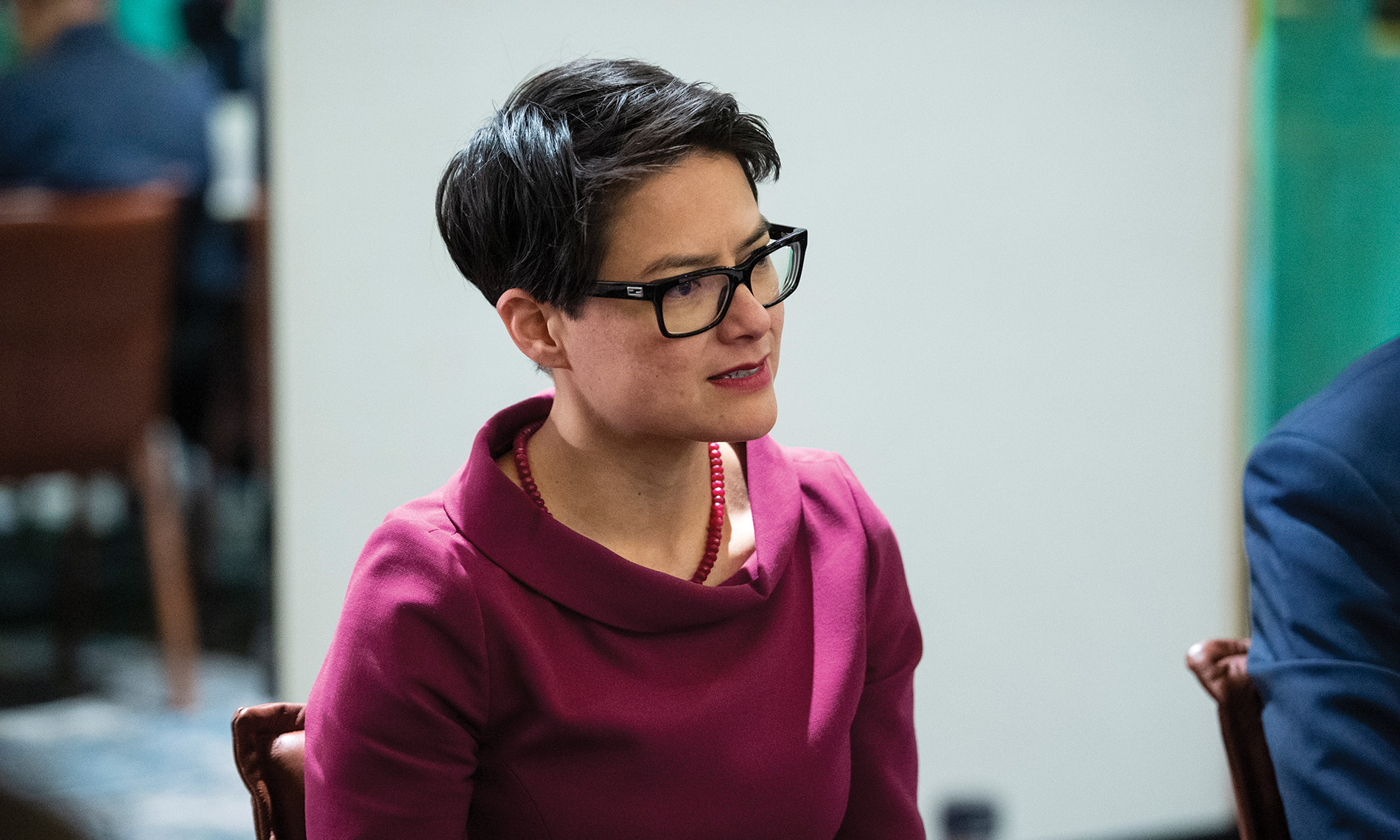
María Gabriela Alvarez de la Fuente

I began my career as a legal assistant at court while I was still studying law at Buenos Aires University. After graduating law school, I spent three years in private practice before moving to BASF Argentina S.A. as an in-house corporate lawyer. In 2003, I had seen a job advertised at BASF and I found it really interesting. While I had really enjoyed my experience working in private practice, I wanted to feel part of a company. I applied for the role, and thankfully was successful! The switch from private practice to an in-house role was not a difficult one for me, and I found that I really enjoyed working with people from across the different departments, getting to know what the business was about, and contributing to its success. Since then, my experience has been solely as an in-house lawyer. I spent 12 years at BASF, during which time I received several promotions, and then followed that with a shorter stint at adidas as their director of legal and compliance (Argentina, Uruguay, and Paraguay). I then joined Colgate-Palmolive in May 2016 as its regional legal director, Southern Cone. Colgate-Palmolive, the US worldwide consumer products company, focuses on the production and distribution of household, healthcare, and personal care products and operates in Argentina through its subsidiary Colgate-Palmolive Argentina.

In my current role, I have simplified several processes within the legal department, and have also worked hard to bring the legal team closer to the rest of the company – and the rest of the company closer to the legal team. I encourage colleagues from other departments to feel free to contact our legal team early, believing they will receive good advice from us, not just as lawyers, but as business partners. I believe that my attitude of openness and transparency has definitely proved successful. In the past three years, I have built up a rich portfolio by supporting projects that involved the launch of new products and technologies, facing challenges from competitors regarding product claims, as well as handling various business restructuring and litigation cases that are still ongoing. At the heart of everything I do, I aim to show that lawyers are not just a cost centre, but are creating value for the businesses in which they operate. I lead my team by example, and concentrate on providing commercially astute and solution-focused advice that enables the business to be successful in the marketplace while also protecting its business model.

While I have managed to build a strong reputation at Colgate-Palmolive for being committed to my vision, I believe I am also known for having a strong focus on people and being passionate about developing a diverse legal team to deliver results.

At Colgate-Palmolive, we are a small team of three people – all women. However, I have always managed very diverse teams during my career in private practice, and in-house at BASF and adidas. Diversity for me, though, is not only about gender; it is about embracing all the different ways of thinking. When I worked for BASF and adidas, I had teams that were very diverse: different ages, sexes, social backgrounds, and points of view. The more diverse a team is, the more creative it can be.

“Diversity for me is not only about gender; it is about embracing all the different ways of thinking.”

As well as being responsible for building my own diverse legal teams, I also promote gender equality across the business. I feel as a leader I have the responsibility to promote diversity. Within Colgate-Palmolive, I am the internal sponsor of the Colgate Women Network in Southern Cone territories, which is the region under my scope (Argentina, Chile, Uruguay, and Paraguay). The Colgate Women Network is a global initiative that fosters an inclusive and diverse environment, and different activities are carried on in every country around the world. But the initiative has local implementation too. In Southern Cone, we organise activities and lectures and try to develop policies in order to help women grow in their careers with Colgate. For example, we organise inspiring breakfasts with women leaders in the region. These are often in an interview format, so that attendees can get to understand their experiences, the obstacles those women had to deal with while they forged their careers, and how they have managed their work-life-family balance. In 2019, we organised lectures on topics such as leadership, personal branding, and personal finance.

I am also committed to promoting gender equality outside my work environment, and I am currently involved with organisations such as IDEA to help promote diversity and inclusion in law firms and companies. While there is certainly a long way to go before there is gender equality in the legal industry, it is not the only industry in which it is more difficult to be listened to and to get ahead if you are a woman. I used to have that feeling – of not being listened to – especially when I was younger. But, the world has changed a lot… and it is still changing. Fortunately, in my current job, I don’t experience this anymore, and I’ve certainly been able to move ahead with my career. What I have observed, though, is that in private practice, the pace of change is much slower: the number of female partners is still much smaller than the number of male partners.

Quotas, of course, could go a long way towards solving the gender imbalance in the legal industry, but I do have mixed thoughts about them. In some cases, I believe quotas could be a good way to help those women who could not have got to a certain place without that kind of help; and I believe they can be helpful, especially in industries in which there is still a lot of work to be done with gender equality. However, using quotas to simply make up the numbers won’t work – for true equity and equality to take hold, there has to be a cultural shift and a change of mindset about women’s place in the workforce.

Denise Guillen Lara

Roman jurist Dompia Ulpianus defined justice as ‘the continuous and perpetual willingness to give each one his own’. This concept of justice has always resonated in my heart; I have always seen justice as the solution to avoid conflict in a large community. This belief was especially relevant to me when I was growing up, given that I was part of a large family consisting of three brothers, one sister, and of course my two parents. For me to survive in this large community, justice had to be implemented amongst our group so that each of us received what it was of our own! I believe it is very important to acknowledge that everyone has a place in their community; my place was as the ‘confrontational member’, always trying to assert and achieve justice. It is no wonder, then, that I decided to study law! I paved the pathway of my profession out of my passion.

Like many other lawyers, I have been both in-house and outside counsel. I started my career working in a big law firm, which allowed me to learn the fundamental skills that have helped me along my career: thorough thinking; in-depth analysis; problem solving; network building; technology tools usage; courage to take new opportunities; understanding of and exposure to international markets; and business ethics. I was also lucky to learn from several role models who showed me how important it is to ‘walk the talk’.

I am an extrovert by nature, and this was particularly useful in my private practice career. It allowed me to confidently interact with senior partners, and to learn from them and their experiences; I emulated what they did to achieve a similar result. After several years working in private practice I took my first in-house role – as general counsel of General Electric (GE). Key to my decision to move was the opportunity to acquire new skills and to learn from new role models. In fact, a big motivator for me when I consider taking on new roles is the leader who I will report into. I look for someone who will support and encourage my constant professional and personal development. Also hugely important to me is that my employer fosters a culture of inclusion and supports the development of female talent. Specifically, I look for programmes and policies that allow women to have a work-life balance, for example remote working and maternity leave.

I have been extremely lucky not to have experienced gender-based barriers during my career. I have never suffered harassment; my bosses have been my biggest sponsors (I have been part of several mentoring programmes); and I have a good work-life balance. I was even once hired during my last month of pregnancy. Unfortunately, this is not the case for all female talent in Mexico. As demonstrated by a 2018 study developed by AbogadasMX jointly with CIMAD and Marea Consulting, there are both internal (personal and unconscious bias) and external barriers (organisational structures) that women face in progressing both in private practice and in-house roles, and that organisations and law firms must do better to create equal opportunities for women. That should start with those who are in leadership positions.

Ultimately, all organisations should be a reflection of the people working for them, and it is the responsibility of leaders to build a culture where the success of the company is intrinsically linked to its inclusion of female talent and to creating equal opportunities for all talent. Implementing programmes and policies that allow for this to happen are vital in eliminating both the internal and external gender-based barriers. When I think of my own experiences I would say that for women in the legal profession, companies (i.e. in-house) are doing a better job than law firms. While law firms most commonly implement special considerations for women at a senior level, in-house counsel seem to have the same opportunities at every level.

One final observation, though, is that neither law firms nor companies tend to have formal mentoring programmes or networking opportunities. The biggest barrier for women in Mexico, I believe, is the perpetuation of ‘machismo’ culture, something that even women seem to believe in and uphold. Approximately 95% of the women lawyers who participated in the AbogadasMX study still believe that they should be the ones taking care of the children and the house. Women lawyers who become mothers often decide not to continue working after having children, or if they do decide to continue, they decrease substantially the amount of hours they work and do not take on further responsibilities. This strong internal bias was shown to be almost equal in private and in-house practice; there was a slight trend towards private practice, mostly due to the need to demonstrate long hours worked because of the hourly billing structure.

“It is the responsibility of every woman in a leadership position to help other women reach their full potential.”

One of the biggest challenges I faced when I was hired to hold the position of LatAm regional counsel was the constant travel. I needed to make sure that my two daughters were taken care of, that they were safe, happy, and attending school. I was able to overcome the obstacles by building a support network (my sister, the nanny, school parents) to help me with the day-to-day duties. All of them have been amazingly empathic and have given me support when I needed it. I have also been able to work remotely, which allows me to compensate for the time that I travel by staying at home with my girls while I work. It’s also really important for me to communicate to my girls that I have to travel as part of my job, but that when I do they will always be well taken care of.

In my current role at Nielsen I help to promote diversity in many ways. Alongside my role as legal director, I am also head of the compliance and integrity programme. It is my job to make sure that no one is discriminated against in any way. I manage all harassment cases and impose penalties, and I make sure that all employees are treated equally and fairly. I am part of an Employee Resource Group (ERG) called WIN (Women in Nielsen), and participate in different activities to help more women achieve leadership positions. I have been invited to share my experiences with other women globally to inspire them, and am currently participating in Nielsen’s global mentoring programme, acting as a mentor for a female talent based in the US. It has been a real thrill to be able to influence the personal and professional development of another woman.

External to my role with Nielsen, I am a board member of AbogadasMX, an association dedicated to helping women lawyers achieve leadership positions. I am also part of the board of INCAM, the longest-running bar association in Mexico striving for gender equality. I am convinced that it is the responsibility of every woman in a leadership position to help other women reach their full potential and progress in their careers. We need to ‘send the elevator down’ to new talent, and we need to see diversity and inclusion of female talent as a competitive advantage.

We are lucky at Nielsen that our CEO is also our chief diversity officer, because he believes that diversity and inclusion are inextricably linked to the overall success of the business: to drive systemic change, we look for diversity in people and thought, and aim to be consistent with our operating principle to engage, include, and decide. We have identified the need for accountability; by this we mean that every Nielsen associate owns diversity and inclusion efforts, and their involvement is linked to performance processes. This helps to ensure that every one of our associates is able to reach their full potential. The entire leadership team now serves as sponsors for ERGs; they are personally accountable for how they are driving diversity and inclusion and Nielsen expects that all people managers become active participants either in ERGs or as mentors. We are also working to achieve gender equality in top leadership positions.

It is important to me to build a diverse team. I lead by example, because I have learned from the example of the leaders that I have reported to. I am also in favour of hiring outside counsel that have diverse teams, because outside counsel should be a reflection of the in-house culture of diversity and inclusion. I need to lead by example in hiring providers that have diverse talent in leadership positions.

I am 100% in favour of gender quotas, but I also believe that positions should be occupied by the best talent. There are always excuses that quotas limit to hire/promote the best talent, but in my point of view this is only an historical excuse not to move forward with quotas and achieve gender parity.

If I could give advice to myself at the start of my career I would say ‘count your blessings every day and appreciate what you have achieved. However, don’t ever think that you’re at the finish line. There are always new opportunities for achieving new goals and it is more important to enjoy the process of achieving the goals than achieving the goal itself. Constant improvement of yourself will produce happiness, pride, joy, and self-accomplishment.’ n

Andrea Camargo

Ever since I was a little girl, I knew I wanted to have a job that would allow me to help others, and, like most law students, I wanted to be part of the dream of ‘justice’. When I graduated from high school, I immediately enrolled in one of the top law schools in Colombia, and ever since, I have not stopped learning. I declare myself an eternal student! I am convinced that one should never stop learning, because law and life are in permanent transformation. You have to be ready to reinvent yourself every day.

After law school and at the same time that I was working, I decided to pursue postgraduate studies with various universities in Colombia. I first studied commercial and corporate law, then financial law, and finally international law. I also wanted to expand my horizons, and so I knew I had to leave my country and travel around the world. I am convinced that this is the only way to understand other cultures and ways of thinking. First I went to France to study international law before moving to Berkeley in the United States to study international trade and commerce. From there, I was awarded a scholarship to study in Spain, where I did a master’s degree in corporate law and an international master of business administration at IE Business School, one of the top five ranked schools that year. I wanted to get an MBA from one of the best-ranked universities because I wanted to fight the stereotype that women and lawyers are ‘not good with numbers’. I was tired of the prejudices of my colleagues who graduated in engineering or financial areas. Also, I wanted to give them better advice by speaking their ‘own language’.

I started my professional career in private practice, before leaving to work for several years in financial institutions both in Colombia and in Europe. Those positions then led me to my current role, as legal director of an infrastructure company in Colombia (Odinsa S.A.). I decided to take an in-house role rather than to continue with private practice for many reasons.

First, I believe that working as an in-house lawyer allows me to have a better and more complete knowledge of the business. I enjoy working more closely with the financial and commercial areas, and being surrounded by people of different professional and cultural backgrounds. I am convinced that this kind of diversity is much easier to find in a company than in legal private practice. I also believe that working as an in-house lawyer makes me a more rounded lawyer and human being, since it allows me to hear and discuss different points of view that do not always coincide with my owns views. One of the other reasons I prefer working in an in-house role is that it allows me to have a better balance between my personal life as a mother of two, and my professional life. This is due to the fact that companies are more prone to provide flexible working than law firms.

Of course, all professions are affected by gender inequalities, but I do believe the legal industry is still one of the more male-dominated industries, probably because of its patriarchal tradition. Even though there is a larger proportion of women law students, after they graduate men are offered better job opportunities than those women. It is a paradox that the profession that should be in charge of providing justice is so full of inequalities. The patriarchal configuration and structure of the legal industry moves law away from its social function and its task of contributing to equality.

Unfortunately, this means there are still many barriers for women in law. During my career I have seen several examples of this:

“We need to teach our girls that they can be whatever they want to be.”

Co-workers and bosses usually assume that if you are a woman, you are not going to be able to take charge in big cases or projects. Women have to prove their value before they are granted trust and confidence.

Women in law are judged by first impressions. As a woman, I definitely feel I have been compelled to dress in a certain way – to ‘dress as a lawyer’ – to be taken seriously, which simply does not happen to male lawyers.

Salaries are not equitable between men and women. Women lawyers are paid less than their equally qualified male colleagues.

Women are usually in middle management roles, but they hardly get to leadership management positions.

It is very difficult for a woman who is also a mother to become a partner in a law firm or to have a post of responsibility in a company, because it is not easy to find balance between personal and professional life. Moreover, our culture tends to dictate that the woman is the one who is expected to take a step back from her career to raise children.

Legal work usually requires you to attend social commitments in addition to your office work – this is always a challenge when you are a mother.

Women in law also usually have to face sexist conversations and jokes from colleagues or clients.

I have seen female lawyers sexually harassed by their bosses.

From my own experience, I would say that the main challenge I had to overcome was to stop my career when I became a mother. I knew that I wanted to spend several months with my newborn children and I was sure that this would halt my career progression – which is exactly what happened. After spending one year with my two children (who are now six and seven years old), it was very difficult to find a job with the same level of responsibility to the one I’d had before. The salary was also an issue, and I was not able to get a job with a similar or higher salary than the one I had before I was pregnant. In fact, I had to start all over again, with a job and a salary at a lower level. Even now, my former male colleagues have better salaries. This was, and still is, the cost of being a mother.

As working women I believe that we all have responsibility in closing the gap between men and women. Being the mother of a boy and a girl, I want them to have the same opportunities. There are many actions we can take to help other women to reach the full potential of their careers:

First, education is fundamental. We need to teach our girls that they can be whatever they want to be. There should not be professions reserved only for men. We are equally capable of performing any job. When boys and girls are equally confident in their abilities, and are given equal opportunities, the gender gap narrows.

Second, women must support other women. Build networks, promote each other, and demand equality in salaries.

Third, we must vocally support policies that promote diversity and inclusion in the workplace.

Fourth, we must adopt flexible working policies that allow women to have a real balance between their family and professional life.

And finally, we have the responsibility to make the problem of gender inequality visible to society through publications, forums, and seminars. Be vocal about the need for equality.

I believe that quotas may help and may be a first step to working towards gender equality. However, I am convinced that they don’t always translate into more power or gains for women. For me, quotas are only one of the tools that can help to solve the problem, but they are not the only tool. Other mechanisms, such as the ones above, are also necessary to achieve equality.

I am also profoundly convinced that as women leaders, we should build teams that are diverse in every sense. We need different genders, cultures, and socioeconomic backgrounds present in our teams so that we can get to better solutions. Different opinions and points of view add value, reinforce the commitment and pride of belonging to a team, improve the richness of the analysis and therefore, the decision-making, and increase the creativity and innovation that support the sustainability of the company. I try to promote these kinds of teams in my work. For any woman considering a career in the legal industry, I would give the advice I gave myself: ‘Dream big: everything is possible. You are just as qualified as any man to perform any job you want. Don’t accept stereotypes, fight inequality, and don’t ever let anyone else tell you what you can or cannot do’.

Andrea Convalia

After graduating from law school at Pontificia Universidad Católica de Chile, I began my legal career as many lawyers do: in private practice. I spent four years with Leighton & Compañia, where my clients were the biggest banks in Chile. I represented them at court, and also assisted their internal departments in M&A and real estate. After my time in private practice, I actually stopped practicing law, and became a stay-at-home mother; I also spent that time trying to become an entrepreneur – but (fortunately) I failed! It was during this time that I realised what it is I truly love to do, and that is to practice law.

However, I decided I did not want to return to private practice, and instead started looking for in-house counsel roles. In 2009, I was offered a role with Cencosud S.A., one of the largest and most prestigious retail conglomerates in Latin America. I stayed with Cencosud S.A. for five years, where I was responsible for banking, insurance, and regulated markets. I was also responsible for leading the corporate law team.

In 2014, I joined the L’Oréal Group as general counsel for Chile, and three years later was given the added role of ethics correspondent for Chile, and data privacy officer for L’Oréal in Chile and Peru. For me, the best thing about being an in-house counsel is that it gives me the platform to combine the excitement of a fast-paced business world with what I’m really passionate about, which is the law. Being able to engage the management team and be a part of the company’s core business, and to view how the company relates to consumers and the market as a result of decisions made based on my own counsel is what ultimately allows me to feel that I made the right career choice.

My team and I are focussed on making the legal department a true business partner. We are changing our approach to technology, while also working collaboratively; we are driven by our passion to shape innovation in the legal industry. To become an important part of a business and to be able to make a difference in society is priceless. It does not make sense to wake up every morning without passion!

Aside from the practice of law, the other thing I am very passionate about is diversity and inclusion, and specifically gender-based issues. I am lucky that L’Oréal is a company that works hard to support these areas. As an active supporter of the UN Women’s Empowerment Principles, at L’Oréal we are involved in many initiatives that aim not only to improve the situation of women both in the private and public spheres but also to recognise the contribution of women to the progress of humankind (namely via the L’Oréal Foundation ‘For Women in Science’ programme). This focus on women’s rights is part of our general diversity policy, which also covers non-discrimination on the grounds of disability; marital status or family situation; sexual orientation; age; political and philosophical opinions; religious belief; union activity; and ethnic, social, cultural, or national origin. The work we do with our suppliers and subcontractors is also a key part of our programme to respect human rights, which is why for me, the representation of women within a legal firm is always a key criteria for selecting my panel firm partners.

“In my own experience, motherhood is a great challenge for women to achieve their professional full potential.”

In my own experience, motherhood is a great challenge for women to achieve their professional full potential. Because I am responsible for leading a team, and am therefore in a position to take and advise on organisational decisions, I am a strong advocate for those women who are about to go on maternity leave or are returning to work after being on maternity leave. I believe that it’s important for companies to provide support beyond what the law states, and I also strongly believe that you should be able to rely on other female colleagues to become a support network during this time. As women, it is important to have the right conversations (which are sometimes tough conversations) to set expectations on what we are willing to do and not do; we must help other women to be proud of their work. This is especially important in the Latin America culture, as it is so paternalistic. That I why I feel very proud to work at L’Oréal, a company that aims to empower women on a daily basis through different programmes and initiatives.

Outside of my role at L’Oréal, I am also a member of the LWOW (LawWithoutWalls) community, a part-virtual experiential learning initiative designed for practicing and aspiring lawyers. By leveraging intergenerational, cross-cultural, and multi-disciplinary exchange, the community brings a human-centered design perspective to law. LWOW unites students from more than 35 law and business schools around the world to create innovation at the intersection of law, business, and technology, while developing skills essentials to any modern professional. It focuses on three core areas: upskilling and reskilling; transforming culture and relationships; and creating innovative solutions to real business-of-law challenges.

One thing I have become more convinced about throughout my career is quotas. During my time as a law student and the first years of my career I believed quotas were not needed, because talent would be recognised no matter what. But a couple of years ago, during a talk with Bruce MacEwan, he quoted that ‘the definition of insanity is doing the same thing over and over again, but expecting different results’ and it really hit me. Women have been struggling for around 70 years to be respected and included among the leaders of any organisation, and nevertheless the efforts and the women participation rate on boards, governments, etc. – it’s nowhere near equal. We need to start doing things differently. And in my own circle of influence, that is exactly what I am trying to do.

A&O re-elects Dejonghe for a second term after heavyweight challenge

Wim Dejonghe

After what was viewed as a too-close-to-call contest, Allen & Overy (A&O) partners have elected Wim Dejonghe as senior partner for a second four-year term.

The move is a vote of confidence for Dejonghe (pictured), who had stood against another heavyweight candidate in the form of Philip Bowden, the City giant’s well-regarded banking co-head. The election also came in the wake of a contentious failed bid for a US merger. Continue reading “A&O re-elects Dejonghe for a second term after heavyweight challenge”

‘Healthy competition’: LOD comes full circle with launch of challenger UK law firm

Simon Harper

Lawyers On Demand (LOD) is launching a ‘challenger’ law firm to compete with traditional firms on providing advice to in-house teams across the UK, three years after the business was first launched in Australia.

The business – LOD Legal – is staffed exclusively by lawyers from an in-house background, with the team currently in excess of 30 lawyers comprised of new full-time employees and existing lawyers from the core LOD team. Like LOD, the business operates under a corporate structure. Continue reading “‘Healthy competition’: LOD comes full circle with launch of challenger UK law firm”

Ashurst enters US West Coast with four-lawyer Santa Monica projects play

Ashurst has launched a four-lawyer transport and infrastructure-focused base in Santa Monica, its second US office after New York.

The firm announced today (25 February) that projects partner Anna Hermelin has relocated from the firm’s Tokyo office to become managing partner of the new West Coast operations in the Los Angeles County. Continue reading “Ashurst enters US West Coast with four-lawyer Santa Monica projects play”

Freshfields loses key rising star Newhouse as Latham renews City M&A push

Latham & Watkins London office

In the latest blow to the UK Magic Circle, Latham & Watkins has hired one of Freshfields Bruckhaus Deringer’s brightest young partners, Sam Newhouse.

The US giant confirmed today (25 February) its most significant move in the UK public company M&A space since the hire of Allen & Overy’s well-liked M&A partner Ed Barnett in 2017. Continue reading “Freshfields loses key rising star Newhouse as Latham renews City M&A push”

Revolving doors: Taylor Wessing bolsters City real estate bench as Clydes revisits Keoghs for Manchester hire

In a muted week for the City recruitment market, Taylor Wessing made the only noteworthy London hire while Clyde & Co focused its attention on its Manchester office, revisiting Keogh for another lateral.

Taylor Wessing hired City real estate lawyer Matthew Swainston from Forsters where he was a partner for more than 14 years. Continue reading “Revolving doors: Taylor Wessing bolsters City real estate bench as Clydes revisits Keoghs for Manchester hire”

London lags global growth as Debevoise turnover breaks $1bn barrier

City of London

US firm Debevoise & Plimpton has increased London revenue almost 9% following a strong year in which global turnover broke through $1bn.

London revenue hit $151.6m, up from $139.3m last year. This growth, however, lagged an impressive 13% uptick globally to surpass $1bn from $929m last year. Firm-wide revenue per partner increased to $7.62m from $6.83m in 2018, although the London figure stayed almost flat at $7.43m, compared to $7.33m last year. Continue reading “London lags global growth as Debevoise turnover breaks $1bn barrier”

#MeToo: SRA decides against Freshfields’ Beckwith misconduct sanctions appeal

Solicitors Regulation Authority SRA

The Solicitors Regulation Authority (SRA) has decided not to appeal the sanctions handed to former Freshfields Bruckhaus Deringer restructuring partner Ryan Beckwith by the Solicitors Disciplinary Tribunal (SDT) for misconduct last October.

The decision brings to a close a long-running and uncomfortable saga for the Magic Circle firm after Beckwith’s sexual activity with a junior member of his team was found to be in breach of principles two and six of the solicitors’ code of conduct, requiring solicitors to ‘act with integrity’ and ‘behave in a way that maintains the trust the public places in you and in the provision of legal services’. Continue reading “#MeToo: SRA decides against Freshfields’ Beckwith misconduct sanctions appeal”

Alberto Vergara, Head of Litigation, Scotiabank Chile

I would say that our legal team is more advanced than other legal teams because the whole bank is making efforts in the area of technology. There are other financial institutions and other companies in other areas that are behind us – sometimes in a very dramatic way – because they don’t, in their businesses, feel that there is an urgency in making the whole business digital. So, obviously, we have an advantage in that area. We also have an advantage because we are an international company. But, on the other hand, sometimes small companies and new companies have an advantage because they start with digital. For us, we are advanced, but sometimes you have to change the habits of people who have several years in the industry – that they have to now learn how to become digital. That’s a difficult issue. Again, we are better in comparison with a lot of other legal teams, but I would say that smaller companies and start-up companies – their legal teams are probably more advanced than us.

Mainly, we use external providers that develop commercial products for the legal industry in Chile. We have different systems: one in the dispute resolution area called Case Tracking, to review the status of your case in the courts. It’s software that is based on cloud computing technology. That provides you with several functionalities that allow you to track and manage your cases and prepare reports, and so on and so forth. It’s a very friendly software, and it’s available for any company or any lawyer and in other Latin American countries, and it’s been very useful for us.

I would say that the challenge is to increase the use of technology. It’s a growing area and there is a big focus on making the whole bank in the legal area digital. So that’s the goal, and that’s the big challenge but, on the other hand, the problem is that you have to invest a lot of time, a lot of money, and especially education in your internal and external stakeholders. So, it’s very challenging, because the world is urging banks, especially in legal areas, to make a big bet on technology and digital tools but, on the other hand, you don’t have the proper resource to do so. Also, the ‘business as usual’ on a daily basis sometimes makes it harder to make that change. I would say we are trying to increase the time and the money that we are spending on digitalisation, but it is difficult to make a schedule or to develop a very precise and clear plan to do so.

IT is often more focused on the commercial side, so it’s difficult in any business to get attention to the legal area. I would say everyone is very keen on improving their digital relationship with the clients, and let’s say the back office of any business is out of their priorities. So, I would say that IT areas are 90% focused on the digitalisation of the relationship with the clients.

I would say there are three main issues where technology is dramatically changing the legal profession.

In first place, the technology is allowing legal areas to do business with less support staff. Right now, you need so many paralegals or so many assistants, so lawyers are increasingly doing, with the support of technology, tasks that in the past would require non-lawyer assistants. That’s the first dramatic change, because it’s making the legal teams – in some cases – all lawyers, and they don’t need too much support from other areas. That probably will increase in the future, and especially general lawyers will very much do everything by themselves. That’s important.

In second place, I would say that the technology is making it so that the legal profession is losing the human touch in a way that, right now, you can negotiate and close a big deal without meeting the other party in person. That’s a dramatic change, because it allows you to work remotely, even in complex fields. The challenge is that by losing the personal touch, it will hurt the lawyers in their capacity to develop negotiation tactics and so forth. You save cost in matters like travel and meetings, but on the other hand, you will lose some useful tools that only the experience of personal relationships provides to lawyers.

In third place, I would say the big question is: how will AI shape the legal profession? Right now many people are talking about AI, but nobody knows for sure how it will work in the legal profession. That’s an open question, and it may imply that some legal teams will invest a lot of money in AI but at the end it will prove useless. On the other hand, some legal teams will find that AI is useful in some areas: for example, smart contracts. In service industries, in which you have a massive contract that you have to sign every day with clients, artificial intelligence in smart contracts could be a useful tool, but again, probably an open question. There could be an important change regarding managing caseloads and case precedents in order to improve your litigation skills but, so far, I haven’t seen any programme that provides you with an edge without an important expense of money.

The innovation ecosystem in Chile is growing, and I would say there are some forces that have driven that growth. Firstly, Chile has been experiencing an economic growth over the last 30 years, which allows us to buy and develop technology. The Chilean economy is also a very open economy, which allows you to look for external experience and allows you to buy and import any solution off any country, without any problem. Also, since we are an open economy, it also provides you an incentive for Chilean companies to expose themselves to other areas. And lastly, since 2008, the Chilean government has been investing big in improving the tech sector – providing incentives to invest public money in the development of new technologies here, and that has been an important governmental push.

Carolina Carrasco, General Counsel, Alstom Chile

Our team is looking for new ways of working and new systems to improve legal work. We are looking for new ideas and resources, in order to become more orientated towards implementing artificial intelligence into our work, and this is just the beginning. We recently reviewed new systems that are currently on the market, but before anything can be implemented, in our case, it needs to be validated and implemented by the central offices based in France.

Recently, I was in a regional legal meeting comprised not only of lawyers, but contract management, insurance and compliance people. In this meeting, we spoke a lot about how we are going to manage artificial intelligence and new technologies. Also, how we can manage automatisation in the best way.

For instance, since I work a lot with contracts and negotiations, it would be very good to have a reliable system where I can find worldwide information. Maybe it exists, but I am not aware of it as this is a new issue to deal with for a lawyer of my generation. I am in charge of Chile, but I have also been in charge of other countries which I am not overly knowledgeable about, such as Colombia. In that situation, I have to go to a local legal firm for assistance.

It is difficult for me to research case judgments from different jurisdictions – it would be great to have a system that would make those processes and daily tasks easier. Finding information like this mostly means I have to go to an external lawyer. I do not work in litigation – it is not my area – but sometimes when I am putting together a legal opinion, I need information on judicial cases. At this moment, this information, for a non-litigation lawyer, is not easily found. And this only refers to automatisation and search.

One of the barriers inherent in implementing legal tech comes internally. I know there are certain constraints on my company to implement new systems as there are some systems already implemented at our central level that sometimes don’t fill all the local needs on automatisation or otherwise, which represents security risks.

The circumstances have not obliged me to seek new support systems as it hasn’t been until recently an issue or something that was considered not only a tool but really a resource for optimisation. Obviously, it would be good if external lawyers used more technology. Ultimately, technology could help lawyers deliver solutions within a shorter period amount of time. But still, I believe that the options available to external lawyers, for example to find case law, are the same as the options that are available to me. In the end, we experience the same difficulties. The only difference is that often I do not have the time to do the research myself.

When it comes to legal technology and innovation, I think the legal sector is falling behind other professional sectors in Latin America. Consider that most doctors have artificial intelligence working with them in order to do surgeries, yet these scientific professions are very different to the law. Lawyers tend to be – maybe because of the past – counsellors of the family or of a company. They tend to be more focused on a close relationship with customers than implementing new technology.

The new and upcoming generation is different. My perception is that, in the last five years, new lawyers coming into the market are much more technology- and AI-oriented. They see technology as an asset – something that could be very useful. I think the view of technology and the role it plays within our profession will eventually change, but no one can tell you how quickly the market will allow the process to be implemented, nor the cost of such optimisation.

Looking to the future, I can imagine working with programmes that would speak to you like a robot. Lawyers will have access to a lot of information that will help you make the right decision much faster in the right situation. I know there are some programmes already out there in which you can enter the facts of a case and the programme helps you make a decision regarding a legal issue based on previous decisions. In this case, artificial intelligence will be able to help you make legal decisions quickly. This is happening now. As a result, it means that your workload will be reduced, because part of the work will be done by technology – the software will only be confirming what you have already analysed in a specific situation, or maybe challenge that opinion so you will have new tools to analyse the situation again. I can imagine the future of legal tech looking something like that – and if things were to head in that direction, it would be very interesting. As a consequence, I believe that some legal professionals are starting to fear artificial intelligence, as they believe that it has the potential to replace lawyers.

I do not believe that AI has the potential to disrupt the legal profession. Even if you feed an AI system all of the information, you will still need a lawyer to go through the process of feeding the information into that system. AI may do part of the job as it seems difficult to imagine now AI orienting customers face to face, negotiating, issuing a legal opinion, or litigating in front of a judge. Closeness is an essential part, nowadays, of our job. Times are changing, and we are always working towards becoming more creative and innovative. But, at the end of the day, I see people are still reluctant towards technological change.

Maybe in the future it will be like the movies: everything will be done in a way which is hard to imagine at this moment. At the same time, thirty years ago it was hard for me to imagine speaking on a smartphone. Now I do almost everything on my smartphone.

An Honest Day’s Work

Since the beginning of the internet, the potential for technology to be exploited and misused has been a primary concern for policy makers. As technology has continued to expand and play an ever more prominent role in our everyday lives, these concerns have only broadened, becoming both more frequent and unique – and with each new technology comes a host of new ethical concerns.

As technology continues to evolve in the business world, while the legal profession may have been slow to adapt and progress, times are changing. The development of technologies such as machine learning and artificial intelligence are being applied to legal in an effort to reduce overheads, improve accuracy and boost efficiency. But despite the advantages legal tech brings, there remain concerns around technology and how it may implicate professional ethics.

In the research that underpinned this report, 18% of those surveyed said that implementing new technologies within their teams had raised ethical questions. On its surface, this would suggest that in the legal space, the use of technology was almost always done in an ethical fashion and didn’t raise concerns. But speaking in more detail with some of those counsel who had faced ethical issues painted a different picture, suggesting instead that many general counsel are not yet attuned to the new types of ethical questions arising.

Ethical by design

Just how technology is developed for, and used within, various legal functions is one source of significant ethical debate – particularly given the inherently secretive nature of the profession. One general counsel working in the banking sector, describes some of the ethical issues encountered with how legal software is applied.

‘In Brazil, we have a major problem dealing with the volume of mass litigation cases involving consumer and labour issues that we face. Here at the bank, we currently have over 120,000 active lawsuits.’

‘To help deal with this, I have software that allows me to access cases to find out what judges are doing, or have done, in cases related to my company and/or my competitors.’

Having software that enables counsel to quickly view other similar cases from the past is not revolutionary, but having cases analysed in order to provide suggested arguments according to the jurisdiction and the judge is.

‘The information is public, but this system can offer me suggestions on which versions of arguments would be best for certain judges. It can also help with predicting what may happen in my case.’

‘Using this, I can build a better defence or consider alternative options. For example, if the software revealed that I have a 70% chance of losing a case, I can use this information to propose that we may be better off agreeing to settle the case. Then, when it comes to working out a settlement, I have the statistical information that would allow me to know how many other similar cases have been settled. That provides me with the information that will help me decide how much money I should settle a lawsuit for.’

Using statistics and predictive capabilities in themselves is not inherently unethical, but the potential to build on this system in unethical ways is apparent. The potential for alternative sources of data that could be used to help build a better profile on judges and predict their behaviour is vast – social media is just one prominent example of this.

‘This kind of concern is being raised, but it is not a major concern right now. What may be an ethical concern is the data itself. The real problem arises only if you use confidential information, or if the data could be used to make correlations,’ says Marcelo de Araujo associate professor of philosophy of law at the Federal University of Rio de Janeiro.

De Araujo has worked closely with developing ethical protocols and codes for emerging technologies, including machine learning. He says that the data used to teach these systems can itself be an unintended source of ethical issues.

Using statistics and predictive capabilities in itself is not inherently unethical.

‘Machines can be influenced by human bias and emotions. If the original data is biased, the output delivered by the machine will also be biased. Machine learning will typically find out underlying patterns in the data set, a task that would take too much time and expertise for human beings to do unaided by AI systems,’ he says.

‘But if the original data set contains an unusual number of references to decisions that, for instance, marginalise black citizens, chances are that the prediction suggested by the AI system will reflect that kind of pattern.’

Alejandro Fernández R-B, head of legal at Cotemar, has grappled with similar issues.

‘In Mexico, when you have a labour case, mainly it’s because the former employee feels that he was entitled to receive a bigger compensation. Some cases, they are right; some cases, they are wrong.’

‘But the software might recommend that I can settle with them for a lower figure that they are entitled to. So, that is the ethical issue. Because in some part, I want to, and it’s my duty with the company, and on the other hand of course, I want to be fair with the former employees. So, that is an ethical issue that I am seeing as a result of this software.’

Show me the data

Since the implementation of the General Data Protection Regulation (GDPR), safeguarding data has not only been an ethical responsibility for general counsel, but a legal obligation. Many countries across Latin America have followed the lead of the European Union and aligned their existing regulations or introduced new laws around data protection.

Brazil’s suite of data protection laws are set to come into force in August 2020. The Lei Geral de Proteção de Dados (LGPD) stands to have a marked impact on business and broader society, with protections possibly set to be enshrined in constitutional law in the future.

‘The public at large increasingly perceives the protection of their personal data as a pressing question. There is now a new bill for an amendment to the Brazilian Constitution that would turn the protection of personal data into a fundamental right,’ explains de Araujo.

‘Most citizens seem to be aware that they are giving away too much personal information online, and that it is far from clear what private companies are currently doing with their personal data. Over the last few months, there have been reports of two cases of technical failures which compromised the personal data of 28,000 citizens in one case, and 70 million in another case.’

Fair and Available

There are a number of ethical rules that apply to general counsel, irrespective of technology. However, as legal tech becomes more prevalent, new ethical dilemmas begin to arise. In Brazil, AI tech is being introduced to reduce the time it takes to settle disputes.

‘The Brazilian supreme court announced in 2018 that an AI system called Victor was being tested in order to speed up court decisions,’ says de Araujo.

‘Currently, the court may take as many as ten years to settle a dispute. Many citizens die before they can obtain the benefits of a favourable decision.’

Victor is an artificial intelligence tool developed in partnership with the University of Brasília. The AI software is designed to process thousands of court decisions already made and identify links between cases. By identifying and analysing previous precedents, the aim of Victor is to increase the speed of legal proceedings through the development of neural networks. Technology has the potential to play a major role in improving legal services in Brazil, but de Araujo believes that algorithmic bias needs to be accounted for.

‘There has not been much public discussion on how Victor is supposed to deal with algorithmic bias. Speeding up court decisions would be a huge improvement in the Brazilian legal system. But quicker decisions will not promote justice for ordinary citizens unless unjust patterns of decision-making in the past are also avoided in the future. For now, it is unclear how the Supreme Court intends to address this issue.’

To avoid transferring prejudicial precedent to future cases, more oversight and transparency within machine learning services is required.

Says de Araujo: ‘The problem could be addressed by examining what exactly the system is doing as it provides scores for risk assessment. But developers may be unwilling to make their AI systems more transparent. They fear that, by making the system more transparent, other developers might take advantage and copy their technology.’

In both of these cases, the culprit was a government institution, heightening public awareness of data-related issues at a time when business is preparing for increased scrutiny with the introduction of the LGPD.

‘As a banking service, we provide credit cards to a lot of our clients. Using this data, I could learn, for example, that a client of the bank is going to the beach every weekend, because they buy something on the way there,’ says the banking GC.

‘The specifics of what you buy is information that is protected by law, but a bank could use other information from the transaction to try and sell the client a product. For instance, you could contact the client to try to sell them travel insurance, because you know that this person goes to the beach every weekend.’

Equally, it could be said it would be unethical if a bank were to use this information to discriminate against a client by developing assumptions based on spending patterns.

‘People who go to the beach every weekend could be discriminated against if I make a correlation with something else that affects their credit score. The client could call the bank and ask, “Why is my credit score affected?” Right now, if I say that our system says you go to the beach every weekend and your salary is $1,000, therefore you probably cannot pay your bills, we would face problems,’ explains a GC in the financial sector.

‘If we make a lot of correlations like this, we can face problems. This kind of model can become so sophisticated – it deals with a lot of data and one of the dangers is that this data could trigger a warning that says this person is a good or bad client for the bank. I think we could face real problems in the future.’

In order to address the potential for making such ethical and legal breaches, banks across Latin America have implemented measures to limit data access across a company.

‘We have a specific department here at the bank comprised of lawyers, software engineers, operations people and risk analysts. They analyse and see the flow of all data in the company and check to see if the information is sensitive or if it must be kept confidential,’ he says.

‘This team applies the law in order to protect the information of the people linked to these types of risks. I think we have this department in the bank after the implementation of the GDPR law and we are spreading this culture of data protection in banking – we are not only compliant to banking secrecy law, but for data protection. There is still a lot to do, but the bank is in a good shape’.

In the future, the implementation of new technology will only continue to make data collection and analysis more sophisticated and complex. Data protection has always given rise to ethical concerns for corporate counsel, but technology has made data security a major point of concern. With data breaches gaining global attention, some general counsel in Latin America believe that it will only be a matter of time before stricter global controls are implemented.

‘I really believe these types of regulations will become global at some point. Maybe the United Nations or another global entity will try to implement regulations that are more globally focused, but I would guess that, regardless, the principles surrounding data protection will all be the same,’ says Pablo Enrique Urrego Hernández, head of legal at Diageo Colombia.

Will Siri practice law?

Separate to the ethical concerns raised from algorithmic bias and data protection are the fears surrounding legal tech’s potential to replace lawyers.

‘Some people believe that there is an ethical discussion surrounding legal software that could attempt to destroy the value lawyers bring,’ explains Urrego Hernández.

‘If you develop software that could replace lawyers, then essentially a lawyer could be replaced by a machine. The idea of technology is not to be viewed as a risk to job opportunities, but instead as a tool that could help lawyers focus on tasks that are much bigger and add more value.’

Despite the way legal tech is viewed, its potential to be an industry disrupter is generally accepted. Of the more than 200 general counsel surveyed across Latin America for this report, 84% thought that technology would be a moderate to great disrupter over the next five years.

‘What will probably happen is that systems will be so highly developed and so detailed on what we want them to do, that tech will probably not take into account any human emotion. There are so many factors and possibilities that could be used to create a system that could probably emulate repetition, but, in the end the human factor is key,’ says Urrego Hernández.

‘At the moment, there is not true artificial intelligence – I do not know whether this could change in the future – but, up until now, there has been no system that can replace human behaviours and ways of thinking.’

Legal tech across Latin America, like much of the world, is still in its development stage. Most of its implementation has revolved around low-level work but, as technology continues to develop, the issues that could be raised by legal tech are still fundamentally unknown.

‘Experience has taught me that while you develop these things, you start seeing issues you have never seen before, and there is no doubt that the future of legal tech will present many barriers that will need to be addressed. At the moment, what we need is to be objective, although imagination is powerful and out-of-the-box thinking is good,’ says Urrego Hernández.

‘The list of ethical concerns that could be raised by new technology is extremely extensive. What should happen is that ethics should be part of your life. At the end of the day, ethics should be one of those main considerations that you have to take into account in every aspect of your life.’

Whether in-house counsel across Latin America resist or embrace technology, legal tech will inevitably transform the delivery of legal services, though not without a host of other issues to contend with. Ethical conduct will remain pivotal to ensuring the legal profession remains independent, effective and accountable.

Pablo Enrique Urrego Hernández, Head of Legal, Diageo Colombia

Diageo, the global leader in alcohol beverages, with an outstanding collection of over 200 brands enjoyed in more than 180 countries around the world, is a technology- and digitalisation-open company. For human resources, we use a platform on which every employee is able to manage their own information, holidays and professional development. IT and HR have developed a learning platform called ‘Learning Hub’. As I see it, you develop as a professional through being proactive about learning new things, and there is an incredible number of courses, trainings and learnings that you can take on this platform during your Diageo career.

There are many learnings and trainings that our corporate team have developed and uploaded to the platform that are related to legal issues, for example, compliance, or ethics or on specific legal issues. We are also developing local learnings and training, as a complement to global platforms.

In legal, we have been working on a platform for contract management. At the moment it is quite simple: you can upload your contract, control duration of the contract, who is the contractor – it’s a summary of the full contract system that allows you to understand when a contract is going to end, and to do whatever you need in terms of requests and keep control of all documents. You have all the elements that you need in order to take decisions.

However, in Colombia, the idea for the future, if possible, is to apply artificial intelligence to this. We are starting this process by developing models of contracts that the system can match with the requests of our clients. For example, if a brand manager needs a contract for sponsoring an event, the idea is not to go to the lawyer and spend one or two hours trying to explain what they need and so on, but to match the models we are creating with the client’s requirements and let them fill the gaps in those contracts. This means taking some risks, of course. But once they have done that, the system will be able to issue the contract with just one previous reading by a lawyer in order to correct small things. That’s a way of trying to make it much more proactive, much more predictive and much simpler.

If this goes well, the idea is to start applying artificial intelligence not just to get the information, but also to ask questions regarding what kind of contract is needed in order to really fulfil expectations. We are developing that tool by first getting the basics.

We also have a very simple software that we use globally to control our legal processes. It’s not rocket science – you submit information into the software and it organises processes according to risk and the information you have given. But the idea is not simply to stop there: I dream of having a general platform that could connect with law firms. You would give information to the system and obtain information directly from the firms, getting the information in an organised and structured way.

Technology is one of those elements that will change the world, especially in legal. Everybody believes that you need a lawyer for doing contracts and that’s not true. You need a lawyer to do the models and to be critical – what are the minimum factors in a negotiation? But if you have artificial intelligence systems developed to do the contracts according to all of the criteria that the lawyer has given, that will change the way we see contract management.

And what is probable is that in the future, many law firms will have to change their way of working. Today, we rely on their name and reputation; you hire a lawyer because he’s important, he can deal with your problems and can give you the right answers. But in Latin America, jurisprudence and judicial decisions have been very clear in the last ten or 20 years and we have some trends that are already recognised. Of course, every problem is different, but if you recognise those trends, you don’t have to ask lawyers for new concepts, you just have to ask them for probable general concepts that you could apply to your specific problem. This means changing the whole system, their way of working and the way they make profits, and I don’t know if law firms are ready to do that or if they are happy thinking about it. In Latin America, and in Colombia specifically, they haven’t done anything about it, at least nothing we can identify. There are just the typical law firms that have a hierarchical structure of partner, associate, staff and so on. They have the old-fashioned way of working and trying to change that is like trying to break a bargain. They do not care much about innovation and, I have to say, it’s frustrating, because in-house legal teams are far ahead of the legal firms in terms of using technology and using these kinds of tools.

Technology is one of those elements that will change the world, especially in legal.

When it comes to technological disruption in-house, it’s all about the way you construct the culture. It’s not just in the legal team, it’s through the whole company, the whole organisation. I believe the first step is constructing a culture of digitalisation, automation and using technology so that people understand that these are tools that can make life easier and better. They are not competition, they will not replace a lawyer – in my team, every person is important. What I want to be able to do is to free capabilities – give my lawyers freedom to work on other issues. If you have a lawyer spending time doing contracts, that’s not right! You need to liberate, create time for them to do all those things and be able to develop other skills. What technology can do is become a partner in that development – it’s their best ally for that. If people start to understand that technology is a partner and not an enemy or a possible substitute for their job, that will change the progress of what we have been doing.

Being honest, this is not easy at all. You have to be open-minded, you have to be ready to assume some challenges, and you have to be able to unlearn. You have to try to forget some things that you have learnt in order to learn new things that could help you to improve. We need to develop leaders on these issues, and my challenge is to become a leader. I probably won’t be the one that will develop the systems but I could be the one who can push everyone to understand that adopting these kind of systems is a good thing.

You might not be able to find what you want because it’s not yet developed, but you can find someone able to develop it. But in order to find that ally, you have to be really open minded. They need information that might be confidential, or to understand problems that normally you would not talk about outside the company. But once you understand they are an ally and give them trust, everything goes more easily.

I think the legal profession is very far behind other professional service sectors when it comes to technology. I believe no one has taken the time to think about changing the way of working that is normal for lawyers. The lawyer has always been seen as the guy who has all the knowledge to fix problems and people believe that technology won’t be something that lawyers could understand or that would be interesting for them. In some ways they are right, because lawyers are difficult people, especially when you talk about law firms – I am a lawyer, so I can say that! I believe there is a kind of natural restriction in the minds of people, but I believe that could change. It’s about the way we construct culture – and we need to start talking about this much more.

I believe many new and young lawyers are thinking how to change the way law firms and in-house teams are working and, in the medium term – in two or five years – we will see some changes.

Data Analysis Part One: Size matters

In-house legal teams come in all shapes and sizes: some companies will have small teams, preferring instead to outsource the bulk of their work to external firms, while others have internal legal departments that would outnumber many major law firms. For the purposes of the research that underpinned this report, a small legal team is classified as one with ten or fewer members, while a large legal team is one with more than ten members.

Of the 140 people who participated in our research, 65% of those were from small legal teams, with the remaining 35% coming from larger teams. The attitudes, ability and budgets of these two different groups had a number of notable differences – and not always in the way one might typically expect.

While our research showed that the overwhelming majority of all legal teams in Latin America used specialised legal technology in some form within their department at 96%, the few that didn’t all came from respondents from small legal teams. How that technology was used was relatively similar between the two different groups in most areas – use for factors like contract management, human resources and law firm relationship management was nearly identical. Where large teams did differ was with case management and dispute resolution, where large legal teams were nearly twice as likely to use specialised case management and dispute resolution technology.

The vast majority of our respondents held a positive outlook on the extent that they believed technology could enhance outcomes for in-house departments, with 66% of all respondents believing it can enhance to a great extent and 31% to a moderate extent. Those from larger teams, however, retained an even more upbeat stance than their smaller counterparts: 85% of those from larger legal teams believed that technology could enhance outcomes to a great extent, compared to 56% of those from smaller teams.

Larger teams were also more likely to have a positive outlook on how their department fared compared to their peers. While the majority of small legal teams retained a positive outlook, at 55%, that number was dwarfed by large legal teams, where 70% said they thought that their department’s use of technology compared favourably with other companies.

Interestingly, while small legal teams were much less likely to have received an increase in their technology budget over the last five years compared with their larger counterparts, that didn’t necessarily translate to feeling unsupported by their company when implementing new technology. While only 52% of small legal teams had received a boost to their budget, 90% of those we surveyed from small legal teams felt that their company was supportive. Compare that to larger legal teams, where 74% had received an increase in their tech budget, but only 78% felt that their company was supportive.

Based on the interviews that complemented the quantitative component of the research, the reasons for in-house legal teams feeling supported by their companies were more nuanced than simply being given the green light to purchase new services. Getting buy-in from the wider company was important to a number of those who we spoke with, with a range of factors noted, including assistance with integrating legal systems across the wider business.

While artificial intelligence remained a rarity in legal departments across Latin America, it was currently being used almost exclusively in large legal teams. Those we spoke to who utilised AI tended to have legal teams that were at the top end of large – with upwards of 50 members on their team – and were primarily utilising it in order to either reduce the more menial tasks their businesses required from legal, or to assist in departments that had large amounts of litigation and disputes work.

That attitude broadly aligned with the reason behind technology implementation. Between the two groups, what was most important when considering legal tech was one area where there was a difference. While smaller teams were mostly concerned with using technology to improve the quality of their work, at 69%, those from larger legal teams were less likely to value improvement of quality, at 57%, and put a higher priority on using technology to reduce costs.

Alejandro Fernández R-B, Head of Legal, Cotemar

I think technology in the in-house department is not an option anymore. Because, as you know, all companies are cost and profit-driven. So, at some point, the question will be on the table: ‘What is cheaper for me’ or ‘What is more efficient for me?’ To have an in-house department, or just to go find a law firm and try to push down the prices? So, I think the technology will give us, as in house lawyers, more possibilities in order to argue that it’s a good idea to have in-house lawyers. I think every company must start to interact with these new technologies to try to develop an idea or a practice to use that. In my case, of course, I’m trying to bring these new technologies and ideas and be open to the market but, otherwise, I try to bring on board young lawyers with these new ideas, who of course can contribute to the development of the legal department.

We deal a lot with in-house software that manages the areas of litigation, arbitration and conflict management. We focus on these areas because of the amount of litigation that we have. For example, in 2009 there was a drop down of oil prices and, as we are a construction and maintenance company, we had to let go of many people because some of our contracts were shut down. That brought us over 100 cases of litigation. So, taking that into account, and also that we have almost 1,200 active suppliers at the moment, we need to find a way to manage this and try to be more strategic.

We have been working in this project almost two years, I believe. At the beginning, there was a lot of data mining. We tried to obtain as much as data as possible from all our contracts and litigation: the value of the litigation, the name of the parties to the contract, the duration of the contract, the purpose, scope and everything else. We did all of this data mining and uploaded it into the software.

At the moment, the software gives me an idea of when, according to the data, is the most proper moment for me to settle. So, this technology gives me all the tools to make a decision and, of course, to manage this big amount of issues.

Before five years, the only contact with technology from our legal department was the cloud and the files’ source. We PDF’d and scanned all the documents and uploaded them, but there was no ‘correct’ way to manage them. In case you wanted to search for a specific file, there was no way to do it. You needed to spend five or ten minutes to find it – if you found it.

The first challenge was to try to obtain budget. It’s not common for in-house – maybe for firms it’s trendier – but for in house, it’s quite new to have this managed software, and it’s newer that you want to create your own software. So, trying to sell the idea to the CEO in order for them to see the benefits that it eventually will bring to the company was really hard. But I can say for sure: today, they can see those benefits and the company is willing to invest more in software within the legal department. Our software was obtained through our in-house IT department, and we spent almost two years working closely between them and our legal department to create this software.

In terms of ethical issues, I’m not sure if you’re aware of this – in Mexico, when you have a labour case, mainly it’s because the former employee feels that he was entitled to receive a bigger compensation. Some cases, they are right; some cases, they are wrong. But that’s purely mathematics. Even if they are right or wrong, my duty as a head of legal is to see the best interests of the company. So, there are some cases that they are right in asking for these extra compensations. But the software might recommend that I can settle with them for a lower figure that they are entitled to. So, that is the ethical issue. Because in some part, I want to, and it’s my duty with the company, and on the other hand of course, I want to be fair with the former employees. So, that is an ethical issue that I am seeing as a result of this software.

Right now, we are planning for next year to add a new part of the software for insurance management, and also for customs management. For customs, we often import the vessels, and our import permit might be valid for six months, seven months, one year or ten years. You have to renew that permit or you will be fined. So, we are thinking to add this part to the software, in order to have a reminder previous to the due date in order for us to renew the permit. Regarding the insurance, it’s the same. We cannot have our vessels or operations without insurance, so the idea is to create these new parts of the software to manage that.

Both external lawyers and in-house teams have to adapt to new processes. But, at some point, we ask for external lawyers to fit our software: we ask them to do it, but we understand that we are not their only client. So it takes time for them to fit the software, and if the software is not with the proper data, we cannot take the proper decision. So it can be difficult – it’s gymnastics. At some point, we have to work on that, and eventually it will be really natural.

Historically, lawyers are not used to using technology in our profession, and the definition of a lawyer has been to do things the old-fashioned way – with paper, or e-mail. Before we took the decision to develop the software in house, we looked at many options within the market, and we noticed that most of the software was being developed in order to manage, first of all, the billing hours for external lawyers and, secondly, to manage contract drafting – and that’s it.

New generations of young lawyers have a different set-up, a different mindset. I think lawyering is a little bit behind if you compare it with other professions, such as marketing. I think these new generations will push harder to improve new technologies in the law practice.

Rafael Dantas, General Counsel and Director – Legal and Compliance Latin America, General Mills

After more than a decade focused on the chemical and pharmaceutical business while working for Bayer, formerly as a tax lawyer and overseeing all the legal areas over the years, I have recently decided to take on an opportunity that has changed my daily routine by moving to General Mills to be part of a great team, working now in the food business. I am now responsible for providing the direction for all legal and compliance matters across our company’s businesses in Latin America. In order to do that, I have a team of six people within the region, and we are now deeply discussing, testing and making a lot of use of technology at General Mills. We are still evaluating tools for litigation – and with my previous experience as head of litigation at Bayer, for me, it is something the company can really make benefit of by having the right data and cost control while using this kind of technology. Nowadays, there is no way you can manage a legal department without making use of technology – and this is for contract, litigation and billing purposes – there is no way you can stay out of it. I am a big believer in technology, and I always try to foster this new technology right at its foundation. So as a business, we are, right now, testing and always looking for new technology, and hopefully we will get it implemented.

In the last three years, the legal sector has offered more in terms of developing technology, and is making real progress. Before that happened, I would say that it was a little behind. I think the legal market is going to keep up this technological momentum, but when compared to other markets, such as finance, we are still behind. I am a big believer that technology helps to streamline and illuminate company overheads. Legal professionals should take technology as part of their job: there is no way you can work in legal [or any other area] without taking technology as part of your job. It will become more and more relevant. You cannot stay away. You have to be prepared. There is no way you can manage a legal department without making use of technology.

For contract management, the use of technology has been helping companies here in Latin America a lot. We have an in-house system for contact management where you can easily pull out a predetermined contract, which dramatically reduces your overhead of in-house lawyers working on standard contracts. This is very helpful in terms of budgeting and overhead production. You are also able to control the workflow within the company: from the start of the contract, when the business unit is negotiating the contract, to the signing of this contact – which goes electronically and by hand. We are also implementing digital signatures for contracts.

For litigation, there has been a lot of upgrading within the systems available in the market – software companies are designing litigation tools: it works both in case management, and in billing. Therefore, you can manage the case and also have your external information managed within the system. This is helpful in both reducing your overhead externally and controlling your case. In the past, companies were used to receiving reports by copying and pasting information into a system. But now we are finding that external law firms are inputting every piece of information on the case, rather than having in-house counsel do this. This technology is making the work of in-house counsel easier.

For budgeting purposes, there has been an evolution in our work because we can now predict cases. You can build your budget on the actual number of cases you have ongoing. You are also able to control the hourly case rate on a case-by-case basis. This brings about more security and predictability on the existing provisions you may have.

I have been implementing new technology within my legal team for a while. It has been more than 12 or 13 years since I began upgrading systems and providing new technology to my team. Like I said, I am a big believer in technology. However, there are two big challenges you face when implementing new technology.

Firstly, the in-house team must be ready to make the change – it demands a lot of work, especially in terms of preparing for change. This requires a lot of work in standardising the documents and the archives for a new system first. You must make sure you are communicating the benefits of such technology to your team, in order to get everyone involved and committed to the project. This is a major internal challenge that you and your in-house team may face.

For budgeting purposes, there has been an evolution in our work because we can now predict cases.

The second challenge concerns external counsel: when you are outsourcing your services to a large number of outside counsels, it is natural that each and every law firm uses their own system and has their own routine. It is difficult to make sure that the external company is using your system or actually providing the information that your company requires. So, when looking into systems, or any new technology, it’s always highly recommended to integrate as much as possible the targeted solution with the existing technology available so no disruption is caused to your routine.

In my view, AI is going to disrupt the legal profession. In the past, people used to instruct lawyers for basic and simple cases. We had to answer the phone multiple times a day to address standard topics and answer these questions. But now, people are able to interact with a machine where their questions are answered and standard contracts are drafted, which saves companies a lot in terms of in-house counsel overhead needs. I think this is something that is already a reality and it will change dramatically the way we interact with our business. AI is our reality if we wish to develop a more standard and simplified way of building documents and contracts for legal work. This is already a reality and something that I would be happy to have the chance to be implementing within the next five years.

Will I lose my job to a computer in the future? This is a question that all lawyers are asking themselves. But, when it comes to views and interpretation of all nuances concerning either contracts or litigation, I still believe a machine will not be able to do this work. A human will always be required to do the job. Although, I do think for less complex things like mass litigation and standard contracts, I have no doubt that these are going to be performed by machines and may pose a threat to people currently performing these jobs. But, for high profile and specific cases, I still firmly believe there is no way a machine will be able to perform these in the same way a human can.

I think there is one topic regarding the use of technology of which I am a little sceptical and that is the predictive ability of software. By the time we receive a new lawsuit, there might be a high chance that the software will say that we are losing the case based on the current position of the court or the current position of the work in your country. The big challenge yet to be overcome is, again, the nuances of a number of court decisions we have and the way a machine interprets and provides its provision. There are a number of cases still decided and won by means of small details and it might be challenging for a machine to process such information in the same way that humans are able to. So, this is one area regarding the use of technology that I view as there still being more proof required.

So overall, I am fully supportive, and I feel the majority of the technology available has been fully proven. I am a big believer that they have come to help and streamline and eliminate the overhead.

El Sendero de la Innovación

On the international stage, Mexico is known for many things – stunning mountain ranges, distinctive folk art, white sand beaches, and well-exported tradition. Now, another distinction is emerging from the Latin American country: one of entrepreneurship and innovation. According to a survey conducted by the Association for Private Capital Investment in Latin America (LAVCA) in 2019, Mexico accounts for the second-highest proportion of Latin America’s start-ups, second only to Brazil.

With this renown comes investment; money poured from around the world into companies of Mexican origin – so much so that, in 2015, Mexico actually overtook Brazil, becoming the most popular destination for private equity vehicles in Latin America, reaching USD$2.1bn in raised capital, according to the Emerging Market Private Equity Association (EMPEA).

In a funding round this year, card payment start-up Clip raised USD$100m, including a USD$20m investment from Japanese giant SoftBank Group. In 2018, Mexican scooter start-up, Grin, raised a Latin American-record breaking USD$20m in a seed round just months after its founding.

But among the positivity to be found on the ground are worrying signs that Mexico’s hard-fought status as an innovation hub is fading: the government in Mexico has softened its commitment to supporting the country’s start-up scene, and hasn’t been able to make a dent in global innovation rankings, in which it ranks near the bottom of the table out of fellow industrialised countries.

Nevertheless, the demographic case is a strong one (a median age of 27 and 86% mobile phone penetration, according to a 2019 report by the Center for Strategic & International Studies (CSIS) Americas Program), and there are highly motivated parties throughout Mexico that are forging ahead, excited to play a role in helping Mexico achieve its massive potential as a nexus of innovation and entrepreneurship in Latin America.

Innovation Actors

Mexico has gradually positioned itself as an innovation hub and global investment destination, but it wasn’t wholly organic. Rather, it has been the result of a push on many fronts: from the federal government, to Mexico’s educational institutions, to the general counsel of industry companies on the ground.

On the government’s part, the Secretariat of Economy established the National Institute of the Entrepreneur (INADEM in Spanish) in 2013, in order to support entrepreneurs and SMEs throughout Mexico, both financially and otherwise. It was the subject of criticism for alleged corruption and inefficiency – and was dissolved in 2019 – but provided direct support to budding entrepreneurs and was initially well funded, with a budget of USD$664m in 2014. The dissolution of INADEM has left a void, and it’s unclear how the new administration plans to enable innovation moving forward. But the economic benefits of realising Mexico’s entrepreneurial potential should be an easy sell for governments.

‘In the beginning, there was a trend, with the government implementing INADEM, in having federal resources used on national investments. At the time, at least 50% of the money invested was put up by INADEM,’ explains Mariana Romero, general counsel at LIV Capital, a leading Mexican private equity fund.

‘You had to compete to get the funding, and fit certain criteria in order to be eligible for the funds. Although it has been terminated now, they are trying other programmes, but they haven’t been so effective. But, the non-financial resources INADEM provided are still being used.’

Azael Capetillo is the director of the INNOVaction GYM – a centre for innovation and entrepreneurship at Mexican university Tecnológico de Monterrey. The centre is located within the university’s school of engineering and, among other things, is focused on accelerating disruption. While the centre caters mainly for students, it is open to enthusiasts and entrepreneurs from the wider community. From that position, Capetillo has seen how the government, both locally and federally, have interacted with the entrepreneurial community in Mexico.

‘The economic office of Monterrey, one of their roles is to increase economic development. They can see through these kinds of actions that their own goals are starting to be accomplished as well. It gets to a point in which this becomes strategic for them, because it progresses their own goals,’ he explains.

‘Sometimes, one of the things the government doesn’t understand is the pains of the industry or entrepreneurs. By working with these kinds of initiatives, they get a close understanding of the problems suffered by the industry and entrepreneurs. Once they understand the problems, they take actions to fix those problems. Most of the time, it’s not that the government doesn’t want to help, it’s that they don’t understand exactly what the problem is.’

This can be of particular concern for start-ups whose business needs have advanced beyond the regulations already in place. For instance, Mexico City-based fintech start-up Credijusto provides asset-backed loans to SMEs in-country.

‘Even though we do structure our loans in a way that you would call traditional lending, the means that we do it from are pointed toward the technological,’ says Ariel A. Lupa Mendlovic, chief legal officer at Credijusto.

‘For example, we are trying to do non-present lending, and that’s where there is a lack of regulation. The regulators are not ready for a company like us approving loans without being in the same room as a client. So, we’re pushing for e-signatures for mortgages, and we are pushing for non-present signatures for IOUs or promissory notes. This is an area of opportunity.’

Mexican Economy

The way that Mexico is governed, together with the economic success that smart regulation and legislation bring, are co-dependent with the well-being of the innovation scene. A healthy Mexican economy will attract more capital, as will inviting regulation – but it is the success of innovative companies in Mexico that feed back into the economy. The result is that every player in the ecosystem plays a significant role in the overall success of the Mexican economy.

‘There are tonnes of opportunities here in Mexico. Mexico is not always seen as that opportunity, because there are worldwide investors that look at other places,’ says Romero.

‘But when you see that there are a lot of good examples in Mexico that we can bring to the world, and put us on the map for investors to see – that’s when you start attracting money to come here.’

Credijusto is a good example of this interconnectedness – in this case, in the fintech sector. Credijusto was born out of the need of SMEs to be able to secure loans at a time when the large, incumbent financial institutions were unwilling to adequately cater to them.

‘Here in Mexico, for instance, there has been a real gap to fill in terms of financial inclusion,’ explains Mendlovic.

‘Banks have been historically fairly conservative in their lending practices – young companies that are creative need a certain amount of financing, but banks would only authorise small amounts, so they were getting left out. But, at a macro level, SMEs are the ones that drive the economy.’

And yet, federal regulations happened to be such that a start-up like Credijusto would be a viable proposition.

‘The gap was easy to fill for Credijusto and similar companies, because regulation in Mexico has been fairly convenient for non-bank lenders.’

Mexico has gradually positioned itself as an innovation hub and global investment destination.

This is also the case for Carlos Sánchez Almada, director of legal, compliance and public policy at Kuesk, another fintech start-up in Mexico offering small loans made available via mobile, facilitated by advances in AI and machine learning, which allow funding decisions to be made in minutes.

‘We are very grateful to the Mexican government because they have given us the opportunity to develop as a new business model, not only by supporting our new concept, but also by allowing us to share our good practices in order to receive their recommendations and apply them to our projects,’ Sánchez explains.

‘Presenting the company and the business model to the authorities is one of my activities, and it is maybe the one I enjoy the most because Kueski has become a high-impact company in Mexico. This is due to the high need for credit accessibility in our country’s population.’

Monterrey, the site of Capetillo’s INNOVaction GYM, is a renowned hub for innovation in Mexico. The reason behind that is another illustration of the interface between business and government, and the roles each play in developing the economy. Initiatives such as Nuevo León 4.0 (Nuevo León being the state in which Monterrey sits) was introduced to modernise the state, long known for its traditional manufacturing and production industries.

‘Monterrey has been an industrial place for many years – over 100. It was a strategy of the government in those times, and now you can see that industry here is very well known for product manufacturing and efficiency. A few years ago, the Secretary of Economy at the time was a businessman, and he realised that the industry here needed to adopt new technology, and he pushed for the creation of this programme – Nuevo León 4.0,’ explains Capetillo.

‘There has been a strategy behind this – that if we don’t change the industry from being a production industry to a knowledge industry, we are sooner or later going to be displaced by someone else. So there is this strategy of moving into a knowledge industry, creating an industry which is leveraged by the previously established companies who create a demand for these new applications. So it’s not only by chance – there has been a lot of planning in the community.’

Romero, having been in the private equity industry for more than a decade, has had a front row seat to the government’s efforts in this area and has taken note of what has specifically contributed to the growth of investment into Mexico. Of particular importance was the recent decision to allow Mexican pension fund managers to begin spending into a broader set of investments than was originally allowed (since the creation of the Mexican retirement fund regime in the 1990s, these pension funds were limited to investments in public debt and foreign currencies). Now, as the Mexican economy has become increasingly sophisticated, regulations have delimited these funds accordingly.

‘Ten years ago, that was unmentionable,’ she explains. ‘Mexican funds had a lot of money and it was just sitting there, and would only be invested in places where there wasn’t much risk, but also not much in the way of returns.’

Education

The aforementioned demographic advantage held by Mexico also means its educational institutions are a critical cog in the machine. According to a 2018 white paper by Mexican industry advocate Entrada Group, Mexico graduates more engineering and technology students on an annual basis than the United States.

‘What the universities have done is to push for knowledge in these areas. Now, it’s a common topic to have blockchain, artificial intelligence, data analysts, cybersecurity and additive manufacturing,’ explains Capetillo.

‘Regulation in Mexico has been fairly convenient for non-bank lenders.’

‘In Monterrey, we have four main universities, which are in the top ten universities in Mexico. Two of our projects, Nuevo León 4.0 and MIT REAP, have joined the universities in pushing for this knowledge and these skills. You have students come in for workshops in Monterrey and then another in other universities and so on. Universities have tried to democratise knowledge and skills in these new technologies.’

Nuevo León 4.0 is a collective effort between the state’s universities, business community and government to maximise output from the longstanding manufacturing centre. MIT REAP – short for Regional Entrepreneurship Acceleration Program – is an innovation accelerator initiated by the eponymous United States university, which isolates regions with great potential for innovation and establishes partnerships with their local communities – particularly their educational institutions – in order to share knowledge across borders. It admits up to eight regions into the programme annually – Monterrey joining in 2018 with Tecnológico de Monterrey as a key stakeholder.

Investing With Mentorship

An indispensable part of the global innovation economy are private equity venture capital funds. Aspiring innovators, with ideas they believe have commercial value, have few options when looking for funding given the chasm between early-stage business propositions and the thresholds and preparation required to embark upon an IPO. Private equity and venture capital firms serve as a facilitator, connecting innovators with sources of cash.

Romero is undoubtedly a reflection of the bullish attitude those GC spoke with towards the role Mexico has to play in the global investment economy, and her enthusiasm for Mexico’s potential and LIV Capital’s ability to realise it is palpable. She joined the company in 2013 as its first in-house legal counsel, at a time when few other funds were considering establishing their own legal team.

‘At the beginning, many firms saw inside counsel as just a cost, and they’d rather hire outside counsel to look after their fund. But I thought that was a mistake: you need a lawyer, and you never know what’s going to happen and you want to save costs by not hiring someone in-house and outsourcing everything to your external lawyer, but he or she does not know the whole story. They don’t know the history of the fund or the portfolio companies. How can an external person be familiarised with the whole structure of the fund?’ she says.

‘Now, I see many fund managers have their own in-house counsel and legal team. You’ll always need support – in-house counsel can’t be all hands-on with everything that happens in the fund; for instance, you might have labour claims or criminal claims – but you need someone to have the ability to collaborate and create a structure in the fund where everything works.’

Starting up the legal function

If the proliferation of in-house counsel within equity funds has been slow to become commonplace, then it’s been even rarer for the high-growth companies they count amongst their portfolio – especially those on the start-up end of the spectrum.

Credijusto, for example, hired Mendlovic as a dedicated legal director at a relatively early stage – and he can see problems arising from a time where there was no legal department within the company. So Credijusto is certainly better off for it, he contends.

‘Our contracts were a mess, and no one in the company could collect on their contracts because they weren’t feasible to litigate. So I came in on a clean slate, and convinced the CEOs that at the core of what we’re doing is selling contracts so it’s very important to have a strong legal team,’ says Mendlovic.

‘We were also wanting to secure VC funding and investments from banks so, on that side, we get all of our advice externally and we were advised well. But, on the other side of the business, that was abandoned to third parties, and external lawyers generally don’t have a deep knowledge of the company, which will always lead to some messes needing to be cleaned.’

‘I like to think of myself as a problem-solving lawyer, and I need to think outside of the box.’

And here again, there is an illustration of how the many ingredients of Mexico’s start-up world connect.

‘You are starting to see a trend – which I’ve been pushing from my side – to have our portfolio companies have their own legal counsel, at the company level,’ says Romero. ‘But it’s often thought that the lawyers of the funds would also be posing as the lawyers of the companies they’ve invested in. Imagine that. How many portfolio companies do you think we have? If I was acting as internal counsel for each of those companies, I wouldn’t have time for anything,’ she says.

‘So, what I have started doing in the past four years is, of the companies we invest in, I make sure they bring in someone. It doesn’t have to be someone that is experienced, because I would be mentoring her or him, and I can be in constant communication with them. We try to differentiate from many other private equity funds. For us, it’s not just money. It’s intelligent money. We’re bringing in the money to grow the business, but we are also helping them – from the business side – to make sure their business is running well on the legal as well as the financial side, so that when an investor eventually comes over, the company has everything they need.’

While ‘fast growth’ might not inspire thoughts of management overly concerned with legal, Mendlovic has found that being the in-house adviser for a start-up has been an experience like no other.

‘Being in a fairly small company – we’re still 260 employees – the environment is actually pretty horizontal. Members of the management team, the CEOs and the founders and the investors walk around through the office and there’s always an element of “Hey, Ariel – we need X. Can we do Y to get it?” And I get interesting questions. I like to think of myself as a problem-solving lawyer, and I need to think outside of the box. It’s pretty interesting to get different members of our team join the compliance perspective with the more aggressive sale perspective to find the perfect solution.’

This aligns with Sánchez’s experience at Kueski.

‘One of the benefits of advising a younger company is the opportunity of establishing the legal foundations from the very beginning,’ he says.

‘As a young, growing company, Kueski faces challenges every day but we do not consider them as problems, but opportunities to learn and become stronger in our determination to be an honourable leading enterprise which can set the example to other start-ups in Mexico.’

Selim Erdil Guvener, General Counsel, International Potato Center (CIP)

CIP is a research organisation conducting agricultural research for development in 22 countries, mainly in the global South – this means we are very much involved with the development of intellectual property. Sustainability in agriculture is a key priority for our organisation. We have reached six million households in sub-Saharan Africa with our sweet potato technologies: we distribute genetic resources so other entities can use them in developing new solutions.

We are very much a capitaliser of technological innovation in terms of agriculture. That is exactly how I see our legal department. We are a service-oriented group of lawyers using technology to support colleagues around the world to be aware of the regulatory elements that they need to be taking into consideration for the implementation of their projects. This is so they can plan, and so that nothing becomes a bottleneck. We organise our portfolio management through a system called OCS – it’s based on ‘Agresso’. This is where we try to automate as much as possible: in terms of creating reports, creating networks for contractual management, and timesheets. An important aspect of our work is supporting the innovation pipeline. We have contracted an external software service provider for management of our IP platform, which covers all IP management processes, from invention disclosure all the way up to licensing. As soon as our colleagues have a brilliant idea, we encourage them to disclose it internally. This triggers a review process, supported by both our legal and finance teams. Then, with approval from assigned leadership, we take all necessary protections, such as intellectual property rights. With our integrated corporate system, we can monitor how we use that technology with different development projects or whether we license it for others to use. We can measure the impact whilst we’re deploying the invention for public benefit. Email almost becomes a burden when you come to the end, with a long exchange of documents from lots of different members of the chain. We work in a decentralised way, so collaborating with Microsoft Teams has been tremendously helpful – it’s fantastic when you’re working across multiple time zones with different people.

We are now a lot closer to our clients thanks to technology. Not only from a telecommunications and technology point of view, but also because we’re able to follow their work and provide support almost instantly.

Now that we have significant information technology support, we can understand what the client’s business actually is.

Let me give you an example: we have a monitoring and evaluation platform where we gather all the information – this is not necessarily legal information. But, we do have the key performance indicators in there. We can look at it and identify the key challenges colleagues are facing. We can see if there is anything related to legal challenges. Therefore, we can pre-empt project implementation challenges before they become real bottlenecks for projects. The ability to work on legal documents in real time is a really big change.

The main challenges we’re experiencing within the legal team concern confidentiality and data security. Now this comes with multiple aspects: it’s not necessarily something the legal department can resolve. We also work in connectivity: we have everything on the cloud, so colleagues are able to operate them when they’re in the field. But, we do have countries and projects where internet connectivity is an issue. In those cases, having world-class technological tools available to us can actually be time-consuming and frustrating. We’ve been looking at how much can we do by teleconferencing rather than travelling, allowing us to have as much face-to-face interaction as possible – without having to travel across the world and contribute to global warming. On one hand, technology is developing significantly, but on the other, there are still parts of the continent that are lagging behind.

For in-house teams, the most important benefit of technology is being able to communicate in real time: shortening the communication time between offices, therefore being able to explain very quickly and provide support from a legal perspective. The legal profession is very much based on the knowledge of the lawyers and the ability to understand the situation at hand: I believe Artificial Intelligence (AI) is particularly useful for in-house teams. The more we can rely on AI, the more we can open up bottlenecks. So, for a small legal department working in multiple jurisdictions, the big challenges are knowledge of local laws and regulations and the language barrier. With local laws and regulations, you can do your research or contract outside counsel. But, with the language barrier, it is more difficult. For example, if you want to work with China, you need both a translator and a lawyer who speaks Chinese. Working with 22 different countries, this has become a bigger challenge. Therefore, AI, in terms of translating written communications, is extremely useful to us today.

With AI, it will be particularly beneficial in streamlining processes for legal teams in the future. I see AI as a continuation and an extension of computing power. We no longer have typewriting, we’re collaborating online via real-time documents – this allows us to work more efficiently. We also see this through Siri and Cortana – they act as a personal assistant, they send an email which causes someone to respond to your queries. If we go from this to ‘hey I am setting up your goals because you have these objectives,’ that would increase the productivity of our legal team. There’s an administrative side. I think we, as lawyers, need to manage AI and it is very dependent on the capabilities of the lawyer. The judgement and understanding of the business that a lawyer has is very difficult to replace with AI, it might be difficult for AI to provide adaptable solutions. I think, for the next ten years, we still need a lawyer to support AI – rather than AI taking over the role of lawyer.

With new technology, new ethical issues are also raised: information is sensitive because it can be personal information, research data and research projects. We want to make sure that our assistance provides efficient protection, but we are constantly challenged by people who want to access our information without proper authorisation. The more digital we become in our work, the more difficult it is to establish network safety and security. So, at the same time, we need to educate the people who are using and accessing our network in order to protect it. This will require training and capacity building for our workforce.

I moved to Latin America six years ago. Previously, I was working in London, Istanbul, Nairobi and Benin. I think the legal profession in Peru is behind the US and Western Europe in terms of adopting new technology. Here, I can still only see technology use at the word processing and some systems levels. But lawyers will need to adapt quickly, as digital transformation is picking up speed, especially in the government.