

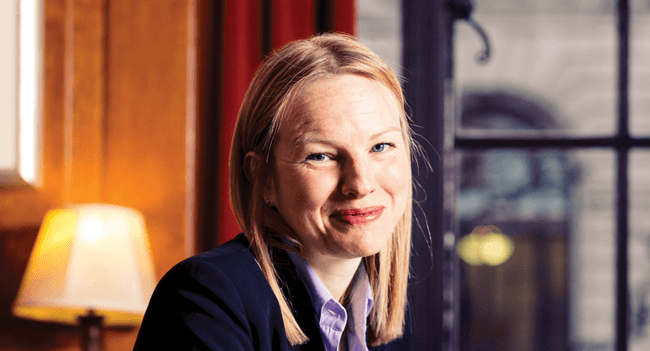
Yvette Ostolaza is Sidley’s management committee chair – a role she has held since 2022 – and a commercial litigator. Here, she discusses her thwarted journalism ambitions, rising through the ranks to leadership roles, and why she thinks external investment in law will catch on
I remember the first time I discovered that women could be lawyers. In middle school I read a book called Rage of Angels by Sidney Sheldon, and the heroine was a lawyer. I’d never thought of a woman being a lawyer; I’d never seen one on TV or met a female lawyer. I didn’t realise it at the time, but that book planted a seed in my mind.
I never assumed I would attend college. Many of the students from my neighbourhood started jobs after graduation to support their families. I was actually engaged to be married after high school, but friends of mine who were older than me and teachers at my high school said: “What, are you kidding me? Look at your grades! You’ve got to go to college, and you can get an academic scholarship!” I ended up not getting married at 18!
The interesting thing about being a first-generation college student is that you may not have any preconceived notions about what you should major in. They gave you these large catalogues when you get admitted to university – they were two inches thick, with a list and description of every major. I went through the catalogue and thought everything sounded interesting! I began reading the majors in alphabetical order – I was interested in anthropology, then archaeology, and astronomy. I even attended an astronomy class, and I realised it was focused on physics – so that didn’t last long.
‘Every time someone at law school would say it was a lot of work, I’d say, “You should try working full-time in management!”‘
I wanted to be a journalist. I double-majored in marketing and communications with a journalism emphasis. But I found when I started to interview for positions, the pay didn’t allow me to live in the cities that you need to live in if you wanted to work for a major newspaper. I’d also taken a constitutional law module – I found law fascinating and did well at the class. The professor said I had an aptitude for law and encouraged me to consider law school. But I didn’t apply just then. Instead, I applied for a position in marketing for a major airline and focused on selling computers and conventions to the travel industry and corporations.
After I graduated, I went into business and worked for Eastern Airlines. At one point there were layoffs, and one of my colleagues who was in his 50s was laid off. He said, “You should go to law school – you’re entrepreneurial, and that’s a business where you can always hang a shingle.” That was very appealing to me. My parents were always small business owners, and being raised in a Cuban immigrant community with a lot of small businesses, I wasn’t afraid of being entrepreneurial or betting on myself.
When I went to law school, I was already used to working long hours and travelling. By contrast, law school didn’t seem so bad! Every time someone would say, “Boy, this is a lot of work,” I would say, “You should try working full-time in management.” I enjoyed the intellectual challenge of the legal coursework and the camaraderie of graduate student life.
The earlier you get to make your mistakes, the better. I took a few summer associate roles while I was at law school, and afterwards I went into private practice. I was fortunate to have been given leadership positions at a young age. When I moved to Sidley, I was serving on the management committee of another global firm and ended up moving with a large team. Sidley had an opportunity to grow in Texas, and we thought it was a better platform for us and our clients. It had a much larger diversified platform, including very strong regulatory, transaction, and litigation practices. Over 50 of us from Dallas and New York moved together, and it’s been great for our clients.
‘I’m fortunate to have experience advising boards in crisis situations. It’s easier to handle your own issues when you’ve had experience in private practice’
It was never my goal to be the chair of a law firm. It just isn’t the way I think. I focus on doing the best job I can, loving what I do, delivering results, having fun, and working with colleagues to help them succeed. I will always put my name in a hat if there’s an opportunity. But I won’t be disappointed if it doesn’t come through. A lot of people worry too much in advance about what their role can be, and they may set themselves up for disappointment. Whereas if you’re good at it, people will come to you and say, “You’re good at this, do you want to do more of what you are already doing, plus teach others to do the same?”
When I was informed that I had unanimously been selected to become chair of the firm’s management committee, it was a very humbling moment. I knew the importance of the role I was taking on, at one of the largest global firms, over 150 years old, and that had so many people that relied on the global leadership team. I also had big shoes to fill. Larry Barden, my predecessor as chair, is a wonderful leader as well as a friend.
It’s important to take a stance only when you need to. What our clients want us to do is to practise law at the highest level and deliver a collaborative team. They need to know we can be in their corner, and we need to show that we can be a law firm that delivers a deep and broad bench of expertise. It can be hard – there are a lot of challenges involved in running a large organisation, from geopolitical issues, competitive pressures, and social issues, to the fact that so many of our younger lawyers have lived their lives in such a public way. I’m fortunate to have in my professional background significant experience in advising boards in crisis situations. It’s certainly easier to handle issues you’re confronted with when you’ve had the experience in private practice.
One of the benefits of being the first in your family to do things is that you’re not afraid to ask questions. You have to continuously learn new areas and challenge yourself. More importantly, you have to listen and take feedback. I would not be here if it weren’t for the many, many colleague doing that for me. That’s particularly important when you’re a first-generation lawyer. You’re counting on other people, in addition to your own skills of observation, learning, reading, to make sure you’re delivering premier legal work.
‘Being raised in a Cuban immigrant community with a lot of small businesses, I wasn’t afraid of being entrepreneurial or betting on myself’
Private investment in law firms is going to happen. What I saw in medicine in the US was, as the laws changed and allowed for investment, medical clients saw nice outcomes from a liquidity standpoint. They were able to expand, to build the market power to let them negotiate from a position of strength. Although legal practices are different in many ways, smaller practices are going to say: “This is the only way I can invest to support my clients and grow.” It can be a good alternative to a merger. I think that third-party investment will be attractive to law firms, just as it was attractive to medical practices.
When you’re a $3.5bn global law firm, you have opportunities that can really change lives. When I joined the firm, the firm accepted a case representing a class of Texans with intellectual and developmental disabilities who had been unnecessarily institutionalised by the state. We worked pro bono over the course of 12 years, and this June we secured a landmark decision which found that Texas needs to redesign its long-term care infrastructure and service delivery, redirecting policy towards individualised support and away from placing people in homes away from their family. We invested hundreds of thousands of hours, and the result will have a really positive impact on the lives of the disabled.
I love travelling, learning about different cultures, and experiencing new cuisine. I hit a lot of continents when I was working in the airline industry – but I still haven’t been to Antarctica! This summer I took the Royal Scotsman train around Scotland, and next year I plan to see the total eclipse in Spain. I also love a good historical fiction miniseries. I love when you see something in a show and you think, there’s no way that happened – then you look it up, and it’s real!








 Earlier this year
 Yen Sum (pictured), the global chair of Latham’s private capital practice, says the expansion of its CLO capabilities is the latest step in a






 CLLS chair and former Simmons & Simmons senior partner Colin Passmore (pictured) had been hopeful that the government would listen to the concerns raised by the industry, and said that he was ‘very, very pleased’ by the news.