McDermott-Schulte merger name confirmed as $2.8bn tie-up gets partner approval

Partners at McDermott Will & Emery and Schulte Roth & Zabel have voted ‘overwhelmingly’ in favour of their merger, with the combined firm set to go live on 1 August.

The merged firm will take the name McDermott Will & Schulte, with more than 1,750 lawyers in total across more than 20 offices around the world, including what will be the ninth largest law firm presence in New York.

The combination will also create a firm with combined revenue of more than $2.8bn – enough to place it on the edge of the top ten largest firms in the world.

McDermott chairman Ira Coleman said in a statement: ‘We’re thrilled to be joining forces with Schulte. We’re not just expanding our expertise, we’re redefining what it means to be a modern, elite law firm – deeply specialized, relentlessly client-focused, and committed to a people-first culture.’

Schulte co-managing partner Marc Elovitz added: ‘By combining our extraordinary talent and premier client base with McDermott’s world-class platform, we’re creating a unique firm with unmatched capabilities. It’s truly transformational.’

Schulte co-managing partner David Efron described the combination as ‘a first-of-its kind deal in our profession, with two elite firms performing at the highest levels choosing to come together.’

The merger, first announced in May, brings together McDermott, which has 1,336 lawyers including 211 equity partners, and Schulte, which has 365 lawyers including 78 equity partners.

McDermott posted revenue of $2.23bn in its most recent financial results, with profit per equity partner (PEP) of $4.8m. Schulte, meanwhile, turned over $618.8m in 2024, with PEP at $4.1m.

Schulte has offices in New York and Washington DC, as well as one office outside the US, in London. McDermott has offices in each of these locations, as well as a further 14 offices in the United States and seven in continental Europe.

[email protected]

Pride Perspectives: ‘It’s easy to think something isn’t your problem – but equality is all of our problem’

DLA Piper associate Cai Cherry on ‘bringing your full self to work’, intersectionality and the importance of active allyship

How easy did you find it to come out professionally, and what were the biggest barriers you had to overcome before you felt ready to come out at work?

When I was growing up, I comforted myself with the idea that even if I was never out, even if I never fell in love or started a family, I could still be successful. I studied hard and lived almost to the point where I forgot I was queer to start with.

But then at university, I found myself slowly embracing the freedoms I had denied myself: wearing the clothes I had envied, watching the TV shows I wanted, listening to the music I liked, and falling in love with the people I was attracted to. I was never ‘in’ at work because it all became so clear that I didn’t have to be.

That’s not to say it’s been smooth sailing: my first supervisor told me that I wasn’t hired to bring my full self to work, I was hired to do my job. But his narrow mind couldn’t comprehend that I was doing my job – and doing a good job at that – because of, not in spite of, the fact I was bringing my full self to work.

I am a good lawyer because I’m confident, because I can understand and empathise with my clients, and because I truly love what I do. I don’t think I could do or be any of those things if I was hiding who I was. 

What motivated you to actively use your voice to advocate for LGBTQ+ voices in the legal sector?  

I was a pretty nerdy kid, obsessed with reading about history and politics and law. I grew up in a small village in the middle of the English countryside – a place that doesn’t celebrate, or even acknowledge, queer people – so diving into the stories of people who could be themselves was how I coped.

I remember when the US Supreme Court legalised gay marriage across the US in Obergefell v Hodges, and reading Justice Kennedy’s majority opinion, where he declared that the hope of the gay couples was ‘not to be condemned to live in loneliness, excluded from one of civilization’s oldest institutions. They ask for equal dignity in the eyes of the law. The Constitution grants them that right.’ I grew up being told from a young age that gay marriage wasn’t right and it wasn’t fair, but I found solace in the law; in the idea that a single piece of paper can contain so much hope, can give so much joy, and can stand up for people who need it.

Law gave me so much, it wouldn’t have been fair to not try to give back as much as I can and ensure the same promise that was there for me can be there for everyone: that no matter who you are, no matter how lonely you feel, you have an ally in the law – something so imperfect but with so much potential, an ideal that we can keep striving to meet. Now that I’m a lawyer, you have an ally in me. That motivates me every day. 

How much obligation do you feel to be a role model within the industry? How helpful are role models in pushing change?  

It is so easy to think something isn’t your problem. When it comes to equality, to justice, it is all of our problem.

I don’t feel an obligation to be a role model – and I’m not sure that anyone would really see me as one, anyway. But I do feel an unavoidable and irrepressible obligation to say what is right and to do what is right, as much and as often as I can.

There are so few queer people in law, and the ones I am lucky enough to work with (both as colleagues and clients) give me so much strength and hope and comfort, but the sector as a whole is struggling to diversify. Despite what law firms might say, we have always followed our clients in culture, in technology, in growth, and in inclusion. I think my value as a role model is limited: I cannot force change, I can only encourage it. The real value comes from clients demanding their lawyers are as inclusive as they are. I think that’s the only way we will see concrete change. 

Regarding your identity as both queer and disabled, how important is recognising intersectionality, and how has your own experience with intersectionality impacted your career?  

I came out as queer, and a month later I became disabled. It was a real rollercoaster of a four weeks. I had just started to understand one part of me, and all of a sudden there was a whole different part of me I had to come to grips with pretty quickly, and it was impossible to separate the two in my life.

I am lucky enough to have co-founded and now lead my firm’s disability pro bono practice, alongside my colleague Ashleigh Alli, who is a racial justice specialist, and my colleague Chris Rennie, who founded the first law firm LGBTQ+ network pro bono practice at DLA Piper. We are also building new pro bono offerings for gender equity, social mobility, and families and carers.

We work together not because we recognise intersectionality, but because it is unavoidable (plus I really like working with both of them!). If you try to segregate issues and not look at them holistically, you’re missing the entire puzzle, not just a piece, and you end up doing a worse job overall.  

What does the legal sector need to do better to include people from the LGBTQ+ community and provide support?  

As we saw in Obergefell, and as we have seen in famous cases in the UK, like Dudgeon or Goodwin, the law is often the only and most effective remedy to injustice, but it is also the perpetrator of the very oppression it can relieve. Lawyers are under professional obligations to uphold trust in the profession and to promote diversity, but we are also under a moral duty to do what is right. We need to be proud in our support of the LGBTQ+ community when we are currently seeing the biggest backslide in a generation.

Law firms hold immense economic, political and social power, but they are too cautious about using it, and in doing so, they let us all down. It starts with investing in their own people, by supporting DEI and people networks, by proactively recruiting LGBTQ+ and other marginalised people, and by creating a culture of celebrating people, not just including them.

But it continues with making the world a better place, rather than just the office: by showing up to Pride, by engaging with clients on LGBTQ+ issues outside of legal advice, and by developing robust and effective pro bono practices supporting the LGBTQ+ community, and by being unashamed of doing what is right. Unless we can meet this moment, we will forever look back on it with shame. That’s not an option I am willing to live with.  

What is the single biggest challenge still facing the LGBTQ+ community in City law? How can it be addressed?  

The biggest problem is the people that support the LGBTQ+ community, but aren’t willing to say it. The ones that complain they don’t care what bathrooms people use, but don’t realise that the problem is others do.

Because of a vocal and aggressive minority, we are seeing a real and dangerous erosion in our rights because the majority aren’t showing up for what they believe in.

It can be addressed very simply: by doing something. It takes seconds to google ways to support trans people. It takes seconds to introduce yourself with your pronouns. But it also takes real time, real investment, and real motivation to make a real change. If you’re not willing to do that, that’s your choice, but you are no ally. To those that are willing, we need you more than ever. 

For more, see ‘We’re all nervous right now’ – how a subdued Pride month got caught in the DEI backlash

More Pride Perspectives:

Clare Fielding: ‘I’m a reluctant activist – as a managing partner I have to be conscious of inclusion for everyone’

Patrick McCann: ‘We need more queer managing partners’

Daniel Winterfeldt: ‘We’ve helped move the UK legal sector from nowhere to a leader for LGBTQ+ inclusion’

Emma Woolcott: ‘We need a plurality of perspectives around the table when decisions are made’

Linklaters re-elects leadership duo after ‘biggest year-on-year increase in profit in more than 20 years’

Linklaters has voted to re-elect its senior and managing partners following what the firm said was a record-breaking year, including ‘the biggest year-on-year increase in profit in more than 20 years’.

Senior partner Aedamar Comiskey and managing partner Paul Lewis have been re-elected by the partnership – ‘with overwhelming support’ – with their new terms set to run till 2029.

They were first appointed to their roles in 2021, and under their leadership, Linklaters has increased revenue by more than 25% from £1.67bn to £2.1bn in 2023-24, with this year’s results set to be announced imminently.

In the same timeframe, profit per equity partner has increased by 7% from £1.77m to £1.9m.

The firm’s ambition to grow its US business was bolstered last year with the opening of an M&A practice in New York with the hire of a six-lawyer corporate team from Shearman & Sterling, led by Legal 500 Hall of Famer George Casey, who was recently appointed as chairman of the Americas.

Further high-profile US hires have followed, including the former global co-head of A&O Shearman’s financial markets practice David Lucking and a four-partner litigation team from New York litigation boutique Patterson Belknap Webb & Tyler. 

Comiskey, a partner since 2001 and formerly the firm’s head of corporate, was elected to a five-year term as senior partner in May 2021, becoming the firm’s first female senior partner. She succeeded Charlie Jacobs, who left at the end of his five-year term to become JP Morgan’s co-head of investment banking.

Lewis, previously Linklaters’ global finance head, was elected to his current role in July 2021. A Linklaters lifer and a partner since 2006, he succeeded Gideon Moore, who served a truncated second term in order to bring the managing partner and senior partner terms into sync.

Declaring herself ‘delighted’ to be extending her term as senior partner. Comiskey said: ‘This is an exciting time for our firm. We have bold ambitions and everything we need to achieve them.’

Lewis added that the firm had made ‘significant progress’ towards putting the firm in ‘the strongest position to win the most complex, cross-border mandates for the world’s leading corporates, banks, funds and financial sponsors.’

The re-elections mean that Comiskey will continue as senior partner until 30 September 2029, and Lewis will continue as firmwide managing partner until 31 December 2029.  

[email protected]

Pride Perspectives: ‘We need a plurality of perspectives around the table when decisions are made’

Mishcon de Reya reputation protection and crisis management head Emma Woollcott on the importance of LGBTQ+ visibility and the impact of role models.

How easy did you find it to come out professionally? And what were the biggest barriers you had to overcome before you felt ready to come out at work?  

It was challenging in the early 2000s, as I had no visible role models with lives anywhere close to the one I wanted – comfortable being open in the workplace about their sexuality, and having families as well as progressing their legal careers. 

I was out at university and law school, but was encouraged to squeeze myself back into the closet as a trainee. I didn’t have the confidence to speak openly until I was qualified, and at a firm which sees diversity and authenticity as strengths. 

How has the industry improved since you began your career? 

It is wonderful to see LGBTQ+ people succeeding across the legal sector, and for community groups to exist within firms, at the Law Society and across many different industries. 

My role requires me to try to quickly understand what is important to clients – what drives them, what worries them, where they have support and where they feel vulnerable. My identity and background – and my experiences of feeling like an outsider – give me power and insight in these moments, for which I am extremely grateful. 

What motivated you to actively use your voice to advocate for LGBTQ+ voices in the legal sector? 

I felt a responsibility to do so. If we do not speak up, our lives and our experiences may be overlooked. 

Law is so pervasive in society that we need a plurality of voices and perspectives around the table when (big and seemingly small) decisions are made. 

How much obligation do you feel to be a role model within the industry? How helpful are role models in pushing change? 

Hugely. It still feels awkward being referred to as a role model, but I’m motivated to be visible enough to show others that it was possible to be out and proud, and for them to know they could reach out for support and insight when needed. 

For more, see ‘We’re all nervous right now’ – how a subdued Pride month got caught in the DEI backlash

More Pride Perspectives:

Clare Fielding: ‘I’m a reluctant activist – as a managing partner I have to be conscious of inclusion for everyone’

Patrick McCann: ‘We need more queer managing partners’

Daniel Winterfeldt: ‘We’ve helped move the UK legal sector from nowhere to a leader for LGBTQ+ inclusion’

Cai Cherry: ‘It’s easy to think something isn’t your problem – but equality is all of our problem’

Stephenson Harwood hits £1m PEP mark and heads towards five-year target to double revenues

Stephenson Harwood has posted double-digit growth for both turnover and profit per equity partner (PEP), as the firm pushes forward with an ambitious goal to double revenues over a five-year period.

Turnover rose by 17% during 2024-25 to reach £309m, up from £264.2m last year. The firm has now seen 50% revenue growth since setting out a five-year strategy in 2022 which included a target of doubling turnover by 2027.

PEP saw even steeper growth, breaking through the £1m mark for the first time with an increase of 29% on last year’s figure of £775,000.

CEO Eifion Morris (pictured above) attributed the growth to a focus on ‘five strategically important sectors’ – decarbonisation, life sciences, private capital and funds, technology, and transportation and trade – adding: ‘we’re not the firm we were a few years ago’.

He also cited three key factors he believes differentiates the firm from its peers – geographic growth and integration, increased bonus recognition, and diversity, equity and inclusion.

In terms of geographic growth, he pointed to strong performances from the firm’s bases in Dubai and Greece, while also underlining that a US merger is not currently on the cards.

‘Unlike many of our competitors, we are not looking for a US merger. Instead, we continue to work closely with a network of US law firms, helping them to ‘quarterback their deals and cases’ through our own offices and contacts’, he explained. ‘For both clients and potential partners and employees, we’re an alternative to the emerging transatlantic behemoths.’

On bonuses, the firm has increased its global bonus pool for employees to £6m, including a 36% uplift in bonuses paid to fee earners, with Morris citing the examples of two managing associates who received bonuses of more than 135%.

DEI – described as ‘a personal priority’ by Morris – is another area where the firm is progressing, with 13% of its UK partnership now from ethnic minority backgrounds, surpassing the a target of 10% by 1 May this year.

While the firm missed its May target of a 35% female partnership, representation has risen to 32%, and the firm has now set out new targets for the next three years, including a 15% ethnic minority partnership in the UK and a 38% female partnership around the world.

The firm also recently announced the promotion of 12 new partners, its second-largest ever cohort.

Morris added: ‘When we launched our current strategy in 2022, we knew it was ambitious. Doubling revenue within five years was no small challenge, but we’re well on our way.

‘This progress reflects the strength of our client relationships and a sharper focus on where we can deliver the most value. What’s made the real difference, though, is how our people have embraced the strategy – especially our focus on five strategically important sectors. Their commitment continues to drive our momentum.

‘That momentum has also brought greater clarity about who we are and what sets us apart.’

[email protected]

Global London 2025

Main Table

LB’s 2025 ranking of the top 50 foreign-headquartered firms in the City by headcount

Global London data highlights City split as half retrench while Paul Weiss and others soar

Global London rankings underline divide among US firms as bold expansion by some offsets caution by others

Global London 2025: Which US firms are setting the pace for City growth?

From Paul Weiss to Proskauer and Sidley to Simpson Thacher, Legal Business takes a closer look at some of the star performers in the LB Global London 2025 report

More than just size: the Global London firms making the best impression on clients

Legal 500 data reveals the top-rated Global London firms on key metrics such as lawyer quality, industry knowledge and value for money

Pride Perspectives: ‘I’m a reluctant activist – as a managing partner I have to be conscious of inclusion for everyone’

Clare Fielding, co-founder and managing partner of specialist planning firm Town Legal, discusses her experience transitioning, her D&I responsibilities as a law firm leader, and becoming a ‘reluctant activist’

How easy did you find it to come out professionally, and what were the biggest barriers you faced when making that decision? 

I didn’t transition while I was in my legal career, but came into the law having transitioned several years previously in the early 1990s. At that time, there weren’t trans policies, or anything like that.

Ultimately, transitioning wasn’t a choice, it was something I was compelled to do. At times it was scary, but the big challenge was coming into work having left with one personal identity and coming back in with a different one.

Obviously, there is the change of gender, but to be perfectly honest the bigger challenge was just having a different name and different identity – that was a bit weird for a while. It takes a while before the person you are now presenting as actually becomes you – the real you (if that makes sense!). 

 Has the industry changed since you transitioned in the 90s? 

When I transitioned I found that people were generally very accepting and very supportive. I think now, in the legal profession, there’s obviously much more overt celebration of trans people, and we run workshops on trans inclusion and all that kind of stuff. That kind of thing didn’t exist when I transitioned, and I think it’s a good thing that we’re now more aware. 

On LinkedIn, you describe yourself as a ‘reluctant activist’. Do you feel an obligation to use your voice to advocate for trans rights, and do you feel an obligation to be a role model? 

I added that only very recently. I’ve always felt it’s important to be ‘out’ and to be a role model of sorts, but I’ve never really seen myself as an activist or banged the drum about trans rights. I never really perceived that I lacked any rights – more fool me, perhaps.

I now describe myself as a reluctant activist because I feel I must get active given what’s going on now, though I never really wanted to be in that sort of role. I knew absolutely nothing about the For Women Scotland case [on the definition of the terms man and woman] until the judgment came out. I took the ‘gender critical’ stuff to be a bit of a niche interest. How wrong was I? So, yes, reluctant activist. 

At the same time, as a managing partner of a law firm, I have to be conscious of diversity and inclusion for everyone in the workplace, and I have to care about the inclusion of groups that I’m not a member of. And that’s the point; you have to brave enough to stand up and make sure that you are creating an environment that’s okay for everyone – I think that’s the biggest learning point for me from all this latest stuff.  

The Supreme Court judgment is essentially a piece of statutory interpretation, so I don’t personally view the judgement itself as a transphobic act – as a lawyer I have to respect the decision, though I am aware a legal challenge is being prepared to it. It’s what happens afterwards that really affects people – me included – more than the judgment itself.

I heard a government minister on the radio saying that trans people have to use their biological sex loos “when they’re out and about” – this is shocking, because it places trans people in danger and it humiliates them. It humiliates everyone involved in that encounter, whether they’re trans or not, and I think it’s irresponsible of the minister to have said that. 

As someone who is a managing partner, do you have a sense of what the legal sector could be doing better to include trans and LGBTQ+ people? 

At one level, just be kind and decent to people and listen to their concerns. It’s not hard. 

It’s also about taking proper independent legal advice. It seems to me – and what a shame to say this – that we need to look very, very carefully at the official guidance which has now been issued for consultation. I think we will be taking careful legal advice on how we can arrange our practices and procedures so that we can be as trans inclusive as we can possibly be; thinking about things like bathroom facilities and so on. 

I think it also means not changing your principles. It means not watering down your DE&I messaging or your DE&I commitment. That’s what it means to me. Even though the political wind is blowing in a certain direction, I think businesses with integrity should be standing strong and not blowing with it.

Or, if you’re a business that is inclined to blow with the wind; fair enough, that’s your choice – but when the wind changes once again, don’t come back and cover all your publicity in rainbow flags – that would be intolerable.

For more, see ‘We’re all nervous right now’ – how a subdued Pride month got caught in the DEI backlash

More Pride Perspectives:

Patrick McCann: ‘We need more queer managing partners’

Daniel Winterfeldt: ‘We’ve helped move the UK legal sector from nowhere to a leader for LGBTQ+ inclusion’

Emma Woolcott: ‘We need a plurality of perspectives around the table when decisions are made’

Cai Cherry: ‘It’s easy to think something isn’t your problem – but equality is all of our problem’

Seven London lawyers make the grade as Bakers promotes 59 in global partnership round

Baker McKenzie has elevated 59 lawyers to partner across its international network, with seven London lawyers making the cut.

The City partner count is the highest since 2021, when eight London lawyers were made up, while the overall figure of 59 is slightly down from last year’s total of 66.

Of the London promotions, two are in the firm’s employment and compensation practice, with the other shared between international commercial and trade; M&A; dispute resolution; capital markets; and banking and finance.

The seven promotions in London means the UK capital is joint top with Bangkok as the city with the most new partners. North America saw 15 promotions across eight offices, with those taking effect from 1 January this year, unlike the majority of Bakers’ promotions, which are effective from 1 July.

Bakers’ M&A practice saw the largest number of additions with 14 new partners around the world. Its employment and compensation practice and tax practice welcomed nine new partners apiece, while dispute resolution added seven new partners.

Taken in conjunction with the firm’s 48 lateral partner hires this year – including recent additions such as investment funds partner Nick Benson, who joined from Latham & Watkins, and restructuring partner Kevin Heverin from A&O Shearman – Bakers has added 107 partners globally since 1 July 2024.

Outgoing global chair Milton Cheng (pictured above) described the new partners as an ‘exceptionally talented group of lawyers’, adding, ‘their unwavering dedication to client service and excellence will be key in driving our firm’s success and we look forward to their many more contributions in the years to come.’

Cheng will be succeeded as global chair later this year by London-based international trade, compliance and investigations partner Sunny Mann, who is set to begin a four-year term in the role.

London partners in full

Sven Bates, international commercial and trade
Matthew Berridge, employment and compensation
Alexander Gee, M&A
Richard Molesworth, dispute resolution
Gillian Parnell, employment and compensation
Tom Quincey, capital markets
Sarah Williams, banking and finance

[email protected]

The top lawyers in Philadelphia, Ohio, and Atlanta revealed in latest Legal 500 US elite rankings

Legal 500 has launched its latest US elite rankings, recognising some of the top lawyers across key practice areas in the cities of Philadelphia and Atlanta and the state of Ohio.

The new rankings are the largest yet in the US elite project, with 309 lawyers ranked from 117 firms, including 109 firms that had not previously been ranked by Legal 500.

The US elite recognises the top lawyers at firms outside of the global elite, with the latest city rankings coming on the back of the launch of the New York, Chicago and Washington DC rankings in February and the Boston, Miami and Charlotte rankings in April, as well as the full Legal 500 US guide, which was published earlier this month.

The rankings cover eight practice areas in total: commercial disputes, corporate and M&A, and intellectual property in Philadelphia; commercial disputes, corporate and M&A, and finance and restructuring in Ohio; and commercial disputes and corporate and M&A in Atlanta.

Cleveland, Ohio-headquartered national firm Thompson Hine has the highest number of individual rankings, with 12; 11 in Ohio and one in Atlanta. Philadelphia-bred firms Blank Rome and Duane Morris are tied for second place, each with nine rankings.

A further three firms have more than seven individual rankings, with Smith, Gambrell & Russell the top performer in the Atlanta rankings.

Firms with most individual lawyer rankings

Firm Rankings Details
Thompson Hine 12 Ohio: commercial disputes (5), corporate and M&A (4), finance and restructuring (2); Atlanta: commercial disputes (1)
Blank Rome 9 Philadelphia: commercial disputes (2), corporate and M&A (3), IP (3); Ohio: commercial disputes (1)
Duane Morris 9 Philadelphia: commercial disputes (3), corporate and M&A (3), IP (3)
Keating Muething 8 Ohio: commercial disputes (3), corporate and M&A (3), finance and restructuring (2)
Ballard Spahr 7 Philadelphia: commercial disputes (3), corporate and M&A (3), IP (1)
Smith, Gambrell & Russell 7 Atlanta: commercial disputes (4), corporate and M&A (3)

Meanwhile, three firms have four or more top-tier individual rankings. Thompson Hine is in first place, with five rankings, tied with Philadelphia-based national firm Ballard Spahr.

The final top-performing firm for tier one rankings is Atlanta-based Krevolin & Horst, which has four lawyers ranked in tier one across the Atlanta rankings.

Firms with at least four tier 1 individual rankings

Firm Lawyer name Ranking
Ballard Spahr Stephen Kastenberg Philadelphia: commercial disputes
Jason Leckerman Philadelphia: commercial disputes
Brian Doerner Philadelphia: corporate and M&A
Gregory Seltzer Philadelphia: corporate and M&A
Lynn Rzonca Philadelphia: intellectual property
Thompson Hine Edward G. Babbitt Ohio: commercial disputes
Will Henry Ohio: corporate and M&A
Tony Kuhel Ohio: corporate and M&A
Louis F. Solimine Ohio: finance and restructuring
Curtis L. Tuggle Ohio: finance and restructuring
Krevolin & Horst Allegra Lawrence-Hardy Atlanta: commercial disputes
Joyce Gist Lewis Atlanta: commercial disputes
Lovita Tandy Atlanta: commercial disputes
Cristiane Wolfe Atlanta: corporate and M&A

Legal 500 is continuing to build out its US elite coverage, with rankings covering key markets from Austin, Dallas, and Houston to Minneapolis and Indianapolis. Check the US elite page to learn more.

[email protected]

Freshfields’ Charles Hayes on emotional intelligence, Formula One deals, sheep and daring to press the button

I’ve always had a strong work ethic. My brother is severely mentally disabled and we were extremely close growing up. That experience gives me profound gratitude for the opportunities I’ve been given and, I like to think, deep responsibility to make the most of them. I think that’s where my drive comes from; in part, at least, a sense I was doing this for both of us.

I gain huge satisfaction from hard work because I know what I’m capable of. Rightly or wrongly, I’ve always believed I could be successful if I work harder than the next person. I’ve been lucky, but I hope I’ve created some luck too.

I never imagined I’d find myself here at Freshfields some 21 years later. I always thought I would do something entrepreneurial and commercial. At university in Edinburgh, a few of us set up a stocks & shares club with money from student loans, and from there developed a business plan for a student financial website – it was basically a precursor of a quasi-student wonga.com. I see now you can square that circle in law.

When I came back to university from my Erasmus year in Aix-Marseilles, I realised everyone else had been busy applying for training contracts while I had been preoccupied planning an overland trip from London to Nairobi for charity. I panicked because I hadn’t thought about what I wanted to do, beyond doing an internship at Lazard. The perceived wisdom at that time was that you qualified as a lawyer, did two years, then went and did something more interesting. Either I’ve never found anything more interesting due to a lack of imagination on my part, or the law just became more interesting for me.

I could well imagine myself in the toolbox company or multi-discipline world I envisaged growing up when it’s time for me to call it a day at Freshfields. I don’t imagine it will be any time soon, but I’d love to see myself doing something that my peers, colleagues and clients look at and go ‘that’s really cool’. Perhaps not as a lawyer; more like a COO or CEO for a spin-out from one of our clients. That’s why I really enjoy having a broad portfolio of interests outside the firm that allow me to use all the skillsets I’ve developed and learn some new ones I can deploy for our clients’ benefit.

I sometimes wonder if some partners hit the end of their law firm careers and think their skillsets will be transferable, but then find themselves frustrated because they’re not. I hope I’m sufficiently humble to have realised I’m not going to be relevant or interesting unless I have a diverse set of skills.

Right now, I’m a non-executive director of a firm in the creative industries, which I love doing, where I learn a tremendous amount from the chair and the executive. I’m also a member of a few philanthropic organisations and think tanks, like The Royal United Services Institute (RUSI), which deals with defence and security. These roles challenge me in different ways, and that’s the point.

I used to describe being a private equity lawyer as the ultimate backstage pass – you can get into any situation, any conversation or investment. Then I saw my byline published by a fantastic alumna who went to join one of our clients with the addition that they’d heard my line on this, and decided they’d rather just be in private equity itself. That was fabulously humbling, in a good way. I don’t use that phrase so much anymore.

I’ve always wanted the profession (and firms) to be ruthlessly meritocratic and straightforward. That’s always appealed to my sense of fairness. But, in order to have a ruthless meritocracy, people need to have the same opportunities and you need to look for raw talent. We are now much better at identifying and being open to talent in all its forms and bringing that through. It’s the right thing to do for us, our clients, the industry and our communities. I want to ensure that people get at least the same opportunity as I did to come into this career and feel comfortable within it too; that’s equally if not more important. There remain barriers and prejudices in areas you wouldn’t expect them to be in our industry. I’m extremely disappointed by that.

Somebody who has been instrumental to my career in many ways is Chris Bown [the founder of Freshfields’ private equity practice and now senior adviser at CVC], who has been a mentor to me the whole way through and remains so. What’s been so powerful about Chris’s interventions is that he is very permissioning, saying: why don’t you speak to them about this or that. Ask the question, why not?

I’ll never forget one of my first deals – helping Aston Martin with a capital raise. I’d never seen the factory. So I asked and a few of us went. Seeing the production line, the component parts and the client’s reaction to our interest in their business taught me an important lesson. Get out from behind your desk. Challenge your own assumptions.

Dare to ask the question – what happens if you press the infamous red button?

There are many career highs, but one of them was definitely getting the call from CVC on my first day as a partner to say: ‘we’re selling Formula One’ – the stars aligned that day. More recently, I was in the room when the bell was rung as CVC listed on Euronext. Watching the share price tick up and seeing the response from people in the room was hugely exhilarating after more than three years’ work on our part.

My low was writing an email to a client where I agreed with their view of a closing account figure, and then added that he also needed to consider X and Y. He ran with his number, and the transaction proceeded, but it was out by about £75m; at which point they said the number had been confirmed by Freshfields. It was really, really, really sweaty.

My learning was that I did that because I was too eager to please and didn’t want to be too direct. Over the years, I’ve tried to become more direct and straight with people. More honest. There’s a joke about what an English person says, what they mean and what’s heard, and those three things are always different. In law, clarity matters. With people, there’s huge benefit in just being straightforward.

When that mistake happened, the partner just said: ‘good luck with that’. I don’t think that would happen now. I think it’s great that the industry has evolved and become so much more supportive.

When I was starting out I was given huge quantities of rope, with which, in all honesty, I probably hanged myself on occasion. Lessons were learned the hard way. I do sometimes worry that we don’t give people enough opportunity to fail now; the opportunity to fully learn. If you don’t give people the opportunity to be allowed to fail, for it to be safe to fail and not failsafe, then I worry they won’t push themselves or test themselves.

I’m now intensely focused on supporting the next generation by creating an environment where people are inspired, encouraged to aspire, and are empowered to seize this amazing opportunity.

I don’t proactively seek out management roles, but I do like leadership. It’s an interesting distinction. There are lots of different types of leadership and leader. Sometimes you need to be the visionary leader, which is ‘this is the strategy, this is what we’re trying to achieve’. Sometimes you need to be the directive leader – ‘this is what we need to do and this is how we’re going to do it’. Sometimes you need to be the servant leader, which is ‘this is what I’m doing, and I would encourage you to do the same as me’, or ‘this is what I’m doing for you as a servant of the firm, please follow me or come with me’.

If I had just one piece of advice to my younger self it would be to calm down. In every capacity. And also, let things break sometimes. Let things go wrong. When I was a senior associate, the thought of something going wrong on my watch was literally world-ending, but I now realise you sometimes you need to let things go wrong. Partly because you need people to learn from that experience, and partly because out of the wreckage you can actually build something better. Let the train hit the buffers.

My tips for success would be to be inquisitive and be permissioning. We’re all very quick to typecast ourselves and say, ‘this is my lane’. But sometimes you need someone to hold a mirror up to you and say ‘you are no longer the person you were, and I give you permission to be the person you have become’. You need to be that person.

I’m an outdoors person. We live in Wiltshire, in the middle of nowhere. I love to get off the train and kick everything else away. My family is absolutely everything. We have four children, two dogs and 11 chickens; then there are about 1,300 sheep in the field next door. I can’t always be at the carol concert or at pick-up from school, but I make sure that when our children do have me they have my undivided attention. That we do something fun together.

You could say my hobby is farming. I’ve always been drawn to rare cattle breeds, but they make a terrible mess. There are often sheep in the next door field. I’ve delivered lambs, which is hard work but amazing. It’s not quite Clarkson’s Farm at home, but it’s not far off and it’s all the mayhem that goes with that. Which I love.

I’m quite practical. You have to be quite handy. I made my wife a table from a walnut tree that came down in my parents-in-law’s garden for her wedding present. It’s very simple, with a waxed finish suspended in a cradle made from oak.

How do I have the time? I work extremely hard during the week, but my weekends are non-negotiable unless it’s absolutely critical.

I will proactively dream up things that I’m going to do at the weekend to restore, refresh, and get perspective, because if you do this job seven days a week, you’ll go absolutely mad. Making toy boats with the children, messing about with a go-kart, refurbishing an old Land Rover, creating ‘rooms’ in the garden or delivering lambs is a little bit of a world away from what I do day-to-day. Just saying.

I hope I’ve developed a level of emotional intelligence that I’ve come to realise is especially valuable in our profession. If I have any particular strength in that area, I owe it to my brother who taught me what it is to communicate; to listen, to observe, and to understand in ways that have shaped who I am, both personally and professionally. And I consider that one of my greatest privileges.

Pride Perspectives: ‘We need more queer managing partners’

Patrick McCann, former Linklaters director of learning and incoming CEO of the City of London Law Society, on being outed at work and why the legal community should stand by their trans and non-binary colleagues.

How easy did you find it to come out professionally? And what were the biggest barriers you had to overcome before you felt ready to come out at work?

I was out and proud in my last year at university. I ended up running the LGBT society, which turned out to be super-successful. I was advised by the brilliant Dean of Law to go back into the closet, so I did. Or I did in as much as ever I could.

A fellow trainee (a nasty fellow, who had been at the same uni) then outed me, I think in an attempt to derail my career, but it was essentially fine, although at least two of my bosses were uncomfortable with my queerness. My boyfriend at the time was diagnosed with AIDS and that was not something I cared to share.

The barriers to my coming out had to do with the perceived discomfort those in positions of influence may feel, and the harm that it would do to my progression. There was some truth in that.

What motivated you to actively use your voice to advocate for LGBTQ+ voices in the legal sector through initiatives you’ve been involved in, including The LLP [The LGBTQ+ Lawyers’ Programme, which was named LGBTQ+: Initiative of the Year at the Legal 500 UK ESG Awards]?

I’ve always been relatively active when I see things that don’t seem right – even at school. I try to better things. Therapy has recently revealed that the main driver for this is that the generation of gay men just ahead of me were decimated by AIDS. I saw many die – and I feel the need to honour them by being successful and helping others to be successful.

I am particularly interested in people getting into the profession and have had some wins in the field of social mobility, social welfare and LGBT work. I’m not sure why any of us are here, if not to help others.

Now I’ve become sufficiently aged – and financially solvent – I can be more outspoken about things. Most days someone contacts me privately to say that I am helping, and so I keep going. I believe LGBTQ+ people have a skillset, often hidden, gained by life experience, which can make them brilliant contributors.

How much obligation do you feel to be a role model within the industry? How helpful are role models in pushing change?

I feel some responsibility but mainly I do it because I think it’s the right thing to do – ethically, societally, mentally – and I am seeing some great, positive change through what people are doing. That in itself is a great reward and means I want to do more. I am a big believer in having role models – I can name a dozen without much effort who have inspired me. If I can do that for someone else, happy days.

What does the legal sector need to do better in order to include people from the LGBTQ+ community and provide support?

Actively reach out to recruit (I founded DiversCity, City Century and Queer City Law Career very much with this in mind). Bring queer people into work, be interested in us, promote us (especially into C-suite roles where we are noticeably absent) and support queer charities and the like.

In work, mentoring programmes and development programmes like The LLP help. Stay ahead of legal developments, reach out to impacted colleagues (trans and non-binary people in particular), enjoy difference, stay visible in your support.

What is the single biggest challenge still facing the LGBTQ+ community in City law? How can it be addressed?

Progression. I think we’re doing well in convincing emerging queer entrants to count themselves into our sector rather than out of it, and we see us do well up to the mid-levels, but we are less apparent in the senior ranks. In the 40 years I have been in and around London law, I have only seen a handful of queer managing partners. We need more Justin D’Agostinos and Clare Fieldings!

The LGBTQIA+ legal types I know are impactful, passionate, creative, empathetic, driven, personable – they have clear leadership qualities. I assess the legal scene to have some reticence about giving the really big jobs to us (although thank you to the City of London Law Society for taking me on).

The other massive challenge at the moment is the treatment of trans people – the impact I see on them from the current political and legal standpoint is devastating. The legal community could do much more to protect them.

For more, see ‘We’re all nervous right now’ – how a subdued Pride month got caught in the DEI backlash

More Pride Perspectives:

Clare Fielding: ‘I’m a reluctant activist – as a managing partner I have to be conscious of inclusion for everyone’

Daniel Winterfeldt: ‘We’ve helped move the UK legal sector from nowhere to a leader for LGBTQ+ inclusion’

Emma Woolcott: ‘We need a plurality of perspectives around the table when decisions are made’

Cai Cherry: ‘It’s easy to think something isn’t your problem – but equality is all of our problem’

Trading places: Latham picks up M&A star in rare Wachtell departure

Latham & Watkins has made a major addition to its M&A practice in New York with the hire of Wachtell partner Zach Podolsky (pictured), marking a rare corporate exit from the elite Wall Street firm.

Podolsky is following his former Wachtell colleague John Sobolewski, who moved to Latham in February, joining as global head of liability management and vice chair of capital markets.

According to data provider MergerLinks, Podolsky was the second most active M&A partner in the US in 2024, leading on seven deals with a total value of almost $70bn. These included co-leading the teams advising ConocoPhillips on its $22.5bn acquisition of Marathon Oil (opposite Kirkland & Ellis), and Diamondback Energy on its $26bn acquisition of Endeavor Energy Partners (opposite Paul Weiss and Vinson & Elkins).

Latham chair Rich Trobman said in a statement: ‘We are focused on serving the needs of our deep and growing client base of public companies as they navigate an increasingly complex and competitive landscape, and Zach’s track record of managing sophisticated transactions further enhances our position as one of the world’s elite M&A firms.’

Elsewhere, Paul Hastings has continued its ambitious energy and infrastructure buildout with the hire of partner Christopher Richardson in Houston. Richardson spent the last year as chief executive and board member at climate technology company 8 Rivers Capital. Before that he spent six years at White & Case, including as head of the energy and infrastructure projects section for the Americas.

Richardson is the eighth energy and infrastructure partner Paul Hastings has recruited since April, following a series of hires from White & Case across Europe and the Middle East.

In the latest instance of partners departing firms to have done deals with US President Donald Trump, Cooley has picked up seven litigation partners from Willkie’s San Francisco office, including office managing partners Benedict Hur and Simona Agnolucci.

The other partners making the move are Joshua Anderson, Tiffany Lin, Jonathan Patchen, Michael Rome and Eduardo Santacana.

Willkie is one of a number of firms to have agreed a deal with Trump, pledging pro bono work for causes the administration supports in exchange for protection from punitive action against the firm.

The group’s move is further evidence of a pattern of litigators leaving firms that have done deals with Trump, including Cadwalader, where litigator Ellen Holloman has left the firm’s New York office for Kaplan Martin, the litigation boutique established in July 2024 by trial lawyer Roberta Kaplan.

Kaplan is well-known for her lead role on the landmark same-sex marriage case United States v Windsor, as well as representing columnist E. Jean Carroll in her defamation suit against Trump.

Holloman spent nearly eight years at Cadwalader as a partner, and her departure follows the exits of white-collar partners Phara Guberman and Kenneth Breen for Foley & Lardner last month.

Akin has made two hires from Mayer Brown in Chicago, bringing over M&A partner Joshua La Vigne and investment management partner Jessica Pan. Pan was a counsel at Mayer Brown, while La Vigne made partner there in January 2024.

The hires come just over a month after Akin brought over Mayer Brown global private funds and investment management practice co-lead Wendy Dodson Gallegos and infrastructure M&A partner Jason Wagenmaker, also in Chicago.

Finally, Fenwick & West has hired partner Jim Hauser into its executive compensation and employee benefits practice in Boston. Hauser joins from Silicon Valley-headquartered firm Gunderson Dettmer, where he spent ten years as a partner, including as co-head of the Boston executive compensation practice.

His hire sees Fenwick expand the Boston office it launched in April with its hire of IP partners Matthew Pavao, Heidi Erlacher and Chen Chen from Cooley.

[email protected]

Shoosmiths pays out £3.5m in bonuses as firm breaks £1m PEP barrier for first time

Shoosmiths has broken through the £1m partner profits mark for the first time, with the firm paying out £3.5m in bonuses on the back of revenues rising to a new high.

Revenues increased by 5% to £217.2m during 2024-25, up from last year’s total of £206.7m, marking 10 years of consecutive growth for the national firm. 

Profit per equity partner, meanwhile jumped by 30% to £780,000 to just over £1m – the first time the firm has surpassed the million-pound milestone – on the back of a 16% increase in profits from £66m to £76.6m.

The firm has now seen PEP surge by 48% over the last two years, up from £676,000 in 2022-23.

In recognition of the strong performance, 1,300 staff members will receive a 5% salary bonus next month, meaning the firm has awarded around £3.5m from its bonus pool this year.

That bonus pool will be increased by a further £1m should staff hit a target of one million Microsoft Copilot prompts by the end of the 2025-26 financial year – a goal that will be reached if each member of staff uses the AI tool four times per day, according to the firm.

CEO David Jackson hailed what he described as an ‘amazing financial performance’.

‘We’ve been super clear about where we think we can add most value to our clients, and as a result they’ve trusted us with more of their business-critical work in those areas,’ he said.

Key recent mandates for the firm have included advising global construction chemicals company FOSROC on its $1.25bn sale to Saint-Gobain, acting for Hipgnosis Songs Fund on its $1.6bn takeover by Blackstone, and assisting Jaguar Land Rover on its £800m digital transformation programme with Tata Consultancy Services.

Shoosmiths also announced plans to downsize its offices in Nottingham and Milton Keynes, with staff in the two offices switching to smaller premises and a flexible working model as part of a cost-cutting drive.

The firm has pulled out of less profitable and non-core areas of work in recent years, divesting its business-to-business recoveries division last year and transferring its private client and family businesses to Rothley Law in 2023.

[email protected]

Revolving Doors: Baker McKenzie picks up leading Latham funds partner as A&O Shearman departures continue

Baker McKenzie has hired investment funds partner Nick Benson into its London office from Latham & Watkins. A Legal 500 leading partner for private funds, Benson spent more than a decade at Latham after joining from Weil in 2014, and has expertise advising a wide range of clients on issues across fund formation and operations.

Global funds group co-chairs Laurent Fessmann and Karl Egbert said in a joint statement: ‘Nick Benson is a fantastic addition to our private funds formation global practice and to our transactional practice group at large. We are all thrilled to collaborate with him. His impressive experience advising sponsors and investors in the private equity fund and secondaries space will enhance our ability to meet our clients’ increasing needs for support with their complex, cross-border matters.’

Benson’s departure is the latest in a series of exits from Latham’s City office in the last year, with nine partners moving to Sidley Austin alone, including finance co-chair Tania Bedi in January and corporate co-chair David Stewart in April.

Baker McKenzie has also hired restructuring partner Kevin Heverin from A&O Shearman in London – another firm that has faced a notable number of exits in recent years, with financial services regulatory heavyweight Barnabas Reynolds leaving for Sullivan & Cromwell earlier this week.

Heverin joined then-Shearman & Sterling as a counsel in 2021 and made partner there in 2023. He brings experience in a range of cross-border and cross-sector restructurings, workouts, and debt financings. His role at Baker McKenzie will see him split his time between London and the Middle East.

Newly merged Herbert Smith Freehills Kramer has hired Alison Hardy to lead its London real estate disputes practice. A Legal 500 leading partner for property litigation, Hardy joins from Ashurst, where she spent seven years as a partner and headed the firm’s real estate disputes practice.

Greenberg Traurig has hired Chris Buck as a shareholder in its London private equity practice. Buck joins from European private investment firm Spheres, where he was general counsel and head of operations. He was previously a senior associate at Goodwin.

The firm has also built its employment benches with the hires of EY Law national employment law head Virginia Allen in London and Watson Farley & Williams partner Giuseppe Bulgarini d’Elci and his three-lawyer team in Milan. Allen joins as Greenberg’s UK employment practice head.

Irwin Mitchell has acquired immigration boutique Carter Thomas, bringing over a private client immigration team across Sheffield, London, Newcastle, and Manchester, including name partner and Legal 500 immigration Hall of Famer Nichola Carter, who established Carter Thomas in 2013 after leaving Penningtons Manches Cooper, where she was head of immigration.

Elsewhere, Osborne Clarke has picked up former A&O Shearman corporate partner Richard Porter. Previously a partner at legacy Shearman & Sterling in London, Porter moved to A&O Shearman’s Singapore office in May 2024 and left the firm in March. He joins Osborne Clarke as a partner in London.

DAC Beachcroft’s London disease team lead Barbara Goddard has left the firm for Clyde & Co, while Forsters has hired Shoosmiths partner Noel Ainsworth to establish a real estate funds practice.

Also expanding its real estate offering is Taylor Wessing, which has hired Winckworth Sherwood litigation and property dispute resolution head and Legal 500 property litigation leading partner Emma Chadwick as head of real estate disputes.

Squire Patton Boggs has hired construction disputes counsel Ciaran Williams from Vinson & Elkins as a partner in London, while Winston & Strawn has brought Cooley special counsel Yulia Makarova into its financial innovation and regulation practice as a partner.

Elsewhere, investment funds partner Carolyn Abram has left Morgan Lewis for Gibson Dunn in Dubai, Simmons & Simmons Singapore dispute resolution lead Mohammed Reza has moved to join local Withers affiliate Withers KattarWong, and EMEA life sciences co-head Frédéric Chevallier has left HSF Kramer for McDermott Will & Emery in Paris.

Finally in Sydney,  White & Case has hired IT and IP partner Nicholas Boyle from Bird & Bird, and Squire Patton Boggs has hired TikTok APAC and emerging markets product privacy lead Tanvi Mehta Krensel as a partner. Mehta Krensel spent just under two years at TikTok after leaving Allens as a managing associate in 2023.

[email protected]

Browne Jacobson’s double-digit streak continues as firm hits new records for revenue and laterals

Browne Jacobson has posted its fourth consecutive year of double-digit growth, with revenues rising to a new record high of £137m.

The 16% hike from last year’s figure of £118m comes on the back of a run of similar increases in recent years, and means the firm has now seen revenue grow by 69% since 2020.

‘It has been a fantastic year,’ managing partner Richard Medd (pictured above) told LB. ‘The great thing is that it has been across all of our geographies, and the majority of our sectors. It sets us up really well for future growth and success.’

Medd, who has been managing partner at the firm since 2020, attributed the growth to the success of the firm’s strategy of ‘working with clients across the public and private sectors who are at the forefront of society’s biggest challenges’.

Last year Medd told LB that the firm wanted to be known as more than just ‘the public sector firm’, and while work for private sector clients is the area where the firm saw the most growth this year – with roles on deals such as Modella Capital’s acquisition of WHSmith’s high street retail divisionhe also pointed to notable growth across education, health and life sciences.

He added that work coming from panels is becoming ‘an increasingly significant part’ of the firm’s business, with recent wins including an appointment to the panel of Serco Group for its UK and European business.

As well as the revenue growth, the firm made 13 lateral partner hires in the last financial year – a firm record.  These include commercial and technology partners Rowan Armstrong and Alex Mason, who joined as part of a five-strong team from EY Law last May, and corporate partners Christian Farrow, Phil Pugh and Tom Saunderson, who joined the firm’s Cardiff office from Acuity Law.

Medd expects the figure of 13 to be broken again this year, with recruitment expected in the firm’s life sciences practice, described as ‘an area of key expansion’.

Andy Stephens, the firm’s chief financial officer, highlighted that alongside the partner hires, the firm added 286 new starters last year across its seven offices in the UK and Ireland. While the firm does not disclose profit per equity partner, Stephens added that he expected the firm’s profitability figures to ‘put a smile on his face’ when released after being fully audited.

The firm is also investing in tech, with Medd confirming pilots of CoCounsel, Legora, Harvey, Curvestone, and others. The firm’s longstanding commitment to social mobility – something Medd says is ‘hugely important to the firm’s people and clients’ – was also reaffirmed last year when it topped the 2024 Social Mobility Employer Index.

While not naming revenue targets, Medd is bullish for the firm’s future and said he sees ‘no reason’ why the firm’s four consecutive years of double-digit organic growth cannot continue.

‘In a world driven by growth through consolidation, acquisitions, mergers and private equity, that’s not our path. We’re building a loyal client base – deliberately and sustainably.’

[email protected]

Trio of international firms hike salaries for newly-qualified lawyers

Ashurst, CMS and DLA Piper have all hiked pay for newly qualified (NQ) lawyers as the battle for junior talent continues to rage.

Ashurst has increased its NQ salary to £140,000, with DLA bumping rates up to £130,000 and CMS to £120,000.

Ashurst’s pay boost represents a 12% increase from the previous rate of £125,000. The increase means Ashurst’s NQ salary has risen by more than 60% in the last five years

In the process, Ashurst has leapfrogged Norton Rose Fulbright and Herbert Smith Freehills Kramer, both of which pay £135,000.

At £140,000, it is on par with Baker McKenzie, Hogan Lovells and Macfarlanes. Alongside Macfarlanes, Ashurst is now the highest paying UK firm outside of the Magic Circle, whose members all pay a rate of £150,000.

DLA’s increase to £130,000 represents an 18% increase from the previous rate of £110,000. The firm has also increased NQ pay by 9.3% to £82,000 in the firm’s six UK offices outside of London.

DLA UK managing partner Andrew Dyson said the increase reflects ‘a significant investment into our people in the UK.’

Elsewhere, CMS’s 9% hike to £120,000 equates to a £10,000 increase from its previous NQ rate of £110,000 and puts the firm level with Travers Smith and Simmons & Simmons.

Like DLA, the international firm has also increased its regional pay rates; NQs in Bristol now receive £76,500, and in Manchester, Sheffield, Liverpool, Edinburgh, Glasgow and Aberdeen the base rate has risen to £68,000.

[email protected]

More than just size: the Global London firms making the best impression on clients

The Legal Business Global London ranking – which ranks the fifty biggest non-UK firms by their London headcount – is largely made up of the biggest firms in the world, with 90% of those fifty also featuring among the Global 100 revenue rankings.

But while revenue and headcount tell one side of the story, there are of course many other criteria that clients care about when choosing a law firm.

And so for an alternative perspective, Legal Business delved into the data gathered during the Legal 500 research to reveal which of the Global London firms score best for client service – based solely on the views of their London referees.

The data is compiled via responses from clients canvassed during the rankings research, when they are asked to rate the firms they instruct on 10 core client service metrics (the full list is at the bottom of this article), using a sliding scale of 0-100. Those responses are then averaged to give an overall score for each firm.

To ensure a representative comparison between firms, we’ve broken down the Global London group into three groups – those with 200+ lawyers in London, those with 50-200, and those with fewer than 50. The below charts provide a snapshot of the five top-scoring firms for each metric.

Skadden scores highest among firms with 200 or more lawyers in London for lawyer/team quality, which is compiled from client scores for three sub-criteria: quality of partners, quality of associates, and partner availability/engagement. The firm held onto its tenth-place spot in this year’s Global London table, with lawyer headcount up almost 12% to 254.

Joint-second place was shared between Weil, Sidley Austin, and Simpson Thacher, just ahead of Latham & Watkins in fifth.

Latham, however, is the highest scoring firm for sector/industry knowledge, which covers two sub-criteria: sector knowledge and sector profile. The firm, which sits top of the Global London ranking for the fourth consecutive year with 594 lawyers, is also one of only two firms to to rank in the top five for all three core criteria – lawyers and team quality; sector and industry knowledge; and value, billing and efficiency – alongside Sidley.

For value: billing and efficiency, which takes into account resourcing, billing transparency, value for money, communication and efficiency, White & Case is the highest-scoring 200+ lawyer firm, just ahead of Sidley and Latham.

Moving into the second bracket of firms by size, Sullivan & Cromwell is the top scoring firm for lawyer/team quality among those with 50-200 lawyers in London. It slipped two places to 38th in the Global London ranking this year, with lawyer numbers down over 6% to 88, although partner count increased 20% to 18.

In second place for lawyers/team quality is WilmerHale – the only firm with 50-200 lawyers to appear in the top five on all three core metrics.

In the 50-200 bracket, Ropes & Gray scores highest for sector/industry knowledge, just ahead of Debevoise & Plimpton. While many firms in this mid-bracket saw year-on-year declines in headcount, Debevoise saw both lawyer and partner numbers rise, up 10% and 25% respectively.

Morrison Foerster scored highest for value: billing and efficiency, and was also third for lawyer/team quality.

Full list of client service criteria

Lawyers/team quality
Quality of partners
Quality of associates
Partner availability and engagement

Value: billing and efficiency
Appropriate resourcing
Billing: transparency
Billing: value for work done
Communication and case management
Efficiency in delivering the legal product

Sector and industry knowledge
Industry/commercial knowledge of the sector
Profile in the sector

For more on value: billing and efficiency, see our feature on the best-performing UK-headquartered firms in the Global 100.

[email protected]


All of the scores in this article are compiled from referee responses collected during Legal 500 research. If you would like to know more, please contact [email protected] – we welcome all feedback on our data and what insights you would like to see.

Sullivan & Cromwell makes rare London lateral with hire of high-profile A&O Shearman partner

A&O Shearman global financial services regulatory co-head and financial institutions sector lead Barnabas Reynolds has left the firm to join Sullivan & Cromwell, in an extremely rare lateral hire for the US firm in London.

Reynolds, who is a Legal 500 Hall of Famer for non-contentious financial services, was one of the most high-profile partners at legacy Shearman & Sterling, where he headed up the firm’s global financial services practice. He took a similar practice leadership role when his firm merged with Allen & Overy last year.

He is known as a proponent of the benefits of Brexit, and in recent years has built a profile as a policy expert and commentator on the opportunities arising from the UK’s split from the European Union.

In a statement, Sullivan co-chairs Robert Giuffra and Scott Miller said: ‘We’re delighted that Barney is joining our firm. Barney is a leader in advising financial institutions in UK and EU regulatory and transactional matters. His addition will strengthen our preeminent financial services group by providing our clients access to the foremost experts on both sides of the Atlantic. We have long represented many of the world’s top financial institutions, and Barney’s addition will allow us to provide full-service advice to our clients around the globe, including from London, which remains a key growth priority for our firm.’

In contrast to many of its US peers, Sullivan very rarely makes lateral hires in London. In the last decade, it has hired only two other partners – former Shearman corporate partner Jeremy Kutner in 2018, and A&O private equity partner Karan Dinamani in 2023.

And partner exits have been just as rare as hires. However, earlier this year the firm saw two departures, with Gibson Dunn picking up European credit and leveraged finance practice head Presley Warner and European restructuring practice head Chris Howard.

Reynolds added: ‘Sullivan is known around the world for its premier financial institutions lawyers and practice. I’m honoured to become part of a global team that is the best in the business.’

A&O Shearman has seen a steady stream of departures since the merger of the two firms was announced in May 2023, with Legal Business research at the start of 2025 finding than more than 100 legacy A&O and Shearman & Sterling partners had left or retired since that date.

In September, the firm announced plans to cut 10% of its partnership by the end of the 2024-25 financial year, but departures have continued into the new financial year, including the news last month that digital infrastructure partner Tom Levine and restructuring partner Nick Charlwood would be joining Paul Weiss’s fast-growing London office.

[email protected]

Slaughters and DLA lead as Poundland seals discount sale

Slaughter and May and DLA Piper have taken lead roles on the cut-price sale of Poundland to retail-focused private equity firm Gordon Brothers.

Pepco Group, which has owned Poundland since 2016, yesterday (12 June) confirmed it had accepted a ‘nominal’ fee – widely reported to be around £1 – for the discount chain, which operates over 800 stores across the UK and Ireland.

Poundland has experienced a sharp decline in sales, prompting Pepco to write down €775m (£660m), primarily relating to goodwill, on its FY24 balance sheet.

A Slaughters team led by restructuring partner Ian Johnson and corporate partner Alex Dustan led the team advising Pepco, alongside finance partner Susan Hughes, restructuring partner Tim Newey,  IP and tech partner Laura Houston and tax partner Gareth Miles. The Slaughters team worked closely with the Pepco legal team led by GC and company secretary Ned Staple.

DLA Piper advised Gordon Brothers on the transaction. The team was led by restructuring partner Rob Russell, supported by finance partners Jonathan Richards, Joseph Frew, Sarah Letson and Gavin Smith; real estate partner Andrew Walker; IP and tech partners David Booth and Satnam Sahota; and tax partner David Smith.

Commenting on the transaction, Russell said: ‘We are delighted to have played a role in the renewal of Poundland; a cornerstone retailer on the UK high street. I have no doubt that the business has a bright future under the stewardship of our valued client, Gordon Brothers.’

Gordon Brothers confirmed it had provided ‘up to £80m to support the management team’s proposed restructuring and turnaround plan for the British discount retailer’.

Both firms have longstanding relationships with the respective clients.

DLA’s Russell also led the team that advised Gordon Brothers on the sale of Laura Ashley to New York-based brand management company Marquee Brands in January this year. On that occasion, he was supported by Manchester-based corporate partner Jonathan Watkins and Massachusetts-based corporate partner Adam Ghander. Greenberg Traurig advised Marquee.

Meanwhile, a Slaughters team led by corporate partner Richard Smith advised Pepco on its 2021 IPO on the Warsaw Stock Exchange.

[email protected]

‘A step into uber-entrepreneurial territory’ – Gateley’s CEO reflects on a decade as a listed law firm

‘We’ve always been an entrepreneurial firm, but listing was a step into uber-entrepreneurial territory,’ says Gateley CEO Rod Waldie of the firm’s decision to become the first UK law firm to float in 2015.

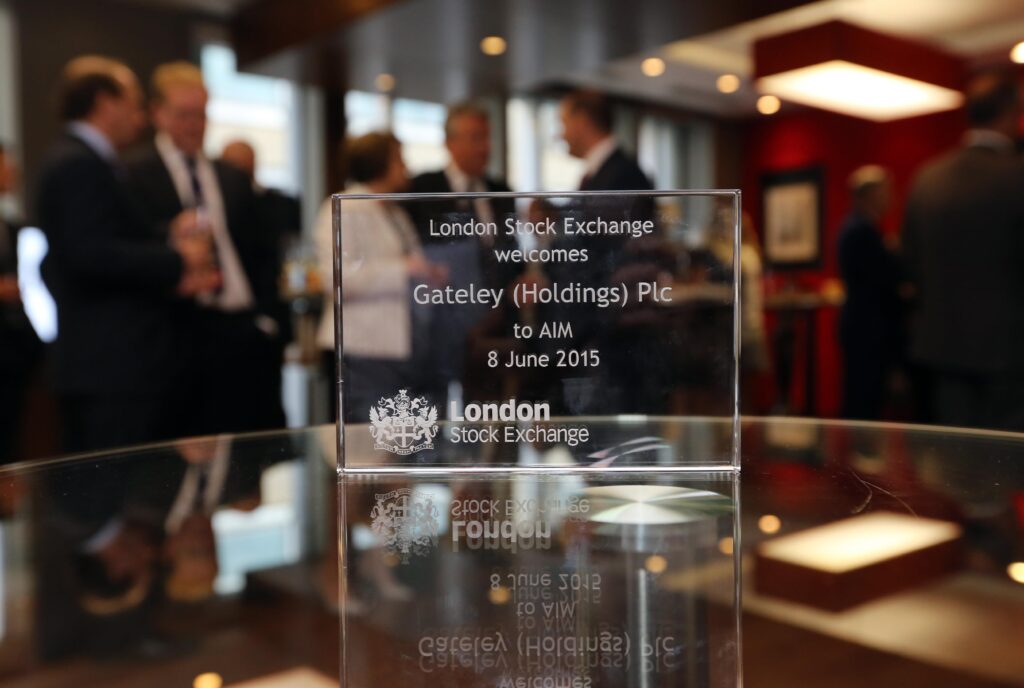
Earlier this month (8 June), Gateley passed a significant milestone: 10 years since listing on London’s Alternative Investment Market (AIM).

When the firm floated on 8 June 2015, it had revenue of £60.9m and a market capitalisation of £100m. A recent trading update stated an expected growth rate of 4% for the 2024-25 financial year – up from last year’s £172.5m to ‘not less than’ £179m, meaning the firm’s revenue will have grown by nearly 200% over the last decade. 

And this growth in revenue has come alongside a significant increase in headcount, driven, in part, by the 14 acquisitions the firm has made since (see list below).

At the time of its IPO, the firm had 154 partners and 380 lawyers. Now, it has 183 partners and 630 total lawyers; not to mention an additional 387 non-lawyer fee earners – meaning almost 40% of its 1,017 fee-earners come from the consultancy side of its business.

Given the mixed outcomes for firms that have listed in the years since Gateley, this growth is not to be sniffed at.

‘That’s a hell of an achievement,’ says Ian Rosenblatt, founder and senior partner of Rosenblatt Law, which emerged from the ashes of failed listed parent RBG Holdings. ‘They must have excellent management who are able to deal with the endless jack-in-the-boxes that pop up.’

So what drove Gateley’s decision to list? Waldie (pictured right) says it stemmed from the firm’s strategic board (with former senior partner Michael Ward and London corporate head Nick Smith credited with spearheading the strategy) wanting to do something that would set Gateley apart from its peers and help it climb the revenue rankings from its then position of 48th in the LB100.

‘We were looking at how we go through the next tier, up to around 25th. We looked at the competitors between 50 and 25 – it’s a very crowded legal services market and a lot of the firms looked fairly similar. We wanted to differentiate Gateley in some way, make ourselves look different, and therefore potentially make ourselves look more compelling, both internally and externally.’
He adds that the listing was viewed as the best way to implement the identified ‘D, D and I’ strategy: ‘differentiate through diversification, along with a different way of incentivising our people.’

Waldie, who led the firm’s property team at the time of listing and replaced Michael Ward as CEO in May 2020, says the board wanted to broaden equity beyond a ‘small number of senior people’ and says it was ‘wonderful’ that on the day of the IPO everyone at Gateley, regardless of their role, received shares. 

The impact of the diversification is similarly clear. Only two of the £56.83m-worth of acquisitions the firm has made since listing have been pure law firms – the 2018 acquisition of Surrey-based GCL Solicitors and the 2020 addition of Tweed Legal in Belfast.

The rest have seen Gateley branch into work including IP protection, chartered surveying and leadership development. The firm also launched a collective action practice (Austen Hays) last year, having recruited Slater and Gordon’s head of collective actions, Chaya Hanoomanjee, in 2023 to lead it.

Indeed, Gateley’s most recent half-year financials show organic revenue from non-legal work growing significantly faster than legal work, with consulting now bringing in around 30% of revenues.

And the firm isn’t done yet. As Waldie comments: ‘The adjacencies have broadened for us in every context, and we’ll continue to keep an eye on opportunities in spaces we find strategically interesting.’

Waldie says he hopes to see more law firms join Gateley on the market and points to IPOs as a possible exit for PE firms, who have been ratcheting up their interest in the legal sector in recent years.

Whether this happens may depend on how his fellow listed firms fare. Of the five firms that have followed Gateley onto the market, Ince Group and RBG Holdings entered administration amid a wave of recriminations, while DWF was taken private by Inflexion in 2023. That leaves Gateley, Knights, and Keystone Law as the survivors. All of those three firms are growing and looking robust, but it is fair to say that IPOs are not proving that popular for firms right now.

Keystone founder and CEO James Knight is honest about shift to law firms being able to list. ‘It’s no secret that it has not been an outstanding success,’ he says, adding that Mishcon de Reya’s costly abandonment of its listing plans in January 2022 was the ‘final nail in the coffin’ for law firm flotations in the immediate future.

Amish Bakhai, managing director at investment bank DC Advisory,  is another sceptic: ‘The trend we’ve seen – not just in legal or accounting services, but across the board – is that there’s now a huge amount of private capital available, from a variety of sources, such that there often isn’t a strong reason to list the business on public markets.’

In contrast, Freeths corporate partner Jeremy Swift, who led on the April flotation of accountancy firm MHA for a market capitalisation of approximately £271m, believes the listing demonstrates that the door hasn’t completely slammed shut for law and professional services firms.

‘There is clearly a demand for high-quality professional service businesses amongst the investment community. I can see room for high-quality law firms to list in London, though I suspect that they will need to be different to those currently on the market.’

Access to external capital is often cited as a primary reason for law firms to list, but Waldie is keen to emphasise that for Gateley, the driving force was the need to corporatise: ‘The LLP model doesn’t lend itself particularly well to acquisitions – the listed structure gave us all of the levers we felt we needed.’

The firm does however have a recently agreed £80m revolving credit facility with Bank of Scotland, HSBC, Barclays and NatWest, with an uncommitted £20m ‘accordion’ option. While the facility provides a buffer against market volatility, it will also be ‘pointed at acquisitions’, according to Waldie.

Some of the money will also be available for lateral team hires, in the vein of the six-lawyer corporate team Gateley recruited from Clyde & Co led by partners Nora Al Muhamad and Darren Harris in March this year as part of what Waldie refers to as a ‘reboot’ of the firm’s Dubai operations.

Waldie describes the hires as a ‘big investment and a clear intention of our intention to grow in Dubai.’

He is quick to clarify, however, that Gateley is not out to plant flags across the globe: ‘What I don’t see in the foreseeable future are lots of Gateley bricks and mortar offices popping up in lots of different jurisdictions.’

Despite the modest rise of 4% in the most recent financials. Waldie’s ambitions remain high: ‘the medium-term target is to grow revenue both organically and through complementary acquisitions to at least £250m.’

And the burning question, with the benefit of hindsight: would he have still recommended listing back in 2015? The answer is a resounding yes: ‘I’m firmly of the view that we couldn’t have achieved what we’ve achieved absent the listing.’

Gateley’s post-listing acquisition: a timeline

2016
April: Tax incentives specialist Acquires Capitus – £2.72m
September: Property consultancy Hamer Associates – £2.05m

2018
April: Human capital Kiddy & Partners – £3m
May: Residential law specialists GCL Solicitors – £4.15m
November: Inward investment consultancy International Investment Services

2019
September: Acquires land referencing consultancy Persona Associates – £250,000
December: t-three, a leadership development consultancy – £3.4m

2020
March: Reputation and media boutique Tweed Law – £2m
March: Corporate advisory and built environment consultancy The Vinden Partnership – £6.75m

2021
July: Chartered quantity surveyors Tozer Gallagher – £700,000

2022
January: Adamson Jones, a patent and trade mark legal practice – £2.5m
April: Smithers Purslow, a multi-disciplinary surveying firm – £20m
October: Symbiosis IP, a patent attorney firm focused on life sciences – £2.5m

2023
July: Chartered surveyors RJA Consultants – £6m

[email protected]