
Global 100 European M&A focus: Riding a black swan

‘What has happened to us?’ An M&A veteran shakes his head incredulously, having uttered the now ubiquitous phrase: ‘stay safe’ to conclude a Zoom call with Legal Business.

This time last year, rainmakers could hardly have imagined being forced into a neverending merry-go-round of video conferencing, let alone ending each conversation with something reminiscent of a BBC Crimewatch catchphrase. Continue reading “Global 100 European M&A focus: Riding a black swan”

Life During Law: Samantha Mobley

My family story is not one of generations of lawyers. My great grandfather was a coal miner in Wales.

I went to school in South Africa and grew up in the apartheid era. My parents moved there when I was a small child and I had always wanted to move back to the UK. I applied to read law at Bristol University and I’ve never regretted it. I worked at the Albion pub in Clifton to pay some of my way through university. Continue reading “Life During Law: Samantha Mobley”

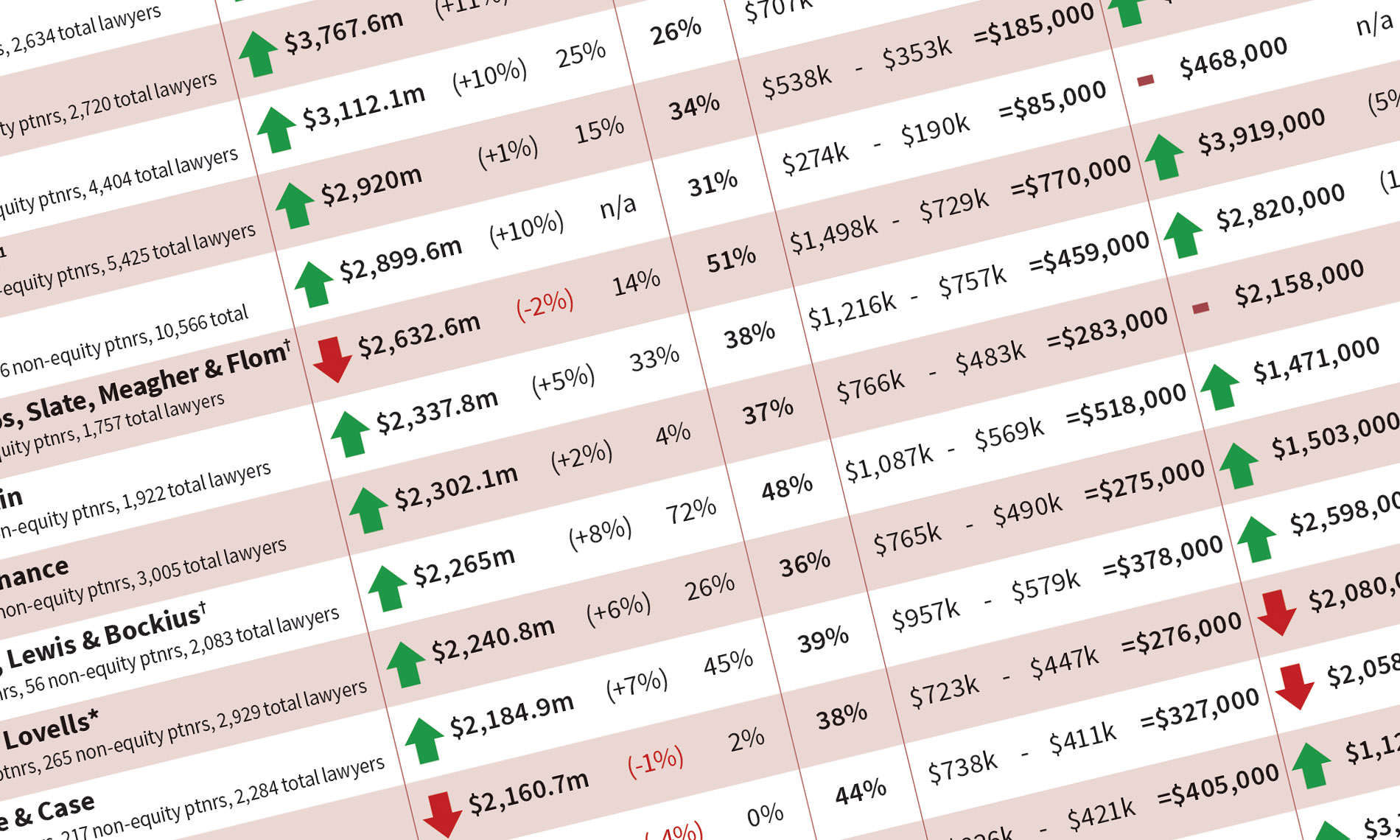
The Global 100 – Core Stats

Top 10 firms by revenue change

Top ten firms by PEP change

Global 100 averages

Revenue and PEP growth across the Global 100

Return to Global 100 menu

The Legal 500 View: The gender agenda: the rankings and firms making progress on diversity

Caroline Edwards

Legal 500 editors Georgina Stanley and Ben Wheway take an in-depth look at gender diversity in the latest Legal 500 London rankings

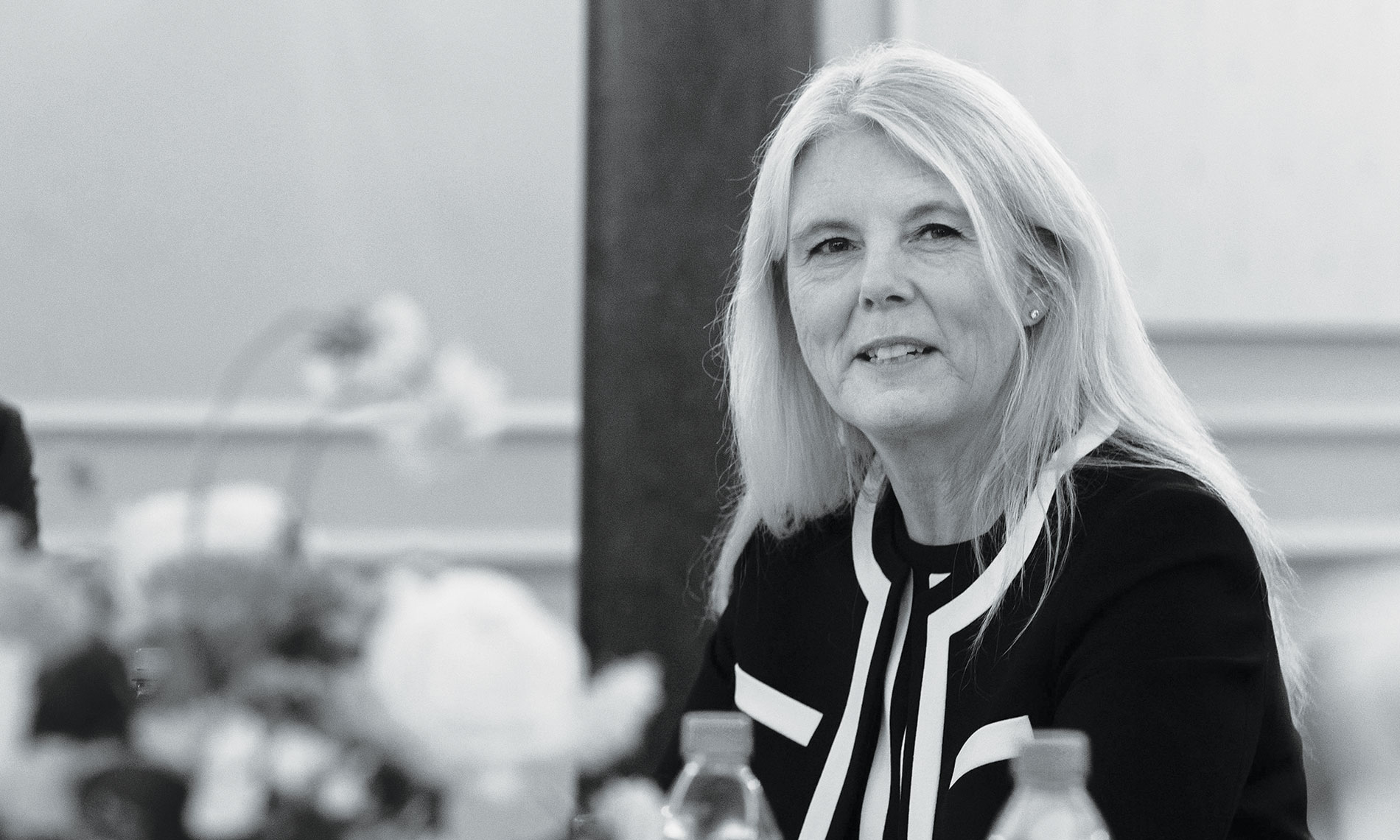
‘Institutional male dominance is hard to shift – it isn’t enough to want to change; sometimes these things are structural,’ says Travers Smith disputes partner Caroline Edwards (pictured) of the difficulties women lawyers can face trying to build their profile in the legal market and the directories that reflect it, including The Legal 500. Continue reading “The Legal 500 View: The gender agenda: the rankings and firms making progress on diversity”

Sponsored practice area spotlight: Insolvency and restructuring: Combining unique skills to achieve a successful outcome

Prager Dreifuss

Insolvency and restructuring proceedings are intricate and complex. Practitioners must be able to combine legal knowledge, in particular in the areas of litigation, finance and transactions, with strategic, tactical and managerial skills to deliver positive results.

Prager Dreifuss has extensive experience and a longstanding tradition in insolvency and restructuring matters. In the wake of the financial crisis, we combined our finance and bankruptcy knowledge which enabled us to assist in complex project financing, also lately in a major multinational commodity project. Our attorneys regularly represent creditors, some of which are banks, hedge funds or other financial institutions, in large national and international insolvency and restructuring proceedings, whether in registering or purchasing claims or in enforcing disputed claims vis-à-vis bankruptcy administrators and before courts. Assisting clients in the recognition and enforcement of foreign judgments in Switzerland and abroad is a key feature of our daily practice. Frequently and increasingly, we are retained by creditors in enforcing claims (awards, bonds) against sovereigns. Continue reading “Sponsored practice area spotlight: Insolvency and restructuring: Combining unique skills to achieve a successful outcome”

Sponsored briefing: The pandemic and Portuguese capital markets

VdA

In 2019, our article in Legal Business ended as follows: ‘Therefore, with the benefits of a renewed legal and regulatory framework and of an environment where low interest rates facilitate access to funding, 2020 is likely to follow in line with the current year, promising continued intense activity and diversity’. In January 2020, VdA organised an international conference on sustainable finance, where we discussed the growing relevance of ESG factors with key players.

However, unpredictably, by March 2020 it was clear that our prediction of ‘continued intense activity and diversity’ was beginning to make little or no sense, as the Covid-19 pandemic reached Portugal (and the world). By the end of March, an unprecedented legal moratoria regime was enacted and subsequently extended until the end of September 2021. Very dark clouds were on the horizon for those looking for funding or refinancing, and on top of the legal moratoria regime, force majeure and material adverse change clauses became hot topics of discussion. Continue reading “Sponsored briefing: The pandemic and Portuguese capital markets”

Revolving doors: European and London laterals head up hiring push before Christmas

starry sky over the City

In a final lateral recruitment drive before Christmas, a number of international firms have unveiled notable partner hires.

Bryan Cave Leighton Paisner has announced the appointment of Jason Marty as its new chief operating officer. Marty, currently global COO at Baker McKenzie, will officially start his new position on 1 March. He will be based in Chicago and play a key role in execution of BCLP’s new business transformation initiative, dubbed Project Advance. Continue reading “Revolving doors: European and London laterals head up hiring push before Christmas”

Dealwatch: $39bn AstraZeneca deal caps off pharma boom year as advisers secure roles on G4S bidding war

Briefcase

News over the weekend of AstraZeneca’s $39bn deal to acquire Alexion Pharmaceuticals has capped off the 2020 pharma boom in style with what has been touted as the largest acquisition of a US target company and the largest acquisition financing of the year.

Elsewhere, advisers benefited from another big-ticket transaction as the bidding war for security services company G4S ramped up with a bid from Allied Universal, and an equity valuation of £3.8bn.  Continue reading “Dealwatch: $39bn AstraZeneca deal caps off pharma boom year as advisers secure roles on G4S bidding war”

Revolving doors: rush of international hires between Global 100 players dominates laterals market

In a week of significant lateral movement between large Global 100 firms, White & Case has expanded its global M&A practice with the addition of Linklaters partner Marc Petitier in Paris.

Petitier is a renowned corporate lawyer with 20 years’ experience at Linklaters who has led on many of the most significant corporate transactions originating from France, advising clients on public and private M&A deals, sales and joint ventures, and corporate governance. He has experience across a number of different sectors, including technology, financial institutions, energy and infrastructure, and on Africa-related deals. Continue reading “Revolving doors: rush of international hires between Global 100 players dominates laterals market”

£14bn Mastercard group action claim to proceed following historic Supreme Court ruling

broken scales

The Supreme Court has today (11 December) dismissed Mastercard’s efforts to thwart former financial ombudsman Walter Merricks’ £14bn group action claim against it in what is a landmark decision for the future of collective actions against companies in the UK courts.

The decision from the Supreme Court upholds a previous ruling from the Court of Appeal and sets aside the original judgment of the Competition Appeal Tribunal (CAT) which would have stymied the group action claim.  Continue reading “£14bn Mastercard group action claim to proceed following historic Supreme Court ruling”

‘Things are looking pretty good’: DWF continues recovery with strong half-year results after tumultuous 2019/20

Hope floats

DWF has continued its recovery in 2020/21, according to the firm’s half-year results, following a torrid year that saw debts rise and underlying profit plunge. 

The results announced today (10 December) reveal net revenue standing at £167.6m for the H1 period ending 31 October, an impressive increase of 15% on the £145.2m the firm posted for the same period last year. The firm’s organic revenue growth, meanwhile, stood at 3% while gross profit recorded a double-digit hike, rising almost 14% to £83.1m.   Continue reading “‘Things are looking pretty good’: DWF continues recovery with strong half-year results after tumultuous 2019/20”

Dealwatch: Advisers wrapped up in flurry of deals in final push before Christmas

In the conspicuous absence of the traditional round of festive parties, advisers have instead busied themselves with getting a host of deals across the line ahead of the Christmas break.

As the pandemic continues to rage on, Coronavirus-driven transactions show no sign of abating, with a €1.8bn financing package for tourism company TUI and the $1bn merger of hospitality companies Ennismore and Accor characterising the current deal market.  Continue reading “Dealwatch: Advisers wrapped up in flurry of deals in final push before Christmas”

Guest comment: A call to arms for the Bionic Lawyer

three lawyers walking in a line

I am you.  I am your colleagues.  I am what your customers have always dreamed of.  I am The Bionic Lawyer…

And so began an open letter to the legal industry from the Bionic Lawyer Project. That letter, published on 24 September, marked the end of the beginning of our project, as a year of energised collaboration paved the way for releasing 16 ‘levers’. Those 16 levers set, we believe, the design principles for the future legal industry. Continue reading “Guest comment: A call to arms for the Bionic Lawyer”

Revolving doors: week of international hires in Asia and Europe as A&O tempts litigator back home from Shearman

In another busy week of lateral recruitment, Allen & Overy has considerably bolstered its disputes offering in London, luring back former associate Susanna Charlwood from Shearman & Sterling, where she had been a partner for five years. 

Karen Seward, Allen & Overy’s global head of litigation, commented: ‘We are thrilled to welcome Susanna back to A&O. Her broad experience across commercial and corporate disputes makes her a valuable addition to the litigation practice and bolsters our bench strength at a time when our corporate clients are operating in a trading environment fraught with uncertainty. Continue reading “Revolving doors: week of international hires in Asia and Europe as A&O tempts litigator back home from Shearman”

‘Drive long-lasting change’: Professionals urged to take part in survey on law and mental health

Stressed lawyer illustration

Professionals across the UK legal industry are being encouraged to participate in new research to assess the impact of workplace culture and practices on employees’ wellbeing, as issues around mental health continue to rise up the Big Law agenda. 

The study is being spearheaded by legal mental health charity LawCare, which is currently running an anonymous online questionnaire across the UK, Ireland, Channel Islands, and Isle of Man until 31 December. The results – which will be announced next year – will form the basis of an academic paper and be used to help LawCare improve the levels of support available to employees in the legal industry employees.  Continue reading “‘Drive long-lasting change’: Professionals urged to take part in survey on law and mental health”

Ready for the new normal: International Arbitration Centre unveils new Covid-compliant disputes facility in London

The International Arbitration Centre (IAC), the purpose-built premier hearing venue situated near to the Royal Courts of Justice on Fleet Street, has opened a new Covid-compliant ‘super suite’ to cater for a projected increase in disputes heard at the centre as hearings roll over from 2020 into 2021 and beyond.

With the launch of a new super suite, the 25,000-sq ft IAC has added its most technically advanced facility yet, accommodating up to 100 people in total – if socially distanced – with up to 50 socially distanced attendees in its main hearing room. Continue reading “Ready for the new normal: International Arbitration Centre unveils new Covid-compliant disputes facility in London”

Life during lockdown

What have we learned since March 2020? For Amar Sundram, head of legal at RBS in India, it is that talk of lawyers being an uncreative species was greatly exaggerated.

‘We are now seven months into the pandemic and the main myths about lawyers have been broken. The myths that we are not adaptive, that we do not take risks, that we are averse to technology – they have all disappeared. Lawyers have found that, when faced with necessity, they can take to new tasks as well as any other professional group.’

Our survey of over 100 of the leading counsel across the Asia Pacific region showed that less than a fifth of legal teams (18%) felt their output was significantly affected by the pandemic, though the bulk of respondents (73%) had experienced some level of disruption.

For many legal teams, the pandemic was an unexpected experiment in working remotely. While over half of legal  teams (59%) had a prescribed remote-working policy in  place before the pandemic hit, and almost all (95%) felt  such a policy was necessary, this was scant preparation  for having the entire team work remotely for weeks at a time.

Marcus Clayton, general counsel and company secretary at leading Australian integrated construction materials producer Adelaide Brighton Cement (Adbri), reflects on the early days of lockdown:

‘With a very lean team to start with, working from home through COVID-19 and splitting the legal team into Team A and Team B made it much harder to produce the expected outcomes, [particularly as] demands increased. We were all to work longer and harder in difficult circumstances to achieve a lesser product than before.’

Many survey respondents pointed to a similar problem, noting that in the early days of lockdown they had been expected to meet more challenges with fewer resources. As one respondent, a legal director working at a large industrials company in Singapore, commented:

‘While demand for regular commercial advice has tailed off somewhat, we have had to contend with an increased number of requests for regulatory advice. At the same time, there has been a huge increase in the number of online meetings, with some of these taking up the entire day. Managing this challenge of growing demand under such unusual circumstances has been particularly difficult.’

Others pointed to the lack of connectivity in the legal team, and the difficulty of ‘discussion, deliberation and evaluation of the finer points of a matter’ while working remotely. Some felt that the organisational support for remote working was still lacking, with one Hong Kong-based general counsel at a consumer electronics company commenting:

‘A documented remote working policy has worked well for us. However, it will only work if home infrastructure allows employees to work remotely. It is more than simply providing a laptop. This has not been a problem with the lawyers in the legal team but has been a problem with support staff.’

The A and B Team

While talk among GCs has turned from “business resilience” to “business resurgence”, few expect their return to normal to be synonymous with a return to the office. Staff may be returning on a team by team rotation, but a growing number of companies have started to think about how they can operate a remote working policy as their default setting.

To do this successfully they will have to deal with the issue of cyber security. As Pulin Kumar, senior legal and compliance director at adidas India, notes:

‘In today’s environment a lot of things are system driven, and once you have a system driven environment then everything has to be connected. It is almost a given that for remote working to succeed information must be highly accessible. The data will flow to far more places and people, so the security checks in place need to be robust. This is a matter for IT teams, but it is also a matter for legal and compliance teams. Employees’ understanding of compliance has to be updated to account for the mass shift we are seeing toward working from home.’

Respondents to our survey echoed this, pointing out that remote working had exposed their companies to enhanced cyber security risks. Over a third (36%) felt the biggest risk came from loss or theft of confidential business information. As one GC commented, ‘Sensitive data and applications are now being accessed through non-secure networks. Businesses need to give this some more thought, and will likely have to invest more time, effort and money to strengthen their IT infrastructure.’

Of course, when it comes to new ways of working, not all legal work is created equal. Work involving insurance claims relating to physical infrastructure, anti-bribery and fraud investigations, or due diligence in the context of an M&A where virtual data rooms are required are all exponentially more difficult to do remotely. As Nancy Wei, associate legal director of Skechers China comments: ‘Remote working is really helpful non-litigation scenarios. For litigation issues, I tend to choose face to face meeting to discuss the facts of the case and collection of evidence.’

A pandemic in numbers

But perhaps we should not dwell on the negatives. One of the most surprising things about the lockdown has been the ability of many businesses to function as normal. Likewise, legal teams have managed to weather the storm successfully. Nearly a third (27%) of respondents to our survey felt their efficiency had improved, while a similar number (24%) said their output had in fact increased. Being on call 24 hours a day does have some advantages….

Another positive has been the invigorating effect remote working has had on legal teams. As Amba Prasad, vice president and head of legal services at Indian construction and engineering conglomerate Larsen & Toubro comments:

‘COVID-19 has shown that the remote working can be efficient despite the challenges of management and the interplay of work related to teams based in different locations. Scaling up our technological infrastructure in a timely manner aided this transition.’

Aside from helping the legal team find new ways to operate efficiently, he continues, the pandemic has had other benefits. ‘It has brought the team together in a manner that was never before seen. Caring and sharing between team members has really become an embedded practice.’

This much is clear from our survey. Fully 31% of those we spoke to said employees within the legal team were happier with their current out of office setup.

While most GCs felt remote work had been a positive thing for the legal team, there are questions of whether the same established structures can endure over the longer term. Bernard Tan, Asia Pacific managing counsel at Agilent Technologies, comments:

‘I don’t think there is an immediate negative impact to productivity as we have the necessary working culture, processes and technical infrastructure that enable work to continue on a remote basis. The concern is more about long term engagement issues and whether, as a legal team, we are able to continue to exert the necessary influence and engagement with internal clients if we work on a 100% remote basis perpetually.’

The solution to this ongoing question will likely involve increased spending on technological infrastructure and enhanced cyber security protocols, but it will equally depend on the approach taken by lawyers. As Nancy Wei concludes:

‘It is going to be a case of legal teams learning new and more flexible ways of doing things. We need to communicate more efficiently and effectively, especially when facing up to balancing business opportunity and risks. Trust among team members is going to be very important in facing up to this uncertain situation.’

With nearly three quarters (73%) of respondents saying the expect remote working to increase over the coming months, pressure on GCs to find ways of dealing with uncertainty is going to be with us looks set to become the new normal.