

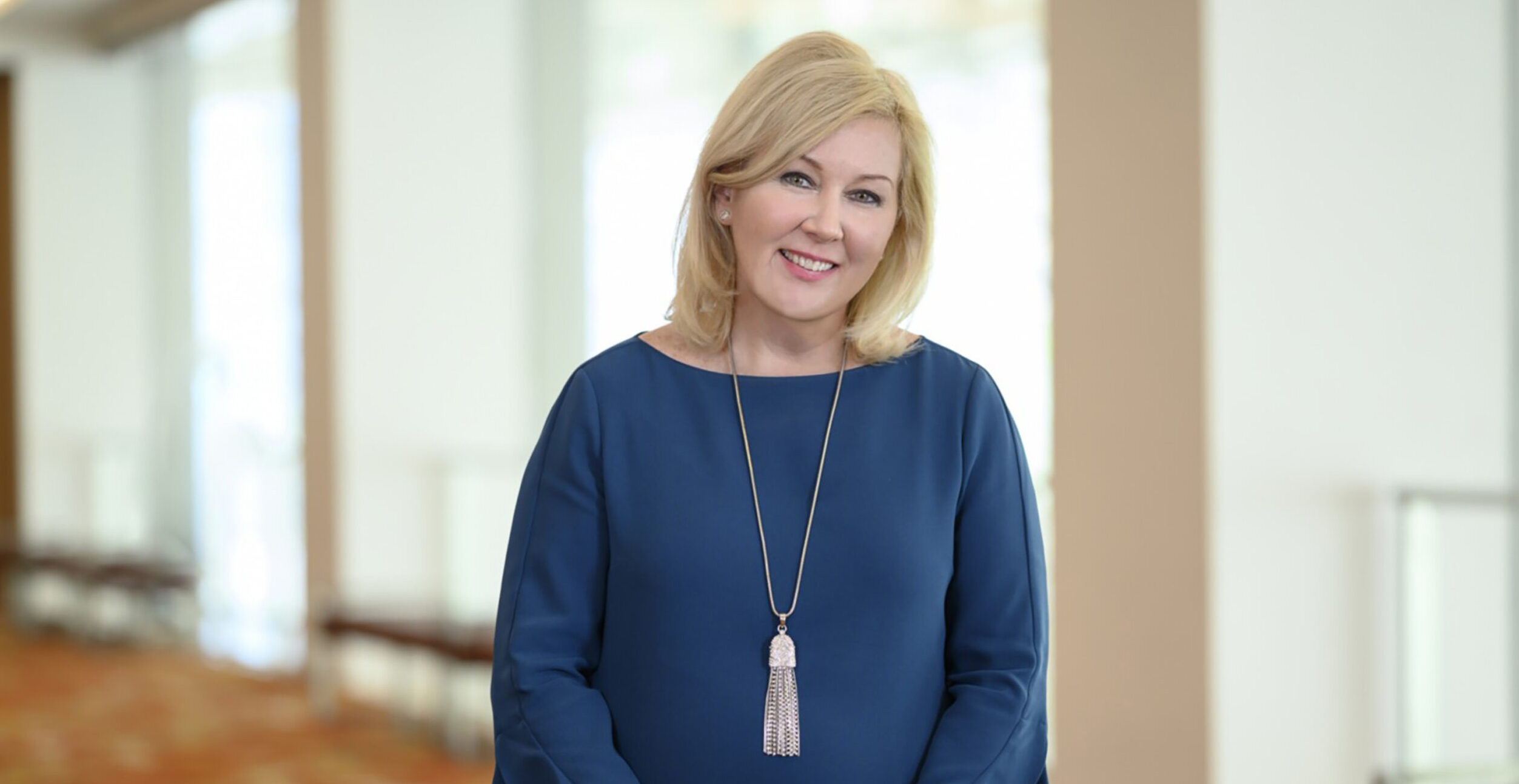
When Dentons announced more than a year ago that EY’s Kate Barton (pictured) would take over from Elliott Portnoy as global chief executive it marked the end of an era for the firm that still brands itself ‘the world’s largest global law firm’.
A highly visible leader, founding CEO Portnoy had held his role since the 2013 three-way merger between SNR Dentons, Salans and Fraser Milner Casgrain that created Dentons in its ultra-expansive global form. Along with founding chair Joe Andrew, he shepherded the firm through more than a decade of expansion, including the ill-fated union with Dacheng that ended in summer 2023.
Now, just over a year since Barton took the helm, Dentons is ready to move to the next stage of its development – to shift from what Barton calls ‘a pre-teen firm’ to ‘young adulthood’.
Leveraging global reach
Barton’s vision for Dentons is broad: ‘We want to be famous for global transactions, global advisory services, and global disputes,’ she says. ‘We want to not only be the world’s largest law firm in terms of countries covered – we want to dominate across those three areas.’
To achieve this, the firm has adopted a new sector strategy focused on seven key industries:
- Consumer products and services
- Energy and resources (split into energy and mining)
- Financial
- Industrials, transportation and infrastructure
- Life sciences and healthcare
- Technology, media and communications
- Real estate
‘You can’t throw the baby out with the bathwater. We have 33 more countries than the next nearest law firm. That is a real differentiator’
Earlier this year, Dentons appointed global leads for each of these sectors, with the positions spread across the firm’s network of offices around the world.
Istanbul partner Doğan Eymirlioğlu leads consumer products and services, with Salt Lake City-based Stephanie Regenold and Santiago-based José Ignacio Morán leading the energy and mining arms of energy and resources, respectively.
New York-based capital markets regulatory team head Matt Yoon leads the financial sector, while industrials, transportation and infrastructure is headed up by Montréal-based partner Ilan Dunsky.
Jean-Marc Grosperrin in Paris leads life sciences and healthcare, and Washington DC-based US privacy and cybersecurity team lead Todd Daubert leads TMT.
Finally, the sector lead for real estate is London partner Alex Coulter.
The distribution of the global sector leaders reflects Barton’s aim for Dentons to capitalise on its scale.
Barton explains: ‘You can’t throw the baby out with the bathwater. We have 33 more countries than the next nearest law firm. That is a real differentiator. Before we disrupt that strength, I want to make sure we press that advantage.’
She does not rule out further expansion over her term – last March the firm announced a tie-up with Thailand’s Pisut & Partners, and Barton points to Japan as another market in which the firm would like to establish a presence.
As a verein, Dentons has a decentralised structure, with high levels of independence across different regions. It is an approach that some argue can cause friction, with some verein firms even needing to cut internal deals to coordinate client service.
But while some integration of Dentons’ existing operations may be on the longer-term agenda, Barton argues that her firm is already more connected than some realise.
‘We’re more integrated than people think,’ she says. ‘We have the joy of having all our European operations in a single partnership, and the UK, Ireland and the Middle East (UKIME) in another. We didn’t have that at the big four. We had region structures, but underneath it, France paid France and Italy paid Italy.’
Unique experience
Barton’s move from Big Four professional services to head a large law firm is an unusual one. She spent nearly four decades at EY, most recently as global vice chair of Tax, Law and People Advisory Services, with a seat on the global executive board.
As her comment on Dentons’ integration suggests, her experience gives her a unique perspective.
‘I’m very familiar with the playbook of running a large globalised business, managing clients, operations, profit pools, and member pools’, she says. ‘But I don’t want to presuppose that what worked for a Big Four firm is going to work for a law firm. I’ve seen what a more mature organisation can accomplish, but the key is making it work for Dentons.’
‘Leaders lead at the right time. Elliott and Joe were perfect to get this off the ground’
This summarises Barton’s approach to her leadership: build on what makes Dentons unique, while looking for opportunities to move it forward.
‘I’m very grateful to both Elliott and Joe,’ she says. ‘I want to commend them for the foresight of the concept of Dentons that I now get to take to the next level.
‘I think leaders lead at the right time. Elliott and Joe were perfect to get this off the ground and I know I have their unwavering support.’
Dentons – key stats
Total revenue: $2.75bn
Total partners: 2,145
Profit per equity partner (PEP): $906k
Number of offices: 172
Number of offices taken from the Dentons website. All other figures taken from the 2025 Global 100 table.