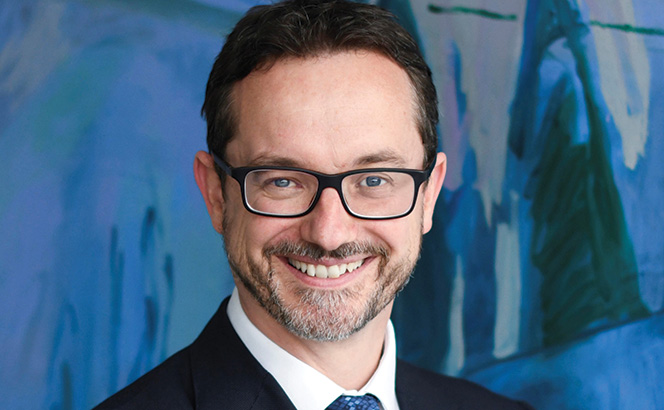


For Pride Month, Stevens & Bolton disputes partner Sophie Ashcroft discusses being a “later in life” lesbian, becoming a visible role model and why law firm culture is so important
How did you experience coming out?
‘I’m a “later in life” lesbian – a common phenomenon among middle-aged women. People can get married quite young, maybe have a couple of kids, and follow that trajectory without really questioning it. Then they maybe get divorced, get released onto the dating scene, and think, maybe I’ll try something else. They’re not constrained so much anymore by society or their family’s expectations.’
‘My experience was a bit like that. I’d had experiences with girls before, but I don’t remember thinking about it, certainly never talking about it with anyone, not a friend, certainly not my parents. I got married at 24 and had my first child when I was 25. I was on that path for a while, then I was divorced and a single mum by the time I was 29. That’s when I went to law school and really focused on building my career.’
‘In 2011 I was working at Clyde & Co. I had a friend in my team who was friends with a gay woman in a different team, and I got to know her through him. One year at the firm’s Christmas party, we spent the whole evening together, and after that our relationship began. I had to think about what that meant and what I wanted. I was 38, financially independent, with a good job and had had my kids already. I knew I really liked her. So I thought, I’m going to see where this goes.’
‘My kids were twelve and ten at the time, so they were old enough to know something was going on. I had to tell them quite early on, which meant telling my parents and their dad too, because I couldn’t ask them to keep it secret. I sort of had to tell everyone all at the same time, which didn’t go brilliantly at first with some people, but largely it was great and everyone was just happy to see me so happy.’
Did you have any worries about how coming out would affect your career?
‘I wasn’t worried exactly about work. I was a bit worried I’d be the subject of gossip – as far as everyone was concerned, I was completely straight before this, and I didn’t want to be seen as just going through a phase.’
‘Obviously my then-girlfriend was out at work, and had been for a long time, and it hadn’t affected her progression at all. But aside from her, I don’t think I really knew of any other lesbian lawyers.’
‘In those days, I was very careful when speaking to clients. Especially when you mention your children, anyone you’re interacting with professionally usually asks you about your husband. No malice intended, that’s just the assumption. And I did sometimes struggle with how to respond, because if I didn’t know the client very well, I didn’t feel confident in assuming that if I said, actually it’s my girlfriend, it would be received well.’
Did you feel any obligation to be a role model for younger people in the sector?
‘I went back to Clydes after maternity leave in 2020, and by that point it was all fine, I was established in my relationship, we worked in the same firm and everyone knew about it. And when I changed job and went to work at Browne Jacobson in 2021, I made a conscious decision in that recruitment process that I was going to be open about the fact that I was gay. Browne Jacobson is very big on all kinds of diversity issues, and I wanted to lend my voice to that – not least because I was going in as a partner. I did want to be a visible role model, so that anybody in the firm who might be more junior, who might be wondering if it would be okay for them to be out at work, would be able to see that being out isn’t a barrier to progression.
‘Since then, I’ve always been completely open about my circumstances. It was a conscious choice, and it did take me a few years to settle into it, to feel comfortable and confident enough in myself, before I wanted to be visible in this way.’
How important do you think networks are for LGBTQ+ people in the profession?
‘Early on, I wasn’t really aware of any networks. I was aware through a gay male friend of a network for property lawyers, though that seemed to be mainly for gay men. I wasn’t aware of anything like that for lesbians or for gay people generally.’
‘I’m now aware of things like InterLaw, which is great. But there could be more cross-firm networks for lesbians, or anything specifically aimed at gay or bi women in law.
‘I’m not sure why that is; perhaps it’s just that there’s a lack of anybody to lead it. There’s Hogan Lovells lawyer Jacqui Rhule-Dagher, whose Legally Queerly initiative is fantastic, but there aren’t many other people I can think of in law who are flying this flag.’
‘There could be more subgroups, but it’s also positive to have bigger things like InterLaw, which is for everyone who identifies as queer. We’re already a minority – and there’s no point setting up a network which may only be attended by a few people. You need numbers.’
Why is visibility in the profession so important?
‘As a partner in a law firm, you play a role in shaping the culture of the firm. It’s important to be visible, not just so that junior people in the firm or at other firms can see that I’m a partner who’s gay and out, and it hasn’t hurt my career, but also for the clients, for two reasons.’
‘One is that the law is often perceived as a very straight-laced profession. The second reason is, from a corporate social responsibility perspective, clients increasingly require their law firms to demonstrate inclusion, both in their policies and in who they put before the client. When you go and do panel pitches, clients no longer want a group of white middle-aged male partners to turn up. They want to have some senior associates and associates there as well, and they want to see people from diverse backgrounds.’
How has the anti-DEI backlash changed attitudes towards diversity?
‘It’s very troubling, particularly when you look at the US and the direction of travel there since the advent of Donald Trump. Then I look at Nigel Farage’s popularity here, and it’s frightening to say that I can see a scenario in which the UK may follow a similar route. We had to wait a long time for same-sex marriage, or for gay people to be able to have children and both be registered as the parents of that child. It would be horrifying to have those rights rolled back over here.’
‘That’s another reason that visibility is important. LGBTQ+ people are not just some kind of oppressed minority. We are successful people who are leading law firms, leading big businesses, and we make the same contribution to society and the economy as anybody else.’
What does the profession still need to do to improve?
‘Most firms, if not all firms these days, have policies in place. They have rules about what’s okay and what’s not, and things like paternity and maternity leave policies that are inclusive of same-sex couples. They have all that infrastructure in place. But what needs to be worked on at some firms is culture. It’s about fostering a culture where these little off the cuff comments and microaggressions aren’t okay, and where people know that there’s a safe reporting route.’
‘As a partner you feel a duty of care to ensure that homophobia or any kind of hate is stopped immediately. You should never feel like a ‘troublemaker’ for reporting that sort of behaviour.’
‘Culture in law firms needs to instil in everybody, at all levels, the belief that the firm will support anyone who is going to call out bad behaviour – particularly if the person doing the whistleblowing is junior, and the wrongdoer is senior to them.’
How have attitudes in the profession changed?
‘In the period that I’ve been out, the profession, and certainly the firms that I’ve worked in, have had a paradigm shift in terms of culture. I now see more out gay men and lesbians, because of things like InterLaw, because of what firms do to support Pride. That’s absolutely brilliant, because had it been like this when I was younger, perhaps I would have thought, I’m just going to date women. I wouldn’t have had to wait to fall in love with one for the concept to even occur to me’
‘People are much more able to be confident in themselves now and it’s great – but in terms of embedding that in culture, there’s always more work that can be done.’