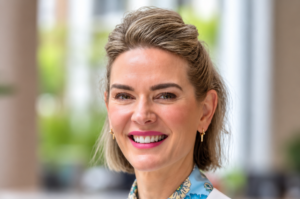


‘We’re a nimble team,’ says Mark Pike, associate GC at Anthropic. ‘We’re trying to keep up with one of the fastest growing companies in the history of capitalism.’
Pike joined Anthropic in 2023, and it’s fair to say the company has been investing heavily in legal since, with a small in-house team of lawyers growing quickly in line with the wider company’s rapid expansion.
But, given that Anthropic reached a valuation of almost $1trn in May this year, surpassing OpenAI to become the world’s most valuable AI company, it’s also fair to say that, compared to the size of the company, the legal team is lean.
As a result, Pike is not just an advocate for the products Anthropic creates, such as Claude for Legal, but an avid user – insisting that without it, he and his team would not be able to get through the volume of work required of them.
‘To keep pace with a company that moves as quickly as Anthropic, in an industry like AI, I absolutely rely on Claude for Legal to get my work done,’ he says.
In February of this year, Anthropic announced its first legal plugin, and in May it launched Claude for Legal, with 12 practice-specific plugins and more than 20 model context protocol (MCP) connectors.
These MCP connectors link Claude to platforms the legal industry already relies on, including DocuSign, Slack, Google Drive and Ironclad, among others.
The practice area plugins include commercial legal, corporate legal, employment legal and regulatory legal, among others, offering a range of skills, connectors and templates for each specific area.
‘You don’t have to trigger these agents by saying a magic spell. They know what to do’
Pike says Claude can be used for a host of legal work, completing repetitive tasks in a fraction of the time it would take manually, freeing up lawyer time for more complex work.
The product team has already seen significant time savings across a range of tasks. Pike highlights the example of privacy impact assessments, which he says used to take two to three hours apiece, and have now been reduced to a 20-minute task, with human oversight.
He explains: ‘I use these repeatable skills to do a first pass and help identify potential legal issues. I keep a human in the loop to review Claude’s analysis, which is based on our previous work, so it’s not generic legal analysis. Claude is leveraging playbooks that it’s often helped us write based on our past work.’
The technology is particularly helpful for ‘needle in the haystack moments,’ Pike says. Claude is able to identify specific themes or information within extensive document hauls, picking out the important points in a deposition or commercial redlining exercise.
What Pike is particularly keen to stress is the potential benefits for in-house legal teams from the combination of the functionality and the time-saving on repetitive tasks.
‘There are so many different types of legal work where people are busy doing repetitive things that Claude is naturally very good at,’ he says. ‘It unlocks law firms and unlocks in-house legal departments to do their best strategic thinking and takes us away from this type of busywork.’
Another feature that is a major potential time-saver for legal teams is Claude’s managed agents. Pike explains their capabilities: ‘Let’s say you had a regulatory managed agent that watched and scanned the horizon on a daily basis. Any time a new law got published in your jurisdiction, it could write a memo for you and send it to you in a dashboard or via email.’
He continues: ‘This is the type of autonomous agentic future that these plugins unlock both on the apps that we build, as well as the apps that our customers are building. You don’t have to trigger it by saying a magic spell. They know what to do.’
‘I’m not going to shy away from the fact that this technology might impact the billable hour’
The technology is already being used by a number of firms and in-house legal teams, with Quinn Emanuel and Holland & Knight among those that have embraced it.
Earlier this year, Freshfields announced a high-profile multi-year partnership with Anthropic, rolling out Claude across the firm and agreeing to collaborate on development of further AI services and workflows.
While the benefits of AI are clear for lawyers and legal teams – more time for strategic advice rather than routine tasks – the longer-term impacts on the legal profession are less transparent.
With in-house teams now able to complete more routine tasks themselves with AI, ultimately less work will go to law firms, which will also have to grapple with the impact of AI on a billing model historically built around hourly rates.
‘I’m not going to shy away from the fact that it might also impact the billable hour and that law firms might need to investigate whether fee-based or project-based outcome approaches are going to be a bigger part of their future,’ acknowledges Pike.
Pike believes that the disruption the legal profession goes through with AI will be worth it in the long term. In three years with the company, his own experience working as a lawyer has already been transformed, and with more upgrades on the way, it won’t stop here.
‘If you had told me when I started at Anthropic almost three years ago that the best model in the world for coding would also be the best model in the world for doing legal work, I would have been so surprised,’ he says. ‘It turns out that giving these models access to legal tools is how they’re able to leverage that same reasoning across different disciplines. It’s been incredible to see.’