
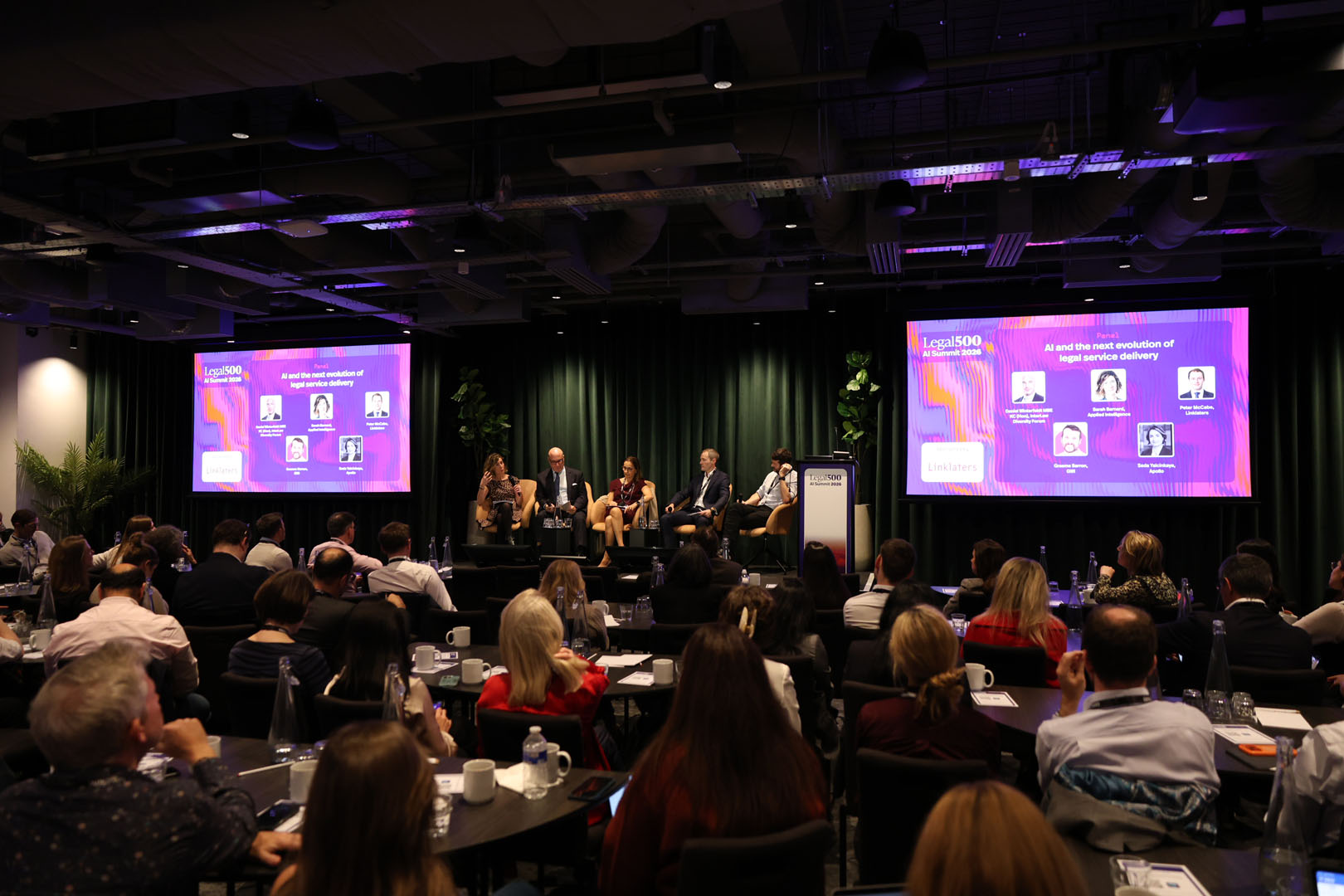
The CEO of the Law Society, Apollo’s International GC and ArcelorMittal’s head of legal technology and operations were among key speakers at Legal 500’s AI Summit yesterday.
When to trust AI, the rise of AI agents, and how AI is being used in practice to transform in-house legal teams were among a host of hot topics debated by more than 100 GCs and senior in-house lawyers at the event, which was held at Minster Building in London.
The event was sponsored by LexisNexis, Harvey, Legora, Wordsmith AI, CMS and Linklaters, all of which hosted panels on the day.
Daniel Hulme, chief AI officer at WPP and CEO of AI company Satalia, set the tone with an energetic keynote speech covering when decision-making should fall to humans and when it should fall to technology. Hulme looked at the areas in which organisations can practically adopt AI and agentic technologies to get real results, as well as exploring the greater impact AI will have on humanity as it evolves and becomes more intelligent.
Hulme’s keynote came after LexisNexis UK head of corporate in-house sales, Mathew Pounder, kicked off the event, followed by a welcome keynote delivered by Karen Waldron, LexisNexis UK director of product development.
Waldron spoke about the findings of a report highlighting the lack of trust many lawyers still have in AI output, and how this can be addressed through technology that provides easily checkable citations, combined with human judgment.
The first panel session, ‘The future is here: which answers can you trust?’, was hosted by Jon Jansen-Alder, LexisNexis’ new director of in-house legal development, who was joined on stage by Siobhan Coetzer, senior legal counsel at WSH Group Limited, Suzy Lovell, deputy GC at Kier Group plc and Sarah Hall, senior legal counsel at E.ON UK.
The group discussed the technologies they had already implemented into their legal teams and broader organisations, what they had found it most useful for, and how to build trust in the outputs.
The day continued with an engaging fireside chat hosted by Harvey’s head of customer engagement K-Ming Lee, who interviewed Sarah-Jane Davies, head of legal technology and operations at steel and mining company ArcelorMittal.
Davies shared the legal team’s journey with AI, discussing how AI tools have allowed the legal department to think more like business people, with a legal layer on top, and how softening KPIs around AI usage has helped to identify where the technology is really adding value. Davies also discussed the organisation’s expectations around AI usage by external advisers.
This session was followed by a panel hosted by Linklaters titled: ‘AI and the next evolution of legal service delivery’. Linklaters’ Sarah Barnard, who is also the director and founder of Linklaters Applied Intelligence, hosted the session and was joined on stage by founder and co-chair of the InterLaw Diversity Forum, Daniel Winterfeldt, Linklaters corporate partner Peter McCabe, Graeme Barron, GC at data infrastructure and analytics company GWI and Seda Yalcinkaya, GC – International at Apollo.
Discussion centred around how AI is being used within their departments and how law firms need to adapt to meet client demands, with Winterfeldt and Yalcinkaya approaching the debate from the highly regulated financial services sector and Barron contrasting this with his experience working within the tech sector.
Topics covered included where outside counsel can still provide value, how the younger generation of lawyers can become strategic advisers in a world in which AI can take on increasingly complex work, and where the technology could be in three years.
 Breakout sessions hosted by LexisNexis, Harvey and Legora followed, in which practical examples were shared around AI in legal practice and how to handle the challenges it presents.
After lunch, CMS took to the stage to discuss ‘AI agents and agentic AI: cutting through the hype’. The session was moderated by John Buyers, partner at CMS, who was joined by Lucy Gilmore, assistant GC – product, privacy and AI at Sprinklr, Christian Keim, VP, head of international legal, deputy GC at Adobe and Feng Taylor-Cai, director, product legal at Airwallex.
The group set the scene by first defining the difference between generative AI, agentic AI and AI agents. The discussion then moved on to look at what is still holding back adoption, the allocation of liability when AI agents are used and whether agents going rogue is a real concern or media hype.
The final session of the day was hosted by Legal Business managing editor Ben Wheway, who was joined on stage by Ian Jeffery, chief executive of the Law Society of England & Wales and Shanthini Satyendra, vice-chair of the AI committee at the Society for Computers & Law, for a timely discussion on new guidance released by the Law Society on the use of AI.
Jeffery discussed the latest guidance, released last month, which is intended to give lawyers a baseline reference to follow when they are using AI tools in practice. Drawing on her experience working in-house, Satyendra discussed how to get the most value from external counsel in the era of AI, the importance of lawyers focusing on value-add work and the opportunities that have yet to be explored.
The day also included live product demos from sponsors and finished with a drinks reception.