When Goodwin’s Silicon Valley-based chief operating officer, Mary O’Carroll, first received a call about the firm she had no interest, dismissing law firms as ‘dinosaurs’.
With a background at tech companies including Google and IronClad, O’Carroll met with around 40 people before she was finally convinced to join Goodwin in August 2024.
Before joining she needed to believe that the partnership was truly bought into the change she wanted to enact. ‘I had no interest in running or simply scaling a law firm. I want to disrupt a law firm,’ she explains.
O’Carroll spent 13 years at Google where she cut her teeth and built the tech giant’s legal operations team. Here, she embraced the ‘move fast and break things ethos’ of the West-coast tech culture that she is now putting in action at Goodwin.
‘At Goodwin, it’s a culture of continuous improvement, launch and iteration,’ she says, ‘We want to move fast, whereas I think some firms just aren’t ready for that mindset.’
According to O’Carroll, while all firms know they must embrace tech and AI with open arms, most partnerships don’t really want the disruption genuine change brings. She says she has puzzled over why the Goodwin partnership seems to be different; the firm focuses on modern industries such as tech and life sciences, but O’Carroll thinks it might have more to do with its Boston heritage making it scrappier, with more to prove.
Certainly, Goodwin’s commitment to change is evident in its recent hires. In addition to bringing in O’Carroll, Chris Grant joined in London in May this year from HSBC to lead a team devoted to rethinking pricing and client value, viewing services from the client’s perspective. Meanwhile, this September, the firm hired Eric Tan in Silicon Valley as its chief digital and technology officer from a Californian tech company. Anthony McCusker, the firm’s chair, previously told LB that the firm is seeking to become ‘not just a vendor but a strategic partner.’
The firm’s most recent results, for the financial year ending 30 September, suggest the strategy is paying dividends. Revenue soared to a record high of $2.7bn as the firm moves to ‘operationalize what it means to be an elite, industry-built law firm’, according to McCusker.
In the months since O’Carroll joined, she has been looking at every function of the business and assessing what needs to change to become an ‘elite firm of the future’. ‘It’s not about tweaking around the edges,’ she says. ‘If we had a fully blank sheet of paper, how would we create this from scratch?’
The traditional attorney review processes is one example of change. ‘When you have 500 to 1000 people – you think, we’re still doing it that way?’ she says.
Her aim is to have development managers gather feedback from clients and partners on a continual basis to create a culture of real-time feedback. ‘Right now associates know where they stand by their [billable] hours, but that is not really a measure of performance. The question is can we get to a place where we measure performance by impact.’
Like many other firms, O’Carroll has also been focused on rethinking the billable hour as a way to better align with client incentives. The firm now uses alternative, more bespoke pricing about 20% of the time, with technology and automation allowing lawyers to focus on more strategic work. ‘You’re going to start to see associates and partners doing more strategic work […] there’s going to be a lot we can push down to technology and supervised business professionals,’ O’Carroll explains.
One of Tan’s briefs, O’Carroll explains, is to focus on better utilising the vast troves of data within the firm. ‘If we unlocked all the knowledge that is inside the firm, how valuable would that be? It can also be anonymised, reused and leveraged across to clients to surface trends and insights,’ she adds.
By her own admission, O’Carroll is impatient. Though pleased with the work over the last year, this has only been laying the foundations to prepare for bigger changes ahead.
‘Law firms are probably not going to exist in the same way even five years from now,’ she says. ‘The future is what excites me and keeps me up at night, because there will come a time where we wake up and the AI works – like really works – where I have confidence in the answers and it is truly saving eight hours a day.’
This is a win, win, win situation, O’Carroll says. ‘It’s a win for clients because the price will go down, it’s a win for firms because profitability should go up even though prices go down, and it’s a win for lawyers because they use their brains on what they went to law school to do.’
But given this will apply to all firms, what, if anything, is going to give Goodwin an edge over every other law firm tooling up for this arms race? ‘To transform a law firm you need three things. You need the partnership to be bought in, you can’t go in thinking you’re going to win them over, they’re either bought in or they’re not. You need leadership that has a strong vision with a clear direction of travel, and with our Goodwin 2033 strategy we have that. And then you need a team that can execute change,’ O’Carroll says. ‘Very few firms have one, never mind all three, of those things.’
She views the biggest threat as coming from AI start-ups because ‘they are not encumbered by the traditional law firm business model’. They might not have the breadth, platform or reputation of well-established firms, ‘but to think no one can disrupt you because you’re the incumbent is foolish. They’re starting with the right model and we’re starting with the wrong one, it’s the classic innovators dilemma,’ she adds, referring to the 1997 book of the same name by Clayton Christensen. ‘We are well positioned. I only joined because I thought we are set up to succeed.’
Just because the partnership is bought in does not mean that O’Carroll is against ruffling a few feathers. ‘We need to tell them more change is coming our way,’ she says.





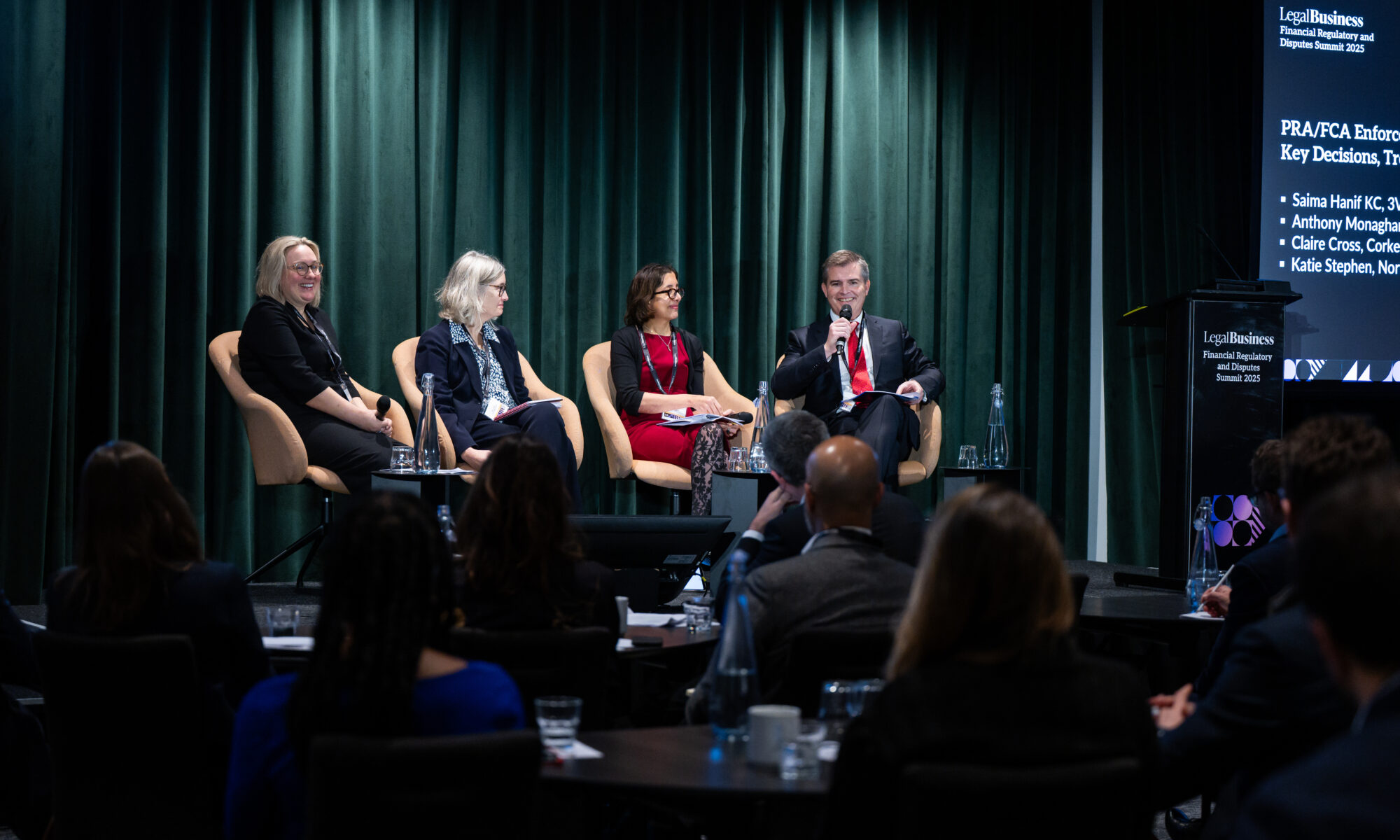
 Commercial litigator Catherine Gibuad KC, of headline sponsor 3VB, opened the morning with an overview of the current state of affairs in enforcement proceedings in the financial services space, outlining some recent significant decisions made by the Supreme Court, particularly those relating to fiduciary duties.