
Under the sword

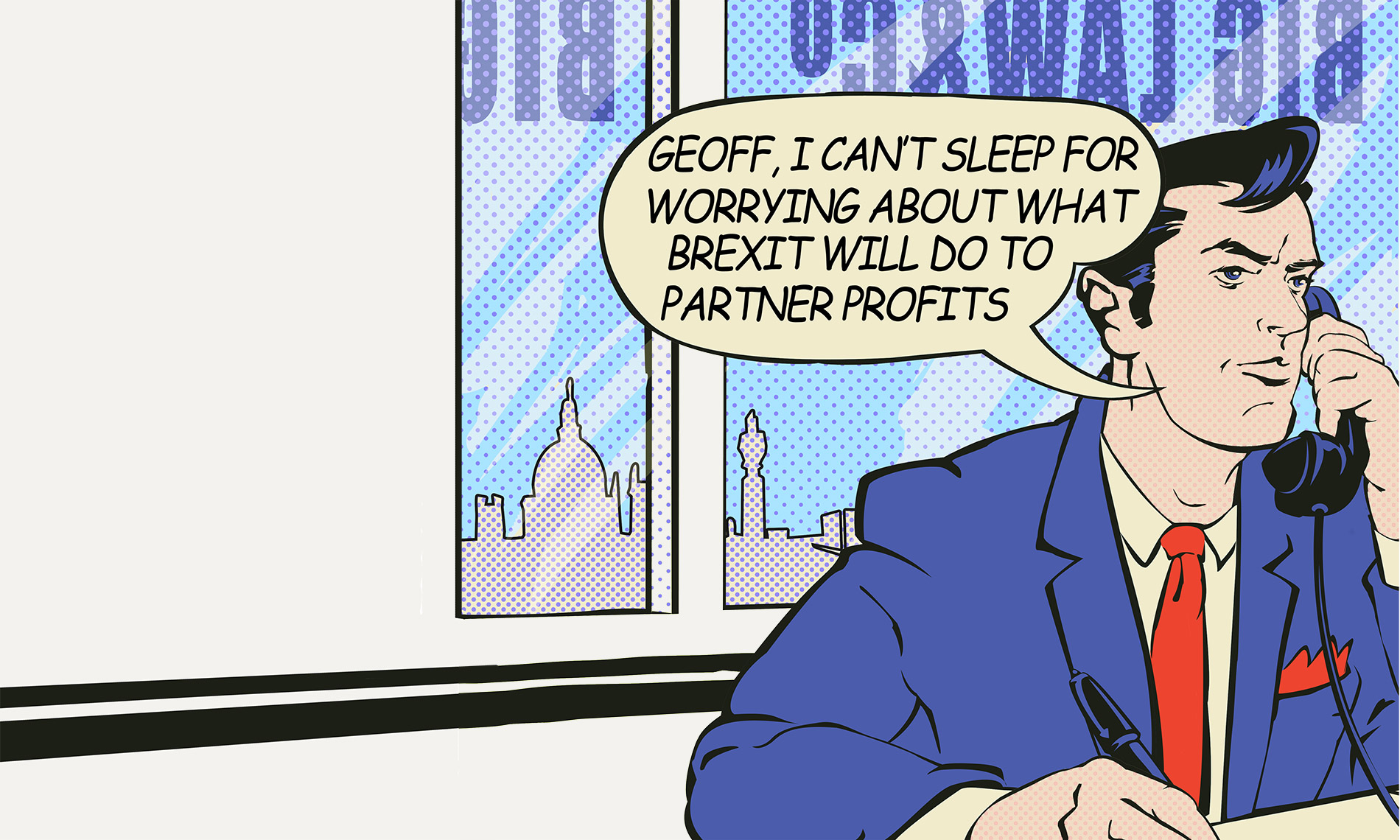
Tom Baker assesses attempts to revive the flagging Serious Fraud Agency amid a fractious political debate

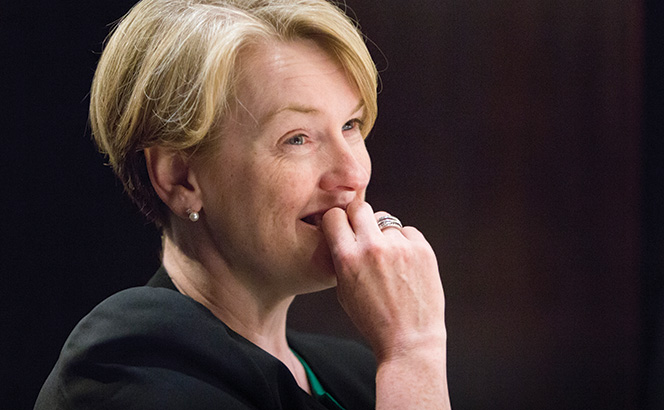
It is fair to say that David Green QC took over the Serious Fraud Office (SFO) in 2012 at what was, even for the frequently beleaguered agency, a low ebb. The good news is the consensus among hardened white-collar crime specialists is that the veteran silk has had considerable success turning around a body derided as toothless and operationally slack. The bad news is that the biggest remaining sceptic of the SFO happens to be the prime minister, with Theresa May having gone into this year’s general election with the pledge to disband the agency, rolling it into her own creation, the National Crime Agency (NCA). Continue reading “Under the sword”

GC 2.0 – The GC Powerlist Summer Reception

photos from powerlist reception

Do you know your cash-burn phase from your TLDNR? Welcome to the buccaneering, hierarchy-lite world of the fast-growth, tech-driven ‘disruptors’, the kind of business that a growing number of lawyers aspire to work in or advise.

Following the launch earlier this year of the 2017 GC Powerlist, which focused on early-stage companies and rising stars at major plcs, we teamed up with DLA Piper to assemble an audience of more than 70 in-house counsel at London’s private members’ club Home House for an informal discussion from the lawyers working at the digital coal-face. The debate covered the launch of the much-touted Disruptive GC group, the challenges of working with impatient entrepreneurs and how lawyers can slot into the culture of a constantly-evolving company. Continue reading “GC 2.0 – The GC Powerlist Summer Reception”

Privilege: A rock and a hard place

For years, privilege was the invaluable asset taken for granted by the profession. But those days have long since passed, with regulators increasingly testing the boundaries of privilege in a series of investigations and court actions.

This trend has re-opened much of the settled law on privilege and generated several cases – most notably the court battle between the Serious Fraud Office (SFO) and mining group ENRC over the disclosure of internal documents – that have made the area one of the most closely watched fields of civil law. Continue reading “Privilege: A rock and a hard place”

Our leadership: Evolving London’s courts for a global market

Despite post-Brexit challenges to the UK’s legal market and persistent concerns over court funding, confidence remains high among commercial practitioners of London holding its place as a top-tier global disputes centre.

In the first panel of the 2017 Commercial Litigation Summit on 3 July a prestigious line-up of jurists and practitioners assembled to discuss key developments in the commercial courts, focusing on initiatives to improve the London commercial courts and attempts to corral spiralling disclosure. Continue reading “Our leadership: Evolving London’s courts for a global market”

Global investigations: Nowhere to run

The first session of the afternoon tackled key aspects of global investigations from an in-house and external adviser perspective. Clifford Chance partner Judith Seddon began by looking at deferred prosecution agreements (DPAs) and self-reporting. She posed the question: ‘How effective are DPAs in changing corporate behaviour? From a corporate-governance perspective, does the failure-to-prevent offence focus the board’s attention on the importance of ensuring it has adequate or reasonable procedures?’

In her view, the Serious Fraud Office (SFO) regards DPAs as an incentive for a corporate to put in place processes to ensure compliance, but it has recognised that there is a fine line between incentivising companies to put things right and to confront economic crime. Continue reading “Global investigations: Nowhere to run”

The new front

warrior with gdpr flag

As expected – or feared – implementing the incoming General Data Protection Regulation (GDPR) is a mammoth task for some companies. ‘It is all-encompassing,’ says Karen Kerrigan, chief legal officer at equity crowdfunding firm Seedrs. ‘The advantage of being a small business is that you can involve all the other departments. Frankly, I would be terrified of GDPR if I was at a large business, because you have to take a much more decisive risk-based approach in terms of what you are physically able to look at. We were able to sit down with our development team, our marketing team and our investments team, and go through every single one of their activities and the service providers they were using.’

To say GDPR will have wide implications for in-house teams is an understatement. It is unlikely that there will be any client or any part of a client’s business that will remain unaffected by the EU regulation, which has a deadline for implementation of 25 May 2018. Continue reading “The new front”

The new space race

space craft

‘For the eyes of the world now look into space, to the moon and to the planets beyond, and we have vowed that we shall not see it governed by a hostile flag of conquest, but by a banner of freedom and peace.’
John F Kennedy

When President John F Kennedy stood before Rice University on 12 September 1962 and boldly declared that not only would the US be the first country to land on the moon, but they would do it before the end of the decade, he captured the imagination of a generation. Continue reading “The new space race”

Waking the giant

Paul Rawlinson

Making Baker McKenzie stand out was once a simple business. The day in 1948 Russell Baker met John McKenzie by chance in a cab, he had already conceived the notion of an international law firm. Formed in 1949, its first international office was added six years later in Caracas, Venezuela. In the decades to follow, the Chicago-bred firm stood out as a genuinely global operator in a profession that remained largely a domestic concern.

True, having been stitched together from a series of financially separate offices, Bakers never worried the legal elite in New York and London, being dismissed by some as a mid-market franchise thanks to a multi-partnership model that was then unheard of. But Bakers could point to global coverage well beyond any peer, including market-leading practices in many jurisdictions where few rivals dared venture. Passing the $1bn mark in 2001, Bakers turned over more than $2bn just seven years later, making it one of the largest firms in the world. Continue reading “Waking the giant”

The Legal Services Act ten years on – still waiting for the Big Bang

Alex Novarese

As this issue hits desks, it will be ten years since the Legal Services Act gained Royal Assent, ushering in the most liberal services market in the world by some margin. Given that span of time, and the five years since the most radical elements of the act came into force with the regime for alternative business structures (ABS), it is natural to ask if it has lived up to billing.

There clearly was an impact of sorts, supporting an environment where new business models and fresh thinking were encouraged. That renewed the legal ambitions of the accountants, encouraged the pioneering UK launch of Slater and Gordon, and made Co-op as close as we have got to Tesco law. After a slow initial start there are now over 700 licensed ABSs in England and Wales, representing a significant chunk of the market. Also significant is the messy regulatory fallout and ongoing turf war that it triggered, which has continued with varying degrees of intensity ever since. Continue reading “The Legal Services Act ten years on – still waiting for the Big Bang”

What’s the point of Baker McKenzie?

Paul Rawlinson

Ever wonder what Baker McKenzie is waiting for? The firm once had a crystal clear market position as the only major commercial practice that got anywhere near being truly globalised. And while the sprawling nature of the network meant a 20-year battle to shrug off the franchise tag, Bakers has long achieved polished mid-market credibility in many key jurisdictions. While it was never a threat to the US and London elite, the logic for an emerging giant to handle the mid-stream work for global plcs speaks for itself. Yet Bakers has continually fallen short of its own rhetoric.

Having been an international trailblazer, growth has been pedestrian for a decade now and there is too little evidence of the oft-promised push up the value chain. Continue reading “What’s the point of Baker McKenzie?”

BLP’s US merger bid – a certain loss of confidence

St Louis

If nothing else, it is safe to say Berwin Leighton Paisner (BLP)’s not-very-convincing claim that management was not dead set on a US merger was stretching it. Because recent news that the firm is debating a union with Bryan Cave screams: ‘We really want a US merger!’

The talks come after last year having gone through a bruising but short courtship with the far larger Greenberg Traurig, the thrusting Miami shop which had a culture clash with BLP that could not have been more obvious if it had been heralded by fireworks. Continue reading “BLP’s US merger bid – a certain loss of confidence”

The last word: Speaking out

Tamara Box

With the recent Weinstein revelations shining a light on sexual harassment and misogyny across every industry, we ask senior lawyers for their views

Call it out

‘Sexual harassment of anybody in any circumstance is outrageous. It must be called out at every opportunity and condemned for what it is – an insidious abuse of power.’

David Morley, member, Mayor of London’s International Business Advisory Council Continue reading “The last word: Speaking out”

Client profile: Mark Maurice-Jones, Nestlé

Mark Maurice-Jones

Unusually for the current UK and Ireland general counsel (GC) of Swiss multinational and famed KitKat creator Nestlé, Mark Maurice-Jones’ career started in teaching.

Armed with a chemical engineering degree from the University of Cambridge that he was unsure how to utilise, Maurice-Jones opted for a year-and-a-half-long stint in Hong Kong teaching maths, physics and chemistry. But ultimately he found the pull of a career in the law more alluring. Continue reading “Client profile: Mark Maurice-Jones, Nestlé”

The Departed

Why would a partner quit an elite London law firm with decades of history, Rolls-Royce support and a superb client base for the uncertain prospects of the City arm of a US rival?

Money is the obvious answer and in a sector in which laterals regularly increase their compensation by 50-100%, that is obviously a big part of the equation. One Freshfields Bruckhaus Deringer rainmaker is currently reported to be sitting on a $10m a year standing offer. Continue reading “The Departed”

Offshore: Riding the storm

palm trees in a storm

Think offshore centre and certain calm images spring to mind: elegant yachts, crystal blue water, sparsely-populated beaches and gently sloping palm trees. However, in September this idyllic cliché was superseded in the public consciousness by horrific scenes of destruction as Hurricane Irma and then Hurricane Maria ripped through the Caribbean. The British Virgin Islands, where nine of the top ten offshore law firms have an office and nearly 400,000 offshore companies are registered, were catastrophically affected.

Favoured by Chinese companies in Hong Kong for more than 30 years, ‘a BVI’ is shorthand for an offshore company, so renown is its status. But while the narrative coming out of the British Overseas Territory has been defiant with Lorna Smith, interim executive director of BVI Finance, saying there was ‘no doubt’ it will fully return, it could take some time before full operational normality as a commercial and litigation centre is restored. At press time, the territory’s company register continued to function via the online portal, VIRRGIN and just prior to the disruption, company incorporation certificates were sent to London by the BVI Financial Services Commission to have them issued there. The commercial division of the High Court had resumed and matters were being heard by the commercial judge sitting in nearby St Lucia in person, or by teleconferencing or videoconferencing if agreed by the parties. Continue reading “Offshore: Riding the storm”

Looking stateside again: BLP in ‘surprising’ merger talks with Bryan Cave

‘Surprising’ was the adjective frequently deployed by City partners in October when merger talks between Berwin Leighton Paisner (BLP) and US firm Bryan Cave were unveiled, with BLP going back to the US market 19 months after its attempts to tie up with Greenberg Traurig ended brutally.

The new candidate for a transatlantic union is closer in size and profitability to BLP compared to Greenberg and the union would create a 1,700-lawyer entity with 32 offices in 12 countries.

Continue reading “Looking stateside again: BLP in ‘surprising’ merger talks with Bryan Cave”

‘Selling the crown jewels’ – Gateley partners in £10m share sale

Michael Ward

Following Gateley’s landmark listing in 2015 where partners pocketed a combined £25m, some senior partners have taken home almost £500,000 each after a stake in the top 50 UK law firm was sold for nearly £10m in October.

Documents at the London Stock Exchange (LSE) show a sale of 6.21% of the firm’s equity due to a ‘strong demand from new institutional shareholders’.

Continue reading “‘Selling the crown jewels’ – Gateley partners in £10m share sale”

Watchstone Group files defence as war of words with S&G over Quindell continues

The ongoing Slater and Gordon (S&G) saga shows no sign of abating, as the Watchstone Group (formerly Quindell) in October denied fraudulently misrepresenting itself over the sale of its professional services arm to the beleaguered law firm.

The £637m buyout in May 2015 proved to be the beginning of a downward spiral for S&G as, following the deal’s completion, the Serious Fraud Office launched a probe into Quindell’s accounting practices. As a result, S&G’s shares tumbled. Continue reading “Watchstone Group files defence as war of words with S&G over Quindell continues”

Disputes eye: How the talent flow demonstrates the Bar’s strength

Speaking to Freshfields Bruckhaus Deringer disputes veteran Jon Lawrence this summer on his decision to join Brick Court Chambers, he said he was not ready for the golf course just yet.

But there has been a wave of Freshfields heavyweights of Lawrence’s vintage who have made a similar move, notably former managing partner Ian Terry, who went to One Essex Court and Raj Parker, who went to Matrix Chambers in 2016. Continue reading “Disputes eye: How the talent flow demonstrates the Bar’s strength”