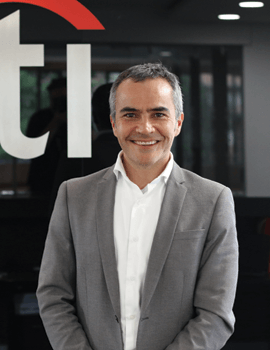
‘Following graduation from law school, I started as counsel for the legal department of Banco de Chile. Shortly after, I was offered a position with Citibank, and I worked for almost a decade for the corporate and investment bank, ultimately as head of investment bank legal. Continue reading “In conversation: Alejandro Rubilar, Senior Country Counsel – Chile, J.P. Morgan Chase Bank”
Notes from the AG
Relaunching the office of the Attorney-general
My family is traditionally one that has always had a relationship to public service and with government in Paraguay. Even though I didn’t consciously have the objective to go into public office, I knew subconsciously that sooner or later the time would come for me to serve my country. Continue reading “Notes from the AG”
In conversation: Adriana Sinisterra Plana, VP Business and legal affairs, Fox Networks Group Latin America
GC: Could tell me a little bit about your legal career and how you ended up at Fox?
Adriana Sinisterra Plana (ASP): I went to school in Bogotá at the University of Los Andes, and then I moved to the US; I lived in Boston, where I received my LLM. Continue reading “In conversation: Adriana Sinisterra Plana, VP Business and legal affairs, Fox Networks Group Latin America”
Crises, consumers and growing controls: trends in financial regulation in South America
In line with the rest of the world in the wake of the Global Financial Crisis, the last decade has seen South American countries apply increased regulatory scrutiny. Unsurprisingly, the financial sector has been at the epicentre of a wave of regulatory reforms sweeping across many of the region’s biggest economies. Continue reading “Crises, consumers and growing controls: trends in financial regulation in South America”
In conversation: Alejandro Anderlic, director of corporate, external and legal affairs, Microsoft
GC: Could you tell me a little bit about your background and how you came to be working in-house at Microsoft?
Alejandro Anderlic (AA): After over 20 years of being in private practice with a law firm, I joined Microsoft back in November 2013. I wanted to be somewhere where I could leave my footprint; where I could make a more positive impact than the one I could make working with a law firm. Continue reading “In conversation: Alejandro Anderlic, director of corporate, external and legal affairs, Microsoft”
Tick tock… the new age of legal operations
No longer gifted a limitless budget for outside spend, GCs are under pressure to deliver the smooth running of all moving parts in the department (and beyond), plus timely and watertight legal advice. Continue reading “Tick tock… the new age of legal operations”
In conversation: Nicolás Cuadros, senior counsel, Philip Morris International
GC: What are you currently working on in the Latin American legal team at Philip Morris?
Nicolás Cuadros (NC): When I was in charge of leading the Colombian legal department, we took a very interesting journey: the launch of a product called ‘IQOS’, a revolutionary tobacco heating system designed to heat, rather than burn a specially designed tobacco stick called Heets. Continue reading “In conversation: Nicolás Cuadros, senior counsel, Philip Morris International”
Colombia Roundtable: Cybersecurity and data protection in the age of hacking
On the morning of Pope Francis’s arrival in Colombia – and as Bogotá went into security lockdown – The Legal 500 and sponsor firm Posse Herrera Ruiz held a breakfast roundtable on cybersecurity and data protection. Continue reading “Colombia Roundtable: Cybersecurity and data protection in the age of hacking”
Playing the game
You may not have heard the term ‘gamification’, but the chances are you’ve experienced a form of it. Continue reading “Playing the game”
Defining value
Premium mediocre
For those well-read followers of Twitter among you, the phrase ‘premium mediocre’ will be a familiar concept. I stumbled across it last year when reading David Walsh’s always stimulating column in The Sunday Times. The phrase was coined by blogger Venkatesh Rao, and I’ll let him explain it: Continue reading “Defining value”
Wanji Walcott, GC, Paypal
This interview was undertaken as part of GC magazine’s research into diversity and inclusion, in association with Paul Hastings, by Catherine McGregor. Continue reading “Wanji Walcott, GC, Paypal”
Ringing the changes: Combating corruption in South America
It’s been a turbulent few years for many of those in the upper echelons of Brazilian politics and business. Around the world, headlines have been filled with salacious tales of corruption, perhaps most notably the bribery and kickback scandal emanating from semi-state-owned oil company Petrobras, embroiling many high-profile individuals and entities across the region. Continue reading “Ringing the changes: Combating corruption in South America”
In conversation: Francisco Baquerizo, general counsel and company secretary, Citibank Colombia
GC Magazine: Can you tell us a little bit about the challenges facing the financial sector in Colombia?
Francisco Baquerizo (FB): This is a very active jurisdiction for producing regulation. Laws and decrees are constantly being issued, so that poses a big challenge to companies in different sectors – pharmaceutical, construction services, financial, health. Continue reading “In conversation: Francisco Baquerizo, general counsel and company secretary, Citibank Colombia”
Trust me, I’m a lawyer…
Academic and Thinkers50 honouree Rachel Botsman is focused on trust. Of late, that focus has looked at how technology has shifted our understanding of trust and impacted on both our personal and professional lives. Continue reading “Trust me, I’m a lawyer…”
In conversation: Oscar Eduardo Gómez, Vice President legal, Grupo Prodeco
GC Magazine: Could you tell me, first of all, how you came to be working in-house, and at Grupo Prodeco?
Oscar Eduardo Gómez (OEG): 25 years ago, I started working at a law firm, then I jumped into the financial sector, as general counsel of different financial companies. Continue reading “In conversation: Oscar Eduardo Gómez, Vice President legal, Grupo Prodeco”
Casa de herrero, cuchillo de palo
‘In the blacksmith’s house,
the knives are made of wood.’
A common saying in Central America, which quite accurately encapsulates a truth that remains an ongoing issue across legal markets in the region: that for all of the formal education, technical nous and practical experience which resides with their partners, all too often, firms fail to apply the same intelligence and detail that they afford their clients, to their own organisation.
The official reasons for this are as varied as they are hollow – volume of work, pace of development or the classic ‘if it ain’t broke, don’t fix it’ approach. But with an eye to the Latin American market in particular, organisational structure – particularly the prevalence of the family firm – is perhaps a far more pertinent consideration than given credit. Let me explain.
Now, first and foremost, there is nothing wrong per se with a family-run enterprise. In fact, a sizeable number of the clients who patronise these firms will themselves be family-owned and operated entities. But, given that it has yet to be proven that legal capability runs in the blood, there are issues apparent that in-house counsel should be considering when selecting and appointing external counsel.
Most importantly, do law firms with a family structure have the capability to continue to offer the most sophisticated legal counsel over time? Or on the contrary, is it more generally the case that such firms – by definition – will tend, over time, towards serving mid-market clients, instead of seeking the most sophisticated, cutting-edge legal services?
The argument could be made that there is never going to be a case for a ‘one size fits all’ approach.
Consider certain sub-sectors, particularly those which are highly specialised or in smaller jurisdictions. In such cases, it’s not uncommon that the most sophisticated legal knowledge resides with sole practitioners. Oftentimes this can be attributed to basic market forces – limited demand results in limited supply – affording the opportunity for said sole practitioner to carve out a defined niche. Generally, this isn’t an issue, because such specialist advice is necessary only on a case-by-case basis.
Instead, where this issue truly comes to the fore is regarding the appointment of a client’s standing counsel. A pair of the region’s final frontiers for legal market development offer apposite lessons in this regard.
Both Ecuador and Paraguay, unlike elsewhere in the region, have yet to experience the arrival of a major international player (although regional player Ferrere is present in both jurisdictions).
Paraguay has been blessed with 4-5% growth for a number of years (although, it should be noted, departing from a particularly low base), which has spurred development at a time when the legal sector is undergoing a wholesale generational transition. Estudio Mersan, Estudio Olmedo, Estudio Riera and Estudio Vouga are all in the midst of a generational handover – a process that has involved significant steps towards greater institutionalisation – one which market leader Estudio Gross Brown has completed.
Ecuador has also seen significant disruption to its legal market over the last two-to-three years, primarily as a result of the entrance of Ferrere. There, competition for talent between a regional power and a market primarily comprising traditional family firms (with their often opaque career pathways – particularly for young lawyers), has spurred change. As a result, the market has become increasingly atomised. Major players including Bustamante & Bustamante, Coronel & Pérez, the former Corral Rosales Carmigniani Pérez (which has reverted to its two former constituent firms, in Quito and Guayaquil respectively), and Paz Horowitz, have all been among those affected.
In both jurisdictions, a myriad of small firms and specialist boutiques have formed as a result. But it remains to be seen if these outfits, with their relatively limited resource bases, can successfully take the next step to establish operations fit for purpose in the modern legal market. The pessimist (or perhaps the realist) would say that instead, these constitute attractive acquisition targets for more sizeable international players – the likes of CMS, Dentons, DLA Piper and Garrigues, for example – looking to establish a foothold in the market. The entrance of any such firms would of course detonate the market once more, likely leading to a further round of modernisation and maturation.
A glance at neighbouring Colombia, where the market has endured the full brunt of the arrival of international players, illustrates what could be ahead. There, the process of consolidation and maturation has resulted in the majority of formerly prominent family firms being either absorbed or suffering a process of gradual dismemberment as their talent is cherry picked by wealthier or more sizeable international players – the likes of Norton Rose Fulbright and Holland & Knight, or in more specialist sectors, DAC Beachcroft and Littler Mendelson.
For law firms, the message is clear: adapt or perish.
For clients, it becomes a case of caveat emptor. They must ask themselves: is the currently contracted service provider fit for purpose, both now and into the future?
The issue then becomes one of tension between adaptation to local market specificity and modern service provision. This is particularly evident in so called ‘secondary markets’ – cities such as Guayaquil in Ecuador or Santa Cruz in Bolivia, Cali and Medellín in Colombia and even perhaps Monterrey in Mexico – all economic powerhouses but which lack the administrative underpinnings found in national capitals, and subsequently tend to display a very different legal culture. Here, the predisposition has often been towards both the use of local practitioners cognizant of the city or region’s specificity, and the ‘lawyer as consigliere’, a mode that long accompanied the family firm organisational model. While this long constituted a barrier to entry (consider the lack of firms from Bogotá in Cali and Medellín, or from Quito in Guayaquil, for example), increasing legal specialisation and new administrative regulations and requirements (corporate governance, data privacy and anti-money laundering, for example – indeed, compliance in general), are now finally breaking down these barriers as clients find traditional firms increasingly unable to service these new requirements.
To remain relevant, law firms must be involved in a constant flight towards the most sophisticated work, a movement that involves not only the capacitation of its lawyers, but also the transformation of the platform from which they work. Such migration is the only insurance against the ongoing commodification of many types of legal work (from capital markets issues that have become a cut-and-paste process to mass trade mark filings), or indeed, their automation, which tend to erode law firm profitability. The ongoing transformation and constant fine-tuning of the law firm platform itself is similarly essential if legal service providers are not going to be left stranded by the changing tides of an economic and business environment, itself increasingly driven by innovation.

US bonuses: Magic Circle follows Wall Street standard with bonus freeze as associate reward season comes round again
Allen & Overy and Clifford Chance have kept top-level US associate bonuses static at $100,000 for the fourth consecutive year, in line with Wall Street giant Cravath, Swaine & Moore’s recent announcement.
The Magic Circle firms are awarding year-end bonuses of $ 100,000 for 2009 and 2010 US associates and $90,000 for 2011 lawyers, A&O and CC both confirmed. Continue reading “US bonuses: Magic Circle follows Wall Street standard with bonus freeze as associate reward season comes round again”
Deal watch: Linklaters and White & Case in landmark Africa project as Slaughters and Macfarlanes lead on Cineworld takeover
UK-based deal specialists were busy this week advising on cross-border transactions spanning three continents.
Linklaters and White & Case have deployed their global teams to act on a $2.73bn refinancing for an infrastructure project across two countries in sub-Saharan Africa. Continue reading “Deal watch: Linklaters and White & Case in landmark Africa project as Slaughters and Macfarlanes lead on Cineworld takeover”
In-house: Aviva appoints new UK insurance head as RBS ends search for legal operations chief
FTSE 100 insurer Aviva has appointed former Bupa UK legal director Alison Gammon as its UK Insurance general counsel (GC) following the departures of Aviva UK Life GC and company secretary Monica Risam and Tim Vickers, who led Aviva’s General Insurance legal team.
Aviva recently brought its UK Life Assurance and UK General Insurance businesses together as UK Insurance, with Gammon now heading the combined legal team. Prior to joining Bupa in 2013 and becoming its UK legal director in 2015, Gammon worked at Legal & General as international legal director for nine years and was a senior associate in Allen & Overy’s financial institutions team. Continue reading “In-house: Aviva appoints new UK insurance head as RBS ends search for legal operations chief”
Ashurst and Hogan Lovells win roles on Palmer & Harvey administration as takeover plan goes up in smoke
City firms have landed lead mandates on the administration of beleaguered British tobacco wholesaler Palmer & Harvey (P&H) following the collapse of a rescue takeover by The Carlyle Group.
Ashurst and Hogan Lovells are advising administrator PwC, which was brought in when a sale process that would see US buyout giant Carlyle acquire the ailing business fell over. Continue reading “Ashurst and Hogan Lovells win roles on Palmer & Harvey administration as takeover plan goes up in smoke”