Data Analysis: Part 4 Positive Disruption

Much has been said about whether disruptive technologies could spell the end of the legal profession as we know it, but GCs aren’t worried. In fact, they’re excited.

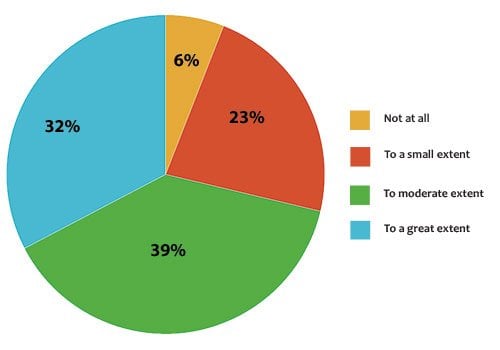
Of those in-house counsel surveyed for this report, the vast majority agreed that technology will disrupt the legal profession in the next five years, with 94% acknowledging that technology will be at least somewhat disruptive. 32% said that they feel this disruption will affect the profession to a great extent.

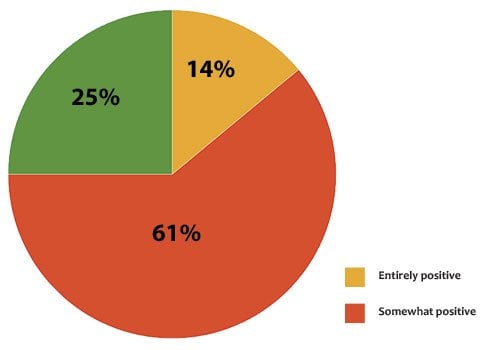
Every respondent that said they expected there to be some disruption in the next five years felt that this would be positive, with 71% saying that the disruption will be ‘somewhat positive’, and 29% saying that it will be ‘entirely positive’.

‘I’m fully convinced of the benefits of the AI, and we all need to adapt to what is coming, because it is coming, whether we like it or not,’ says Cristina Álvarez Fernádez, head of legal at Cintra. ‘I’m 100% optimistic this technological revolution is going to be good for us: we’re simply going to provide legal services differently.’

This positivity is echoed by the approach many of the GCs interviewed for this report have taken to the issue: embrace disruption and reap the benefits.

‘The legal function needs to and can play a role in showcasing the benefits of introducing technological solutions in an enterprise,’ says Johan Huizing, associate general counsel at Itron. ‘We must be leaders in adoption of high-performing technology and not merely followers. Only then can we play a role as thought leaders and will we be accepted as team members that have value for the business.’

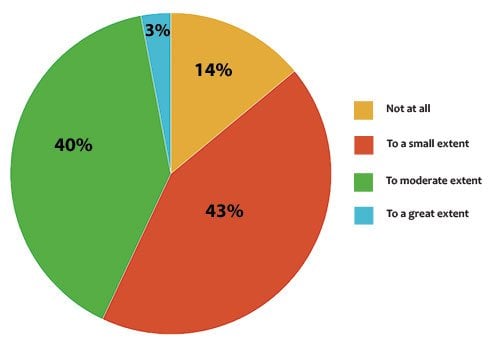
To what extent do you agree that technology has disrupted the legal profession in the past 5 years?

‘Legal professionals who want to thrive in modern business must lean towards technological transformation,’ adds Tobiasz Adam Kowalczyk, head of legal at Volkswagen Poznan.

‘The great news is that lawyers have the tools at their disposal to enable this change. The digital revolution offers us the chance to compete, and it provides law firms and legal departments with the ability to transform into something much more exciting. The legal profession will not disappear, but it will surely change due to technology. This shift will most probably trigger new forms of what being a lawyer means. The sooner we accept it as the new normal, the better off we’re going to be.’

One general counsel from a prominent international engineering firm, who did not think that AI will be a factor within the next ten years, said that their main concerns were ethical.

To what extent do you agree that technology will disrupt the legal profession in the next 5 years?

‘How can you build trust in code? There are ethical questions around its use in certain applications such as disciplinary actions or other employment-related areas,’ they said.

‘It’s not all hype, but the profession is very conservative and the ultimate question is: to what extent will management trust a “machine”?’

Virtually all of those surveyed agree that AI will be a disruptor in the legal industry, with just 9% feeling that it will not be a disruptor at all. Despite this apparent enthusiasm, just 6% said their team currently uses an AI solution, all of whom said they only use it to assist in low-level work. Within this small group, overall feelings on AI’s ability to act as a disruptor in the industry are positive: 83% agreed that AI would be a disruptor, with half feeling that such disruption would come between the next five and ten years.

When asked which factor was more important when considering adopting an AI-based tool, all respondents cited either the reduction of costs (38%) or an improvement in quality of work (62%).

‘Looking forward, AI will be able to cover all technical and easy legal work: cost reduction, quality improvement,’ says Artem Afanasiev, general counsel of DIXY Group.

Overall, the key disagreement comes over the question of when, not if. Over half feel that AI-based disruption would come between the next five to ten years, but a portion said they thought the disruption would come much later: 23% think it won’t be a factor for at least ten years.

Overall, how positive do you think technology disruption will be?

Then comes the question of preparation. If disruption is coming for the legal profession, all eyes will turn to the incumbent lawyers to see how they fare in response to the seemingly inevitable changes heading for their profession. Whether or not legal education institutions and professional development programmes throughout Europe have left today’s lawyers well placed to adapt and thrive will be imperative.

When asked about current lawyers’ preparedness for technological disruption, the in-house counsel surveyed and interviewed were less enthusiastic. 14% felt that today’s lawyers, on average, were adequately prepared; 61% did not. The rest were unsure.

‘AI is limited for the majority of in-house right now because the base data sets are not in place, substantial enough or well enough maintained,’ explains the general counsel for a prominent consumer goods brand.

‘This is a real point of difference with the accounting/finance world where recording data in a structured way has always been the order of the day – that area will see a huge impact from AI in the near future whereas in-house legal first needs to get its ducks in a row, change its behaviours and set that foundation upon which expensive AI solutions are built.’

Giulio Romanelli, Associate Partner, McKinsey & Company and John Pyall, Head of MGA Cockpit, Munich Re UK

GC: In the legal sector, many people describe the emergence of legal tech start-ups as ‘fintech’s little brother’. Could you tell me about the emergence of fintech, Giulio, and how it has impacted the banking sector?

Giulio Romanelli (GR): Banking has historically been one of the business sectors most resilient to disruption by technology. However, in the last ten years, fintechs have moved quickly, forcing incumbents to rethink their core business models and embrace digital innovations. In the last five years, we’ve seen a significant journey as fintechs have become more and more mature.

Today, banks remain uniquely and systemically important to the economy; they are the major repository for deposits, which customers largely identify with their primary financial relationship; they continue to be the gateways to the world’s largest payment systems; and they still attract the bulk of requests for credit.

Some things have changed, however. Firstly, the financial crisis had a negative impact on trust in the banking system. Secondly, customers are more open to relationships that focus on origination and sales. Thirdly, mobile devices have undercut the advantages of physical distribution. Plus there has been a massive increase in the availability of data alongside a significant decrease in the cost of computing power.

GC: To what extent would you term it a disruption?

GR: We can call this a disruption in the sense that fintechs have a unique opportunity for customer disintermediation, by leveraging advantaged modes of customer acquisition, a step-function reduction in the cost to serve, innovative use of data and advanced analytics, and segment/niche-specific propositions.

GC: When insurtechs started popping up in the insurance space, what was the reaction like in the industry, John?

John Pyall (JP): At the beginning, to a certain degree, insurtechs were looked upon with interest, but as: ‘It’s a bit gimmicky, it’s interesting but it’s not for us.’ And then, over time, they were looked at with more and more interest. From our point of view, we made a clear play in that direction. But I think there still is a little bit of ‘watch and see’ about the insurance market as a whole.

GC: Have insurtechs disrupted the insurance space?

JP: I think people look at disruption as being a negative idea. I think insurtech start-ups have, to a certain degree, enhanced the insurance area because they have actually allowed insurers to touch into areas that we previously may not have been able to. For example, digital partners have allowed us to reach out to new customers that we may not previously have ever gotten close to, simply because of the mediums they use to connect to their services. We have insurtechs that purely use social media to market to their customers and their clients and, to a certain degree, their distribution models are so different from what we were traditionally used to it has meant we have got avenues to customers we would never have considered five years ago.

That may be younger people, it may be people who are more engaged in social media. It may be people who are looking to insure single item contents, which insurers wouldn’t have looked at before. We would have had difficulty insuring people employed in the gig economy, doing three jobs in a day, but these new models enhance our ability to do so.

GC: Has this involved an element of culture change?

JP: When you have companies coming in that are younger, more flexible and they are able to drive through changes very quickly within their own organisations, you look at that and say: ‘We need to show that we have that ability as well. If we want to be in this market we have to be able to deal with that.’ So therefore it does actually allow people to think positively about how can we adapt, to differentiate ourselves within these markets.

GC: Looking again to the banking sector, how have established banking organisations responded to fintech disruption? Has it has a knock-on transformative effect in terms of the way these organisations use technology?

GR: As successful fintechs have rapidly matured from start-ups to mature technology disruptors, banks have started the long journey to transform their core digital capabilities, with several areas of focus. These include: a digital-native customer experience; big data and advanced analytics; moving towards a scalable technology landscape through cloud and automation; adoption of APIs (Application Programmable Interface).

Firstly, banks have been creating an integrated customer experience inspired by digital attackers, versus using a one-size-fits-all distribution. So rather than using the branch as the main point of interaction with customers, all the banks have mobile apps and they are very proud of the features that they use to differentiate themselves.

Innovating the customer experience by integrating with fintechs can provide advantages. For example, take the typical onboarding time for corporate lending. A fintech such as Kabbage proposes to reduce the onboarding time for down from something close to days, to something which is close to minutes.

Secondly, using data-driven insights and analytics holistically across the banks. While focus is generally on ‘customer-facing’ use cases, it’s very interesting to see advanced analytics applied internally to drive operational efficiency. For instance, advanced analytics to improve quality and efficiency of KYC [Know Your Customer] and anti-money-laundering.

Thirdly, banks have been mitigating the potential cost advantage of attacks through radical simplification and refining of technology infrastructure, both on process and existing technologies. For example, leveraging and deploying new technologies such as Cloud enables banks to move towards a more scalable and cheaper technology footprint.

Finally, there are several cases in which banks want to be able to offer not only their own solutions, but to also be able to link to third-party solutions. Some financial players want to offer third-party APIs directly to their own customers. And this is happening right now in terms of payments.

GC: How has technology transformation been received in the banking sector – has it required a lot of culture change?

GR: All of the above have required a significant shift in terms of culture and capabilities of incumbents, which are nowadays focusing more and more to attract digital/tech talent.

Moreover, the pace of innovation in banking is accelerating rapidly, requiring banks to increase their speed to keep up, adopting Agile software development techniques, which imply a radically different way to think about the organisation.

GC: John, in the insurance space, can you tell me a little bit about your role in Munich Re, and how the company is working with insurtechs?

JP: I head the MGA Cockpit, which assists our digital partner unit in onboarding new digital partner business into the Munich Re. A digital partner is a partner – an insurtech start-up normally – which is interested in using digital means like an app, social media, or the internet, in order to secure insurance business. The Cockpit was created 18 months ago through the Munich Re think tank to help the due diligence process of the start-up.

We have a digital partner unit that finds new ideas and new business to be brought in as a product, and we assist them in making that a viable insurance product. Basically somebody comes to our digital partners unit with an idea, and we help them develop that into a formalised product and assist them to bring that into operation.

GC: How do you do that?

JP: We may look at whether they want to write that as a single risk, as a group policy, do they need to write it with an MGA? We look at what’s needed in the wording in order to make it effective. We then see what they need to do: how they are going to handle the claims, do they need to outsource that, we might provide them with someone to manage the claims on their behalf.

GC: Are incumbent insurance organisations under threat from insurtechs or is it going to be a process of greater partnering, do you think?

JP: There’s always going to be one or two insurtechs that may seem to be a potential threat. But I would say that generally the growth will be by partnering – that’s where people are really looking. There are very few that are coming in to disrupt the entire chain; I think most are looking to assist within the distribution chain itself. That helps both the existing business and the new start-up, so there are advantages to both sides if you get it right.

GC: How are banks working with fintech companies? To what extent are partnerships occurring? What are the benefits of partnering? And what are the challenges?

GR: Whereas market and media commentary has emphasised the threat to established business models, the opportunities for incumbents to develop new partnerships aimed at better cost control, capital allocation and customer acquisition are growing.

The vast majority of fintechs focus on retail banking, lending and payments. In many of these areas, start-ups have sought to target the end customer directly, bypassing traditional banks. In some cases, this is further accelerated by regulatory changes such as PSD2 [the second Payment Services Directive, a 2015 EU Directive] in Europe, accelerating the shift towards open banking ecosystems.

However, most recent analyses suggest that the structure of the fintech industry is changing and that a new spirit of cooperation between fintechs and incumbents is developing. For example, ING partnered with the lending start-up Kabbage back in 2015 to deliver instant capital to SMEs. Another example is the fact that blockchain development in recent years has been mainly pushed by consortia, bringing together banks and fintechs.

This offers significant benefit for both parties, as it allows fintechs to rapidly access and offer their services to large pools of customers, while incumbents can rapidly deploy customer-centric digital-native services, and strengthen their own digital capabilities and talent pool. Looking ahead is whether such a ‘coopetition’ model is really sustainable in the long term – ie whether one side of this equation becomes more relevant.

GC: From an insurance incumbent point of view, John, what might be the blockers to partnering with insurtechs?

JP: I think culture does have something to do with it – can you build new technology into your existing systems?

Regulation is also one. We are a very regulated industry, so we have to be careful about how we take steps. It cannot be revolution, it has to be evolution. New technology makes people nervous – they understand their business and they understand how it works. If you then drop outside of that, can you write the business in a different model? How does that work?

Another thought is whether you are actually going to end up competing against yourself. That is a clear worry that people have – am I actually just offering the same thing but getting less value out of it?

GC: In your opinion, Giulio, what are the most exciting technological developments in the banking sector?

GR: Looking forward, the most exciting technology developments are related to the next evolution of current tech must-haves, from advanced analytics and machine learning, to intelligent automation, to blockchain, to internet of things.

GC: And how about the insurance sector?

JP: In terms of new tools, there are home and emergency products, for example alarm systems which allow you to instantly know if you’ve got water leakage or a fire or something like that when you’re away from your home.

A lot of it is around trying to change how product service is given, so we’ve got flight cancellation tools looking at how you can get on a new flight.

There are ways insurers are using data to be more proactive and customer-centric in managing loss better, so if there’s a flood, we can identify which potential customers are affected instead of waiting for them to contact us.

I think the way customers approach insurers is going to change quite dramatically as well. They can manage their whole claim themselves, so they know where the claim is at any stage.

GC: In terms of the technology that’s underpinning these new insurance facilities, what are the trends there?

JP: The technology itself is very AI-dominated. It is very much about how much can we automate so that we can respond quicker to customer needs, and keep them informed.

The balance is between automation and empathy – you don’t want a chat bot to respond to a customer in a very automated way when you’re dealing with something which has an emotional requirement.

GC: Do you get a lot of pushback from customers on that?

JP: If you have bought through a digital platform, to a certain degree you assume you are going to go through a digital journey and there’s a certain acceptance to that. However, there are times where people want to drop out of that digital journey, and you have to be prepared to respond to those touch points.

The key is to be flexible, to look at where it can actually genuinely assist, but to make sure you put your customer first. Whereas AI can actually help you reduce cost and make that customer journey more effective, what you don’t want to do is lose that empathetic relationship with the client so they become a customer that touches base with you once and looks purely at price.

Cristina Álvarez Fernández, Head of legal Europe, Cintra

We are exploring how to benefit from tools based on artificial intelligence within our legal department. We still haven’t found the right tool or technology for implementation – but I don’t think we’re far away either. It’s about following a process and making sure – especially the first time – that we do this the right way.

A Fresh Start

This has been a new process for us and we’ve been very deliberate about the steps involved. The first thing we did was to really thoroughly research and find out just what’s in the market. We used a range of sources, from specialist legal magazines, through to talking with our peers – both legal and otherwise.

I have encouraged an internal analysis of the current developments of artificial intelligence in the legal field. We have identified a few tools that could ease the work of the legal department. If we can implement these tools successfully, this will result in economic savings for the company and will help to allocate the resources of the department more efficiently.

At present, we’re currently at the stage where we’re testing tools that we’ve identified that are currently in the market. I think that the first tool we implement will be for contract review. We’ve invested a significant amount into this system already and are hoping that we can have it ready to go by the end of 2018.

First Things First

Contract management and review was a logical first step for us, particularly around NDAs. People always find the same dangers in that kind of contract, so it’s routine work. It can be done by a very junior lawyer – once you explain to that lawyer what the issues are, normally it’s something that can be done really quickly. The line of thinking we took was to take this one step further and try to give it to technology. This is the starting point from which we can hopefully expand.

I don’t think this will replace entirely, at least so far, a person in our team. We’re certainly not planning to get rid of someone just because we believe that work will be done by a machine – not at all. I think this is going to help us to better allocate the resources that we have. We’re not a large department, so where I really see the benefit is being able to focus on things that really need our minds and judgement – which is where technology is probably the least useful at the moment.

Inside Out

I do think that, in time, technology will help us reduce our external legal spend. If we can develop systems within our department that can take on some of this load – particularly where there are significant amounts of data – then we should be able to bring more of this work in-house.

I think that, in time, we will see the relationship between in-house departments and external firms change as a result of technology – mostly where fees are concerned. I suspect that the fees of law firms can be reduced, or at least controlled, depending on the market and matters at hand. But I don’t think the interplay will shift, where we’ll suddenly be dealing with machines rather than a person. At least I can’t anticipate that now – but who knows, maybe in the future, that will be the way!

I have genuinely been surprised and impressed at how the legal sector is dealing with innovations. It’s amazing how the law firms have seen the importance of new technology and they are really getting involved in these matters. Certainly, the sector is always very traditional and conservative, so when we first undertook the research process of finding out what was in the market, it came as a pleasant surprise to see that law firms are leading innovation in the legal sector and how many are doing things like working with start-ups in developing new technology.

I do think that the main driver motivating law firms is profitability. The way in which firms assess and charge their fees, it was getting to a point where it was going to be very difficult to sustain. Clients in particular are trying to change the way that they invoice, looking at alternate fee arrangements or, in some cases, bringing more work in-house. As a result, I think they have been forced to find ways to reduce cost and maintain their profitability. But at the same time, they will have no doubt seen other industries disrupted by technology and seen that this is the way forward.

A Group Effort

Ferrovial’s IT department has been an asset – they’re a really big part of the Ferrovial Group and have been essential throughout this process. They are genuinely curious about the technologies available and their potential impact on both our department and the wider group. They seemed enthused that we were taking an interest in this and were actively helping us along in this process.

One factor which may be more unique to Ferrovial, is that our IT department work with a lot of innovative start-ups. The group is actively working with, even financing some start-up businesses, and the IT department have been looking at some of these to see whether there are tools that could be adapted to legal, or developed specifically for us and our needs.

This isn’t something that’s unique to legal, it’s been happening in other departments already. In general, our company and group are very interested in innovation and new technology. It’s crucial for a business like Cintra and will become even more important in the future. We work closely with roads, in particular toll roads – so innovations like driverless cars have the potential to be transformational for the business. But as with any shift, there are a host of legal issues that will go along with that. So, it’s about bringing all of those factors together and becoming more innovative, thinking more innovatively, collaborating and using technology.

KWM administration report shows £18.3m hole for creditors as former staff set for payouts

King & Wood Mallesons Shattered

Two years after the collapse of King & Wood Mallesons (KWM) the saga rumbles on, with administrators primed to pay former staff as an £18.3m funding deficit leaves unsecured creditors out of pocket.

A progress report filed last week details how some former employees of the firm have been ranked as preferential creditors following KWM’s 2017 insolvency. These employees will now be eligible for successful claims on failing to consult on the redundancy process, as well as payouts on wages and holiday pay. Continue reading “KWM administration report shows £18.3m hole for creditors as former staff set for payouts”

Comment: Too much jam today for partners yet the future of law will need long-term investment

Simon Levine

A little over five years ago Legal Business produced a cover feature dubbed ‘How to improve a law firm in 17 easy steps’. The piece – intended as a series of practical proposals to improve the working of law firms – has aged as well as anything printed in these pages.

And while point one – on overhauling lockstep partnerships for the age of global law – has been borne out, it is the second proposal, to phase out full profit distribution models, that is more pressing to the profession. Problems with lockstep are a peculiar challenge for London’s elite. In contrast, the historic model that has prevailed in legal partnerships of distributing the near-entirety of profits to partners annually speaks to an entire industry in danger of tipping itself over a cliff. Continue reading “Comment: Too much jam today for partners yet the future of law will need long-term investment”

DLA global turnover surpasses $2.8bn in second year of growth

Big Law giant

DLA Piper added 8% to its global top line in 2018, making for consecutive years of growth following a dip in 2016.

The firm’s global revenue rose to $2.84bn, up on last year’s $2.63bn and continuing a bounce back from when the firm’s total turnover dipped below $2.5bn in 2016 because of exchange rate fluctuations across its international business, which is divided between an international LLP and a US LLP. Continue reading “DLA global turnover surpasses $2.8bn in second year of growth”

‘Great synergies’: Mayer Brown adds long-awaited restructuring hires with DLA duo

Mayer Brown

Chicago-bred Mayer Brown has bolstered its restructuring, bankruptcy and insolvency (RBI) practice with a double hire from DLA Piper in London.

DLA veterans Michael Fiddy and Amy Jacks join Mayer Brown as co-head of the firm’s global RBI practice and co-head of the firm’s UK RBI practice respectively. Fiddy will lead the global group alongside New York partner Brian Trust and Hong Kong-based partner John Marsden, while Jacks takes on her leadership role alongside partner Devi Shah. Continue reading “‘Great synergies’: Mayer Brown adds long-awaited restructuring hires with DLA duo”

‘A leading player’: Fieldfisher ups real estate game with RPC construction and projects team

Fieldfisher

Enterprising top-25 firm Fieldfisher has made a significant construction and projects play, hiring a team including two partners from RPC.

Dan Preston, who was RPC’s head of construction and projects, is joining Fieldfisher alongside fellow partner David Thorne in addition to a team of five associates. One of those is senior associate Jamie Key, who will join Fieldfisher as a partner. Continue reading “‘A leading player’: Fieldfisher ups real estate game with RPC construction and projects team”

Revolving Doors: Crowell & Moring taps Squire Patton Boggs for UK partners as DLA leads hefty international recruitment round

starry sky over the City

City recruitment was steady last week with Crowell & Moring being the main mover after luring yet more talent from Squire Patton Boggs. Meanwhile Monckton Chambers secured Steven Gee QC from Joseph Hage Aaronson and DLA Piper and Mayer Brown made moves in a busy international round.

Crowell & Moring has emboldened its London strategy lately by recruiting from Squires. Energy partner Robin Baillie joined the firm last week, with Crowell & Moring looking to export its strong US energy practice to the UK.

Baillie had been at Squires since 2014, and brings with him senior associate Stefanie Atchinson who joins as counsel as well as associate Lydia Taylor. Meanwhile, Squires banking and debt finance partner Andrew Knight is also set to join Crowell & Moring at the beginning of April. The exits come after Squires lost a three-partner team to Crowell & Moring in recent weeks, with litigation partner Laurence Winston and insolvency partners Cathryn Williams and Paul Muscutt also decamping. Squires former City litigation head Robert Weekes meanwhile joined the firm in January, while 15 other lawyers left the firm for Morgan Lewis in February.

Monckton Chambers made a law firm play, adding Joseph Hage Aaronson litigator Steven Gee QC to its ranks. Gee returns to the barristers’ chambers after five years at the litigation boutique, having formerly headed up Stone Chambers.

Joint head of Monckton Chambers, Philip Moser QC, welcomed the hire: ‘Steven’s significant experience, both at the Bar and in a law firm, will provide inspiration and impetus further to expand Monckton’s commercial litigation and arbitration work. We believe his addition is a significant milestone in the recognition of Monckton Chambers as a leading set for commercial litigation and arbitration.’

Finishing off the City hires, DAC Beachcroft acquired David Johnson from Weightmans where he led its political and markets advisory group for four years. Johnson focuses on handling large-loss catastrophic injury cases and high-value fatal accident claims.

Eversheds Sutherland, meanwhile, made a hire in the regions, with the addition of corporate partner Michael Birchall, who joins from Addleshaw Goddard.  Birchall will now spearhead the firm’s corporate practice in Manchester while also working closely with the firm’s team in Leeds. Birchall had previously been based in both Manchester and London for Addleshaw.

Further afield, DLA Piper led a busy international recruitment round, hiring in Frankfurt and Dublin. In Germany the firm enhanced its litigation and regulatory practice with the hire of Gleiss Lutz associated partner Emanuel Ballo. It marks a return for Ballo, who had worked at DLA Piper between 2011 and 2015, having advised a number of international companies on issues related to white collar crime.

Meanwhile DLA Piper hired tax partner Maura Dineen to the firm’s newly opened Dublin office. Dineen joins from Mason Hayes & Curran, and is DLA Piper’s fifth partner hire in Ireland in a month.

Fieldfisher made a double hire in Madrid, with Jesús Estévez and Elizabeth Malagelada joining the firm’s Spanish offering. Both come from Big Four outfit EY, where Estévez worked in the firm’s banking and finance practice while Malagelada worked in the tax department. Estevez had been a partner at EY For four years and prior to that was a partner at Baker McKenzie; Malagelada meanwhile had been at EY for six years.

Completing the international recruitment round, Mayer Brown expanded its corporate and securities practice in Hong Kong with the hire of former Kirkland & Ellis and Hogan Lovells partner Steven Tran. As a private equity and M&A lawyer, Tran acts for funds and major financial institutions and has been based in Asia for almost 20 years.

‘Steven’s appointment reflects the continued growth of our corporate capabilities in Hong Kong as a service hub for Asia,’ said Jason Elder, co-leader of Mayer Brown’s corporate and securities practice.

[email protected]

Calls for a ‘radical overhaul’ of NDAs as #MeToo saga prompts UK gagging order law reform

Zelda Perkins

The government has proposed new legislation that would make it illegal for employers to use gagging orders to prevent the reporting of sexual misconduct in the workplace to police.

The move, announced by business minister Kelly Tolhurst today (4 March), comes as #MeToo continues to rage in the legal profession and beyond after the use of non-disclosure agreements (NDAs) to hide sexual offences came to light in several high-profile cases. Continue reading “Calls for a ‘radical overhaul’ of NDAs as #MeToo saga prompts UK gagging order law reform”

Watson Farley & Williams makes major City energy play with Clifford Chance Africa director

Selecting recruits

Watson Farley & Williams (WFW) is set to hire Titus Edjua, director of Clifford Chance’s (CC) Africa group, to boost its project finance capabilities.

According to a source, one other lawyer is due to be joining WFW from CC as part of the same move, but this has not been confirmed by either firm. He is set to start at WFW on 1 April. Continue reading “Watson Farley & Williams makes major City energy play with Clifford Chance Africa director”

‘Only the beginning’: Latham adds more than $300m to top line as Sidley nears £100m in the City

Big Law giant

A year after becoming the first law firm to break the $3bn barrier, Latham & Watkins has posted an even stronger set of financial results, growing revenue at a faster 11% rate to hit $3.386bn in 2018.

Meanwhile, Sidley Austin joined the growing number of US firms to report double-digit growth for their City operations in 2018, hiking London revenue 14% to £97.5m. Continue reading “‘Only the beginning’: Latham adds more than $300m to top line as Sidley nears £100m in the City”

‘Better than many’: Paul Hastings sees London revenue grow 14% as Milbank breaks $1bn barrier globally

starry sky over the City

Paul Hastings saw its strong revenue growth in London tempered slightly to 14% in 2018 in what remained a strong year for the US outfit.

The double-digit revenue increase in London is lower than last year’s 25% rise, however it outstrips the firm’s global growth figure of 9%, itself up from 4% last year. Profit per equity partner (PEP) meanwhile broke the $3m mark, rising 12% to $3.25m. Continue reading “‘Better than many’: Paul Hastings sees London revenue grow 14% as Milbank breaks $1bn barrier globally”

Magic Circle leads tech foray as Slaughters unveils tech incubator and Linklaters and A&O back Nivaura in $20m funding round

Jane Stewart

Slaughter and May has announced today (27 February) its much-anticipated legal tech incubator, Slaughter and May Collaborate, with the firm primed to select about six legal tech companies for its first cohort.

Magic Circle counterparts Allen & Overy (A&O) and Linklaters, meanwhile, have both featured in fintech company Nivaura’s $20m funding round as the City elite bustle to achieve a technological advantage. Continue reading “Magic Circle leads tech foray as Slaughters unveils tech incubator and Linklaters and A&O back Nivaura in $20m funding round”

Chicago firepower for RPC as insurance team secures formal US tie-up

Chicago

RPC has announced its insurance practice will form an official alliance with Chicago-based law firm Hinshaw & Culbertson.

The partnership will see both firms deepen their existing relationship in the insurance sector, with talks regarding a formal alliance developing throughout January. The firms will now work together on pitching and client marketing as well as collaborating on professional indemnity mandates. Continue reading “Chicago firepower for RPC as insurance team secures formal US tie-up”

Revolving Doors: Crowell & Moring secures three-partner team from Squire Patton Boggs while Dentons makes City hire from Fieldfisher

Dentons

City recruitment was active last week, as Crowell & Moring and Dentons made the standout hires while Baker Botts also made a City move.

US firm Crowell & Moring led the way in the City, recruiting a three-partner team from Squire Patton Boggs a month after hiring financial litigation partner and former City head Robert Weekes from the same firm. Weekes will be joined by litigation partner Laurence Winston, London insolvency head Cathryn Williams and insolvency partner Paul Muscutt. Continue reading “Revolving Doors: Crowell & Moring secures three-partner team from Squire Patton Boggs while Dentons makes City hire from Fieldfisher”

The International Arbitration Centre launches: The City finally gets the disputes space it’s been waiting for

For years seasoned practitioners have bemoaned the lack of top-notch arbitration facilities in London, casting an envious eye at the polished offerings in rival hubs like Singapore, even as the City has boomed as a global centre for dispute resolution. Now advisers sick of arguing about venues and decamping to hotels for major disputes are about to have their wishes granted with the launch this week of a world-class arbitration centre from Legalease.

Following more than two years of development – including extensive consultation with senior arbitrators to refine its bespoke design – the new International Arbitration Centre (IAC) covers four floors at 190 Fleet Street, right in the heart of London’s legal community. Continue reading “The International Arbitration Centre launches: The City finally gets the disputes space it’s been waiting for”

Tightening of ranks at Hogan Lovells sees PEP approach $1.4m as turnover rises 4%

Steve Immelt

Hogan Lovells has posted an 8% increase in profit per equity partner (PEP) to $1.38m after reducing equity partner headcount 6% to 523 in 2018.

The firm today (25 February) posted revenue of $2.12bn, up 4% on $2.04bn in 2017, a less pacey rate of growth than the 6% achieved in each of the previous two years. Revenue per lawyer (RPL) grew at a faster 6% pace to $804,000 as the firm cut its legal workforce 2% to 2,637 while total partner headcount, including non-equity partners, was down 4% to 803. Continue reading “Tightening of ranks at Hogan Lovells sees PEP approach $1.4m as turnover rises 4%”

Comment: Beyond barbarian – Another stride as Kirkland signs private equity’s most wanted

Freshfields Bruckhaus Deringer

If the news in late 2017 that Freshfields Bruckhaus Deringer private equity veteran David Higgins was joining Kirkland & Ellis was an insult to his Magic Circle firm, the announcement barely into 2019 that Kirkland was following up with his colleague Adrian Maguire looks like grievous injury.

The record-breaking transfer of Higgins was a symbolic reverse and a significant demonstration of Kirkland’s determination to push into mainstream sponsor work in Europe. Yet it was not entirely unexpected – there had been indications that Higgins was becoming disenchanted due to issues with Freshfields’ finance practice and a lack of a more meaningful leadership role. Where he went was more surprising than the matter of his departure. Continue reading “Comment: Beyond barbarian – Another stride as Kirkland signs private equity’s most wanted”

DPAs in spotlight as SFO ends long-running Rolls-Royce and GSK investigations

GSK

The Serious Fraud Office (SFO) has today (22 February) ended investigations into two landmark cases involving Rolls-Royce and GlaxoSmithKline, prompting scepticism from white-collar lawyers.

Despite agreeing a £497.3m January 2017 deferred prosecution agreement (DPA) with the car manufacturer, the SFO has pulled its bribery and corruption probe into Rolls-Royce following a ‘detailed review of the available evidence’. Continue reading “DPAs in spotlight as SFO ends long-running Rolls-Royce and GSK investigations”