Tobiasz Adam Kowalczyk, Head of Legal and Public Policy, Volkswagen Poznan

When I came to Volkswagen two years ago, I started auditing how we were handling cases and legal topics in our organisation, and I learned that in this field we were taking a bit of a classical approach. We didn’t really have a system in place that could embrace all of the legal queries, legal contracts, and everything else which comprised the work of the legal department. My impression is that while a lot of lawyers use new technologies and devices, we often do so in a way that replaces the old functionality without truly embracing the power of technology.

A one-stop shop

I proposed that we should implement a legal management system so that we would have all of the data – contracts, agreements and everything else you can imagine – connected to legal services and outcomes in a single system. Each employee in the company has access to the system and can submit legal queries. As an administrator of this system, I can delegate specific tasks to a lawyer in my team. But what is important is that the internal clients submit all the necessary data into the system so we don’t lose time calling each other or sending emails – everything is there in the system so we can render the legal advice. The same happens with the legal opinions, legal questions – internal clients can submit a query, and then I seek the right person in my team to respond. We have different response times based on the urgency of the query. You can access the system from any place – it’s online in the cloud, so my team can work from home or while travelling on business.

At the moment, the system is a database, but we are working with a legal tech start-up to test the addition of artificial intelligence solutions in a specific module that will create agreements for our internal clients. There will be no lawyer needed: you will just submit all the necessary data and the algorithm will prepare the agreement for you. We think this will streamline the process.

Benchmarking

Our system gives an opportunity to benchmark the work of my lawyers – how much time they need to respond, and how many queries they receive – you can extract this data from the system. I even have statistics. It helps to have an overview of the workload of the lawyers, so I can see how many cases they are dealing with and their response times. It also gives me a nice view of what issues are particularly complicated, and which we find time-consuming.

the challenge was to get the specific budget for the implementation.

The lawyers in my team are very supportive of the system. Even those with less of a technical acumen are gradually adapting to this technical revolution, not to mention those who grew up in the digital age who adapt on the spot.

The costs of changing the paradigm

The challenge was to get the specific budget for the implementation. Convincing the management board was actually the first milestone for me – just to get the money and to convince the decision-makers that this was something we should do – because for them it’s also a change in the paradigm. We are quite a big organisation, with lots of departments and lots of different systems, and we wanted our system to be connected directly to our finance system so we could also track some standings and combine agreements with the invoices. The whole phase of implementation was quite troublesome, and it required cooperation with external IT advisers and our internal IT department, and a whole testing phase. We also had to provide training for the employees outside of legal, because previously it was easy for them – they were just grabbing a phone and calling a particular lawyer. Now they had to do it online without any support. So the beginnings were not easy, but now everyone has gotten used to it.

When thinking about technology, I tend to look for stuff from outside my company, to the people working in legal tech. I also try to be active in the legal tech space in Poland, and am vice chairman of the German-Polish Chamber of Commerce Legal Tech Commission. We meet every two or three months to discuss what’s going on in the legal market, and it’s very important for me to exchange opinions with my peers from other big corporations in Poland about how they use legal technologies to tackle problems, and what solutions they are using.

Getting ahead

Very often, if I’m writing a bid for legal services and want to cooperate with external counsel, I ask them if they are using any technological tools that can support me, or whether their legal advice can be rendered in a better structured way, or if there is the possibility that they will provide me with the necessary data direct into my system. For me, if a law firm could show that they have some legal tech solutions supporting their services, that would be an advantage.

I know that the big names are working on new technology, but my experience is that although it is cascading from the headquarters, there is not that much success in this field yet. I know that there are some Magic Circle firms that are even giving free office space for start-ups, and are creating and cooperating very closely. I think that this is happening in the Polish market, but it’s still not very common. It is a hot topic, everyone is talking about it, but then when you ask about the implementation, or what kind of tools people are using, it’s still at the early stage.

I believe that within the next two or three years we will see more technological disruption happening: more companies offering those services and more in-house counsel looking for those services on the market. It is growing and it will change the legal landscape. To be successful in the market, you have to be an early adopter, you have to be at the forefront, because otherwise you are just a follower.

We talk about external lawyers always being part of the project team. A very good example is due diligence when you are buying a property or making an acquisition. Now there are really good legal tech tools in place, which can analyse a lot of documents so that the lawyers can focus on giving more client-oriented advice. They can be closer to the client, and closer to their businesses rather than just sitting and analysing papers and, for me, that’s the biggest positive aspect of technological evolution and disruption.

Balancing the personal with the efficient

Some lawyers in my field have this feeling that we are losing the personal touch with our clients, and that we are just putting systems and technology in place. I think if you are working for a law firm, then that’s the most important thing – if I like a particular lawyer, I will work with them regardless of which firm they are working with because I know them, I know they’re a good professional and very responsive. But lawyers need to wear many hats – they need to be lawyers, they need to be project managers, very often they need to be psychologists and mediators, and this is the value that they add to the business. So if they can leave some of their work to algorithms and deal with the client instead – understand their business and their challenges – then that’s important, I think, from my perspective as GC.

In corporate legal departments, I think that technology can create an additional layer between the lawyer and the internal client. But I think our role is a little bit different: we are not looking for the client, clients are looking for us; we always have sufficient jobs to do. So from this perspective, I think it can optimise our work because then the internal client will think: ‘Do I really need to ask this question, maybe I can find it somewhere else, maybe they have a directory of frequently-asked-questions, maybe there are some common agreements which I can use and download from the system without contacting the lawyer.’ It’s easy to just take the phone and call a lawyer, but if you have to put some data in the system and think about it, then you might think, ‘Maybe it’s not a really big issue for me or maybe I don’t really need the legal support.’ In short, in internal legal departments, technology can help us to focus on where the real problems are, and devote our time to the legal issues which are really essential or which add value to the company.

A look ahead

Despite clear interest from the in-house community, the growth of legal tech hasn’t achieved the same blistering pace that fintech has managed. The rate at which the financial sector has caught on has meant wide-ranging technological innovation, at every level of the industry.

‘As successful fintechs have rapidly matured from start-ups to mature technology disruptors, banks have started the journey to transform their core digital capabilities, with several areas of focus. These include: a digital-native customer experience; big data and advanced analytics; moving towards a scalable technology landscape through cloud and automation; adoption of APIs (Application Programmable Interface),’ says Giulio Romanelli, associate partner at McKinsey & Company.

Part of the reason for the legal profession’s shortfall is a lack of enthusiasm on the part of the legal community and a natural aversion to change, but that doesn’t tell the whole story.

‘There’s a lot of hype in the space and I think there are often very clever technical solutions looking for problems,’ says Chris Wray, chief legal officer of Mattereum, a start-up working to bring blockchain technology to business.

‘Although there is interest in the theory or the potential, I think there’s also, quite rightly, a demand for: what’s the use case right now? I’m not sure I would criticise the profession generally for being somewhat cautious. I do think there’s a curiosity and a willingness to try and learn about both the potential implications and to update skills accordingly but there’s also, I think, the correct recognition that a lot of the use cases are still in the future.’

The reality is that, for blockchain, alongside more prosaic types of technological assistance, many legal teams remain in monitoring mode – surveying the field and keeping tabs on likely applications, but not necessarily investing just yet.

‘We simply have to be clever in finding the right applications, and also doing a little bit of trial and error rather than just rushing to one of the service providers, buying their generic application and then learning later that it was not the most suitable application,’ says Dr Alexander Steinbrecher, head of group corporate, mergers and acquisitions and legal affairs, Bombardier Transportation.

‘I’d rather invest a little bit more time window shopping and defining our needs rather than rushing ahead and being the first users.’

The sense among the in-house counsel surveyed was that their private practice counterparts aren’t faring much better: just 40% of respondents said their external legal advisers were implementing new technology to deliver their legal services and solutions. Still, one common sentiment among those interviewed was that private practice has a role to play in being a first mover in the legal tech takeover, setting the example for in-house teams to follow.

‘When we first undertook the research process of finding out what was in the market, it came as a pleasant surprise to see that law firms are leading innovation in the legal sector and how many are doing things like working with start-ups in developing new technology,’ says Cristina Álvarez Fernández, head of legal Europe at transport infrastructure developer Cintra.

‘Clients in particular are trying to change the way that they invoice, looking at alternate fee arrangements or, in some cases, bringing more work in-house. As a result, I think they have been forced to find ways to reduce cost and maintain their profitability. But at the same time, they will have no doubt seen other industries disrupted by technology and seen that this is the way forward.’

In an increasingly competitive European marketplace for legal services, corporate pressure on the billable hour is driving law firms (including those at the sharper, mid-sized end) to increase their own efficiencies, and reshape their service offering and value add for companies.

‘Let’s be fair: some parts of a lawyer’s job are not very fun. You want to be doing the legal work and so the technology enables that by taking away a lot of the drudgery. The smart lawyers understand that they can pull that off, they can get more work, win more competitive panels, they’ll grow their share of clients and have a more fulfilling legal practice,’ says a spokesperson at one law firm-sponsored legal tech accelerator.

Bridging the Gap between Technology and Four Generations

When acting for in-house counsel, adaptability is a quality that independent law firms have in their favour. It is the agility of their operations and the ongoing awareness of novel developments that can give them the competitive edge.

Globally, experts predict that by 2020, millennials and generation Z will account for more than half of the world’s working population. For the first time in history, four generations with an age gap of over 50 years will be working side-by-side in the same environment. Millennials are rapidly becoming the most powerful connector between these generations and will soon be in leadership roles within firms and in-house counsel positions. They are the first generation to grow up in a fully digital society, which accounts for a completely different approach to objectives. Leveraging the most technically savvy talent, coupled with a firm’s visionary decision-makers, will inevitably create a lucrative approach to meeting and exceeding client expectations.

As found by a survey for millennial lawyers and their millennial clients conducted by World Services Group, firms should look to develop expansive multigenerational strategies for their new client groups, offering the most comprehensive array of professional services. They should look internally to create committees that focus on the millennial client, on process efficiencies, and on keeping current with the latest technological developments. Then, by focusing on the client’s business as a whole, savvy firms may quickly become trusted partners asked to act on their strategic advice for deals or territories that they had not previously supported.

The biggest evolution to the legal industry is yet to come, and while technology is the cause, it is also the very thing that is bridging the generational gap in the industry. The successful law firms will be easily identifiable, not because of the technology they utilise, but because as a firm, the indispensable need for flow among the generations will create a new culture that more easily matches client needs.

But some in-house are more sceptical about the extent to which law firms are truly aboard the innovation wagon.

‘It’s mainly driven out of fear. It’s less: “Let’s be super innovative and change the market and then ultimately be super profitable”, it’s more: “I think something’s happening and it may have a negative impact on our business model so let’s work on it to manage the negative impact”,’ says Matthias Meckert, head of legal at PGIM.

‘The activity on the side of the law firms – all of them talk the talk but only a few are actually able to deliver. It may have something to do with the fact that law firms are run by lawyers and rarely by entrepreneurs. Behind the scenes, many admit that they are fearing the investment. The ones who invest do really exciting stuff.’

While in-house teams might be more cautious when it comes to making decisions on which solutions to adopt, at law firms, the conversation is sometimes clouded by existential angst.

‘The conversations we are having with in-house teams on the application of AI technology are different to the conversations we are having with law firms. With law firms, there’s always that concern of: “If we adopt this technology, how is it going to affect our model? How is it going to change the way that clients perceive us? Is it going to make the client value us less because we’re using technology to support us in the work?” Whereas with in-house teams, it’s fairly straightforward: “I need to make a change, and I can see that this is going to make my life more efficient, more interesting and more stimulating” – it’s a much less complicated discussion,’ says Emily Foges, CEO of legal AI platform, Luminance.

Disruption – at the margins

When asked whether technology had the potential to disrupt the legal profession over the next five years, 84% said they believed that technology will be disruptive. The real trouble comes when trying to drill down on what form this disruption might take.

Just 6% of those who believed technology will be disruptive in the next five years thought that the disruption would be negative. 66% felt that it would be somewhat positive, and 29% thought that the disruption would be entirely positive.

Between the believers and non-believers, there is room for nuance. Many GCs are taking an approach that falls dead in the middle of those who think that tech is going to revolutionise the profession in moments and those who think it’s all smoke and mirrors with no real capacity for change. Instead, they believe that rather than technology being a disruptor of the in-house legal role, it does not go far enough to modernise and truly transform.

‘By implementing some tech tools you get a 10%, maybe 20% efficiency increase. This is not really disruptive, this is where I am improving a little bit, I’m streamlining existing structures, but not changing the fundamentals,’ says Meckert.

‘Change gets really exciting once you say, “Let’s start big picture and not with the details – why are we doing that, how do we create value for our business, should we outsource or should we collaborate with others?” Then you start really changing the game.’

Most in-house commentators are confident that the core tasks carried out by lawyers are unlikely to face the kind of disruption that renders the profession obsolete. Although standard and routine work is likely to eventually be automated, businesses will still require lawyers to provide advice on more complex issues such as risk management and corporate governance. Many anticipate an opportunity to engage in more strategic, value-added work, such as relationship-building, lobbying and training across the business. Jobs lost are predicted to be on the routine end – perhaps paralegals, those providing exclusively contractual or notary services, or those providing non-complex high street advice.

private practice has a role to play in being a first mover in the legal tech takeover.

‘According to one global consulting firm, 85% of the jobs that people will have in 2030 don’t exist today – which is quite frightening, because it means that only 15% of today’s jobs will survive to 2030. But I would not say that 85% of what I’m doing with my legal team will no longer be done by us in 2030,’ says Steinbrecher.

‘… Smart in-house legal teams will have managed to develop in-house legal expertise and knowledge in areas where they are no longer dependent on external lawyers, and they can only do that because they are no longer wasting their time and energy on low-skilled, legal administration work.’

Far from reducing headcount in-house, it will actually help combat attrition, some predict.

‘People are less interested in doing day-to-day work on a repetitive basis. People would like to do projects which are more challenging, would like to be empowered. So if you could outsource more administrative and bureaucratic things to a service provider or a tech solution, super, as those tasks need to be completed,’ says Meckert.

‘We embrace those solutions as resources would become free to do higher value, higher risk, more intellectually challenging, more fulfilling work. This keeps my team engaged and allows a better contribution towards the business.’

Similarly, on the law firm side, a digital revolution must be accompanied by an analogue one for any real disruption to occur.

‘Law firms need cultural disruption. Lots of law firms talk about being disruptive, but very few are. There has been very little disruption of law as a service and the change that will be best received by their clients is unlikely to be technology led,’ says Ruth Pearson, general counsel of LendInvest.

A (value) chain reaction

The ecosystem of law firms, their clients, businesses, their in-house teams, and third-party legal tech providers has always been delicate, but the surge of innovation and technology is challenging the value chain to shift to accommodate the changing roles played by each link.

In light of this, each player must go through a process of understanding the space they occupy in this new value chain. Suddenly liberated by the digitalisation of research, due diligence, analysis and document drafting, lawyers will be free to build on the customer relationship by being more responsive and alive to the impact of their advice – particularly in companies moving at a highly innovative pace.

‘If my business is now fully embracing, for example, processing and collecting data and I could patch my piece of the puzzle – the legal data – into that platform, that’s great. In the age of platform industries, the law department can’t be an island, it needs to be integrated and fully aligned with the business and its digital strategy.’ says Meckert.

‘The best inspirations are those I get from conversations outside my “home” industry or with non-lawyers. Those ideas challenge the way we think traditionally.’

Patching into the corporate zeitgeist enabled the Cintra legal team to leverage company-wide investment in technology for the legal team and plan its own technological upgrade. The legal team has worked closely with the IT team to investigate potential new legal tech tools.

‘This isn’t something that’s unique to legal, it’s been happening in other departments already. In general, our company and the group are very interested in innovation and new technology,’ explains Álvarez Fernández.

‘I think that in time, we will see the relationship between in-house departments and external firms change as a result of technology – mostly where fees are concerned. I suspect that the fees of law firms can be reduced, or at least controlled, depending on the market and matters at hand. But I don’t think the interplay will shift.’

Many agree that they do not see an Uber-type revolution arriving on the horizon for the external legal services market, although most concede that there will be some future adjustment of legal service providers.

‘It will be a game changer in the end. Alternative service providers are entering the market in Europe (some have been in the States for a long time now) and some of them have their own technology,’ says Sánchez Soriano.

‘I’m also seeing small law firms with very, very specialised people in technology projects. I think that is becoming interesting because these are not the typical law firms that we are used to working with, but maybe for very technological projects, you’d call these people who are doing things in blockchain or using other technologies.’

Human resources

One other very significant way in which this trend towards technology is changing legal departments and private practice firms is in the makeup of their personnel. 60% of those surveyed for this report felt that today’s lawyers were not adequately equipped to adapt to technological changes within the legal profession.

In response, a focus on technology innovation has led, in some cases, to the creation of roles to specifically facilitate transformation, as innovation managers, data scientists and legal technology administrators begin to enter the field, particularly in law firms. However, such functions are currently less common in-house.

‘Sometimes I have found people in-house who, additionally to their own duties, are in charge of innovation, but the problem in many cases is that these people don’t have a real budget for implementation or even worse, that they don’t have the support from the general counsel or the wider business,’ says Sánchez Soriano.

But, at least on the technical side, some predict that these roles could eventually permeate the in-house ecosystem, as legal specialists with the responsibility for licensing and maintaining tools and platforms like the standardised written and coded terms utilised in smart contracts. Digital legal officers or lawyers that compile software tools with intelligent applications could evolve.

‘The new role of lawyer is more likely a legal process designer to some extent,’ says Dr Volker Daum, general counsel of B. Braun Group.

‘… This will create and maintain jobs, and may even create future jobs, because it’s not just legal advising anymore – we are part of the process and the value chain.’

But equally, although the nature and nascence of new technology makes it difficult to immediately separate the truly transformative from the passing curiosity, hard tech skills of some sort will inevitably be in need of an upgrade.

‘We have projects focused on everything from blockchain to machine learning, so as lawyers, we need to understand these technologies but also provide legal advice for the new questions and challenges that will arise as a business,’ says Sánchez Soriano.

‘We put a high premium on lawyers who understand our business well.’

‘…We will be considering all this for the training we need to give to our lawyers and the people we will be hiring in the future, so that we are able to provide legal advice to innovative projects. If you don’t understand blockchain, for instance, it will be very difficult for you to provide advice on it.’

Counsel are divided over the extent to which it will be necessary for lawyers to learn coding, beyond the skills that will likely be taught as a routine part of elementary education for future (and, to some extent, current) generations.

Shaking the foundations?

If lawyers entering the profession today are required to be of a different breed than those that came before them, the question must be asked: are legal education institutions preparing them for this?

Up until now, the bedrock of a solid legal training has been the time spent as a trainee or junior lawyer on due diligence, contract drafting and analysis.

‘We can already remember (fondly or not) the time when, not so long ago, junior lawyers would spend hours preparing first drafts of transactional documents and hence were indirectly trained to the underlying issues behind a specific drafting or wording,’ says Olivier Kodjo, general counsel of ENGIE Solar.

But even if the potential impacts of automation and AI are overblown, these institutions will have to adjust to avoid an undermining of the experiential foundations of the profession. Alternative training models will likely have to be found: a training that neglects the technological skills that are becoming part and parcel of the job is becoming increasingly unfeasible.

‘As educators, we need to be doing these things… Even if you are not convinced, you need to better train your students on these kinds of tasks because they ask for it,’ says Professor Christophe Roquilly, Dean for Faculty and Research at EDHEC Business School.

However it is achieved, demystifying technology for lawyers at all levels – and thereby equipping them for an innovative, digital future – will likely be a bridge to the elusive culture change that underpins the successful evolution and future-proofing of the industry.

‘Innovation flows much better when people are able to see machine learning not as magic, not as something that someone with a magic wand goes ‘Ping!’ and it starts working,’ says Professor Enrique Dans, Professor of Information Technologies and Systems at IE Business School.

In today’s business world, more than ever before, learning is a lifelong pursuit and it is the responsibility for those at the top of each organisation – the corporation, the law firm, the law school – to have the foresight to set a tone that prioritises innovation and agility. For true innovation to take hold, there needs to be an agreement of what constitutes good service and an alignment of priorities and mindsets throughout the organisation and the value chain – to avoid each party being left incompatible with the other.


Data Analysis: Part 4 Positive Disruption

Much has been said about whether disruptive technologies could spell the end of the legal profession as we know it, but GCs aren’t worried. In fact, they’re excited.

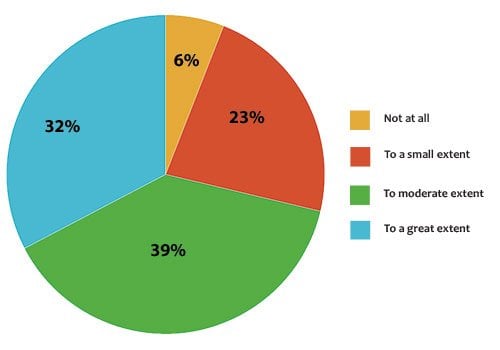
Of those in-house counsel surveyed for this report, the vast majority agreed that technology will disrupt the legal profession in the next five years, with 94% acknowledging that technology will be at least somewhat disruptive. 32% said that they feel this disruption will affect the profession to a great extent.

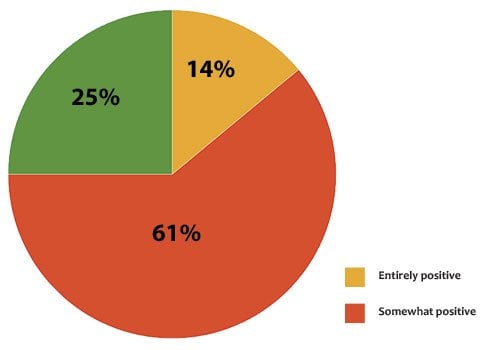
Every respondent that said they expected there to be some disruption in the next five years felt that this would be positive, with 71% saying that the disruption will be ‘somewhat positive’, and 29% saying that it will be ‘entirely positive’.

‘I’m fully convinced of the benefits of the AI, and we all need to adapt to what is coming, because it is coming, whether we like it or not,’ says Cristina Álvarez Fernádez, head of legal at Cintra. ‘I’m 100% optimistic this technological revolution is going to be good for us: we’re simply going to provide legal services differently.’

This positivity is echoed by the approach many of the GCs interviewed for this report have taken to the issue: embrace disruption and reap the benefits.

‘The legal function needs to and can play a role in showcasing the benefits of introducing technological solutions in an enterprise,’ says Johan Huizing, associate general counsel at Itron. ‘We must be leaders in adoption of high-performing technology and not merely followers. Only then can we play a role as thought leaders and will we be accepted as team members that have value for the business.’

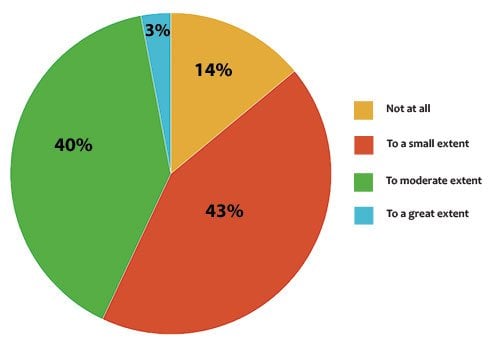
To what extent do you agree that technology has disrupted the legal profession in the past 5 years?

‘Legal professionals who want to thrive in modern business must lean towards technological transformation,’ adds Tobiasz Adam Kowalczyk, head of legal at Volkswagen Poznan.

‘The great news is that lawyers have the tools at their disposal to enable this change. The digital revolution offers us the chance to compete, and it provides law firms and legal departments with the ability to transform into something much more exciting. The legal profession will not disappear, but it will surely change due to technology. This shift will most probably trigger new forms of what being a lawyer means. The sooner we accept it as the new normal, the better off we’re going to be.’

One general counsel from a prominent international engineering firm, who did not think that AI will be a factor within the next ten years, said that their main concerns were ethical.

To what extent do you agree that technology will disrupt the legal profession in the next 5 years?

‘How can you build trust in code? There are ethical questions around its use in certain applications such as disciplinary actions or other employment-related areas,’ they said.

‘It’s not all hype, but the profession is very conservative and the ultimate question is: to what extent will management trust a “machine”?’

Virtually all of those surveyed agree that AI will be a disruptor in the legal industry, with just 9% feeling that it will not be a disruptor at all. Despite this apparent enthusiasm, just 6% said their team currently uses an AI solution, all of whom said they only use it to assist in low-level work. Within this small group, overall feelings on AI’s ability to act as a disruptor in the industry are positive: 83% agreed that AI would be a disruptor, with half feeling that such disruption would come between the next five and ten years.

When asked which factor was more important when considering adopting an AI-based tool, all respondents cited either the reduction of costs (38%) or an improvement in quality of work (62%).

‘Looking forward, AI will be able to cover all technical and easy legal work: cost reduction, quality improvement,’ says Artem Afanasiev, general counsel of DIXY Group.

Overall, the key disagreement comes over the question of when, not if. Over half feel that AI-based disruption would come between the next five to ten years, but a portion said they thought the disruption would come much later: 23% think it won’t be a factor for at least ten years.

Overall, how positive do you think technology disruption will be?

Then comes the question of preparation. If disruption is coming for the legal profession, all eyes will turn to the incumbent lawyers to see how they fare in response to the seemingly inevitable changes heading for their profession. Whether or not legal education institutions and professional development programmes throughout Europe have left today’s lawyers well placed to adapt and thrive will be imperative.

When asked about current lawyers’ preparedness for technological disruption, the in-house counsel surveyed and interviewed were less enthusiastic. 14% felt that today’s lawyers, on average, were adequately prepared; 61% did not. The rest were unsure.

‘AI is limited for the majority of in-house right now because the base data sets are not in place, substantial enough or well enough maintained,’ explains the general counsel for a prominent consumer goods brand.

‘This is a real point of difference with the accounting/finance world where recording data in a structured way has always been the order of the day – that area will see a huge impact from AI in the near future whereas in-house legal first needs to get its ducks in a row, change its behaviours and set that foundation upon which expensive AI solutions are built.’

Giulio Romanelli, Associate Partner, McKinsey & Company and John Pyall, Head of MGA Cockpit, Munich Re UK

GC: In the legal sector, many people describe the emergence of legal tech start-ups as ‘fintech’s little brother’. Could you tell me about the emergence of fintech, Giulio, and how it has impacted the banking sector?

Giulio Romanelli (GR): Banking has historically been one of the business sectors most resilient to disruption by technology. However, in the last ten years, fintechs have moved quickly, forcing incumbents to rethink their core business models and embrace digital innovations. In the last five years, we’ve seen a significant journey as fintechs have become more and more mature.

Today, banks remain uniquely and systemically important to the economy; they are the major repository for deposits, which customers largely identify with their primary financial relationship; they continue to be the gateways to the world’s largest payment systems; and they still attract the bulk of requests for credit.

Some things have changed, however. Firstly, the financial crisis had a negative impact on trust in the banking system. Secondly, customers are more open to relationships that focus on origination and sales. Thirdly, mobile devices have undercut the advantages of physical distribution. Plus there has been a massive increase in the availability of data alongside a significant decrease in the cost of computing power.

GC: To what extent would you term it a disruption?

GR: We can call this a disruption in the sense that fintechs have a unique opportunity for customer disintermediation, by leveraging advantaged modes of customer acquisition, a step-function reduction in the cost to serve, innovative use of data and advanced analytics, and segment/niche-specific propositions.

GC: When insurtechs started popping up in the insurance space, what was the reaction like in the industry, John?

John Pyall (JP): At the beginning, to a certain degree, insurtechs were looked upon with interest, but as: ‘It’s a bit gimmicky, it’s interesting but it’s not for us.’ And then, over time, they were looked at with more and more interest. From our point of view, we made a clear play in that direction. But I think there still is a little bit of ‘watch and see’ about the insurance market as a whole.

GC: Have insurtechs disrupted the insurance space?

JP: I think people look at disruption as being a negative idea. I think insurtech start-ups have, to a certain degree, enhanced the insurance area because they have actually allowed insurers to touch into areas that we previously may not have been able to. For example, digital partners have allowed us to reach out to new customers that we may not previously have ever gotten close to, simply because of the mediums they use to connect to their services. We have insurtechs that purely use social media to market to their customers and their clients and, to a certain degree, their distribution models are so different from what we were traditionally used to it has meant we have got avenues to customers we would never have considered five years ago.

That may be younger people, it may be people who are more engaged in social media. It may be people who are looking to insure single item contents, which insurers wouldn’t have looked at before. We would have had difficulty insuring people employed in the gig economy, doing three jobs in a day, but these new models enhance our ability to do so.

GC: Has this involved an element of culture change?

JP: When you have companies coming in that are younger, more flexible and they are able to drive through changes very quickly within their own organisations, you look at that and say: ‘We need to show that we have that ability as well. If we want to be in this market we have to be able to deal with that.’ So therefore it does actually allow people to think positively about how can we adapt, to differentiate ourselves within these markets.

GC: Looking again to the banking sector, how have established banking organisations responded to fintech disruption? Has it has a knock-on transformative effect in terms of the way these organisations use technology?

GR: As successful fintechs have rapidly matured from start-ups to mature technology disruptors, banks have started the long journey to transform their core digital capabilities, with several areas of focus. These include: a digital-native customer experience; big data and advanced analytics; moving towards a scalable technology landscape through cloud and automation; adoption of APIs (Application Programmable Interface).

Firstly, banks have been creating an integrated customer experience inspired by digital attackers, versus using a one-size-fits-all distribution. So rather than using the branch as the main point of interaction with customers, all the banks have mobile apps and they are very proud of the features that they use to differentiate themselves.

Innovating the customer experience by integrating with fintechs can provide advantages. For example, take the typical onboarding time for corporate lending. A fintech such as Kabbage proposes to reduce the onboarding time for down from something close to days, to something which is close to minutes.

Secondly, using data-driven insights and analytics holistically across the banks. While focus is generally on ‘customer-facing’ use cases, it’s very interesting to see advanced analytics applied internally to drive operational efficiency. For instance, advanced analytics to improve quality and efficiency of KYC [Know Your Customer] and anti-money-laundering.

Thirdly, banks have been mitigating the potential cost advantage of attacks through radical simplification and refining of technology infrastructure, both on process and existing technologies. For example, leveraging and deploying new technologies such as Cloud enables banks to move towards a more scalable and cheaper technology footprint.

Finally, there are several cases in which banks want to be able to offer not only their own solutions, but to also be able to link to third-party solutions. Some financial players want to offer third-party APIs directly to their own customers. And this is happening right now in terms of payments.

GC: How has technology transformation been received in the banking sector – has it required a lot of culture change?

GR: All of the above have required a significant shift in terms of culture and capabilities of incumbents, which are nowadays focusing more and more to attract digital/tech talent.

Moreover, the pace of innovation in banking is accelerating rapidly, requiring banks to increase their speed to keep up, adopting Agile software development techniques, which imply a radically different way to think about the organisation.

GC: John, in the insurance space, can you tell me a little bit about your role in Munich Re, and how the company is working with insurtechs?

JP: I head the MGA Cockpit, which assists our digital partner unit in onboarding new digital partner business into the Munich Re. A digital partner is a partner – an insurtech start-up normally – which is interested in using digital means like an app, social media, or the internet, in order to secure insurance business. The Cockpit was created 18 months ago through the Munich Re think tank to help the due diligence process of the start-up.

We have a digital partner unit that finds new ideas and new business to be brought in as a product, and we assist them in making that a viable insurance product. Basically somebody comes to our digital partners unit with an idea, and we help them develop that into a formalised product and assist them to bring that into operation.

GC: How do you do that?

JP: We may look at whether they want to write that as a single risk, as a group policy, do they need to write it with an MGA? We look at what’s needed in the wording in order to make it effective. We then see what they need to do: how they are going to handle the claims, do they need to outsource that, we might provide them with someone to manage the claims on their behalf.

GC: Are incumbent insurance organisations under threat from insurtechs or is it going to be a process of greater partnering, do you think?

JP: There’s always going to be one or two insurtechs that may seem to be a potential threat. But I would say that generally the growth will be by partnering – that’s where people are really looking. There are very few that are coming in to disrupt the entire chain; I think most are looking to assist within the distribution chain itself. That helps both the existing business and the new start-up, so there are advantages to both sides if you get it right.

GC: How are banks working with fintech companies? To what extent are partnerships occurring? What are the benefits of partnering? And what are the challenges?

GR: Whereas market and media commentary has emphasised the threat to established business models, the opportunities for incumbents to develop new partnerships aimed at better cost control, capital allocation and customer acquisition are growing.

The vast majority of fintechs focus on retail banking, lending and payments. In many of these areas, start-ups have sought to target the end customer directly, bypassing traditional banks. In some cases, this is further accelerated by regulatory changes such as PSD2 [the second Payment Services Directive, a 2015 EU Directive] in Europe, accelerating the shift towards open banking ecosystems.

However, most recent analyses suggest that the structure of the fintech industry is changing and that a new spirit of cooperation between fintechs and incumbents is developing. For example, ING partnered with the lending start-up Kabbage back in 2015 to deliver instant capital to SMEs. Another example is the fact that blockchain development in recent years has been mainly pushed by consortia, bringing together banks and fintechs.

This offers significant benefit for both parties, as it allows fintechs to rapidly access and offer their services to large pools of customers, while incumbents can rapidly deploy customer-centric digital-native services, and strengthen their own digital capabilities and talent pool. Looking ahead is whether such a ‘coopetition’ model is really sustainable in the long term – ie whether one side of this equation becomes more relevant.

GC: From an insurance incumbent point of view, John, what might be the blockers to partnering with insurtechs?

JP: I think culture does have something to do with it – can you build new technology into your existing systems?

Regulation is also one. We are a very regulated industry, so we have to be careful about how we take steps. It cannot be revolution, it has to be evolution. New technology makes people nervous – they understand their business and they understand how it works. If you then drop outside of that, can you write the business in a different model? How does that work?

Another thought is whether you are actually going to end up competing against yourself. That is a clear worry that people have – am I actually just offering the same thing but getting less value out of it?

GC: In your opinion, Giulio, what are the most exciting technological developments in the banking sector?

GR: Looking forward, the most exciting technology developments are related to the next evolution of current tech must-haves, from advanced analytics and machine learning, to intelligent automation, to blockchain, to internet of things.

GC: And how about the insurance sector?

JP: In terms of new tools, there are home and emergency products, for example alarm systems which allow you to instantly know if you’ve got water leakage or a fire or something like that when you’re away from your home.

A lot of it is around trying to change how product service is given, so we’ve got flight cancellation tools looking at how you can get on a new flight.

There are ways insurers are using data to be more proactive and customer-centric in managing loss better, so if there’s a flood, we can identify which potential customers are affected instead of waiting for them to contact us.

I think the way customers approach insurers is going to change quite dramatically as well. They can manage their whole claim themselves, so they know where the claim is at any stage.

GC: In terms of the technology that’s underpinning these new insurance facilities, what are the trends there?

JP: The technology itself is very AI-dominated. It is very much about how much can we automate so that we can respond quicker to customer needs, and keep them informed.

The balance is between automation and empathy – you don’t want a chat bot to respond to a customer in a very automated way when you’re dealing with something which has an emotional requirement.

GC: Do you get a lot of pushback from customers on that?

JP: If you have bought through a digital platform, to a certain degree you assume you are going to go through a digital journey and there’s a certain acceptance to that. However, there are times where people want to drop out of that digital journey, and you have to be prepared to respond to those touch points.

The key is to be flexible, to look at where it can actually genuinely assist, but to make sure you put your customer first. Whereas AI can actually help you reduce cost and make that customer journey more effective, what you don’t want to do is lose that empathetic relationship with the client so they become a customer that touches base with you once and looks purely at price.

Cristina Álvarez Fernández, Head of legal Europe, Cintra

We are exploring how to benefit from tools based on artificial intelligence within our legal department. We still haven’t found the right tool or technology for implementation – but I don’t think we’re far away either. It’s about following a process and making sure – especially the first time – that we do this the right way.

A Fresh Start

This has been a new process for us and we’ve been very deliberate about the steps involved. The first thing we did was to really thoroughly research and find out just what’s in the market. We used a range of sources, from specialist legal magazines, through to talking with our peers – both legal and otherwise.

I have encouraged an internal analysis of the current developments of artificial intelligence in the legal field. We have identified a few tools that could ease the work of the legal department. If we can implement these tools successfully, this will result in economic savings for the company and will help to allocate the resources of the department more efficiently.

At present, we’re currently at the stage where we’re testing tools that we’ve identified that are currently in the market. I think that the first tool we implement will be for contract review. We’ve invested a significant amount into this system already and are hoping that we can have it ready to go by the end of 2018.

First Things First

Contract management and review was a logical first step for us, particularly around NDAs. People always find the same dangers in that kind of contract, so it’s routine work. It can be done by a very junior lawyer – once you explain to that lawyer what the issues are, normally it’s something that can be done really quickly. The line of thinking we took was to take this one step further and try to give it to technology. This is the starting point from which we can hopefully expand.

I don’t think this will replace entirely, at least so far, a person in our team. We’re certainly not planning to get rid of someone just because we believe that work will be done by a machine – not at all. I think this is going to help us to better allocate the resources that we have. We’re not a large department, so where I really see the benefit is being able to focus on things that really need our minds and judgement – which is where technology is probably the least useful at the moment.

Inside Out

I do think that, in time, technology will help us reduce our external legal spend. If we can develop systems within our department that can take on some of this load – particularly where there are significant amounts of data – then we should be able to bring more of this work in-house.

I think that, in time, we will see the relationship between in-house departments and external firms change as a result of technology – mostly where fees are concerned. I suspect that the fees of law firms can be reduced, or at least controlled, depending on the market and matters at hand. But I don’t think the interplay will shift, where we’ll suddenly be dealing with machines rather than a person. At least I can’t anticipate that now – but who knows, maybe in the future, that will be the way!

I have genuinely been surprised and impressed at how the legal sector is dealing with innovations. It’s amazing how the law firms have seen the importance of new technology and they are really getting involved in these matters. Certainly, the sector is always very traditional and conservative, so when we first undertook the research process of finding out what was in the market, it came as a pleasant surprise to see that law firms are leading innovation in the legal sector and how many are doing things like working with start-ups in developing new technology.

I do think that the main driver motivating law firms is profitability. The way in which firms assess and charge their fees, it was getting to a point where it was going to be very difficult to sustain. Clients in particular are trying to change the way that they invoice, looking at alternate fee arrangements or, in some cases, bringing more work in-house. As a result, I think they have been forced to find ways to reduce cost and maintain their profitability. But at the same time, they will have no doubt seen other industries disrupted by technology and seen that this is the way forward.

A Group Effort

Ferrovial’s IT department has been an asset – they’re a really big part of the Ferrovial Group and have been essential throughout this process. They are genuinely curious about the technologies available and their potential impact on both our department and the wider group. They seemed enthused that we were taking an interest in this and were actively helping us along in this process.

One factor which may be more unique to Ferrovial, is that our IT department work with a lot of innovative start-ups. The group is actively working with, even financing some start-up businesses, and the IT department have been looking at some of these to see whether there are tools that could be adapted to legal, or developed specifically for us and our needs.

This isn’t something that’s unique to legal, it’s been happening in other departments already. In general, our company and group are very interested in innovation and new technology. It’s crucial for a business like Cintra and will become even more important in the future. We work closely with roads, in particular toll roads – so innovations like driverless cars have the potential to be transformational for the business. But as with any shift, there are a host of legal issues that will go along with that. So, it’s about bringing all of those factors together and becoming more innovative, thinking more innovatively, collaborating and using technology.

KWM administration report shows £18.3m hole for creditors as former staff set for payouts

King & Wood Mallesons Shattered

Two years after the collapse of King & Wood Mallesons (KWM) the saga rumbles on, with administrators primed to pay former staff as an £18.3m funding deficit leaves unsecured creditors out of pocket.

A progress report filed last week details how some former employees of the firm have been ranked as preferential creditors following KWM’s 2017 insolvency. These employees will now be eligible for successful claims on failing to consult on the redundancy process, as well as payouts on wages and holiday pay. Continue reading “KWM administration report shows £18.3m hole for creditors as former staff set for payouts”

Comment: Too much jam today for partners yet the future of law will need long-term investment

Simon Levine

A little over five years ago Legal Business produced a cover feature dubbed ‘How to improve a law firm in 17 easy steps’. The piece – intended as a series of practical proposals to improve the working of law firms – has aged as well as anything printed in these pages.

And while point one – on overhauling lockstep partnerships for the age of global law – has been borne out, it is the second proposal, to phase out full profit distribution models, that is more pressing to the profession. Problems with lockstep are a peculiar challenge for London’s elite. In contrast, the historic model that has prevailed in legal partnerships of distributing the near-entirety of profits to partners annually speaks to an entire industry in danger of tipping itself over a cliff. Continue reading “Comment: Too much jam today for partners yet the future of law will need long-term investment”

DLA global turnover surpasses $2.8bn in second year of growth

Big Law giant

DLA Piper added 8% to its global top line in 2018, making for consecutive years of growth following a dip in 2016.

The firm’s global revenue rose to $2.84bn, up on last year’s $2.63bn and continuing a bounce back from when the firm’s total turnover dipped below $2.5bn in 2016 because of exchange rate fluctuations across its international business, which is divided between an international LLP and a US LLP. Continue reading “DLA global turnover surpasses $2.8bn in second year of growth”

‘Great synergies’: Mayer Brown adds long-awaited restructuring hires with DLA duo

Mayer Brown

Chicago-bred Mayer Brown has bolstered its restructuring, bankruptcy and insolvency (RBI) practice with a double hire from DLA Piper in London.

DLA veterans Michael Fiddy and Amy Jacks join Mayer Brown as co-head of the firm’s global RBI practice and co-head of the firm’s UK RBI practice respectively. Fiddy will lead the global group alongside New York partner Brian Trust and Hong Kong-based partner John Marsden, while Jacks takes on her leadership role alongside partner Devi Shah. Continue reading “‘Great synergies’: Mayer Brown adds long-awaited restructuring hires with DLA duo”

‘A leading player’: Fieldfisher ups real estate game with RPC construction and projects team

Fieldfisher

Enterprising top-25 firm Fieldfisher has made a significant construction and projects play, hiring a team including two partners from RPC.

Dan Preston, who was RPC’s head of construction and projects, is joining Fieldfisher alongside fellow partner David Thorne in addition to a team of five associates. One of those is senior associate Jamie Key, who will join Fieldfisher as a partner. Continue reading “‘A leading player’: Fieldfisher ups real estate game with RPC construction and projects team”

Revolving Doors: Crowell & Moring taps Squire Patton Boggs for UK partners as DLA leads hefty international recruitment round

starry sky over the City

City recruitment was steady last week with Crowell & Moring being the main mover after luring yet more talent from Squire Patton Boggs. Meanwhile Monckton Chambers secured Steven Gee QC from Joseph Hage Aaronson and DLA Piper and Mayer Brown made moves in a busy international round.

Crowell & Moring has emboldened its London strategy lately by recruiting from Squires. Energy partner Robin Baillie joined the firm last week, with Crowell & Moring looking to export its strong US energy practice to the UK.

Baillie had been at Squires since 2014, and brings with him senior associate Stefanie Atchinson who joins as counsel as well as associate Lydia Taylor. Meanwhile, Squires banking and debt finance partner Andrew Knight is also set to join Crowell & Moring at the beginning of April. The exits come after Squires lost a three-partner team to Crowell & Moring in recent weeks, with litigation partner Laurence Winston and insolvency partners Cathryn Williams and Paul Muscutt also decamping. Squires former City litigation head Robert Weekes meanwhile joined the firm in January, while 15 other lawyers left the firm for Morgan Lewis in February.

Monckton Chambers made a law firm play, adding Joseph Hage Aaronson litigator Steven Gee QC to its ranks. Gee returns to the barristers’ chambers after five years at the litigation boutique, having formerly headed up Stone Chambers.

Joint head of Monckton Chambers, Philip Moser QC, welcomed the hire: ‘Steven’s significant experience, both at the Bar and in a law firm, will provide inspiration and impetus further to expand Monckton’s commercial litigation and arbitration work. We believe his addition is a significant milestone in the recognition of Monckton Chambers as a leading set for commercial litigation and arbitration.’

Finishing off the City hires, DAC Beachcroft acquired David Johnson from Weightmans where he led its political and markets advisory group for four years. Johnson focuses on handling large-loss catastrophic injury cases and high-value fatal accident claims.

Eversheds Sutherland, meanwhile, made a hire in the regions, with the addition of corporate partner Michael Birchall, who joins from Addleshaw Goddard.  Birchall will now spearhead the firm’s corporate practice in Manchester while also working closely with the firm’s team in Leeds. Birchall had previously been based in both Manchester and London for Addleshaw.

Further afield, DLA Piper led a busy international recruitment round, hiring in Frankfurt and Dublin. In Germany the firm enhanced its litigation and regulatory practice with the hire of Gleiss Lutz associated partner Emanuel Ballo. It marks a return for Ballo, who had worked at DLA Piper between 2011 and 2015, having advised a number of international companies on issues related to white collar crime.

Meanwhile DLA Piper hired tax partner Maura Dineen to the firm’s newly opened Dublin office. Dineen joins from Mason Hayes & Curran, and is DLA Piper’s fifth partner hire in Ireland in a month.

Fieldfisher made a double hire in Madrid, with Jesús Estévez and Elizabeth Malagelada joining the firm’s Spanish offering. Both come from Big Four outfit EY, where Estévez worked in the firm’s banking and finance practice while Malagelada worked in the tax department. Estevez had been a partner at EY For four years and prior to that was a partner at Baker McKenzie; Malagelada meanwhile had been at EY for six years.

Completing the international recruitment round, Mayer Brown expanded its corporate and securities practice in Hong Kong with the hire of former Kirkland & Ellis and Hogan Lovells partner Steven Tran. As a private equity and M&A lawyer, Tran acts for funds and major financial institutions and has been based in Asia for almost 20 years.

‘Steven’s appointment reflects the continued growth of our corporate capabilities in Hong Kong as a service hub for Asia,’ said Jason Elder, co-leader of Mayer Brown’s corporate and securities practice.

[email protected]

Calls for a ‘radical overhaul’ of NDAs as #MeToo saga prompts UK gagging order law reform

Zelda Perkins

The government has proposed new legislation that would make it illegal for employers to use gagging orders to prevent the reporting of sexual misconduct in the workplace to police.

The move, announced by business minister Kelly Tolhurst today (4 March), comes as #MeToo continues to rage in the legal profession and beyond after the use of non-disclosure agreements (NDAs) to hide sexual offences came to light in several high-profile cases. Continue reading “Calls for a ‘radical overhaul’ of NDAs as #MeToo saga prompts UK gagging order law reform”

Watson Farley & Williams makes major City energy play with Clifford Chance Africa director

Selecting recruits

Watson Farley & Williams (WFW) is set to hire Titus Edjua, director of Clifford Chance’s (CC) Africa group, to boost its project finance capabilities.

According to a source, one other lawyer is due to be joining WFW from CC as part of the same move, but this has not been confirmed by either firm. He is set to start at WFW on 1 April. Continue reading “Watson Farley & Williams makes major City energy play with Clifford Chance Africa director”

‘Only the beginning’: Latham adds more than $300m to top line as Sidley nears £100m in the City

Big Law giant

A year after becoming the first law firm to break the $3bn barrier, Latham & Watkins has posted an even stronger set of financial results, growing revenue at a faster 11% rate to hit $3.386bn in 2018.

Meanwhile, Sidley Austin joined the growing number of US firms to report double-digit growth for their City operations in 2018, hiking London revenue 14% to £97.5m. Continue reading “‘Only the beginning’: Latham adds more than $300m to top line as Sidley nears £100m in the City”

‘Better than many’: Paul Hastings sees London revenue grow 14% as Milbank breaks $1bn barrier globally

starry sky over the City

Paul Hastings saw its strong revenue growth in London tempered slightly to 14% in 2018 in what remained a strong year for the US outfit.

The double-digit revenue increase in London is lower than last year’s 25% rise, however it outstrips the firm’s global growth figure of 9%, itself up from 4% last year. Profit per equity partner (PEP) meanwhile broke the $3m mark, rising 12% to $3.25m. Continue reading “‘Better than many’: Paul Hastings sees London revenue grow 14% as Milbank breaks $1bn barrier globally”

Magic Circle leads tech foray as Slaughters unveils tech incubator and Linklaters and A&O back Nivaura in $20m funding round

Jane Stewart

Slaughter and May has announced today (27 February) its much-anticipated legal tech incubator, Slaughter and May Collaborate, with the firm primed to select about six legal tech companies for its first cohort.

Magic Circle counterparts Allen & Overy (A&O) and Linklaters, meanwhile, have both featured in fintech company Nivaura’s $20m funding round as the City elite bustle to achieve a technological advantage. Continue reading “Magic Circle leads tech foray as Slaughters unveils tech incubator and Linklaters and A&O back Nivaura in $20m funding round”

Chicago firepower for RPC as insurance team secures formal US tie-up

Chicago

RPC has announced its insurance practice will form an official alliance with Chicago-based law firm Hinshaw & Culbertson.

The partnership will see both firms deepen their existing relationship in the insurance sector, with talks regarding a formal alliance developing throughout January. The firms will now work together on pitching and client marketing as well as collaborating on professional indemnity mandates. Continue reading “Chicago firepower for RPC as insurance team secures formal US tie-up”

Revolving Doors: Crowell & Moring secures three-partner team from Squire Patton Boggs while Dentons makes City hire from Fieldfisher

Dentons

City recruitment was active last week, as Crowell & Moring and Dentons made the standout hires while Baker Botts also made a City move.

US firm Crowell & Moring led the way in the City, recruiting a three-partner team from Squire Patton Boggs a month after hiring financial litigation partner and former City head Robert Weekes from the same firm. Weekes will be joined by litigation partner Laurence Winston, London insolvency head Cathryn Williams and insolvency partner Paul Muscutt. Continue reading “Revolving Doors: Crowell & Moring secures three-partner team from Squire Patton Boggs while Dentons makes City hire from Fieldfisher”

The International Arbitration Centre launches: The City finally gets the disputes space it’s been waiting for

For years seasoned practitioners have bemoaned the lack of top-notch arbitration facilities in London, casting an envious eye at the polished offerings in rival hubs like Singapore, even as the City has boomed as a global centre for dispute resolution. Now advisers sick of arguing about venues and decamping to hotels for major disputes are about to have their wishes granted with the launch this week of a world-class arbitration centre from Legalease.

Following more than two years of development – including extensive consultation with senior arbitrators to refine its bespoke design – the new International Arbitration Centre (IAC) covers four floors at 190 Fleet Street, right in the heart of London’s legal community. Continue reading “The International Arbitration Centre launches: The City finally gets the disputes space it’s been waiting for”

Tightening of ranks at Hogan Lovells sees PEP approach $1.4m as turnover rises 4%

Steve Immelt

Hogan Lovells has posted an 8% increase in profit per equity partner (PEP) to $1.38m after reducing equity partner headcount 6% to 523 in 2018.

The firm today (25 February) posted revenue of $2.12bn, up 4% on $2.04bn in 2017, a less pacey rate of growth than the 6% achieved in each of the previous two years. Revenue per lawyer (RPL) grew at a faster 6% pace to $804,000 as the firm cut its legal workforce 2% to 2,637 while total partner headcount, including non-equity partners, was down 4% to 803. Continue reading “Tightening of ranks at Hogan Lovells sees PEP approach $1.4m as turnover rises 4%”