

On notice: Teva’s entire $330m legal spend could go to one law firm

teva

Everything is up for grabs at Teva Pharmaceutical Industries – well, certainly from an external law firm perspective. The Israeli-based company – the largest manufacturer of generic drugs globally – recently announced that all existing law firm relationships were under review, with a view to reducing the number of law firms used and to cut costs. While conceptually, that may not seem like anything groundbreaking in and of itself, Teva has taken things further than usual – going as far as warning existing firms that it is more than conceivable that they won’t continue to be instructed.

‘Revenue growth at Teva is flat. Law firms’ rates are going up. We have to do something different – that is it in a nutshell,’ explains David Stark, chief legal officer at Teva Pharmaceutical Industries. ‘We took a run at this five years or so ago. Things were hectic back then, and there wasn’t really the ato do it, and it was incredibly time intensive.’

The company’s well-documented cuts took place from late 2017, and the legal team was instructed to align legal spend with the wider business. A year ago, in mid-2018, the process of reducing outside counsel spend began.

‘The company had been in an acquisition phase leading up to this, and when you acquire companies, you acquire law firms.’ When pressed on how many law firms Teva uses, Stark admits it is many hundreds (our own research at The Legal 500 suggests around 700 in total). ‘The ultimate goal would be to use just one, but in the short term, that is just unrealistic. But we can make a significant reduction, even by 50% in year one.’

The process began with Teva writing to all of its outside counsel, informing them of the company’s review process and the reasons underpinning the exercise.
‘We wanted to have transparency, we wanted the firms to know what we were doing,’ says Stark. ‘With some firms, we have very strong relationships. It’s no comment on our current firms, but we aren’t going to move work around for the sake of it. It’s got to be a compelling reason, at a similar or lower cost. Firms that we are currently working with should see this as an opportunity.’

Knowing law firms as we do, this must have come as something of a shock – so how did they react?

‘A mixed bag, to be honest. Firms that are doing a lot of work for us, to be honest, don’t like it. They see it as a big ask, to effectively go through the pitch process again,’ says Stark. ‘Firms that do a little bit of work for us are the ones that are really excited. And firms that we don’t know at all, that we have invited in to tender, are not sure what to make of it.’

But Stark says that the firms that succeed as a result of the lean process will have bigger scope within Teva.

‘We are looking to have fewer people interacting with law firms, but there have to be smarter approaches. Yesterday I was in the office with a senior lawyer at one of our firms, and what he wanted to talk about was rate increases!’

Higher rates seem to be more of the norm at the moment, partly because many clients are letting them get away with it.

‘The economy is on fire, and top firms gravitate to easier clients. We may not be able to afford some firms, so we have to choose our set of firms very carefully. Firms we instruct need to have flexibility and be rate competitive,’ says Stark.

‘At present we have more high-end legal work, so why fool around with low rates? But a lot of that work is coming to an end. From here on, it will be slow but steady progress. It won’t be less money, more work, but instead more certainty around a broader bucket of work for the preferred firms.’

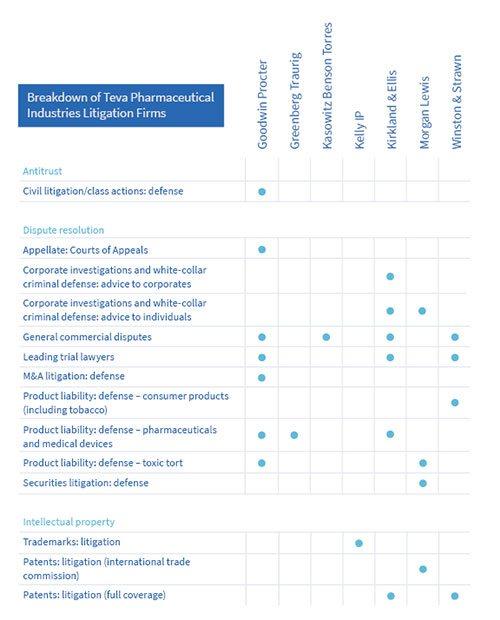
Stark is being deliberately cautious about the amount of external spend that Teva is currently making. While he coyly admits that it is ‘more than $100m’, our own research team has been digging deeper into this. Looking at the firms and types of work that is typically done, we estimate that the actual number will be over three times that, at around $330m. Some firms are estimated to be in eight figures for their fees, so there is a lot at stake for partners if they lost that work.

‘There will be benefits for the company,’ says Stark. ‘We will get some savings. But there are definitely going to be some surprises in store, and there will definitely be some lessons learned.’

Working with Teva and Stark on this process is Smarter Law Solutions. Founded by Trevor Faure, formerly global general counsel at Ernst & Young, Smarter Law consults with companies to cut legal costs and implement lean processes.

Under the Smarter Law led-system, firms that submit to the process are assessed on pricing and other data metrics and, following a period of research and interviews, a far reduced panel of firms will be announced by the end of the year. Just what that process entails is detailed in Faure’s new book, Smarter Law: transforming busy lawyers into business leaders.

I often find myself looking at theoretical books that might have some practical application in the field of law, but this book is based on the experiences of over 200 in-house case studies. What the book allows GCs to do is dip in and out of the experiences of their peers and cherry pick the techniques and applications that will work for their in-house departments. To find out how the kinds of techniques that Teva are using currently, the ‘Win: Win: Win RFP Process’ chapter is a must read. It explains how a tender process allowed a client to pay law firm bidders more than their proposals and still reduce spend by 44%.

In recent months, we have seen a growing movement back to simplicity, from the #bringbackboring campaign, to the simple mantra of ‘people, process, delivery’. The Smarter Law approach isn’t based on the future of law, it is firmly rooted in the here and now. What GCs can do right now to improve efficiencies, working practices and transform the function. The best learning comes from who have done it before. Don’t take my word for it, get a copy and delve into it yourself – you will benefit and you will learn. Available from: gcm.ag/smarter_law.


Dice falls in Linklaters’ favour as partner profits shoot up 10% and £100m added to top line

Gideon Moore

Linklaters has posted the strongest financial performance of its peer group with a 7% revenue uptick to £1.63bn and double-digit profit growth.

The results today (11 July) show profit per equity partner (PEP) at the Magic Circle law firm rose 10% to £1.7m in 2018/19 after being flat in a mixed 2017/18. Continue reading “Dice falls in Linklaters’ favour as partner profits shoot up 10% and £100m added to top line”

Not easy out there: A&O adds £75m to its top line amid muted PEP showing

Andrew Ballheimer

Bringing up the rear of the Big Four City firms to post solid but unspectacular financial results, Allen & Overy (A&O) has increased its top line by 5%, sending revenue up by £75m to nearly £1.63bn.

A&O’s £1.627bn turnover relegated it from second to third largest Magic Circle firm in revenue terms after Clifford Chance (£1.693bn) and Linklaters (£1.629bn) but above Freshfields Bruckhaus Deringer (£1.472bn). Continue reading “Not easy out there: A&O adds £75m to its top line amid muted PEP showing”

Some challenges: Travers ups NQ pay range following 11% revenue growth and subdued PEP

David Patient

Travers Smith has marked a tenth consecutive year of revenue growth with an 11% increase in turnover, although profit per equity partner (PEP) grew at a more subdued 4%.

Revenue at the firm grew to £162.5m for the 2018/19 financial year – good for growth of more than 70% over the last five years – while PEP hit £1.25m. The firm subsequently joined the raft of firms increasing pay for newly-qualified solicitors (NQs), lifting their base rate salary to £85,000. NQs have the potential to receive between £93,500 and £110,500 with bonuses and other discretionary payments. Continue reading “Some challenges: Travers ups NQ pay range following 11% revenue growth and subdued PEP”

Macfarlanes’ revenue continues to defy gravity but PEP holds steady

Charles Martin

City stalwart Macfarlanes has posted a mixed bag of financial results as the ninth consecutive year of revenue growth failed to translate into a rise in profit per equity partner (PEP) following last year’s 26% surge to £1.74m.

The results announced today (10 July) show turnover grew 8% to £216.98m in 2018/19, a significantly slower pace than last year’s exceptional 20% rise to £201.5m. Continue reading “Macfarlanes’ revenue continues to defy gravity but PEP holds steady”

Gateley IPO pioneer Ward to stand down as chief executive

Michael Ward

The man who led Gateley in its pioneering move to become the first UK law firm to float on the public markets is to step down as chief executive next year.

Michael Ward, who has spent over thirty years at Gateley, will be succeeded by the firm’s Manchester office head and leader of its national property team, Rod Waldie, from 1 May 2020. Ward will remain on the board of directors and lead Gateley’s non-legal businesses. Continue reading “Gateley IPO pioneer Ward to stand down as chief executive”

Pinsents holds back ‘significant’ investment from partner profits amid 7% revenue growth

John Cleland

Pinsent Masons has ring-fenced ‘significant funds’ from partner profits in a bid to prioritise investing in the business, in turn cutting profit per equity partner (PEP) by 5%.

Revenue at the firm for the 2018/19 financial year rose 7% to £482m, slightly ahead of last year’s 6% increase and good for growth of more than 40% over the last five years. Gross profit rose 2.5%, but PEP fell to £620,000 from £653,000 as the firm put aside funds for investment in areas including IT and cybersecurity. Continue reading “Pinsents holds back ‘significant’ investment from partner profits amid 7% revenue growth”

Revenue continues to fly at Bird & Bird as PEP growth lags behind

David Kerr

Global traveller Bird & Bird has recorded its 28th consecutive year of revenue growth, hiking its top line 7% to £361m in 2018/19 as profit per equity partner (PEP) rose 4% to £575,000.

Announced today (9 July), the results show the pace of growth slowed down in sterling terms compared to last year’s 11% uptick to £337m, but in euro terms it slightly improved, with a 7% hike to €409.5m compared to last year’s 6% growth. Continue reading “Revenue continues to fly at Bird & Bird as PEP growth lags behind”

Knights eyes another four acquisitions after 51% revenue increase in first post-IPO results

David Beech

Knights has produced a strong debut financial year following its AIM listing, with acquisitions and organic growth propelling the firm to more than £50m in turnover.

Turnover at the company was up 51% to £52.7m, slightly ahead of expectations the company flagged in May, including 15% organic growth. Revenue per fee earner was up 22% to £131,000, with a net 46 increase in fee earners over the year, while net debt fell to £14.1m from £26.3m. Continue reading “Knights eyes another four acquisitions after 51% revenue increase in first post-IPO results”

NRF hires the mind behind Barclays radical panel shake-up to launch legal ops consulting arm

Stéphanie Hamon

Norton Rose Fulbright (NRF) is making an ‘offensive move’ against the Big Four on legal operations consulting with the hire of the well-regarded former Barclays’ head of external engagement, Stéphanie Hamon (pictured).

The firm announced today (9 July) that Hamon, who quit the bank earlier this year, will join as a fee-earner in August to head the new practice and help ‘in-house departments function like a business’. Continue reading “NRF hires the mind behind Barclays radical panel shake-up to launch legal ops consulting arm”

Ashurst set to reach £1m PEP target after 31% surge as revenue tops £641m

Paul Jenkins

Paul Jenkins, Ashurst’s indomitable managing partner, is aiming to reach profit per equity partner (PEP) of £1m in the next financial year as the City stalwart unveils its best financial results to date.

On the back of three consecutive years of growth, the firm added £77m to its top line to hit £641m for the year to 30 April 2019, a significant 14% increase on the £564m turnover of last year. Continue reading “Ashurst set to reach £1m PEP target after 31% surge as revenue tops £641m”

The hard sell

‘I have never instructed a Big Four firm on a legal matter,’ says one UK general counsel of a large multinational. ‘The accountants’ legal offering is not something I’m close to,’ concedes Tesco GC Adrian Morris. The respective legal chiefs at The Royal Bank of Scotland (RBS) and Lloyds Banking Group strike a similar note: ‘We don’t currently use any of them,’ says Michael Shaw, while Kate Cheetham notes: ‘Our use of these offerings is quite limited.’ Continue reading “The hard sell”

Broader horizons – GCs taking outside roles

One of the set-piece debates of day one of Enterprise GC covered a pressing issue for GCs – how to widen their skillset by gaining board experience, as well as practical tips on becoming a non-executive director (NED) in particular. The session, chaired by veteran City columnist James Ashton, featured some seasoned campaigners: Michael Coates, associate general counsel for Shell UK and a director for a number of Shell companies; Eversheds Sutherland partner Denise Jagger, who has a portfolio of non-executive directorships and trustee roles; Stuart Morton, head of the legal and professional services function at executive search firm Odgers Berndtson; and Rob Webb QC, now a senior adviser at Brunswick and former general counsel for both British Airways and Rolls-Royce, who has held a number of board roles throughout his career.
Continue reading “Broader horizons – GCs taking outside roles”