
Now Playing: The Future of India and Audio Streaming

India’s distinct cultural environment has given birth to a rich music scene that is fast-growing and ever-changing, but dealing with its gargantuan population and slowly developing telecommunications infrastructure may be key to a lasting legacy.

The average internet user in India spends 21.5 hours streaming music every week – nearly four hours more than the average listener elsewhere. But translating this enormous consumer base into strong bottom-line figures remains a challenge for the industry across the board.

Relatively speaking, India was an overdue entrant into the digital space for music. The late penetration of smartphones, combined with inadequate digital infrastructure made data consumption a premium service only available to the wealthy elite.

That changed in 2016, when telecommunications giant Reliance Industries and its mobile network subsidiary, Jio, entered the market. Following a significant investment by Reliance Industries into fibre-optic networks across India in the preceding years, the launch of Jio brought with it significant disruption to the domestic mobile landscape – namely, all inclusive and unlimited mobile data.

‘Reliance came in, gave away free data, and immediately changed the consumption habits of the average Indian user,’ says Ali Sachedina, general counsel and head of business affairs at JioSaavn, a domestic digital streaming service and itself a subsidiary of Reliance Industries.

‘Before Jio launched, people in India would send a WhatsApp message, turn off their data and turn it back on to receive a message because it was insanely expensive for the average Indian to have a proper data plan. After the launch, whether you were a doctor or a rickshaw driver, people were able to live stream on their phone – whether that was music or video – giving rise to companies like our own.’

Change the Tune

The sudden availability of free data in India had a dramatic effect on the digital environment. From a standing start in 2016, India now ranks as the largest consumer of mobile data globally, helped by the fact that it also boasts the lowest prices for data consumption.

‘This has given billions of consumers access to the internet and legitimate sources of content, which is really driving the legitimate growth of digital music in India,’ says Sankalp Dalal, head of legal at Zee Music Company.

Established two years prior to Jio’s data revolution, Zee Music Company had already snapped up a large chunk of licences for Bollywood music, but saw marked growth following improvements to the availability and accessibility of mobile data.

Similarly, JioSaavn also finds its roots in Bollywood music. Created as the result of a merger between JioMusic, the digital music arm of mobile operator Jio, and Saavn, an entertainment distributor focused on Bollywood and entertainment, JioSaavn is the strongest domestic player in India, accounting for 37.8% of the streaming market. Crucially, the 2018 merger combined two key business strands vital for streaming businesses: licences and users.

With 104 million monthly active users and the rights to more than 50 million tracks, the combined entity boasts a wealth of perhaps the two most important factors in the business. Those two factors are also inextricably reliant on the ability of the company’s counsel to both establish and navigate the complex web of licences. JioSaavn works with thousands of different record labels and music publishers, requiring constant negotiation by the business and its counsel in a constantly evolving environment.

‘There are three key stakeholders in any licensing endeavour: the finance team, who model and understand what our obligations are from a revenue perspective; the content team, who handle the day-to-day operation of the labels and licensors; and the legal team, who need to align everyone’s wants and needs in the agreement,’ explains Sachedina.

‘Legal needs to work closely with the other teams when forming and reviewing the agreements. We have to consider the various implications, especially when it comes to the revenue element and the limitations on a product or service. We have to ensure that everything is aligned, before effectively expressing that to the licensor.’

As the music industry in India evolves, achieving alignment across the business functions will become increasingly imperative. Like in many growth industries, short-term profitability – particularly when the entities are well funded – is often cast aside in favour of prioritising factors that will lead to long-term revenue growth.

In the digital streaming space, expanding the userbase and catalogue of licences are the top priorities. But, unlike in other industries, the nature of licensing – particularly in a global environment in which other jurisdictions have already reached maturity – means that costs are a major consideration from the outset. Compensation is generally determined in terms of the number of times the property is streamed, meaning that for each user listening to music, there must be an associated model for contributing towards the costs incurred.

‘Margins are getting smaller. A fair amount of our revenue goes to pay content licensors, both on the music publishing and on the sound recording side. It compels us to look at other avenues of revenue generation and ways to add to our bottom line,’ says Sachedina.

‘As legal, we need to look at everything from a risk management, compliance and value-enhancement standpoint. If there’s a new pricing structure we want to address, we have to look at it through a legal lens and how it affects us in our other endeavours. This requires us to have an absolute knowledge of the business.’

Face the Music

On a global level, as the music industry shifts towards a business model predicated on mass consumption via digital streaming – one where artists are compensated based on the number of times their properties are played – the potential of India and its 1.3 billion people is vast, with international players taking notice.

‘In the past, we were able to convince labels and licensors that India operates with a very unique set of circumstances – the userbase is different and their consumption patterns are different,’ explains Sachedina.

‘Now we’re getting to a point where the labels and licensors want us to operate on the same level as other streaming services around the world.’

Driving that change has been the entrance of major global players into the Indian market. Earlier this year, Spotify and YouTube Music both officially came online in India, armed with deep pockets, expansive licences and best-in-class technology – as well as different value propositions for consumers.

‘The difficulty lies in getting your average Indian user to see value in a premium service.’

‘If there’s one challenge that any music streaming service or content licensor has, it’s YouTube. You can’t argue with its scale or that their rates are so low – after all, it’s hard to compete with free,’ says Sachedina.

‘The challenges from a content perspective are large, but it’s primarily a pricing problem. The issue is with the Indian community itself: getting them to attribute value to a platform or service that delivers music. The difficulty lies in getting your average Indian user to see value in a premium service because, quite frankly, if it’s free – why should they pay for music?’

It is this struggle to compete with ‘free’ that has dominated the conversation around digital music services, particularly in India. Services like JioSaavn offer their platform for free, but give users the option to pay a subscription fee to gain access to a premium service – unlocking exclusive music, offline features and higher quality streams, in addition to eliminating advertisements.

Out of the 150 million active music streaming users in India, those who subscribe to fee-paying platforms make up only about 1% at present.

‘There are about one million paid subscribers, meaning there’s huge growth potential there. But they need to figure out a model which appeals to the Indian consumer. In my view, streaming services in India will need to find a hybrid between subscription and advertising models in the long term,’ says Dalal.

The challenge comes in convincing consumers that the premium option is worth paying for. The widespread accessibility of music on platforms like YouTube and the sizeable amount of pirated music create substantial problems in encouraging consumers to pay a fee for the additional benefits.

‘The traditional model of the free user and the paid user was that you could download music and listen to it offline. But as connectivity increases and improves, the advantage is lost,’ says Vijay Basrur, founder of OK Listen!, a digital platform for independent artists to earn money through streaming.

‘I think a lot of businesses are now trying to have a subscriber model drawn by original content, or an equal system around music which could extend further than any existing pure streaming services. Businesses like JioSaavn, Gaana, Amazon or Apple – everything is part of a broader system play. They have the benefit of bundling the music together with other services, which helps them by not allocating the entire subscription costs.’

Beating the Black Market

Shifting consumers on to platforms for the legitimate and legal consumption of music is a potential game changer for the industry. Both premium and freemium revenue models capture market share that was previously lost to piracy, bringing new sources of revenue into the mix that were unattainable before the advent of streaming.

‘In 2008, music was primarily consumed on phones via Bluetooth and pirated tracks. Outside of that, the industry was purely physical media sold at an incredibly discounted rate – the markup was set at a bare minimum, yet there was still rampant piracy,’ says Sachedina.

Ali Sachedina, General Counsel and Vice President of Business Affairs, JioSaavn

Taking an unusual path to the top legal job at Indian streaming site JioSaavn, Sachedina discusses his journey into music.

‘Before I joined Saavn, I started my career as a criminal defence lawyer. I was obsessed with music, but moved to New York City and worked in compliance at a bank – and it wasn’t for me. It was at that time I decided I was going to jump straight into the music industry. I wrote to a guy who was managing one of the artists I really liked. I ended up becoming his intern and went from a six-figure salary to zero for two years, but I was happier than I’d ever been.

I started managing bands, but I didn’t really understand how law, music and media tied in together. Eventually, I met a lawyer who had worked in the music business for almost 40 years and was working in-house for the company that managed Aerosmith. He was an old-school, Irish lawyer who told me: “I’m not going to pay you, but what I will do is teach you everything you need to know to set up your own shop.” That’s how I started my career in the music industry – as a lawyer, at least.

I went to India for the first time in my life in 2002. Over the course of a number of trips, I started meeting artists and musicians, helping them understand their IP rights, what to look out for in terms of management deals and recording contracts. At the same time, I had a practice in New York primarily representing hip-hop artists, bands like Mobb Deep and artists out of Canada. I was working on an entire spectrum of deals – anything that came my way, I’d do it.

Working with South Asian artists, I had heard of Saavn and had even done panels with some of their members. Then I started negotiating deals against them – representing artists who were being signed to the various programmes they had. In 2017, they approached me about being their general counsel and the rest is history. I’ve been here since April 2017, so it’s not a long tenure, but it’s been an incredibly sharp learning curve for someone who was living a very rock-and-roll lifestyle as a music lawyer!’

‘Piracy was tackled really effectively by Bollywood, where there was a physical product: DVDs, CDs or tapes. They would literally have police going out and shutting down pirate stores.’

The fact that music piracy has primarily moved to the digital realm does make tackling it a more involved process, but Sachedina points to the success of shutting down illegal cricket streams as evidence that it’s a solvable problem.

‘There’s nothing bigger in India than cricket. Hotstar deliver that content exclusively and have been very effective in stopping pirate cricket and World Cup streaming through a combination of both legislative and judicial orders,’ says Sachedina.

‘Music has yet to be given that sort of push, but that is changing. One of the reasons is because music industry organisations that represent us haven’t, until recently, made it a focus. At Saavn, we’ve been proactive in speaking to labels and helping them understand that piracy is a real issue. Not only this, but it’s an issue that, if properly addressed, would be of benefit to everyone.’

Cracking down on piracy has the ability to have transformative economic effects.

In 2014, it was estimated that 99% of all music in China was obtained illegally. Subsequent action by Chinese authorities resulted in millions of songs and a swathe of websites being taken down overnight, as well as commitment to ongoing enforcement.

Since then, China’s music market has transformed. Tencent Music, the music streaming arm of Chinese internet behemoth Tencent Group, counts 644 million monthly active users across its platforms and controls more than 70% of the market. Since its 2016 launch, the business has been spun off and floated on the New York Stock Exchange, with a $24bn market cap.

‘All we have to do is look at China, who were trendsetters with what they did. The proof was in the pudding: there is immense value in tackling piracy,’ says Sachedina.

‘We’re still missing an effective judicial and legislative protocol to address piracy, but the Indian government has been incredibly receptive. They’re getting ahead of the curve, but it will require a joint effort with the industry bodies in India. We need to find a solution that maintains neutrality – not being draconian by implementing a stringent anti-piracy regime that impedes personal freedoms or access to content but, rather, a balancing act.’

While a series of legislative responses will take time to materialise and be enforced, positive signs are being seen from the judiciary in getting on top of piracy.

‘China were trendsetters with what they did… there is immense value in tackling piracy.’

‘The Indian courts are being proactive,’ says Dalal, noting that even small procedural changes can have a marked impact on the workload of counsel.

‘Recently, the Delhi High Court passed an order so that when infringing websites have been blocked, content owners only need to go to the registrar of the Court to then block any mirrored sites. You no longer need to keep going back to court to ask after an injunction for affiliated sites.’

Clear as a Bell

Barely three years on from Jio’s data revolution, India can now count itself as one of the most attractive markets for digital streaming globally. While revenue models and legislation are yet to reach maturity, the rapid development of infrastructure and subsequent change in consumption habits are causes for optimism.

‘I think we’re only just scratching the surface in terms of music’s potential in India, as now there’s an audience and an ability to reach them very easily,’ says Basrur.

‘There is an issue with revenue: monetisation can be particularly hard, especially when you deal with independent artists like we do. But we have already seen a massive change. If we take ten years as a measure of time, we have witnessed a massive shift occur in just the last two years.’

‘At present, music in India is getting around five billion streams every month. I expect that to rise to at least ten within the next couple of years, opening more opportunities for businesses and customers,’ adds Dalal.

The pace of change that has occurred in India, combined with the only very recent entrance of major global players, means that a maturation and sophistication should be expected as the industry settles in. But in order to capture that potential, ensuring that the regulations and legislation keep pace with innovation will need to be a priority.

‘We are moving at an accelerated rate, but I’m not sure that all of our infrastructure from a legal, compliance and regulatory point of view is in order; at least in a way that’s best for the Indian user,’ says Sachedina.

‘I do think that’s going to take a year or two to get ironed out and dealt with properly, but it’s getting there. I’m very optimistic about the future of streaming and content delivery.’


In conversation: Amar Sundram, National Director – Legal and General Counsel, EY

GC: Can you tell me about your background and how you came to work in the law?

Amar Sundram (AS): I graduated in History (Honours) from Kirori Mal College, North Campus, University of Delhi. After graduating, I joined the law course in the Campus Law Centre, University of Delhi, which was a three-year course. This was one of the best law colleges in India, and as my journey progressed, history took a back seat and law became interesting. I was picked up during the campus placement and selected from 200 students as an in-house law trainee with DCM Shriram Consolidated Ltd, which was a manufacturing set-up in the small industrial city of Kota, Rajasthan.

GC: What made you want to join a company, rather than going to a law firm or becoming an independent litigator?

AS: To be transparent, it was not my preferred option, but it came by as a university placement. I decided to take a chance, to get a view of how being an in-house lawyer works, and what that organisation looked like. My initial thought was that I would stay for six months and then try something else. But the initial exposure was so good – there were a couple of high stakes litigations and I was given a chance to interact with two of the most senior lawyers in India in the Supreme Court. As my interest started developing, my inclination and desire to continue with law as an in-house counsel continued, and therefore I continued with my in-house career.

In 1997, I was elevated to the position of heading the legal department in one of the chemical plants where DCM was expanding, in another industrial city – Gujarat. This gave me an excellent opportunity to learn and interact with regulators and government officials, and get involved in inspections and understanding different components of the business, while interacting with various plant heads for different verticals. Meanwhile, I completed my post-graduate degree in law, an LLM from University of Delhi.

GC: What are the main challenges of your role currently?

AS: Heading the legal and compliance function of a large organisation like EY, with more than 17,000 employees including more than 450 partners spread across various service lines, is in itself a challenge. The ability to articulate the solution, taking care of the concerns and problems and then finding a common business-legal resolution that is acceptable to multiple stakeholders is a challenge I face almost on a daily basis. Instilling a culture of ethics, integrity and compliance by addressing the workforce in town halls across ten cities has been an interesting journey.

GC: What are the major challenges facing the consulting sector currently in India?

AS: This is not specific to EY, but for consulting organisations, like any other organisation that is product-driven, or any specific sector-driven organisation, what is happening today is there is a lot of new legislation and a lot of new regulations have come up. The economy is growing in India, there is a lot of investment and, therefore, new challenges are also being thrown open. The regulators have become very, very vigilant, and therefore the biggest challenge for any organisation that is into consultancy or that is product-driven is compliance. The old-fashioned style of working where organisations felt you can manage the work and not be compliant is history now. Today, organisations have to comply, and they have understood the ground reality that if they are not compliant it will hit their business. So in a consulting organisation, the challenge is more in terms of understanding the regulations and ensuring that we are on the right side of the law.

GC: What do you think has driven that? Why is compliance so much more important now than it was in the past?

AS: Ours is a global organisation, which has a presence across many countries, and globally people are seeing a trend in the change to law. Now law is no more a domain that is internal to a country – there are laws which are global laws, there are laws which have implications outside of one country. Legal has become a truly global function – this was not the scenario some five or ten years back. When organisations become global, the challenges become global.

GC: Can you tell me about your legal team at EY in India?

AS: When I joined EY India some seven years back, there were just two junior lawyers. Now there are 15 competent lawyers in my team looking after the entire legal function for India and Bangladesh, with added functions of compliance and secretarial.

GC: Can you talk about the journey of growing the legal team, and any major learnings you picked up along the way?

AS: The journey was not easy, as the legal department was initially seen as a cost centre. Generating confidence in the entire workforce, including the senior leadership team, of our ability to deliver and prevent litigation (and thus the expense), was indeed a journey well accomplished. Today, the team is competent to handle any problem and has been well groomed to represent the general counsel office. We work like a law firm, and any new legislation or new judgment that impacts the current business or is otherwise landmark is debated amongst the team. Knowledge is shared and each team member contributes.

GC: What’s your proudest moment or biggest achievement?

AS: The fact that the employees and the leadership across various service lines treat the entire legal team as their trusted and reliable advisers. They don’t hesitate to come to us at the first instance of a problem, even if they have committed some lapses, and to open up and discuss the issue with complete confidence and transparency – knowing full well that all their problems will have a solution from the general counsel office.

GC: What was your strategy for developing a close relationship and trust between the legal team and the wider business?

AS: The biggest step I took was to reach out to people – give them confidence, give them a decent hearing. And be available when they need me – so it is not that I am available only when I am available, but I am available when they want me to be available: taking calls, responding to their queries, meeting them, taking that express step to interact, understand the business, understand their problems, understand what they are doing and how law is embedded in their role and functionalities. How we can be helpful and how we can contribute, rather than waiting for them to come up with a problem and then giving a solution. I took the step of reaching out to the people, understanding, and asking them the question ‘how can we help you?’

That was a journey, a gradual process of transformation happened where people started believing that the legal department is fully integrated into the business. Their objectives and our objectives are common: we also want to do business, we also support them within the legal framework. And when the objectives are common, there will be a meeting of minds – and that is how people develop that trust.

GC: What have been your biggest challenges, and what did you learn from them?

AS: ‘Never give up’ is the mantra that I learnt in my career. There is no problem that does not have a solution. I have a policy for all my internal clients: please come to me with your problems; I will embrace your problem as mine and will provide you with a workable solution.

The message for young lawyers, which I give while delivering honorary guest lectures in law universities, is to read and write. A senior IT professional once asked me why people are now choosing law as a career and why lawyers are so successful. My response was that a good corporate lawyer has the ability to see the future direction and the ability to articulate his thought process, which no other professional has.

GC: What do you see as the big events or challenges on the horizon over the next year or so?

AS: The regulatory environment across the world is changing. One regulator is now interacting with another regulator. This is a digital world and the world of data. New legislation is being enacted and the thrust is compliance rather than contravention of law. Issues like insolvency, data privacy, arbitration, eradication of corruption and insider trading law compliances are going to be the main challenge that any organisation in India will be grappling with in the next three-to-five years. Organisations across all sectors will need a strong and competent in-house legal team to address these challenges. Breaches are going to be expensive, and will hit the business hard in this world of ‘media trial’.

GC: How do you think GCs and legal can have an impact in this world of ‘trial by media’? What can they do in this sphere when issues can be less tangible than a financial penalty?

AS: As you have rightly said, financial penalty is just one aspect. The media has become, especially in the Indian context, very, very sensitive and they love picking up news which excites, and which can catch the attention of the people. So reputational risk is something that is paramount to us. We do not want to be seen as an organisation which has issues, which has concerns – we want to be seen as an organisation which is compliant. We are very conscious of our reputation, we are very conscious of how people see us.

Our entire business is based on trust, and that is where the general counsel office has a big role to play – to ensure that the entire workforce, all the employees work, in tandem with the internal policies, they work in tandem with the laws, and any violations or any perceived violations are quickly resolved and people are taken to task. We are very firm in terms of enforcing our policies, we are very firm in terms of telling them: this is the applicable law, this is what the law says and what you are doing is not the correct way of doing it. The objective is to convince them.

In my organisation, people are receptive, they are compliant, because that is how the organisation. In an organisation of large repute we believe in compliance, we believe in not violating the law. That is an organisational culture and gradually everybody gets along with that policy.

GC: Would the legal team be involved if there was bad press arising from some kind of violation?

AS: Certainly, absolutely. If there is any kind of violation, any kind of internal disciplinary proceeding, the GC is always involved and always consulted and we do a very fair and transparent investigation in order to bring out the truth.

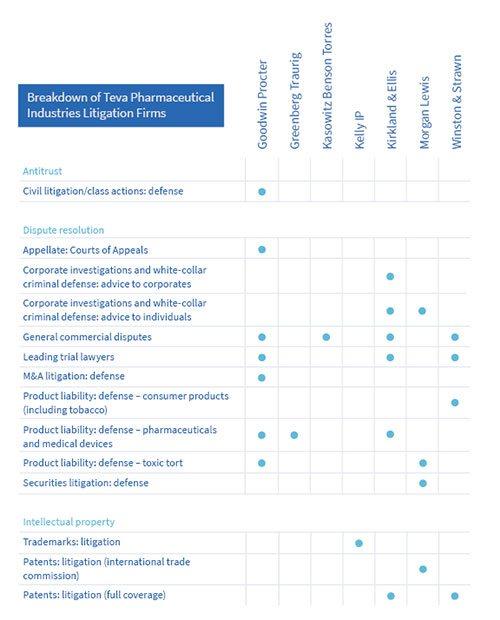
On notice: Teva’s entire $330m legal spend could go to one law firm

teva

Everything is up for grabs at Teva Pharmaceutical Industries – well, certainly from an external law firm perspective. The Israeli-based company – the largest manufacturer of generic drugs globally – recently announced that all existing law firm relationships were under review, with a view to reducing the number of law firms used and to cut costs. While conceptually, that may not seem like anything groundbreaking in and of itself, Teva has taken things further than usual – going as far as warning existing firms that it is more than conceivable that they won’t continue to be instructed.

‘Revenue growth at Teva is flat. Law firms’ rates are going up. We have to do something different – that is it in a nutshell,’ explains David Stark, chief legal officer at Teva Pharmaceutical Industries. ‘We took a run at this five years or so ago. Things were hectic back then, and there wasn’t really the ato do it, and it was incredibly time intensive.’

The company’s well-documented cuts took place from late 2017, and the legal team was instructed to align legal spend with the wider business. A year ago, in mid-2018, the process of reducing outside counsel spend began.

‘The company had been in an acquisition phase leading up to this, and when you acquire companies, you acquire law firms.’ When pressed on how many law firms Teva uses, Stark admits it is many hundreds (our own research at The Legal 500 suggests around 700 in total). ‘The ultimate goal would be to use just one, but in the short term, that is just unrealistic. But we can make a significant reduction, even by 50% in year one.’

The process began with Teva writing to all of its outside counsel, informing them of the company’s review process and the reasons underpinning the exercise.

‘We wanted to have transparency, we wanted the firms to know what we were doing,’ says Stark. ‘With some firms, we have very strong relationships. It’s no comment on our current firms, but we aren’t going to move work around for the sake of it. It’s got to be a compelling reason, at a similar or lower cost. Firms that we are currently working with should see this as an opportunity.’



Knowing law firms as we do, this must have come as something of a shock – so how did they react?

‘A mixed bag, to be honest. Firms that are doing a lot of work for us, to be honest, don’t like it. They see it as a big ask, to effectively go through the pitch process again,’ says Stark. ‘Firms that do a little bit of work for us are the ones that are really excited. And firms that we don’t know at all, that we have invited in to tender, are not sure what to make of it.’

But Stark says that the firms that succeed as a result of the lean process will have bigger scope within Teva.

‘We are looking to have fewer people interacting with law firms, but there have to be smarter approaches. Yesterday I was in the office with a senior lawyer at one of our firms, and what he wanted to talk about was rate increases!’

Higher rates seem to be more of the norm at the moment, partly because many clients are letting them get away with it.

‘The economy is on fire, and top firms gravitate to easier clients. We may not be able to afford some firms, so we have to choose our set of firms very carefully. Firms we instruct need to have flexibility and be rate competitive,’ says Stark.

‘At present we have more high-end legal work, so why fool around with low rates? But a lot of that work is coming to an end. From here on, it will be slow but steady progress. It won’t be less money, more work, but instead more certainty around a broader bucket of work for the preferred firms.’

Stark is being deliberately cautious about the amount of external spend that Teva is currently making. While he coyly admits that it is ‘more than $100m’, our own research team has been digging deeper into this. Looking at the firms and types of work that is typically done, we estimate that the actual number will be over three times that, at around $330m. Some firms are estimated to be in eight figures for their fees, so there is a lot at stake for partners if they lost that work.

‘There will be benefits for the company,’ says Stark. ‘We will get some savings. But there are definitely going to be some surprises in store, and there will definitely be some lessons learned.’

Working with Teva and Stark on this process is Smarter Law Solutions. Founded by Trevor Faure, formerly global general counsel at Ernst & Young, Smarter Law consults with companies to cut legal costs and implement lean processes.

Under the Smarter Law led-system, firms that submit to the process are assessed on pricing and other data metrics and, following a period of research and interviews, a far reduced panel of firms will be announced by the end of the year. Just what that process entails is detailed in Faure’s new book, Smarter Law: transforming busy lawyers into business leaders.

I often find myself looking at theoretical books that might have some practical application in the field of law, but this book is based on the experiences of over 200 in-house case studies. What the book allows GCs to do is dip in and out of the experiences of their peers and cherry pick the techniques and applications that will work for their in-house departments. To find out how the kinds of techniques that Teva are using currently, the ‘Win: Win: Win RFP Process’ chapter is a must read. It explains how a tender process allowed a client to pay law firm bidders more than their proposals and still reduce spend by 44%.

In recent months, we have seen a growing movement back to simplicity, from the #bringbackboring campaign, to the simple mantra of ‘people, process, delivery’. The Smarter Law approach isn’t based on the future of law, it is firmly rooted in the here and now. What GCs can do right now to improve efficiencies, working practices and transform the function. The best learning comes from who have done it before. Don’t take my word for it, get a copy and delve into it yourself – you will benefit and you will learn. Available from: gcm.ag/smarter_law.

Dice falls in Linklaters’ favour as partner profits shoot up 10% and £100m added to top line

Gideon Moore

Linklaters has posted the strongest financial performance of its peer group with a 7% revenue uptick to £1.63bn and double-digit profit growth.

The results today (11 July) show profit per equity partner (PEP) at the Magic Circle law firm rose 10% to £1.7m in 2018/19 after being flat in a mixed 2017/18. Continue reading “Dice falls in Linklaters’ favour as partner profits shoot up 10% and £100m added to top line”

Not easy out there: A&O adds £75m to its top line amid muted PEP showing

Andrew Ballheimer

Bringing up the rear of the Big Four City firms to post solid but unspectacular financial results, Allen & Overy (A&O) has increased its top line by 5%, sending revenue up by £75m to nearly £1.63bn.

A&O’s £1.627bn turnover relegated it from second to third largest Magic Circle firm in revenue terms after Clifford Chance (£1.693bn) and Linklaters (£1.629bn) but above Freshfields Bruckhaus Deringer (£1.472bn). Continue reading “Not easy out there: A&O adds £75m to its top line amid muted PEP showing”

Some challenges: Travers ups NQ pay range following 11% revenue growth and subdued PEP

David Patient

Travers Smith has marked a tenth consecutive year of revenue growth with an 11% increase in turnover, although profit per equity partner (PEP) grew at a more subdued 4%.

Revenue at the firm grew to £162.5m for the 2018/19 financial year – good for growth of more than 70% over the last five years – while PEP hit £1.25m. The firm subsequently joined the raft of firms increasing pay for newly-qualified solicitors (NQs), lifting their base rate salary to £85,000. NQs have the potential to receive between £93,500 and £110,500 with bonuses and other discretionary payments. Continue reading “Some challenges: Travers ups NQ pay range following 11% revenue growth and subdued PEP”

Macfarlanes’ revenue continues to defy gravity but PEP holds steady

Charles Martin

City stalwart Macfarlanes has posted a mixed bag of financial results as the ninth consecutive year of revenue growth failed to translate into a rise in profit per equity partner (PEP) following last year’s 26% surge to £1.74m.

The results announced today (10 July) show turnover grew 8% to £216.98m in 2018/19, a significantly slower pace than last year’s exceptional 20% rise to £201.5m. Continue reading “Macfarlanes’ revenue continues to defy gravity but PEP holds steady”

Gateley IPO pioneer Ward to stand down as chief executive

Michael Ward

The man who led Gateley in its pioneering move to become the first UK law firm to float on the public markets is to step down as chief executive next year.

Michael Ward, who has spent over thirty years at Gateley, will be succeeded by the firm’s Manchester office head and leader of its national property team, Rod Waldie, from 1 May 2020. Ward will remain on the board of directors and lead Gateley’s non-legal businesses. Continue reading “Gateley IPO pioneer Ward to stand down as chief executive”

Pinsents holds back ‘significant’ investment from partner profits amid 7% revenue growth

John Cleland

Pinsent Masons has ring-fenced ‘significant funds’ from partner profits in a bid to prioritise investing in the business, in turn cutting profit per equity partner (PEP) by 5%.

Revenue at the firm for the 2018/19 financial year rose 7% to £482m, slightly ahead of last year’s 6% increase and good for growth of more than 40% over the last five years. Gross profit rose 2.5%, but PEP fell to £620,000 from £653,000 as the firm put aside funds for investment in areas including IT and cybersecurity. Continue reading “Pinsents holds back ‘significant’ investment from partner profits amid 7% revenue growth”

Revenue continues to fly at Bird & Bird as PEP growth lags behind

David Kerr

Global traveller Bird & Bird has recorded its 28th consecutive year of revenue growth, hiking its top line 7% to £361m in 2018/19 as profit per equity partner (PEP) rose 4% to £575,000.

Announced today (9 July), the results show the pace of growth slowed down in sterling terms compared to last year’s 11% uptick to £337m, but in euro terms it slightly improved, with a 7% hike to €409.5m compared to last year’s 6% growth. Continue reading “Revenue continues to fly at Bird & Bird as PEP growth lags behind”

Knights eyes another four acquisitions after 51% revenue increase in first post-IPO results

David Beech

Knights has produced a strong debut financial year following its AIM listing, with acquisitions and organic growth propelling the firm to more than £50m in turnover.

Turnover at the company was up 51% to £52.7m, slightly ahead of expectations the company flagged in May, including 15% organic growth. Revenue per fee earner was up 22% to £131,000, with a net 46 increase in fee earners over the year, while net debt fell to £14.1m from £26.3m. Continue reading “Knights eyes another four acquisitions after 51% revenue increase in first post-IPO results”

NRF hires the mind behind Barclays radical panel shake-up to launch legal ops consulting arm

Stéphanie Hamon

Norton Rose Fulbright (NRF) is making an ‘offensive move’ against the Big Four on legal operations consulting with the hire of the well-regarded former Barclays’ head of external engagement, Stéphanie Hamon (pictured).

The firm announced today (9 July) that Hamon, who quit the bank earlier this year, will join as a fee-earner in August to head the new practice and help ‘in-house departments function like a business’. Continue reading “NRF hires the mind behind Barclays radical panel shake-up to launch legal ops consulting arm”

Ashurst set to reach £1m PEP target after 31% surge as revenue tops £641m

Paul Jenkins

Paul Jenkins, Ashurst’s indomitable managing partner, is aiming to reach profit per equity partner (PEP) of £1m in the next financial year as the City stalwart unveils its best financial results to date.

On the back of three consecutive years of growth, the firm added £77m to its top line to hit £641m for the year to 30 April 2019, a significant 14% increase on the £564m turnover of last year. Continue reading “Ashurst set to reach £1m PEP target after 31% surge as revenue tops £641m”

The hard sell

‘I have never instructed a Big Four firm on a legal matter,’ says one UK general counsel of a large multinational. ‘The accountants’ legal offering is not something I’m close to,’ concedes Tesco GC Adrian Morris. The respective legal chiefs at The Royal Bank of Scotland (RBS) and Lloyds Banking Group strike a similar note: ‘We don’t currently use any of them,’ says Michael Shaw, while Kate Cheetham notes: ‘Our use of these offerings is quite limited.’ Continue reading “The hard sell”