‘… the more human activities disrupt the climate, the greater the risks of severe, pervasive and irreversible impacts for people and ecosystems, and long-lasting changes in all components of the climate system.
… we have the means to limit climate change and its risks, with many solutions that allow for continued economic and human development. However, stabilizing temperature increase to below 2°C relative to pre-industrial levels will require an urgent and fundamental departure from business as usual. Moreover, the longer we wait to take action, the more it will cost and the greater the technological, economic, social and institutional challenges we will face.’*
*IPCC [Intergovernmental Panel on Climate Change] 2014: Climate Change 2014: Synthesis Report. Contribution of Working Groups I, II and III to the Fifth Assessment Report of the Intergovernmental Panel on Climate Change [Core Writing Team, R.K. Pachauri and L.A. Meyer (eds.)]. IPCC, Geneva, Switzerland, 151 pp.
Rising temperatures and sea levels, shrinking ice sheets and sea ice, extreme weather events. They’re all mainstays of today’s news cycles with a worrying – and intensifying – frequency.
‘The more you read about the shape of our planet and the state of our biodiversity, it’s inevitable that you become concerned, it’s inevitable that you want to do something. The only way I think you can exist nowadays in an unengaged way, as a non-activist if you will, is by shutting yourself off completely from all this information,’ says Jasper Teulings, general counsel of Greenpeace International.
But concern no longer lies solely with environmental organisations. Hand in hand with alarming predictions for food and water supply, health and the survival of masses of animal and plant species constitute a range of potential – and in some cases, current – shocks to the global economy, financial systems and corporate world.
In September 2015, Mark Carney, governor of the Bank of England, gave a landmark speech to Lloyd’s of London in which he detailed the ‘mega risk’ to financial stability that climate change poses. Carney laid out what he called ‘the tragedy of the horizon’ – the implications for carbon emitters and extractors, insurers, investors and other actors of failing to take a longer-term view:
‘The horizon for monetary policy extends out to two-three years. For financial stability it is a bit longer, but typically only to the outer boundaries of the credit cycle – about a decade. In other words, once climate change becomes a defining issue for financial stability, it may already be too late.’
He identified three ways in which climate change could disturb financial stability:
‘First, physical risks: the impacts today on insurance liabilities and the value of financial assets that arise from climate- and weather-related events, such as floods and storms that damage property or disrupt trade;
‘Second, liability risks: the impacts that could arise tomorrow if parties who have suffered loss or damage from the effects of climate change seek compensation from those they hold responsible. Such claims could come decades in the future, but have the potential to hit carbon extractors and emitters – and, if they have liability cover, their insurers – the hardest;
‘Finally, transition risks: the financial risks which could result from the process of adjustment towards a lower-carbon economy. Changes in policy, technology and physical risks could prompt a reassessment of the value of a large range of assets as costs and opportunities become apparent.’
When facing down the physical, investment, regulatory and transition risks inherent as the world adjusts to the reality of a changing environment, lawyers are situated at the heart of corporate, government and regulatory life, and are therefore uniquely situated to support and deliver the systemic change likely to occur.
Teulings is clear about the value lawyers can bring to the climate change table:
‘What is required for us to effectively combat climate change is a systemic change, and a lot of lawyers are in very influential positions in very influential companies, and in government positions – and that’s where they can contribute to the systemic change that we need,’ he says.
‘In terms of government roles, it means supporting regulation that reduces our emissions and supporting any form of regulation that speeds up the energy transition that is needed. Also, I think it’s about shifting money that is currently still in a disproportionate amount invested in fossil fuel infrastructure or exploration and development. There are still more subsidies going into fossil fuels at the global level than into renewable energy. That’s bizarre.’
James Thornton, CEO of ClientEarth – a charity composed of lawyers and environmental experts who use the law to hold governments and other organisations accountable over climate change, nature loss and pollution – is also passionate about the importance of legal professionals, especially those in-house.
‘General counsel are among the most important actors in the whole financial system in moving society towards proper action about climate change,’ he says.
‘Because of their trusted position as advisers to senior management and boards, they are in a remarkable position to say, “I’ve understood the legal implications of the financial risk of climate change, and here’s how we need to manage for them”. They can either be enablers or blockers.’
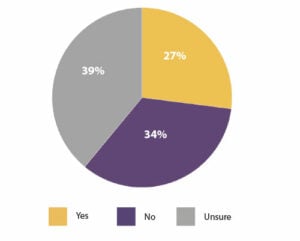
But work remains to be done to translate an awareness of climate change risk into readiness for it. Earlier in 2019, the Dutch Association of In-House Counsel (NGB), in conjunction with Dutch law firm Houthoff, approached nearly 3,500 in-house counsel. Despite nearly half of respondents claiming to see climate change risks, only around 15% said they were ‘prepared’ or ‘very well prepared’ for them. In addition, only 7% of them saw themselves as a ‘pioneer’ within their organisation in this area (figures taken from Climate Change and the Role of the In-house Counsel, Houthoff).
Some corporate counsel find themselves in a different set of circumstances, however. For those lawyers, climate change is such an inexorable fact that their organisations have made a mission statement out of avoiding it, building the company around products or services that aim to fight it.
Bills into mills
Ecotricity is one such enterprise. Founded in 1996, it was the world’s first green energy company, and it generates a substantial amount of its supply of green energy rather than buying it on the market. The company builds its own generation assets, like wind turbines and solar parks, supplying electricity and gas to around 200,000 domestic and business customers.
Ecotricity has irons in many (fossil-free) fires, including a wind turbine manufacturing and maintenance company called Britwind, and Ecotalk, a green mobile deal that uses customers’ bills to buy land previously used for intensive farming and turn it into havens for nature. Last year it launched a vegan food company, Devil’s Kitchen, which supplies plant-based food to schools and colleges around the UK. Ecotricity also established and now runs one of the UK’s largest electric car charger networks.
‘That’s part of our ethos,’ says head of legal, Elspeth Vincent. ‘Bills into mills: whatever we receive by way of income, it’s ploughed straight back into all kinds of green initiatives, including building and maintaining renewable assets in order to power green electricity into the grid.’
‘We’re taking the plants directly and turning them into meat.’
Unusually, the company also has its own professional football club: Forest Green Rovers. The club has electric car chargers, solar panels and even a solar-powered robot lawnmower. In 2018, it was presented with a ‘Climate Neutral Now’ award by the UN.
‘There are three principles that we hold as core to our business as being as green as we can be – food, transport and energy, and the football club has those aims at its heart as well. The pitch is organic, and the food is all vegan, which can be quite contentious sometimes for your average football fan that comes travelling here,’ says Vincent.
Outside of sporting greatness, Ecotricity’s goal is to find new ways to bring the green agenda to business and commerce. But cuts to renewable subsidies in the UK pose a challenge to the company’s asset-building model, because despite falling costs for producing wind and solar power, the scale at which viable projects need to be built can be prohibitive for operators, amounting to what Vincent terms a ‘harsh renewable landscape’.
Every little bit helps
Corporate counsel supporting companies with a green mission have an obvious role to play in battling climate change, and for those who want to contribute to environmental sustainability in the most direct way, the time is nigh, as many companies are innovating solutions in a wide range of sectors.
‘There are increasingly a lot of interesting companies out there that are attracting investment and having success with building more sustainable ways for us to conduct ourselves as a civilisation – whether that’s our dietary practices, our energy sources, our transit systems – that need good lawyers to help them succeed. Of course, companies don’t have a monopoly – there are regulatory organisations and non-profits – and if you’re interested in working in this field it is probably the best time in recent memory to go out and find an interesting opportunity,’ says Wagner.
But even for legal departments in companies without a direct green mandate or involvement in regulating those that do, there is scope for making changes to reduce adverse climate impact. Reducing paper use, rethinking policies for corporate travel, investment in technology and providing pro bono advice to NGOs or non-profits can all have an impact, as can ensuring that the company is aligned with the UN’s Paris Agreement on climate change.
At Ecotricity, Vincent raises the idea that companies could use their buying power to encourage external providers of legal services to take a supply of green energy – in much the same way as corporates often use the power of the purse to encourage diversity among panel firms.
‘I actually heard this from another GC at a conference, and it really made me think. It was a much bigger company than Ecotricity, with a far greater panel of law firms, and therefore the ability to choose competitively was at their fingertips a little bit more,’ she recalls.
‘But when they were asking law firms to provide a proposal, one of the deciding criteria for whether or not they would get the job was whether they procured a supply of green energy for their building.’
‘If we are continuing to be a renewable developer – a company that invests in a green economy – then that comes with a degree of innovation. As a legal team, we have to be live to that – we have to be able to understand difficult technical concepts and difficult commercial prospects that haven’t necessarily been done before,’ she explains.
‘That comes with a very novel approach to commercial contracts or to understanding long-held legal principles, and then bringing them into a new framework for a different kind of technology or a supply of electricity. You have to be fleet of foot.’
The legal team supports the company in putting its mouth where its money is, lobbying on climate issues and partnering with organisations like Extinction Rebellion and anti-fracking campaigners. Most recently, evidencing concerns about the climate risks of a no-deal Brexit, the company’s owner and founder, ‘Dale Vince’, was seen in the Scottish courts alongside others seeking to compel the UK Prime Minister, Boris Johnson, to comply with the Benn Act and send a letter to the European Council requesting an extension to the Brexit date or to authorise an official of the court to do so.
Scaling the impossible
In the US, California-based Impossible Foods is trying to solve the climate conundrum from a different perspective. Pat Brown, a Stanford biochemist, set himself the challenge of finding the most important problem facing the world that he could solve with science. He came up with climate change – and took a novel approach. Brown recognised the impact that human appetite for meat was having on resource consumption, fresh water use and greenhouse gas emissions, but that climate change alone was not convincing large enough numbers of people to switch to a plant-based diet. He set about using his skills to create ‘meat’ made from entirely plant-based ingredients. The company’s ground beef analogue and its ‘Impossible Burger’ have been available in restaurants since 2016 – counting the likes of Burger King among its customers – and recently went on sale in retail outlets. The company eventually aims to launch plant-based versions of a full range of meat, poultry, fish and dairy.
‘It is an animal-free product, but it is meat chemically and in terms of its content, just instead of feeding plants to a cow and having it break them down, we’re taking the plants directly and turning them into meat,’ says chief legal officer, Dana Wagner.
‘We wanted to create food from plants that satisfies people’s existing tastes rather than asking them to change their tastes.’
As such, Impossible Foods has set itself a substantial task – persuading meat-lovers that a plant-based product can be as satisfying as an animal one in terms of flavour, texture, and nutritional content. But Wagner believes that, despite the ongoing R&D challenges, the potential for iterating its products to improve on nutritional content is a big advantage in the long term over animal-based foods.
‘The cow doesn’t really change very much and its product hasn’t really changed for thousands of years. Earlier this year we released the second-generation version of our burger product and we were able to the reduce levels of saturated fat and sodium and increase the protein. We can optimise and use science and technology to make an even better item of food,’ explains Wagner.
But tinkering with one US cultural icon – the hamburger – has led to a confrontation with another: the cowboy.
‘Last year there were a number of initiatives at the state level in the United States led by various cattlemen organisations to restrict how plant-based foods may label and market themselves to consumers – they were trying to restrict, among other things, the use of the word “meat”,’ says Wagner.
‘We certainly think that definition was at odds with the English language and the idea that people would be confused into thinking a plant-based meat came from an animal are very low – companies like ours are loud and proud about the fact that no animals are involved; that’s our selling point to consumers, actually.’
On the regulatory side, thus far, things have been smoother. As developers of entirely plant-based foods, the company sits comfortably within existing food regulatory frameworks, unlike cell-based lab-grown ‘clean meat’, which has faced more regulatory uncertainty.
The armour, the sword and the shield
But some organisations are involving their legal teams in a targeted way, weaponising the law in the fight against climate change. One such entity is Greenpeace, an NGO well known for direct action on environmental issues, as well as its lobbying and investigative work. Greenpeace International is the global governing body for the organisation’s 26 national and regional organisations, and has an 11-strong legal team of barristers offering support to their local activities, led from Amsterdam.
As with any organisation, the legal team acts as Greenpeace’s ‘armour’. This means ensuring compliance with local regulations in areas such as charities law, tax, IP, governance and labour law.
‘We can optimise and use science and technology to make an even better item of food.’
‘In order for us to be the risk-taking organisation that we like to be, we need to ensure that we’re compliant, because that’s an expression of our core values,’ says Teulings.
‘But it is also necessary because we know that as a campaigning organisation, we’re often subjected to additional scrutiny.’
In addition, the team functions as the organisation’s ‘shield’, dealing with reactions to Greenpeace campaigns.
‘All of those actions are covered by fundamental freedoms such as free speech and freedom of association and assembly, but sometimes they trigger responses from either governments or corporations in the form of disproportionate penalties and sanctions imposed on activists and activism, such as “SLAPP” suits – strategic litigation against public participation,’ Teulings explains.
An example of the ‘shield’ in action is the case of the Arctic 30: 28 Greenpeace activists and two journalists who sailed through Arctic waters in 2013 to protest against a drilling platform operated by Gazprom. Russian authorities boarded Greenpeace vessel ‘The Arctic Sunrise’, detained those onboard and transported them to Russia, where they were remanded in custody and charged with piracy, later converted to hooliganism, before being freed two months later. The Dutch government successfully sought an order from an international tribunal arguing that the matter was a violation of the international Law of the Sea, and a declaratory judgment that the Russian authorities had violated international law.
‘We collaborated intensively with the Dutch government and provided full information at a very detailed level on what happened, and we made our own submissions in those proceedings,’ says Teulings.
‘As a result of that, the right to peaceful protest at sea in those two rulings was recognised, advanced and secured in international law. That’s a way you could say that a strategic defence to a disproportionate response to our campaign activities can actually be used to advance fundamental rights – and that’s exactly what the shield is about.’
‘Strategic litigation can have an impact that goes well beyond national borders.’
The ‘sword’ refers to supporting strategic litigation to further the organisation’s activism on climate change and biodiversity. Greenpeace commissions scientific research, at times using it to bring litigation – often in partnership with academics or other NGOs – such as People vs Arctic Oil. In this case, Greenpeace Nordic and Nature and Youth, another NGO, brought a constitutional challenge against the Norwegian government arguing that the licences it had granted for further oil and gas exploration in Arctic waters violated not only Norway’s own constitution, but also its obligations under the UN’s Paris Agreement on climate change.
‘In the first instance, the Oslo District Court ruled in favour of the Norwegian government – it did recognise for the first time that the right to a healthy environment is a claimable right with teeth, but it found that the government had not violated this right. The case has been appealed and the appeal will be dealt with this Autumn, so that’s clearly a priority for us,’ says Teulings.
Another example is the matter brought by Greenpeace Philippines and local organisations before the Philippines Commission on Human Rights, following loss of life during Typhoon Haiyan in 2013. The Commission was asked to investigate the responsibility of fossil fuel companies in contributing to the devastation. The investigation has been completed and a report is awaited.
‘Strategic litigation can have an impact that goes well beyond national borders, and I think this case is expected to have a similar impact,’ says Teulings.
‘Even though it won’t lead to an enforceable claim for damages against these companies, it will hopefully constitute a key building block in the further building of creating climate accountability at the global level.’
Strategic cases like these, he explains, ‘inspire other organisations, they inspire judicial audacity – and that’s the level of audacity that’s needed to tackle this global problem.’
Wielding the sword
Perhaps no one knows more about strategic litigation than ClientEarth – and founder James Thornton (himself a lawyer) is passionate about the potency of pursuing legal avenues in climate issues. He first came across environmental lawyers when editing the Law Review at NYU School of Law.
‘In my third year, one of my colleagues came in and said, “James, I’ve just done a clinical programme with this group of environmental lawyers, NRDC [Natural Resources Defense Council, a US-based non-profit].” So then I did a clinical programme with them, and I saw that they were working to the highest legal standards and that this was a new idea – to have lawyers use their skills to protect the environment.’
After qualifying, Thornton worked on Wall Street for a while, before working for NRDC full time. But nowadays, his organisation has only one client, the Earth.
‘Lawyers have an absolutely pivotal role to play in the climate fight. Law is the first language of governments and business. Campaigning and mobilising public opinion is key to persuading the courts of the public mandate to act,’ he says.
‘But, ultimately, it is the patient, painstaking work of lawyers that identifies wrongdoing, finds the right legal lever, and brings about positive change by compelling compliance in court.’
ClientEarth uses scientific research to develop policy, and then lobbies institutions like the UK, Polish and European parliaments to turn policy into law, battling subsidies to fossil fuel industries and working towards legislation that gives incentives to renewable energies. Crucially, it mobilises its repository of legal experience to help enforce that legislation.
‘Litigation is very important because it’s a way of sending powerful signals to vested interests who have never been challenged before successfully. It’s also a very powerful way of getting governments to comply with their own laws,’ says Thornton.
In 2018, for example, the UK’s High Court found against the UK government in litigation over air quality in 33 towns and cities, ordering the government to force these local authorities to deal with illegal pollution levels.
‘In a real way [the UK government] are doing it – too slowly – the steps that will lead to cleaner air, which they clearly never would have done without the order. And we’re doing this in more than ten countries across Europe, so we’re holding the governments across Europe to their own commitments, their own legal duties,’ says Thornton.
Outside Europe, Thornton has advised members of the Chinese Supreme Court, congress, legislature and the Ministry of Ecology and Environment in connection with the development of a pioneering law allowing Chinese environmental NGOs to sue polluting companies, and training of environmental court judges and prosecutors.
For Thornton, it’s all about using lawyers to make, enforce and change the rules if necessary – sometimes in creative ways. In its case against Enea, co-owner of a project to build a new coal-fired power station in Poland, ClientEarth bought shares in the company and commissioned financial analysis used to present concerns at a shareholders meeting, demonstrating that the investment was flawed. When the project proceeded anyway, the organisation brought a successful shareholders suit.
‘When it comes to climate change, or environment more broadly, for general counsel, the questions are: what should I tell my CEO? What should I tell my board of directors? What sort of duties do we have? People have been saying we should do the right thing, but nobody has been saying this is actually a fiduciary duty and if you make the wrong decision, you’ll be liable for it. We think this should become the turning point, when general counsel are able to say, look, climate change equals financial risk, which equals fiduciary duty, which requires you to manage for the risk. And if you start managing for climate change risk, you think about it in a very different way,’ says Thornton.
Thornton believes that the next challenge for in-house counsel is to bridge what he calls the ‘imagination gap’:
‘It is one thing to accept the proposition that climate change risk triggers fiduciary duties. But what does that mean for you when you go to work on Monday morning? What does it mean when you advise the directors on a Thursday afternoon? How do you move down from the abstract principle to the detailed advice?’
Translating the abstract into the concrete is the very raison d’etre of lawyers. And if more of them, be they in organisations with a mission to combat climate change or not, begin to apply this skill – the results could be world-changing.