On 29 April Legal Business launched its first summit focused on M&A and corporate transactions. The one-day event saw us team up with a host of leading firms including Latham & Watkins, Linklaters, Bristows and Greenberg Traurig to debate the key trends in the deal market in front of more than 150 delegates.
Nice problems to have – Where now for Stephenson Harwood as veteran chief hands over?
With longstanding chief executive Sharon White bowing out, Stephenson Harwood can look back on a strong ten years. Thomas Alan assesses its record and prospects
‘My understanding is the Stephenson Harwood of 2002 needed a new strategy because it was doing very badly,’ reflects corporate head Andrew Edge, looking back on the City thoroughbred’s much-publicised problems. ‘It was losing people and the finances were extremely precarious.’ Continue reading “Nice problems to have – Where now for Stephenson Harwood as veteran chief hands over?”
Letter from… Amsterdam: Dutch lawyers find a deft balance amid testing times in cross-border trade
The secret to making your country attractive to foreign investors at a time when populism is reshaping global politics and protectionism is on the march? A stable and business-friendly government, an open society, a well-trained and internationally-minded workforce, and reliable infrastructure are not bad places to start.
And, luckily for Amsterdam’s legal elite, the Netherlands has them all. ‘In these uncertain times, the country has been able to show some stability and that’s appealing,’ says Allen & Overy (A&O)’s local senior partner Brechje van der Velden. ‘Its attractiveness was and still is its reliability – multinationals having security for the future,’ notes Baker McKenzie’s Kim Tan. ‘We know what’s going to happen. The government is co-operative and transparent.’ Continue reading “Letter from… Amsterdam: Dutch lawyers find a deft balance amid testing times in cross-border trade”
The price of everything – Law firm metrics cannot measure broader values that will define their future
Pinsents senior partner Richard Foley argues the industry needs new benchmarks for success
As Legal Business publishes its LB100, it seems apt to step back and ask ourselves whether the industry is focusing on the right things as it seeks to measure success. It should be uncontroversial to say that if law firms are to work better – for themselves, the wider business community and society – they must be diverse and inclusive of all talents. Measuring that type of success is every bit as important as whether a firm moves up or down a place or two in the financial league table. So, perhaps one measure we should look to in the next year’s LB100 is the progress firms are making in tackling issues of inclusion and diversity? Continue reading “The price of everything – Law firm metrics cannot measure broader values that will define their future”
Ireland: Follow the money
Since it exited from an emergency bailout from the European Commission, the European Central Bank and the International Monetary Fund, and began its rapid recovery, Ireland has enjoyed star-performer status in Europe. Ireland’s GDP grew by 6.7% in 2018, making it the region’s fastest-growing economy for the fifth consecutive year. Simultaneously, according to the EY Attractiveness Survey Europe, foreign direct investment (FDI) in Ireland has been reborn, leaping a remarkable 52% compared to 2017 while the EU suffered an overall decline.
Of the 265 new investment projects announced in Ireland last year, 134 featured first-time investors – the highest total in a single year, according to IDA Ireland. ‘The challenge now,’ says the IDA, ‘is to make sure the FDI portfolio grows further’. This is some challenge given the headwinds of Brexit and a broader economic slowdown. Although such external factors may ultimately derail their ambitions, Irish law firms have been making good while they can. Continue reading “Ireland: Follow the money”
The Last Word: Sound methods
No-deal Brexit, accountants, Millennials and soothsaying – LB100 leaders give their views on a hazy 12 months ahead
Change is gonna come
‘You cannot continue having 10-15% growth every year – not even the Chinese economy has achieved that! The profession as a whole has had a good year, but the rate of growth has slowed down. The comforting factor is that every single business is in the same place as us. We are all doing our best to protect and predict. Anyone who tells you what’s going to happen… well, that’s just guesswork.’ Continue reading “The Last Word: Sound methods”
LB100 2019: Methodology and notes
LB100 law firms
The firms that appear in the Legal Business 100 (LB100) are the top 100 law firms in the UK (usually LLP partnerships but also some alternative business structures – see footnotes), ranked by gross fee income generated over the financial year 2018/19 – usually 1 May 2018 to 30 April 2019. We call these the 2019 results. Where firms have identical fee incomes, the firms are ranked according to highest profit per equity partner (PEP). Continue reading “LB100 2019: Methodology and notes”
LB100: Partner earnings
Top 50 firms ranked by highest top of equity
* Does not include DWF, Irwin Mitchell, Gateley and Keoghs. See methodology
** Womble Bond Dickinson equity spread based on UK partners only
LB100 Second 50 – City and Boutique: The adventurers and the settlers
While the UK lurches through a Brexit drama entirely of its own making, mid-market and boutique London-based firms have focused on diversifying their services or using their unique offerings to differentiate themselves from the pack.
The combined turnover for the 18 City firms that sit in the second 50 of this year’s Legal Business 100 (LB100) is £839.7m, an increase of 8%. Average revenue increased 15%, reaching £46.7m. But, inevitably, the top-line growth of the firms in this group is distorted by some sizeable merger activity. Two of those firms have seen large jumps in revenue and headcount: Gordon Dadds, which after acquiring a large chunk of Ince & Co in 2018 and following its initial public offering (IPO) in 2017 – has seen turnover jump 68% from £31.2m to £52.6m under its new Ince branding (see case study). Bircham Dyson Bell, which merged with Reading stalwart Pitmans in December 2018, saw turnover climb from £33.7m to £52m as a result – a spike of 54%. With that level of artificial top-line growth, profit levels are hard to sustain. A 4% growth in the number of equity partners across the group has contributed to average profit per equity partner (PEP) only moving up 3% from £416,000 to £427,000. Continue reading “LB100 Second 50 – City and Boutique: The adventurers and the settlers”
Case study: Ince
What a difference a year makes. After an initial public offering, a series of acquisitions – including City institution Ince & Co in October 2018 – and a share price drop earlier this year, Ince Group plc, which previously operated as Gordon Dadds, moves up 23 places in the Legal Business 100 2018/19 following a 69% boost in revenue from £31.2m to £52.6m.
The listed firm added £21.4m to its top line through five acquisitions in 2017 and 2018. The group reported a 73% profit increase from £8.8m to £15.2m, while earnings per share surged by 79% and dividend per share increased by 50%. However, the group reported a £14.3m non-recurring acquisition cost and a debt reduction of £5.5m, bringing the actual figure down to £2.9m. Continue reading “Case study: Ince”
LB100 Overview: Apocalypse soon?
As Legal Business was unpacking the 2018/19 financial results of the UK’s top 100 law firms, the Office for National Statistics reported that Britain’s economy had shrunk for the first time since 2012. The 0.2% fall in output in the second quarter of 2019 was the latest in a series of ominous signs for a nation that appears, at the time of writing, on course for a cliff-edge exit from the European Union amid a chaotic political landscape and falling currency.
As Legal Business went to press, a row was raging over government moves to prorogue Parliament in the run-up to the 31 October deadline to exit the EU, threatening constitutional wrangles and a no-deal Brexit. A nation famed for exporting democracy, its strong institutions and a stable business environment is looking more Banana Republic than Britannia resurgent by the day. Continue reading “LB100 Overview: Apocalypse soon?”
Case study: Clyde & Co
A model of consistency in the Legal Business 100, 2018/19 was Clyde & Co’s 21st consecutive year of growth – albeit with a merger or two thrown in. This time around it grew 11%, adding £59.7m to its top line to reach £611m.
In just three years, the firm has grown by 36%, or £160m in total. ‘If you went back eight years, we were around £250m turnover. We are now a £600m+ business,’ says senior partner Simon Konsta. Continue reading “Case study: Clyde & Co”
Case study: Addleshaw Goddard
Back in 2014, not many – if any – would have predicted Addleshaw Goddard would boast one of the highest percentage growth rates in profit per equity partner (PEP) across the Legal Business 100 over the next five years. But with PEP increasing 13% to £730,000 in the 2018/19 financial year, PEP has risen an impressive 87% over that time.
Top-line growth between 2014 and 2019 is similarly impressive, up 61% to £275.4m, topped by a 14% increase year-on-year. In the five years leading up to 2013/14, turnover for Addleshaws had dipped 1% as the global financial crisis weighed heavily. PEP also fell 11% in 2013/14 due to exceptional expenses including partner restructuring and a written off conditional fee agreement – hence the low starting base for the dramatic growth in partner profits over the last five years. Continue reading “Case study: Addleshaw Goddard”
LB100: Core stats
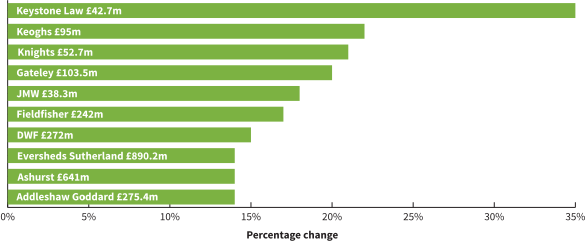
Ten fastest growing firms by revenue
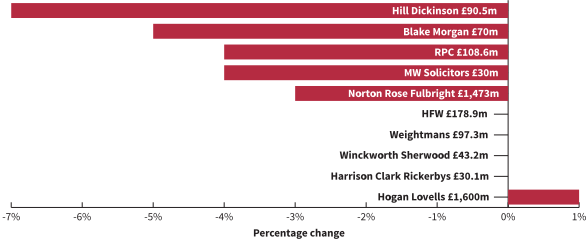
Ten slowest growing firms by revenue
LB100 Second 50 – Regional focus: Crawling on a razor
Smaller regional and national firms have gained ground on their London rivals in this year’s Legal Business 100 (LB100) after years of the productivity gap widening in favour of the City. And, as some of the strongest performers from the 32 regional firms in the 51-100 bracket have shown, a big part of the shift has come from a growing trend of partnering up with law’s global elite to effectively provide northshoring outposts for blue-chip clients.
Following a muted period and just 1% growth last year, the group’s collective revenue rose a solid 7% to £1.36bn in 2018/19, for an average revenue of £42.4m. The productivity per capita at regional firms, traditionally weaker than London counterparts, also grew where City firms lagged this year, closing a gap that had been steadily widening. Revenue per lawyer climbed 9% to £197,000, compared to an almost flat £267,000 in London. Profit per lawyer stayed flat at £38,000, against £78,000 in the City, which was down 6%. Profit per equity partner (PEP), however, slid 5% to £339,000. Continue reading “LB100 Second 50 – Regional focus: Crawling on a razor”

Case study: Foot Anstey
With just over 200 lawyers and only 48 partners, Foot Anstey has been among the ten fastest-growing firms in the Legal Business 100 over the last five years. Stretch that track back to six years, and the firm has nearly doubled its turnover to £47.2m. Profit per equity partner has also grown 52% since 2014, up a healthy 8% to £400,000 in 2018/19.
That growth, including a 9% revenue uptick this year, has come from a smaller base than many but is also organic. The firm’s corporate practice grew by about 30%, property litigation was up 23%, and the finance team boomed on the back of 75% growth in Islamic banking and private equity work lifting 85%. New client wins included motorway service operator Welcome Break, private equity firm Livingbridge, and a reappointment to FTSE 100 retailer Kingfisher’s legal panel. It also advised on the £1.6bn Pivot Power electric vehicle recharging network – the world’s biggest. Continue reading “Case study: Foot Anstey”
New players and funding prompt evolution of disputes but City leaders adapt well
‘We’ve disrupted the market – everybody knows about us now,’ says Quinn Emanuel Urquhart & Sullivan London co-managing partner Ted Greeno of the US firm’s inexorable rise in the City.
The ex-Herbert Smith Freehills (HSF) partner, himself one of a string of high-profile recruits Quinn Emanuel made since its London launch in 2008, has a point. The disputes-only powerhouse now counts some 85 full-time partners and associates in London – a larger team than Slaughter and May’s litigation offering and not far off the size of Clifford Chance (CC)’s muscular City practice (see below). Continue reading “New players and funding prompt evolution of disputes but City leaders adapt well”
Legal 500 Data: Behind the story
The Legal 500 2019 : how do the LB100 firms rank?
This year’s Legal Business 100 (LB100) presents a clear picture of the firms continuing to dominate the UK legal market by turnover and profitability – but who comes out top in terms of The Legal 500 rankings? Continue reading “Legal 500 Data: Behind the story”
A no-deal outlook and the law – time for pragmatic pessimism
We go to press with Parliament locked in battle with the Government over threats to take the UK into a ‘no-deal’ exit from the European Union (EU). I’m not going to offer political predictions but we are clearly at the point where a disorderly exit from the EU is a very real prospect for the country and the profession.
The good news is that the largest UK law firms feel confident they can largely mitigate the immediate impact of no-deal, even with the abrupt end of EU rights to practise that have been such a boon. This is because potentially obstructive Bars in key markets in France and Germany have been kept onside and UK lawyers feel that other decent workaround options are available (see pages 12-13). With leading UK firms also having substantial foreign operations, including the Legal Business 100 having 19% of their lawyers in mainland Europe, and rapidly increasing their ranks of Irish-registered solicitors, the large outfits at least are braced. The Law Society recently issued research arguing a no-deal would knock 10% off the value of the UK legal market, equivalent to more than £3bn, and costing 10,000 jobs. Most law firm leaders see such predictions as excessive – a scepticism I share – though the industry does believe such an exit would be damaging. Continue reading “A no-deal outlook and the law – time for pragmatic pessimism”
LB100: Legal elite shows resilience amid ominous haze
It is a measure of how fast-moving the Brexit-dominated landscape now is that imagery in this year’s Legal Business 100 (LB100) is dominated by Conrad, Castro and Coppola as the summer months have moved to rapidly challenge notions of how Britain works. One of the most stable and predictable major economies in the world has been locked into a mounting political conflict more akin to a banana republic than the Mother of Parliaments. Sooner or later Westminster drama on this scale will spill into a real economy that already contracted in the second quarter.
And yet, the UK’s largest law firms have endured another 12 months of uncertainty and ominous haze with impressive resilience, pushing revenues up 9% to £26.35bn, one of the better years of all-round performance since the banking crisis. And though a handful of mergers flatter that headline figure, 28 firms managed double-digit revenue growth, showing that plenty of UK firms are thriving in these challenging conditions. Continue reading “LB100: Legal elite shows resilience amid ominous haze”