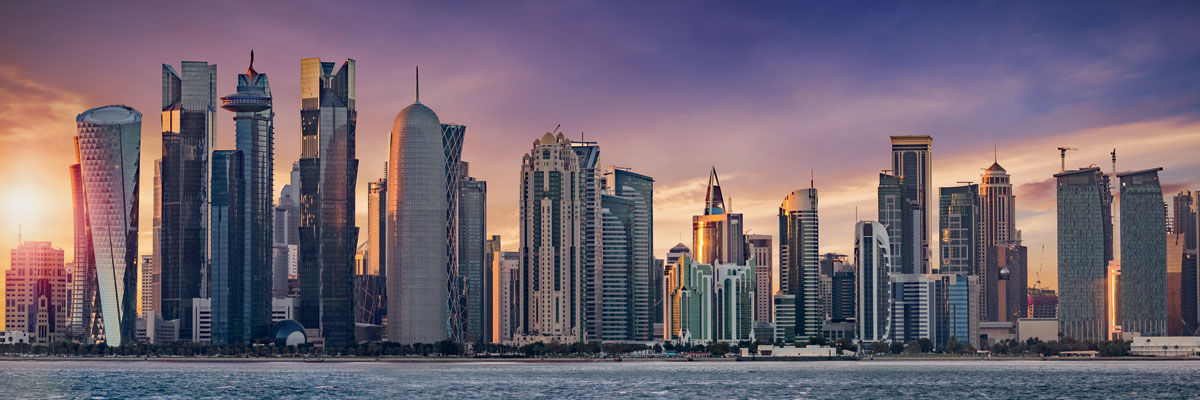
The State of Qatar is an independent emirate located along the western coast of the Arabian Gulf. Among its vast shale and crude oil stockpiles, the country is known to have the third largest natural gas reserve in the world. Since becoming independent in 1971, Qatar has used its considerable natural resources to transform itself into an economically flourishing nation in the Gulf.
In a bid to become less vulnerable to the boom and bust cycles of oil and natural gas prices, Qatar has shifted its focus from the energy sector towards developing a robust financial industry and infrastructure portfolio.
In recent times, however, geopolitical pressures have forced the country to diversify its economy. In 2017, the United Arab Emirates, Bahrain, Saudi Arabia and Egypt cut diplomatic trade ties with Qatar, claiming – among other allegations – it supported terrorism. Although these claims have been vehemently denied by Qatar, a land, sea and air blockade remains in place today.
Despite the blockade, Qatar has maintained steady economic growth. According to Nasser Al Taweel, chief legal officer of Qatar Financial Centre Authority (QFCA), there are positives to be derived from the incident.
‘It was a major event that happened in the State of Qatar, but speaking about it three years after the blockade, it was a very good thing that it happened to us, simply because it was a wakeup call,’ explains Al Taweel.
‘It made us think a lot more about the future, thinking about cost efficiency in terms of whatever goods or services we need. It forced us to think about building our financial sector in a more robust manner and to think about depending less on others.’
Compared to neighbouring nations, Qatar has been slow to develop its now thriving economy. Making up for lost time, Qatar’s rich history has enabled it to adopt a uniquely global outlook as it continues to develop at a rapid pace.
‘The country has only become rich in the last 20 years. That has resulted in very quick changes, not just in the business environment, but to the economy and the look and feel of the city,’ says Christopher Berlew, chief legal officer of Qatari Diar.
As a result, in house counsel have been playing a crucial role behind the scenes to assist and facilitate such rapid change.
The build up
A major driver for change occurred in 2010, when Qatar won its bid to host the 2022 FIFA World Cup. The decision secured Qatar’s place in history as the first Middle Eastern country to host the event, while refocusing the nation’s infrastructure development agenda.
Leading legal operations for the property development branch of the State of Qatar’s sovereign wealth fund, Qatari Diar, is Christopher Berlew.
‘As part of the state sovereign wealth fund, we are quite a large player in the market here and we are playing an integral part to the preparations for the 2022 World Cup,’ he says.
‘We are building the Lusail City project, which is an enormous new city just north of Doha, which will become the new administrative capital of Qatar.’
The development will hold numerous sports arenas, five training fields and will be the location of the main stadium for the 2022 World Cup. Construction plans also include 22 hotels with fully equipped facilities to host teams, spectators and visitors.
‘We are ramping things up to get the key parts of the Lusail City project finished and operating by the time of the World Cup. The pace will continue to pick up until 2022 – the games are sort of at the end. We are targeting for everything we are building to be ready in the middle of summer, this time in three years.’
With the construction of several major stadiums and housing developments under way, Qatar has made a significant investment into upgrading its infrastructure networks. As the general counsel overseeing these developments, Berlew believes acting on behalf of a sovereign wealth fund gives rise to its own set of challenges and considerations.
‘What makes it uniquely interesting and challenging is: a sovereign wealth fund is not purely an economically rational actor. It doesn’t just chase the highest returns. It does not behave like a purely private investor. Although it has an interest in making good returns on the State’s money, it is interested in getting some perhaps non-monetary returns from some of its investments – whether that be diplomatic or charitable.’
On the right track
Experiencing similar challenges is Stephen Hibbert, general counsel of Qatar Rail, a state-owned and operated enterprise. Joining the team in 2012, Hibbert was tasked with the legal challenge of overseeing the construction of Qatar’s multibillion-dollar rail network.
‘In terms of the legal challenges, they were setting up and running a company and drafting all of the contracts from square one,’ he says.
“What makes it uniquely interesting and challenging is: a sovereign wealth fund is not purely an economically rational actor.”
‘This is not like Sydney Trains or National Rail, where you’ve got suites of contracts and you’ve got a library of technical specifications. Actually, nothing existed. You’re starting from a blank sheet of paper.’
The rail network is comprised of three major projects: the Doha Metro, the Lusail Tram, and the Long Distance Rail, which will connect to a wider rail network.
‘The legal challenges were primarily concerned with the drafting of big, complex contracts for an environment which had never seen this type of work before, and for contractors coming from overseas, many of whom had never worked in Qatar before.’
From a legal standpoint, the sheer management of such an endeavour would be a challenge for any in-house lawyer. Drawing from his past railway work in Australia and Asia, Hibbert explains that the key to success is providing support on every level.
‘We put people inside with government agencies, payment organisations, within the department of environment and we engage with them directly with the supply chain at various points, to make sure that our contractors were successful.’
Making financial cents
In addition to major infrastructure developments, Qatar has worked to strengthen its economy by building a robust and steady financial sector.
‘The financial sector in Qatar has been very stable. It’s one of the more stable financial sectors I think regionally, and I think it would be fair to say in the world. The financial sector is strong and is growing,’ explains Nasser Al Taweel, chief legal offer of Qatar Financial Centre Authority (QFCA).
The QFCA is a platform within which investors and business owners can set up a company in Qatar. It consists of an independent regulator, as well as an independent judiciary – which includes a civil and commercial court, in addition to a regulatory tribunal.
‘The QFCA has its absolute autonomy when it comes to regulations, when it comes to establishing businesses, when it comes to issuing licences,’ explains Al Taweel.
‘The role of chief legal officer at QFCA, in addition to the normal ins and outs that chief legal officers do – like ensuring contracts are drafted and reviewed, providing legal advice, managing legal matters and defending their organisations against any litigation – we have the role of the regulator.’
QFCA provides an independent legal and business framework that promotes the development of a capital market. Al Taweel believes an autonomous system that serves the interests of both regional and international investors will only strengthen Qatar’s economy.
‘For the system to work, what we need to do is have our own laws and regulations. Putting in these laws and regulations is the responsibility of the legal department. Therefore, we spend a lot of time basically drafting these regulations, making sure that they work, which is a completely different beast altogether compared to drafting a contract,’ says Al Taweel.
‘When I draft a contract, it’s a bilateral agreement, or sometimes multilateral. But when you have unidentified parties when you draft a law, it’s completely different, it’s a completely different set of skills.’
Although building a parallel and separate financial body is a challenge, it is an essential element needed in order to keep up with – and further promote, particularly internationally –Qatar’s economic growth story.
‘Since our financial sector is developing so rapidly, a lot of the development of that is a legal development. So, we are talking about amending laws, amending regulations and hence forth. I am involved in a number of committees, a number of engagements outside the boundaries of the QFCA, mainly to try and assist in basically upscaling the financial sector in the State of Qatar,’ says Al Taweel.
‘It’s not easy to make changes and improvements in any system, let alone the financial system, which is normally hard to amend and change because there are so many interests involved.’
A hotel takeover
In addition to establishing a secure financial sector, the State of Qatar has developed an enviable property portfolio – which is only set to expand in coming years. Overseeing part of this growth story is legal director of Katara Hospitality, Kushagra Priyadarshi.
‘Katara Hospitality is owned by the sovereign wealth fund of Qatar, which is the Qatar Investment Authority. They hold almost all of the luxury real estate in almost four continents. They also have a huge portfolio of luxury real estate in this country, which is Qatar,’ explains Priyadarshi.
Qatar’s property portfolio is currently valued at over USD$15bn and includes iconic hotels such as the Plaza in New York, the InterContinental Amstel Amsterdam, The Savoy in London, Raffles Hotel Singapore and The Peninsula Paris – just to name a few.
“Qatar is full of opportunities, endless opportunities. Every day you have something new. We are a very vibrant country, with a very young leadership.”
‘Most of the legal work happens from the head office where I am stationed. My work includes any transactional plus legal and compliance work that relates to all our properties and portfolios, which are basically under my oversight,’ says Priyadarshi.
‘My job here includes a whole spectrum of hospitality and luxury real estate work, which includes overseeing any mergers and acquisitions, any and all sorts of financing which relates either to deposit financing, corporate financing, acquisition financing, treasury matters and all of that. Then any litigation disputes.’
Katara Hospitality manages over 75 subsidiaries, which are spread all across the world. Managing these jurisdictions has been one of the biggest challenges, explains Priyadarshi.
‘One of the key challenges is the interaction between all of these different jurisdictions. Since all of it is being managed through the central location here from the head office [Doha], we need to have an overview of all jurisdictions and how they interact with each other to come up with a comprehensive legal strategy of compliances and conformity across these jurisdictions.’
Financing the future
Considerable oil and gas reserves, wise infrastructure investments, and a strong financial sector have secured Qatar as one of the wealthiest countries in the world on a per capita basis, and general counsel have played a vital role behind the scenes advising and assisting upon the nation’s continued growth.
‘I think a country that is undergoing a major development and a major improvement of their systems – for that country there will always be a role for in-house counsel,’ explains Al Taweel.
‘Qatar is full of opportunities, endless opportunities. Every day you have something new. We are a very vibrant country, with a very young leadership that is ambitious, that wants to change for the better and that is very well educated.’
The opportunities available to general counsel are also a reflection of Qatar’s outward-facing business agenda. Hosting the 2022 FIFA World Cup is not only a breakthrough for the Middle East, but strengthens Qatar’s global outlook.
‘I think the World Cup is going to change the map,’ says Al Taweel. ‘It’s going to change the way people are looking at business and the State of Qatar. I think a lot of people are now encouraged, compared to before Qatar was hosting the World Cup.’ n