State of Qatar

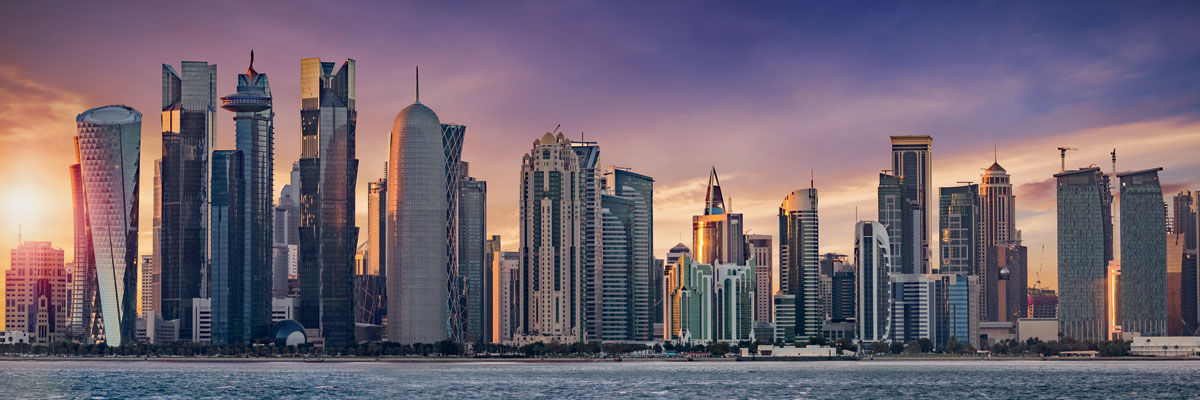
The State of Qatar is an independent emirate located along the western coast of the Arabian Gulf. Among its vast shale and crude oil stockpiles, the country is known to have the third largest natural gas reserve in the world. Since becoming independent in 1971, Qatar has used its considerable natural resources to transform itself into an economically flourishing nation in the Gulf.

In a bid to become less vulnerable to the boom and bust cycles of oil and natural gas prices, Qatar has shifted its focus from the energy sector towards developing a robust financial industry and infrastructure portfolio.

In recent times, however, geopolitical pressures have forced the country to diversify its economy. In 2017, the United Arab Emirates, Bahrain, Saudi Arabia and Egypt cut diplomatic trade ties with Qatar, claiming – among other allegations – it supported terrorism. Although these claims have been vehemently denied by Qatar, a land, sea and air blockade remains in place today.

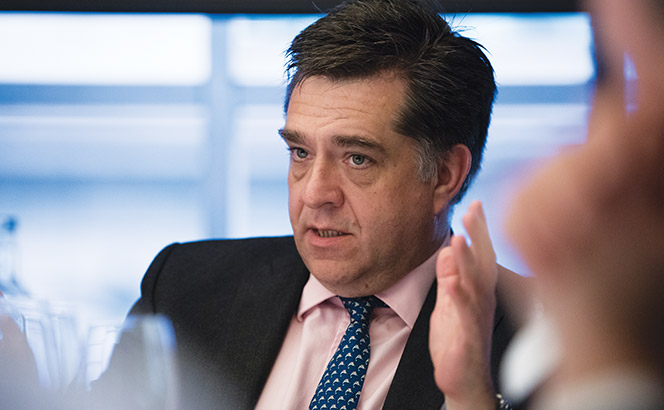
Despite the blockade, Qatar has maintained steady economic growth. According to Nasser Al Taweel, chief legal officer of Qatar Financial Centre Authority (QFCA), there are positives to be derived from the incident.

‘It was a major event that happened in the State of Qatar, but speaking about it three years after the blockade, it was a very good thing that it happened to us, simply because it was a wakeup call,’ explains Al Taweel.

‘It made us think a lot more about the future, thinking about cost efficiency in terms of whatever goods or services we need. It forced us to think about building our financial sector in a more robust manner and to think about depending less on others.’

Compared to neighbouring nations, Qatar has been slow to develop its now thriving economy. Making up for lost time, Qatar’s rich history has enabled it to adopt a uniquely global outlook as it continues to develop at a rapid pace.

‘The country has only become rich in the last 20 years. That has resulted in very quick changes, not just in the business environment, but to the economy and the look and feel of the city,’ says Christopher Berlew, chief legal officer of Qatari Diar.

As a result, in house counsel have been playing a crucial role behind the scenes to assist and facilitate such rapid change.

The build up

A major driver for change occurred in 2010, when Qatar won its bid to host the 2022 FIFA World Cup. The decision secured Qatar’s place in history as the first Middle Eastern country to host the event, while refocusing the nation’s infrastructure development agenda.

Leading legal operations for the property development branch of the State of Qatar’s sovereign wealth fund, Qatari Diar, is Christopher Berlew.

‘As part of the state sovereign wealth fund, we are quite a large player in the market here and we are playing an integral part to the preparations for the 2022 World Cup,’ he says.

‘We are building the Lusail City project, which is an enormous new city just north of Doha, which will become the new administrative capital of Qatar.’

The development will hold numerous sports arenas, five training fields and will be the location of the main stadium for the 2022 World Cup. Construction plans also include 22 hotels with fully equipped facilities to host teams, spectators and visitors.

‘We are ramping things up to get the key parts of the Lusail City project finished and operating by the time of the World Cup. The pace will continue to pick up until 2022 – the games are sort of at the end. We are targeting for everything we are building to be ready in the middle of summer, this time in three years.’

With the construction of several major stadiums and housing developments under way, Qatar has made a significant investment into upgrading its infrastructure networks. As the general counsel overseeing these developments, Berlew believes acting on behalf of a sovereign wealth fund gives rise to its own set of challenges and considerations.

‘What makes it uniquely interesting and challenging is: a sovereign wealth fund is not purely an economically rational actor. It doesn’t just chase the highest returns. It does not behave like a purely private investor. Although it has an interest in making good returns on the State’s money, it is interested in getting some perhaps non-monetary returns from some of its investments – whether that be diplomatic or charitable.’

On the right track

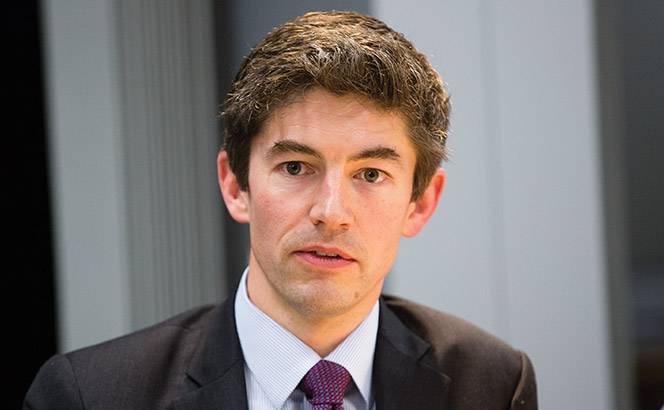
Experiencing similar challenges is Stephen Hibbert, general counsel of Qatar Rail, a state-owned and operated enterprise. Joining the team in 2012, Hibbert was tasked with the legal challenge of overseeing the construction of Qatar’s multibillion-dollar rail network.

‘In terms of the legal challenges, they were setting up and running a company and drafting all of the contracts from square one,’ he says.

“What makes it uniquely interesting and challenging is: a sovereign wealth fund is not purely an economically rational actor.”

‘This is not like Sydney Trains or National Rail, where you’ve got suites of contracts and you’ve got a library of technical specifications. Actually, nothing existed. You’re starting from a blank sheet of paper.’

The rail network is comprised of three major projects: the Doha Metro, the Lusail Tram, and the Long Distance Rail, which will connect to a wider rail network.

‘The legal challenges were primarily concerned with the drafting of big, complex contracts for an environment which had never seen this type of work before, and for contractors coming from overseas, many of whom had never worked in Qatar before.’

From a legal standpoint, the sheer management of such an endeavour would be a challenge for any in-house lawyer. Drawing from his past railway work in Australia and Asia, Hibbert explains that the key to success is providing support on every level.

‘We put people inside with government agencies, payment organisations, within the department of environment and we engage with them directly with the supply chain at various points, to make sure that our contractors were successful.’

Making financial cents

In addition to major infrastructure developments, Qatar has worked to strengthen its economy by building a robust and steady financial sector.

‘The financial sector in Qatar has been very stable. It’s one of the more stable financial sectors I think regionally, and I think it would be fair to say in the world. The financial sector is strong and is growing,’ explains Nasser Al Taweel, chief legal offer of Qatar Financial Centre Authority (QFCA).

The QFCA is a platform within which investors and business owners can set up a company in Qatar. It consists of an independent regulator, as well as an independent judiciary – which includes a civil and commercial court, in addition to a regulatory tribunal.

‘The QFCA has its absolute autonomy when it comes to regulations, when it comes to establishing businesses, when it comes to issuing licences,’ explains Al Taweel.

‘The role of chief legal officer at QFCA, in addition to the normal ins and outs that chief legal officers do – like ensuring contracts are drafted and reviewed, providing legal advice, managing legal matters and defending their organisations against any litigation – we have the role of the regulator.’

QFCA provides an independent legal and business framework that promotes the development of a capital market. Al Taweel believes an autonomous system that serves the interests of both regional and international investors will only strengthen Qatar’s economy.

‘For the system to work, what we need to do is have our own laws and regulations. Putting in these laws and regulations is the responsibility of the legal department. Therefore, we spend a lot of time basically drafting these regulations, making sure that they work, which is a completely different beast altogether compared to drafting a contract,’ says Al Taweel.

‘When I draft a contract, it’s a bilateral agreement, or sometimes multilateral. But when you have unidentified parties when you draft a law, it’s completely different, it’s a completely different set of skills.’

Although building a parallel and separate financial body is a challenge, it is an essential element needed in order to keep up with – and further promote, particularly internationally –Qatar’s economic growth story.

‘Since our financial sector is developing so rapidly, a lot of the development of that is a legal development. So, we are talking about amending laws, amending regulations and hence forth. I am involved in a number of committees, a number of engagements outside the boundaries of the QFCA, mainly to try and assist in basically upscaling the financial sector in the State of Qatar,’ says Al Taweel.

‘It’s not easy to make changes and improvements in any system, let alone the financial system, which is normally hard to amend and change because there are so many interests involved.’

A hotel takeover

In addition to establishing a secure financial sector, the State of Qatar has developed an enviable property portfolio – which is only set to expand in coming years. Overseeing part of this growth story is legal director of Katara Hospitality, Kushagra Priyadarshi.

‘Katara Hospitality is owned by the sovereign wealth fund of Qatar, which is the Qatar Investment Authority. They hold almost all of the luxury real estate in almost four continents. They also have a huge portfolio of luxury real estate in this country, which is Qatar,’ explains Priyadarshi.

Qatar’s property portfolio is currently valued at over USD$15bn and includes iconic hotels such as the Plaza in New York, the InterContinental Amstel Amsterdam, The Savoy in London, Raffles Hotel Singapore and The Peninsula Paris – just to name a few.

“Qatar is full of opportunities, endless opportunities. Every day you have something new. We are a very vibrant country, with a very young leadership.”

‘Most of the legal work happens from the head office where I am stationed. My work includes any transactional plus legal and compliance work that relates to all our properties and portfolios, which are basically under my oversight,’ says Priyadarshi.

‘My job here includes a whole spectrum of hospitality and luxury real estate work, which includes overseeing any mergers and acquisitions, any and all sorts of financing which relates either to deposit financing, corporate financing, acquisition financing, treasury matters and all of that. Then any litigation disputes.’

Katara Hospitality manages over 75 subsidiaries, which are spread all across the world. Managing these jurisdictions has been one of the biggest challenges, explains Priyadarshi.

‘One of the key challenges is the interaction between all of these different jurisdictions. Since all of it is being managed through the central location here from the head office [Doha], we need to have an overview of all jurisdictions and how they interact with each other to come up with a comprehensive legal strategy of compliances and conformity across these jurisdictions.’

Financing the future

Considerable oil and gas reserves, wise infrastructure investments, and a strong financial sector have secured Qatar as one of the wealthiest countries in the world on a per capita basis, and general counsel have played a vital role behind the scenes advising and assisting upon the nation’s continued growth.

‘I think a country that is undergoing a major development and a major improvement of their systems – for that country there will always be a role for in-house counsel,’ explains Al Taweel.

‘Qatar is full of opportunities, endless opportunities. Every day you have something new. We are a very vibrant country, with a very young leadership that is ambitious, that wants to change for the better and that is very well educated.’

The opportunities available to general counsel are also a reflection of Qatar’s outward-facing business agenda. Hosting the 2022 FIFA World Cup is not only a breakthrough for the Middle East, but strengthens Qatar’s global outlook.

‘I think the World Cup is going to change the map,’ says Al Taweel. ‘It’s going to change the way people are looking at business and the State of Qatar. I think a lot of people are now encouraged, compared to before Qatar was hosting the World Cup.’ n

Christopher Berlew, Qatari Diar

Qatar is quite a small country, but because of its wealth and strategic importance, not to mention a World Cup coming up, it has a much more global outlook than would normally be the case for such a small country, and such a small market.

I work as the chief legal officer of Qatari Diar, which is the property development arm of the State of Qatar sovereign wealth fund. We are wholly owned by the Qatar Investment Authority, which is the main sovereign wealth fund – and we engage in real estate property development and some investment, both here in Qatar – which is a big part of our operations – but also around the world.

Now we, as part of the state sovereign wealth fund, are quite a large player in the market here. We’re an integral part of the preparations for the 2022 World Cup, because we are building the Lusail City project. This is an enormous new city we are building just north of Doha (the existing capital), which will become the new administrative capital. It is also the home of the main stadium – the lead flagship stadium for the World Cup – which is where both the ceremonies and the final game will be played. We’re building a lot of the infrastructure that will be used as part of the 2022 World Cup, too.

We’re currently investing – and have already invested a huge amount of money – in Lusail, and we are really ramping things up to get it finished, but it is very much a work in progress. There are key parts of the Lusail City project that have been identified as priorities, that need to be finished and operating by the time the World Cup commences. So are a lot of things that go on with that. In terms of challenges, it really is to mobilise and get the necessary plans done, get the contractors mobilised and ensure that everything is finished in time.

The World Cup was awarded to Qatar back in 2010. Since then it has contributed in a major way to the process, which was already going on. Qatar is a very small country and began to develop quite late – even later than some of its neighbours here in the region.

The country only become wealthy in the last 20 years. That has resulted in very quick changes – not just in the business environment, but to the economy as well as the look and feel of the city. The options that are available to people, the size and composition of the population, have all changed, so it’s been a massive shift – not just to the business environment, but in all aspects of Qatar.

What you have is a country where the leadership is trying very hard to make up for lost ground and develop quickly into a modern country that can eventually sustain itself without relying so heavily on petrol dollars for its income. That means massive investment in infrastructure, education and housing. It means building a modern city with a modern outlook, and everything to take the country past and beyond the years after the World Cup.

The pace will continue to pick up until 2022. We are targeting for everything we are building to be ready in the middle of summer in three years’ time. Inevitably there will be delays, but the pace will continue to pick up until then. n

Stephen Hibbert, Qatar Rail

I started with Qatar Rail in February 2012. As of August 2019, we have just opened the first metro line in Doha and we look forward to opening the rest of the network, 37 stations – 31 of which are underground – by November 2019.

One of the great challenges for Qatar Rail is doing a railway project in a country that has never seen a train, has no laws relating to railways, no rail safety and no experience in anything in rail. Everything you work on is like starting on a blank sheet of paper.

In terms of some statistics, during the course of the project we brought into the country 21 tunnel boring machines – which has gone into the Guinness World Records. We tunnelled 140km under the city of Doha to build the network. To do that in a country with the heat in summer, that’s a real challenge – and, at its peak in 2018, we had 84,000 people working on the project. So the sheer management of that in any country would be tough.

With regards to the legal challenges, we were setting up and running a company and drafting all of the contracts from square one. This is not like Sydney Trains or Network Rail, where you’ve got suites of contracts and you’ve got a library of technical specifications. Rather, nothing existed – so we had to import it all. Qatar Rail is a company that consists of people who have been working on rail projects all around the world.

The legal challenges included drafting big, complex contracts for an environment which had never seen this type of work before and for contractors coming from overseas – many of whom had never worked in Qatar – to undertake these type of projects. So they were complex from a technical specifications point of view and an engineering point of view. They were a challenge certainly from conditions of contract, the contract style and approach to the procurement.

The challenges in the Middle East, firstly, is the environment; it is quite hostile for three, or four, or five months of the year. Secondly, everything depends on the maturity of the industry you’re working in; if you are working on a rail project in Qatar, then the supply chain can be challenging. For example, the local industries have never made precast concrete rings – let alone 4 million of them. We have never imported tunnel boring machines, set them up and run them under the city. If it’s a fully designed, architecturally specified hotel, then it’s fine. But when it’s new, and it’s different – every aspect of it is a challenge. The government authorities who have to issue approvals and review designs and documents may never have seen some of these things before, so they needed support at every level. We put people inside with government agencies, payment organisations, within the department of environment, and we engage with them directly with the supply chain at various points, to make sure that our contractors were successful. n

Commentary | Sultan Al-Abdulla & Partners

As part of its effort to diversify its economy away from a reliance on petroleum, the State of Qatar has initiated numerous market liberalisation programmes to make foreign investment into the country more attractive. While these programmes were at various stages of implementation, the imposition of the blockade by some neighbouring countries has ultimately driven home the importance of creating more opportunities for foreign investment and put these programmes on the fast track. Additionally, with construction on the infrastructure for the FIFA World Cup 2022 continuing apace, most of the roads, metro and stadia infrastructure is nearing completion. As a result, Qatar’s economy has largely recovered from the blockade’s effects thanks to a number of recent developments.

The cornerstone of Qatar’s foreign investment legislation is Law No. 1 of 2019 (‘Foreign Investment Law’). Previously, the amount of permissible foreign shareholding was 49% of the shares in a limited liability company (unless permission for a higher shareholding has been granted by the Ministry of Commerce and Industry). The Foreign Investment Law no longer limits such higher share ownership to companies operating in a limited number of sectors. A foreign shareholder may now own more than 49% in a commercial company operating in any sector (with the exception that an LLC may not engage in banking or insurance business, and foreigners are prohibited from acting as commercial agents). However, we expect that obtaining special dispensation for a higher shareholding by foreigners will be easier under the new law. Further, participating in real estate trading is no longer prohibited to foreigners.

Another significant recent development has been the almost total abolishment of the ‘kafala’ or sponsorship system in Qatar. Prior to this development, expatriate employees were not permitted to leave the country without the permission of their employer. As of 28 October 2018, expatriate employees may travel freely in and out of the country (unless they are one of the 5% of employees designated by the employer that still require an exit permit).

In addition, as part of its drive to make Qatar a more attractive investment location, the Qatar Free Zones Authority was established to supervise several new free zones the first of which, Ras Bufontas, is expected to come online in September 2019. The free zones offer significant investment incentives, including bespoke legislation that permits 100% foreign ownership, tax-free operations for a period of 20 years, and a first-class infrastructure.

For those investors seeking a longer-term investment, Qatar has recently promulgated Law No. 13 of 2018, enabling foreign investors to obtain permanent residency status. The following types of current residents are eligible for the permanent residency permit: (i) residents who have a normal residency permit, have resided for 10 continuous years in the country, and were born in Qatar, and (ii) residents who have a normal residency permit, have resided for 20 continuous years in the country, and were born abroad (i.e. outside of Qatar). New applications for permanent residency permits will be reviewed by the Ministry of Interior, with a limit of 100 such permits being issued per year. All applicants must be fluent in Arabic.

Qatar has also enacted Law No. 3 of 2019, amending the Civil and Commercial Procedural Law (‘Amending Law’). Under the Amending Law, several amendments were introduced to speed up court rulings and other procedures related to experts. The enforcement of judgments will be conducted through a new department named the Enforcement Management Department, with enhanced procedures to ensure efficient handling of enforcement. The Amending Law also provides that the parties to a dispute will not be allowed to adjourn the proceedings for the same reason more than twice and such an extension, if granted, will not exceed two weeks, potentially decreasing the duration in reaching finality for cases.

Qatar’s construction sector has seen tremendous activity in anticipation of the FIFA World Cup in 2022. Although the World Cup construction continues unabated, the number of construction disputes before local courts and arbitral tribunals has increased exponentially, leading to increased case work for local firms.

While Qatar has been working to diversify and liberalise its economy, it has not neglected its energy sector. As the leading exporter of natural gas, Qatar’s energy sector has seen several significant developments. Late last year, Qatar announced that it was leaving the Organization of the Petroleum Exporting Countries (OPEC). Additionally, the lifting of the moratorium on development of the North Field, the world’s largest non-associated gas reservoir, and the implementation of the North Field Expansion Project by Qatar Petroleum, should boost Qatar’s liquefied natural gas output from 77 million tonnes to 110 million tonnes. The front-end engineering design contract for the project has already been awarded and Qatar Petroleum expects to issue onshore engineering, procurement and construction contracts by year end.

According to the International Monetary Fund executive board, Qatar has successfully adjusted to the economic impact of the blockade. As Qatar’s economy continues to grow, more foreign investment opportunities will become available, increasing its appeal. By continuing to pursue further market liberalisation and introduce additional incentives for foreign investors, Qatar is on track to continue its rise as a leading destination for doing business both regionally and globally.

Kingdom of Saudi Arabia

Despite Saudi Arabia often being compared to neighbours such as the UAE, the Kingdom stands alone in the region in many respects – culturally and economically. But the winds of change blowing in from the rest of the Gulf are making their mark and, if the Kingdom can be compared to the likes of the UAE, it is because the ruling classes are embracing change as a necessity – albeit the speed and shape that such change is taking may be unique.

The headline differentiators are inherently contradictory: on the one hand, you have Saudi Arabian women being granted the right to drive amidst a swathe of liberalisations; while on the other hand, you have Skype and WhatsApp – both rapidly becoming key tools in the arsenal of businesses around the world – being banned in the Kingdom. But to focus on the areas where Saudi Arabia may be lagging behind some of its closest neighbours is to paint an incomplete picture of a country that, in actuality, is undertaking a rapid period of modernisation. At the centre of this transformation are the general counsel (both born locally and expatriated from abroad) who are finding ways to partake in the oncoming new era, which is providing opportunities to meaningfully affect the course of business in Saudi Arabia to a degree rarely seen in other jurisdictions.

Saudi Vision 2030

Like many other countries in the region, Saudi Arabia has been vocal about its plans to create and introduce the next era for the country. Unlike, say, the UAE’s Vision 2021, however, Saudi Arabia’s equivalent – Saudi Vision 2030 – is both much newer and operating on a longer time scale.

Introduced in 2016 by Crown Prince Mohammed bin Salman, the vision is intended to reduce the Kingdom’s dependence on oil, diversify its economy, and massively invest in public infrastructure across the country, with a focus on healthcare, education, recreation and tourism. This has created a flurry of development across the country, with a frenzy of economic activity vastly changing the physical and metaphorical landscape of Saudi Arabia.

‘Saudi Arabia has initiated five-year development plans since 1975, so that the recent 2030 vision plan of modernisation is built on the progress of its antecedents, so that each generation benefits from the progress of the past,’ explains Dr Saleh Al-Oufi, general counsel at Taqnia Holding.

‘Nevertheless, a new generation of leaders brings with them new challenges and impetus for development, such as the Crown Prince unveiled Vision 2030 – an ambitious programme of development for the Kingdom. The Crown Prince noted that “Our Vision is a strong, thriving, and stable Saudi Arabia that provides opportunity for all”.’

A key part of the diversification of the Saudi Arabian economy is the growth of the private sector, which is unusually small compared to the Kingdom’s substantial public sector. Saudi Arabia has fought to achieve this by reducing red tape, improving the efficiency of the courts, and lowering the barriers for foreign entities to enter the Saudi Arabian market. As the private sector does grow, so too does the chance for in-house counsel – both locally born lawyers looking to leave the public sector or foreign lawyers that have been lured to the country by increasing opportunities – to play a meaningful role in business within one of the region’s most exciting economies.

‘The region is so dynamic, with things constantly changing all around us. It’s not just social, not just economic and it’s not just political. There are so many aspects of change,’ says Shaun Johnson, director (legal) of Vision Invest (formerly ACWA Holding) in Riyadh.

‘Saudi is transforming into one of the world’s most competitive economies and attracts expat workers from around the globe,’ adds Farah Zafar, chief legal officer for the Public Investment Fund of Saudi Arabia.

“The region is so dynamic, with things constantly changing all around us. It’s not just social, not just economic and it’s not just political.”

‘As a result, the working environment is very multicultural and welcoming. The people of Saudi Arabia are just amazing – they’re hospitable, hardworking, focused and are looking to the future in so many ways. They are witnessing a transformative era in their history and the excitement and momentum is infectious. This results, therefore, in an opportunity to exchange cultures across people, ideas, and experiences, in order to learn and grow together – to achieve the unimaginable.’

Al-Oufi echoes this sentiment and is bullish on the opportunities enjoyed by in-house counsel thanks to Saudi Arabia’s ambition.

‘I see my role and the role of every legal professional increasing, as the Vision 2030 outlines economic development among several specific goals and initiatives for the Kingdom to achieve,’ he says.

‘In the economic sector, regulations have been streamlined to encourage foreign investment and that will lead to the emergence of key opportunities for partnership in a number of industries such as manufacturing, and technology transfer. These efforts will provide all Saudi legal professionals better opportunities to participate in the execution of Vision 2030 for the Kingdom of Saudi Arabia.’

Shaun Johnson began his career working in private practice on large infrastructure deals in Australia. Finding himself working in a similar industry in Saudi Arabia, Johnson is in a unique position not only to contrast the in-house role with that of his former life, but also to contrast Australia’s approach to infrastructure development with that of Saudi Arabia’s.

‘Working in the Middle East is a stark contrast to working in other jurisdictions and with other governments. In prior roles I’ve experienced situations where some objectives relating to infrastructure were good for the national interest, but those objectives would often get mired in political football. Of course many Middle Eastern countries are not ruled by elected parliaments, but the unimpeded political desire to want to do better is certainly present,’ he explains.

‘When we look at some of the ambitious development programmes in Saudi Arabia, what we’re basically asking is, is this supported from the top down? And I think what we’ve got here in this region, and in particular in Saudi Arabia, is that the top are saying, “We are ambitious because we want the world’s best practice. We want to achieve international standards. How can you help us make this become a reality?” So there is a strong desire and a willingness to make things happen. That is what Saudi Arabia set out in their Vision 2030 publication. The next step has to be how to implement it. I think public sector capacity building, privatisation and private sector corporatisation will allow both the public and private sectors to achieve the national goals. Of course that’s going to take a bit of time, but I see progress happening every day.’

Megaprojects

The efficiency and drive from the top to transform Saudi infrastructure has manifested in a number of large-scale megaprojects, that not only would usually have been achievable under these timeframes, but perhaps not achievable at all. These giga-projects form a core part of Vision 2030 and include initiatives such as the planned Neom, a smart city powered entirely by renewable energy sources that is expected to cost in excess of USD$500bn, as well as an entertainment resort in Riyadh named Qiddiya, which is expected to cost USD$8bn. All are designed to effect Saudi 2030’s ambition of increasing spending across a diverse array of industries within the Kingdom.

Farah Zafar is chief legal officer for Amaala, a giga-project launched by the Public Investment Fund of Saudi Arabia. Set to play a key role in the delivery of Saudi Vision 2030, Amaala is intended to serve as an ‘uber-luxury’ tourism destination, ultimately covering 3,800km2 of land, mixing the natural (and largely unseen, globally speaking) beauty of the Kingdom with state-of-the-art construction.

‘Amaala will curate truly authentic end-to-end journeys for its visitors and transcend national boundaries, to conceptualise, build and operate an integrated destination that shall become a year-long, exclusive, by-invitation-only, global, purpose-driven community of connoisseurs, pioneers and thought leaders, all connected by a shared commitment to the practice of advancement of arts and culture, wellness and environmental preservation,’ she says.

Given the gargantuan size of these giga-projects and the average length of time to completion (Phase 1 of Amaala is set to open Q4 2020, with a final completion date set for 2028), the need for a steady hand is great. For Amaala, Zafar is that steady hand and, as with many in-house legal roles, the boundaries of Zafar’s responsibilities have long since expanded beyond a purely legal remit.

‘As chief legal officer for Amaala, I am responsible for creating and establishing the regulatory and governance framework required to deliver luxury resorts of this nature in the Kingdom, together with all legal, commercial, construction, infrastructure, development and investment matters thereof,’ explains Zafar.

The role is varied, to be sure, but Zafar brings a wealth of experience managing similar infrastructure projects in the region. This experience includes working directly for the Engineers Office of His Highness Sheikh Mohammed Bin Rashid Al Maktoum in Dubai, serving as the head of capital transactions for Dubai Holding – where Zafar was able to bring in AED 11.3bn worth of project capital to the city – and has acted on behalf of the governments of Dubai, Oman, the Emirate of Ajman and Qatar.

‘I feel as if my past experience has culminated in me being blessed with this role, as I see everything with the clarity required to make Amaala successful from a feasibility, investment, infrastructure, development and construction stand point, not just legal,’ she says.

“I believe recruiting lawyers from different backgrounds and training provides for an excellent working environment.”

‘I am therefore in a unique position to be able to support each and every work stream in Amaala, provide the platform of what they need to deliver,and, with this in mind, I actually drafted a comprehensive project plan which details 1177 deliverables and over 34 work streams to be delivered over the next 9-12 months. That is called clarity.”

Clarity is a word often associated with Saudi Arabia’s vision for the future, and so it is easy to understand why someone with Zafar’s background has been entrusted with a project so vital to that future.

Barriers

Although there is plenty of drive from the top and a glut of talent on the ground able to give teeth to that change, there are still barriers standing between Saudi Arabia and its 2030 Vision.

While Saudi Vision 2030 is intended to ween the Kingdom off oil, the fact remains that it is the largest oil exporter in the world – being home to the second-largest petroleum reserves and fifth-largest natural gas reserves in the world. As such, the status of Vision 2030 is largely contingent on the stability of regularly fluctuating resource prices. Saudi Vision 2030 was announced at a time when oil prices were hitting troughs, and the need to diversify was both apparent and easily sold to the country at large. Oil prices have been steadily rising since that trough and, as such, initiatives aimed at curbing oil dependence (such as fuel tariffs and related price increases) are not as easy for Saudi society to digest.

There is also the purely logistical consideration of the capability of a relatively newly opened business sector to facilitate the kinds of changes envisioned by the Government.

‘There’s a strong desire there and there’s a willingness to make things happen – Saudi Arabia has set this out in its Vision 2030 mission statement – but the next step has to be how do you implement it correctly and efficiently,’ cautions Johnson.

‘I think the public sector is getting up to speed, but putting those processes in place to allow the private sector to come in and help the government achieve its goals will take a little bit of time – but it is happening.’

Culture

To many, Saudi Arabia might be most easily distinguished by its conservatism, which frames public life in a way that isn’t seen to the same degree elsewhere in the region. But this, as with the business sphere, is changing, according to Zafar.

‘The legal arena in Saudi Arabia is taking great strides towards increased diversity. I myself am a major champion of diversity in the workplace, having built a team consisting of women and men from all corners of the world, including the Middle East, Europe, Africa and South America,’ she explains.

‘I believe recruiting lawyers from different backgrounds and training provides for an excellent working environment, as there is rarely a legal issue that arises which one of us hasn’t come across or managed. It is great to also see the increase of women in the workplace in the Kingdom and the talented Saudi women that are big contributors, hardworking and incredibly professional across sectors.’

Dr Al-Oufi agrees, and sees this as an inevitable change in the coming years, as Saudi Arabia works towards its lofty Vision 2030 goals – a factor which will inevitably require the gradual opening of the Kingdom.

‘In general, Saudi Arabia will become a more open society, with more modern education and healthcare, which are the fundamentals of any society. In addition, employment opportunities for both male and female will expand, as society will become more open and accepting of a working environment in which females and males work side by side.’

Shaun Johnson, Vision Invest

I’m now in my fourth year in Riyadh. I think the training that I received in private practice in Australia and the UK has certainly helped me in terms of the transactional side of things in Saudi Arabia. But I think what really helped enormously were my last few years in the UK working in-house. I began to really hone in on developing my skills within a corporate at a senior level, and I have now been able to deploy best-practice methodologies and principles at a senior level within my role here in Saudi. The thing is, some companies here in the region have very sophisticated legal departments, some don’t, and many have functions that sit in the middle. I think when you come to the Middle East from a mature/sophisticated professional environment, you should be able to add inherent value on an individual basis. However, the key to making your success sustainable will depend on how much you’re able to implement, transfer and embed your best practices within that environment to carry on when you’re gone.

One of the things that I enjoy the most about working in this region is that you have an opportunity to add value at a very senior level, and perhaps in a more effective manner than you might do if you were working in a larger westernised organisation that has multiple layers of bureaucracy. I’m not saying that bureaucracy is a bad thing, as sometimes that’s the only way you can control large organisations. But I think in this region we have a fantastic opportunity to really influence best practice as companies start to mature and institutionalise certain ways of working.

The Vision 2030 document came out in 2016, mapping out the next 14 years. So it’s not an overnight process, it’s a long-term process, and I think, as a consequence, there can be certain frustrations that creep in. I’ve seen people who come here as expats and maybe stay for a year or two and then think, ‘This isn’t moving as quick as I’d hoped’. And I have to say to a lot of them: what did you expect? This isn’t the UK, this isn’t the US: there’s a whole paradigm shift happening here so you need to be here for the long term, you’ve got to evolve with it. I think one of the things this region absolutely values is longevity and loyalty in terms of staying in the region. I see a lot of advisers flying in on a Sunday morning and flying out at the end of the week – and that might work for some, but those who live and breathe the market here will find that that’s where the real value comes from. In terms of enablers, working in the Middle East is a stark contrast to working in other jurisdictions. In prior roles, I’ve experienced situations where some objectives relating to infrastructure were good for the national interest, but those objectives would often get mired in political football. Here, the politics are of course of a different nature, but there is unequivocal support from the top down to improve the country by stating what these foundations and pillars are in Vision 2030. This political will therefore becomes the enabler as Saudi Arabia is constantly changing and challenging the status quo in order to become world’s best practice.

So there is a strong desire and a willingness to make things happen. That is what Saudi Arabia set out in their Vision 2030 publication. The next step is implementation. I think public sector capacity building, public sector privatisation and private sector corporatisation will allow both the public and private sectors to achieve the national goals. Of course that’s going to take a bit of time, but I see progress happening every day. n

Dr Saleh Al-Oufi, TAQNIA

The Saudi Technology Development and Investment Company (TAQNIA) was established in June 2011 by Royal Decree to localise technology in Saudi Arabia and commercialise outputs of R&D centers. TAQNIA invests in technology that contributes towards Saudi Arabia’s economic diversification. TAQNIA is owned by the Public Investment Fund (PIF), which drives strategic and sustainable diversification enabling growth in different industries in Saudi Arabia. TAQNIA exerts all of its efforts to be fully aligned with Saudi Vision 2030.

My role as a general counsel is guiding and monitoring the legal affairs activities in TAQNIA Holding and its subsidiaries. As a general counsel for more than 17 years, our legal department work relates to guiding the company to its objectives. To be more illustrative, in recent years the role of our department has broadened far beyond narrowly defined legal matters to encompass such things as risk, compliance, finance, regulation, human resources, and business issues. Our department is becoming increasingly involved in matters that are not strictly legal, such as risk management and business strategy, especially in the area of risk management.

Saudi Arabia has initiated the 5 years development plan since 1975, so that the recent 2030 vision plan of modernisation is built on the progress of its antecedents as each generation benefits from the progress of past. Nevertheless, a new generation of the leaders brings with them new challenges and impetus for development, such as the Crown Prince unveiling of Vision 2030, an ambitious programme of development for the Kingdom. The Crown Prince noted that “Our Vision is a strong, thriving, and stable Saudi Arabia that provides opportunity for all”. Accordingly, I see my role and the role of every legal professionals is increasing as the Vision 2030 outlines economic development among several specific goals and initiative for the Kingdom to achieve. In the economic sector, regulations have been streamlined to encourage foreign investment, and that will lead to the emergence of key opportunities for partnership in a number of industries such as manufacturing, and technology transfer. These efforts will provide opportunity will provide all Saudi legal professional better opportunities to participate in the execution of the 2030 Vision of the Kingdom of Saudi Arabia.

For my role – or for that of any legal professional – it will make for a better environment to work with the changes that have been made and improvement to laws and regulations in the Kingdom. TAQNIA will have more opportunities for business as the 2030 Vision mandates localisation of any government-made contract which may reach 45% of the contract value and thats excellent for those companies that are well established in technology development like TAQNIA.

In general, Saudi Arabia will become a more open society, with more modern education and healthcare, which are the fundamentals of any society. In addition, employment opportunities for both male and female will expand, as society will become more open and accepting of a working environment in which females and males work side by side. n

Commentary | Hatem Abbas Ghazzawi & Co

2018 has witnessed many developments, reforms and initiatives towards promoting growth in the private sector and attracting foreign investment into Saudi Arabia. In line with Vision 2030, the government is working towards improving the Kingdom’s rankings in the World Bank’s Doing Business report. The 2018 Doing Business report cites Saudi Arabia for its reforms in several areas, including enforcing contracts, protecting minority investors and making it easier to trade across borders.

Tayseer, a government committee consisting of over 20 government entities created with the objective of improving the business climate for the private sector, has played an important role in effecting reforms and increasing the efficiency of government services. Such reforms include the introduction of instant municipal licences for certain activities, the issuance of building permits within 15 days in certain instances, and reducing the requirements for incorporation of companies.

Another noteworthy initiative is the Small and Medium Enterprise General Authority ‘Munsha’at’, which is a government authority created for the purpose of encouraging and supporting local entrepreneurship by providing financial support, consultation services and exemption from selected incorporation requirements to small and medium-sized enterprises. As legal counsel advising both Saudi clients and foreign investors, we find ourselves updating our memos regularly with respect to incorporation requirements, as the Kingdom’s efforts towards simplifying the incorporation process for all types of companies are ever increasing.

Furthermore, many applications that were previously filed manually are now filed electronically, pursuant to the Kingdom’s efforts to achieve a ‘digital economy’. In 2018, the National Committee for Digital Transformation and subsequently the National Digital Transformation Unit were created to oversee this important pillar of the Kingdom’s Vision 2030. This digitisation initiative has proven to be efficient, but at times challenging, specifically when there is no room for adjustments when making selections from drawdown menus.

It is difficult to summarise – and sometimes even keep up with – the changes and reforms taking place in Saudi Arabia, which in addition to the above include many major developments such as the introduction of Value Added Tax (VAT) in the beginning of 2018, as well as introduction of a bankruptcy regulation. This places responsibility on legal counsel to ensure that their advice to prospective clients is up to date and to ensure that existing clients remain in compliance with applicable regulations and requirements.

United Arab Emirates

Internationally, the Middle East is often seen – at least in a commercial sense – to revolve around the United Arab Emirates. In many ways, it does. For a combination of reasons – mostly financial – the country’s business environment has matured at a speed far beyond its neighbours. That the UAE largely shares a legal history with the rest of the Middle East makes the country a fascinating case study: why has the UAE managed to position itself as a hub for international commerce, when many of its neighbours have not?

Big brother UAE

‘As in-house counsel for this region, you’re operating in an environment which Transparency International will tell you is some of the most challenging,’ describes Bruce McAlister, general counsel for GE’s Global Growth Organization. ‘The UAE, obviously not. The UAE is far more mature and the ease of doing business, and business conduct, is very good.’

It’s this maturity that has allowed the UAE to become the region’s business paragon, with the commercial certainty that follows. For a company looking to invest capital in the region, a jurisdiction in which avenues of dispute resolution are clear and plentiful, and in which the legal system is accessible and, above all, fair – is critical.

‘For the region, it is very much on a jurisdictional basis. In the UAE, you have a good judiciary here. You’ve got a good, competent judiciary, and you’ve got good arbitration and mediation forums. So you have the ability to predict the outcome,’ says McAlister.

‘The UAE obviously have spent a lot of time training up their judiciary and spending a lot of money and resources on it.’

This maturity isn’t by accident, and it extends to nearly all facets of business life in the UAE. Seeing the opportunity and knowing what a barrier uncertainty can be, the UAE has made a concerted effort to develop its business and legal infrastructure to encourage businesses, both local and international, to set up in the country – and stay there. While vestiges of older times still exist in this respect, the UAE has moved fast – and continues to do so – to achieve its goals.

‘The UAE is highly regulated,’ continues McAlister. ‘It has looked to best practices around the world in terms of regulation. So for example, for nuclear, the regulations of creating a nuclear authority and nuclear regulatory bodies were all taken from best practice and from regulations that have been permeating throughout the world.’

For instance, the bones of UAE’s labour laws have been in place since 1980 – a time vastly different from the current era of towering skyscrapers and hundred-million dollar super yachts. It is no surprise then that these have been a priority for the governments in UAE, and this year. The last 24 months have seen a slew of proposed and enacted regulations, as well as decrees to flesh out the underlying law – bringing in concepts such as multiculturalism and anti-discrimination. This is part of a wider push by the government to sell the country as a tolerant one – in fact, 2019 has been designated by the government as the ‘Year of Tolerance’. This interplay between the definition of a goal and the willingness by the arms of government to enact meaningful change in order to achieve it has been characteristic of the UAE, and goes a long way towards explaining the country’s meteoric rise on the world business stage.

Paved without gold

Today, the UAE’s reputation precedes it. However, the legal infrastructure supporting the country and its towering skylines began life further afield in Egypt. This, say general counsel, has informed the legal development of the Emirates and Dubai in particular – and still colours business today, as the country sources best practice from all over the world to build a haven most compatible with international investment.

‘The Gulf Cooperation Council (GCC) legal systems are mostly based on Egyptian systems,’ explains Fady Zedan, senior counsel at Kuehne + Nagel. ‘When the Gulf was coming up, they hired Egyptian law professors to put the constitutions, the legal systems in place. Some countries actually developed to the point that they ran faster than Egypt – for instance, Dubai – and some stayed in the same position they were in 40 years ago.’

“The last 24 months have seen a slew of proposed and enacted regulations, as well as decrees to flesh out the underlying law.”

Because of this quirk of history, the UAE’s constitution prescribes a civil law jurisdiction, and distinguishes between two sources of law – those at the local level (passed by the individual emirates that make up the UAE) and those at the federal one (passed by the federal government and applicable across the Emirates). As in other civil law jurisdictions, the legal principles on which the country is governed are codified as opposed to sourced eclectically as in common law. When the UAE constitution was enacted in 1971, it was inheriting the civil code of Egypt, which itself was largely built even earlier, at the start of the 20th century.

‘If you look at this civil law for example, they have a civil procedural law, which talks about procedure. And you have the civil law itself, which talks about the rules and the substance of the law. Now, for the whole of the GCC – let’s say Qatar, Saudi, Kuwait, the UAE – take the Egyptian law, and you’ll find the exact same article but with a different number,’ Zedan explains.

‘If you compare the dates, you’ll find that the Egyptian law was put in when the British were in Egypt in the 20s and 30s. Here, it’s the 70s, but it’s pretty much the same thing. Whenever I am faced with a legal issue in the Middle East, I know that whatever I know in one country will be reflected in the law of another country, but under a different article.’

This combination of the rigidity of civil law and the inheritance of Egypt’s ageing legislation is not conducive to a bustling destination for international business. But, despite similar beginnings, experiences of these legal systems differ greatly between each country in the Gulf. This, Zedan says, is because of innovation and, in particular, the UAE’s willingness to modernise.

‘Take Kuwait, for example. If you go to Kuwait, you will find that the legal system and the government regulatory environment is similar to Egypt – it’s like a photocopy. Here in the UAE, it started like this, but then they developed. I think innovation plays a big part in this – the e-courts, the e-filing systems – these help a lot in terms of efficiency,’ he says.

‘In Egypt, you can have a labour case go up to seven years, and then you get a final verdict. Here in the UAE, you can get it in a year, maximum.’

The efficiency comes at a cost – quite literally. Whereas filing a dispute with courts in Egypt will cost very little, in the UAE, things are more expensive. This may deter would-be litigants to a degree, but the efficiencies that courts in the UAE have been able to achieve have changed the perception of dispute resolution when compared to Egypt, where the threat of a multi-year court battle is real, and enough to make parties consider other, more amicable resolutions.

‘Dubai made a more efficient system – how the cases get assigned to the judges, how the judges manage their time. Yes, some people still complain about how slow the justice system is in Dubai and in the UAE. But, in the UAE especially, I think compared to the rest of the region, it’s very developed.’

Position of general counsel

What results from all of the legal history, rapidly expanding infrastructure and ferocious desire by government to be seen as a suitable business destination, is an environment in which in-house counsel are critical – and one in which the top stakeholders recognise their value.

‘I would say there has been some maturity and understanding of legal’s role,’ explains Zedan. ‘You see this in companies which were outsourcing everything to the law firms – now they are hiring general counsel.’

Like the rest of the Gulf, the UAE suffered during the global financial crisis. As a newly developed nation, the tumult of that time forced business to confront issues it had largely managed to avoid during its prosperity.

‘There were lots of disputes about collections – companies not paying each other. And at this point, I think they realised the problem – you know, are contracts in place? What safeguards do we have? It wasn’t like the good old days where the money was flowing all around the GCC and everyone was happy, and everyone was being paid on time,’ explains McAlister.

‘I think that from [the UK], there was clearly a push by the in-house legal team to get recognition, to get onto the board. Here, it’s a pull. The board, having to deal with the types of issues [that you deal with in this region], have pulled the general counsel onto the board, pulled to place senior counsel into leadership positions and realised very quickly that they needed competent lawyers to be able to handle it.’

Local hospitality

The history of the UAE – and the same is true of much of the wider region – is such that, regardless of the dispute resolution infrastructure in place, business tends to lean away from disputes. While this was easier pre-financial crisis, a culture of relationship preservation has remained.

“The DIFC is an answer to those wanting to do business in the region, but are unable or unwilling to submit to the civil system, with its rigid and often outdated laws.”

‘When I look back in terms of our major disputes in the region, it’s always none – I mean, there’s very few. I don’t know if that’s just a reflection of the folks that we deal with or the nature of the specific industry we’re in,’ says Dzul Bakar, vice president and general counsel at Shelf Drilling.

‘In our business, I think there is this view, from a service contractor point of view, that we are interested in long-term work with the client. Invariably, there will be some disputes, but we try and resolve it as amicably as possible. No doubt, sometimes, from a contractual point of view, you feel strongly that you are entitled to something, but in the interests of future work, you compromise.’

International hospitality

The UAE and, in particular, Dubai, have never seen the need to eschew their local jurisdiction entirely in order to attract foreign investment. It has shown there that the two are not mutually exclusive. An often negotiated point in any cross- border deal is choice of jurisdiction and law, and Dubai has recognised this and created a way to make life easier for those doing business within its borders. The city of Dubai built the Dubai International Financial Centre in 2004 as a special economic zone. Operating as an independent jurisdiction, the DIFC has its own civil and commercial laws, which are codified in English and default to English law in the case of any uncertainty.

‘This is where Dubai played it smart, because they made the DIFC. If you are coming from the UK, or coming from another common law jurisdiction and you’re establishing a company, you might be hesitant to go through the local legal system; you still have the choice to use common law. You don’t have to be based in the DIFC to submit to the law of England and Wales,’ explains Zedan.

The DIFC is an answer to those wanting to do business in the region, but who are unable or unwilling to submit to the civil system, with its rigid and often outdated (having been inherited from the Egyptian system) laws. It is being used to great effect too, growing in popularity each year. In 2018, the DIFC reported a record-high 437 new company registrations, a 15% increase in active registered companies to 2,137, a 15% increase in financial-related firms registering with the DIFC to 625 (including over 80 registered fintech companies), and an increase in net profit of 11%, raising the profit to USD$88m. These numbers put the DIFC squarely on track to meet its ambitious goal to triple in size by 2024. The global appeal of a zone such as the DIFC is also apparent in the diversity of the businesses it houses: the Centre reported that at the end of 2018, the DIFC’s resident companies are 36% Middle Eastern, 33% European, 11% from Asia and 10% American, with the remaining 10% from other countries.

GC abroad

Despite the lengths to which the Emirates has gone to ensure a comfortable business environment, it’s still an adjustment for the flock of legal personnel that find themselves serving in the UAE. The differences are still there. But, after all, it isn’t homogeneity with the rest of the world that draws expat general counsel to Dubai and the UAE. It is the challenge of difference.

‘One of the reasons why I wanted to move was that I was very much a Swiss product, and I knew that at some point people would potentially challenge me in my ability to adapt,’ explains Joanne Fischlin, head of corporate, external and legal affairs for Microsoft’s Gulf operations. After spending the first years of her in-house career in various Swiss companies, she made the move to Dubai as the senior legal counsel for Firmenich in 2013.

‘You know, as a female, if you go to the Middle East and you’re successful, it pretty much clears that question out of any line of questions in your future career.’

‘I think the big difference when I moved to Dubai is more the cultural sensitivity; understanding the codes and things like not taking offense if you have to get out of the room for the males to make the compromise because they just won’t do it in front of a female. You have to understand that sometimes you’ll be confronted with situations where you’re just going to have to accept that it’s not the way it’s done In your country, and it’s nothing against you, it’s just culturally different.’ n

Bruce McAlister, GE Global Growth Organization

I’ve been with GE just over 20 years. In that time, 14 have been in the UK and now over five have been in the Middle East.

I think the challenge of being able to operate here from a multinational corporation is with distance from headquarters; as soon you have distance from headquarters, it slows down the ability to react, while at the same time your commercial deals progress quicker. You want fully empowered, competent, experienced legal counsel being able to do some of your deals. The size of the deal, in this region, especially the type of infrastructure projects that we get involved with (which are in the health, power, aviation, and removal sectors) are large. They can run from hundreds of millions to billions of dollars.

I think the role of the general counsel in this region is multi-faceted. You are having to tackle a lot of issues, and there is scarcity of resources. So when you have to build up a team that is competent and qualified, you are fighting for resources and I think the key thing is, it will be resources from the region. My experience has been that being able to have an Arabic speaker is important – someone that can understand the laws in these countries. Most of [the laws] are codified, but you need someone that can understand Arabic and deals with the customers, but also deals with the laws. Because you are contracting out of the local office and you’re working with the government, you’re contracting under the local laws.

There’s a requirement for steady hands – someone that has had the experience to be able to sift the business leadership – so the business leadership was constantly looking for that trusted adviser to drive strategy, be that commercial strategy adviser, fill that stewardship role of being able to protect the brand and reputation. You’re operating in a region which Transparency International will tell you is one of the most challenging – but, within that, the UAE obviously not. The UAE is far more mature in terms of ease of doing business and business conduct – it is very good. But you leave the UAE and it becomes very challenging. If you look at the likes of Iraq, Egypt, Tunisia and Pakistan – those are difficult jurisdictions to operate in.

In terms of the stewardship role, there’s a lot of challenging work that you’re undertaking when you’re dealing with large engineering deals, B2B-type arrangements and large consortium agreements. We’re always dealing with partners, and you’ve got to be very careful about who you select as a partner, because you know we all are subject to the extraterritorial reach of the Bribery Act and the Foreign Corrupt Practices Act.

We know that obviously there is a legal side to this, but your brand can be impacted so badly by choosing the wrong kind of a partner to go into a major transaction with. It’s quite a role to try and do here in the Middle East. It’s work keeping your company and its resources safe. If you’re operating in some of these countries, you’ve got to make sure you’ve got a safe environment for your employees, that you know your employees that are coming into that country, and you’ve considered all the measures that are required to protect them when they come in. n

Joanne Fischlin, Microsoft

I was born and bred in Switzerland. I qualified in Geneva, then spent a couple of years in private practice before finding it wasn’t really my cup of tea. I moved to Ralph Lauren and spent close to four years at their EMEA headquarters.

The plan was to go abroad and work for Bulgari in Rome. That was my dream job. That didn’t happen, because I literally ended up on the road from Ralph Lauren in a fragrance and flavour company. I moved to Dubai with them as their EMEA general counsel, and between 2008 and 2012, the economic turmoil in Europe was terrible. I was spending more time with HR closing down plants than I did with the business. So, at some point, I said to my general counsel, ‘Please allow me to go and sit where business still actually thrives’. That’s what triggered the move to Dubai six years ago. I initially had a three-to-five year assignment, but then after one year, my group general counsel asked me to come back to Switzerland.

My husband and I were happy in Dubai and just one year of expatriation is not something that would have made sense in terms of career development either, so I moved to NASDAQ Dubai, then back to private practice to set up my business – high level in-house secondment. Around this time I also seconded for Microsoft, and then the person I was seconding for resigned and put my name forward, and I ended up getting the job.

I think the challenge in the tech industry is that the technology goes at a way faster pace than the regulation. What we see mostly is that governments are struggling to keep up. Sometimes they come up with what they think is fancy regulation but actually it just doesn’t meet the purpose, or it stifles innovation, or it just misses its target. So I think that the beauty of being in such a large organisation like Microsoft is that you’re actually spending this time on the advisory part, and you’re going to sit with governments to help them understand what type of regulation they should put in place, discussing how they should start thinking about those major disruptions that are going to come with the adoption of technology.

I think that what’s starting now – and will take a couple of years – is ethics in artificial intelligence, particularly responsible adoption of artificial intelligence. Because again, as one of the massive, hyper-scale cloud service providers and obviously key generators of artificial intelligence – powered tools, we have a massive responsibility to make sure that we sell that stuff to the right people, that we understand how the technology can be misused, and how it can put people out of jobs. Because all of those questions are driven out of the legal function at Microsoft, we have a huge role to play in terms of making sure that our customers are looked after, because every business is becoming a digital business.

I think that what one needs to understand is that you can’t be arrogant and think that you’ve figured it out. Nobody has, and it will take the brainpower of a lot of different people in a lot of different areas to actually get that right. So, we do rely on a lot of external resources, but we also, I think, try to put our neck out there and put forward solutions where we think that is the best approach to make sure that the technology doesn’t go south. n

Commentary | Al Suwaidi & Company

Key trends and recent developments in the UAE business and legal landscape suggest continued growth in commercial opportunities for investors and corporates looking to enter and expand in the UAE.

In 2018, the UAE Cabinet passed a landmark decision allowing 100% foreign ownership of companies onshore. This marks a major change from the current regime, where foreigners must seek a local partner to set up and serve the onshore market and where the only alternative for 100% foreign ownership is with one of the UAE’s many free zones. With the recently passed Foreign Direct Investment (FDI) Law of 2018, 100% foreign ownership shall be allowed across 13 sectors and 122 economic activities within them.

We expect international investors to start preparations to identify relevant opportunities across the 13 sectors opened to 100% foreign ownership.

Along with the announcement of 100% foreign ownership in selected sectors, the UAE has also launched long-term residence visa programmes that aim to attract international talent into the UAE, such as entrepreneurs, investors, scientists and special talents. In addition to the above-mentioned 10-year UAE residence visa, investors who invest in a property in UAE can apply for a 5-year UAE residency visa, as can entrepreneurs who have secured a project within the UAE approved by an accredited business incubator.

As the UAE positions itself at the forefront of innovation and adoption of leading-edge technologies globally, it is worth highlighting specific initiatives and regulatory developments made by the UAE government to promote the transition of the UAE economy into one that is more digitally enabled and ready to adapt to the future.

The Dubai Land Department (DLD) is one UAE government agency that is leading in the push for innovation and rollout of seamless and efficient customer experiences through digital solutions. The DLD has rolled out blockchain technology to automate and optimise real estate business processes end-to-end. The DLD is employing blockchain across three initiatives: Ownership Verification, Property Sale by the Developer and Smart Leasing. Through the blockchain platform, DLD aims to improve the provision of services, effectiveness of collaboration among all parties involved in the real estate market and an enhanced security for real estate properties conducted digitally.

The DLD has also launched several digital applications to facilitate real estate transactions and processes across multiple stakeholders.

The UAE’s push on the international front as well is driving further economic growth as the UAE seeks to play a vital role in China’s Belt and Road Initiative. Recent visits by President Xi Jinping to the UAE last year and His Highness Sheikh Mohammed bin Zayed, Crown Prince of Abu Dhabi and Deputy Supreme Commander of the UAE Armed Forces to China resulted in a series of agreements that will surely propel the UAE further ahead in its economic agenda.

The UAE’s efforts to facilitate business and trade, to make starting and operating from the country easier on investors, are gaining recognition globally. The World Bank, in its Doing Business 2019 report, has elevated the UAE by 10 notches to 11th best in the world for doing business and #1 in the Middle East and North Africa (MENA) region. This ranking puts the UAE as the leader in the Arab world and the broader MENA region for the sixth consecutive year. The UAE’s focus on nurturing entrepreneurs and turning the UAE into the region’s start-up hub, has significantly pushed its ranking into the top 20 of the global rankings.

Construction and preparations are progressing on schedule for the organisers and exhibitors for Expo 2020 in Dubai that starts in October of next year. The Expo is expected to bring in tourists, businesses and investors to the UAE, which will have a cross-sectoral impact for the UAE economy. With the theme of “Connecting Minds, Creating the Future”, the Expo is expected to generate increased interest into the UAE and further promote its position as the place to do business in to address opportunities in the GCC, MENA and beyond.

No UAE outlook will be complete without touching upon the real estate and construction sector. While real estate prices and rents have decreased significantly from their peaks, it is worth mentioning that the construction sector in UAE showed growth in 2019 and is projected to continue in 2020. The growth rate of Dubai’s construction continued to trend upward in 2019 at a rate of 54%, with Expo 2020 driving the growth. Construction projects value hit AED 3 trillion in June 2019, with further growth and activity to continue beyond 2030.

Continued steady growth by the UAE economy, coupled with forward-looking legal and regulatory changes made by the UAE government ensure that the UAE remains the MENA region’s leader for doing business. The opportunities on offer, either through the acceleration of technology and digital initiatives or landmark international events, all add up and position the UAE as an attractive destination for investors and businesses. Interested investors, businessmen and highly skilled individuals have several options to establish themselves in the UAE and benefit from the opportunities on offer, aided by first-class infrastructure and an environment most conducive for doing business in the region, with world-class legal support available when required. n

Mayer Brown makes up three in the City in 27-strong global partner promotion round

Mayer Brown

Mayer Brown has promoted three lawyers to partner in London in a scaled back round that saw 27 partners minted globally.

The firm has been more conservative in its promotions across the board than last year, when it promoted four in London as part of a round that saw 34 made partner globally. As with last year’s round, Mayer Brown managed only one female partner promotion in the City. Continue reading “Mayer Brown makes up three in the City in 27-strong global partner promotion round”

Revolving doors: Shoosmiths hires first COO as DWF acquires small Australian firm and others look to the continent

Paris, France, Eiffel Tower

City lateral recruitment was quiet last week, with firms instead hiring in Europe as Shoosmiths appointed a chief operating officer (COO) and DWF made another acquisition.

Paul Hastings hired the former director of legal affairs for the OECD (Organisation for Economic Cooperation and Development), Nicola Bonucci, as a partner to its Paris office. Continue reading “Revolving doors: Shoosmiths hires first COO as DWF acquires small Australian firm and others look to the continent”

‘A complete waste’: Tories revisit judicial review and Human Rights Act in latest manifesto pledges

The Conservative Party has been criticised for looking to rekindle the debate over judicial review and the Human Rights Act should it win the upcoming general election, with the creation of a Constitution, Democracy & Rights Commission also on the agenda.

The stripped-back manifesto promises to ‘update the Human Rights Act and administrative law to ensure there is a proper balance between the rights of individuals, our vital national security and effective government.’ Continue reading “‘A complete waste’: Tories revisit judicial review and Human Rights Act in latest manifesto pledges”

In-house: National Grid drops three firms from panel following ‘pay to play’ review

Alison Kay

BDB Pitmans, Irwin Mitchell and Norton Rose Fulbright have been dropped from National Grid’s panel, understood to be worth about £12m a year in the UK alone, following an extensive tender process which saw firms pay to compete for spots.

Womble Bond Dickinson is the sole new appointee on a roster which reduced the number of advisers from 12 to ten. The review, which began in May this year, was potentially going to reduce the number of advisers to six, but Addleshaw Goddard, Bryan Cave Leighton Paisner, CMS Cameron McKenna Nabarro Olswang, Dentons, DLA Piper, Eversheds Sutherland, Herbert Smith Freehills, Linklaters and Shakespeare Martineau all retained their spots. Continue reading “In-house: National Grid drops three firms from panel following ‘pay to play’ review”

Chadwick gets second term as Bakers’ London head after winning contested election

Alex Chadwick

Baker McKenzie tax partner Alex Chadwick (pictured) will lead the firm’s City office until the end of 2022 after seeing off competition from antitrust partner Samantha Mobley.

The firm announced today (19 November) the election of Chadwick for a second three-year term at the helm of the firm’s 500-strong London base, following a contested vote last night. Continue reading “Chadwick gets second term as Bakers’ London head after winning contested election”

RPC abandons all-equity structure in sweeping partnership shake-up

James Miller

Reversing a common trend among many City firms in recent years, RPC is to introduce the roles of fixed share and salaried partner for the first time in its history – a move the firm said reflected ‘changing expectations of people, market and client demand’.

However, the status of its current 76 equity partners will remain unchanged – the move only applies to future promotions and hires. Continue reading “RPC abandons all-equity structure in sweeping partnership shake-up”

Revolving doors: City hires aplenty as Goodwin adds Kirkland PE player and Weil makes restructuring lateral

City of London

Leading US firms have continued to ramp up lateral recruitment in London as Goodwin Procter hired a private equity partner from Kirkland & Ellis and Weil, Gotshal & Manges added to its restructuring bench.

Goodwin hired Kirkland partner Carl Bradshaw to its private equity group. Bradshaw focuses on cross-border private equity deals and has worked on deals including leveraged buyouts, carve-outs, public-to-privates, consortium deals and co-investments. Continue reading “Revolving doors: City hires aplenty as Goodwin adds Kirkland PE player and Weil makes restructuring lateral”

Freshfields recruits Linklaters’ alternative legal services head as chief operating officer

Mark Higgs

Linklaters’ global head of alternative legal services has quit just months into his role to become chief operating officer at Freshfields Bruckhaus Deringer.

Mark Higgs (pictured), the former head of Ashurst Advance who was hired by Linklaters in April to spearhead its flexible lawyering platform, Re:link, is joining Freshfields in December. He had been chief operating officer of Re:link and became global head of alternative legal services at Linklaters in October. Continue reading “Freshfields recruits Linklaters’ alternative legal services head as chief operating officer”