How would you describe the current state of the Turkish legal market?
In two words, ‘fragile’ and ‘optimistic’. For the last half decade Turkey has been busy with national security, all types of elections, geopolitical developments and positioning, global mind games and, consequently, a recessed economy. Such uncontrollable developments are naturally pressing on business law and the legal market. Due to the above stated facts there have been several conditions precedent over the investment climate that negatively affect the legal market.
Given Turkey’s recent economic problems and the government’s new 5% growth target, how is this affecting your clients and what adjustments are they making given the current investment/economic climate?
All clients have been repositioning their status while revising business plans and budgets as the conditions are redealt with. Export and new markets are main ways out for manufacturing businesses as the Turkish lira has been devaluing over the past year. As a general overview, apart from clients’ short term, midterm loans have been restructured in a lot of big names in the Turkish market where our clients may have benefited. Clients aim to be transformed to sharp sharks from big whales by trying to increase profitability rather than revenues via certain measures such as cost cutting, reduction of headcount, prolonging maturities and other measures over procurement.
How can you and your clients mitigate the risks should there be an economic downturn?
Generally, they have been extremely diligent over their risk management in order to avoid potential unexpected disputes. They reduce national sales since there may be collateral problems with their dealer or clients. Therefore, they have been transformed conservatively by reducing their appetite for risk. Since collection and maturity are two big problems in the national market, they try to increase their liquidity. As stated above, they also experience certain day-to-day measures when trying to increase their export, while exploring new markets as much as possible. Furthermore, potential collaborations, alliances and partnership opportunities have been increased, since clients need market expansion.
What practice areas are busy and why, and which are the biggest originators of work, and why?
In the beginning of 2019, we have been appointed by two leading conglomerate companies in Turkey active on wide areas of business such as FMCG [manufacturing, fast-moving consumer goods], energy and logistics. As we also advise them on dispute resolution, litigation and employment, we took over more than 3,000 files from ten different law firms. That means our dispute resolution, litigation and employment departments have been very busy.
As a compliance department, we have also been appointed by several worldwide big names on wide areas of practice such as technology, FMCG, entertainment and cryptocurrency. Therefore, the compliance team is always busy and this is also an optimistic development regarding Turkey, with newcomers considering entering the market.
The M&A department has always been regularly active, especially for the last three to four years as we have been into ten law firms on deal counts under reputable tracking platform records. Despite the negative developments stated above, the first two to three quarters of the year were slow, however there have been optimistic developments that will keep our teams busy.
What changes have you noticed this year in the type and origin of work?
M&A work has slowed down due the stated political, geopolitical and financial developments, while dispute resolution, employment and compliance work have been substantially increased. We have the advantage of being a full-service firm with a strong, multi-skilled team.
Do you anticipate a resurgence in infrastructure/project finance?
Not in the short term as the market has reached saturation. However, there may be a spring in the mid term.
How is the local dispute resolution market – what types of disputes are prevalent?
Always busy even if the clients try to reconcile and diligently mitigate the risks. Our dispute resolution department both focuses on mass commercial disputes and employment disputes from well-respected clients, but also a high number of niche, unique cases that may turn into litigation battles.
The Turkish central bank’s drive to reboot growth, slashing benchmark rates by 7.5% since July and offering incentives for banks to offer credit – what impact is that having on bank advisory work?
Unfortunately, that was not efficiently reflected in the real market, excluding restructurings.
Which sectors are of most interest to M&A/private equity investors?
Export-oriented manufacturing, technology, e-commerce, services, energy and F&B [food and beverage].
What Turkish legislation has provided an impetus to foreign direct investment (FDI) and in which sectors?
There are certain legislations that were brought in for simplifying the investment climate, employment incentives and increasing free zones. However, there were also legislative developments questioned by foreign investors, such as limitations on contracts with foreign currencies, which kept legal world very busy. Currently VW’s choice of Turkey as a greenfield hub will certainly be a great indicator for FDI.
As the Turkish energy sector is being rapidly reshaped, what opportunities does this provide?
The market has been energetic for the last two years due to national tenders on renewable energy. Such tendered projects will most probably be the subject of takeovers that will increase the energy M&A market.
What impact is there for Turkish companies in compliance with global regulations and new national regulations, eg Turkish Data Protection Law, modelled on GDPR?
Data protection compliance in line with GDPR has been a trending topic since 2016. However, apart from highly affected sectors such as healthcare, banking, insurance and retail, international companies and some conglomerates have high corporate governance and awareness levels. More than 50% of the Turkish business world is not yet compliant with legislations. That has kept a new legal services market despite the cost concerns of the business world, especially when considering the high amount of consequences in administrative, financial and legal due to non-compliance.
Firefighters were called out to The Law Society’s headquarters over the weekend after a major fire broke out, damaging the historic building late on Saturday, 1 February.
The fire was brought under control early on Sunday, with no injuries sustained as a result. The alarm was sounded on Saturday night after the annual Junior Society dinner was held at the premises, 113 and 114 Chancery Lane in central London. Continue reading “‘Deeply upset’: Law Society’s historic HQ suffers damage after outbreak of major fire”
Morrison & Foerster (MoFo)’s City revenue has lifted 25% for a third consecutive year, outpacing a strong global showing and kicking off US reporting season with a showing of expansive City growth.
The firm’s revenue increase to £38.6m comes amid a 10% global increase in the last fiscal year, from $1.04bn to $1.15bn. Meanwhile, revenue per lawyer grew 4% and profit per partner grew 5% to the highest levels in the firm’s history at just over $2m. Continue reading “MoFo ups City revenue an impressive 25% as US reporting season begins”
Operating profits at CMS Cameron McKenna Nabarro Olswang rose 20% to £192.8m after the firm restructured its Hong Kong and Turkish offices, the LLP accounts have revealed.
Norton Rose Fulbright (NRF) also filed its LLP books this week (31 January), showing a £2m decrease in revenue in its EMEA business to £480.7m following a move to the US calendar year-end in 2018. Continue reading “LLP: CMS lifts profit amid Hong Kong and Istanbul restructuring as year-end move dampens NRF’s turnover”
The management of Freshfields Bruckhaus Deringer has seen a 20% drop in pay even as its Asia business offered a silver lining with double-digit turnover growth.
Published today [31 January], the City giant’s LLP accounts for the financial year to 30 April 2019 make for subdued reading as the firm grew its top line by only 4.2% – or £61m – to £1.493bn from £1.432bn the previous year. Management pay fell from £18.6m to £14.9m. Continue reading “Freshfields lags Magic Circle as management pay drops 20% amid muted top line growth”
DLA Piper has increased profit at its international LLP for the fourth year running despite a sustained period of investing ‘tens of millions’ of pounds in office moves, refurbishments and IT systems.
A strong year for its European offices – and the implementation of new accounting standards – simultaneously saw revenue lift 18.5% to £1.09bn, although on an underlying basis it climbed about 7%, slightly up on last year’s 5% increase. Continue reading “DLA cracks £1bn international revenue after pumping ‘tens of millions’ into offices and IT”
Allen & Overy (A&O) is reviewing equity points for partners in Germany, following a gruelling few years which saw a shift to corporate from a declining banking business.
The proposal, reported to amount to a 15% reduction in equity points but still under discussion, will be an unwelcome development among partners in the firm’s Frankfurt, Hamburg, Düsseldorf and Munich offices. It comes after unease bred from the firm’s previous restructuring led to a number of high-profile departures in 2018, including Frankfurt global head of employment and benefits Tobias Neufeld and German dispute resolution head Daniel Busse, who both set up their own boutiques. Continue reading “Essential to success: A&O reviewing equity point cut in Germany”
The team behind the City’s new cutting-edge arbitration centre has launched a membership service for independent practitioners, with full clerking and admin support as well as a home in the heart of London’s legal community.
The new business, Int-Arb Arbitrators, is backed by the International Arbitration Centre (IAC), the world-class disputes hub launched last year at a four-floor site at 190 Fleet Street in central London. Continue reading “City’s new disputes hub launches home for independent arbitrators”
DWF has continued its expansionist strategy following last year’s initial public offering (IPO), dipping into its war chest to acquire managed services company Mindcrest in a £14.2m deal announced today (29 January).
Chicago-based Mindcrest offers managed services across contract management, compliance, legal analytics, litigation and investigations for international corporates. The majority of the business’s staff are based in Pune, India, where it has operated for over 15 years, but smaller offices are spread across Chicago, New York and London. The business has expected sales of £9.2m for the 2019 financial year. Continue reading “DWF continues global expansion with £14.2m managed services play”
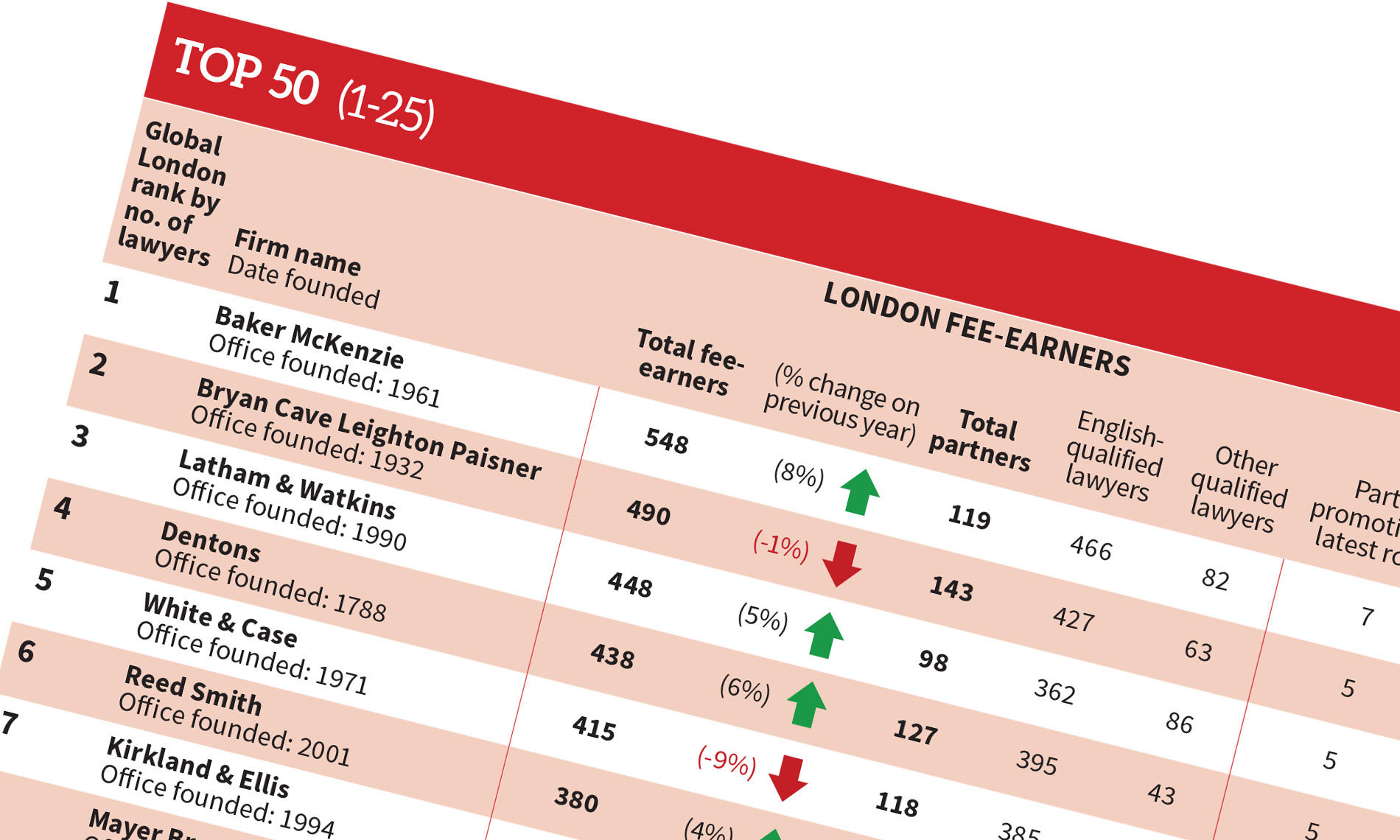
Latham & Watkins has become the latest US player to expand its City emerging company capabilities by targeting two mid-market UK firms for a double-partner hire.
Taylor Wessing has seen one of its more senior departures in recent years as its head of technology, media and communications Mike Turner decamped to the US firm alongside Bird & Bird’s corporate partner Shing Lo. Both hires, announced today (29 January), were voted in by Latham’s partnership in early January and will join the firm over the next few weeks. Continue reading “Taylor Wessing loses practice head as Latham targets UK mid-market for first City tech laterals”
In a relatively subdued week for the London lateral market, Goodwin Procter and Shoosmiths made the only noteworthy hires in the City.
Goodwin secured a prominent hire to its private equity group, recruiting CMS’ private equity head James Grimwood to its London office. Grimwood has experience in advising on M&A, joint ventures and corporate reorganisations. He has acted on private equity transactions for institutions and management teams. Continue reading “Revolving doors: Goodwin recruits CMS private equity head as Shoosmiths adds cyber partner in London”
Solicitors in England and Wales received a glowing review in a new survey of legal needs but evidence of gaps in access to justice shows the profession has a perception problem.
The survey – the largest legal needs survey of its kind – was conducted by the Legal Services Board and Law Society using data collected by YouGov covering the experiences of 28,633 people. Solicitors ranked highest for service satisfaction, with nine out of 10 people who had used a solicitor satisfied with the service they received, while 84% believed the solicitor provided value for money. Continue reading “Lawyers rank top for satisfaction, value for money, but access to justice gaps persist”
Penelope Warne (pictured) will remain at the helm of CMS Cameron McKenna Nabarro Olswang until May 2024 after the partnership confirmed her as senior partner for a second term.
A spokesperson for the firm said the vote by the partnership closed today (24 January) but declined to comment on whether the election was contested. Continue reading “Warne gets second term as CMS UK senior partner”
Squire Patton Boggs has entered the Italian legal market with a four-partner Milan base while Norton Rose Fulbright has become the latest to join a long series of office closures in the Middle East.
Squires said today (23 January) it has picked the Northern Italian city for its 45th office with a team from US rival Curtis, Mallet-Prevost, Colt & Mosle, led by Italy managing partner Galileo Pozzoli. Continue reading “International round-up: Squires enters Italy as NRF shuts Bahrain outpost”
Herbert Smith Freehills (HSF) has finalised a move to absorb its German partnership into its UK LLP, as firms enter the final stages of preparations ahead of a 31 January Brexit.
The move was implemented in December last year as the firm faced a complex regulatory environment in Germany due to the UK’s imminent departure from the European Union. Without the change, HSF would have been incapable of existing as an English company domiciled in Germany. Continue reading “HSF brings German offices into UK LLP to mitigate Brexit concerns”
It’s not often a FTSE 100 GC and a law firm offer themselves up to the media to discuss a deal. Even panel review stories rarely elicit comment beyond a few contrived lines about ‘innovation’, ‘alignment’ and ‘deeper relationships’. So when BT legal chief Sabine Chalmers and DWF arranged conference calls in the summer to announce a five-year managed services contract, it was difficult to not get caught up in the (relative) excitement. True, BT had spent more than a year assessing dozens of potential providers and DWF was talking up its first major post-IPO client win, but the mood music was quite catchy: ‘Law firms are going through a period of tremendous transformation’ proclaimed Chalmers, ‘It’s an incredible opportunity,’ gushed DWF’s managed services head Mark St John Qualter.
But are they? Is it?
Managed services deals involving transferring staff are far from new, but this was a substantial, multimillion-pound arrangement for insurance and real estate work that saw 40 of BT’s in-house legal team switch to DWF. It is a model GCs often espouse but rarely follow.
Yet it is the direction an increasing number of law firms are expecting and banking on. When Eversheds Sutherland chief executive Lee Ranson recently opened a client function launching his firm’s New Law arm, Konexo, he invoked Hemingway to describe the threat new delivery models pose to law firms: ‘How did you go bankrupt? Two ways. Gradually, and then suddenly.’
The past decade has also seen a boom in new legal service providers and investment, as well as the much-hyped re-emergence of the Big Four accounting firms in law. It is not that long ago that the New Law market was basically a coin flip between Axiom and Lawyers On Demand (admittedly with a bunch of legal process outsourcers toiling in the background generally failing to live up to their early-2010s sales pitch).
But it has gone quiet again over the past six months. The only industry figures who bring up the BT/DWF deal are law firm leaders, with few GCs having even noticed it. And yet there are still predictions of legal departments rapidly shrinking courtesy of a fresh wave of outsourcing, as experienced by other corporate departments such as finance and HR.
As Chalmers notes in the first of IHL’s new series of set-piece interviews with leading GCs, however, law firms will struggle to get the business model to work unless they land long-term commitments from a handful of clients at once. DWF’s competitors on the BT deal, for instance, still argue the firm offered a cut price nobody else could match.
GCs, meanwhile, complain that firms oversell their ambitions and that New Law providers are still too risky for much more than contract lawyer resource. One EMEA law head of a global financial services giant also contends regulators would be ‘crawling all over us’ if they outsourced in-house lawyers.
Outsourcing of staff is therefore consistently hamstrung by law firms requiring immediate scale to build the necessary platform and a lack of partnership buy-in on the one hand, and GCs having little appetite to ship off swathes of their own empires after decades of sustained in-house growth on the other.
For all the ambition of advisers, managed services deals – at least those based on wholesale staff transfers – are destined to be nothing more than the flavour of the month they were once again over the summer of 2019. ‘Innovation’ and ‘alignment’ do so often end up as mutually exclusive.
[email protected]
National Grid drops three from panel
BDB Pitmans, Irwin Mitchell and Norton Rose Fulbright have been dropped from National Grid’s panel, understood to be worth about £12m a year in the UK. Womble Bond Dickinson is the sole new appointee on a roster that reduced the number of advisers from 12 to ten. Addleshaw Goddard, Bryan Cave Leighton Paisner, CMS Cameron McKenna Nabarro Olswang, Dentons, DLA Piper, Eversheds Sutherland, Herbert Smith Freehills, Linklaters and Shakespeare Martineau have retained their spots. Continue reading “Significant matters – Winter 2020”