
Sponsored briefing: Technology projects – Plan for success (and if things go wrong)

Addleshaw Goddard looks at the impact of technology on future planning

Involving a disputes lawyer in your business shouldn’t start when you get into a dispute

If you are in business, you are a technology business – this is the reality of the modern marketplace. From the smallest pop-up shop to FTSE 100 entities, technology is at the core. Digitalisation and automation are now woven through every aspect of business, whether front-end customer engagement, supply chains, outsourcing, back-end administration or compliance and audit functions. And this trend will continue; recent data shows many businesses are planning to spend between 20% and 50% of their investment capital on digital projects.

With that opportunity comes risk: increasingly, the prospects and viability of a business are tied to its tech.

Your business needs to be alive not just to the benefits that new technologies will bring to your operations, but also to the challenges inherent when introducing it and, once implemented, your increasing reliance on it. As your business becomes ever-more dependent on technology (with the rise of 5G, artificial intelligence, machine learning, cloud storage, big data and blockchain), so the scale of the risk to your business increases if that technology fails. Several companies have made unwanted headlines over high-profile tech disasters.

Planning for change

Most technology projects are intended as a catalyst for change within a business – whether to vital logistics and administration functions, the customer journey, or the business as a whole. Robust planning processes are essential from the beginning of such projects. All your stakeholders must buy in, so as to realise the changes you are seeking. And even with that planning and commitment in place, most IT implementation projects will often encounter time, money, resource and/or scope issues during their implementation.

Your business needs a clear strategy (commercial, technical and legal) to steer a course to success. And success will demand not just leadership and discipline from the senior management, but also a robust and holistic contract and implementation plan – covering everything from scoping, tendering, contact negotiation and signing, through to the ‘go-live’ and continued operation/upgrades and ultimately exit.

You need to think carefully about what you want to achieve with this new tech and how and when you want to achieve it. Are these deliverables understood by your providers and clearly set out in your contract? Are there sufficient incentives in your contract for the provider to deliver against the requirements and milestones? Will your operations, including your data, be sufficiently protected throughout this period of change?

Getting the right advice at the start could save a series of headaches (or worse) later on.

Planning for challenges

Inevitably, as with all projects, tech initiatives will see varying degrees of success. So you need to be prepared if, or more likely when, your project faces challenges. What levers do you have (contractual or otherwise) to get the project back on track?

And when a dispute materialises, the contract will be tested. Does it place escalation obligations on the parties that are constructive or distracting? Does it encourage co-operation or brinksmanship? How easy is it to withhold payment or services – or even terminate? What limitation and/or exclusion provisions apply? What about exit management? Having a clear strategy that can cater for both success and failure will be key in these circumstances.
Ultimately, you may need to bring or defend a claim. While this tends not to be a GC/board’s preferred option, the prospect of proceedings can sometimes be used strategically to achieve a final resolution, frequently without the need to go to trial.
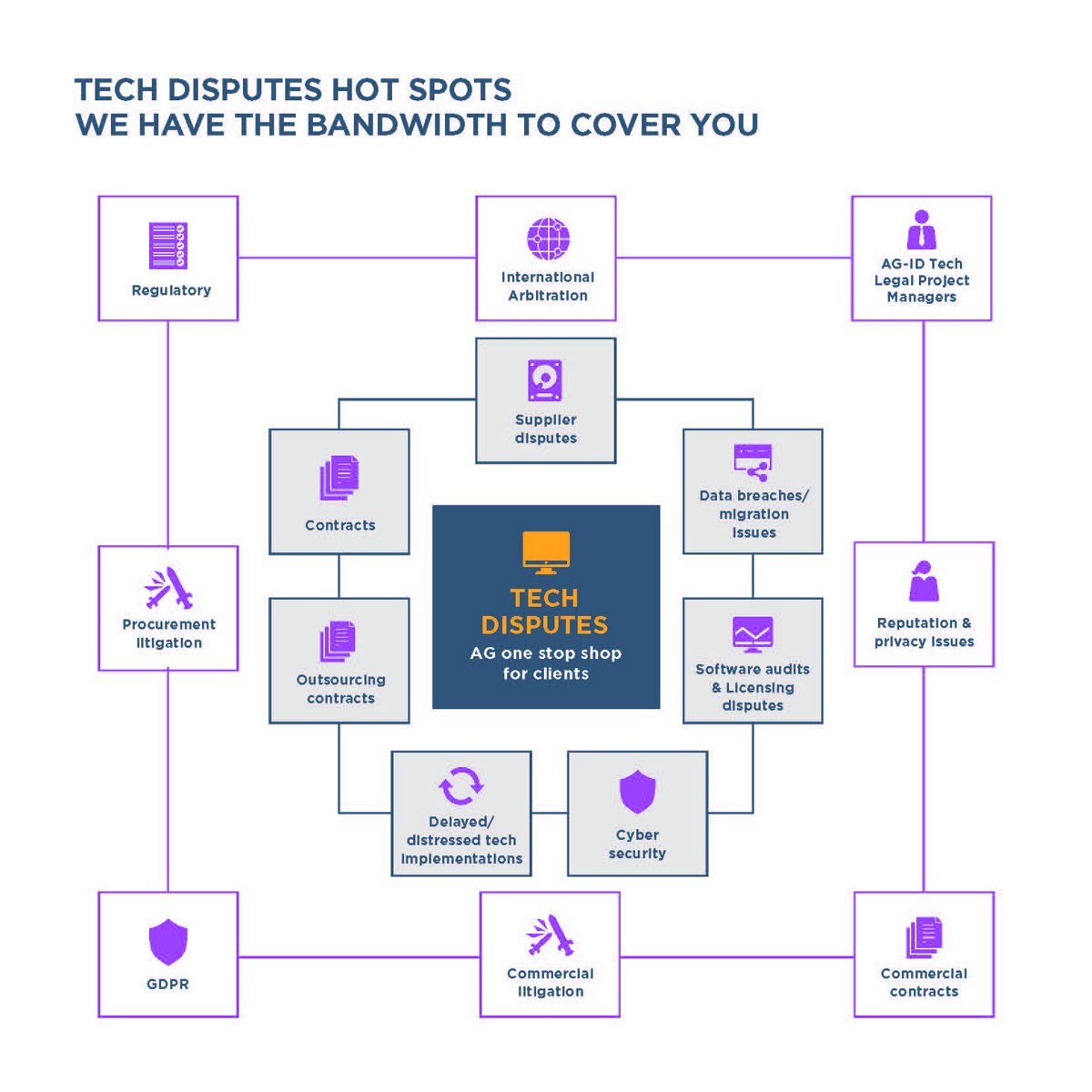
Importantly, time is often a more critical factor in tech disputes than in many other forms of dispute. Technology evolves at a fast pace. Accordingly, in a dispute it can be vital for issues to be resolved before the existing tech on which the business presently depends becomes obsolete, or the market moves on and your investment (or even your whole operation) is sunk. Where timing is a factor, many businesses will want to consider alternative dispute resolution (ADR) before legal proceedings are commenced. This can include the new contractual adjudication scheme launched by the Society for Computers and Law, a three-month procedure that aims at swift settlement of tech disputes.

Even where a tech project has been implemented successfully, issues may arise later on. Such an issue could occur due to a security breach (eg, hacking incident) or human error (eg, accidental data disclosure). It is increasingly important for businesses to be as well drilled for tech incidents, such as a cyber-attack, as they are for a fire. Prompt action will be needed to secure your tech infrastructure, reassure your customers, regulators, workforce and investors, keep your supply chain intact, restore business critical operations, manage the media fallout and seek redress from the culprits. The extent to which businesses (even ‘big business’) are ready for this type of potentially business-critical risk varies greatly.

Planning for the future

The UK is the third-largest market for AI investment behind the US and China. A report by Microsoft last year showed 56% of businesses are adopting AI, and suggested every company may incorporate it in some form in the next five years. So, before too long, what we currently think of as ‘tech risk’ will just become ‘risk’. An office without email is unthinkable now, despite the fact that many senior executives began their careers in offices without much more than a single computer. It is likely the same will become true of AI, blockchain and many other ‘new technologies’.

Planning for success

As a business, you have a careful balancing act to manage. You will have to continue to evolve your IT systems to remain relevant and ahead of competitors, but you must also do what you can to ensure the new technology is implemented and operated in a way that is as low-risk as possible.

The success of your IT will increasingly go hand in hand with the fortunes of the business itself. Having tech issues resolved quickly and efficiently (and, yes, perhaps quietly), across all your operations and jurisdictions, will be essential.

Engaging the right advisers who can give the right guidance at the right time, taking a holistic view of the business (and not just tech) issues, with full-service capability to act across sectors and borders, and who are themselves tech competent and enabled, can save valuable resource, time and money – and potentially the business itself. And, while you can’t always plan for the unforeseen, having a strategy to deal with such risks will be invaluable in the event of unwanted interference in your business.




Return to the Disputes Yearbook 2020 menu

Sponsored firm profile:
Cripps Pemberton Greenish

When you have a dispute, you need a lawyer who can get straight to the facts of the matter. Client focused and commercial in our outlook, we can be relied upon to take a practical and pragmatic approach to dispute resolution. If you’re looking for a scorched-earth approach we can oblige, but we are more often found steering matters along a more constructive path.

With a total of 38 lawyers, of whom 13 are partners, our team of dispute resolution specialists is large enough to offer a full range of services and deep expertise, while being compact enough to care.

We have disputes specialists in the following areas:

  1. Commercial contracts disputes: the full spectrum of commercial contracts and agreements.
  2. Post-transaction claims: including breach of warranties or indemnities.
  3. Director and shareholder disputes: we are recognised experts in this field.
  4. Insolvency-related disputes: including winding-up and directors’ duties claims.
  5. Real estate and construction disputes: we are nationally recognised for our expertise.
  6. Professional negligence: experienced pursuers of negligent advisers.
  7. Regulatory disputes: health and safety, environmental and other regulations.
  8. Employment litigation: including injunctions to enforce covenants.
  9. Wealth disputes: nationally recognised expertise in wills and trusts litigation.

We resolve disputes for all kinds of UK and international businesses. While we work for clients across all industry sectors, we have specialist knowledge of the advertising media and technology, health and care, retail leisure and hospitality sectors.

Many of the team are ranked in the legal directories and are celebrated as leaders in their fields. These include Ed Weeks (shareholders disputes), Jo Ford (insolvency), Miles Paffard and Kerry Glanville (real estate), Nitej Davda (construction), Russell Simpson (professional negligence) and Phil Youdan (regulatory).

To discuss how we can help, please contact:

Ed Weeks
Partner
E: [email protected]
T: +44 (0)1892 506 196


TUNBRIDGE WELLS
Number 22 Mount Ephraim
Tunbridge Wells
Kent TN4 8AS

Tel: +44 (0)1892 515 121

LONDON
45 Cadogan Gardens
London
SW3 2AQ

Tel: +44 (0)20 7591 3333

Web: www.crippspg.co.uk

Return to the Disputes Yearbook 2020 menu

Perfect storms – Cases of the year

Sarah Parkes

Cash-rich funders; conflict-free boutiques; class actions aplenty. While some predict another economic downturn on the horizon, providing an uptick in conventional litigation work, these themes have defined the more eye-catching disputes of the past year. Add to the mix an increase in cyber-related litigation and accusations of fraud and regulatory missteps against some of the leading firms’ key institutional clients, and a kinetic disputes scene emerges.

Many of these developments are US imports, particularly class actions and a more aggressive approach to accusations of fraud. These US-style claims are often being pursued by disputes boutiques increasingly allying themselves with external funders. As a result, the stranglehold City bluebloods have over big-ticket litigation has loosened, while some feel only two or three of the smaller players are of sufficient quality to cause real disruption (see our boutiques report). Continue reading “Perfect storms – Cases of the year”

Sponsored briefing: Disruption, disintermediation and disputes

Stewarts

Stewarts’ Marc Jones discusses the implications of crypto-assets for the litigation sphere

The chances are that in January 2009, when the first bitcoin was mined, nobody reading this article had heard of bitcoin, crypto-currencies, blockchain or smart contracts. Less than a decade later in late 2018, the World Bank raised $110m by selling a ‘blockchain-operated debt instrument’. This instrument runs on a private version of the Ethereum blockchain, which creates, allocates, transfers and manages the bond to maturity using distributed ledger technology. Continue reading “Sponsored briefing: Disruption, disintermediation and disputes”

Sponsored briefing: The changing paradigm of commercial disputes in India

Singh & Associates

Manoj Singh and Nilava Bandhopadhyay give an overview of the new Indian Arbitration and Conciliation (Amendment) Act

India is one of the fastest growing major economies, even during the present global economic slowdown. A number of ambitious regulatory reforms have recently been launched by the government, resulting in India ranking 63rd in the ‘Doing Business 2020: World Bank Report’ – a jump of 65 places – since 2014. The growth of the economy, has brought with it a multitude of complex, commercial disputes, making commercial litigation inevitable. Being a global economic powerhouse, and in the interest of integrating with the international business community, Indian laws have repeatedly been amended to keep India on par with legal regimes in other leading commercial law jurisdictions. A testament to this is the recent Arbitration and Conciliation (Amendment) Act, 2019, which endeavours to make India a global hub of business by giving effective solutions for dispute resolution through international commercial arbitration. Among others, the amendment seeks to institutionalise and streamline the process of arbitration in India by establishing the Indian Council of Arbitration. The Indian judiciary, too, has played its part by pronouncing a number of judgments aimed at making the country more ‘pro-arbitration’. A catena of judgments – past and recent – have upheld the doctrine of minimal judicial intervention enshrined in section 5 of the Arbitration and Conciliation Act, 1996. This article examines some of the recent legislative changes and judicial changes that seek to transform India into a global commercial litigation hotspot. Continue reading “Sponsored briefing: The changing paradigm of commercial disputes in India”

Sponsored briefing: Financial services regulation in Australia at boiling point

Gilbert + Tobin

Richard Harris assesses the challenges facing financial services businesses in Australia

The regulation of financial services businesses in Australia stands at an extraordinary confluence of separate but interrelated developments that represent a profound shift in the regulatory landscape. Continue reading “Sponsored briefing: Financial services regulation in Australia at boiling point”

Sponsored briefing: A cultural shift – has the fallout from the financial crisis changed corporate culture in financial services or is there still work to be done?

White & Case

Zeena Saleh, associate, and Chris Brennan, partner, at White & Case on corporate culture

The concept of corporate culture was the focus of much discussion at the Legal Business Financial Regulatory and Disputes Summit 2020 (the Summit). Since the 2007/08 financial crisis, culture is a concept that has become an increasingly important priority for financial services firms and conduct regulators across the globe. There is no doubt that firms and their senior managers are more aware of the importance of ensuring a good corporate culture throughout their business. However, with more reports of financial and non-financial misconduct within the market, it seems likely that regulators will consider further work needs to be done.
Continue reading “Sponsored briefing: A cultural shift – has the fallout from the financial crisis changed corporate culture in financial services or is there still work to be done?”

Sponsored briefing: Business as usual in the UK courts

Nicole Jadeja

Pinsent Masons discusses exciting times for UK patent litigation in 2020 and beyond

For the past four years, Brexit has dominated the legal headlines as well as the popular press. It would be remiss in 2020, the year in which the UK leaves the EU, to fail to acknowledge its significance. However, despite the political and economic uncertainty, we patent lawyers are confident that 2020 will see business as usual in the UK courts. Continue reading “Sponsored briefing: Business as usual in the UK courts”

Sponsored briefing: The Singapore Convention – The mediator’s perspective

Independent Mediators

Michel Kallipetis QC was the International Academy of Mediators (IAM) representative at the drafting of the Singapore Convention. He provides a brief overview of the Convention and some analysis from a mediator’s perspective

The Grand Ballroom of the Shangri-La Hotel in Singapore was the proud setting for the momentous occasion on 7 August 2019 when the United Nations Convention on International Settlement Agreements Resulting from Mediation (Singapore Convention) was signed by no less than 46 states. It was a spectacular conclusion to three years’ work and consultation by UNCITRAL’ s Working Group II. Since then six other states have also signed. Notable signatories are the US, China, Russia and India; notable absentees at the moment are the UK, Canada, Australia and the EU. The Convention will come into force six months after three states have ratified the Convention. At the time of writing, two states have ratified the Convention: Singapore and Fiji. The Singapore Convention responds to the demand from a growing body of mediation users for an enforcement mechanism applicable to mediated settlement agreements in cross-border disputes. It is to be hoped that the UK, once untrammelled by the provisions of the European Union Treaty signed in Maastricht, will feel able to join the major economic trading nations and sign the Convention. Continue reading “Sponsored briefing: The Singapore Convention – The mediator’s perspective”

Sponsored firm profile: Independent Mediators

Independent Mediators

Independent Mediators manages the practices of nine of Europe’s leading full-time civil and commercial mediators. The mediators joined forces to form a dedicated mediation ‘chambers’ which offered a new model for independent mediation practice.Independent Mediators manage the practices of nine of Europe’s leading full-time civil and commercial mediators. The mediators joined forces to form a dedicated mediation ‘chambers’ which offered a new model for independent mediation practice.

In brief

  • The business was launched in 2007 and now comprises nine full-time commercial mediators, two of whom are well-known commercial negligence silks and seven former solicitors.
  • Independent Mediators has been involved in more than 5,500 mediations since launch.
  • Between them the mediators have undertaken more than 8,750 mediations during their careers.
  • IM mediators have worked with parties from over 85 countries, as mediators, mediation advisers to governments and companies and in delivering mediation training.

They are acknowledged as leading mediators in The Legal 500 and Chambers & Partners. In addition all have been welcomed into the Legal 500 Hall of Fame. They all feature in the international directory Who’s Who Legal: Mediation, which recognises the world’s leading commercial mediators. Three of our mediators feature in a list of those selected by Who’s Who Legal as ‘Global Elite Thought Leaders’ in mediation. Recognition of our standing in the international mediation sector was cemented when Independent Mediators were awarded Mediation Firm of the Year 2019 and Bill Marsh was awarded Mediator of the Year 2019 by Who’s Who Legal at their annual awards ceremony.

Our mediators cover a wide range of commercial disputes in almost every sector of business and law. Values range from tens of thousands to multi-billion pounds and are between parties from all walks of life and all over the world, including companies both public and private, national governments, public bodies/authorities and group actions. The mediators regularly travel all over the UK and internationally for mediations.

The mediators are self-employed and independent, and share a central service to administer all their mediations, offering clients the advantages of:

  • A single contact point for all nine mediators – no need to call each mediator separately.
  • Instant diary availability and mediation bookings.
  • Harmonised documentation and fees – with complete transparency on all fees.
  • A standard mediation agreement and timetable for submission of papers.

The structure ensures maximum convenience and speed for clients with minimum overheads. Our aim is to make the process of appointing a mediator as straightforward as possible.


Charles Dodson Phillip Howell-Richardson Kate Jackson

Michel Kallipetis QC Jonathan Lloyd-Jones Mark Lomas QC

Bill Marsh Andrew Paton Nicholas Pryor

L-R, top to bottom: Charles Dodson, Phillip Howell-Richardson, Kate Jackson, Michel Kallipetis QC, Jonathan Lloyd-Jones, Mark Lomas QC, Bill Marsh, Andrew Paton and Nicholas Pryor


Independent Mediators
International Dispute Resolution Centre,
70 Fleet Street,
London, EC4Y 1EU

Tel: +44(0)20 7127 9223
Email: [email protected]

Web: www.independentmediators.co.uk


Return to the Disputes Yearbook 2020 menu

Sponsored briefing: Surveillance capitalism

Brown Rudnick

Jane Colston discusses how the legal world is wrestling with technology regulation

As technology becomes increasingly sophisticated, making every aspect of our lives more streamlined and efficient, the legal world is wrestling with how best to regulate that technology in a way that does not stifle innovation but allows humans to understand and keep control of technology, and make sure it is applied in a way that takes into account human morals and ethics. Continue reading “Sponsored briefing: Surveillance capitalism”

Sponsored briefing: Parties’ ability to agree on procedural aspects of a lawsuit under Brazilian law

Pinheiro Neto Advogados

The team at Pinheiro Neto discuss Brazil’s civil procedure code

Brazil’s Civil Procedure Code (CPC), enacted in 1973, provided for a very few opportunities in which the litigating parties could agree on changes to procedural aspects of the case, eg the choice of forum (forum conveniens) and the conventional stay of the developments for a certain period. Continue reading “Sponsored briefing: Parties’ ability to agree on procedural aspects of a lawsuit under Brazilian law”

Sponsored briefing: IP litigation in Portugal – from the ’00s to the ’20s

VdA

António Magalhães Cardoso and Sara Nazaré discuss IP Court challenges

Going back to the 2000s, disputes arising from the enforcement of industrial property rights were to be tried before the Court of Commerce, which also handled matters relating to bankruptcy, and many other issues involving commercial companies’ legal disputes and issues. The Court of Commerce was completely overloaded with the work that the latter involved and all the cases involving industrial property rights, especially patents, in light of their complexity, were completely clogged. The situation was so critical that preliminary injunctions were being filed against the actual infringement of patent rights and the Court of Commerce was taking more than two years to serve the defendants. Continue reading “Sponsored briefing: IP litigation in Portugal – from the ’00s to the ’20s”

Sponsored briefing: From Barings to Bitcoin, the forensic accounting market – past, present and future

Grant Thornton UK

Grant Thornton UK’s Michael Barber considers the progression of the forensic accounting profession and looks ahead to what may be in store in the coming months and years

The past

Origins: Maxwell, Barings and beyond

Forensic accountancy. The term strictly refers to accountants whose work supports legal proceedings of various kinds. This is not dissimilar to the way that a forensic pathologist might provide expert evidence to the court. Only forensic accountants substitute corpses for cashbooks and scalpels for sale-and-purchase agreements (SPAs). Continue reading “Sponsored briefing: From Barings to Bitcoin, the forensic accounting market – past, present and future”

Sponsored firm profile: Gilbert + Tobin

Gilbert + Tobin

Gilbert + Tobin: Disputes + Investigations

The disputes and investigations team at Gilbert + Tobin specialises in assisting clients to navigate complex and significant contentious issues. We work closely with our clients to develop an approach best suited to achieving their objectives and the protection of their interests. We understand that litigation should always be a last resort but, where necessary, needs to be handled strategically and commercially, and with jealous regard to your reputation.

Our lawyers have been and continue to be involved in Australia’s most high-profile commercial disputes, litigation, investigations and inquiries. Clients come to us for our sophisticated and strategic litigation and dispute resolution services across a broad range of legal areas. We work closely with clients to deliver focused, timely and cost-effective solutions. Continue reading “Sponsored firm profile: Gilbert + Tobin”

Sponsored briefing: A guide to white-collar offences

Basham, Ringe y Correa

Basham, Ringe y Correa on key white-collar and fraud offences in Mexican law

Basham, Ringe y Correa SC is a full-service law firm with a strong presence in Latin America and is the Lex Mundi representative for Mexico. The firm’s clients include prominent international corporations, many of them on the Fortune 500 List, medium-sized companies, financial institutions and individuals. Basham’s preventative and strategic consulting in all law practice areas allows the firm to offer its clients effective, complete and timely solutions to their concerns. The firm’s in-depth knowledge of the international as well as the domestic market gives it the solid base and perspective needed to offer fully integrated and tailored solutions to every client. The firm’s lawyers actively participate in worldwide associations, as well as in international transactions, something that has promoted the exchange of information and experience. Basham, Ringe y Correa is aware that each client requires objective counselling, experience and professionalism. The firm’s lawyers are well-known leaders in their respective fields of specialisation and are committed to providing legal services at the highest standards of quality. Continue reading “Sponsored briefing: A guide to white-collar offences”

Sponsored firm profile: Shoosmiths

Shoosmiths

Shoosmiths’ specialist team of litigation, international arbitration and dispute resolution lawyers, based in 13 locations across England, Scotland and Northern Ireland, helps clients redress the balance – maximising value, minimising risk and enhancing reputations.

Through our unique advisory services solutions and award-winning litigation services offer, we provide early practical and pragmatic advice to minimise risk and avoid disputes arising. Continue reading “Sponsored firm profile: Shoosmiths”