Market Report: Intellectual Property – A delicate balance

With global hubs fighting to attract big-ticket IP disputes, the London courts are facing a tougher challenge than they are used to. Dominic Carman reports

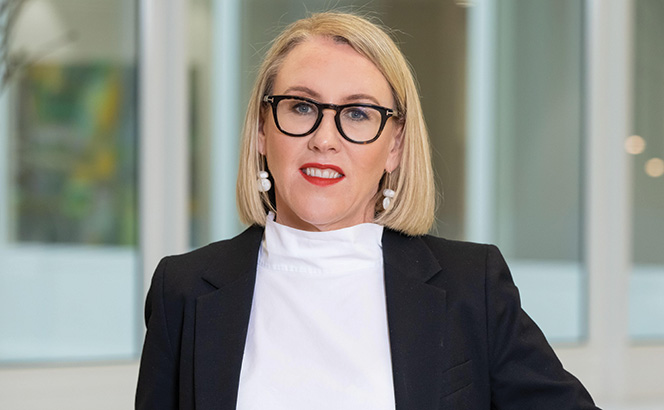
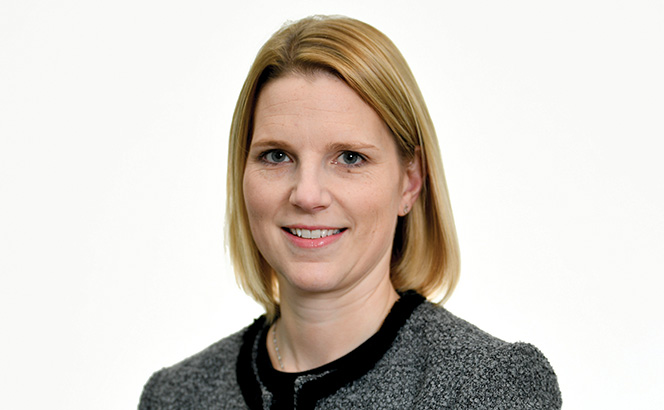
IP litigation continued apace in 2019 with a multiplicity of disputes. ‘Unlike everything else in relation to Brexit, certainly in the life sciences space and in patent litigation, things carried on pretty much as normal and we had quite a lot of cases,’ says Charlotte Weekes (pictured), contentious IP partner at Pinsent Masons. ‘People talk about some jurisdictions being pro-patentee or pro-challenger: the UK courts seem fairly well balanced.’ Continue reading “Market Report: Intellectual Property – A delicate balance”

Market Report: Fraud – Sleight of hand

Criminal investigations aside, the rise of cyber crime and forum shopping means the UK is a perennially popular location for resolving civil fraud disputes. Dominic Carman reports

According to the Crime Survey for England and Wales, fraud offences now constitute nearly half of all recorded crime. Last year they increased by 9% to breach the four million mark, although the survey suggests that fewer than 20% of frauds are ever reported. Simultaneously, organisations that investigate large-scale fraud, such as the National Crime Agency and the Serious Fraud Office, are routinely regarded by commentators as underfunded, understaffed and – at times – unable to cope. Continue reading “Market Report: Fraud – Sleight of hand”

Sponsored briefing: The evolution of the Commercial Bar

Duncan Matthews QC, co-head, and Jemma Tagg, chief executive, reflect on the evolution of Twenty Essex and wider sector changes across the Commercial Bar

Reflecting on the past

Twenty Essex enjoys a rich heritage as one of the longest-established sets of commercial and international law chambers. Twenty Essex barristers have always been at the forefront of ground-breaking legal precedent in reported cases before apex courts and tribunals.
Continue reading “Sponsored briefing: The evolution of the Commercial Bar”

Sponsored briefing: After a busy year in offshore litigation, what
lies ahead in 2020?

Christian Hay gives an overview of Collas Crill’s disputes work in 2019 and discusses the challenges and trends that can be expected over the next year

2019 was Collas Crill’s busiest year for dispute resolution. Our litigation teams in the British Virgin Islands (BVI), Cayman Islands, Guernsey and Jersey were firing on all four cylinders.
Continue reading “Sponsored briefing: After a busy year in offshore litigation, what
lies ahead in 2020?”

Market Report: Tax Litigation – Introducing the hard line

Post Brexit, HMRC is renewing its litigation focus on corporate tax evasion, enhanced by new powers to investigate corporate criminal offences. Dominic Carman reports

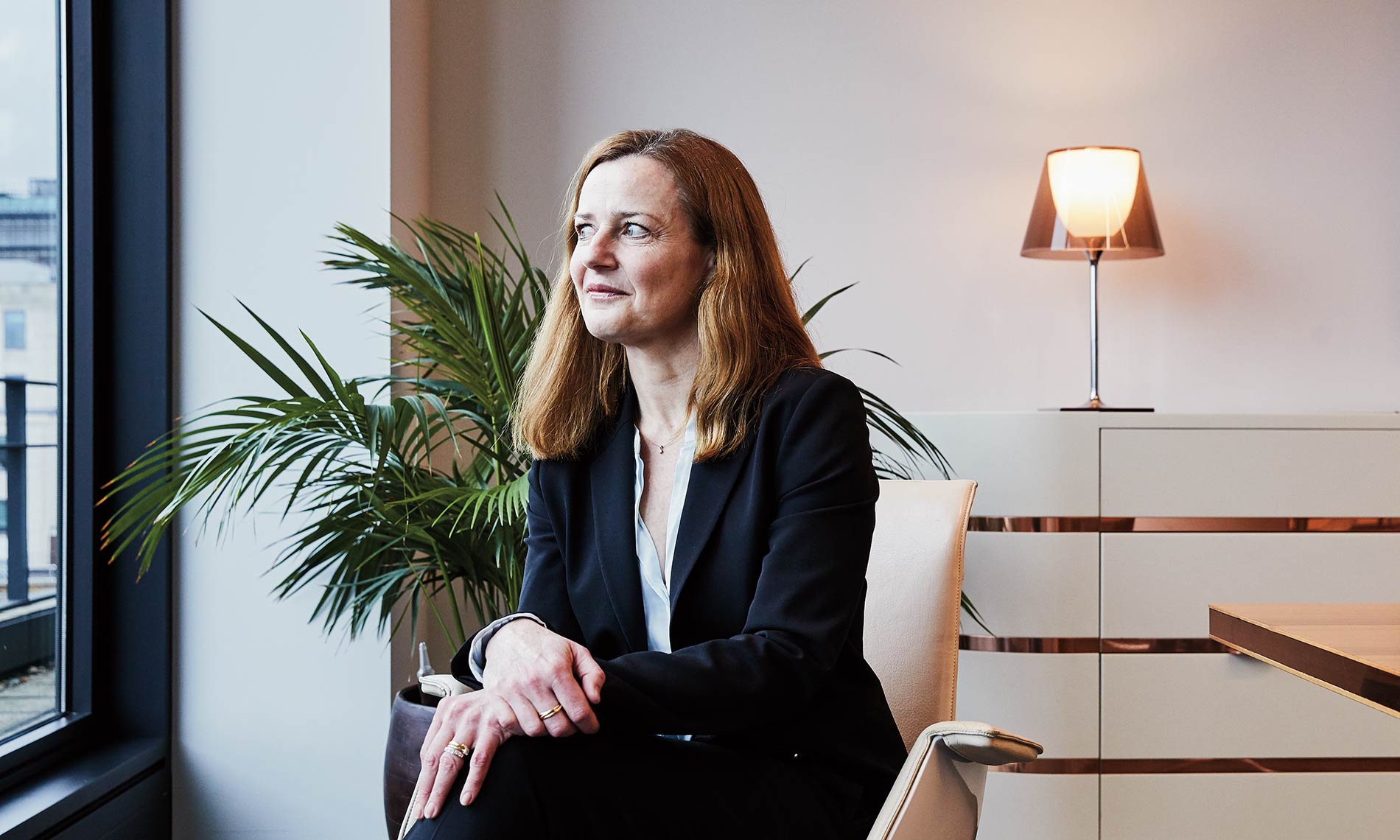
Like stargazing through a telescope, tax disputes look back in time. The typical gestation period between issues first catching HMRC’s attention and a dispute reaching court can take up to five years, sometimes longer. Nick Skerrett (pictured), head of contentious tax at Simmons & Simmons, says there has been a maturation of the governance processes within HMRC. ‘It is starting to bed down and HMRC has become more adept in its approach to working out those cases that it ultimately wants to come before the courts from those that it does not,’ he says. Continue reading “Market Report: Tax Litigation – Introducing the hard line”

Market Report: Construction – Building a case

Despite efforts to minimise the level of construction disputes, adjudication, litigation and arbitration are all flourishing. Dominic Carman reports

While there are many relevant statutes and a significant body of case law, construction disputes benefit from having a single overarching piece of legislation: the Housing Grants, Construction and Regeneration Act 1996, commonly known as the Construction Act. In some recent decisions, judges have increasingly endeavoured to broaden the ambit of the act, which was last amended in 2011, to capture a wider range of construction activities as the sector continues to recover from a turbulent political period. Continue reading “Market Report: Construction – Building a case”

Sponsored firm profile:
Simmons & Simmons

You cannot control the outcome of tax litigation and, in the current political environment, judgments can be hard to predict. We focus on the elements we can control.

Our approach is intellectually rigorous, to ensure all potential technical arguments have been evaluated and managed so there are no surprises at trial. We investigate thoroughly, then focus on meticulous case preparation and strategic planning.
Continue reading “Sponsored firm profile:
Simmons & Simmons”

Arbitration – ‘There’s a new generation coming’

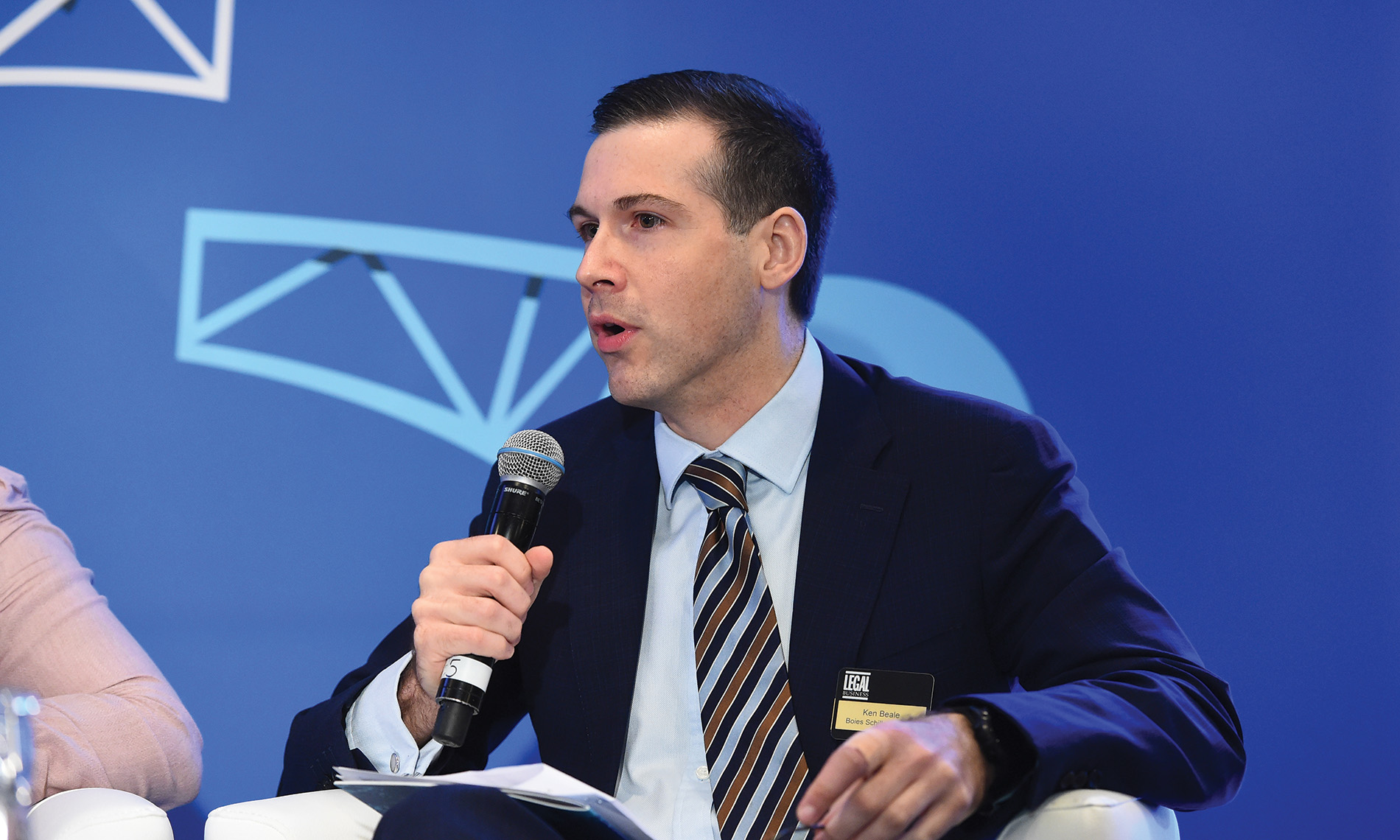
Kenneth Beale

‘Arbitration is the Savile Row of dispute resolution. It’s not the M&S off-the-rack suit, you can create a bespoke arbitration clause that does almost anything you want it to do,’ said Kenneth Beale, an arbitration partner at Boies Schiller Flexner in London. Is it then any surprise that financial institutions are increasingly opting to use arbitration for dispute resolution?

Beale was one of a host of top names speaking at Legal Business’ 2019 International Arbitration Summit in November when he made that comment, setting out how much things have changed in the financial services sector in recent years. Continue reading “Arbitration – ‘There’s a new generation coming’”

Sponsored firm profile: Int-Arb Arbitrators

Int-Arb Arbitrators is a specialist set of international arbitrators and mediators based in London, which has been created to allow each member the freedom to operate without conflicts. Members of Int-Arb Arbitrators are completely independent, not attached to a law firm or barristers’ chambers and with a sole focus of sitting only as an arbitrator or mediator.

Each member is supported by an experienced team who all have legal management backgrounds. Our team know the arbitrators and mediators’ respective practice and areas of expertise, fully. This is complemented with an administrative and business support service provided to members which include diary and practice management, marketing and business development.

Int-Arb Arbitrators has a diverse list which allows an opportunity to provide both suitable and wide-ranging recommendations. The management team offers a bespoke and transparent service to those who approach us, when in search of an arbitrator or mediator. We talk through and have detailed conversations to understand the requirements of the dispute to suggest the most appropriate arbitrator or mediator.

Service delivery and attention to our clients is unparalleled and centred on excellence. We not only save time with your search but add value and comfort when making a choice of arbitrator or mediator.

Firm overview

Our members have expertise in complex investor state, corporate and commercial, construction and engineering, technology and telecommunications, banking and finance, transport, IP, M&A, insurance and re-insurance, mining, energy and oil and gas disputes.

Int-Arb Arbitrators members are internationally recognised and can accept chair, sole and party appointments. Experience covers substantial disputes under all of the key institutional rules including ICC, ICDR, LCIA, ISCID, SIAC, DIAC, HKIAC, CAS, SCC, KCAB, UNCITRAL, WIPO and ad hoc arbitrations in a variety of seats ranging from London, New York, Paris, Dubai, Singapore, Geneva, Hong Kong and in other regions across the US, Canada, Europe, Latin-America and the Caribbean.

Sam Carter, managing director
Int-Arb Arbitrators

Int-Arb Arbitrators members

David Cairns

Arbitrator

David Cairns is a leading international arbitrator based in Madrid and London. He joined Int-Arb Arbitrators after spending 20 years at international law firm, B Cremades y Asociados in Madrid, Spain.

Specialist areas include investor-state, construction and engineering, commercial and IP disputes. He has a particular region focus of Spain, Latin America and London.

He is fluent in Spanish and has extensive experience of both common and civil law approaches to disputes and arbitration.

Calvin Hamilton

Arbitrator

Calvin Hamilton is a seasoned arbitrator based in Barbados and London with 35 years of international arbitration experience, as counsel and arbitrator including his time as partner at two leading firms in Madrid. His region focus is the Caribbean, Latin America, London and the US.

Specialist areas include investor state, corporate and commercial disputes. He has a good cultural knowledge and understanding of common and civil law approaches.

He is fluent in Spanish, proficient in French and has working knowledge of Portuguese. He is a dual national of Guyana and Spain and admitted in New York and Madrid.

John Judge

Arbitrator

John Judge is an internationally-recognised arbitrator based in Toronto and London. He joined Int-Arb Arbitrators from 39 Essex Chambers in London having previously spent 25 years at Stikeman Elliott, in Toronto.

Specialist areas include construction, engineering and infrastructure, oil and gas, mining and investor state disputes, across the globe.

He has also sat on a wide range of commercial and corporate, banking and finance, investment, M&A, insurance and reinsurance, real estate, IT and telecommunications and transport disputes.

Janet Walker

Arbitrator

Janet Walker is an international arbitrator based in London, Toronto and Sydney who joins Int-Arb Arbitrators from Outer Temple Chambers, London.

Specialist areas include construction, heavy equipment, M&A, IP, environmental, finance, employment and shareholder disputes.

This combined with more than 20 years as a consultant and expert in a range of matters particularly those arbitration-related. She is fluent in English and has good written and oral comprehension of French and Spanish.

Jane Player

Mediator

Jane is a leading international mediator. Formerly a partner at King & Spalding, co-head of the international dispute resolution group and head of the London disputes team at Bird & Bird, and DLA Piper respectively.

Specialist areas include corporate and contractual claims, fraud and project disputes including pharmaceuticals, energy, technology, IP and media disputes.

She has a reputation for managing cross-cultural aspects of joint venture and international shareholder disputes including early neutral evaluation and expert determination. Fluent in French, Spanish and Italian to varying degrees.


OWEN LAWRENCE
Chief Executive
[email protected]

Tel: +44 (0) 203 928 7272
DDI: +44 (0) 203 928 7288
Mob: +44 (0) 793 034 2588

SAM CARTER
Managing Director
[email protected]

Tel: +44 (0) 203 928 7272
DDI: +44 (0) 203 928 7280
Mob: +44 (0) 791 719 1476

DEMI ROBINSON
Arbitrator Practice Assistant
[email protected]

Tel: +44 (0) 203 928 7272
DDI: +44 (0) 203 928 7281
Mob: +44 (0) 753 502 9639

Web: www.int-arbitrators.com
Email: [email protected]

Return to the Disputes Yearbook 2020 menu

Sponsored firm profile:
Trowers & Hamlins

Trowers & Hamlins has one of the largest disputes practices in Birmingham, handling high-end, complex and often cross-border matters for clients across all types of contentious work, with specialisms in commercial litigation, civil fraud and investigations, property litigation and construction disputes.

Our Midlands practice is deeply connected into our wider business, with a significant proportion of our work originating from our international offices across Malaysia and the Middle East, and our strategic partnership with Interlaw – an elite global network of over 7,000 first-class lawyers in 150 cities worldwide.

We act on a wide range of commercial disputes, with key strengths in international, particularly Middle East-related work, heavyweight commercial matters and disputes involving public sector bodies. We are advising the Central Bank of Bahrain bringing claims worth close to £3bn in connection with the AHAB and Saad Group frauds, for example, and we also receive regular mandates from the Abu Dhabi National Oil Company. Our work on disputes emanating from the Middle East includes cases played out in the local courts and arbitral tribunals in that region, as well as in London and other international disputes hubs.

Handling complex high-value matters

Closer to home, our team has had a number of its recent cases in the Commercial Court reported and receives instructions in commercial disputes from both regional and national players. We have a strong record of working with in-house counsel teams in difficult, sensitive and complex claims and investigations.

Trowers has a long history of acting in disputes involving the public sector and continues to be a leader in this field. For example, we are on the panel for the Department of Health, who we advise on various high-value claims.

We are one of the only firms with a team recognised for its civil fraud expertise, where we act for a wide range of public, private and third-sector clients dealing with prevention, investigations and recovery actions across multiple jurisdictions. With deep experience in freezing injunction applications, we also advise on anti-bribery and fraud prevention issues and are increasingly known for significant instructions arising from cyber crime. We support both domestic and international clients dealing with the regulatory and data issues that arise from cyber events and our team regularly speaks at conferences on cyber security and dealing with breaches.

Supporting a broad client base

Our real estate litigation team in the West Midlands has grown considerably in recent years and now stands apart for the breadth of both its work and its client base, covering the full range of City-quality contentious property work in the regional market. Our clients include significant public sector pension funds and investment funds, NHS foundation trusts, West Midlands-based property investors and corporate occupiers, large and small developers, high-net-worth-individual clients, large and small housing associations and care providers, including the West Midlands Metropolitan Authorities Pension Fund, Westminster City Council (investment property), King’s College Hospital, Mainstay Residential, Midland Heart and Citizen Housing Group.

Our construction litigation practice in Birmingham is focused on the development of risk management and dispute avoidance strategies to help clients retain control of projects. When action does become necessary, we guide clients towards the most satisfactory outcome possible, whether that is through adjudication, mediation, conciliation, early neutral evaluation, expert determination or a more bespoke process. The disputes team is an integral part of our projects and construction department, providing a full service to construction projects on a local, national and international basis. We advise housing associations, NHS trusts, contractors and leisure developers across the Midlands region on a range of significant contentious matters relating to construction aspects of various schemes and projects.

We believe our full-service litigation practice in the Midlands stands apart for its ability to cope with complexity and diversity, and for its national and global reach. We have significant expertise using litigation funders to finance claims ranging from £200,000 to over £100m – we always look at the big picture when supporting clients, pursuing the most effective dispute resolution achievable.

In order to develop our relationships with in-house counsel, we run a breakfast series called Counsel’s Club where we discuss topical issues and share experiences, resulting in valuable collaboration and information sharing.

Key partners

Helen Briant

Partner, commercial litigation
E: [email protected]
T: 0121 214 8867

Helen Briant is a partner in Trowers & Hamlins’ commercial litigation practice in Birmingham, specialising in commercial litigation and arbitration. She regularly works with in-house legal teams to resolve substantial commercial disputes. She has particular experience in working for clients in the manufacturing and engineering sector. She also has significant experience dealing with complex and sensitive disputes involving private wealth, investments, trusts and estates, and her work is usually cross-border. Briant’s clients include high-net-worth individuals, business owners, trustees, executors and beneficiaries, and many of the cases that she works on involve fraud and dishonesty.

Yetunde Dania

Partner, property litigation
E: [email protected]
T: 0121 214 8822

Yetunde Dania specialises in residential landlord and tenant property matters for large and small housing associations, and UK and overseas-based private landlords with property portfolios in the UK. Her work includes contentious and non-contentious issues, such as providing advice and assistance to clients in complex possession and injunction claims, defending counterclaims for disrepair and/or allegations of alleged landlord-related regulatory failures, in both the county and magistrates’ courts, and she provides advice across the very wide spectrum of residential landlord and tenant legislation.

Michael Green

Partner, property litigation
E: [email protected]
T: 0121 214 8861

With almost 20 years of real estate litigation experience acting for a range of private and public sector clients, Michael Green joined Trowers & Hamlins’ property litigation team in Birmingham in 2018 with the objective of broadening its practice. He acts for investors, corporate occupiers, developers and public sector bodies, including public sector pension funds and other investment funds. Green’s clients comprise a mix of real estate stakeholders in the Midlands, together with London-based clients. He has particular expertise in complex commercial landlord and tenant disputes, including those arising in the context of large-scale redevelopments.

Mark Kenkre

Partner, commercial litigation
E: [email protected]
T: 0121 214 8863

Mark Kenkre specialises in commercial litigation, arbitration and conducting investigations, with an emphasis on complex and commercially sensitive disputes involving allegations of fraud. He has an interest in technology, cyber crime and cyber security issues, including the development of fraud risks relating to blockchain technology and developments in legal technology, and he is a member of the Commercial Fraud Lawyers Association and the Fraud Advisory Panel.

Guy Willetts

Partner, property litigation
E: [email protected]
T: 0121 214 8845

Guy Willetts has more than 30 years’ experience in the resolution of property disputes, acting for owners or occupiers of all types of commercial property (including shops, offices, warehouses and industrial buildings), investors and developers, local authorities, pension funds, NHS trusts and government agencies. He has been involved in a number of landmark cases and is focused on getting the right result in the most cost-effective manner, which may involve alternative dispute resolution, including self-help remedies, mediation, arbitration or expert determination, with the courts as a last resort.


10 Colmore Row
Birmingham
B3 2QD

Tel: 0121 214 8800

Web: www.trowers.com

Return to the Disputes Yearbook 2020 menu
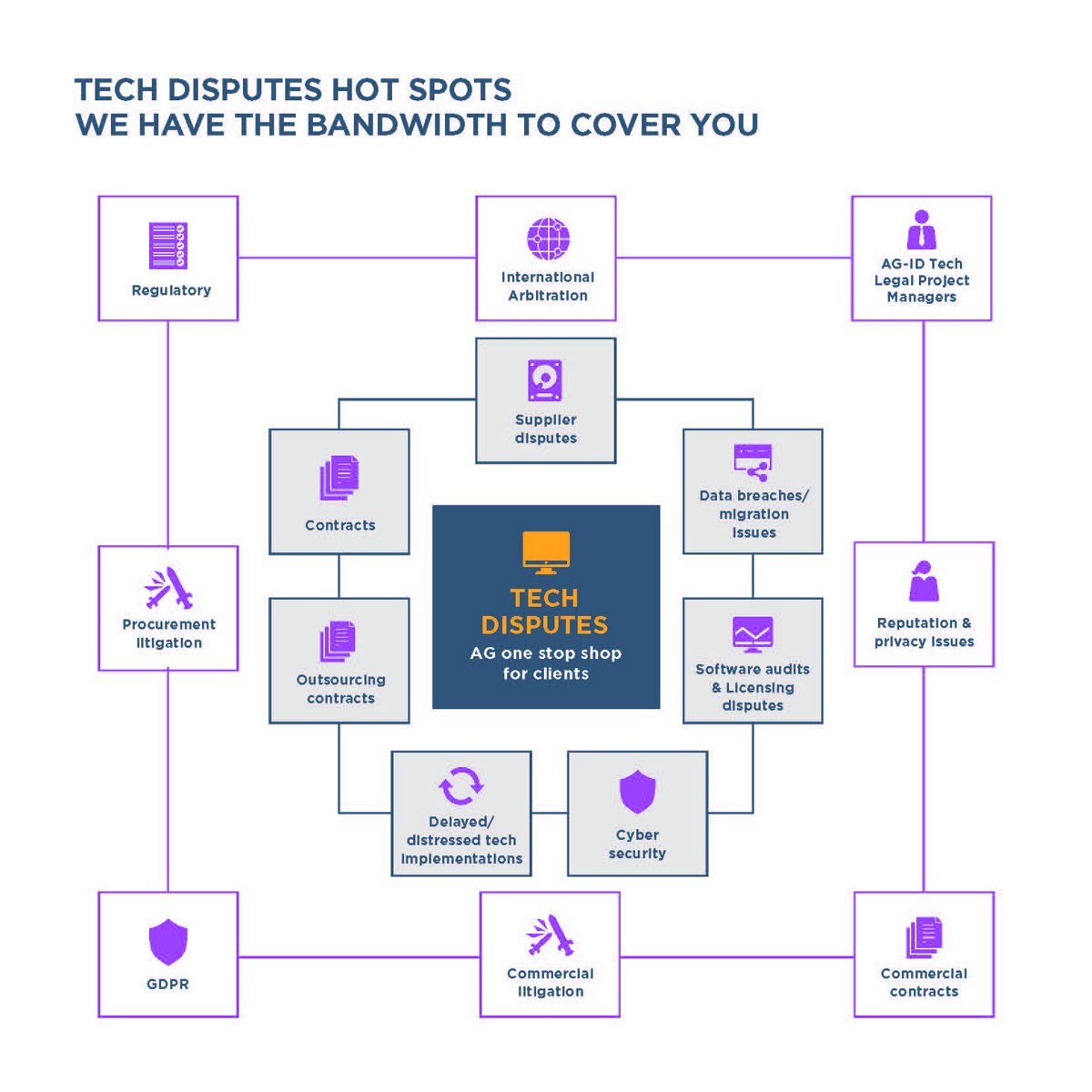
Sponsored briefing: Technology projects – Plan for success (and if things go wrong)

Addleshaw Goddard looks at the impact of technology on future planning

Involving a disputes lawyer in your business shouldn’t start when you get into a dispute

If you are in business, you are a technology business – this is the reality of the modern marketplace. From the smallest pop-up shop to FTSE 100 entities, technology is at the core. Digitalisation and automation are now woven through every aspect of business, whether front-end customer engagement, supply chains, outsourcing, back-end administration or compliance and audit functions. And this trend will continue; recent data shows many businesses are planning to spend between 20% and 50% of their investment capital on digital projects.

With that opportunity comes risk: increasingly, the prospects and viability of a business are tied to its tech.

Your business needs to be alive not just to the benefits that new technologies will bring to your operations, but also to the challenges inherent when introducing it and, once implemented, your increasing reliance on it. As your business becomes ever-more dependent on technology (with the rise of 5G, artificial intelligence, machine learning, cloud storage, big data and blockchain), so the scale of the risk to your business increases if that technology fails. Several companies have made unwanted headlines over high-profile tech disasters.

Planning for change

Most technology projects are intended as a catalyst for change within a business – whether to vital logistics and administration functions, the customer journey, or the business as a whole. Robust planning processes are essential from the beginning of such projects. All your stakeholders must buy in, so as to realise the changes you are seeking. And even with that planning and commitment in place, most IT implementation projects will often encounter time, money, resource and/or scope issues during their implementation.

Your business needs a clear strategy (commercial, technical and legal) to steer a course to success. And success will demand not just leadership and discipline from the senior management, but also a robust and holistic contract and implementation plan – covering everything from scoping, tendering, contact negotiation and signing, through to the ‘go-live’ and continued operation/upgrades and ultimately exit.

You need to think carefully about what you want to achieve with this new tech and how and when you want to achieve it. Are these deliverables understood by your providers and clearly set out in your contract? Are there sufficient incentives in your contract for the provider to deliver against the requirements and milestones? Will your operations, including your data, be sufficiently protected throughout this period of change?

Getting the right advice at the start could save a series of headaches (or worse) later on.

Planning for challenges

Inevitably, as with all projects, tech initiatives will see varying degrees of success. So you need to be prepared if, or more likely when, your project faces challenges. What levers do you have (contractual or otherwise) to get the project back on track?

And when a dispute materialises, the contract will be tested. Does it place escalation obligations on the parties that are constructive or distracting? Does it encourage co-operation or brinksmanship? How easy is it to withhold payment or services – or even terminate? What limitation and/or exclusion provisions apply? What about exit management? Having a clear strategy that can cater for both success and failure will be key in these circumstances.
Ultimately, you may need to bring or defend a claim. While this tends not to be a GC/board’s preferred option, the prospect of proceedings can sometimes be used strategically to achieve a final resolution, frequently without the need to go to trial.

Importantly, time is often a more critical factor in tech disputes than in many other forms of dispute. Technology evolves at a fast pace. Accordingly, in a dispute it can be vital for issues to be resolved before the existing tech on which the business presently depends becomes obsolete, or the market moves on and your investment (or even your whole operation) is sunk. Where timing is a factor, many businesses will want to consider alternative dispute resolution (ADR) before legal proceedings are commenced. This can include the new contractual adjudication scheme launched by the Society for Computers and Law, a three-month procedure that aims at swift settlement of tech disputes.

Even where a tech project has been implemented successfully, issues may arise later on. Such an issue could occur due to a security breach (eg, hacking incident) or human error (eg, accidental data disclosure). It is increasingly important for businesses to be as well drilled for tech incidents, such as a cyber-attack, as they are for a fire. Prompt action will be needed to secure your tech infrastructure, reassure your customers, regulators, workforce and investors, keep your supply chain intact, restore business critical operations, manage the media fallout and seek redress from the culprits. The extent to which businesses (even ‘big business’) are ready for this type of potentially business-critical risk varies greatly.

Planning for the future

The UK is the third-largest market for AI investment behind the US and China. A report by Microsoft last year showed 56% of businesses are adopting AI, and suggested every company may incorporate it in some form in the next five years. So, before too long, what we currently think of as ‘tech risk’ will just become ‘risk’. An office without email is unthinkable now, despite the fact that many senior executives began their careers in offices without much more than a single computer. It is likely the same will become true of AI, blockchain and many other ‘new technologies’.

Planning for success

As a business, you have a careful balancing act to manage. You will have to continue to evolve your IT systems to remain relevant and ahead of competitors, but you must also do what you can to ensure the new technology is implemented and operated in a way that is as low-risk as possible.

The success of your IT will increasingly go hand in hand with the fortunes of the business itself. Having tech issues resolved quickly and efficiently (and, yes, perhaps quietly), across all your operations and jurisdictions, will be essential.

Engaging the right advisers who can give the right guidance at the right time, taking a holistic view of the business (and not just tech) issues, with full-service capability to act across sectors and borders, and who are themselves tech competent and enabled, can save valuable resource, time and money – and potentially the business itself. And, while you can’t always plan for the unforeseen, having a strategy to deal with such risks will be invaluable in the event of unwanted interference in your business.


Return to the Disputes Yearbook 2020 menu

Sponsored firm profile:
Cripps Pemberton Greenish

When you have a dispute, you need a lawyer who can get straight to the facts of the matter. Client focused and commercial in our outlook, we can be relied upon to take a practical and pragmatic approach to dispute resolution. If you’re looking for a scorched-earth approach we can oblige, but we are more often found steering matters along a more constructive path.

With a total of 38 lawyers, of whom 13 are partners, our team of dispute resolution specialists is large enough to offer a full range of services and deep expertise, while being compact enough to care.

We have disputes specialists in the following areas:

  1. Commercial contracts disputes: the full spectrum of commercial contracts and agreements.
  2. Post-transaction claims: including breach of warranties or indemnities.
  3. Director and shareholder disputes: we are recognised experts in this field.
  4. Insolvency-related disputes: including winding-up and directors’ duties claims.
  5. Real estate and construction disputes: we are nationally recognised for our expertise.
  6. Professional negligence: experienced pursuers of negligent advisers.
  7. Regulatory disputes: health and safety, environmental and other regulations.
  8. Employment litigation: including injunctions to enforce covenants.
  9. Wealth disputes: nationally recognised expertise in wills and trusts litigation.

We resolve disputes for all kinds of UK and international businesses. While we work for clients across all industry sectors, we have specialist knowledge of the advertising media and technology, health and care, retail leisure and hospitality sectors.

Many of the team are ranked in the legal directories and are celebrated as leaders in their fields. These include Ed Weeks (shareholders disputes), Jo Ford (insolvency), Miles Paffard and Kerry Glanville (real estate), Nitej Davda (construction), Russell Simpson (professional negligence) and Phil Youdan (regulatory).

To discuss how we can help, please contact:

Ed Weeks
Partner
E: [email protected]
T: +44 (0)1892 506 196


TUNBRIDGE WELLS
Number 22 Mount Ephraim
Tunbridge Wells
Kent TN4 8AS

Tel: +44 (0)1892 515 121

LONDON
45 Cadogan Gardens
London
SW3 2AQ

Tel: +44 (0)20 7591 3333

Web: www.crippspg.co.uk

Return to the Disputes Yearbook 2020 menu

Perfect storms – Cases of the year

Sarah Parkes

Cash-rich funders; conflict-free boutiques; class actions aplenty. While some predict another economic downturn on the horizon, providing an uptick in conventional litigation work, these themes have defined the more eye-catching disputes of the past year. Add to the mix an increase in cyber-related litigation and accusations of fraud and regulatory missteps against some of the leading firms’ key institutional clients, and a kinetic disputes scene emerges.

Many of these developments are US imports, particularly class actions and a more aggressive approach to accusations of fraud. These US-style claims are often being pursued by disputes boutiques increasingly allying themselves with external funders. As a result, the stranglehold City bluebloods have over big-ticket litigation has loosened, while some feel only two or three of the smaller players are of sufficient quality to cause real disruption (see our boutiques report). Continue reading “Perfect storms – Cases of the year”

Sponsored briefing: Disruption, disintermediation and disputes

Stewarts

Stewarts’ Marc Jones discusses the implications of crypto-assets for the litigation sphere

The chances are that in January 2009, when the first bitcoin was mined, nobody reading this article had heard of bitcoin, crypto-currencies, blockchain or smart contracts. Less than a decade later in late 2018, the World Bank raised $110m by selling a ‘blockchain-operated debt instrument’. This instrument runs on a private version of the Ethereum blockchain, which creates, allocates, transfers and manages the bond to maturity using distributed ledger technology. Continue reading “Sponsored briefing: Disruption, disintermediation and disputes”

Sponsored briefing: The changing paradigm of commercial disputes in India

Singh & Associates

Manoj Singh and Nilava Bandhopadhyay give an overview of the new Indian Arbitration and Conciliation (Amendment) Act

India is one of the fastest growing major economies, even during the present global economic slowdown. A number of ambitious regulatory reforms have recently been launched by the government, resulting in India ranking 63rd in the ‘Doing Business 2020: World Bank Report’ – a jump of 65 places – since 2014. The growth of the economy, has brought with it a multitude of complex, commercial disputes, making commercial litigation inevitable. Being a global economic powerhouse, and in the interest of integrating with the international business community, Indian laws have repeatedly been amended to keep India on par with legal regimes in other leading commercial law jurisdictions. A testament to this is the recent Arbitration and Conciliation (Amendment) Act, 2019, which endeavours to make India a global hub of business by giving effective solutions for dispute resolution through international commercial arbitration. Among others, the amendment seeks to institutionalise and streamline the process of arbitration in India by establishing the Indian Council of Arbitration. The Indian judiciary, too, has played its part by pronouncing a number of judgments aimed at making the country more ‘pro-arbitration’. A catena of judgments – past and recent – have upheld the doctrine of minimal judicial intervention enshrined in section 5 of the Arbitration and Conciliation Act, 1996. This article examines some of the recent legislative changes and judicial changes that seek to transform India into a global commercial litigation hotspot. Continue reading “Sponsored briefing: The changing paradigm of commercial disputes in India”

Sponsored briefing: Financial services regulation in Australia at boiling point

Gilbert + Tobin

Richard Harris assesses the challenges facing financial services businesses in Australia

The regulation of financial services businesses in Australia stands at an extraordinary confluence of separate but interrelated developments that represent a profound shift in the regulatory landscape. Continue reading “Sponsored briefing: Financial services regulation in Australia at boiling point”

Sponsored briefing: A cultural shift – has the fallout from the financial crisis changed corporate culture in financial services or is there still work to be done?

White & Case

Zeena Saleh, associate, and Chris Brennan, partner, at White & Case on corporate culture

The concept of corporate culture was the focus of much discussion at the Legal Business Financial Regulatory and Disputes Summit 2020 (the Summit). Since the 2007/08 financial crisis, culture is a concept that has become an increasingly important priority for financial services firms and conduct regulators across the globe. There is no doubt that firms and their senior managers are more aware of the importance of ensuring a good corporate culture throughout their business. However, with more reports of financial and non-financial misconduct within the market, it seems likely that regulators will consider further work needs to be done.
Continue reading “Sponsored briefing: A cultural shift – has the fallout from the financial crisis changed corporate culture in financial services or is there still work to be done?”

Sponsored briefing: Business as usual in the UK courts

Nicole Jadeja

Pinsent Masons discusses exciting times for UK patent litigation in 2020 and beyond

For the past four years, Brexit has dominated the legal headlines as well as the popular press. It would be remiss in 2020, the year in which the UK leaves the EU, to fail to acknowledge its significance. However, despite the political and economic uncertainty, we patent lawyers are confident that 2020 will see business as usual in the UK courts. Continue reading “Sponsored briefing: Business as usual in the UK courts”