
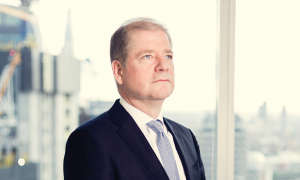
‘I think – and I say this as the pessimist – we will easily move ahead on our strategy.’ Frances Murphy, Morgan, Lewis & Bockius
To mark the launch of our 2020 Global London report, we ask senior figures at leading US firms for a progress report

‘I think – and I say this as the pessimist – we will easily move ahead on our strategy.’ Frances Murphy, Morgan, Lewis & Bockius
To mark the launch of our 2020 Global London report, we ask senior figures at leading US firms for a progress report

Emily Bernstein demonstrates how Investec can help to find personal banking solutions for clients in the legal industry
The legal partners I work with have unique careers and unique incomes to match. Continue reading “Sponsored briefing: It’s the little things that count”

The team at GGP gives an overview of the firm’s offering including a focus on how it is meeting the needs of clients during the coronavirus crisis
Gajski, Grlić, Prka & Partners Law Firm (GGP) is a Croatian full-service law firm with extensive experience in litigation, corporate and commercial law, M&A, labour law, insolvency law, privatisation and restructuring proceedings, public procurement, competition policy and state aid as well as intellectual property. We have a special department for criminal law with an emphasis on most complex white-collar crimes where we lean on our multidisciplinary approach and a wide knowledge covering criminal, commercial and tax law. Continue reading “Sponsored profile: Gajski, Grlic, Prka & Partners, Zagreb, Croatia”

The success of Latham & Watkins’ expansion globally in recent years is backed up by Legal 500 data. Fifty-seven of its practices have achieved top-tier rankings globally across The Legal 500 in 2019/20, compared to 40 in 2014-15. While only one of these 17 new top-tier rankings is in the UK, the firm’s growing dominance in London is still supported by the UK Legal 500 data. Continue reading “Legal 500 Data: Behind the story”

State court litigation and private arbitration proceedings require practitioners to combine legal thoroughness and the management of evidence with strategic ingenuity. Understanding court processes, legal practice and tactical procedural advantages all add up to sound advice in contentious legal matters.
Dispute resolution in all its appearances enjoys a long-standing tradition at Prager Dreifuss. Our attorneys represent parties before local state courts as well as administrative authorities. Debt collection and bankruptcy matters are strong areas of our practice, in particular in disputes involving foreign parties. International arbitration has attained special significance in our firm and a number of our attorneys are regularly appointed as arbitrators in institutional and ad hoc arbitration tribunals. Continue reading “Sponsored spotlight: Dispute resolution: Strategic case management with legal acumen”

Legal Business (LB): Eighteen months in the group general counsel role, what have been some of the key projects since you landed? The wider business has been through a lot of transformation, how is legal keeping up?
Sabine Chalmers (SC), group GC, BT: When I joined, Gavin Patterson was my boss. He’s since left the business and we’ve transitioned to Philip Jansen from Worldpay. During that time the focus has been on learning the company and industry, getting to know and work with a new CEO, new board, my team, and as a result of all that identifying as quickly as possible what the strategic priorities for the function are and how to best support the business. Early on I reorganised my leadership team to mirror the evolving structure of the business, to ensure we had GCs reporting to me that were lined up with each of the business and corporate units: we announced that in June 2018. Continue reading “The BT interview – ideas from the bath”

Rising temperatures and sea levels, shrinking ice sheets and sea ice, extreme weather events. They’re all mainstays of today’s news cycles with a worrying – and growing – frequency.
‘The more you read about the shape of our planet, it’s inevitable you become concerned, it’s inevitable that you want to do something. The only way you can exist nowadays in an unengaged way, as a non-activist, is by shutting yourself off completely from all this information,’ says Jasper Teulings, general counsel of Greenpeace International. Continue reading “The imagination gap – Meet the GCs on the frontline of the climate change battle”

Thomas Alan finds revenue growth tempered at many US firms with 2019 proving a sterner test for the global elite
It would have been difficult to match the rampant advances of US firms among the Global 100 in 2018 and so it has proven. A handful of the largest players endured quieter years with uncertainty identified as the primary culprit, but the big picture is still one of global growth, as Kirkland & Ellis became the first law firm in the world to hit $4bn, just two years after breaking the $3bn barrier. Continue reading “‘Universal slowdown’ adds up to a less dynamic year but Kirkland becomes first $4bn law firm”

Kirkland & Ellis topped M&A rankings for Europe last year, bringing in a total of $224.2bn in deals, while Freshfields Bruckhaus Deringer came in second at $221.7bn. Little wonder then that rival Latham & Watkins has targeted Freshfields for its most significant London lateral hire in some time, bringing in public M&A rising star Sam Newhouse.
It is inevitable that public M&A work in London – long-considered the preserve of the Magic Circle – has become the latest hunting ground for ambitious US players as an alternative to private equity and funds-driven corporate work. White & Case is well-established in the area and Weil, Gotshal & Manges has made no secret of its desire to find talented company for veteran Mike Francies, as it did with the hire of David Avery-Gee from Linklaters last year. Continue reading “Corporate losses continue for Freshfields as Latham makes public M&A play in London”

Thomas Alan assesses the fresh controversy around SFO tactics
It claims it is a public service hamstrung by archaic laws and deserves more sympathy; its critics make unfavourable comparisons to the civil service and question the competency of its lawyers. Continue reading “Barclays acquittal draws flak for flawed SFO prosecutions despite record Airbus win”
With real estate investment moving out of paralysis post-election, Muna Abdi asks which firms are best prepared to take advantage
The enduring political and economic quagmire in the UK, initially shaped by the 2016 Brexit referendum, provided much of the framework for pessimistic commentary towards the end of the decade on many sectors, not least real estate. But the start of 2020 has brought fresh impetus: ‘The end of Corbynism will encourage most in the real estate market, which is not known for its left-wing leanings. It will also see a return of the uber-rich to London with high-end and luxury residential already experiencing a massive boost,’ predicts Eversheds Sutherland head of London real estate, Bruce Dear. Continue reading “Cranes in the sky: UK real estate market rebuilds”
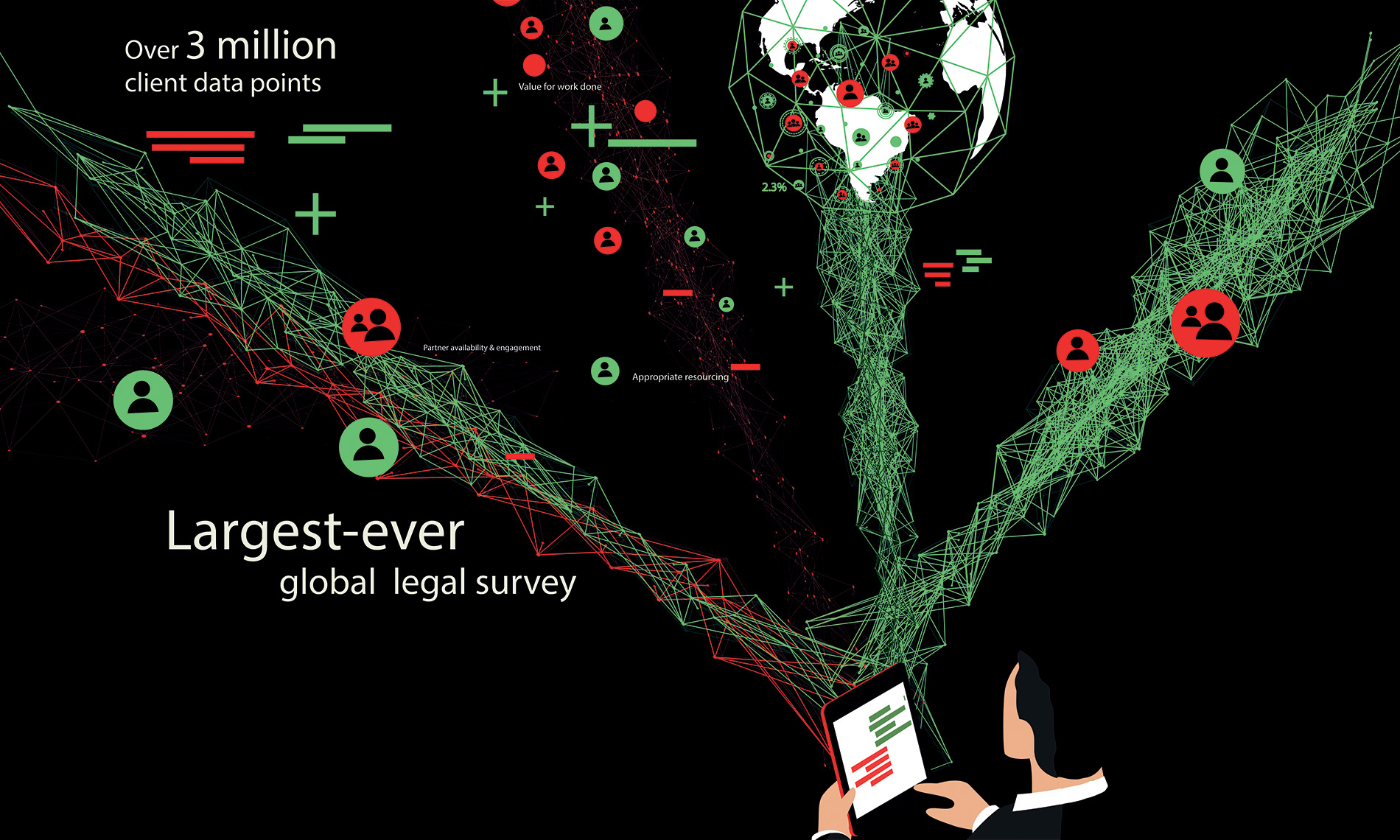
The world’s largest law firms are continuing to get bigger. Last year the combined number of lawyers across the Global 100 rose to almost 150,000, with Dentons – the world’s largest by headcount – housing more than 10,000 globally.
But while these international giants now cater to most commercial legal needs, in most corners of the globe, groundbreaking new analysis of the views of the people these firms care about most – their clients – has found conclusive evidence that smaller, specialist practices are outstripping them on quality of service. Continue reading “Client service uncovered: The best-rated firms revealed”

Sponsored by


‘Vantage points’
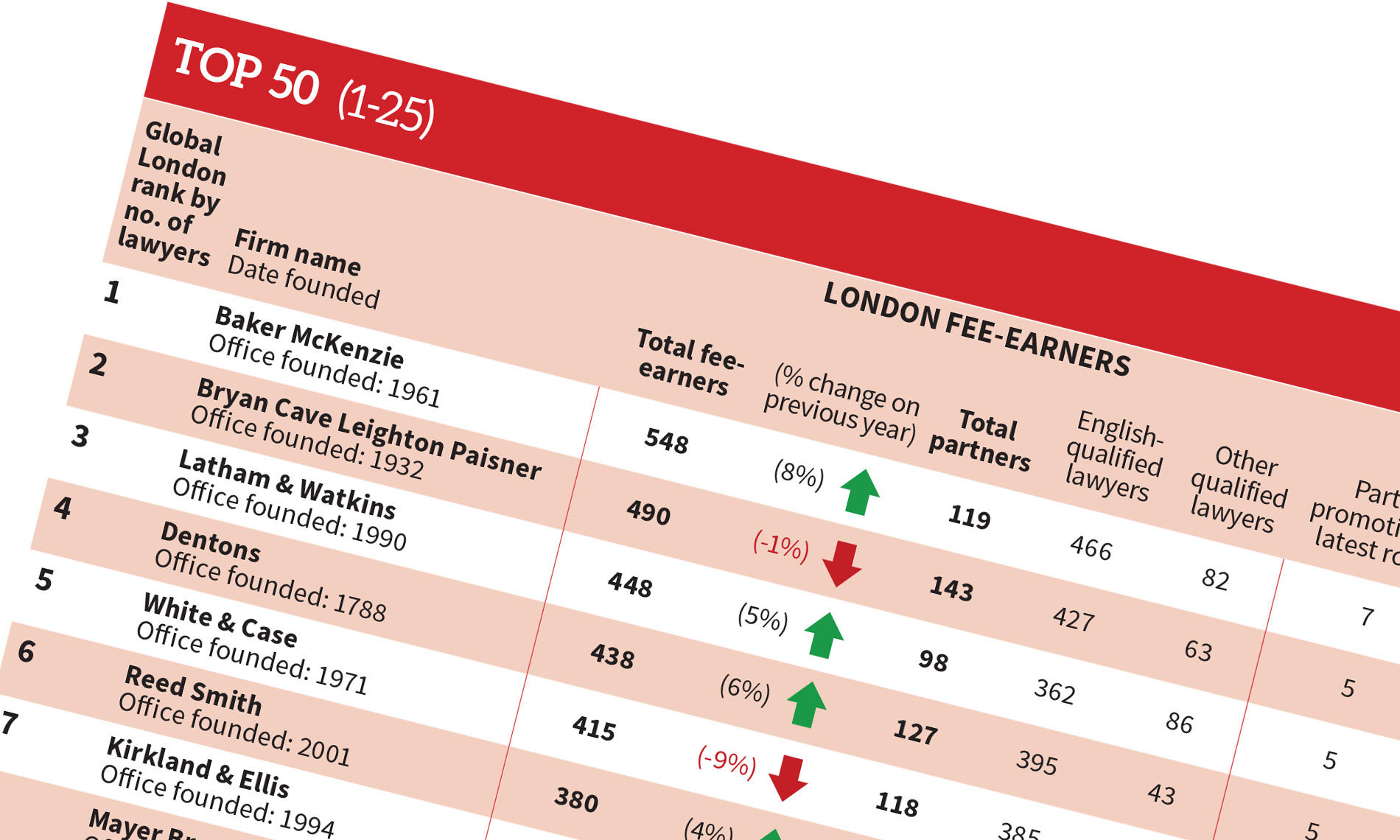
Global London top 50
‘Heavy hangs the crown – Can Latham remain the global firm to beat?’

‘F=ma’
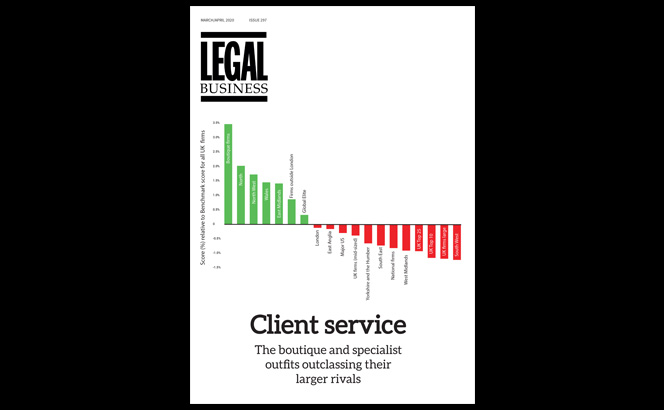
While much of the country works from home we are providing more options for you to access your copy of Legal Business. Please see below for links to a limited version followed by a complete version. The complete version is only accessible to subscribers. Please make sure you are logged into the site to see the link.
Limited version Continue reading “Access your print copy online – LB297”

Upon confirmation of the spread of Covid-19 in Turkey with the declaration of the first case on 11 March 2020 and simultaneously with the World Health Organization’s declaration of COVID-19 as a global pandemic, government started to take certain measures including banning people above the age of 65 from going out; closing down certain workplaces. The measures are actively changing based on the evolution of the pandemic disease, yet, no complete lock down has been announced for many sectors but companies are encouraged to take their own measures during this period. This article mainly focuses on the impact of the Covid-19 pandemic on the employment relationship by presenting possible options provided under the Turkish labour legislation.
It is globally accepted that the Covid-19 pandemic is a force majeure event. However, force majeure provisions provided under the Labour Code (Law No 4857) (published in the Official Gazette dated 10 June 2003 and numbered 25134) (Labour Code) allow parties to terminate the employment relationship under limited circumstances. Continue reading “Sponsored briefing: Labour law issues in Covid-19 crisis”
The Banking Regulation and Supervision Agency (the BRSA), the Central Bank of Republic of Turkey (the CBRT) and the Banks’ Association of Turkey (the BAT) have swiftly taken several measures after the declaration of the first confirmed Covid-19 case in Turkey on 11 March 2020 in order to mitigate the outbreak’s impact on the financial markets and soften expected disruptions in commercial activities that may be caused by Covid-19. Such measures are set forth by the relevant regulators in order to provide flexibility to financial institutions (the FIs) to ensure (i) financial stability of the FIs and (ii) meet FIs customers’ needs such as facilitating cash flow of individuals and SMEs which are likely to be the most affected by this outbreak and ultimately to mitigate the macroeconomic effects and risks arising from Covid-19 in financial markets.
Firstly, the BRSA, in its press release dated 16 March 2020, indicated that the business continuity plans prepared routinely by banks in accordance with the Guide on Management of Operational Risks with the aim of continuity of FIs’ activities and limitation of losses which arise from severe business interruptions are re-examined by the BRSA and in this regard all necessary measures are taken. This measure has been taken by the BRSA within the framework of prudent supervision approach. Continue reading “Sponsored briefing: Measures taken by the regulatory authorities in the banking sector regarding the Covid-19 outbreak”

Norton Rose Fulbright (NRF) is asking its staff to agree to a 20% cut of weekly working hours and delaying profit distribution to partners in response to the Covid-19 crisis.
The firm announced today (20 April) it is asking its employees to sign up to a temporary change of their contract for one year from 20 April which will make them eligible to move to 80% of their working hours and base salary. Continue reading “NRF asks staff to cut working hours by a fifth and defers partner pay in re-introduction of financial crisis-era flexi scheme”

Businesses have shown remarkable resilience through an era defined by increasingly rapid change. Innovation, diversity and agility have driven adaptability and resilience. But now such resilience is facing a far more severe test in the shape of the coronavirus pandemic sweeping through societies and economies. Yet well-led businesses identify themes and opportunities emerging even from this crisis.
General counsel have the challenge of juggling (i) strategy – working with their boards on strategy and performance; (ii) legal issues and regulatory change; and (iii) team leadership and delivery (who, what, where, how). Identifying a framework and common themes can help decision-making. Continue reading “Competition, supply chains and act of God clauses – First considerations for GCs in their Covid-19 responses”