Editor’s Letter

Lawyers across the world like to talk about rubber stamping things, even though few who qualified in the last 15 years will have seen a rubber stamp let alone used one to certify a document. But, as we found out speaking to GCs across Asia Pacific for this special report, when a lawyer in that region talks about rubber stamping something, they often mean it literally.

‘Most documents I deal with require physically stamping,’ lamented one Indian GC. ‘Even if you want to automate some part of that process in the end you will need to get a stamp. That means a trip to another office, a taxi ride somewhere else in the city, a long wait in a queue. All to get that piece of paper stamped.’

India may be notoriously bureaucratic, but the problem was far from unique to that country. GCs from Japan, Korea, Indonesia, and even ultra-efficient Singapore told us of cultures rooted in face-to-face contact, deference to senior decision makers and established hierarchies. As a result, even that simplest of legal technologies, the electronic signature, had failed to take root.

The obstacles facing GCs who wanted to introduce technology felt unmovable. Until a pandemic hit. After nearly a year of lockdown, businesses across Asia have embraced new ways of working.

To understand just how much lawyers have adapted to tech in these strange times, GC magazine teamed up with World Services Group to survey over 100 of Asia Pacific’s leading general counsel. We asked them about everything from the impact of Covid-19 on the legal team’s efficiency to their use of AI, how they find the right software (and the money to buy it), and their expectations of outside counsel when it comes to technology.

We found evidence of a region that is almost uniformly embracing technology, a region where even the most entrenched cultural habits may be coming to an end. But let us not get carried away.

Any discussion of how GCs in the Asia Pacific region are using legal tech is liable to fall into the trap of focusing on culture first. Certainly, this special edition shows much evidence of country-specific traits that are restricting or encouraging the use of technology, but it also shows that GCs the world over are facing the same issues when it comes to technology.

Broadly, there are three steps involved in the acquisition of legal tech, all of which are things lawyers have historically struggled with: Knowing what’s out there; understanding and benchmarking the capabilities vs the cost, and convincing the business that it is going to save time and money. Until GCs get to grips with these procurement-driven approaches to buying technology their successes in finding suitable platforms is likely to remain limited.


Foreword: Ramon Moyano

On behalf of all of World Services Group, I am delighted to welcome you to the third edition of our GC special reports, looking at the importance and impact of technology on the legal profession.

This issue of the report is indeed a timely one, as at no point in our professional lives has the profound effect of technology been more evident. Since the onset of the pandemic, private practice and in-house counsel alike have universally transitioned to new ways of working largely driven by technology, demonstrating on one hand the adaptability of the profession, while on the other, dispelling tired notions of lawyers as technological luddites.

As the legal leaders featured throughout the report illustrate, innovation – particularly as it pertains to technology – is apparent in every corner of the profession. Just as we saw in the first two editions, neither budget nor business size need to be obstacles to innovating, with much of the counsel-driven development originating from little more than an idea and an opportunity.

Yet as we celebrate the shared successes seen across the legal industry, we must remain cognizant that innovation is a journey on which we will never reach a final destination. And with evolution emerging from every corner, it would be all too easy to rest on our collective laurels instead of continuing to build on the progress made. So, while we look on at the innovators and their accomplishments detailed throughout the report, we should also consider what we can do to foster and facilitate the emergence of the next wave of visionaries, set to take the profession further still.

Here at World Services Group, we want to embody the change that we advocate for. As an organization, we have seen that investing in technology, talent and corporate sustainability best practices that foster social and economic development are essential elements for ongoing business success – all of which represent key commitments I have made for my tenure as Chairman in 2020-21. By taking a strategic approach to our proprietary digital platform, empowering emerging leaders across our network, as well as improving training and accessibility to technology for all our membership, World Services Group is committed to ensuring that we are properly prepared to capitalize on the growing wave of technological innovation, for the benefit of both our members and clients.

In closing, I’d like to thank all of those in the legal community who contributed their thoughts and insights as part of the research for this report. By sharing your own lived experiences along this journey, I have no doubt you will help to shape and inspire the coming generation of leaders and innovators, set to once again disrupt the idea of what it means to be a lawyer.

Ramon Moyano
Chairman
World Services Group

Partner
Beccar Varela

Zero-sum gain

Legal tech is becoming big business in the Asia Pacific region, so much so that the Singapore Academy of Law (SAL) has opened a legal tech accelerator. But much of the industry’s focus remains on selling to law firms. For GCs and in-house legal teams, making sense of the myriad systems can be a daunting task.

It is no surprise then that GCs would like to see law firms doing more to help them make sense of the market. While more than half of respondents to our survey (62%) said their external firms were using technology to deliver legal services, under a quarter (23%) said their firms had offered to share information on how technology might benefit their legal team’s operations.

‘Law firms need to demonstrate the value to in-house teams of adopting technological solutions’, noted one respondent, a Hong Kong-based legal manager at an international consumer goods company. ‘Right now, I think the focus of law firms is using technology to improve their bottom line rather than creating value for clients.’

Another respondent, an Indonesia-based head of legal at a large insurance provider, added: ‘It would be great if the external firm could also offer the service of helping in-house teams find the right legal tech solution for their team. They are often far more aware of the trends and services being used in the market so this would really help us understand things.’

Given the clear client demand, it is surprising that law firms are not seeing the opportunity here. Then again, law firms themselves may have a lot to learn. Just 22% of respondents were satisfied with the technology being used by their external firms.

Law firms should take this dissatisfaction seriously – 94% of respondents said it was important for law firms to keep up with new technologies, while 59% said they had started assessing their firms’ use of technology as part of their formal panel review process.

The incentive for law firms is clear. While legal tech is often seen as a disintermediator, disruptor or challenger to the established order, it does not have to be treated as a zero-sum game. As Susan Cattell, senior legal operations manager at Australian financial services company AMP, notes: ‘Clients and law firms have to work together to ensure the right tech solutions have been put into place and that they benefit both parties.’

Comment: Failings in Beckwith prosecution undermine #MeToo fight and muzzle regulator

line-up

The ink is barely dry on Friday’s High Court ruling that overturned the Solicitors Disciplinary Tribunal’s finding against ex-Freshfields partner Ryan Beckwith and the shockwaves are starting to be felt around the legal industry.

In the unlikely event that the substance of the ruling has escaped anyone, the Queen’s Bench Division’s judgment reversed the SDT’s October 2019 findings that Beckwith’s drunken sexual activity with an intoxicated associate breached Principles 2 and 6 of the Solicitors Regulation Authority’s code of conduct, reversed his £35,000 fine and quashed the £200,000 costs order.  Continue reading “Comment: Failings in Beckwith prosecution undermine #MeToo fight and muzzle regulator”

BT to invest £2.7m into 30-strong legal support hub in Northern Ireland

Telecoms giant BT announced today (1 December) it is poised to commit £2.7m in investment to create a new legal support hub in Belfast which will house 30 commercial lawyer positions over the next four years.

The standalone centre will be the first of its kind for BT in Northern Ireland, with its lawyers being used to provide legal support to colleagues across the wider BT Group. Seven of the 30 commercial lawyer positions are already in place.  Continue reading “BT to invest £2.7m into 30-strong legal support hub in Northern Ireland”

Revolving doors: spate of hires from regional UK and niche City firms dominate lateral recruitment  

By far the largest group of hires of the latest batch this week has been made by listed LB100 firm Keystone Law, showing the attractiveness of the alternative law firm model to recruits from conventional practices in the current climate.

Keystone has added another 14 new partners – 11 of which were lateral hires – including Stuart Carter, an energy partner from Fieldfisher; IP specialist Fiona Nicholson from Bristows; Edwin Coe employment partner Alexandra Carn; Fletcher Day property litigators Chris Hill and Greg Barnbrook; real estate partners James Daglish and John Downing from Goodman Derrick; litigation specialists Elaine Chan and Robert Kenyon from Ward Hadaway and PDT Solicitors respectively; and corporate partners Anna McGill, who joins from Gordon Brown Law, and Oliver Mellman, who was managing director of Provenance Legal.  Continue reading “Revolving doors: spate of hires from regional UK and niche City firms dominate lateral recruitment  “

‘Popular outcry is not proof’: Beckwith’s #MeToo decision overturned in controversial court judgment

In what has been described as a landmark ruling, former Freshfields Bruckhaus Deringer partner Ryan Beckwith has prevailed in his appeal in the High Court against the Solicitors Disciplinary Tribunal’s findings against him in a high-profile sexual misconduct case.

The Queen’s Bench Division today (27 November) overturned the tribunal’s October 2019 findings that Beckwith’s behaviour with a junior lawyer was in breach of principles two and six of the Solicitors Regulation Authority’s code of conduct, requiring solicitors to ‘act with integrity’ and ‘behave in a way that maintains the trust the public places in you and in the provision of legal services’.  Continue reading “‘Popular outcry is not proof’: Beckwith’s #MeToo decision overturned in controversial court judgment”

Revolving doors: Greenberg makes Dutch real estate play in brisk week for lateral hires

Amsterdam - ABN AMRO

Greenberg Traurig has made a notable team hire in Europe in the past week, with a key partner exiting a leading independent Euro Elite firm in favour of a large international player.

Greenberg, for which real estate is a signature practice in its home market of the US, has bolstered its Amsterdam offering with the addition of an Amsterdam and London team led by partner David van Dijk from leading Benelux independent NautaDutilh. Van Dijk is noted as a leading individual in the Netherlands chapter of The Legal 500 EMEA and has been the head of the international real estate practice at Nauta and a member of the supervisory board of the firm based in Amsterdam, where he has led a robust practice for many years, in both transactional real estate and disputes involving the asset class. Continue reading “Revolving doors: Greenberg makes Dutch real estate play in brisk week for lateral hires”

‘Leading-edge experience’ – Slaughter and May looks in-house to make rare City disputes partner hire

broken scales

Slaughter and May has made a rare City hire, the firm announced today (19 November), recruiting a partner into its disputes and investigations practice from in-house.

Gayathri Kamalanathan is currently head of group litigation and enforcement at Danske Bank in Copenhagen, having been at the bank for almost two years, but is now set to join Slaughters in April. Prior to joining Dankse Bank, Kamalanathan had an eight-year spell at Deutsche Bank where she served as managing director UK head of litigation and enforcement and spent nine years at Freshfields Bruckhaus Deringer where she was a senior associate. Continue reading “‘Leading-edge experience’ – Slaughter and May looks in-house to make rare City disputes partner hire”

The year of working from home

A growing gig economy, automation, Brexit… the threats to UK employment were already growing. Then a global pandemic hit. As life is redrawn and rebuilt on a near-daily basis by Covid-19, employment lawyers are struggling to recontextualise existing laws while grappling with the ever-changing guidelines being churned out at dizzying speed. Kathryn Dooks, a partner in the employment team at Kemp Little, recalls the ‘mad rush’ at the beginning of the crisis. Continue reading “The year of working from home”

Competition at a crossroads

Mark Friend, partner and head of the London antitrust group at Allen & Overy, argues competition law in the UK is ‘currently at a crossroads’ and cites the current political climate and comments made by the Competition and Markets Authority’s (CMA) former chairman, Lord Tyrie. ‘This crossroads is partly driven by Brexit, and what that will mean to the CMA and future enforcement priorities, but also partly driven by this feeling among some policy makers that competition law may not be working properly, or is not adequately protecting all consumers.’ Continue reading “Competition at a crossroads”

Eye of the storm

‘We are on the threshold of what is going to be the biggest restructuring challenge in the history of insolvency. Nothing will have come close’. So says Mark Phillips QC of South Square Chambers on the Corporate Governance and Insolvency Act 2020, passed in June 2020 at the height of the Covid-19 crisis. The legislation’s stated purpose is to give companies affected by the lockdown and the potential fallout from the UK’s exit deal – or lack of one – with the European Union the breathing space and tools needed to survive a mounting debt or liquidity crisis.

Continue reading “Eye of the storm”

Eye of the storm

‘We are on the threshold of what is going to be the biggest restructuring challenge in the history of insolvency. Nothing will have come close’. So says Mark Phillips QC of South Square Chambers on the Corporate Governance and Insolvency Act 2020, passed in June 2020 at the height of the Covid-19 crisis. The legislation’s stated purpose is to give companies affected by the lockdown and the potential fallout from the UK’s exit deal – or lack of one – with the European Union the breathing space and tools needed to survive a mounting debt or liquidity crisis.

Continue reading “Eye of the storm”

Mediations in an emergency

It doesn’t need to be said that the current Covid-19 pandemic will have significant, lasting impacts on businesses. Parties negotiating contracts even a year ago could never have envisioned the situation in which they would now find themselves, and the resulting tangle of part-performance and non-performance is expected to significantly overburden courts around the world, both while the crisis is ongoing and after, when the disputes that have been put on hold for the duration of the crisis begin to flood the judicial system.

Continue reading “Mediations in an emergency”

‘We expect the highest standards of behaviour’: Finance partner leaves Slaughter and May following investigation

Slaughter and May office

A partner has left Slaughter and May following an internal investigation, the firm has confirmed today (18 November). Finance partner Oliver Storey has retired from the firm’s partnership with immediate effect, with Slaughters notifying the Solicitors Regulation Authority (SRA) of the matter.

Senior partner, Steve Cooke, said in a statement: ‘Following an internal investigation, Oliver Storey has retired from the partnership with immediate effect. The SRA has been notified and we will not be commenting further at this time. Continue reading “‘We expect the highest standards of behaviour’: Finance partner leaves Slaughter and May following investigation”

End of an era for Travers as Reed to succeed Patient as managing partner

David Patient is to hand the Travers Smith managing partner baton to private equity partner Edmund Reed, the firm announced this morning (16 November).

Reed, a partner in Travers’ private equity and financial sponsors group and member of the firm’s partnership board since 2013, will assume the role on 1 July 2021. Continue reading “End of an era for Travers as Reed to succeed Patient as managing partner”

Revolving doors: partner recruitment takes on more international hue with key hires in Asia and Middle East

Global 100 heavyweight Milbank has made the most significant lateral hire play of the past week, hiring not one but three private equity specialists in Hong Kong from the Magic Circle.

The firm has hired two Clifford Chance mergers and acquisitions partners, Andrew Whan and Neeraj Budhwani, and Linklaters global head of banking Davide Mencacci. Continue reading “Revolving doors: partner recruitment takes on more international hue with key hires in Asia and Middle East”

Falling angels

Seemingly unable to move on from damaging #MeToo allegations; suggestions of an inappropriate drinking culture; an incomplete UK move to Bishopsgate; and a succession of high-profile departures culminating in Skadden’s poaching of Bruce Embley on the eve of Dawson’s appointment; all have contributed to keeping Freshfields in the press for the wrong reasons.

At the same time, and perhaps most important of all, there is the reputational elephant in the room: namely, the cum-ex scandal in Germany. This involves aggressive tax strategies that were championed by a former Freshfields partner so as to take advantage of apparent loopholes in German dividends tax law. (See ‘Der Freshfields-Skandal‘ for detailed analysis.)

What seems striking to outsiders is that other prominent (and respected) law firm tax departments in Germany – notably Linklaters and Hengeler Mueller – said no to their clients on these trades and refused to sign off legal opinion letters. So it seems that what Freshfields was doing was not common market practice (in other words, it cannot be said that every other law firm was doing the same, which is the usual excuse when a tax ploy proves to have been ill-conceived).

The consequences have been enormous. Firstly, it is estimated that cum-ex claims in Germany amount to €11bn (obviously, not all were signed off by Freshfields). Secondly, the Freshfields partner, along with a more junior colleague (also a partner at Freshfields), has since been arrested and faces criminal prosecution. Thirdly, Freshfields has settled a claim from the aggrieved administrators of Maple Bank (a cum-ex client of the firm that reclaimed €380m in tax that was never paid – and which has since gone bust) for €50m.

The two Freshfields partners involved have resigned. But the concern must be that there are potentially other cum-ex clients who might be minded to bring a claim against the firm, if only because German tax authorities now take such a dim view of such tactics. No doubt Freshfields has sufficient professional indemnity cover to meet claims that might be made, although it’s reasonable to suppose that partners in London (and other non-German locations) might be unhappy at having to make contributions.

Meanwhile reputational damage is already obvious – the German government has distanced itself from Freshfields and made clear it will not instruct the firm (when asked whether firms like Freshfields or others should be excluded from receiving future instructions, the German finance minister replied: ‘I cannot imagine that new assignments will be placed there’ – which is a nice way of saying they will not get any work). Might other EU governments follow its lead?

Similarly, in the corporate sector, German semiconductor manufacturer Infineon (market cap of $30bn) was forced to justify retaining Freshfields as legal counsel after one of its shareholders challenged the firm’s ethical standards. GCs we surveyed for The Legal 500 Deutschland voiced their anxiety about being ‘thrown into the same pot’ by continuing to instruct a firm associated with ethically suspect advice. And with peer firms in Germany already grumbling about the impact of the scandal on recruitment into their tax departments, how can Freshfields hope to safeguard its own longer-term position in the market?

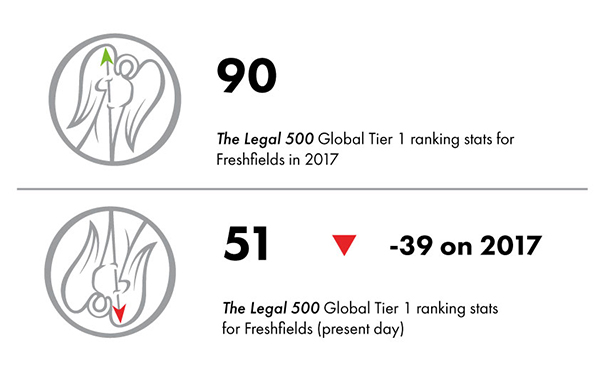
There are indications that this is not a one-year problem, and that there are more deep-seated causes for concern. At The Legal 500 it is noticeable to me that in recent years there has been a sharp decline in the number of Legal 500 top-tier recommendations globally for Freshfields (compare 90 in 2017 and 51 this year). Perhaps that is due to the firm being less open and transparent about its work, but I suspect it runs deeper than that – and it reflects less enthusiastic recommendations from clients and peers, as well as a change in the culture of the firm.

Global law firms build their practices on the basis of global expertise (which Freshfields has in abundance), but also on a global reputation. In effect, global clients want to be associated with the best and they want to be associated with legal brands that enhance their own corporate values. The danger for Freshfields is that cum-ex makes it a target of global activism (for instance, by tax-transparency campaigners in the UK) which might escalate into further bad PR. And that may then lead some major clients to question whether there are other law firm brands that they might prefer to be associated with.

That is the big unknown for Freshfields. With good fortune this will remain a localised (German) crisis. With bad luck it could turn into an international embarrassment.

The future reputation of Freshfields will be decided in the medium to long term. In the short term, I note the firm’s decline in our rankings. I note the negative comments from German GCs. I note some significant departures. I note a culture that seems to be more inward-looking and less transparent than it was a few years go. And I worry that the firm may have become over-aggressive in its pursuit of profits.

Above all else, it is client perceptions that matter. On that basis, if Freshfields was quoted stock, my buy/hold/sell recommendation would be: ‘Sell’.

John Pritchard