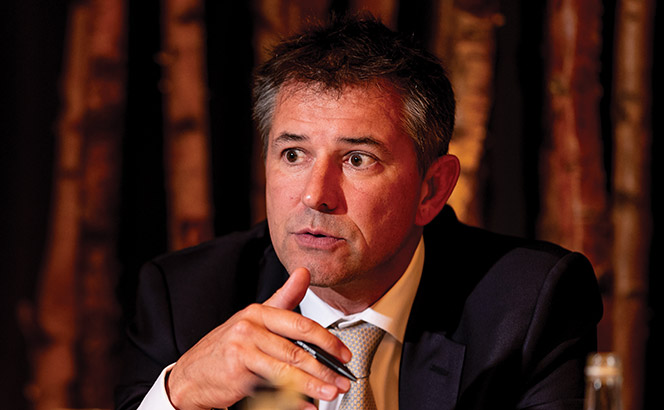
Revolving doors: Greenberg makes Dutch real estate play in brisk week for lateral hires

Amsterdam - ABN AMRO

Greenberg Traurig has made a notable team hire in Europe in the past week, with a key partner exiting a leading independent Euro Elite firm in favour of a large international player.

Greenberg, for which real estate is a signature practice in its home market of the US, has bolstered its Amsterdam offering with the addition of an Amsterdam and London team led by partner David van Dijk from leading Benelux independent NautaDutilh. Van Dijk is noted as a leading individual in the Netherlands chapter of The Legal 500 EMEA and has been the head of the international real estate practice at Nauta and a member of the supervisory board of the firm based in Amsterdam, where he has led a robust practice for many years, in both transactional real estate and disputes involving the asset class. Continue reading “Revolving doors: Greenberg makes Dutch real estate play in brisk week for lateral hires”

‘Leading-edge experience’ – Slaughter and May looks in-house to make rare City disputes partner hire

broken scales

Slaughter and May has made a rare City hire, the firm announced today (19 November), recruiting a partner into its disputes and investigations practice from in-house.

Gayathri Kamalanathan is currently head of group litigation and enforcement at Danske Bank in Copenhagen, having been at the bank for almost two years, but is now set to join Slaughters in April. Prior to joining Dankse Bank, Kamalanathan had an eight-year spell at Deutsche Bank where she served as managing director UK head of litigation and enforcement and spent nine years at Freshfields Bruckhaus Deringer where she was a senior associate. Continue reading “‘Leading-edge experience’ – Slaughter and May looks in-house to make rare City disputes partner hire”

The year of working from home

A growing gig economy, automation, Brexit… the threats to UK employment were already growing. Then a global pandemic hit. As life is redrawn and rebuilt on a near-daily basis by Covid-19, employment lawyers are struggling to recontextualise existing laws while grappling with the ever-changing guidelines being churned out at dizzying speed. Kathryn Dooks, a partner in the employment team at Kemp Little, recalls the ‘mad rush’ at the beginning of the crisis. Continue reading “The year of working from home”

Competition at a crossroads

Mark Friend, partner and head of the London antitrust group at Allen & Overy, argues competition law in the UK is ‘currently at a crossroads’ and cites the current political climate and comments made by the Competition and Markets Authority’s (CMA) former chairman, Lord Tyrie. ‘This crossroads is partly driven by Brexit, and what that will mean to the CMA and future enforcement priorities, but also partly driven by this feeling among some policy makers that competition law may not be working properly, or is not adequately protecting all consumers.’ Continue reading “Competition at a crossroads”

Eye of the storm

‘We are on the threshold of what is going to be the biggest restructuring challenge in the history of insolvency. Nothing will have come close’. So says Mark Phillips QC of South Square Chambers on the Corporate Governance and Insolvency Act 2020, passed in June 2020 at the height of the Covid-19 crisis. The legislation’s stated purpose is to give companies affected by the lockdown and the potential fallout from the UK’s exit deal – or lack of one – with the European Union the breathing space and tools needed to survive a mounting debt or liquidity crisis.

Continue reading “Eye of the storm”

Eye of the storm

‘We are on the threshold of what is going to be the biggest restructuring challenge in the history of insolvency. Nothing will have come close’. So says Mark Phillips QC of South Square Chambers on the Corporate Governance and Insolvency Act 2020, passed in June 2020 at the height of the Covid-19 crisis. The legislation’s stated purpose is to give companies affected by the lockdown and the potential fallout from the UK’s exit deal – or lack of one – with the European Union the breathing space and tools needed to survive a mounting debt or liquidity crisis.

Continue reading “Eye of the storm”

Mediations in an emergency

It doesn’t need to be said that the current Covid-19 pandemic will have significant, lasting impacts on businesses. Parties negotiating contracts even a year ago could never have envisioned the situation in which they would now find themselves, and the resulting tangle of part-performance and non-performance is expected to significantly overburden courts around the world, both while the crisis is ongoing and after, when the disputes that have been put on hold for the duration of the crisis begin to flood the judicial system.

Continue reading “Mediations in an emergency”

‘We expect the highest standards of behaviour’: Finance partner leaves Slaughter and May following investigation

Slaughter and May office

A partner has left Slaughter and May following an internal investigation, the firm has confirmed today (18 November). Finance partner Oliver Storey has retired from the firm’s partnership with immediate effect, with Slaughters notifying the Solicitors Regulation Authority (SRA) of the matter.

Senior partner, Steve Cooke, said in a statement: ‘Following an internal investigation, Oliver Storey has retired from the partnership with immediate effect. The SRA has been notified and we will not be commenting further at this time. Continue reading “‘We expect the highest standards of behaviour’: Finance partner leaves Slaughter and May following investigation”

End of an era for Travers as Reed to succeed Patient as managing partner

David Patient is to hand the Travers Smith managing partner baton to private equity partner Edmund Reed, the firm announced this morning (16 November).

Reed, a partner in Travers’ private equity and financial sponsors group and member of the firm’s partnership board since 2013, will assume the role on 1 July 2021. Continue reading “End of an era for Travers as Reed to succeed Patient as managing partner”

Revolving doors: partner recruitment takes on more international hue with key hires in Asia and Middle East

Global 100 heavyweight Milbank has made the most significant lateral hire play of the past week, hiring not one but three private equity specialists in Hong Kong from the Magic Circle.

The firm has hired two Clifford Chance mergers and acquisitions partners, Andrew Whan and Neeraj Budhwani, and Linklaters global head of banking Davide Mencacci. Continue reading “Revolving doors: partner recruitment takes on more international hue with key hires in Asia and Middle East”

Falling angels

Seemingly unable to move on from damaging #MeToo allegations; suggestions of an inappropriate drinking culture; an incomplete UK move to Bishopsgate; and a succession of high-profile departures culminating in Skadden’s poaching of Bruce Embley on the eve of Dawson’s appointment; all have contributed to keeping Freshfields in the press for the wrong reasons.

At the same time, and perhaps most important of all, there is the reputational elephant in the room: namely, the cum-ex scandal in Germany. This involves aggressive tax strategies that were championed by a former Freshfields partner so as to take advantage of apparent loopholes in German dividends tax law. (See ‘Der Freshfields-Skandal‘ for detailed analysis.)

What seems striking to outsiders is that other prominent (and respected) law firm tax departments in Germany – notably Linklaters and Hengeler Mueller – said no to their clients on these trades and refused to sign off legal opinion letters. So it seems that what Freshfields was doing was not common market practice (in other words, it cannot be said that every other law firm was doing the same, which is the usual excuse when a tax ploy proves to have been ill-conceived).

The consequences have been enormous. Firstly, it is estimated that cum-ex claims in Germany amount to €11bn (obviously, not all were signed off by Freshfields). Secondly, the Freshfields partner, along with a more junior colleague (also a partner at Freshfields), has since been arrested and faces criminal prosecution. Thirdly, Freshfields has settled a claim from the aggrieved administrators of Maple Bank (a cum-ex client of the firm that reclaimed €380m in tax that was never paid – and which has since gone bust) for €50m.

The two Freshfields partners involved have resigned. But the concern must be that there are potentially other cum-ex clients who might be minded to bring a claim against the firm, if only because German tax authorities now take such a dim view of such tactics. No doubt Freshfields has sufficient professional indemnity cover to meet claims that might be made, although it’s reasonable to suppose that partners in London (and other non-German locations) might be unhappy at having to make contributions.

Meanwhile reputational damage is already obvious – the German government has distanced itself from Freshfields and made clear it will not instruct the firm (when asked whether firms like Freshfields or others should be excluded from receiving future instructions, the German finance minister replied: ‘I cannot imagine that new assignments will be placed there’ – which is a nice way of saying they will not get any work). Might other EU governments follow its lead?

Similarly, in the corporate sector, German semiconductor manufacturer Infineon (market cap of $30bn) was forced to justify retaining Freshfields as legal counsel after one of its shareholders challenged the firm’s ethical standards. GCs we surveyed for The Legal 500 Deutschland voiced their anxiety about being ‘thrown into the same pot’ by continuing to instruct a firm associated with ethically suspect advice. And with peer firms in Germany already grumbling about the impact of the scandal on recruitment into their tax departments, how can Freshfields hope to safeguard its own longer-term position in the market?

There are indications that this is not a one-year problem, and that there are more deep-seated causes for concern. At The Legal 500 it is noticeable to me that in recent years there has been a sharp decline in the number of Legal 500 top-tier recommendations globally for Freshfields (compare 90 in 2017 and 51 this year). Perhaps that is due to the firm being less open and transparent about its work, but I suspect it runs deeper than that – and it reflects less enthusiastic recommendations from clients and peers, as well as a change in the culture of the firm.

Global law firms build their practices on the basis of global expertise (which Freshfields has in abundance), but also on a global reputation. In effect, global clients want to be associated with the best and they want to be associated with legal brands that enhance their own corporate values. The danger for Freshfields is that cum-ex makes it a target of global activism (for instance, by tax-transparency campaigners in the UK) which might escalate into further bad PR. And that may then lead some major clients to question whether there are other law firm brands that they might prefer to be associated with.

That is the big unknown for Freshfields. With good fortune this will remain a localised (German) crisis. With bad luck it could turn into an international embarrassment.

The future reputation of Freshfields will be decided in the medium to long term. In the short term, I note the firm’s decline in our rankings. I note the negative comments from German GCs. I note some significant departures. I note a culture that seems to be more inward-looking and less transparent than it was a few years go. And I worry that the firm may have become over-aggressive in its pursuit of profits.

Above all else, it is client perceptions that matter. On that basis, if Freshfields was quoted stock, my buy/hold/sell recommendation would be: ‘Sell’.

John Pritchard

Der Freshfields-Skandal

It’s 9 September in the German parliament. Stefan Liebich of the democratic socialist party, Die Linke, stands up to quiz finance minister Olaf Scholz, a member of the Social Democrat Party. His question:  ‘Have there been any thoughts on your part whether firms like Freshfields or others should be excluded from receiving future instructions?’

Scholz responds: ‘In relation to the law firm you mentioned… I cannot imagine that new assignments will be placed there’.

For any normal law firm that would be a body blow. For an international firm with 27 offices in 17 jurisdictions, representing financial institutions and governments, as well as national and multinational corporations, it is a humiliation. How did the oldest international law firm in the world end up with such a public slap-down? And what prompted Scholz, one of the candidates to succeed Angela Merkel, to suggest the German government should stop instructing Freshfields?

The answer lies in the cum-ex tax fraud scheme, widely acknowledged as the biggest tax scandal in Germany’s history, in which Freshfields Bruckhaus Deringer has been identified as a major player. Since its offices were first raided in the autumn of 2017, Freshfields has been hit with a steady stream of bad press for its involvement in the scheme. In August 2019, liquidators of the now defunct Frankfurt-based lender and Freshfields client, Maple Bank, which conducted cum-ex trades, sued the firm for damages. Freshfields agreed to a €50m settlement.

Cum-Ex: What is it?

The cum-ex scandal involves a controversial dividend arbitrage trading practice, which took advantage of a loophole in German tax law. It involved banks and stockbrokers rapidly exchanging shares with (cum) and then without (ex) dividends between three parties, in a way that enabled them to hide the identity of the actual owner. At least two of these parties then claimed rebates on capital gains tax that had only been paid once. These trades were executed between 2001 and 2011, and were formally prohibited in Germany in 2012. Because of these deals, billions in tax went uncollected by the German state. Other countries beyond Germany have also been affected by the cum-ex tax fraud scheme. Across Europe, cum-ex trading is said to have cost taxpayers up to €55bn.

Reporting has largely focused on investigations surrounding the departure and subsequent arrest of partner Ulf Johannemann, the firm’s former international head of tax, in November 2019. More recently, in June 2020, another tax partner, who was the firm’s last specialist for tax products in Germany and an alleged adviser on cum-ex products, also left Freshfields and was charged with aiding and abetting serious tax evasion.

Freshfields’ direct response to the whole matter has appeared subdued. The fact that the firm created a  German ethics committee, with a code of ethical principles and rules of conduct, in May 2020, perhaps was a belated acknowledgement of the need for change but was unable in practical terms to extricate the firm from the scandal.

What is clear is that the cum-ex scandal has shaken the entire tax sector and in turn inspired reflection on the professional and social responsibilities of major actors such as Freshfields. As a result, law firms’ approach to the circuitous issue of ethics now has greater impact on law firm selection decisions.

We spoke to top general counsel (GCs) in Germany to gauge their reaction: to what extent will ethical standards play a role in choosing a law firm? Should a law firm’s work be not only legally but also ethically and morally sound? Will GCs be content to work with Freshfields (and other firms) implicated in the cum-ex scandal? And what reputational damage – if any – will those firms suffer?

Legal or illegal? Moral or immoral?

Structured finance in tax law is not new, departments for tax-optimised products at financial institutions are not new and, indeed, tax arbitrage and dividend stripping is neither new nor criminal. To the frustration of tax lawyers, some falsely lump together cum-cum and cum-ex deals – two different types of dividend stripping – and most would agree that the illegality of cum-ex is not as straightforward and quite as obvious as, say, the carbon trading tax fraud (which has similarly been dubbed the ‘fraud of the century’).

Nonetheless, to  many tax lawyers, cum-ex deals, which essentially involve claiming tax credit twice on taxes only paid once, simply didn’t feel right. The market quickly divided into those who gave legal opinions and those who didn’t. Freshfields positioned itself in favour of these trades and their approval was key to banks going ahead with the transactions. Importantly and – in retrospect – embarrassingly for Freshfields, two of its leading competitors, Linklaters and Hengeler Mueller, both took a more conservative approach – and did not provide the necessary legal opinions to make cum-ex deals viable. So it appears that Freshfields was the outlier – albeit in a highly profitable sector of the tax market.

Looking back, tax lawyers agree that attitudes to tax avoidance have changed since the 2007/08 financial crash. Advice on tax reduction was previously very much the primary focus for many tax departments, and aggressive tax planning was not out of the norm. While this may still be the case for some, the cum-ex scandal has no doubt contributed towards a shift in attitudes. These days, the new key theme is risk minimisation. Clients’ appetite for risk has decreased dramatically and, as one tax partner at a large international firm points out, there are now even sustainability reports in tax law. Today, there is a completely different kind of awareness than there was ten years ago – and that new approach goes hand in hand with a call for transparency.

One might still argue that the tax adviser’s job is to assist the client with paying only those taxes that are required, and the point of tax advice is to arrange fiscal relations in order to pay the least taxes necessary. At the same time, however, as a GC and managing director at a major software company points out: ‘As an independent body responsible for the administration of justice, the lawyer also has obligations to society that exclude representing unethical practices’. While this latter commitment might have limitations, for instance in relation to representation in criminal proceedings, the ethical component of legal advice is actively influencing companies‘ choice of law firm.

Traditionally, ethics and law go hand in hand. Law firm partners should have an innate moral compass. On that basis no distinction should be necessary between legally sound and morally or ethically justifiable advice, and for corporate counsel this distinction should not play a role either when mandating a firm. Ethics committees and supervisors should therefore – in theory – be superfluous. But that traditional approach is now seen as old-fashioned and incompatible with some aggressive profit-driven clients demanding aggressive profit-driven solutions. The danger for any law firm is that it is obliged to adopt the moral compass of its important (high-profit) clients and place money-making over traditional ethics. That is a problem that faces all major firms, not just Freshfields, although it is Freshfields that is providing a case study in how high-profit work can come at a reputational cost.

What is significant from our conversations with German corporate counsel is the indication that client prerequisites are changing. While ethics were ‘taken for granted as an unwritten law’ (in the words of the GC at a major German manufacturer), that is seemingly going to change, with a greater expectation on firms to take responsibility for clear ethical policies and positions.

Today, nobody would deny that the cum-ex scheme is a crime against the taxpayer, so how is it that some tax lawyers and some firms – not just Freshfields – committed to approving these deals? Several GCs have commented  on corporate law firm culture and what they perceive to be changes in law firm behaviour: ‘These institutions change people’, according to the head of legal at a multinational financial services company, adding that they believe there is ‘an attitude that everything which is not legally prohibited is allowed.’

‘Two rotten apples discredit the entire firm’

So, who should take the blame for overstepping ethical boundaries and getting involved in what later transpired to be a huge tax evasion scheme at the taxpayers’ expense? From the GCs’ point of view, some maintain that the focus should remain on individual lawyers or, at most, specific legal teams.

Possible misconduct by individuals does not automatically mean misconduct by everyone else. But the cum-ex scandal has shown that an individual’s actions may lead not only to that individual’s reputation being damaged but that of an entire department will likely suffer as well. By extension it is entirely feasible that repercussions could end up being firm-wide. As a senior regional counsel at a medical technology company puts it: ‘Two rotten apples discredit the entire law firm… the behaviour of individual representatives of a law firm suggests the approval of unethical behaviour by other colleagues.’

Whether flawed culture has afflicted Freshfields is uncertain, but the danger for the firm is one of perception: whether those two malefactors are seen (fairly or unfairly) to indicate a deeper-seated problem in the larger organisation. At the very least, the crisis poses questions over internal checks and balances. The GC at a US retail company makes a blunt assessment: ‘The firm’s role in the scandal must be made clear and there needs to be a statement about the firm’s values, to which it will adhere in the future.’ Freshfields’ May 2020 code of ethical practice might have sought to answer the second part of this, but the risk for the firm is that it is seen as no more than a belated PR exercise to try to distance itself from the ongoing bad publicity without directly confronting the part it played in cum-ex matters.

Conversations with German GCs show that specific individuals’ or departments’ involvement in unethical behaviour is the most relevant factor. However, when it comes to securing new business, the focus is on the entire law firm.

Beyond not wanting to be associated with questionable ethics, some corporate counsel already go one step further and consider themselves to be ethical guides whose job is to set out the right path not solely on a legal level. One respondent, in their role as in-house counsel at a German consumer electronics company, sees themself ‘as a kind of moral compass for the company’. As such, mandating a firm involved in the cum-ex scandal goes against the grain.

‘Legally clean work is no longer enough today,’ they comment. Instead law firms are subjected to a holistic analysis by legal departments, and this in turn means ethics and morality are increasingly and more explicitly incorporated into corporate decision-making processes. If firms do not meet ethical standards, this may be reason enough not to mandate them. This is where reputational damage potentially has a snowball effect. Corporate counsel will be reluctant to be seen as approving of seemingly unethical behaviour. As a GC at a food services conglomerate states: ‘If some clients avoid the firm, remaining clients could feel they have been thrown into the same pot morally.’ In short, clients end up needing to justify mandating a firm whose ethics have already come under question and whose reputation has already taken a hit.

Freshfields has already come close to this scenario. In February, the giant German semiconductor manufacturer Infineon (market cap of $30bn+) was forced to justify retaining the firm as legal counsel after one of its shareholders challenged the decision’s ethical standards. ‘The board of directors instructed the law firm Freshfields, which is said to be responsible for what is probably the biggest tax robbery in post-war history,’ stated the shareholder, pointing to a violation of Infineon’s code of ethics and its code of business conduct.

Fairly or not, that is the context in which finance minister Scholz indicated that the German government should no longer instruct Freshfields. If the German government will not instruct the firm, then the pressure on GCs (German and non-German) not to appoint it may be ratcheted up another notch. The obvious danger for Freshfields with state intervention of this kind is that a local problem becomes a global problem – and that the governments of other countries decide that they should distance themselves from the firm.

The resounding message from clients is that any firm involved in an alleged scandal should not simply keep quiet. Instead, the firm should openly address and deal with its behaviour. As a first step, a firm should ‘fully clarify [the involvement in the scandal] and, if necessary, distance itself from unethical individuals’, says a senior regional counsel at a medical technology company.

A director of legal operations at a multinational pharmaceutical company agrees: ‘What matters to us is that law firms deal transparently and consistently with the issue.’ This includes ‘open communication and consequences of possible participation’. They point towards the need for documentation of measures that are being taken to prevent such a situation from arising again, sustainable instruments for monitoring and control, as well as training.

On top of that, they call for ‘a very clear statement from the firm’s management on the ethical principles to which the employees are obliged’. The Infineon example illustrates the dangers for firms not perceived to have taken up a proactive commitment to ethical standards, where that commitment has often already been taken by the client itself.

Indeed, some GCs report that they already include ‘ethical standards and values’ in their assessment when selecting preferred legal advisers, and law firms are increasingly measured against codes of conduct. This also reflects the larger trend within corporate companies, and the same is now expected of their business partners, including their legal advisers.

An existential threat?

No doubt, the consequences of being involved in the cum-ex scandal are existentially threatening for some individual financial, and also some legal advisers in Freshfields and other law firms (Freshfields was not the only law firm implicated in the global cum-ex market).

But it goes beyond the individual. As the cum-ex tax fraud scheme has engulfed law firms across Europe, departments and firms as a whole may need to delve deeper, openly evaluate the ethical aspects of their own practices and put new measures in place that reflect today’s call for transparency, accountability and ethical standards.

The results of our informal survey of German GCs showed that 88% agreed that firms involved in the scandal would suffer reputational consequences, and the same percentage claimed to take ethics into consideration when selecting a firm. Less than a third claimed to be content to work with implicated firms.

For months, Freshfields took little obvious public responsibility for its cum-ex advice. Only in late February did the firm for the first time issue a self-critical statement, when managing partner Stephan Eilers spoke with the German weekly newspaper Die Zeit. Previously, the firm’s official line focused entirely on the legality of its advice with no comment on the criminal legal proceedings against its partners or the damage claim settlements over its advice to the now defunct Maple Bank.

In a tentative change in communications, Eilers acknowledged that its advice in the context of cum-ex deals is not a glorious chapter in the firm’s history. The timing of this first open recognition of reputational damage strongly suggests it was spurred by the Infineon incident: it shortly followed Infineon’s AGM, where the Freshfields client was forced to justify using the firm.

Only a few months later, in May, Freshfields recognised the need to address its ethical standards by establishing an ethics committee and publishing its code of ethical principles and rules of conduct. But by then much harm had already been done. The clear message from some German GCs is that they still feel they are waiting for clarification from Freshfields on the role the firm played in cum-ex advice. Instead, Freshfields has become known for a wall of silence.

‘What matters to us is that law firms deal transparently and consistently with this issue.’

What will the firm do next? One suggestion from the reputational-damage casebook might be to appoint a credible outsider to conduct an independent review, which would then be published. That might go a long way to reassuring clients that the firm retains its moral and ethical compass. The model might be the searingly honest review commissioned by house-builder Persimmon in 2019 (which confronted the issue of whether high earnings had come at an unacceptable cost). There is no historical precedent for a Magic Circle firm doing that; Freshfields had no comment in response to this suggestion being put to them.

GCs report that relationships with firms allegedly involved in the scandal are likely to come under increased scrutiny, although relationships would not be immediately terminated. However, when it comes to new instructions, alleged involvement in cum-ex deals is seen as much more likely to rule out a firm from selection.

In short, existing relationships may – for now – continue, albeit harmed, while new relationships have unquestionably been jeopardised: ‘I consider it impossible to instruct law firms known for such practices,’ says one GC. ‘Freshfields Bruckhaus Deringer will suffer reputational damage for a long time due to Ulf Johannemann’s advice,’ states another.

There is also an expectation that there will be more accused parties, more proceedings and more who will suffer the consequences. When speaking to tax lawyers at firms and to their clients there is certainly the sense that the entire sector has suffered a blow.

For Freshfields’ new leadership team of senior partner Georgia Dawson and the three joint replacements for Eilers – Rafique Bachour, Alan Mason and Rick van Aerssen – these problems are first-hand and real. The firm’s reputation has been trashed in Germany in a way that would have been inconceivable a few years ago. There may be other global issues to contend with, ranging from the strategic (can the firm establish itself in the US and what additional pressures do those efforts place on the already brittle lockstep pay structure?) to a series of significant departures (notably that of M&A co-head Bruce Embley to Skadden, Arps, Slate, Meagher & Flom on the eve of Dawson’s election). However, those may yet pale into insignificance compared to the potential damage to the firm’s standing caused by the cum-ex scandal. Ultimately a Magic Circle law firm trades on its reputation – damage that, and you can end-up damaging the whole firm.

Stop press

At the end of January it was reported that Freshfields had made a voluntary payment of €10m to the Frankfurt Public Prosecutor’s Office (PPO), and that the PPO no longer pursuing the firm as a concerned party in connection with Maple Bank. Freshfields said that the move followed “constructive dialogue” with the PPO and had not admitted guilt and/or liability. While Freshfields’ hope will be that a line can be drawn underneath the affair, their efforts to move on seem unlikely to be helped by the cum-ex scandal rumbling on in Germany and beyond (with Danish prosecutors now investigating and charging traders with tax fraud). Cum-ex long since moved from dramatic incident to long-running saga, and the consequent fundamental problem for Freshfields seems likely to be one of long-term reputation, heavily damaged by association with the largest tax scandal in modern European history and unanswered questions over how the firm allowed itself to be implicated in the first place. €10m will not buy back that reputational damage.


Research: Anna Bauböck, Editor of  The Legal 500 Deutschland.

Commentary: John Pritchard.

All interviews with German GCs and corporate clients were carried out in September 2020.

Ireland: No luck required

Legal Business’ last deep delve into the Irish legal market revealed a country on the rebound. Since the country’s exit from a bailout package cobbled together by the European Commission, the European Central Bank and the International Monetary Fund, the island of Ireland had proven itself robust.

By 2019 that recovery looked even more assured: GDP grew a strong 5.5%, making it six consecutive years as Europe’s fastest-growing economy. For comparison, Hungary was closest last year to matching its pace with a growth of 4.9%. Sure, the persistent gnaw of uncertainty could be felt as Brexit loomed ever larger, but the feeling was after years of forewarning, Irish business was as prepared as it could be in the face of a tumultuous but manageable 2020. Continue reading “Ireland: No luck required”

LB100 Second 50 – Regional view: Make do and mend

While smaller regional and national firms gained significant ground on their London rivals in last year’s Legal Business 100 (LB100) after years of the productivity gap widening in favour of the City, they have upped the ante again this year. Some of the strongest performers from the 31 regional firms in the 51-100 bracket have shown a resilience that sets them apart.

Following last year’s 7% overall revenue growth, the group’s collective revenue rose a Covid-defying 7% again to £1.46bn in 2019/20, for an average revenue of £47m. However, productivity per capita at regional firms, although always traditionally weaker than London counterparts in the Second 50, saw some retrenchment. Revenue per lawyer dropped 2% to £193,000, while profit per lawyer also fell 2% to £37,000. Average profit per equity partner (PEP), however, managed to move up 4% to £352,000. Continue reading “LB100 Second 50 – Regional view: Make do and mend”

Sponsored briefing: Portuguese Market Update – Sustainable Financing

VdA

The Paris Climate Agreement, signed in Paris on 12 December 2015, strengthened the call to action among the financial community by setting a new long-term goal on finance: ‘making finance flows consistent with a pathway towards low greenhouse gas emissions and climate-resilient development’. Portugal ratified the Paris Agreement in 2016 and has since taken the first steps towards what will hopefully be a robust and appealing green financing market, which has recently shown a more consistent path.

The development of Portugal’s green financing market has been mainly led by banks and big listed companies with sustainability strategies, seeking to obtain or allocate funding while pushing forward with the decarbonisation of the Portuguese economy.

In the corporate sector, EDP – Energias de Portugal has prepared its MTN Debt Programme for the issuance of green bonds, the proceeds of which are being directed to financing or refinancing portfolios of wind and solar energy generation facilities, thus overcoming the first-mover fear that was holding back the Portuguese market.

Earlier this year, mortgage lender Unión de Créditos Inmobiliários, Establecimiento Financiero de Crédito – Sucursal em Portugal entered the universe of European green securitisations by privately placing its inaugural RMBS Green Belém No. 1, a deal having Tagus STC (a Portuguese securitisation vehicle) as issuer and backed by Portuguese residential mortgages originated by UCI Portugal. This was the first ‘green’ RMBS securitisation in the Iberian Peninsula, with UCI Portugal committing to use the proceeds from this deal to fund earmarked green building initiatives and sustainable finance projects in Portugal and Spain. This was also the first securitisation to be labelled ‘STS’ (simple, transparent and standardised) under the Securitisation Regulation in Portugal and the first to be successfully completed within the difficult context of the Covid-19 pandemic, just as states of emergency were being declared in various countries around the world, including Portugal.

Following clear and documented policies for climate action and environmental sustainability, as well as a renewed ambition to establish a trend for investments in this domain, the European Investment Bank subscribed part of the senior class of the issuance. This marked the return of supranational institutions to the Portuguese RMBS market, which will hopefully send a clear message to other potential investors as to the robustness and health of this market.

Sustainalytics, an independent global provider of ESG and corporate governance research and ratings, played a crucial role in both issuances by confirming that each was in compliance with the Green Bonds Principles, a set of voluntary process guidelines established by the International Capital Market Association recommending transparency and disclosures and promoting integrity in the development of the Green Bond market.

Euronext Lisbon – the Portuguese stock exchange and member of the Euronext platform – also launched in 2020 a new suite of ESG-focused products, services and initiatives, designed to provide a robust framework of tools for European capital markets to fuel sustainable growth. Euronext Green Bonds offerings (which included the RMBS Green Belém No.1) saw a 70% increase in the number of issuers since launch and led to Euronext expanding its offering to other ESG-related bonds, including blue, social, sustainability and sustainability-linked bonds.

More recently, a reflection group on sustainable financing was created, being composed of the main players in the Portuguese financial sector and coordinated by the Ministry of Environment and Energy Transition, in cooperation with the Ministry of Finance and the Ministry of Economy. This group launched two important documents ‘Guidelines for Accelerating Sustainable Financing in Portugal’ and ‘Letter of Commitment for Sustainable Financing in Portugal’, which establish guidelines and commitments with respect to sustainable financing, such as the commitment to developing a fiscal policy in favour of sustainability and the signatories’ commitment to promoting training in sustainable financing aimed at their employees at different levels of the organisation (including board level).

September 2020 saw the incorporation of a national green development bank. Banco Português de Fomento springs from the will to streamline the action of financial institutions in support of the economy, by maximising the efficiency of their action and promoting their strategic co-ordination while simultaneously aiming to provide financial capacity and accelerate the various existing sources of financing dedicated to investing in sustainable, carbon neutral and circular economy projects.

2020 has seen the Portuguese financial sector embracing ESG and is on the path to increasing the supply of financial products that promote decarbonisation, while also bringing awareness to sustainability policies and projects among Portuguese SMEs


For more information, please contact:

Benedita Aires
Partner, Banking & Finance
[email protected]


Sebastião Nogueira
Senior Associate, Banking & Finance
[email protected]


VdA
T: (+351) 213 113 400
Rua Dom Luís I, 28
1200 151 – Lisboa

www.vda.pt

Sponsored practice area spotlight: M&A: Legal experts who will take you from deal structuring to execution

Prager Dreifuss

M&A situations call for experienced practitioners with a solid background and in-depth knowledge of the market as well as a strong focus on the client’s needs.

Prager Dreifuss is one of the leading Swiss law firms for transaction-related work. Our longstanding expertise in related fields such as banking and finance, competition law, capital market law and regulation, tax law, restructuring and insolvency, contract, employment and intellectual property law as well as corporate law allows us to find effective, innovative and holistic solutions for all types of M&A deals. Continue reading “Sponsored practice area spotlight: M&A: Legal experts who will take you from deal structuring to execution”