While much of the country works from home we are providing more options for you to access your copy of Legal Business. Please see below for links to a limited version followed by a complete version. The complete version is only accessible to subscribers. Please make sure you are logged into the site to see the link.
In a final lateral recruitment drive before Christmas, a number of international firms have unveiled notable partner hires.
Bryan Cave Leighton Paisner has announced the appointment of Jason Marty as its new chief operating officer. Marty, currently global COO at Baker McKenzie, will officially start his new position on 1 March. He will be based in Chicago and play a key role in execution of BCLP’s new business transformation initiative, dubbed Project Advance. Continue reading “Revolving doors: European and London laterals head up hiring push before Christmas”
News over the weekend of AstraZeneca’s $39bn deal to acquire Alexion Pharmaceuticals has capped off the 2020 pharma boom in style with what has been touted as the largest acquisition of a US target company and the largest acquisition financing of the year.
In a week of significant lateral movement between large Global 100 firms, White & Case has expanded its global M&A practice with the addition of Linklaters partner Marc Petitier in Paris.
Petitier is a renowned corporate lawyer with 20 years’ experience at Linklaters who has led on many of the most significant corporate transactions originating from France, advising clients on public and private M&A deals, sales and joint ventures, and corporate governance. He has experience across a number of different sectors, including technology, financial institutions, energy and infrastructure, and on Africa-related deals. Continue reading “Revolving doors: rush of international hires between Global 100 players dominates laterals market”
The Supreme Court has today (11 December) dismissed Mastercard’s efforts to thwart former financial ombudsman Walter Merricks’ £14bn group action claim against it in what is a landmark decision for the future of collective actions against companies in the UK courts.
DWFhas continued its recovery in 2020/21, according to the firm’s half-year results,following a torrid year that saw debts rise and underlying profitplunge.
In the conspicuous absence of the traditional round of festive parties, advisers have instead busied themselves with getting a host of deals across the line ahead of the Christmas break.
In another busy week of lateral recruitment, Allen & Overy has considerably bolstered its disputes offering in London, luring back former associate Susanna Charlwood from Shearman & Sterling, where she had been a partner for five years.
Professionals across the UK legal industry are being encouraged to participate in new research to assess the impact of workplace culture and practices on employees’ wellbeing, as issues around mental health continue to rise up the Big Law agenda.
The study is being spearheaded by legal mental health charity LawCare, which is currently running an anonymous online questionnaire across the UK, Ireland, Channel Islands, and Isle of Man until 31 December. The results – which will be announced next year – will form the basis of an academic paper and be used to help LawCare improve the levels of support available to employees in the legal industry employees.Continue reading “‘Drive long-lasting change’: Professionals urged to take part in survey on law and mental health”
The International Arbitration Centre (IAC), the purpose-built premier hearing venue situated near to the Royal Courts of Justice on Fleet Street, has opened a new Covid-compliant ‘super suite’ to cater for a projected increase in disputes heard at the centre as hearings roll over from 2020 into 2021 and beyond.
What have we learned since March 2020? For Amar Sundram, head of legal at RBS in India, it is that talk of lawyers being an uncreative species was greatly exaggerated.
‘We are now seven months into the pandemic and the main myths about lawyers have been broken. The myths that we are not adaptive, that we do not take risks, that we are averse to technology – they have all disappeared. Lawyers have found that, when faced with necessity, they can take to new tasks as well as any other professional group.’
Our survey of over 100 of the leading counsel across the Asia Pacific region showed that less than a fifth of legal teams (18%) felt their output was significantly affected by the pandemic, though the bulk of respondents (73%) had experienced some level of disruption.
For many legal teams, the pandemic was an unexpected experiment in working remotely. While over half of legal teams (59%) had a prescribed remote-working policy in place before the pandemic hit, and almost all (95%) felt such a policy was necessary, this was scant preparation for having the entire team work remotely for weeks at a time.
Marcus Clayton, general counsel and company secretary at leading Australian integrated construction materials producer Adelaide Brighton Cement (Adbri), reflects on the early days of lockdown:
‘With a very lean team to start with, working from home through COVID-19 and splitting the legal team into Team A and Team B made it much harder to produce the expected outcomes, [particularly as] demands increased. We were all to work longer and harder in difficult circumstances to achieve a lesser product than before.’
Many survey respondents pointed to a similar problem, noting that in the early days of lockdown they had been expected to meet more challenges with fewer resources. As one respondent, a legal director working at a large industrials company in Singapore, commented:
‘While demand for regular commercial advice has tailed off somewhat, we have had to contend with an increased number of requests for regulatory advice. At the same time, there has been a huge increase in the number of online meetings, with some of these taking up the entire day. Managing this challenge of growing demand under such unusual circumstances has been particularly difficult.’
Others pointed to the lack of connectivity in the legal team, and the difficulty of ‘discussion, deliberation and evaluation of the finer points of a matter’ while working remotely. Some felt that the organisational support for remote working was still lacking, with one Hong Kong-based general counsel at a consumer electronics company commenting:
‘A documented remote working policy has worked well for us. However, it will only work if home infrastructure allows employees to work remotely. It is more than simply providing a laptop. This has not been a problem with the lawyers in the legal team but has been a problem with support staff.’
The A and B Team
While talk among GCs has turned from “business resilience” to “business resurgence”, few expect their return to normal to be synonymous with a return to the office. Staff may be returning on a team by team rotation, but a growing number of companies have started to think about how they can operate a remote working policy as their default setting.
To do this successfully they will have to deal with the issue of cyber security. As Pulin Kumar, senior legal and compliance director at adidas India, notes:
‘In today’s environment a lot of things are system driven, and once you have a system driven environment then everything has to be connected. It is almost a given that for remote working to succeed information must be highly accessible. The data will flow to far more places and people, so the security checks in place need to be robust. This is a matter for IT teams, but it is also a matter for legal and compliance teams. Employees’ understanding of compliance has to be updated to account for the mass shift we are seeing toward working from home.’
Respondents to our survey echoed this, pointing out that remote working had exposed their companies to enhanced cyber security risks. Over a third (36%) felt the biggest risk came from loss or theft of confidential business information. As one GC commented, ‘Sensitive data and applications are now being accessed through non-secure networks. Businesses need to give this some more thought, and will likely have to invest more time, effort and money to strengthen their IT infrastructure.’
Of course, when it comes to new ways of working, not all legal work is created equal. Work involving insurance claims relating to physical infrastructure, anti-bribery and fraud investigations, or due diligence in the context of an M&A where virtual data rooms are required are all exponentially more difficult to do remotely. As Nancy Wei, associate legal director of Skechers China comments: ‘Remote working is really helpful non-litigation scenarios. For litigation issues, I tend to choose face to face meeting to discuss the facts of the case and collection of evidence.’
A pandemic in numbers
But perhaps we should not dwell on the negatives. One of the most surprising things about the lockdown has been the ability of many businesses to function as normal. Likewise, legal teams have managed to weather the storm successfully. Nearly a third (27%) of respondents to our survey felt their efficiency had improved, while a similar number (24%) said their output had in fact increased. Being on call 24 hours a day does have some advantages….
Another positive has been the invigorating effect remote working has had on legal teams. As Amba Prasad, vice president and head of legal services at Indian construction and engineering conglomerate Larsen & Toubro comments:
‘COVID-19 has shown that the remote working can be efficient despite the challenges of management and the interplay of work related to teams based in different locations. Scaling up our technological infrastructure in a timely manner aided this transition.’
Aside from helping the legal team find new ways to operate efficiently, he continues, the pandemic has had other benefits. ‘It has brought the team together in a manner that was never before seen. Caring and sharing between team members has really become an embedded practice.’
This much is clear from our survey. Fully 31% of those we spoke to said employees within the legal team were happier with their current out of office setup.
While most GCs felt remote work had been a positive thing for the legal team, there are questions of whether the same established structures can endure over the longer term. Bernard Tan, Asia Pacific managing counsel at Agilent Technologies, comments:
‘I don’t think there is an immediate negative impact to productivity as we have the necessary working culture, processes and technical infrastructure that enable work to continue on a remote basis. The concern is more about long term engagement issues and whether, as a legal team, we are able to continue to exert the necessary influence and engagement with internal clients if we work on a 100% remote basis perpetually.’
The solution to this ongoing question will likely involve increased spending on technological infrastructure and enhanced cyber security protocols, but it will equally depend on the approach taken by lawyers. As Nancy Wei concludes:
‘It is going to be a case of legal teams learning new and more flexible ways of doing things. We need to communicate more efficiently and effectively, especially when facing up to balancing business opportunity and risks. Trust among team members is going to be very important in facing up to this uncertain situation.’
With nearly three quarters (73%) of respondents saying the expect remote working to increase over the coming months, pressure on GCs to find ways of dealing with uncertainty is going to be with us looks set to become the new normal.
Legal technology is something we have been exploring long before COVID-19 arrived, but the current pandemic has certainly forced us to fast track projects that we had been planning for the future. I would not say that we are using sophisticated systems – in our market sector it is not necessary to be at the cutting edge – but we have found ourselves using much more technology.
At the beginning of this pandemic there were obstacles to overcome, because we just didn’t know what to expect. No one knew how long the ‘work from home’ situation would last, but I don’t think anyone expected it to last for so long.
As general counsel and compliance officer for the entire food group at Pilmico, I am essentially managing legal work throughout the region. This can be difficult, especially as I am dealing with a range of jurisdictions with different laws on a daily basis. There is no real legal or regulatory alignment across the ASEAN region, which is certainly an obstacle to introducing new tech-enabled processes.
Most legal tech innovations I have come across have originated in Singapore. This is of course partly the result of Singapore’s strong culture of innovation, and the generous funding available for such initiatives, but it also depends to some extent on the regulatory environment. For example, Singapore recognises e-signatures, while countries such as Indonesia do not. As such, a platform which is supposed to lighten the burden by implementing e-signatures is not much use to a business that has a pan-Asia Pacific footprint.
From an operational perspective, things can get even more tricky. Remote working has impacted our operations throughout the Asia Pacific region, which means we not only have to focus on tools that can help our employees at headquarters in Singapore, but for all our staff across various markets.
Over the past few months, technology-driven developments and initiatives designed to make working from home easier have been prioritised. We have rolled out a new console system within the team to help us manage legal files. This has been very useful in making sure we retain and track important documents. This system was initially going to be introduced in the second half of next year, but we fast-tracked the initiative to help assist the transition towards working from home.
The experience has helped me see that in many areas we were still working in a very traditional way. For example, I would review a Word document, send it via email to the other party for review before receiving a marked-up copy for further review. When you look at documents being reviewed in this way, you end up creating many drafts and different versions of one document.
Being forced to adopt new solutions has certainly shown me that it is not the only way to do things. Even something as simple as Google Docs can help solve this issue, but I am increasingly interested in exploring the more sophisticated solutions that are available, such as a one-stop-shop that assists with drafting, reviewing, signing and retaining documents, as well as assisting with contract templates.
The biggest impact technology has made during the lockdown is in terms of how we share information and knowledge. We are now using virtual meeting platforms on a daily basis, sometimes several times a day. I suppose that shows that, for many tasks, there is no substitute for personal contact. We still need to discuss and exchange ideas, but perhaps the way in which we deliver our services will continue to evolve. However, I would say that we now spend more time interacting with our colleagues outside Singapore than ever before. If anything, the inability to travel has brought the wider team closer together.
‘If I’d lived in Roman times, I’d have lived in Rome.’
John Lennon’s famous words when asked by a journalist why he was living in New York, then the cultural and economic centre of the world. In 2020, a growing number of tech investors that have relocated to Beijing are giving a similar answer.
President Xi Jinping has outlined a plan to make China a world leader in advanced technologies, investing more than a trillion dollars into key industries. Even without this state support, the country’s tech sector is on an upward swing. Investment in its artificial intelligence (AI) sector for the first half of 2020 has already surpassed US$9bn, making China one of the leading global players in the field.
Following China’s lead, tech companies across Asia have seen a boom in investment. Many of the region’s fastest growing businesses – Hong Kong’s WeLab, Singapore’s Synagie, India’s GoBolt – are led by charismatic, tech-savvy entrepreneurs.
The region’s legal industry, often seen as a bastion of conservative values, is now waking up to the challenge of technology. Singapore now houses one of the largest legal tech accelerator programs in the world, Chinese courts have become world leaders in the use of technology, and even less mature markets have turned to technology as a way of bypassing their stretched legal systems.
To find out why the region is proving to be such a fertile ground for legal innovation, and how this is impacting in-house counsel, we spoke to general counsel who are making the most of legal tech.
State aid
States across Asia Pacific are jostling for position, with substantial sums being spent by governments aiming to achieve legal technological pre-eminence. Already, legal tech initiatives region-wide have ridden on the crest of this wave. For example, Indonesia has made amendments to laws affecting legal tech, for instance by introducing a list of certified Indonesian e-signature providers. India has huge domestic demand for legal tech as it looks to boost efficiency in what is still mostly a pen and paper legal system.
Increasingly, the more established corridors of business are looking to capitalise on this success. Stung by the rising number of high-profile tech companies looking to list outside the region, the Singapore Exchange (SGX) has started offering grants to help fast growth businesses cover the legal and regulatory costs of their listings. In a similar move, Hong Kong’s financial secretary Paul Chan Mo-po has set aside HK$50bn (US$6.5bn) in funding to support greater innovation and technology development in Hong Kong.
In April 2020, the Government of Hong Kong announced a HK$35m LAWTECH Fund to assist law firms and chambers upgrade their IT systems. As Jerrold Soh, assistant professor of computational law at Singapore Management University (SMU), explains:
Jerrold Soh, assistant professor of computational law at Singapore Management University (SMU)
‘Hong Kong’s approach is similar to Singapore’s in that it is driven by external demand, but their focus is more on the mainland China market, especially technology related to the Belt and Road Initiative (BRI). For instance, a comprehensive electronic dispute resolution, arbitration and mediation platform was constructed out of Hong Kong to assist the
BRI’.
Taken together, these initiatives suggest a regional trend, but the Asia Pafic tech market is anything but a unified field. It is, says Jerrold Soh, a market preoccupied with solving domestic rather than regional problems, and nowhere is this truer than in China.
‘Domestic demand is the key driving force for Chinese tech companies, many of which are not so much interested in attracting outside investment. They really are just building their own topologies, and the same rule applies in the
legal tech space.’ ‘There are so many new tech startups, firms and applications that are being built there. Not only are these companies becoming significant players, but they are changing the way we think about the law. You can have an entire dispute resolved on an app, powered by WeChat. That is something incredibly exciting in the legal field that is being driven by Chinese tech and innovation’.
While many of even the largest tech companies remain unknown outside the PRC, they boast user bases that would be the envy of a Silicon Valley unicorn. They are also becoming increasingly sophisticated, adds Ivy Wu, head of legal for Greater China at American business-to-business IT service provider DXC Technology.
‘In the time I have observed the development of legal tech in China, I have found that in both litigation and non-litigation products the technology has developed amazingly quickly. For non-litigation software – for example, for document management and review tools – Chinese technology is now more advanced than anything available internationally. There are suppliers focusing on contract management processes and internal process approval on legal documents which have proved to be very effective, as has software aimed at the record keeping of signed agreements.’
Nancy Wei, head of legal for Skechers China, says the rapidly maturing domestic tech scene offers legal counsel greater flexibility when it comes to resourcing legal matters.
Nancy Wei, head of legal, Skechers ChinaKenji Tagaya, general counsel executive officer and head of the legal group, JERA
‘We use a mix of both international and domestic Chinese technology in our team. For our database systems we use internationally known suppliers that have been active in the market for several years. However, for contract management we select local suppliers who may or may not have international experience, but who, in this area, tend to provide systems that are more user-friendly for the Chinese market’.
Kenji Tagaya, general counsel executive officer and head of the legal group at JERA, Japan’s largest power generation company, says it is common for large organisations to look to both domestic and international providers.
‘We introduced two [tech providers] for contractual review purposes, one English and one Japanese. I find this necessary as a Japanese solution is needed for Japanese-language documents and an international provider is needed for English-language documents.’
‘Some international companies also claim that they have Japanese language adaptability, but the quality is limited because of the nature of AI. Unless they process a huge amount of data, the AI will not grow to a level of capability that satisfies us.’
A home-grown revolution
It is not just the rise of domestic tech firms that is changing the way GCs operate. Increasingly, legal teams across the Asia Pacific region are looking to develop their own IT platforms before turning to external suppliers.
Carl Watson, general counsel for Asia at design and engineering consultancy Arcadis, underlines the value this brings to the legal team.
‘What I would say is that you don’t know what you don’t have until you look… There’s a whole volume of very helpful apps that you’re paying for anyway, but you probably don’t even know it; I’ve always been quite interested in what’s available and then optimising these sorts of technologies.’
‘Demonstrating value through use of simple technology tools to provide dashboard insight into what we’re doing [is] how I got the ball rolling in the very early days. I think it’s about building trust and identifying tools that were available without needing any great investment’.
Faz Hussen, general counsel and director of government relations at McDonald’s Singapore, has found similar benefits in harnessing existing technology within the legal team.
‘Using home-grown software has two main advantages. It is obviously much cheaper, and developing our own in-house software means that we can hedge on business costs as opposed to getting them signed off for external technology.’
‘Perhaps a bigger advantage is that internally developed technology can be customised to match systems we are already familiar with. That will ensure other business units can seamlessly work with the platform.’
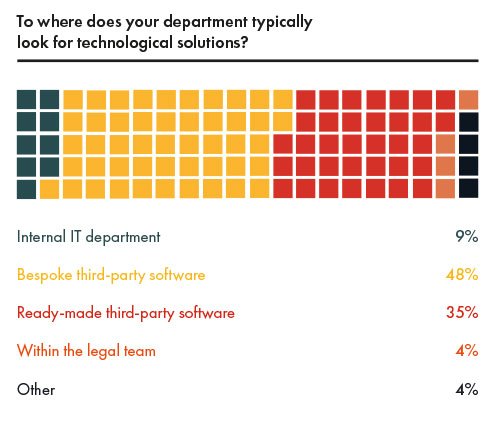
Turning to the results of our survey of over 100 legal teams across Asia Pacific, it seems that this message has yet to find a mass audience. Only 9% of legal teams are currently looking internally to develop tech solutions, while 83% of teams are looking to tech vendors for readymade or bespoke solutions.
Needs-driven Innovation
Technology and the legal profession in Asia-Pacific have long had a delicate relationship; while the potential impact of technology has long been understood – albeit oftentimes fodder for debate – its implementation and execution has, until recently, remained largely an academic exercise for most.
‘The practice of law is very much dependent on everyday life,’ explains Janet Toh Yoong Sang, partner at Shearn Delamore & Co.
‘With the growing use of technology all around the world, private practice law firms have been encouraged to use legal technology to keep up with the quickly changing nature of business and industry.’
But much like their in-house counterparts featured throughout the report, private practice lawyers have had to learn and adapt quickly to these new working habits brought about by the pandemic – including the toolsets which facilitate remote legal work. For many, this marks a sharp departure from established norms – with much of the profession in Asia-Pacific notoriously reticent on technology-driven shifts to legal practice. But for most in private practice, the global pandemic has meant that integrating technology has fast become a business imperative.
‘In-house clients are expecting that we have sufficient knowledge of the various technology tools available and how best to make use of them so that the successful delivery of legal services during the pandemic can be ensured,’ explains Zhuowei (Joyce) Li, partner at Han Kun Law Offices.
‘Many expect that social distancing measures will be central to commercial thinking for years to come, making the effective use of technology a vital component for maintaining business relationships and offering the best service to our clients.’
That experience echoes the results of the empirical research which underpins this report, with technology becoming an increasingly important factor for in-house counsel when assessing their law firms, with 59% of respondents reporting that a firm’s use of technology comprised a direct part of panel reviews and 68% saying that it was either very important or crucial that law firms remained abreast of new technologies. While some of that shift may be attributable to the short-term needs-driven innovation, few anticipate the uptake in technology to be a fast-passing trend.
‘As service providers, we are naturally driven by client demand, and that demand will push law firms like ours to use more and better technologies in the coming years,’ says Vinay Ahuja, Partner – Indonesia, Lao PDR & Thailand and Head of Indonesia Practice at DFDL Tax & Legal.
‘Since March we have seen just how much technology can facilitate legal work, and I do not think I will be the only person to predict this will become an established habit among all lawyers.’
Nonetheless, homegrown legal solutions are finding champions at the largest companies. Sheldon Renkema, general legal manager at top-10 ASX listed diversified conglomerate Wesfarmers, has worked to introduce a number of self-service tools into the legal department, including a non-disclosure agreement tool that allows commercial teams to generate and execute a compliant confidentiality agreement.
Sheldon Renkema, general legal manager, Wesfarmers
‘Our objective is to identify processes that our lawyers would otherwise do that are not particularly complex and not particularly strategically significant. And where we can, making use of a tool so that can be done within the business in a user-friendly way that manages the risk’.
Creating tech solutions internally can also act as a catalyst for the creation of a culture of open-mindedness and creativity within teams, which can pay dividends in other areas. As Bernard Tan, Asia Pacific managing counsel for US-headquartered analytical instrumentation manufacturer Agilent Technologies comments, ‘It is important that we don’t just follow corporate-wide technology projects. We need to create a culture of innovation and digitalisation within the legal function itself, and that means we need a sort of skunkworks for the legal team itself to develop and pioneer new tech.’
Chek-Tsang Foo, group deputy general counsel of NTT Limited, has followed this ethos, working with legal colleagues to create a suite of proprietary legal tech solutions, including a contract risk scoring tool for contracts. The next few years, he says, will be transformational for legal teams.
‘Legal tech will not just change how fast we work, but what we work on. As technology matures, routine and repetitive work can effectively be automated. This frees up bandwidth for internal lawyers to do more complex work that requires more creativity.’
‘It will allow us to spend much more time on things like negotiations, resolving complex matters and proactive legal risk management. The in-house team may also start to provide new areas of value to the enterprise, leveraging the legal team’s skillsets and attributes. The future is also what we create, with the help of legal tech. Perhaps technology will help solve the modern in-house counsel’s struggle for sufficient bandwidth.’
Inflection point
For GCs across the world, 2020 has been a year of learning to work remotely. As DXC Technology’s Ivy Wu puts it:
‘COVID-19 has totally changed people’s lives and changed the way workplaces operate, and people have spent a long time adapting to a work from home lifestyle. This will have big implications for the uptake of legal technology.’
‘In recent years, legal innovation has mostly benefited law firms and companies, but we are now seeing a trend toward traditional legal venues embracing technology. Courts are encouraging lawsuits to be filed online, and there is a push towards virtual hearings. Legal technology has made things more efficient for all players in the legal system, and those effects will continue to grow.’
JERA’s Tagaya adds: ‘Until now, Japan has had a tendency to believe in paper, ink and physical signature or seal. But now that COVID-19 has forced companies to examine technological solutions and embrace non-traditional working practices, it may have opened up their eyes to the possibilities that technology provides, which will lead to a corresponding increase in demand and thus growth of this sector’.
Julien Bergerat, head of legal and chief compliance officer for Nghi Son Refinery and Petrochemical (NSRP), a joint venture to build and operate the largest petrochemicals refinery in Vietnam, is an old hand when it comes to working remotely.
Before moving to NSRP in 2019, he held senior positions in Kuwait, Qatar, Switzerland and France. The ability to access legal information on demand has now become an expectation, he says:
‘We are living in a world where technology cannot be avoided, and the legal profession is no exception. Contract management, document automation and storage, legal research and, more recently, client relationship management and data and contract analytics tools are used by legal professionals as a matter of course’.
Benjamin Teong, associate counsel for legal operations, Lazada
‘Over the last decade, legal technologies have given the profession opportunities to improve its overall efficiency and the tools to adapt to agile and challenging working environments. The lower cost of hardware, improved ease of use of software and increased mobility have allowed for easier means of communication but, most importantly, they have enabled lawyers to work from almost any location extremely efficiently’.
But it is not just the demands of remote working that are changing the way legal teams operate. The pressure to do more with less, never far from the minds of GCs, has suddenly become one of the main priorities of businesses fighting to cut costs in a time of crisis.
Benjamin Teong, associate counsel for legal operations at Lazada, one of South East Asia’s largest e-commerce companies, sees adapting to this change as an increasingly unavoidable part of managing a legal function.
‘For in-house counsel, the scope of the work and its complexity is increasing, but we are being forced more and more to work with leaner teams and really maximise the manpower that we do have. There is pressure to achieve more creative and innovative outcomes for the company’.
‘We have tools that are specifically geared toward ensuring that we work efficiently and avoid low-value work as much as possible. We have a workflow management tool, which tracks any work requests to the legal team, allowing us to manage it from the time that we receive the request until the request is fulfilled, and to prioritise issues that are more pressing’.
Off-the-shelf solutions
Across Asia Pacific, GCs are finding that the simplest technologies carry the most impact when it comes to changing the way their teams operate. For Dimas Nandaraditya, general counsel of Indonesia-based Traveloka Group, this relatively simple software has proved to be a quiet revolution.
‘Adopting a new technology requires time and managing multiple vendors and software for our business processes can be cumbersome, therefore we prefer out-of-the-box solutions.’
‘We adopted software that sends regular reminders on when a contract or license is due to expire, which means lawyers no longer need to go through all documents one by one to assess the relevant expiry date or manually send reminders to the relevant stakeholders. The technology itself is rather simple but its impact is very significant: it makes our lives easier’.
There is, adds Nandaraditya, a degree of skepticism toward more advanced forms of legal tech, such as machine learning. ‘Basic AI functions such as e-discovery or automated diligence are starting to get traction, but I doubt that they will be widely available in the next one to two years.’
Jeremy Ryan Chua, general counsel of JAC Liner Group, one of the largest bus companies in the Philippines, has a similar take: ‘Artificial intelligence can assist in gathering data and narrow down possible decision-making choices, it cannot replace the intuition, on the ground experience, and foresight of a seasoned lawyer’.
Made in China
As US sanctions start to bite, businesses in the PRC are becoming ever more reliant on domestic technology. GC asks what it means for the country’s lawyers.If you want to build a nuclear powerplant, a maglev train, or a quantum computer it is increasingly likely you will rely on Chinese expertise. In the space of little more than two decades China has emerged as a global economic powerhouse, transforming itself from the home of low-cost manufacturing to a leader in cutting edge technologies.
Bin Zhao, senior vice president, legal and government affairs at tech multinational Qualcomm has seen China’s technological prowess grow over two decades.
‘Since late 1900s, China has started to highly promote the tech industry. The government made a lot of direct/indirect investments and extended a significant amount of polices in all business areas to advance Chinese technological development. That is when big multi-national tech companies came into China and made business successes.’
‘At that time, there was a honeymoon period between China and multi-national companies, and American companies such as Microsoft, Intel and many others grew significantly during this period, taking advantage of both the open-door policy, and the Chinese leadership’s good intentions to merge into the international market. The situation however has changed dramatically recently, and the tensions between the US and Chinese governments are making things much less clear.’
Dealing with this uncertainty is likely to be a key theme for the coming months. DXC Technology (DXC) is just one of a plethora of American companies operating in China that has felt the repercussions of ongoing trade wars.
‘It is not something we can really prepare for,’ says Ivy Wu, head of Greater China legal at DXC. ‘Draft copies of regulations are coming out all the time, so we review to determine whether they will impact our business.’
‘As in-house counsel we have to be fast acting, agile and knowledgeable in all aspects of laws in China. When a crisis happens, you need to keep in mind what kind of risk is associated, then you need to take some action, and manage all situations in a proper way.’
Indeed, escalating tensions between the United States and China have dominated news headlines in recent years. Chengyang Xie, vice president & chief legal officer at Foxconn Industrial Internet Co Ltd (FII), believes the potential decoupling between the United States and China is one of the chief concerns for in-house counsel in the region.
‘When the trade war between the United States and China began to bite, we really saw things change. This year, the sanctions on Huawei and other entities have continued to be challenging, and there are now over 200 entities on that sanctions list. This will be a great challenge for the years to come. The one certainty is that everything is uncertain for multinational companies in China.’
Getting technical
Trade tensions aside, China’s corporate counsel are finding themselves facing the same pressure to do more for less as US counterparts. While using technology to streamline processes has been on the radar of legal teams for some time, the recent COVID-19 pandemic has accelerated the need for new ways of delivering legal advice.
Gordon Liu, vice president, legal for Dell Greater China, says he has been fortunate in his ability to draw on a comprehensive suite of workplace technologies.
‘Dell was a forerunner in workplace tech, so we have the infrastructure to work from a distance. Even before the pandemic, we were used to working in this way. However, systems that were somewhat experimental are now becoming our default way of working. For example, we use a contract management tool, which generates a lot of standard contracts, as well as handling negotiations, revisions and other changes. The pandemic has accelerated our use of these technologies, and our strong position in this field has allows us to navigate the lockdown without interruption.’
Adds Xie: ‘The lockdown has taught us that remote teams can communicate just as effectively. In my regional cluster we handle business across 12 countries, so managing a legal team without face-to-face contact is something we are accustomed to. However, the enforced reliance on tech to conduct our daily business has been an interesting lesson to us all. We have seen that many matters are more efficiently processed with software.’
‘Legal technology has become more important in the daily practice of in-house counsel. We now use tech-enabled platforms for legal drafts, intellectual property work and legal databases.’
Despite the advantages of legal tech, in-house have also experienced drawbacks, says Zhao: ‘On one hand, internet-based, cloud-based and 5G smart phone-enabled tools have significantly improved lawyers’ efficiency. At the same time, when everybody is connected, and information and data is always flowing around, you have to be aware of the most current information and recent trends, and that is not easy.’
The innovation race
As China continues to support digital innovation and investment, corporate counsel find themselves under more pressure to evolve. Despite the challenges, in-house counsel across China have embraced tech to boost efficiency, connect legal teams and manage the ever-growing pressure to do more with less.
‘The tech sector is a rapidly growing industry in China. There has emerged quite a few online, e-commerce and technology companies. With fast growth, there is a lot of energy volatility in the market,’ says Liu.
However, as the domestic tech companies continue to develop in China, the future of international tech giants remains ambiguous.
‘When talking about the future, the first word that jumps into my head is uncertainty,’ says Zhao. ‘I think that is the biggest challenge facing all multinational companies doing business in China.’
As Zhao puts it, the next few months will be decisive for multinationals in China: ‘This is a very important point in history. We will have to wait and see what is going to happen after the US presidential elections. It will determine a new era of history for high-tech companies, and their future development in China.’
Perhaps unsurprisingly then, while the potential of advanced legal tech continues to excite the region’s GCs, it has so far failed to gain any real traction in legal teams. Josh Lee Kok Thong, chair of Asia Pacific wide legal tech forum ALITA, remains optimistic.
‘The technology is really improving. One example is ROSS Intelligence, which recently rolled out a free Google Chrome extension. Users can plug in the case that they want to review, and the system will instantly pull it out. Tools like this will change how in-house counsel behave.’
‘The next generation of AI technologies will help lawyers start to write and craft opinions. This will be a game changer because it helps spark the inspiration process, it eliminates writer’s block and enhances the cognitive abilities of lawyers. Building on this, the technology is a game changer. It will allow lawyers to gain new ways of thinking and new insights they may not have seen before.’
This should come as no surprise. As Per Hoffman, vice president and head of legal affairs and sourcing for North East Asia at Ericsson, comments:
‘China is huge, so when it does something the volume it does it with and the impact that has on markets are all huge. AI will be the thing that will come into legal areas. Today you have contract databases where you can search and find various contract clauses. But the next step after that will be AI. China has one of the most advanced AI research and development environments in the world, so for lawyers that is the place we will look to for change.’
When I moved in-house around 20 years ago I knew I wanted to work in the IT industry. The pace of change made it the most exciting place for a lawyer to work, and I have been in the front row ever since. While many of the business technologies we use on a daily basis have evolved rapidly, the technologies enabling support functions have been much slower to take off. Until now.
Onboarding legal tech used to be a matter of trial and error. The technologies on offer felt like a solution looking for a problem, and while there was a lot of interest surrounding legal tech it was difficult to make a concrete use-case for what was available. In the last few years, new systems for contract management and document discovery have appeared on the market and are now extremely helpful for in-house legal teams.
These improvements have little to do with technological development – after all, similar systems have been available to businesses for many years – they result from the growing recognition in-house counsel are a viable market for software vendors’ products services. With the growing economic significance of in-house lawyers as a consumer group, the market has finally moved to develop solutions that meet our needs, which are very different to those of law firms.
For in-house lawyers technology has to be easy to use. It needs to work with other systems and align with existing work workflows, and it has to give functionalities that are fit for purpose. All this needs to be backed up by high-levels of support in terms of training and other assistance. In short, in-house lawyers are not looking for off-the-shelf solutions, we are looking outcome-oriented vendors who are able to work collaboratively to meet our needs.
This collaboration needs to begin at the concept and design stage of a piece of software. Knowing the pain points GCs face, or what does and does not work within a typical company environment would help a great deal in making a system that is fit for purpose. For GCs, the price of a system is not just the cost of the license fee. It is also the time spent customising the software, the effort that goes into implementing the software, and the change management and project management requirements that come with it. We have gone through this cycle many times in the past, so we are extremely aware of it.
At all large businesses the legal team works in an ecosystem. This means when we are purchasing external legal tech, we are looking for products that can scale out. Contract management tools, for instance, can be used for other things. That makes a huge difference in terms of bang for your buck. We are really looking to leverage company-wide platforms.
The other big development I have seen in the legal tech space is a growing awareness among GCs that they need to take control of their team’s transformation. Legal tech is not always about finding external solutions. Often, it is just as important to look within. Currently we are looking at leveraging company-wide platforms as a set of collaborative tools that we can use, ideally with no need to integrate any foreign software or systems into our own ecosystem. We are also leveraging enterprise systems and customising them for our requirements. These systems may not have been designed to meet our needs, but they can nevertheless be extremely useful. It is all about being creative and experimenting with the technology you have available to you.
In the same vein, we have also developed tools within our own function. For example, my in-house legal team created a contract risk scoring tool three years ago. We use it to provide a numerical risk rating to contracts, assessed against our internal legal risk policy and tolerances. We have also built in a traffic-light feature based on the ratings. The tool has since been incorporated into the region’s enterprise deal assessment system, which takes into account assessments from other functions as well.
With all these developments, the next few years look set to a transformational period for legal teams. Legal tech will not just change how fast we work, but what we work on. As technology matures, routine and repetitive work can effectively be automated. This frees up bandwidth for internal lawyers to do more complex work that requires creativity. It will allow us to spend much more time on things like negotiations, strategic planning and resolving complex matters. That is cause for optimism. Perhaps technology will help solve the modern in-house counsel’s struggle for sufficient bandwidth.
For GCs, technology is very much a love-hate relationship. We love using technology and are increasingly reliant on it, even though we hate to admit it. The pressure every business has been under to work remotely is showing us how much we rely on technology to operate, which was a trend that started long ago.
Within the legal function we are now using technology for everything from e-discovery to data mapping and analytics. Even beyond front-end legal work, we are using technology to update our insurance certification or take care of our invoicing and billing. Really, we could not operate as a function without this technology. The question, then, is not whether legal technology will become important – it is already essential to the way we operate – but how it will change what we do, and whether it will replace certain tasks. As far as I can see technology will not replace lawyers, but it will open up new ways of working and allow us to see things that were previously invisible.
Working within a rather lean legal team means that each person has to draw on whatever resources are available to maximise his or her benefit to the business. I am a certified data protection officer and sit as the designated privacy representative for the Asia region. I’m also a certified enterprise risk advisor, a certified business continuity manager, and have just sat the anti-bribery exams. Having that broad-based training is one way of maximising the range of matters I can cover. The other is using technology effectively.
I estimate that our use of technology allows each lawyer to double their workload, so this is not an inconsiderable benefit to the team. The other big benefit technology brings to our legal work is that it allows us to take a more systematic, joined-up approach to risk. The ability to search documents quickly and reliable is one of the best ways to identify and mitigate risk patterns in litigations, investigations, complaints and a many other areas.
This is a fast-moving area of legal tech and one where we really need to keep our eyes open. For example, investigations require detailed knowledge of the underlying facts, and increasingly sophisticated software is being developed all the time. As lawyers, we have to be very open-minded to the possibilities this software will unlock. We almost have to forget that we are lawyers for a moment and think of it as a data mapping task rather than a legal task.
To use legal tech effectively you cannot be afraid to fail. You have to explore new technologies, launch new programmes and initiatives, and start working in different ways, but you also have to know when to abandon software and strategies that are not effective. This requires a fundamental shift in thinking for most lawyers.
Open yourself to new ideas, trial new software and ways of completing legal tasks, but don’t be afraid to admit that something isn’t right for you. You have to be very careful, because not every technology will suit your use case. Try and test as much as possible before determining whether you can actually implement it for use in the long-term.
When it comes to identifying and procuring new technology, we are fortunate to have a supportive IT function. New software is purchased by IT at group level, but every decision follows close discussions with the various business units and support functions to make sure a product will do or can adapt to what we need it to do. My experience is that IT are always eager to explore new tech and are happy to find things that will make your life easier. Building that relationship with your IT people is essential to getting the right tools. But of course, as GC I also need to be involved in the process because only the front-line legal staff can truly stress-test a system.
While there have been big changes in the market for legal tech, most law firms remain quite conservative here and tend to focus on legal skill sets at the expense of other ways of working. However, there are signs of change. New business models that offer on-demand legal staff or a mix of outsourcing and technology-based solutions at competitive price points are becoming more accepted. Ten years ago no one thought it would work, particularly in this market. Now they are threatening the traditional firms. The lesson here is clear. Both in-house and private practice lawyers must be more receptive to new ways of defining products, markets and clients. Technology itself will not leave us behind, but our inability to adapt to its consequences certainly will.
As everyone knows, life after COVID-19 will not simple return to normal. New working arrangements are here to stay, and that means technology will become an increasingly important aspect of working life.
The number one goal of innovation in our legal team, in an organisation manufacturing basic commodities, is to be able to do more with less – to consistently deliver high quality outputs at lower cost, so we are contributing to improving our organisation’s profit. There’s always pressure to keep costs to the minimum, but there is also a particular risk in needing to do more and more in terms of meeting increasing compliance requirements whilst containing costs.
The second goal is to increase reliability. There are more regulatory requirements to deal with and more things being asked of us, and to do that confidently and efficiently we need to make sure that the information and the processes we’ve got to be able to do that are robust and reliable – so I know that when the CEO wants a piece of information I can produce it reasonably quickly, and we are providing various stakeholders with confidence about our organisation’s governance.
We’re in the early stages of looking to see what new legal technology is available that can successfully meet our needs. I’ve been an in-house lawyer for over 20 years now and am probably one of the longest serving in-house lawyers in Australia. I use a basic, but robust and reliable system which has served us well.
We use a SQL Server relational database for recording and linking all the information we use every day, such as information about matters we are working on, agreements, property details, intellectual property, company details, and external lawyers’ fees, but we are looking to upgrade from this. We have been looking at what there is on the market, and there have been some quite interesting developments in terms of matter management. Overall, our organisation does not have a consistent process for information management, leaving it to particular teams to make their own arrangements.
Marcus Clayton
We have had a lot of growth over the time I’ve been here and we’re a much bigger company now, with more operations, more people, and more issues that need to be resolved every day. We are in a period of rapid change for our organisation. One aspect of this is the organisation is about to embark on a digital transformation project planned to unlock value, including a focus on the benefits from automation and smart analysis of our financial and operating systems and processes. We’re also looking at how that works for us in the legal team, to bring it all together over the next probably six months, against the objectives of robustness and reliability that I mentioned before.
We are currently looking at NetDocuments, iManage and a couple of other leading information management systems and are also looking around for matter management systems. What did surprise us was that there was not really one overall, out of the box, comprehensive package available for the typical needs of an in-house counsel team like ours.
We try to keep things as simple as we can, and we prefer just to go out and get something that is going to do what we want off the shelf. Our needs will be similar to many other companies’ needs. Given that we already have a good simple set up, we don’t want to have something new that is of a proprietary nature and forces you to go down a route in doing things their way, that may not align with our preferences, and could provide less functionality than we’ve got at the moment.
A couple of high-level IT leaders I have worked with recently, inside and outside our organisation, have confirmed a contemporary approach is to use out of the box wherever you can. They also reinforced a strong preference for a cloud-based approach, rather than on premises facilities.
We have quite a free rein in terms of what technology we can onboard within the team. Of course, if it doesn’t work or deliver value, I carry the can for that. To learn about the value of the technology which is now available, we went out and got anecdotal evidence, did research, and then followed up with a few of the aggregator providers about what they would recommend. That led us to talking to some people, getting some demonstrations and forming our views.
I was surprised at the low estimates for setting up this system and migrating our data. I feared from previous experience that the actual costs could be greater than the optimistic forecasts, so in the budget I’ve put in a more realistic amount than has been suggested for a migration (which of course we will manage carefully). I’ve also said we want to do it in incremental stages, which helps us manage the transition risks.
We’re a small department, who operate in a company that has traditionally run everything very lean. That’s the environment I’ve been working in for a long time with colleagues in the legal team. We evaluate our technology intuitively and based on how much it is actually helping us to achieve our objectives. Having said that, we are building KPIs into our assessment process at the moment as part of our structured evaluation procedure.
When staying abreast of what legal technology is available, organisations such as ALITA are useful and easy to access to corroborate what we’re finding in other places, and help us to test things anecdotally against promotional material or the stated capabilities of the tech.
I’ve followed what’s going on in artificial intelligence relevant to our responsibilities, and I can see where it will have application, but in our case we are a heavy manufacturing industrial company which doesn’t have a lot of low-value, high volume legal work. We leverage our internal expertise with carefully selected external advisors who we are confident will apply themselves creatively and deliver value for us, and while I currently don’t see a big role for AI in our legal team on a regular basis, we’re continuing to monitor its progress. We have used AI in certain cases, for instance during some major litigation, and I was really impressed with the quality that came back from applying AI to our discovery records. Automation, AI, and machine learning are opportunities we are planning to exploit for our heavy manufacturing business, with an expectation of significant benefits, so we are on the look out for where these sort of opportunities might be there for the legal function also.
COVID-19 and its effects have of course had an influence on the way we are working at the moment. From March to July, everyone was working from home, and in July we cautiously moved back to offices, following a contingency plan which for us had a ‘team A’ and ‘team B’ that were in the office on alternating weeks.
We are operating throughout Australia, so we have had experience with the different situations in the different states. We’ve had experience with all the video conferencing facilities, and have had a major rollout of hardware and software to people who weren’t using stuff in a mobile way to the same extent as others. In our legal function we’re all equipped with laptops and iPads, and because (pre-COVID-19) we’re often all around the country, it wasn’t a great change for us. The relational database that I mentioned before has given us a really solid framework for our essential information, so that even though the team’s been at home for some time over lockdown, we’ve been able to continue all of that essential stuff without any glitches whatsoever.
Going forward, I think that technology will change the roles of in-house lawyers in a more subtle way than many are predicting. Some tech that we use, such as hearings via video conferences, can be used tactically, and you need to consider that before being pushed down a certain path – should you agree to videoconference or not agree? Are you giving up some advantage if witnesses are not being cross examined in person, or if your representatives are interacting with the court in different ways? This shows that technology needs to be adopted in a measured way, because there are just too many side issues that come up.
Our Annual General Meeting (AGM) was in May, so we had to deal with how we were going to do this in the middle of the pandemic, with the restrictions on meetings. This quickly exposed us to virtual AGMs, but these are still not that straightforward. We did a hybrid AGM, which went well apart from the fact that a third-party tech provider played the CEO’s speech before the Chairman’s speech. It was simple human error, despite numerous rehearsals undertaken and the procedures we had in place. Most viewers would not notice, but it just highlighted that there are risks in new technology. Next year, I think we’ll probably still do a hybrid AGM, but we will have learned the lessons, I don’t think we’ll move to a fully virtual AGM.
Young lawyers who will have to drive the profession’s use of technology forward should be clear about what they are trying to achieve from legal tech. That’s cost efficiencies, delivering valued outcomes, avoiding surprises, and having reliable information and systems and tools to be able to do the task that you’re responsible for dependably. Everything comes back to that, and that’s what we’re trying to do in order to deliver value for our shareholders. You need to have a mindset that is going to let you understand how you can use the technology and the potential developments to further what the organisation is trying to achieve. You can’t be divorced from the underlying nature of the business.
As the saying goes, “Ask a hundred lawyers and you’ll get a hundred answers”. Ask over a hundred lawyers about legal tech and the picture becomes even less clear. The legal tech ecosystem itself is so fragmented that almost no two GCs have the same thing in mind when talking about their use of technology.
Some companies are, to varying degrees of sophistication, implementing forms of automation or AI to solve legal or contractual issues, others are partnering with law firms to produce software capable of handling very specific issues like ISDAs, CLOs or loan documentation. But those applications of legal tech remain in the minority. Clearly, there is a distinction between legally useful technology and legal tech. Some basic elements of every office’s software suite can be legally useful, though they are not generally badged as legal tech.
The results of our survey show that by far the most common use of legal tech, shared by nearly a third (32%) of teams, was contract management. However, the overall picture is one of a market still in its infancy. Respondents were as likely to use tech to manage relationships with their external firms (17%) or handle invoicing (14%) as they were to do automate legal advice.
Notably, these trends affected companies of all sizes: those employing more than 50,000 people and with legal teams with over 100 staff were no more likely to use advanced legal tech than small to medium-sized organisations. This should come as no surprise. Even companies that specialise in developing very sophisticated technology face the same issues as their less technologically advanced counterparts when it comes to finding solutions for the legal team.
As one respondent representing a Hong Kong-based tech and IT solutions company commented, ‘As a provider of services then of course [the business] will have all this fancy technology, but most companies are much more sophisticated at developing things for clients than for themselves. As a user, as a GC using software to do something, you are in the same box as everybody else.’
Clearly, more money is invested in the revenue-generating side of a business than on its support functions. As experimental psychology has shown time and again, people naturally favour making gains over protecting losses, and businesses seem to be no different.
‘Take a large bank,’ continues our respondent. ‘It may have well over 1,600 lawyers globally. That bank is effectively running a top 20 law firm in terms of its legal staff, and that’s before you even consider its far larger compliance team. Yet when you look at how it is doing its legal work it will be nowhere near as sophisticated as a law firm. To understand why that should be the case you’ve got to consider that the law firm is practicing law as a business whereas the in-house counsel is a cost. Anything that solves a problem for in-house counsel therefore needs to be quantified as a cost saving when proposed to the business, which makes it much harder to justify.’
‘Even the most persuasive pitch for new legal technologies looks unappealing to most businesses because all you’re doing is comparing one cost with another cost: the cost of technology vs the cost of salaries to do the same job. Either way you’re reinforcing the view that you are a drag on the business that will incur costs! It’s not at all true – those are jobs that need to be done, but it’s how people will see it.’
Innate risk aversion when it comes to corporate budgeting is only part of the story, however. Part of the answer to why GCs struggle to acquire technology lies within the legal team itself. First, lawyers tend to be poor at understanding and explaining their technology needs. They may understand their legal needs very well, but this does not necessarily translate into seeing what sorts of tools they need to accomplish that end.
As another respondent pointed out, it also requires a lot of time and no small amount of skill to adequately benchmark legal tech. ‘Even doing the work to see whether an automatic translation service for legal documentation is efficient if automated and whether that can be measured in terms of efficiency gains is not something I would expect many GCs to successfully handle. Lawyers are generally terrible at that sort of exercise, which is a procurement exercise we are just not trained in.’
But – and this is neither the first nor last time this will be said about the subject of legal tech – a change may be about to come.
Over two thirds (68%) of those surveyed said that the use of technology within the legal team had increased significantly over the past five years. Just 5% reported that their use of technology had not increased at all. The bulk (95%) of respondents though that legal tech would end up significantly enhancing the day-to-day operations of the legal team, while nearly three quarters (73%) said they would like to step up their use of technology.
Perhaps a clearer indication of this change is that, for all their cynicism over tech, GCs are not disputing that it has changed the profession – 87% of respondents said that legal tech had already changed the industry to at least some extent. Even more strikingly, 95% of GCs felt legal tech would change the industry in the coming years, with 33% saying that the change would be significant.
Digital transformation is a hot topic right now and DXC Technology is an industry leader in this field. We leverage technological innovations to deliver better business outcomes by driving new levels of performance, competitiveness and lower prices. Put simply, we work hard to make sure other businesses stay ahead of the curve when it comes to technology.
The legal team has embraced this approach. As [DXC general counsel] Bill Deckelman said, the digital innovation tools that our department has had access to since 2017, [when DXC was formed through a merger of the recently spun-off Hewlett Packard Enterprise’s Enterprise Service segment and Computer Sciences Corporation (CSC)], represent a unique opportunity to position our legal team as global thought leaders in legal digital transformation.
From the very start of our journey we aimed to do something different, partnering with UnitedLex to help restructure the global legal team. At the time, this was the largest-ever managed services transaction in the legal space. By bringing in new technologies we have developed a far more agile way of working that enables us to cover more ground than ever before. We have created a digital platform housing legal research, templates and advice. This allows us to provide a lawyers on demand service for a range of matters, from documentation to compliance, from litigations to procurement. Supplementing this, AI-based legal tools and machine learning allow us to better predict risks, understand customers’ problems and improve performance.
This technology has undoubtedly improved our efficiency. It can streamline templates and playbooks, assist with negotiations, help with training and rationalise workflows. It also allows each team member to properly track their work in real time so the management team is constantly aware of the progress being made on a matter. This means management can identify gaps in our coverage and move to respond to potential issues faster than ever before.
Ivy Wu
It has also helped us show management the value our team brings to the company. We can track the value of each matter we are supporting, whether that is by managing litigation risk or contributing to new business. The feedback from business has been very positive. They are able to see that the cost saved or value added by the legal department far exceeds our budget.
Technology reduces the barriers to collaboration across functions. It can be a useful way of working with various business units to identify pain points, opportunities and solutions. In fact, the new ways of working we have developed have been so successful that we plan to make remote working, at least to some degree, a permanent feature of the way we operate. Technology will not replace lawyers, but it will require a re-imagining of resources, both technical and personal. Legal work will place much more emphasis on the ability to collect, analyse and process relevant data.
The push to introduce new legal technologies is to be welcomed, but there is still a long way to go. Many of the new tools that have come to market are very complex, do not allow for optimisation, and requires a big time commitment on the part of GCs to fully learn its functionalities. Of course, the more time you have to spend learning a new system, the less effective it is as a cost-saving tool. Team members may also need to repeatedly log in, complete registration forms, or provide other information.
International legal service providers should also consider customising their products to work in Mandarin, or tailoring them to fit local cultural usage. China is a very large market, and enhanced support for our lawyers would be beneficial to both domestic businesses and multinational companies.
There is no doubt that legal technology has helped everyone in the market improve their performance. Most interesting has been the impact it has had on the judicial system. The ability to file lawsuits electronically or attend virtual hearings has proved very successful in China. This is a very important development, especially for employees of multinational companies who are not able to be physically present during the course of a matter. Other developments are even more surprising. While previously it was very time consuming to notarise electronic evidence, we are now able to apply blockchain technologies to preserve electronic evidence.
There are a lot of changes taking place. Our mission in the DXC legal department is to understand these changes, learn as much as possible about the technologies powering them and, most importantly, to be at the forefront of any future change.



















 Carl Watson, general counsel for Asia at design and engineering consultancy Arcadis, underlines the value this brings to the legal team.