
Sponsored briefing: Changing roles and expectations on the relationship between in-house legal counsels and law firms

The position of in-house legal counsel has been taking place effectively across the world since the beginning of the ’80s. This position comes forward with the headlines as in-house legal counsel, chief legal counsel (CLO), and head of legal are titles in common use nowadays. As these positions become widespread and with the proliferation of the legal departments in companies, the relationship between the law firms and in-house legal counsel has gained great importance.

The Relationship between In-House Legal Counsel and Law Firms

Taking numerous changes in today’s modern world into consideration, it can be easily said that the roles, perspectives and job descriptions of in-house legal counsel have been altered. Such change along with the various requirements has moved the longstanding relationship between in-house legal counsel and law firms to another dimension.

Let us consider the position that in-house legal counsel have reached. In a globalised world, the points that companies have reached and served have started to spread all over the world rather than a specific region while the growth rate of the companies has increased many times more. With the effect of that, economic environment, the competition dimension, the management perception and the changes on the distribution of tasks ended up with higher expectations from legal counsel such as taking commercial decisions, planning budgets, being aware of technological developments, shortly, working with full business awareness by effecting the in-house legal counsel’s perspective. Under these parameters, the companies offer enormous opportunities to legal counsel for innovation, leadership, and decision making at the highest levels – especially as companies have gone global. One of the most significant roles of in-house legal counsel, who started to have many hats such as risk manager, ethics and compliance officer, administrative official affairs, wise adviser, shows itself as ‘leadership’.

Looking at the last ten years’ in-house counsel positions, the in-house legal counsel had to work with and lead almost all departments within the company, it is an inevitable fact that today’s requirements have moved this figure into a position that conducts risk analysis and leads business decisions, even though we would be picturing a figure whose sole duty is evaluating the legal compliance of the decisions taken by the company and also trying to abstain to direct the commercial decisions. In the light of this reality, we can describe that the relationship and expectations between in-house legal counsel and law firms have evolved and transformed with the usual flow of the process. In order not to block off the flow, law firms are also expected to observe this process and keep up with today’s global and modern developments. The evolution of general counsel is examined through a conversation with the chief legal counsel of one of Turkey’s leading holdings who conveyed his experiences. He has observed this development by working in the same company for many years and witnessed that the profession has changed with the evolution of the opinion of legal view starting from compliance for technological developments well into commercial decisions. That was a great real-life experience.

A Role Comprising Strategy and Leadership

The expanding roles led lawyers to get more into the business world. Rather than evaluating the legal consequences of the commercial decisions taken by the company, law firms – which have the motive of efficiency, value and commercial awareness that shape the relationship between corporate identity and law – were among those preferred to be consulted by in-house legal counsel. Nowadays, the law offices that have a good grasp on the corporate memory of the represented company, are competent in assisting the company to achieve its strategic goals for different locations in a globalising world and which can expand its visions, stand out in this choice.

With the transition of in-house legal counsel from a figure just providing legal advice to a complex role covering strategy and leadership, the expectation that will affect the critical business decisions by providing a legal perspective as ‘more than a lawyer’ also shows itself for the law firms. The most significant reason for the increase of need for law firms are the growing business volume of in-house legal counsel and the expansion of the job description within the company. The emerging role of the law firms can be defined also the lawyers’ lawyer position. It can be easily said that while in-house legal counsel sit in the driver’s seat, the law firms are always ready for the duty as a co-pilot. Therefore, the need for an effective and powerful co-pilot brings out a search for quality.

The in-house legal counsel of a leading international company in the automotive sector, described this search as ‘effective, solution-oriented, fulfilling the requirements in a short time’ during a Legal 500 GC Summit. While ‘time, solution-oriented, correct and feasible answers’ increase preference, law firms, which can use their legal perspective on business-critical decisions within the scope of business strategy of the company, are in the leading role of the evaluated in-house legal counsel-law firm relationship.

Law firms that can use the legal perspective on critical decisions in terms of business within the scope of the company’s business strategy take the lead role of the transformed internal legal adviser-law firm relationship. The key issue is to understand the client’s business needs including its appetite for risk. At this point, the need for lawyers who blend law and commerce, follow up technological, economic and sectoral developments is not negligible. The evolution of the profession has also changed the definition of relationship management between in-house legal counsel and law firms. Being able to keep up with the fast-changing criteria and definitions that emerged in this context made the expanding role of lawyer more business-oriented. Adopting a critical role in managing corporate risk and strategic decisions, lawyers become the bilateral winner of this change and transformation.

For more information, please contact:

Vefa Reşat Moral, managing partner

Moral & Partners
Hakkı Yeten Caddesi Selenium Plaza No: 10C Kat: 16, Fulya, Beşiktaş, İstanbul

T: 0 212 232 35 95
E: [email protected]

moral.av.tr/en

Wilson ends Uber journey to take up head of legal role at Fremantle

Matt Wilson

In-house stalwart and GC Powerlist UK regular Matt Wilson is leaving his position as associate general counsel (GC) for EMEA at Uber to assume the GC role at British TV production multinational Fremantle.

Wilson, who will join up with his new employers in August, calls time on a frenetic six-year stint at fast-growing Uber, which has been beset with thorny legal and regulatory issues throughout his tenure. Continue reading “Wilson ends Uber journey to take up head of legal role at Fremantle”

Smith rings off as Telefónica GC amid looming £31bn Virgin Media and O2 megamerger

Edward Smith

Noted in-house veteran Edward Smith is to leave his role as general counsel of Telefónica UK after 20 years at the company as telecoms giants Virgin Media and O2 prepare to finalise their £31bn merger.

Smith (pictured) joined the company as legal counsel from Freshfields Bruckhaus Deringer in 2001 and his career there has spanned roles including head of corporate and commercial law and head of legal. Continue reading “Smith rings off as Telefónica GC amid looming £31bn Virgin Media and O2 megamerger”

Comment: Hired guns and troubleshooting – privilege confusion in UBS rape probe another jolt for City law

Legal hacks frequently stand accused of making sensationalist statements once the dust has settled when it comes to lawyer conduct in emotive matters, especially where the Solicitors Regulation Authority (SRA) is involved. In our defence, we largely base initial treatment of these cases on the views of numerous market contacts at the time.

The overturning of findings against former Freshfields Bruckhaus Deringer partner Ryan Beckwith last year springs to mind. Early sentiment was of general horror about unhealthy drinking cultures and abuse of power. Later many City partners reviewed their opinion to align with the High Court’s assertion that ‘popular outcry is not proof that a particular set of events gives rise to any matter falling within a regulator’s remit’ – the age-old dismissal of the case that ‘this sort of thing happens all the time’. Continue reading “Comment: Hired guns and troubleshooting – privilege confusion in UBS rape probe another jolt for City law”

Revolving doors: Memery Crystal goes public after £30m buyout as Withers opens in Boston

In another week of frenetic partner moves, the parent company of listed firm Rosenblatt has acquired mid-market corporate firm Memery Crystal in a £30m deal.

Behind the deal is AIM-listed RBG Holdings. The 29 partners at London-headquartered Memery are set to receive both cash and a RBG shares for their stake in the firm. Continue reading “Revolving doors: Memery Crystal goes public after £30m buyout as Withers opens in Boston”

Sponsored briefing: Dear ‘Do More With Less’ CEOs. Can We Talk?

Google “do more with less in legal” and many of the top results date back to 2008 and beyond. It is difficult to remember a time when legal budgets were not on the chopping block. Yet there has never been a time when their services were more in demand—from global regulation to cybersecurity to go-to-market strategy.

If organizations are going to complete their long-sought-after digital transformation in as litigious a world as today’s, legal must lead. And they cannot do so armed with nothing. Continue reading “Sponsored briefing: Dear ‘Do More With Less’ CEOs. Can We Talk?”

Guest comment: The post-pandemic recruitment race

Stressed office workers

Nathan Peart, managing director at Major, Lindsey & Africa, says firms must become flexible or lose their best associates.

Without much choice, the legal industry got flexible last year. Even firms that snubbed working from home pre-pandemic had to get on board. Through the lens of recruitment, this has laid bare the realities of law firm life – without the fancy offices, wining and dining and team camaraderie, associates have reflected on the core of their job and what they get in return for mounting workloads and blurring lines between work and home. Many are questioning whether their firm is all it is cracked up to be. Continue reading “Guest comment: The post-pandemic recruitment race”

Dealwatch: Advisers secure Darktrace float and $12bn Aramco sale as Globalworth proves hot property

Another blistering week of deal announcements has seen corporate advisers tasked with a diverse selection of mandates, from the much-anticipated £3bn initial public offering of Darktrace to a $12bn disposal by Aramco and an unusual joint offer for Globalworth Real Estate Investments valued at €1.6bn.

The proposed listing on the London Stock Exchange of British cybersecurity start-up Darktrace has elicited much market speculation, coming as it does after the IPO of food delivery company Deliveroo, which many have termed disastrous. Continue reading “Dealwatch: Advisers secure Darktrace float and $12bn Aramco sale as Globalworth proves hot property”

‘My race in big law has been run’: White & Case private equity veteran Bagshaw to depart this summer

White & Case’s high-profile private equity head Ian Bagshaw is set to leave the firm in June to pursue other opportunities outside of law.

The White & Case partnership was informed of Bagshaw’s departure in an internal announcement this morning (16 April). In a LinkedIn post published today, Bagshaw said: ‘After seven years at each of Eversheds, Clifford Chance, Linklaters and White & Case, I have decided that my race in big law has now been run. Continue reading “‘My race in big law has been run’: White & Case private equity veteran Bagshaw to depart this summer”

Revolving doors: Two in, one out for White & Case amid busy week for lateral hires

broken scales

In a dense round of disputes-heavy lateral partner recruitment, firms and chambers have made key additions to their rosters of senior advisers this past week.

Firstly, White & Case’s highly-rated commercial litigation partner Hannah Field-Lowes has joined Goodwin in London after a three-year stint. Field-Lowes has over 15 years’ experience in complex cross-border and domestic cases, particularly in disputes arising from the private equity market.   Continue reading “Revolving doors: Two in, one out for White & Case amid busy week for lateral hires”

Kirkland closes in on $5bn revenue as it remains world’s highest-grossing firm

riding on a Kirkland & Ellis wrecking ball

Kirkland & Ellis has added $680m to its top line to trounce Latham & Watkins yet again as the world’s highest-grossing law firm, as global turnover surged 16% to $4.83bn.

The Chicago-bred giant had a significant uptick in private equity work to thank for its stellar 2020 results, which saw revenue surge from $4.15bn in 2019. Continue reading “Kirkland closes in on $5bn revenue as it remains world’s highest-grossing firm”

Dealwatch: Cazoo and Arrival fuel SPAC bonanza as Slaughters leads on Covid vaccine deal

The special purpose acquisition company (SPAC) frenzy and coronavirus have continued to drive the market in recent days, with transatlantic corporate teams steering the multibillion-dollar Cazoo and Arrival deals, while an agreement for the acquisition of Covid-19 vaccines has proved a shot in the arm for Slaughter and May and Covington.

The Cazoo de-SPAC heralded key mandates for Freshfields Bruckhaus Deringer, Kirkland & Ellis, Slaughters and Cravath, Swaine & Moore. The deal will see the UK online car retailer and AJAX I, a publicly-traded SPAC, merge to form a company with an enterprise value of $7bn. The combined company will retain the Cazoo brand and will be listed on the New York Stock Exchange. Continue reading “Dealwatch: Cazoo and Arrival fuel SPAC bonanza as Slaughters leads on Covid vaccine deal”

Revolving doors: Simmons makes double Dutch hire as Bakers expands finance practice

Amsterdam - ABN AMRO

In the latest round of lateral partner hires, Simmons & Simmons has significantly strengthened its presence in the Netherlands through a pair of lateral partner appointments.

David Shearer, formerly a partner at Dentons, and ex-AKD partner Robert Jean Kloprogge will join Simmons’ Amsterdam office. Both Shearer and Kloprogge are corporate and M&A lawyers. Head of Simmons’ Dutch operations, René van Eldonk, said the appointments were ‘a hugely significant step in the achievement of our ambitious growth plan in the region. This spate of recent hires demonstrates our ongoing commitment to growing our offering to clients across Europe.’ Continue reading “Revolving doors: Simmons makes double Dutch hire as Bakers expands finance practice”

Vodafone puts emphasis on ESG in new eight-firm adviser panel

Rosemary Martin

Vodafone has completed the latest refresh of its legal advice panel, selecting eight firms based on a commitment to shared diversity and ESG best practice.

Latham & Watkins, Deloitte and TLT are the new additions from the last review in 2018, alongside Hogan Lovells, Linklaters, Osborne Clarke, Slaughter and May and Wiggin, which have retained their spots. This is a slight increase from the seven firms selected in 2018’s overhaul . The panel will provide broad legal cover on commercial, real estate, employment, regulatory and litigation, as well as support for legal transformation. Continue reading “Vodafone puts emphasis on ESG in new eight-firm adviser panel”

Skadden goes organic with three City promotions as investment intensifies in London

Pranav Trivedi

Skadden has made up its largest haul of new partners in London since 2008, a further showing of support for the City office after an uncharacteristically expansive stint in the lateral recruitment market of late.

The move sees the famously conservative Wall Street giant promote three new partners as part of a 17-strong global round, matching a commitment to organic growth in London last seen 13 years ago. Continue reading “Skadden goes organic with three City promotions as investment intensifies in London”

Moving the needle on progress

In no uncertain terms, 2020 has truly been a year of reckoning for the US: Donald Trump is vying for a second term in the White House. Tragic killings of black civilians at the hands of white law enforcement provoke widespread outrage and demands to ‘defund the police’. A deadly global pandemic is ruining lives and upending the economy, and the President suggests intravenous disinfectant may be the cure.

As the year’s events exceed even the sharpest satire, and with the country at its most divided in living memory, to the average onlooker it may appear impossible to envision anyone making inroads to promote tolerance, mutual respect, diversity or inclusion. On the contrary, such widespread discontent has compelled individuals and companies alike to double down on their commitment to equality, take pause to examine their attitudes to race, to gender, and to any traditionally ‘othered’ group in society, and ultimately to take bold and meaningful actions to combat injustice.

The legal industry has been no exception to this call for action, as diversity and inclusion has shifted from a mere extra-curricular endeavour to an unquestionable expectation from colleagues, business leaders, and clients alike. As the last few years have seen the juncture of corporate strategy and social justice go mainstream, is corporate America entering a new era of social consciousness that is meaningful beyond profit and loss? And, if so, how are legal departments playing their part and taking action?

In a series of exclusive interviews, the legal thought-leaders spearheading D&I in the US speak to GC about the new initiatives shaking up the industry, the value of a diverse team, and how minority GCs who’ve paved the way are inspiring the diverse talent of today.

“If everyone is moving forward together, then success takes care of itself.” The timeless words of Henry Ford ring as true today as they did a century ago, a timely reminder that progress is a necessarily collective endeavour.
Indeed, collaboration is the modus operandi of Diversity Lab, the undisputed stalwart and main facilitator of D&I initiatives in the US legal field. As its name suggests, Diversity Lab takes a science-based approach to monitoring and enhancing D&I through the use of metrics, behavioural data, and design-thinking. New initiatives are formulated in ‘hackathons’, with the best ideas then piloted in law firms and legal departments across the country. In the US, D&I has not been approached in such an analytic fashion before; it is this cutting-edge strategy, coupled with a culture of teamwork and collective success, that has law firms and in-house departments flocking to work with the group.

Through a roster of joint initiatives and partnerships, Diversity Lab’s programmes cut across conventional competitive boundaries, ensuring that no matter what path aspiring lawyers take, they will be supported, encouraged, and accepted throughout. Drawing on the success of programmes like the Mansfield Rule (now available to in-house departments from last Summer) and the On-Ramp Fellowship, Move The Needle is Diversity Lab’s latest project.

“It’s our pull-all-the levers, let’s-see-if-we-can-really-make-a-change programme,” says Leila Hock, Diversity Lab’s director of legal department partnerships. “The idea for Move The Needle came about when we were all talking about every struggle that a diverse lawyer has, starting from law school up until maybe they’re managing partner – what are all the struggles and feelings they’re going through? We can’t solve this problem by focusing on one part of the career path or pipeline; they really all work together.”
Hoping to drive progress across the career spectrum, five of the country’s top law firms have invested $5 million to fund experimental approaches to D&I over the next five years. MTN’s 28 founding general counsel will also work with these firms, while also piloting these new initiatives within their own legal departments and with external counsel.

“We found five brave, trailblazing firms that were willing to work with us to pull all the levers across different areas, look at their practice groups individually, and see what, from a talent perspective, each group needed to retain and attract diverse lawyers,” explains Hock. “We’re working very closely with them to implement all of our pilots. They’re our ‘lab’ right now to test a lot of our new initiatives, report back and see how they work and make adjustments. Our strong hope is that much of what we implement with them will work and help them achieve their goals, and we’ll then be able to disseminate them more broadly into the legal market.”

Many hands make D&I work

For many of MTN’s founding GCs, the biggest draw is its uniquely experimental nature which fosters innovation in a way that many firms or in-house departments couldn’t – or wouldn’t – do alone, especially when it comes to financing. “One of the things that attracted me to Move The Needle is that it focuses on the relationship between the client – being me, the in-house lawyer – and the law firm. I think that’s a tremendous area of opportunity,” says Laura Quatela, Senior VP and CLO at Lenovo and MTN founding GC. “I’m sure some ideas will work, others will be utter failures, but the law firms, to their everlasting credit, have committed big bucks to fund this experimentation over the next several years. That’s really what was needed, because we have tight budgets, law firms have profitability targets, so I think the funding was necessary and will hopefully help us, in fact, move the needle.”

Hock agrees: “My guess is the talent leads or D&I leads within Move The Needle firms feel like they have a lot more leeway to do their job. Not only do they have the money that they’ve committed, they also have us at Diversity Lab and the entire team helping them achieve their goals, but they also have each other. One of the big pillars of the Move The Needle fund is collaboration in a way that collaboration in the legal industry hasn’t happened before, which is across firms. They’re talking and brainstorming with, technically, their competitors, and I think we’re seeing a lot of growth and learning from that, for sure.”

So, with the knowledgeable support of Diversity Lab, the backing of legal leaders at firms and in-house, and a much-needed cash injection, what has MTN been able to achieve so far? “We’re at the point now where we’re whittling down the ideas to some initiatives that we all want to line up behind,” explains Quatela. “One of the things we’ve talked about doing is a combined law firm/in-house summer programme, where interns or clerks have the opportunity to experience both early in their training. They can start to make the important decisions, like, where do I really want to end up? Which of these backdrops will cater to my own personal objectives?

“Through MTN, I’m personally trying to focus on the ‘off-ramp’. Both law firms and in-house experience this off-ramp of particularly women and underrepresented minorities who, when they get to year five or six, when they could really start to be positioned for leadership, and they leave. Why is that? It happens with such regularity in the legal profession. What are we not doing for these folks? Part of it, I think, is belonging, creating an inclusive culture, but what else is there? How can we incentivise people to stay off the exit ramp? For me, Move The Needle will give us an opportunity to try some things in that regard, that will hopefully make a difference.”

Another way MTN has sought to enhance progression opportunities for diverse attorneys is through piloting a mentoring programme between high-potential associates and GCs. “We’re mentoring them to understand what works well in a pitch, what doesn’t work well, how can we get more engaged on certain matters, inviting them to meet with my direct reports so we can talk about the issues that we face, and whether or not there are opportunities for that person’s firm to get engaged,” explains Rishi Varma, founding GC from HP Enterprise. “It starts creating a connection that results in an engagement, and results in origination credit. That diverse attorney at that law firm is then viewed as somebody who will carry that client forward, and hopefully as they become a partner, a senior partner, a managing partner, they carry that forward. We think about metrics from a diversity perspective, but it’s important to recognise the different obstacles beneath those metrics.”

He who pays the piper calls the tune

As figures from the ACC show that corporate legal departments spent an average of $9.7 million on outside counsel in 2018, the purchasing power that US in-house departments can wield in the name of D&I is significant. Diversity Lab and the Move The Needle GCs have been quick to realise this fact, which is particularly salient when contracting external counsel.

For fellow founding GCs, U.S Bancorp’s Jim Chosy and Hannah Gordon of the San Francisco 49ers, Move The Needle has provided opportunities to open dialogue on D&I with external counsel, ensuring that diversity metrics are front and centre when deciding which firms to contract. “In-house legal departments have big role to play in positively influencing diversity with outside counsel,” says Chosy. “Given our purchasing power, we’re able to drive change and I feel an obligation to do this with our law firms, which we consider an extension of our own in-house function. We do this in several ways, including as I’ve mentioned with the Mansfield Rule, the Move the Needle Fund, and our Spotlight on Talent program. We also request and measure diversity data from our law firms to help drive hiring decisions, and last year presented our first U.S. Bank “Invested in Diversity” award, in recognition of firms’ efforts and success with diversity.”

“Move The Needle is a helpful tool for all of us who would like to ensure that we are acting really responsibly in the way that we seek and select outside counsel,” says Gordon. “We’ve had conversations with existing counsel about the importance of diversity to us, and I think the positive we’re seeing out of that is that outside counsel does listen, and does pay attention to how they staff your cases. I think there’s two things that all of us are looking at when it comes to this issue. One is, what are the overall demographics and statistics of a firm? Then secondly, who is actually the staff on your particular matter? Both of those are important.”

Varma is also acutely aware of GCs’ pivotal role in reading deeper into diversity statistics. “One of the reasons I became a founding member of Move The Needle as a general counsel was, it’s my problem. I’m the one who’s hiring outside counsel, so it’s important to recognise that there are many obstacles to improving that diversity, starting with how people get credit and how people move through the ranks of those law firms. You cannot just look at the numbers at the firm, or the numbers on my matter – you have to look at the quality of the representation you get. If I had a firm working on a matter, and I saw consistently that they had about 10 to 15% of the representation that was diverse, that could be good, or they could have somebody who is diverse at the very top level, but the people doing a significant majority of the work are not as diverse.”

Far from a trite marketing exercise, research from Deloitte confirms that companies who can unlock the collective potential of diverse teams can expect to see innovation increase by around 20%, with risk falling by 30%. Simply hiring a diverse array of people, however, is not enough to achieve these results: while diversity is the bricks that build a team, inclusion is the mortar that bonds teams and ensures members feel a sense of authentic belonging.

Dealwatch: Transatlantic teams energise £8bn National Grid acquisition as Freshfields and Latham dine in on Deliveroo IPO

As the City marks the one-year anniversary of the first coronavirus lockdown, elite playmakers continue to do deals from their living rooms, with a sizeable National Grid acquisition and Deliveroo’s multibillion-pound initial public offering making headlines in recent days.

Last week (18 March) FTSE 100 utility National Grid emerged as the winner of a competitive auction to acquire Western Power Distribution (WPD), the UK’s largest electricity distribution business, from PPL Corporation for an equity value of £7.8bn. Continue reading “Dealwatch: Transatlantic teams energise £8bn National Grid acquisition as Freshfields and Latham dine in on Deliveroo IPO”

Revolving doors: Knights acquires Surrey firm as Freshfields strengthens Silicon Valley offering

Ever-expansive listed firm Knights has made its latest major acquisition through the £5.3m buyout of Surrey-based Mundays.

The purchase sees Mundays’ 34 fee-earners, including six partners led by Weybridge-based managing partner and head of corporate Neale Andrews, join Knights, bringing with them key strengths in corporate, real estate and private client law. Continue reading “Revolving doors: Knights acquires Surrey firm as Freshfields strengthens Silicon Valley offering”

Moving the goal posts

Plans to mitigate sources of investigatory risk and respond when an investigation does occur must change according to the risk profile of the business. Between novel technologies, evolving sensibilities and seismic shifts within industry, regulators and investigatory bodies are changing focus regularly. So too are business attitudes toward risk changing.

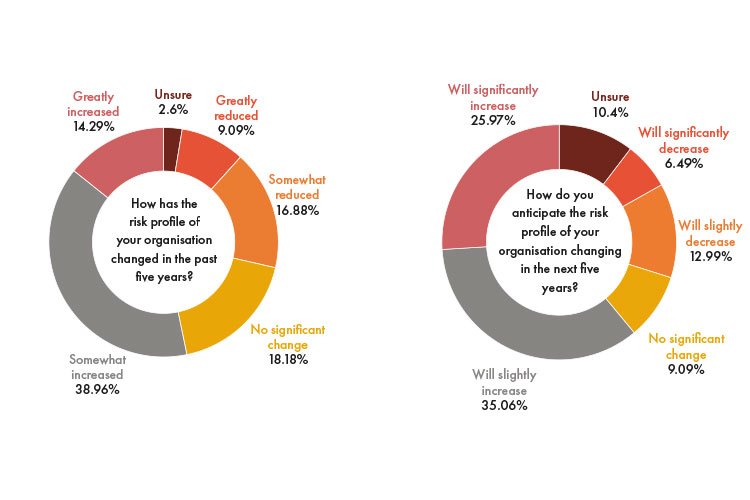
Generally speaking, when asked how the risk profile of their business has changed over the past five years, 53% of in-house counsel said it had at least somewhat increased. When asked to look ahead at the next five years, 26% felt that the risk profile of their business would significantly increase over the next five years, with 61% feeling that there would be at least a slight increase in their business’ risk profile.

When looking at changing risk profiles, data breaches are a good example: it wasn’t so long ago that the range of companies that rely on the collection and use of data was limited. Now, data has pervaded nearly every aspect of commerce. Retail stores that may historically have collected very little personal data now capture all manner of information at the point of sale for loyalty programmes, not to mention the continued recission of relatively anonymous brick-and-mortar buying in favour of online shopping.

To go back further, increasingly globalised markets and supply chains have largely informed recent interest in modern slavery. Modern slavery regimes set an expectation that companies must not hide behind the strongest link in the compliance chain, instead being held accountable for the weakest link: a company in the United Kingdom may be perfectly above-board in a foreign jurisdiction, but regulators now hold those companies to the standard of UK law for their actions in jurisdictions further up the supply chain, where protections against abuse and exploitation are not as strong.

Reading the room

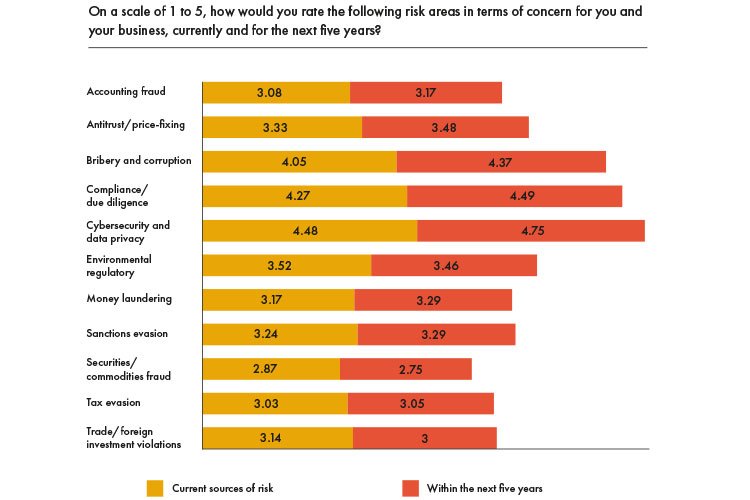
GC surveyed top in-house counsel from across the world, asking participants to rate their organisation’s current risk levels on a scale of 1 to 5, 1 being the lowest risk, and 5 the highest. The responses were broken up into the following categories:

  • Accounting fraud
  • Antitrust/price-fixing
  • Bribery and corruption
  • Compliance/due diligence
  • Cybersecurity and data privacy
  • Environmental regulatory
  • Money laundering
  • Sanctions evasion
  • Securities/commodities fraud
  • Tax evasion
  • Trade/foreign investment violations

Cybersecurity and data privacy risks were rated as the highest concern by survey respondents, both in terms of the risk they currently pose to businesses and how that risk was expected to change in the next five years. Cybersecurity and data privacy risks were rated at an average of 4.48/5 currently, which ballooned to 4.75 when respondents were asked to look ahead at the next five years.

Compliance and due diligence are also top of GCs’ minds – both when speaking about their organisation’s current level of risk and when looking ahead to how this might change over the next five years – coming in at an average rating of 4.27 with an expected increase of 0.22 to 4.49 in the next five years.


On average, nearly every category is expected to become more risky over the next five years. Bribery and corruption risks polled the biggest jump, increasing by 0.32 points on the survey’s five-point scale.

Risking it online

With cybersecurity and data privacy almost unanimously rated as the most pressing risks for GCs both currently and in the coming years, many of the in-house counsel surveyed and interviewed for this report had much to say on the subject.

‘Cyber threats form one of the biggest security risks of the 21st century,’ said Ritankar Sahu, general counsel and head of compliance for the Maxpower Group, operating throughout Southeast Asia and the Middle East.

‘Most Fortune 500 companies have been victims to some form of cyberattack leading to economic damage ranging from a few thousand to a few billion dollars. Cyber-attacks have increased dramatically in the last few months amidst the pandemic.’

Until relatively recently, it might have made sense to talk about cybersecurity and data privacy in terms of specific sectors, but the adoption of mobile platforms and cloud services – be they for internal operations, customer interactions, or both – has made cybersecurity everybody’s problem. In fact, the sector in which a given survey respondent is working had virtually no impact on their perception of cybersecurity and data privacy as a risk: GCs working for manufacturing companies were just as worried as those working for healthcare providers.

This is something that Seshani Bala, general counsel at Chartered Accountants of Australia and New Zealand, has seen personally.

‘Another big challenge is that we are trying to give customers and members a personalised experience, and to make data-driven decisions as a business,’ says Bala.

‘So, we are collecting more data to focus on that personalised, segmented experience. That increases the potential privacy risks in the event of a data breach. The penalties are very high under GDPR and Australian law. We are now seeing other countries move to a mandatory notification system that is in line with GDPR standards, and this poses greater pressure on organisations to make sure they have robust policies and procedures to quickly comply with those notification requirements.’

‘With the rapid development of online services, the risks associated with data storage and cybersecurity will develop,’ agrees Roman Kuznetsov, legal manager at WILO RUS.

Bala has worked closely with stakeholders in the wider business to make sure data protection policies are both clearly understood and rigorously enforced.

‘Once we have made sense of that, we can then drive processes and controls to reduce risk in that space. We partner very closely with our IT team. I think that has probably been the biggest change I have seen the last 12 to 24 months. I think Legal and IT need to be best of friends in-house, and you really need an integrated approach to effectively manage risk in that space.’

‘Before moving to a digital solution, I think it is really key to understand how each platform stores, secures and moves data. Mapping out that data flow process and understanding the data risks and data journey, as well as how it integrates with other platforms or plug-ins in other locations is important. It’s a given that digital solutions need to comply with applicable privacy laws but legal technology solutions also need to appropriately protect legal privilege, corporate record holding, and in-house destruction and recovery policies.’

Modern working

While the large difference between current risk and expected risk over the next five years is undoubtedly a reflection of an increasingly data-driven world, the effects of the COVID-19 pandemic will certainly also be playing a role. With home working becoming near-ubiquitous over the past few months, the volume of data being transmitted – either from workstation to workstation, colleague to colleague or business to customer (and vice versa) – is at an all-time high. This, too, means that the scope for bad actors to gain access to confidential data is also higher than ever.

‘The effects of the pandemic, and the current situation the world is in, pose several challenges for us in terms of rearranging our fraud agenda,’ says Gustavo Sáchica, chief legal and compliance officer at Allianz in Colombia.

‘In-house legal counsel need to anticipate the possibilities of fraud under pandemic circumstances. At Allianz, we have measured and stressed our risk tests in order to consider as many possibilities as possible.’

‘Due to Covid-19, increased working from home has resulted in a rise of remotely-accessed work platforms and digital ecosystems,’ says Sahu.

‘Enterprises still have lots to do before they can claim that they are breach-proof.’

‘This has made us highly dependent on technology which in turn has exposed us to more sophisticated cyber threats. For MAXpower, this has not been much different. Our fleet of gas engines are spread across remote sites in South Asia, and given applicable travel restrictions, we have had to rely extensively on our cloud based technology platform which lets us track ‘live’ operating performance, profitability and emissions from a centralised asset dashboard. The technology also lets us engage in predictive analytics and gives us valuable fleet-level insights.’

‘From a risk management perspective, I think the industry view is that enterprises still have lots to do before they can claim that they are breach-proof. MAXpower’s exposure is no less than other similarly placed power producers in the market.’

‘We constantly strive to make our systems less vulnerable to digital threats. As general counsel, I recognise that we are not breach-proof and regularly engage in conversations with our operations folks trying to gauge whether we are doing enough.’

For some in-house counsel worried about what the future might hold for their cybersecurity efforts, the risk is already eventuating.

‘We have also seen our mail servers being the victim of ransomware attacks and we have had to strengthen our firewalls,’ explains Sahu. ‘In the months to come, I am certain that companies will allocate more budget and resources to address cybersecurity risks, and I do see a rise in procurement of cybersecurity insurance coverage.’

Regulators

The interaction between the regulators’ attitudes to risk and the reality on the ground for in-house counsel is complicated. In some instances, regulators are leading the charge by focusing on an area of concern and proactively shoring up the relevant protections, or cracking down on non-compliant entities. On the other hand, regulators may have fallen behind the in-house community in how they approach these areas of concern. In this way, regulators can make a company’s compliance journey both easier and more difficult.

‘Increased oversight by regulators is reshaping the way we approach risk.’

Khaled Shivji, chief legal officer at the UAE’s Moro Hub, highlights this point. ‘In order to reduce the regulatory cost of compliance, we would be grateful to see more proactive guidance from regulators and prosecutors about the kinds of risks they believe are rated by the national and state governments as risks that, if not tackled, will diminish the country’s overall international rankings concerning white-collar crime.’

‘Increased oversight by regulators is reshaping the way we approach risk,’ agrees Armando Cruz, director at KPMG in Mexico.

And as with everything, this dynamic between regulators and the market is being redefined by COVID-19, according to Maria Alvear, general counsel at Chile’s GASVALPO.

‘In my view, the whole landscape will change after COVID-19 crisis lowers its impact. It will probably remain within us for a while and that encourages us to change our old ways of working and doing business, including regulatory risk management.

‘Regulatory risk management has been very challenging during these months, with several regulations being issued due to COVID, so it’s hard to keep up-to-date and perform accordingly. I guess this uncertainty that we are facing will remain; sticking to regulatory compliance will become more important than it is today to avoid a situation where lack of control and uncertainty give space for corruption to enter the business.’

Data Analysis Part One: The Ethical Shield

Virtually all respondents to our survey had an opinion on whether ethics and compliance were treated as two different topics within their organisation. There was no overwhelming consensus, however 61% of survey participants said that they are not treated as distinct concepts within their organisations; 35% said that they were.

‘Many companies think that these should be separated, where one should focus on the law and the other on the company culture as a whole,’ explains Armando Cruz, director at KPMG in Mexico.

Regardless of the relationship between the two, some consensus has emerged from the results suggesting that the question of ethics does and should touch all areas of the business – not least of all in avoiding the ire of regulators and investigatory bodies.


90% of in-house counsel consider corporate ethics highly important in avoiding white-collar investigations. Similarly, 87% considered the legal team as ‘highly important’ to the promotion of an ethical business culture within an organisation – 12% consider it ‘moderately important’ – and just 1% of respondents thought that the legal team was less important than that.

The results show a near-universal appreciation for ethics within a business by in-house counsel. This is unsurprising. However, what is surprising is the extent to which that feeling from general counsel does – or doesn’t – manifest within the wider business.

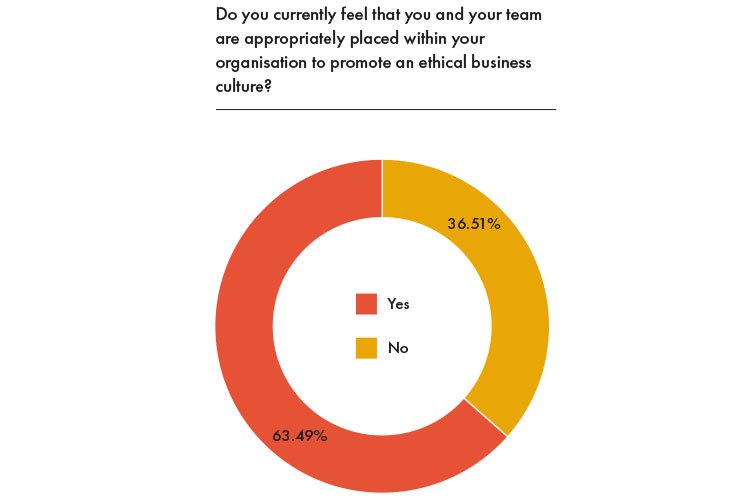
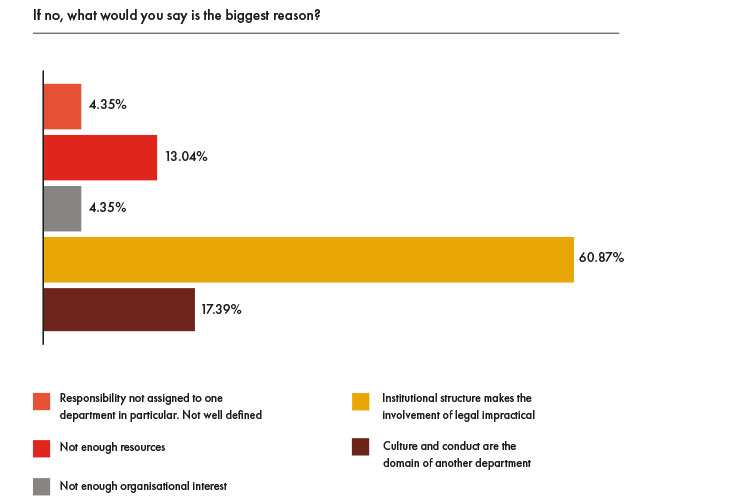
Despite near-universal agreement among in-house counsel that their teams are important to an organisation’s ethical makeup, just 63% felt that they and their teams are appropriately placed to promote an ethical business culture within their organisation.

‘Even though they are managed by same team, they are materially different,’ says Miguel Oyonarte, VP legal and corporate affairs at VTR Comunicaciones SA.


‘Ethics is much bigger in terms of scope and impact on culture. For its successful management, it requires the lead of the CEO and all their direct reports. It is also much more difficult to change – it requires full cultural change.’

Indeed, those who didn’t feel that their team is appropriately placed overwhelmingly pointed to factors external to the legal team as being the biggest reason. 61% cited institutional structure as making legal’s involvement impractical. The next most cited reason was that culture and conduct were the domain of another department (17%).