

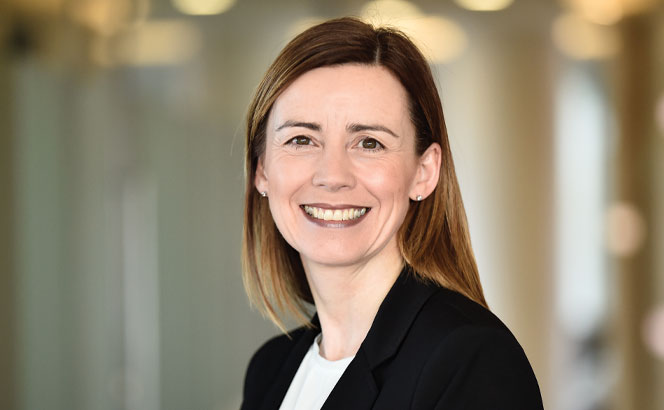
Pinsent Masons’ profit per equity partner has fallen a little over 7% to £740,000, with managing partner Laura Cameron (pictured) citing ‘a bumper year in terms of investments.’
Meanwhile, revenue was up 3.3%, to £703m. The results mark a slowdown on the previous year’s, when Pinsents increased its revenue by 4.7%, and its PEP by 0.5%.
Total lawyer headcount increased from 2,024 to 2,036, with partner numbers dipping from 492 to 490, while equity partners ticked up from 201 to 214.
In the last year, the firm has opened a new office in Warsaw and an international delivery centre for alternative legal services in Cape Town, established a new joint venture in China, and hired in a total of 27 lateral partners.
‘It is no surprise that we’re going to see that level of investment take its toll on profitability,’ Cameron told LB. ‘But we absolutely know what we’re doing; this is our strategy.’
The decision to open in Warsaw was driven by the potential for growth in two of the firm’s strongest sectors: infrastructure and energy. Cameron said the board had been eyeing the market for some time, with the external economist that regularly advises the board extolling the virtues of the region’s economy.
By contrast, it was demand in the science and technology sector that motivated Pinsents to open in China via a joint venture with leading Chinese firm China Commercial Law Firm in March.
On Cape Town, Cameron said: ‘The Vario [alternative legal services] part of our business has been a really important part of our offering to clients, and I believe it differentiates us from our competitors.’
The international delivery centre that opened in the city in February houses paralegals, project managers, company secretarial staff and document production.
‘We’re clear-eyed about what we want to do and how we’re going to go about it. That will have a consequence – but it’s a consequence we accept’
At the same time, the firm has also invested in lateral hires in its core markets, including in London, where it has made hires across corporate, litigation, financial services and pensions.
At the start of the year litigator Jessica Wicker joined the firm from Close Brothers Group where she was previously head of legal, litigation. Last October, it hired equity capital markets partner Nicholas Holmes from Ashurst and US securities partner Dinesh Banani from HSF Kramer.
Last year the firm also introduced a new retail, sport and hospitality sector, which recorded growth of 31% in the most recent financial results, with financial services growing by 12% and energy and natural resources by 10%.
While Pinsents does not break down its results by region, it did note stronger performance in the Middle East despite geopolitical tensions. ‘Some of the economic challenges across the wider European region mean we haven’t had as much growth as in the Middle East, for example,’ Cameron said.
As well as embarking on a strategic partnership with Legora, the firm has rolled out homegrown technologies, launching REcapture, which improves data-led decision making for lawyers working on real estate transactions, and developing Portana, which streamlines the due diligence reporting process for complex M&A transactions.
‘We have factored into our model that serious investment in technology is just the way it’s going to be for the future,’ Cameron added. ‘We welcome and embrace that.’
The results come shortly after the firm elected a new senior partner, with financial services sector head John Maciver set to take over from Andrew Masraf on 1 October.
Last October, speaking to LB, Masraf said: ‘Some firms have reported significant growth, whether that’s top line or profitability. I see that as a motivator – it’s within our gift to follow a similar trajectory.’
Cameron described the latest year as ‘another solid year of growth’, adding that the firm has increased its top line by £100m over the past three years without merging.
‘We’re clear-eyed about what we want to do and how we’re going to go about it, and that will have a consequence,’ she said, referring to the drop in profitability. ‘But it’s a consequence we accept as we know it’s the right path to take.’