
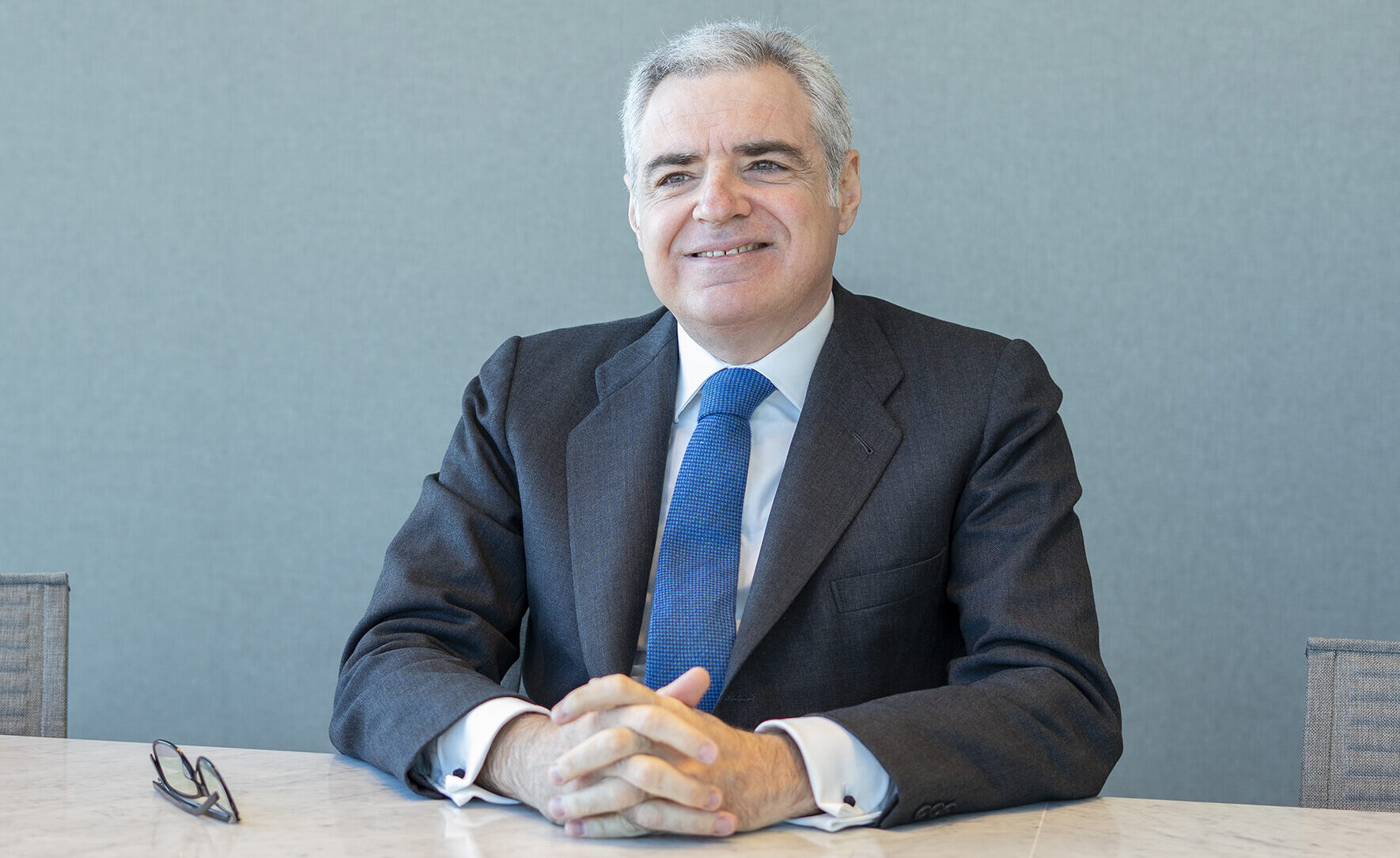
‘We’re here to grow, and not to lead an easy life,’ says Pedro Pérez-Llorca, senior partner of Madrid-headquartered Pérez-Llorca, the firm he has led since 1997.
These are not idle words. Last month, Pérez-Llorca entered into an agreement with Peruvian firm Miranda & Amado — the Spanish firm’s third Latin American merger in as many years, and one that, once approved, will add 33 partners and 132 lawyers to Pérez-Llorca’s ever-expanding network.
And Pérez-Llorca, who has decamped to Mexico City for the duration of 2026 — ‘the closest experience I’ve ever had to New York’ — in an effort to spearhead the firm’s internationalisation effort, says that the firm is not done.
Discussing the rationale for the most recent integration, he described Peru as a strategic market with a sophisticated legal sector, strong international investment flows and key strengths in infrastructure, energy, mining, finance and disputes.
Speaking before the merger he told LB: ‘We have said that we want to be an Ibero-American firm [spanning the Iberian Peninsula and Latin America]. It is clear that it would make sense for us to expand our platform into perhaps a couple of additional jurisdictions.’
Some Latin American market observers have tipped the firm for a move into Chile next, with Santiago-headquartered Barros & Errázuriz viewed as a strong candidate. For one thing, Barros & Errázuriz is a former member of Affinitas, an alliance of Latin American firms that disbanded last year after more than two decades of operation. Miranda & Amado was also a member, as well as Colombian firm Gómez-Pinzón, which agreed its own merger with Pérez-Llorca last May.
‘Our focus right now is very clearly on successfully completing and executing the integration in Peru,’ said Pérez-Llorca when pressed on further expansion. ‘We are building this project with a long-term vision and with a very disciplined approach.’
Scaling fast
‘Everything that is good about the firm is connected to growth,’ says Pérez-Llorca — and the firm has grown rapidly. Its 2025 financials saw revenue of €211.3m, a sixfold increase from the €33.19m it posted in 2016.
And while the firm does not publish its profit per equity partner, with Pérez-Llorca saying he is implacably against the ‘peculiar practice,’ it saw headcount shot up over the last five years, from 280 fee earners including 60 partners in 2021 to 689 fee earners including 108 partners at the beginning of 2026.
That growth has come alongside an explosive internationalisation that has seen the firm open in Libson in 2024, and launch in Mexico and Colombia through mergers in 2024 and 2025 respectively. The firm has also launched further hub offices over the last five years, in Brussels in 2022 and Singapore in 2023, with Abu Dhabi expected to open this year.
The Portugal office was launched with the hire of 17 lawyers from rival firms, including RRP Advogados, from which Pérez-Llorca recruited corporate and M&A partner Rodrigo Falcão Nogueira alongside banking and finance partners Carlos Vaz de Almeida and Manuel Cordeiro Ferreira, all of whom led major practices at RRP. Since then, the Lisbon office has grown to 43 lawyers and 14 partners following a further round of strategic hires, most recently corporate and infrastructure partner Sébastien Coquard, who joined in October from an in-house position at major conglomerate MSC Mediterranean Shipping Company.
‘Entering the Portuguese market really changed the game for us’
‘The real internationalisation of our firm started in 2023, with our entry into the Portuguese market,’ says Pérez-Llorca. ‘Before that, we had a Brussels office and a New York office, and a London office. But entering the Portuguese market really changed the game for us.’
The firm has raced to 10 Legal 500 rankings in Portugal, with tier 2s in banking and finance, project finance and transport. And Pérez-Llorca says that the success of its Lisbon launch has convinced the firm to ‘replicate the model’ through expansion into Latin America.
And while the firm’s growth is proof that Pedro Pérez-Llorca is fully committed to the firm’s internationalisation, for a long time, he insists, he was putting the brakes on as others tried to persuade him to expand, asking partners why it made sense to go to another country when he could point to major companies that were not yet clients from his Madrid office window.
However, Pérez-Llorca says: ‘At some point, that argument was no longer valid, because the partner would say, “Yes, we are working for that client. And actually, we’re doing quite important work for them.”‘ When the firm’s growth reached this point, Pérez-Llorca says it was time to expand: ‘Okay, we have a strong footprint in our home market, we have a premium position, we have a profitable business. We’re big enough. We are mature enough. Let’s do it.’
The road to El Dorado
Asked to describe the thinking behind the firm’s Latin American expansion Pérez-Llorca chooses to use another word:
‘I think it’s a bet. There would be a positive bias in calling it thoughts. One that implies that it is right and will work out well. It is a bet. And the bet is in order to preserve a brilliant future for the youngest people in the organisation, you need to internationalise. Otherwise, there will be a limit. At some point, you will reach a ceiling in terms of growth, and that will change completely the dynamics and the culture and the spirit of the firm.’

He states that without internationalisation the firm would be forced to either move into the middle market in Iberia or to stop growth. Neither of which appeal.
Founded in 1982, the firm will celebrate its 50th anniversary in six years’ time. By then, Pérez-Llorca says, ‘we would like the organisation to have become the premium Ibero-American law firm in the market.’
He continues: ‘We would hope it is perhaps twice its current size in revenue terms, and that it has successfully integrated several markets while preserving, or achieving, premium positions in each of them.’
And if that sounds like an ambitious target then that is entirely on brand: ‘There is always an element of refusing to accept reality. Of excessive ambition’, he says of the firm’s philosophy. I don’t want to call it arrogance, but the Greek word hubris is good. There is an element, just an element, of hubris in refusing to accept reality, a refusal to settle. We have that and that’s what takes you to the next rung of the ladder.