In the wake of Freshfields’ landmark multi-year deal with Anthropic, Freshfields chief innovation officer Gil Perez and partner and co-head of the firm’s internal innovation and legal tech development lab Gerrit Beckhaus, explain why the firm is doubling down on its bet that frontier AI will fundamentally reshape legal services.
‘There is now an acceptance that technology is at the core of legal moving forward,’ says Perez. ‘So though a lot of firms have talked about it, not many have actually implemented it. There’s a lot of talk, no walk.’
 Beckhaus (pictured right) shares that conviction and wants Freshfields lawyers to view AI as central to their workflows: ‘The mindset we are trying to instil is that for any given task, you justify why you’re not using AI to help to solve it.’
He stresses that this is not about minimising lawyers’ agency: ‘It’s not just pressing a button and sending off the results, it’s helping lawyers to do better and more impactful work.’
The deal further deepens an existing relationship between the two companies, as Freshfields separately acts as external counsel for Anthropic.
The recently announced deal represents the first time Anthropic has entered into a strategic partnership with a law firm, underlining the mutual respect that underpins the collaboration.
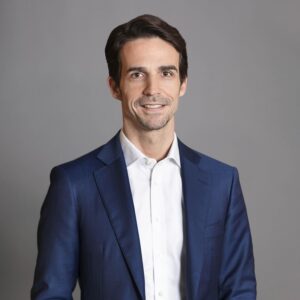
Perez (pictured below) explains that the arrangement will create a blueprint that Freshfields can leverage beyond its work with Anthropic: ‘Our legal team will be working directly with Anthropic’s legal team to explore how we could collaborate and set up workflows between a law firm and Anthropic, when both parties are proficient in AI. We will get a glimpse into the future and be able to then parlay that to our clients.’
A second strand of the partnership focuses on product deployment. Freshfields has already rolled out Claude Opus and Claude Sonnet across the firm, and plans to do the same with Cowork, Anthropic’s agentic AI platform.
 At the same time, the firm will gain access to Anthropic’s early-access programme, giving it visibility over products still on the future roadmap.
The announcement comes just one year after Freshfields’ partnership with Google, prompting questions in some quarters about whether there is unnecessary overlap between Google Gemini and Anthropic’s Claude, which occupy similar spaces in enterprise AI.
Beckhaus argues that this optionality is precisely what gives Freshfields its competitive edge in legal tech. Rather than locking lawyers into a single ecosystem, the firm has built a proprietary platform that allows professionals to choose the tools best suited to the task.
Asked whether lawyers and business staff can choose between Claude and Gemini, he confirms they can, adding: ‘And they can use others as well. Most legal tech AI tools don’t provide that capability to choose between models. You just use the applications and that’s it.’
Where AI comes in, the question of billing soon follows, with the perennial question being whether greater efficiencies will lead to lower legal fees.
Beckhaus believes that this framing misunderstands the impact of AI. In his view, the technology is not simply reducing the time spent on tasks, it is enhancing the scope and quality of the service. ‘It’s comparing apples with oranges,’ he says. ‘Because the end product I deliver to the client today, in the due diligence space as an example, is completely different from what we did in the past.’
‘In the past, based on the agreed scope of review, we identified documents in scope and threw out other documents out of scope, because there was a limited commercially feasible possibility to really analyse them,’ he explains. ‘Today, AI allows us to digest way more data and maybe identify more risk to be analysed and mitigated.’
That said, Beckhaus acknowledges that, in certain cases, clients with a higher tolerance for risk may choose a narrower scope of review for a lower fee: ‘Again in the example of due diligence, you decide on the scope, and the level of risk you are comfortable with,’ he says. ‘In general, we are using AI anyway. The question is do we just use it to support the manual review or are there even elements that can be done solely by AI.’
And while the firm is more focused on itself than its peers, there is a confidence that the partnerships with Google and Anthropic have put Freshfields in a strong position.
As Perez says: ‘It’s a year since we made our Google announcements and still no other law firm has come out and adopted it in the same way that we’ve done. By the way, I think they’re wrong. They should look into Google and start adopting it. We’re doing the same thing again with Anthropic, and I expect other firms to follow our lead. And hence, we’re ahead of the pack.’